As spring gets closer and closer, I’m watching the weather daily. I know what I want, but the light wind conditions may only last a couple of days, while I need a week plus.
In the last weeks, the more I have thought of this, the more I am thinking of getting north as best I can, probably well offshore.
Offshore solves a number of issues for me:
I like the open ocean
far less fishing activities, like boats and nets
more sea room, if I need to run before the storm (this is always a consideation in my planning)
getting big chunks of distance done in a short time, 3 days = 500 nm
did I say I like the ocean
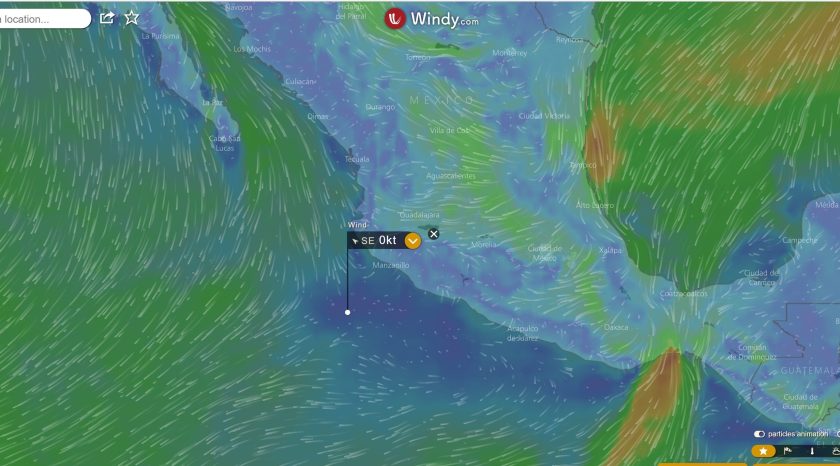
I like the GUI and data presentation of Windyty.com, so all the maps I show are from them and when I do look at weather, I look at them before anything else. This is what a great case looks like. How long it will last? Not long enough, but a few days, then with a low pressure system developing further west, would give me favorable winds for the second of two 3-day periods (the steaming distance between Huatulco and Cabo San Lucas is 900 nm or 6 days.
Now this looks great. Too bad it will last a day or two and I need 9!
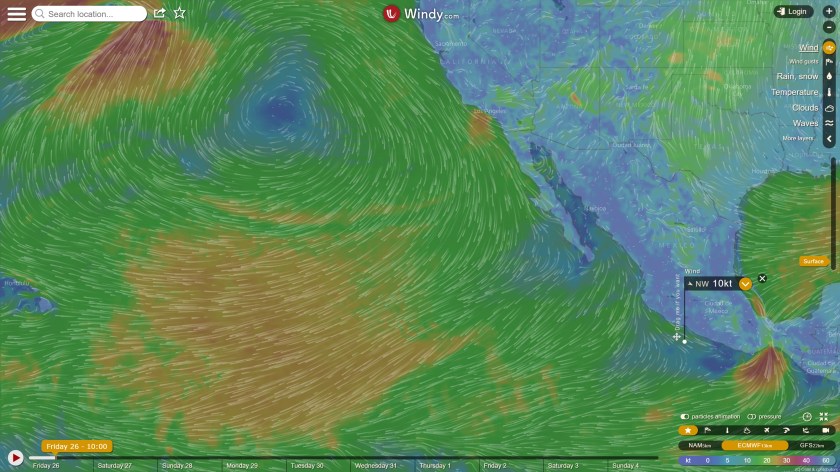
This case though is far more typical, with NW winds >15 knots, even more so in the summer than now.
Just when I thought I had the Plan, I read a story about drug driven crime spreading to the west coast of Mexico. Manzanillo, one of my planed stops, was prominently mentioned.
20180126 Win dyty Depiction of Surface Winds
Where does that leave me? Besides the obvious, afraid!
Last summer I had a detailed plan to cruise up the coast of Mexico, stopping every night, hitting all the nice spots, with only a couple overnight passages. Let’s call that plan, the Coastal Cruise Plan. This is essentially what we had done 3 years ago in the Baltic. I had even spent the last month alone, cruising from Stockholm all the way back to Ireland.
Last year, I had my nephew, Micah, with me from Ireland to Costa Rica. It’s no coincidence that when he left Dauntless in March to go to law school, I lost a lot of my ambition to continue north alone. Cruising alone for me is not fun. It’s what I do when I need to get from A to B or as I did from Stockholm to Waterford.
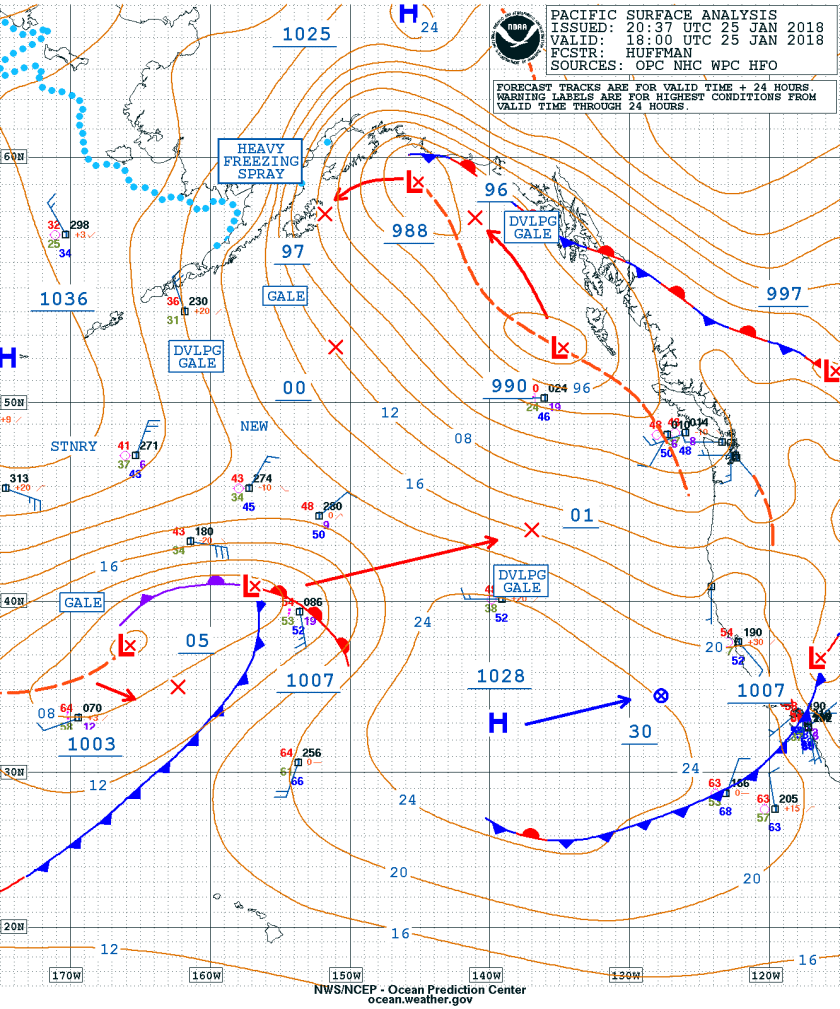
20180126 NWS P_e_sfc_color
I am hoping that this coming summer, my girlfriend Trinh and her son, Thien, will have visas for Mexico. This is something that I must initiate this April when I return to Huatulco. If that is possible, they, with other friends who have expressed interest in joining Dauntless this summer, would make the Coastal Plan at least feasible. We would enjoy the numerous stops and towns along the coast, plus many eyes make for less stressful cruising.
A visa for the U.S. is another story and it takes forever. I’m hoping for 2019.
The Pacific coast of Mexico is not the Baltic and North Sea. The weather is not necessarily worse, but the predominant winds are from the northwest, the direction Dauntless must go. Adding to that problem, there are numerous fishing boats and nets and other boat traffic near the coast, whereas in the Baltic, there was none of that.
Lastly, safe harbors (protected from weather) on the Pacific coast of Mexico are few and far apart. North from Huatulco to Manzanillo, a distance of almost 600 miles, there are only two safe harbors. In a normal (for me) coastal cruise of 40 to 60 miles per day (6 to 9 hours), that’s 8 out of 10 nights anchored or in some port, at the mercy of the weather.
That’s a no-go.
For those of you who have read my precious comments about weather forecasts, you will know that even in the best circumstances, I don’t trust weather forecasts past three days and even at that I assume they are 50% off. That means, if the forecast is for winds from 270° at 12 knots, I plan for winds 240° to 300° at 8 to 16 knots (50% and 150% of forecast).
Therefore, to cruise an unprotected coast in any but the mildest of conditions is perilous.
I needed a plan B. The Near Coastal Plan.
In this plan, we will take what the weather gives us. If we get four good days (favorable winds and seas) we’ll cruise until the weather becomes unfavorable. This potentially means we would take chunks of distance, 3 days, 24/7 is 450 nm. Making the entire trip into 4 chunks of 500 miles each, would get the job done and reduce time spent too close to the coast.
It would be far less fun however, but probably safer in many ways and less stressful.
Then came plan C, the Ocean Plan.
But first we talk to talk about hurricanes.
Hurricane season runs from June through October, with the highest frequency, mid-July to mid-September.
I can see an advantage in avoiding the high summer. Looking at the Windyty depiction of the surface winds over the eastern Pacific today, you can see the big ass high pressure system that keeps the easterly trade winds over Hawaii (far left of picture) as well as the northwest winds over the west coast of California and Mexico. Now, one of the disruptors of these winds are hurricanes. The circulation pattern around hurricanes is far smaller than this massive high-pressure system, but a Pacific Ocean hurricane a few hundred west of Mexico, would cause southerly winds off the Mexican coast.
If it moved slowly north, maybe I could tag along??
It all depends on the situation and I’d have to figure out my escape routes, but it’s something for me to think about and plan for. It’s also significant that eastern Pacific hurricanes are weaker than Atlantic ones, with wind patterns not much stronger (if at all) than Northern Atlantic low-pressure systems in August and September (and I’ve certainly had my fun with those!).
Then the Ocean Route would entail an end around, running almost west, then curving slowly northwestward and finally northward, ending up east of Ensenada or southern California. With little winds, it would be an easy 10 to 12-day voyage, just like I did alone from the Azores to Ireland. I’d only do this though if I saw the possibility of an extended time of light winds.
Also, time of year matters in my decision making. In the scenario just mentioned above, In May or June, I’d have plenty of time to wait or make it happen. I may have different options later in the summer.
In September 2015, while waiting in Norway to cross the North Sea (I anticipated a 72-hour crossing), my weather windows were getting smaller and smaller. September is simply too late to be doing such a trip. But Sweden was so nice!
There had been strong northerly winds 25+ winds and driving rain, for days. I waited and waited. Finally, I saw a high-pressure ridge building into the North Sea from the English Channel, but this ridge of high pressure was also moving eastward. But it only gave me a two-day window for a three-day trip.
Dauntless Crosses the North Sea 2015
I had to take it. It meant that I left my little port of Egersund, Norway, with 35+ knot winds from the NNW and rain. If you look at my route I took to Fraserburgh Bay, Scotland, those strong winds caused that dip in my route. Even with the paravane stabilizers, it’s just easier on the boat to put the winds and resultant seas on the starboard stern quarter. After 24 hours, as the winds died, I was able to head more westerly and on the third day, to the northwest. But that little longer route also added 12 hours to the trip and the next frontal system was right on, so my last 8 hours were in the weather again.
Would a longer, better weather window has come eventually? Sure. In the winter, under very cold air and high pressure. I couldn’t wait that long.
Dauntless in Ireland, next to a fishing boat with almost the exact same lines. There is a reason she handles the North Atlantic like she was born there.
When we decided to cruise the world or at least get away from the coast, we knew we wanted, needed a boat that that could all that and more. All the readings I did about boats and people cruising in boats all over the world, led me to Kadey Krogen.
Our little 42-foot boat was well built, extremely well designed for the worst of the worst and affordable.
Having Dauntless under my feet gives me confidence that she can handle any stupid situation I put her in.
Yesterday, Vietnam beat Qatar in the semi-finals for ASEA U23. I think it’s the first time Vietnam has ever been in the finals. It was a very close game and the Vietnam team kept on coming back each time they fell behind.
But I had no idea the town, HCMC, would go so wild. When Trinh asked if I wanted to go out and check out downtown, I said sure, I’m always up for an adventure.
These pictures and videos show the traffic, at a density I have never seen before. The main road we are on is a road I take a few times per week, sometimes at rush hour. The traffic is heavy and slower (10mph instead of 20 or 25mph!), but this gridlock, this number of motorbikes and people on the road was astounding.
I was also struck by the number of families out. It was clear from how people were dressed, that many had picked up family members after work or been picked up. Many, like Trinh, had gone home to pick up her son, Thien, after his after-school tutoring that ended at 7:00 p.m.
We only got about halfway to our intended destination, by then I realized it was more about the experience and not about the place.
The final will be Saturday afternoon. I’m sure it will be interesting.
On a side note. As a proud American and military veteran, even after 9 months, I still have mixed feelings of seeing the (North) Vietnamese flag flying. This night there were more than I’ve ever seen, hundreds of times more than on Independence Day. But in spite of that history, in all my travels around the world, the Vietnamese here in Ho Chi Minh City, (Saigon) are the friendliest to Americans I’ve ever encountered.
As I sit in my 10th floor apartment in Ho Chi Minh City, a.k.a. Saigon, the People’s Republic of Vietnam this balmy January 2018, writing these words, I think back one year. I was in Martinique, in the Lessor Antilles, luxuriating in having just completed a harder than expected crossing of the Atlantic from North Africa to North America.
Looking north from my apartment in HCMC, Vietnam
Vietnam wasn’t even on the radar and if it was, I thought it was a wave top. Impossible it imagines how different 2017 would end up.
So, how can a person who doesn’t have a clue as to where they will be in 12 months’ time write about planning?
And not only write about, but spend a good portion of every day’s waking hours thinking about The Plan? So much so that just a while ago, I found myself looking at the noonsite.com information about Taiwan.
Taiwan? wtf, he still hasn’t figured out how to get Dauntless out of Mexico, you’re thinking.
And right you are. So, I thought you would be interested in knowing or better understanding my planning process.
To understand my planning process, let’s look at my goal and some background information:
The Goal
Long term, cross the North Pacific, return to Northern Europe & complete my circumnavigation.
Short term, spend a couple of summers in Southeast Alaska.
Near term, get Dauntless to California before next winter.
Dauntless is now in the wonderful little town of Huatulco, Mexico, in the little Bahia Chahue.
Background information
In 2016, once I made the decision to return to North America, I made an elaborate plan (published in some blog post last year) to transit the Panama Canal and cruise up the west coast of North America to SE Alaska.
Looking aback at the plan now, I stayed pretty much on time and on target, only transiting the Panama Canal a couple weeks later than originally planned, until Costa Rica.
Arriving in Golfito, Costa Rica in March 2017, the wheels then came off or a more apt description, I was beached.
What happened? A perfect storm of: local bureaucracy, my nephew who cruised with me since Ireland, had to go back to school and I met this wonderful woman in faraway Vietnam.
Returning to Dauntless in June, I needed to get moving north. Costa Rica is a wonderful country that I had visited in 2004 and had really looked forward to returning. But, it turns out, it is not really cruiser friendly. The few marinas are ridiculously expensive and the paperwork of checking in and out was cumbersome and confusing.
My newfound friend, Cliff joined me and we took Dauntless from Costa Rica to Mexico. Mexico, it turns out is everything Coast Rica isn’t. Cliff had to go back to work and hurricane season had arrived, so in reaching the wonderful town of Huatulco in August, I decided that enough was enough.
The Task at Hand is to get Dauntless from southern Mexico to California, 1800 miles.
Dauntless cruises at about 6.5 to 6.8 knots. thus a 24-hr. period is 150 nm. That’s the figure I use for planning. With light winds and small seas, then the planning exercise is about planning stops after a day of cruising.
Two years ago, in the Baltic Cruise, I largely ignored the weather and planned the whole 4,000-mile trip based on cruising days of 5 to 8 hours. Usually we would stay a few days in each town or city stop. But the pacific coast of North America is a whole different creature.
Climatology tells me that the winds are predominantly from the northwest (the direct I must go) 2/3’s to ¾’s of the time. I use Jimmy Cornell’s Ocean Atlas which has pilot charts for each ocean by month. Jimmy Cornell’s Pilot Charts also tell me the secondary wind direction and currents. June thru September is 4 months, 120 days. I figure that I will have favorable winds about ¼ of those days, or 30 days. I have 1800 nm to go divided by 30 days means 60 miles per day. No bad, about what I did in the Baltic in September.
But it also means that when the winds are favorable, I must make miles. The reality of seasonal climatology is best looked at and planned for over periods longer than a few weeks. In this situation, I can easily be stuck in port 30 days waiting for the winds. Then if I’m lucky, I’ll have a good period, 5 to 10 days of southerly winds. Depending upon where we are along the coast, it means we may do 48, 72 or even 96 hours to take advantage of our good weather window.
Now in this context, when I say “weather” I really mean winds and seas. I’ve left port on many stormy days. Rain, showers do not bother me, it’s really all about the winds and seas for my little Kadey Krogen.
The effect of head winds and seas vary greatly. 5 to 7 knots are hardly noticeable and may produce small seas, less than 2 feet. Dauntless will lose a few tenths of a knot under such conditions.
Going out into the storm
As winds off the bow become stronger, it all goes down rapidly from there. 12 to 15 knots produce 3 to 5 ft. seas, pitching become unpleasant and we’ll lose more than a knot of speed. 18 + knots are untenable from a comfort level. Too much hobby horsing and probably down to 5 knots, less with any counter current. This is what happened to me off the French coast going up the English Channel to Holland. We were making 2 to 3 knots in pure misery of pitching. Because of the conditions, I finally decided to abort to Ostend, Belgium. It took another 6 hours to go 15 miles. Some of the worst 6 hours I have ever experienced. The Kadey Krogen was fine, she takes a beating and keeps on ticking. The humans inside were not as happy.
What I took out of that beating was to more carefully consider winds and seas on the bow. A 20-knot wind from the stern is fine. We had 20 days of that crossing the Atlantic last year. Even 20 knots (and resultant seas) on the beam are ok. The paravanes are most effective with beam seas. Though I tend not to venture out in such seas if I am in port. 20 knot headwinds are untenable. Stay in port. If at sea, options are reduced, but probably a change in direction is warranted.
I use Windyty.com for my forecast winds. I tend not to look at forecast seas because the accuracy is seldom good enough to use in an effective manner. Though Windyty will give you the first, second and third swells.
Now when it comes to forecast winds, for whatever reason, the forecast winds are almost always understated, though I do realize it’s possible that I only notice the over and not the under. Thus, when winds are forecast to be 12 knots, that usually means 8 to 15 knots. If 8, ok, if 15 it’s a no go. So, in this case, I will use 8 knots for the Go-No Go decision.
From Huatulco to the Channel Islands, it’s only 1800 nm in three long legs. that’s basically the distance I did between Martinique and the Panama Canal. But with much more un-favorable winds and currents.
Top speed for Dauntless is about 8.5 knots, but it’s non-factor because it’s impossible to justify the double to treble fuel consumption for 2 knots. So, my effective (long term) hurry up speed is 7.5 knots at 1800 rpms and 2 gallons/hour. Thus, I usually keep it to 1700 rpms, 6.8 to 7.0 knots and 1.6 gal/hr.
In my next post, Planning is the Mother of Anticipation, I’ll discuss the Mexican coast, what options we’ll have, crew and hurricanes.
As I flit from place to place, I wonder what drives me. After all, crossing oceans, flying from continent to continent, costs time and money.
View of the Dolomites from Budoia, Pordenone, Italy, Christmas 2017Budoia, Pordenone, Italy, Christmas 2017
“Is it worth it?” I’ve asked myself that question many times, not only since Dauntless entered my life but well before it.
Bahia Guacamaya
In the summer of 1970, I worked driving a cab in New York. Coming home day after day covered in sweat, dust and grime, in the days before air conditioning. But at the end of that long, hot, humid and dirty summer, having survived not only the weather and the traffic, but the escalating crime in the City, I took my money and bought my first car.
Of course, it was a car my father recommended. He was a master a virtually anything he was interested in doing and cars were one of his interests, so there was no thought of getting anything but what he pointed out.
Northeast Italy, December 2017
Good move. My first car was ugly, like a box and battleship grey. And only a week after getting it, I packed it up and stated the long, 3.000-mile, trip back to the University of Washington in Seattle, with nary a thought. My attitude has always been If other’s have done it, so can I. Even then, the pattern of not stopping until late into the evening, running on fumes or taking “short cuts” was apparent.
Northeast Italy, December 2017
I never thought I was particularly brave, in fact, I knew I was pretty shy and afraid of the dark.
But that didn’t matter because there was always something new to see over the next hill or around the next curve.
The 21 days on the westward crossing last December were very similar, yet so different.
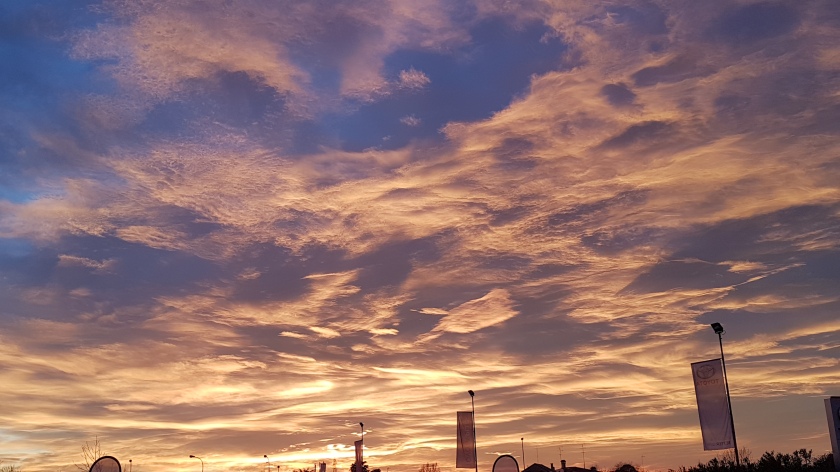
I looked forward to the day, the sunrise. What clouds would we have today? Rain or showers? The sky always had something new; something I hadn’t seen before. In my first Atlantic Passage in 2014, I had tried to avoid developing rain showers or thunderstorms. But in a boat going 6 knots, that is a futile gesture. Even more so, this last trip, I looked forward to the cleansing rain. I also didn’t want to upset the boat. She gets in a rhythm, let here stay in it without any major course changes.
The only thing I never liked was blue sky. My two years living in southern California were the worst, blue skies every day. I almost died of monotony. Even now, on the boat, I see a building storm on the horizon and I can’t look away. I’m fixated, as if watching a beautiful woman get dressed, what will the final look be? But storms are even more interesting than people, because their lifetimes can be minutes or hours.
These days, visiting my friends in Italy and Holland, the first time seeing them since my Atlantic Passage last Christmas, I’ve been able to recount the story numerous times.
Many say how brave I am. But I know better; I’m not brave at all, I’m simply curious.







 Dauntless at Sea