Cabo San Lucas is a sunny, dry, playland for those with more money than sense. It’s a step towards reality, if your starting point was the Mexican Pavilion at Disney World or Las Vegas.
Cabo at night
It’s everything I have a point of avoiding during my last 40 years of international travel and exploration.
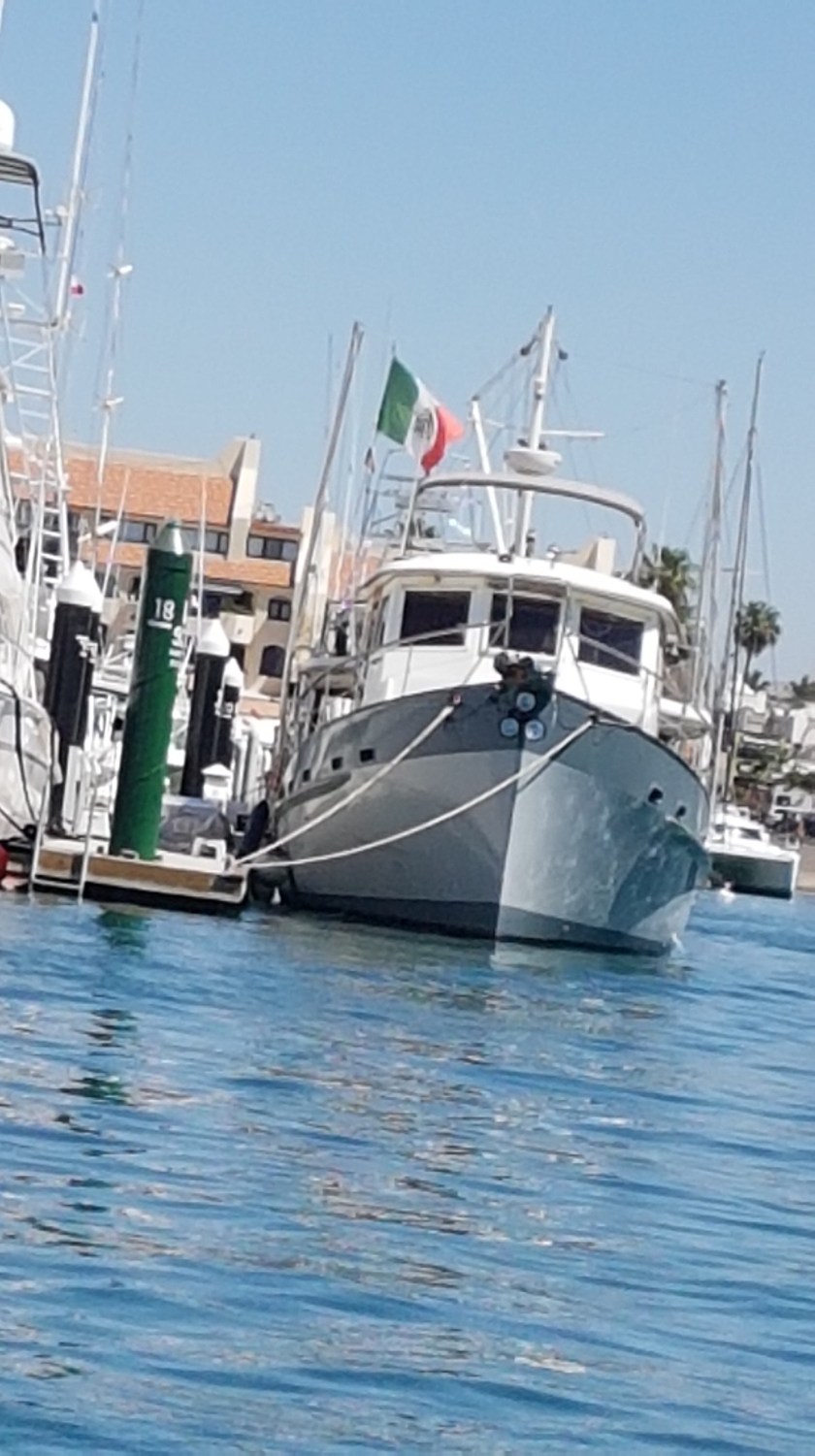
Worse of all, it was expensive for Dauntless, almost $100 per day at the IGY Marina. The marina in fact, was on the only bright spot of the whole experience. Accommodating, warm, friendly staff. It was no problem for me to stay on the “T”, as I did not like the idea of trying to maneuver down the various slip xxx.
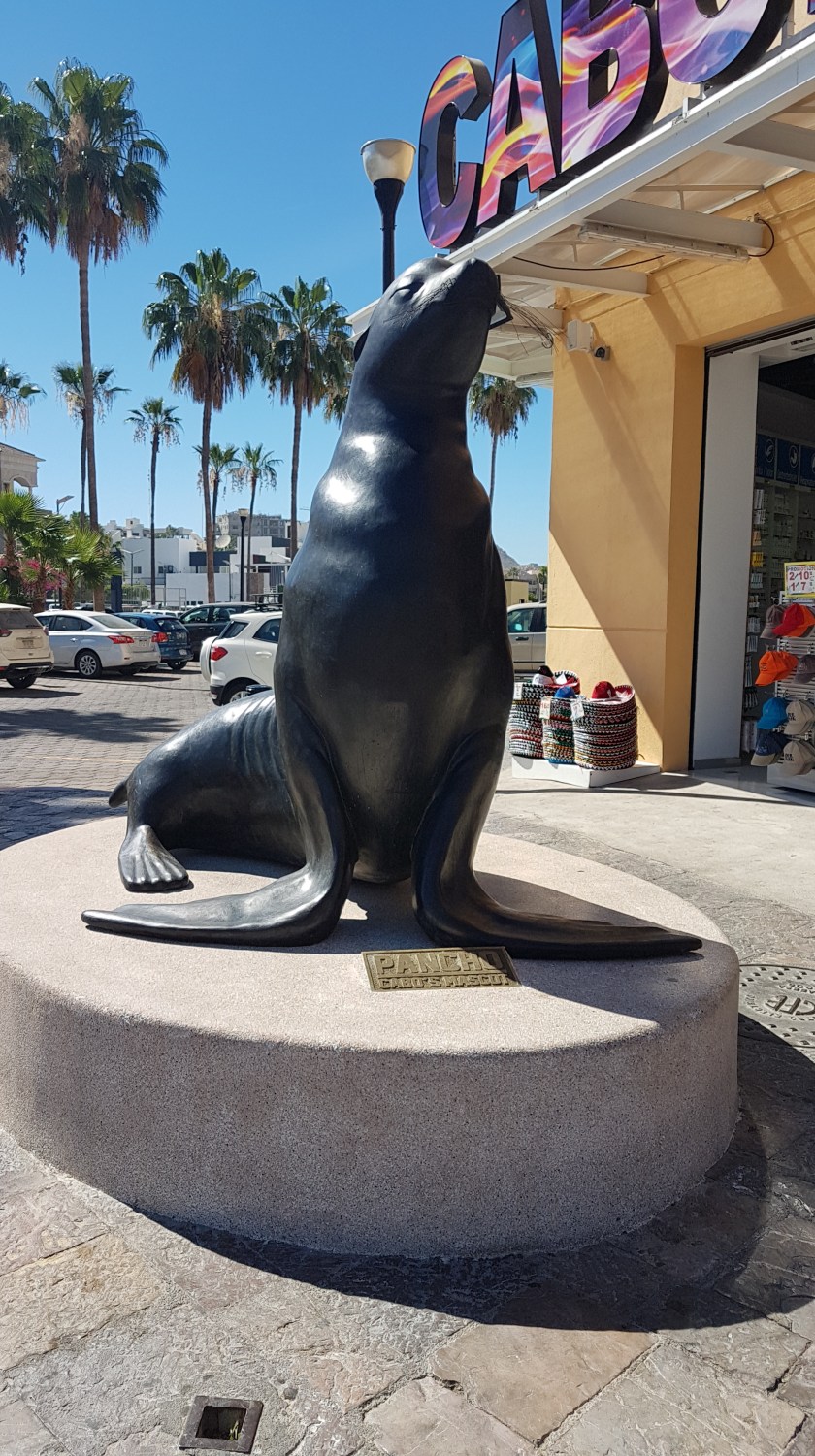
And then there was Pancho, the 12-year-old sea lion, who lives in the harbor and this marina it seems.
Pancho hitching a ride and waiting for free fish
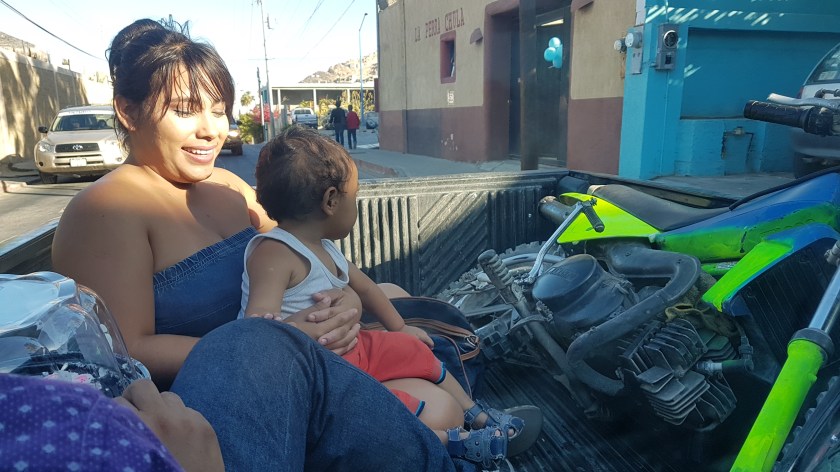
The other bright spot of time spent in Cabo, was meeting a family, wo was having a birthday party in town at their son’s bar. Larry and I were the only patrons and seeing me eyeing the cake, they must have felt obligated to invite us to share it with them.
An excellent pizza
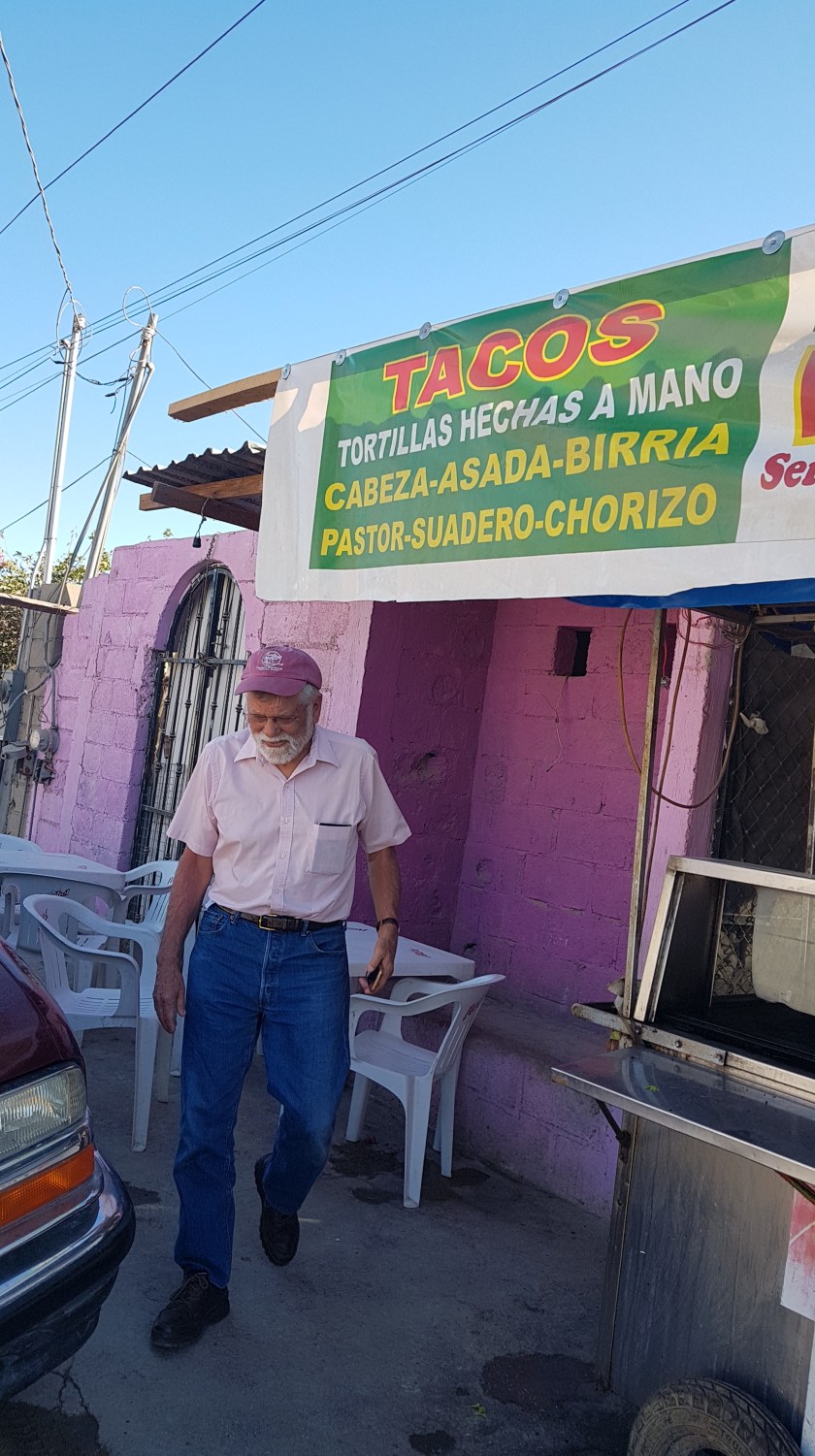
We inquired about finding really food, not tourist food, and they squeezed us into their little pickup and off we went to the Mexican part of town. Whatever we ate was delicious and I cherish these types of experiences. A wonderful experience in otherwise a boring town.
Our new found freinds
That’s the Good, the Bad and the Ugly are best left unsaid. There is no reflection here, no lessons learned. I knew what it was and it was.
Pancho on the dockThe statue of PanchoLittle Mexican PlaceDauntless wanting to leave
After three nice days in Zihuantanejo and Xtapa, Brian, me and the boobies set out for Cabo 4 days away.
The NW winds had died down and we got going under high broken clouds and the temperature in the low 80’s. Winds were light, then as the day progressed, turned southerly (good), but the Pacific coast of Mexico just can’t help itself and my evening the winds were out of the north and northwest again, though not too strong at 8 knots.
Leaving Xtapa for Puerto San Lucas, Day 1, May 6, 07:36
For the next 36 hours the winds were about 5 to 9 knots, at night from the E or SE as a land breeze and during the day from the W or NW as a sea breeze (blowing on to the land to our E).
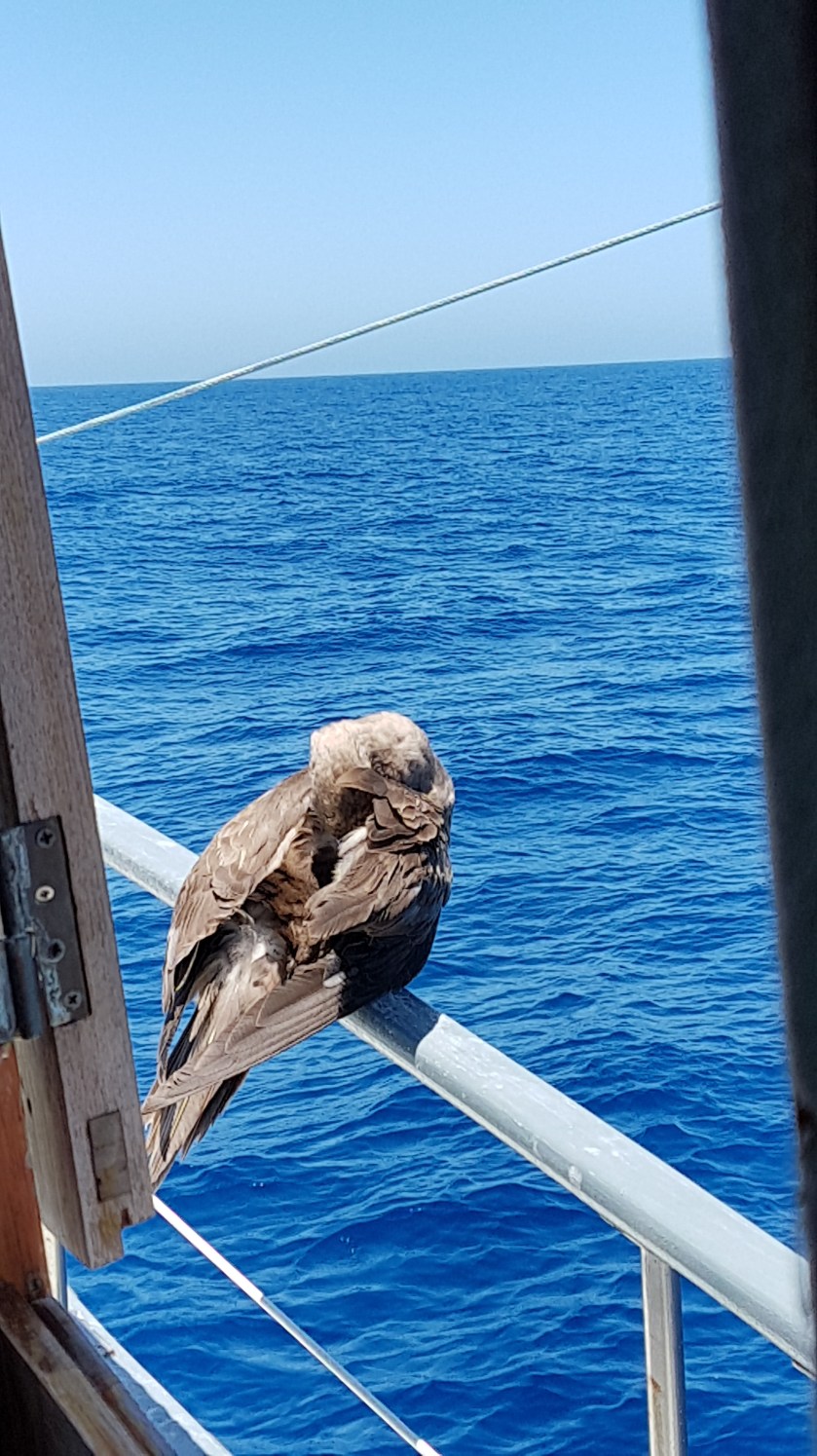
I was pleased to see the boobies return. They seemed to get the routine down better this time and at times we had as many as a dozen on the rails just enjoying the free ride.
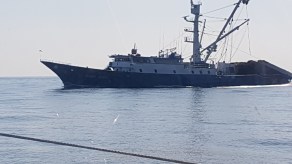
We got buzzed by a fishing trawler, which is becoming the norm since returning to North America.
The fishing trawler that just had to check us out to make sure we were not taking his fish.
The only place it happened in Europe was in the Bay of Biscay. If the French won’t tolerate the Uber disruption, they certainly won’t tolerate anyone taking their fish. That we just look like a trawler, especially with our paravane poles, is an annoying coincidence.
Boobie resting outside pilot house door
In the first 48 hours, we put 333 nm under our belt; more than halfway.
Winds picked on the third day, from the west, and we in the mid-teens overnight, causing the most pitching and rolling since leaving Xtapa. I deployed the windward bird to keep the rolling manageable. Having the windward bird in the water is 80% as effective as both birds and the effect on the drag is the same, thus the bird doing the work also produced the drag.
Just physics, there are no free lunches.
Video of the Second evening
Error
This video doesn’t exist
We entered the harbor and large marina of Puerto Los Cabos at 20:25; 85 hours after leaving Xtapa and 570 nm later. Turned out this was the easiest three days of the entire Baja Bash only I didn’t know it yet!
Puerto Los Cabos was a disappointment. Only a few dollars cheaper than the marina a Cabo San Lucas, it was surrounded by … nothing. A 5-minute taxi ride that cost 30 pesos ($1.50) cost in Huatulco and 50 pesos in Xtapa now cost 200 pesos. I ended up renting a car for $60 for 24 hours. That made it easy to go to airport and drop Brian off and so a little shopping. I ended up staying two nights.
I was spending $90 a day in the marina, Cabo was about the same price. Anchoring was pragmatic at best near Cabo. From reading reviews on Active Captain and Noonsite, the anchorage was open to the swell, but worse, was in the area of all the tourists doing water hijinks. Thus, the locals discouraged boats from anchoring in various ways, which I did not want to test.
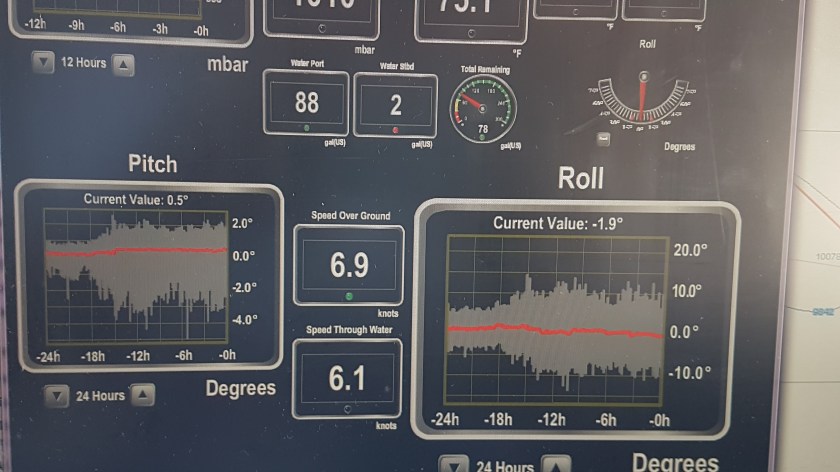
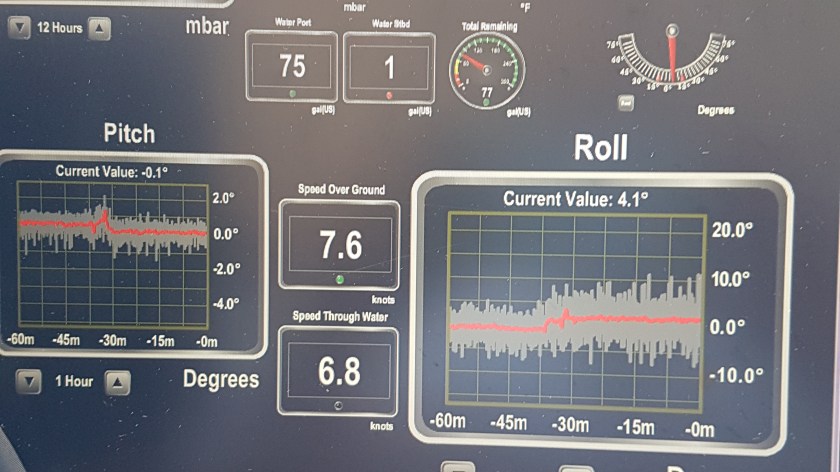
Maretron data showing weather data and pitch and roll for the last 24 hours. At this point, the roll tolerable, the pitch is not (multiple scale by about 4, thus -4 is about 16 degrees bow up)
Video of El Cid now passing behind us.
Error
This video doesn’t exist
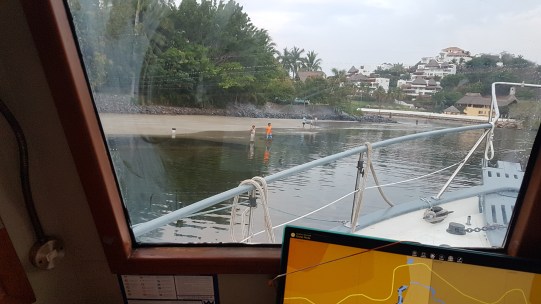
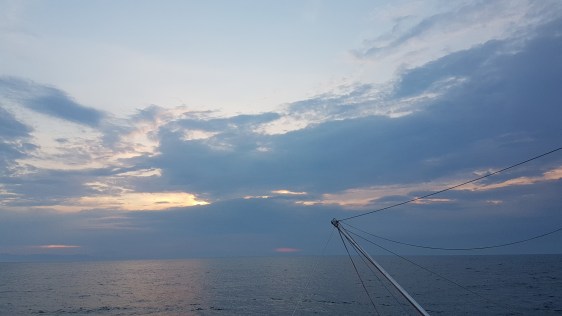
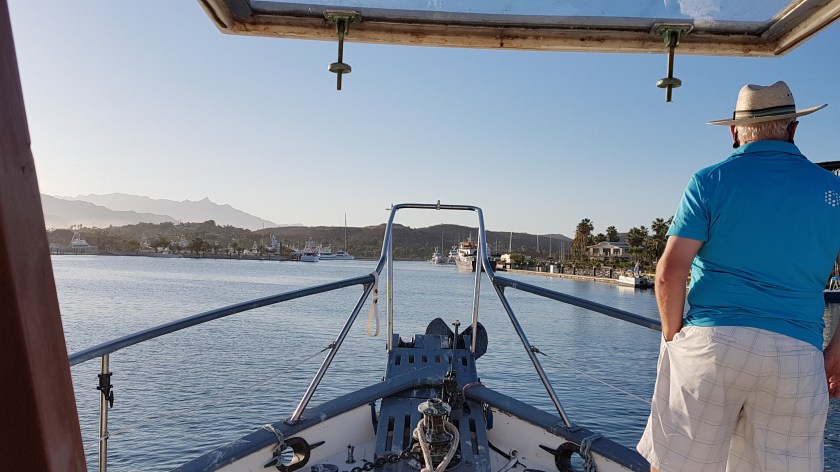
Maretron data showing the roll with bird in the water and increase after I pulled it.Boobies on the port side railEl CId passes behind usAIS on Coastal Explorer showing El CId passing behind usEncounter with passing cargo ship at 03:00. He looks closer on the chart because of the resolution, but why take chances in the middle of the night, thus the course change.Morning of Day 2Morning of Day 2. West of ManzanilloDauntless entering the harbor at Puerto San Lucas
I was hoping I’d only be in Cabo a day or two at best and a few days at worst.
The hoped-for weather window kept teasing me and then slamming shut in my face. In the last 5 years and 20,000+ miles, I can count on one hand, the number of times I’ve started a passage only to turn around. Cabo made me count on my fingers and toes.
After three days in Xtapa, I was getting ready to go again.
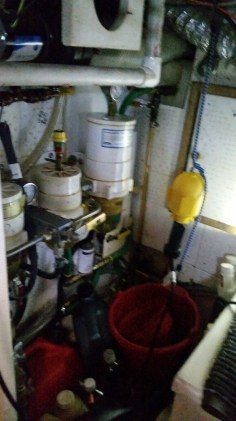
My Racor systems
The night before departure, I topped up all our fluids, both oil and coolant were down, since we had those repairs the days earlier. While they were topped up upon completion of those repairs, it takes running time for air to work out of the systems.
The rough seas and miserable pitching of the last few days seemed to really scour the fuel tank, so I ran the fuel polisher system (filtering fuel to take water and impurities out) on the starboard tank for 8 hours the day before. During the 8 hours, vacuum on the filter had increased from 4”, which is OK, but not great, to only 5”. Which is marginal. Since we were getting underway for another multiple day passage, I changed the fuel polisher filter, a Racor 900 filter system (Racor 2040 2-micron filters bought on Amazon for $12 each.
I usually don’t run the fuel polisher that often anymore. Unless needing to really top up the tanks, like leaving the Canaries for the Caribbean, I only put new fuel in one tank. Thus, I can isolate any issues. I then run the fuel polisher on the new fuel to check it out. Usually an hour; If the vacuum doesn’t change significantly, I turn it off. Sometimes the vacuum will even go down, when the new batch of fuel is better than what was in the tank.
Underway, I also always set the return to the same tank it is feeding from. Once, in prehistoric times, I set the return to the other tank as a means to transfer fuel. Of course, I forgot and ran out of fuel while running. I didn’t do that again.
But I did. This second time, I had inadvertently left both feeds and returns open. For whatever reason, my system tends to return more fuel to the port tank and less to the starboard tank if both returns are open. Thus, I emptied one tank. But this time, the engine did notice because I had also left the sight tubes open on top and bottom. The result was that although the starboard tank was empty, enough fuel was being returned, keeping the sight tube full, which was then fed back to the engine.
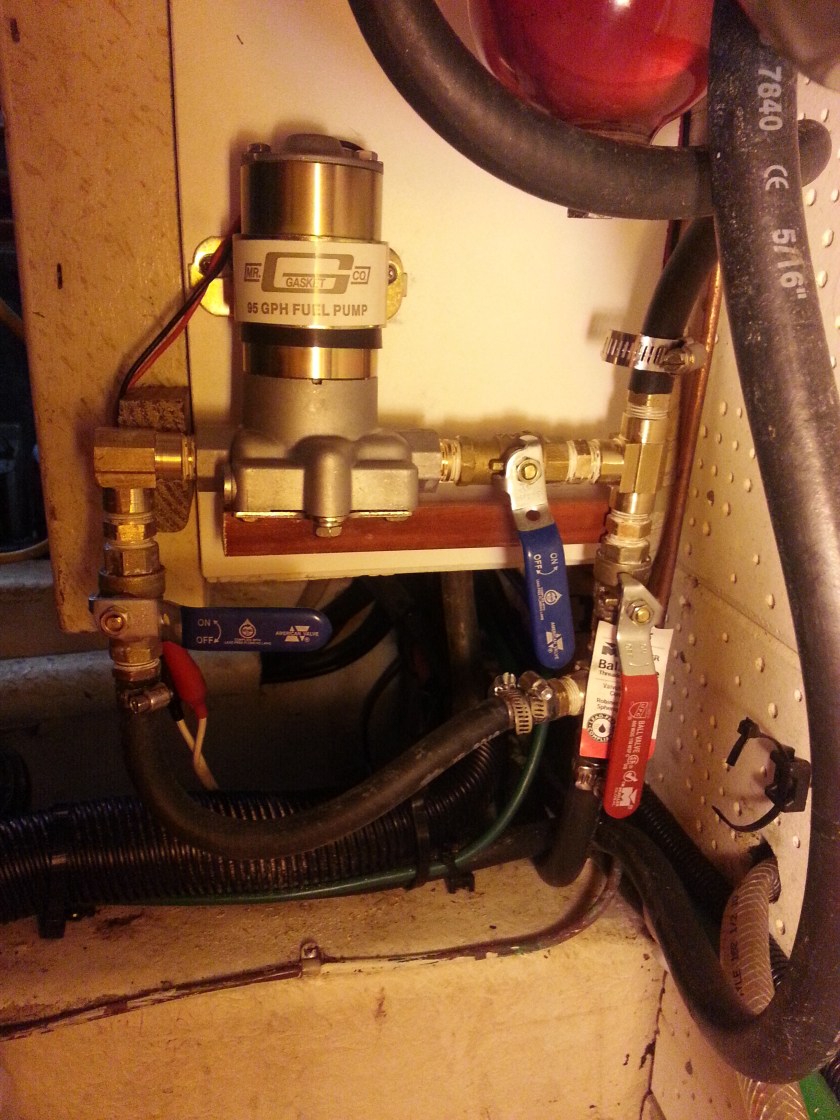
Aux fuel pump
Had I closed the sight tube, the engine would suck air from the tank feed.
Lesson learned. Nowadays, besides feeding and returning to the same tank, I also keep the top of the sight tubes closed, so that fuel goes back to the tank. Otherwise, it defeats the purpose of using cooler fuel from the tank.
I like the Racor setup very much. Twin primary filters, Racor 500, in parallel, and a Racor 900 for fuel polishing and transfer. For a long-distance cruiser like Dauntless, it’s a mission critical system. Meaning don’t leave home without it. When underway, I don’t go into the engine room often, maybe only twice a day, once in the evening before my shower and bed and in the morning, after my early morning watch. (I usually wait until crew is awake, so I don’t wake them by opening engine room hatch, unless the night before I thought I may have an issue, then I check again as soon as I wake).
Racor filters
The parallel Racors really give me peace of mind. In the early days, when changing filters was more of an adventure than it should be, if I suspected a problem, I’d immediately switch filters to the new one and then monitor the new one for issues (water or clogging). But I didn’t have to deal with the filter just then. If in a benign environment, I may shut down the engine, but that is rare. Nowadays, I can change a filter in less than two minutes and that includes priming engine if need be. I installed an electric fuel pump just for that purpose. It makes doing any fuel related work so easy. I used to hate changing the engine mounted filters. I still have the scar on the back of my hand from spending days trying to prime engine (turned out to be a failed O ring had clogged fuel line to Injector pump). Nowadays, if I do switch filters while underway, I will change the old filter, so I always have a new one ready to go at an instant.
Fuel from Colon Panama Strange coincidence that the only place I got significant water in fuel was the only place that gave me a bottle of fuel to prove it was good. Ummm
Nowadays, I almost never have an issue. But when I do, I need the fuel polisher now.
Like when we fueled up in Colon, Panama, waiting to transit the Panama Canal. It was a fuel barge, made even sketchier because they spent some time transferring fuel from a tug to the barge and then to my boat. Once I returned to our slip and ran the fuel polisher, it picked up a lot of water. Another reason to never run from both tanks at once. I knew I had a problem, but it was isolated in the port fuel tank. I also installed those plastic drains that can be opened by hand on all three Racor filters. So, in a situation like this, it made it particularly easy to run fuel polisher a while, when bowl is full of water, empty, run, repeat, until I decide to also change filter. I’ll usually do that at the end. Then give it a good run again to make sure it’s good to go.
I’ve had a few occasions, in which I just let the fuel polisher run and the vacuum gets to 22” to 24” of mercury (Hg). When that happens, I am ever more grateful that none of that crap got to engine or even primary filters.
Because the Racors are doing their job so well, I don’t change the engine mounted fuel filters very often. Maybe even on the order of 500 to 1000 hours. This interval has gotten longer and longer because even in the past when I did have some water in the primary filter, the secondary engine mounted filters had none.
I like Fram
You may think that that’s excessive. What’s the harm in changing the primary filters? In my first year or two, the primary filters were the cause of all sorts of issues from blocked fuel lines to air in the system. They are hard to reach, which introduces a greater possibility of error in replacement or even affecting some other nearby engine component.
The Ford Lehman SP135 engine and I have an agreement. I don’t mess with it and it does its’ thing, which is to never stop until so commanded. So, I am particularly careful working near the engine.
A couple of weeks later, this system would again save my bacon. I had carelessly kept running from the starboard tank, even after it went below the sight tube. I did have a reason, I wanted to see if I had really needed the expensive fuel I had added in some expensive place.
I’m in the pilot house and suddenly, I hear the pitch of the engine change. Remember, the Ford Lehman and I have an agreement. The engine pitch never changes. So, in seconds I had the hatch open and was down in front of the engine by the Racors. I instantly switched filters, then took the time to look around. The engine was starting to surge now (up and down in rpms). I looked at the feed tank and saw no fuel in the sight tube. Now the sight tube is still about 20 gallons above the feed line. I open the port tank feed and return and close the starboard feed and return.
Surge continues. I ask Larry to give it some throttle. No change. Throttle back to just above idle. I turn on the electric fuel pump used to prime filters. Add throttle. In about 5 seconds that seems like 5 minutes, the engine smooths out. I wait another minute and turn off electric fuel pump and carefully adjust valves that put electric fuel pump into main fuel line. (otherwise, when first installed, the fuel pump just pump fuel around in a circle, with out the need to go to the engine. Under normal setting this fuel pump is isolated in a parallel loop and the engine uses gravity feed and it’s lift pump).
From first change of engine pitch to running normally again took less than 60 seconds.
A little background. I came to Vietnam with some trepidation. I don’t like hot climates, hot weather or most foods that they produce. I came to meet my special person though I had an open mind. In the early days, I made the mistake of saying I didn’t particularly like “Hot Pot” as Lãu is translated in English (and my spelling here is not 100% correct, as I can’t find the correct accent for the “a”.
Vietnamese Lẩu. This a fish version that both Trinh and I prefer
A very bad translation at that. I, of all people, should have known better.
Having spent the last 40 years in and out of Europe, if I venture into a place that even has a menu in English, I always ask for the native language, be it Italian, French, Spanish, Dutch or German. Why? Because generally, the translator is trying to put the food into a familiar concept, when no such comparison exists. Sometimes even the literal translation misses the mark widely.
One time in Wissembourg, an ancient French town along the French-German border, after a typically simple, but exquisite French dinner, the dessert offered was “frozen omelet”. We passed, but on walking out, we realized what they were offering was Baked Alaska, (whipped egg whites surrounding a block of ice cream that is browned in the oven) one of my favorite desserts.
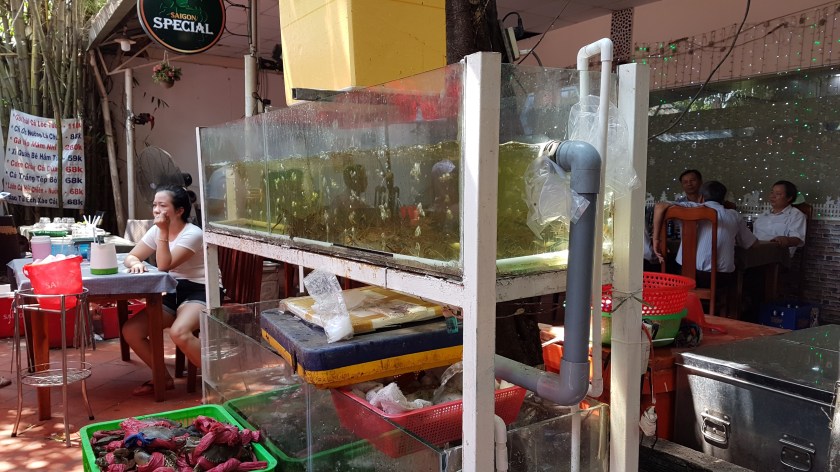
The recent home of the fish before he made it to the pot. The restaurant will grill the half the fish, with the other half going into the Lẩu
Fast forward 40 years later and my ill-informed comment about Hot Pot, had me missing a Vietnamese specialty for months until the confusion was cleared up. But why such confusion in the first place?
Because the Natives are trying to put it into a context we understand. The problem is that there are 500+ Chinese who also have a thing that’s called “Hot Pot” in English, which is totally different that the Vietnamese version. Even the Koreans have a version, which they call Shabu Shabu, which in my mind is better way to handle different foods that don’t translate well. If I go to a Korean restaurant and see Shabu Shabu, I know exactly what I am getting. When I see “Hot Pot” the only thing I am sure of is that a pot is involved, and it will be hot.
Even the Google Translation of Lãu leaves a lot to be desired. Their definition, “a casserole of meat and vegetables, typically with a covering of sliced potato”.
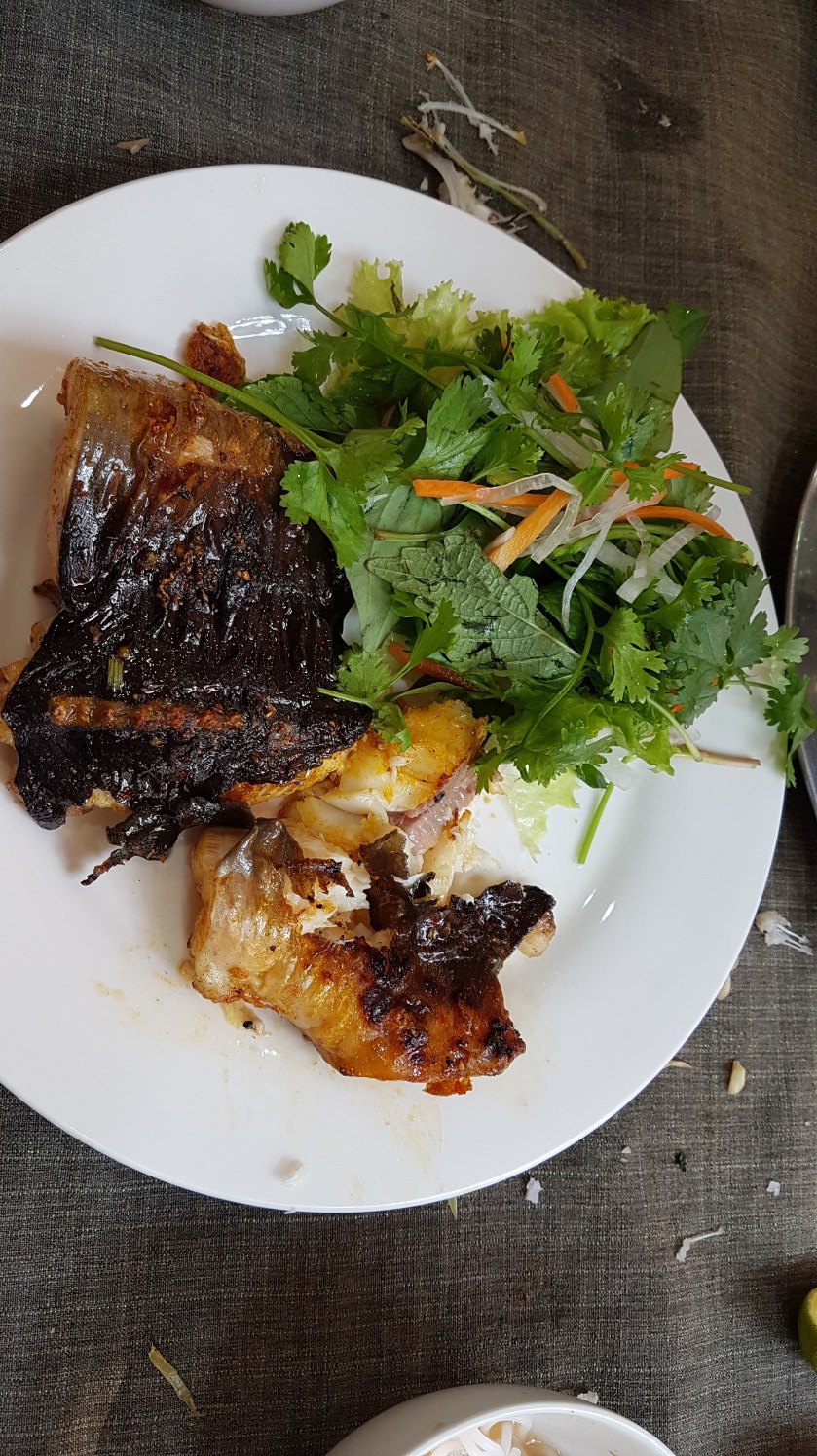
The grilled portion of the fish
Who came up with that definition? A twenty something person who read about ancient life in the Midwest?
When will I ever learn? I don’t know what part of me ignores good advice that I give others. It can be about weather, stocks, women or whatever, I’m very consistent, as I seem to consistently do what I tell others is a fool’s errand.
I suppose that makes me the fool.
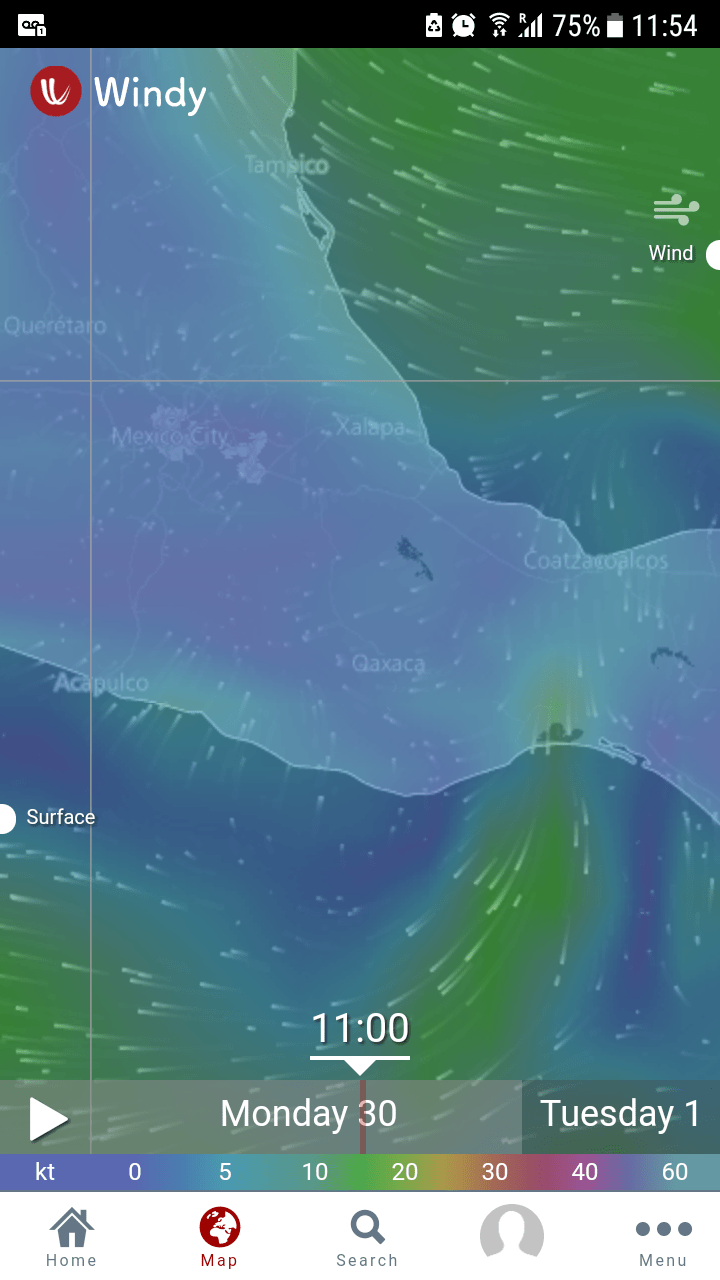
How it looked on the day of departure for current conditions
Yep, I have certainly earned that this year.
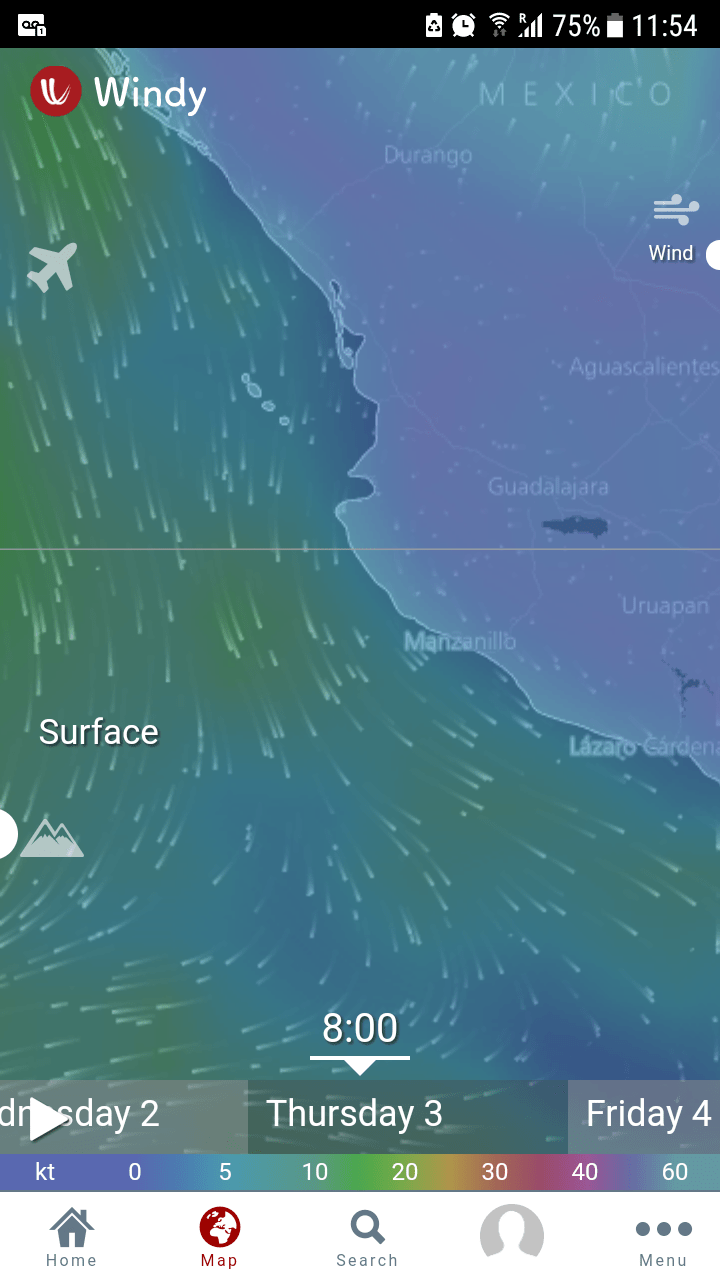
Here are the four snapshots taking from Windy.com of the southern Pacific coast of Mexico taken on 30 April 2018, Monday. These shots highlight what I mean by chasing forecasts. This is different than waiting for the right weather window. That I also had done.
A reminder of some of the vocabulary I use.
Windy.com aka windyty.com is a pretty slick graphical user interface for the numerical weather forecasts that are produced by the National Weather Service, the Europeans, the U.S. Navy, etc. On Windy, at the bottom right of the screen, you can select the two or three models available to view: ECMWF 9km, GFS 22km, and in CONUS, the NAM 5km. The number that follows the model name is the grid resolution, smaller being better. If I was on the east coast USA, I would only look at the Nam. I trust it less on the west coast, since it’s near the edge of the model.
How it looked on the day of departure for the next day, Tuesday
In any case, no matter where I am, I always look at only one model, because I have no way to know which model is working best for that time, space and season. I use the ECWMF because of the lower grid spacing (excluding the NAM). Next spring, as I prepare to move north again from San Francisco Bay, I will use the NAM and read the NWS forecast discussion for my area of interest. Nothing else. If you look at too much stuff, you will just get confused. (this is well documented, but I won’t go into it now).
How it looked on the day of departure for the next two days, Wednesday
While in Huatulco, I was waiting for the right weather window. I was hoping for 3 to 4 days of light or southerly winds (at any speed). Looking at the forecasts, it seemed the week of 30 April was it.
I did well wait for the right weather window, what I did poorly was chasing the forecast.
Looking at the map that shows Tuesday 1 May, the Tehauntepec winds were blowing from the Northeast, and while there were northwesterly winds off the coast, there was that lighter blue area well off the coast with winds that seems to be northerly, then turning more northeasterly. That would have been great.
So, I left Huatulco with the idea of heading west longer than needed to try to get west of the stronger NW winds.
That’s Chasing Weather Forecasts. For the first 3 days it seems to work well. We did have light winds and when the winds did pick up from the NW, they were still less than 10 knots.
The problem was as the winds got stronger, we were so far off shore, 70 miles, that we were left with few good options. The 14 hours backtrack to Xtapa was the result.
If one has about capable of 20 knots, then the math changes significantly. Then it’s more viable to chase good weather. But when you boat plods along a fuel sipping 5 to 7 knots, it becomes impossible to get to the right time and place and then stay in that honey spot. Weather moves to quickly.
How it looked on the day of departure for the 3rd day, I’d hoped to be in that area of lighter winds 150 nm due S of Manzanillo. I don’t even know if it ever existed.
In the North Atlantic, Dauntless made about 140 nm per 24-hour day. In that same time, a low-pressure system will move 500 nm and the associated cold front will move even faster. There is no getting out of the way.
In this last passage up the west coast, I didn’t bother with weather forecasts once underway. All I needed to know was that once the stronger NW winds set in, they would get stronger before they got weaker.
Returning to Xtapa was the solution. Chasing areas for better weather, would have been a fool’s errand.













 Dauntless at Sea