Follow us at:
https://share.delorme.com/Dauntless
.OK, Ladies and gentlemen, boys and girls, the time has finally come to get this show on the road
Dauntless is loaded, (I wish I was) and most stuff is put away, well, at least on the outside of the boat.
After more than 5 years of dreaming, hoping, wishing, planning, reading and even some arithmetic, the time has finally come to shove off.
In about 4 hours, Sunday, 20 July 2014, Dauntless, with Julie and I will depart our home away from home in Providence, Rhode Island and set our sights on the Portuguese islands of the Azores.
But before we can even go east, we must travel down the Narragansett River, then northeast through Buzzards Bay, to pass through the Cape Cod Canal in midafternoon when we will have favorable currents.
From then, we’ll see how we feel, whether to anchor one last time in North America at the tip of Cape Cod or to turn right and head east.
While our route is somewhat dependent on weather and seas, we are planning on the great circle route (course 082° T) from Cape Cod to the Azores as it takes one southeast of Nova Scotia, east along 42°N then east-southeast.

1900 nm, it will take 13 days, maybe 12 with the following seas we hope to have, we will pretty much be riding over the top of the Bermuda/Azores High.
We now have a Delorme InReach Satellite Phone. It will only do texts, but it does allow two way communications all the way across the ocean. You can follow our route with updates every 10 minutes and/or contact us by going to the website https://share.delorme.com/Dauntless
Once on the above page, on the left column, you click on my name, which allows you to select the other buttons above, Locate, Message, and Center. So Locate pings the phone, basically updating the map. Message allows you to send us a text message and Center, does just that, it re-centers the map.
I’ll pretty much have the InReach on until I get to winter quarters, probably in Ireland, probably at the end of September.
There have been many a day, night, that this Robert Service poem kept me going.
Oh, I’m not talking about Dauntless, or challenges of the sea, that’s the easy stuff, as is a number of things I’ve done in my life,
No, I’m talking about the tough stuff, like having a small business, and dreading the call from the bank, in which I had to cover to checks before day’s end. Teaching, being in front of 30 kids, who while they do want to learn, being teenagers, they feel their job is to really make you earn it and if you don’t come up to their expectations, they will let you know in that cruel way only teenagers can do.
Being a principal of a school that was ultimately slated to close, that was full of adults who thought they had no responsibility for that outcome.
Robert Service came into my life, in 1985, when I had moved back to Alaska for the second time. Leonie and I took many trips to the end of the road: up the Haul Road to Prudhoe Bay; down the Alaska Highway to Dawson, in the Yukon and of course down the Steese Highway to Central (where two families got into a real gun shooting feud form their respective porches) and Circle Hot Springs, The road to the Kennecott Copper Mines, where one had to leave the car and pull yourself over a river sitting in a bucket and lastly, numerous drives, many late into the night between Anchorage and Fairbanks, sometimes with temperatures below minus 40° F &C, with the car losing oil every mile because the block could not warm up enough driving 70 mph at those temps.
So many a night, I would read this poem, knowing I had no choice but to press on, that the next day would be better, sometimes it was, sometimes not.
But, it got me here, and life couldn’t be better. So I’d thought I’d share.
|
http://freemasonry.bcy.ca/biography/service_r_w/the_quitter.html
An Update
After 5 years of planning, reading, thinking, asking, listening and worrying, we are just days away from leaving
Thanks to Parks and the cat, at Hopkins-Carter, I got a great deal on a whole bunch of stuff, including a Digital Yacht Class B AIS Transponder, which just went live minutes ago. http://www.hopkins-carter.com/
I even installed the silent switch.

My MMSI is 367571090.
The computer is from Island Time PC and everything is running though that, including Wifi extender. Call Bob, he is great and always ready to help, even when I’m doing something stupid. http://islandtimepc.com/
I should have done it months ago, but it is what it is. Now, I must figure out how to get Coastal Explorer to see my Maretron Network. The rest of the programming, I figure I can learn during the next few weeks. I should be somewhat adept by the time I get to the Azores. Luckily, you don’t need much navigation to cross the Atlantic, just ask Columbus.
I will take pictures and document all the changes, hopefully in the next few days, before we leave, (though is you have been paying attention, I’ve been promising that for months).
Also, stay tuned, as I will also be giving you the Delorme Earthmate link for Dauntless. Then you can ping and even text me.
Gotta Go. Much left to do, like getting new compass to talk to ComNav and where is that Alternator and why does it have so many wires on the back?? I knew I should have taken a picture of it BEFORE I disconnected everything. EEK
 Update Sep 2020
Thanks to Bill Grothe, who sent me a number of pictures, which I 
 have uploaded to my smugmug account.
They are all downloadable.
Enjoy.
+++++++
Looking at today’s North Atlantic Ice situation in preparation for our journey across the Atlantic, it seems there is too much ice to take the great circle route to northern Europe. For Dauntless, the only real danger is sinking and the only real way to sink it to hit or get hit by something, be it another boat, a whale or an iceberg. We can’t make a passage through iceberg-strewn waters. Other ships we can avoid, while praying to the Poseidon that we don’t come upon a sleeping whale.
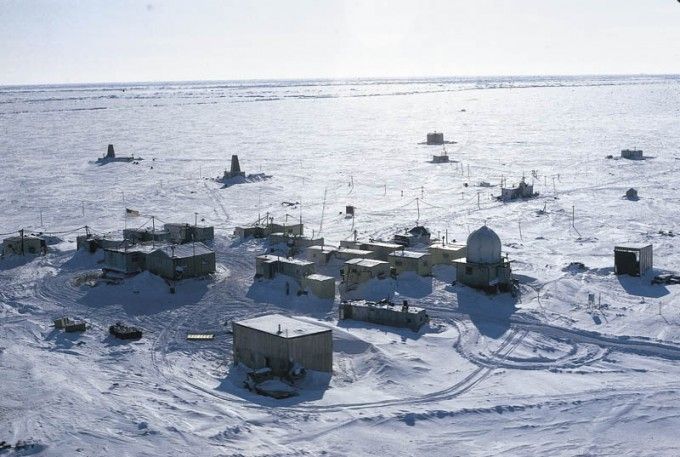
Besides my 10 years in Alaska, I also spent 6 months living and working on an iceberg: a giant, tabular block of ice, roughly 3 miles wide, 4 miles long and 80 feet thick, called Fletcher’s Ice Island T-3. I was 22 and it was my first work experience after college, unpaid except for room and board. Looking back, I think that iceberg is part of the reason I’m willing to cross the Atlantic on a 42-foot boat, and even see it as a comfortable experience. I was attracted to Alaska and the Arctic because it was a place of mystery. No cell phone in those days, and so little communication. Later, even living in Alaska 20 years later, in the 90’s meant no communication for 300 miles between Fairbanks and Anchorage. In high school, when I read Jack London’s “To Build a Fire,” I was struck by the consequences of simple mistakes. But the Arctic is full of people who survived on wits, knowing what mistakes could cost them.
I arrived on T-3 only three years after running out of gas in eastern Washington (see last blog posting). Little did I dream on that day that I would be sitting on the top of the world, literally. Well, almost the top. At the time, T-3 was about 400 miles from the North Pole. Our camp was situated on the edge of the iceberg. We were there to collect zooplankton from the ocean and make sonar maps of the bottom of the Arctic Ocean.
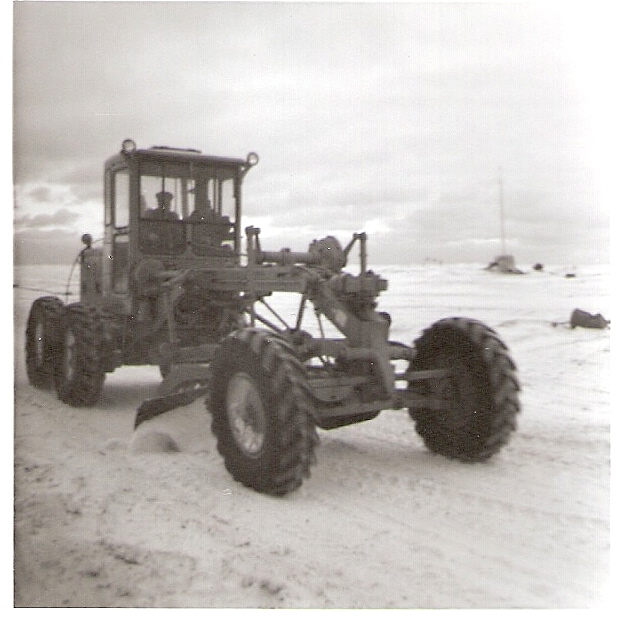
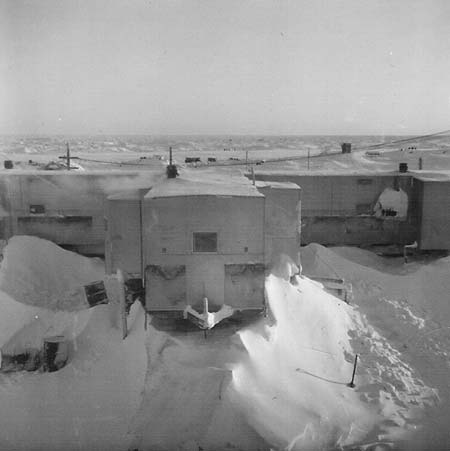
People wise, there were eight of us: 4 of us from the University of Washington (UW), a researcher from Lamont Geophysical Laboratory, Arnie Hansen from the Naval Arctic Research Laboratory (NARL), and the camp manager, Bill Hallett, and his Eskimo assistant, both also from NARL. The assistant was a master at driving our CAT and our Grader, which were the main vehicles of the camp and used to move virtually everything, including our trailers, which had to be moved twice during the summer to avoid the fate of being left on an ice pillar (see picture below). Bill himself was a remarkably resourceful man I’ll talk about later.
We UW folks split up and pretty much worked in pairs. My partner Chris and I collected zooplankton from various depths of the Arctic Ocean while the other two analyzed water chemistry. In fact, we ended up collecting the largest number of zooplankton samples the UW had ever collected.
I also, took one weather observation a day, which although it sounds meager, really helped me during the rest of my forecasting career and even today, 40 years later!!!
Our camp on T-3 consisted of about a dozen ATCO trailers, roughly the size of a 40 foot truck trailer. There used to be hundreds of these stacked up along route 509 as it crossed the Duwamish in Seattle, but looking now at Google Satellite (do they have their own actual satellite yet?), sadly they are gone. Though from above, you can still see the impressions they left on the ground after sitting for probably 30 years. They were probably last used in building the Alaska Pipeline. I’ve driven countless friends past these trailers to show them how I used to live.
So, back to T-3. I had just graduated from the UW, but had to miss my graduation to make the flight from Barrow to Resolute, NWT, Canada. From there, we flew on a Twin Otter to Eureka, where we refueled and waited to make sure the plane could receive the radio beacon that T-3 transmitted.
The UW had allowed women one year and it didn’t turn out well. Think Many Men behaving Badly Over a Couple of Women. The only women within thousands of miles. It was the winter, when the camp expanded to about 40 people: 40 men, 2 women, and did I mention guns and alcohol.
The UW in their mode of “let’s not kill people to make a point,” (remember this was back in the early 70’s before we let Political Correctness trump Common Sense) decided after that, no more women. Since I was arriving in the summer there were many less people, as the camp had to be supplied by air drops by airplane.
U.S. Air Force Alaskan Command C-130’s would fly from their home base at Elmendorf (near Anchorage), fly to NARL at Point Barrow, pick up our supplies, that had been put onto pallets and then left in the 24/7 summer sun for a day or two, and then fly 2000 miles, drop our stuff on pallets tied to big parachutes, do a wing wave and fly off to Thule, Greenland, about 1000 miles to our south southeast.
A few asides:
By the way, I stopped drinking milk for these six months. While other’s drank it sour or not. Interesting. Moving to Italy three years later, totally ended my milk drinking. Italians don’t drink milk, only babies and they don’t get it from a carton.
Another interesting tidbit that you will wonder how you could have lived so long without knowing, in Korean, the translation for breast is milk tank and fish is water meat. Sometimes literal is best.
Back to the T-3. These airdrops were scheduled for every three weeks starting in July until we got the hell out of there, when it was cold enough to build an ice runway and the C-130’s could land. We would be getting low on food at the end of three weeks, so we did not like any delays, at all. Winds too high? Drop anyway. The Air Force guys also didn’t want to have to come back, so pretty much we almost always got a drop close to schedule. Obviously, they needed to be able to see our camp and the one time they did drop with 40 knot winds, we did lose a pallet that took off across the ice never to be seen again (well, Artie, the intrepid NARL guy I mentioned, who is featured in some of the polar crossing books of the 1960’s, did retrieve our mail).
So we got deliveries and mail, but could send nothing out until the ice runway could be built. Think of a situation in which you can get a letter every 3 weeks, but there is no way to send anything out—unimaginable today. It was four months before we could get our mail out. How was anyone to know they were still loved? How mankind survived 500,000 years without cell phones if not unimaginable, is certainly cruel and unusual punishment.
So no cell phones, no fax, no games, no TV, no nothing. We did have a building, the old observatory, which was filled maybe a thousand paperbacks. That was the entertainment.
Daylight was constant by the time we got there, having flown for two days all over northern Canada (NARL didn’t trust our 30-year old DC-3 plane to fly over the ocean). The sun was up all the time. The sun was actually hot and sometimes we would be out in T-shirts, even though the air temperature on the hottest days never goes above freezing! Most days, temps were in the teens or low 20’s F.
We occasionally walked on the sea ice. Our work hut was on sea ice, because the sea ice was only 8 feet thick and we had a little derrick set up with a winch to haul nets and Nansen bottles in and out of the ocean. During the height of the summer, there were melt ponds all over, like little, or sometimes big, lakes. The blue ones were just on top of ice, but the black holes looked just like they sound, black, and I was terrified to go near them. They were black because the ice had melted all the way through to the ocean, so one was looking at the arctic ocean. Seals would occasionally pop their heads out. Falling in would have been a matter of life and death. Sea ice grows from below and melts from above. So by August we needed to keep a heat lamp on in our hole for our net, otherwise it would freeze over within hours.
The camp did have one rifle, which we took with us whenever on the sea ice in case we encountered a polar bear. Never did, much to my disappointment, but I stopped taking the rifle, because I thought I was going to shoot any bear anyway. Same reason I won’t have a weapon on the boat. I never saw a polar bear, but I did see a few seals.
As the summer wound down, much of August was cloudy, very little snow though. The arctic region is pretty much a dessert. Just windy and cold.
The first sunset was September 7th; the last sunrise was September 14th. So within a week, we went from total day to total night. Temperatures in September were often below 0°F, -17°C.
The next two months were colder still, minus 20 to 30°F with winds almost always.
We built an ice runway under those conditions that ended up having a large lake in the middle, which we found with the CAT one night. Took us 24 hours to get the CAT out.
My adventures on T-3 ended when a Markair C-130 came to pick us up in the middle of November. I arrived in Fairbanks after a direct flight form T-3 to Fairbanks International, with two dollars in my pocket. (Mark Air did not have the same fears of NARL about flying their planes directly over the top of the world, they were in a hurry, this wasn’t a government flight after all!)
What influenced me the most on this experience? Our camp manager, Bill Hallett. He was the epitome of what Alaskans were in those days. He saved the camp twice, once when a fire broke out near the generator hut and the second time, in late October, when we had all expected to have been gone a month earlier and our generator gave out. He literally rebuilt the thing within a day, as we stood by and helped as best we could, as the camp got colder and colder. With no electricity to run the heaters, they would still burn, but could not distribute the heat, thus the few feet around the heater in each trailer would be roasting, while each were below freezing and getting colder, with the outside temperature of -35°F. All we had was a single HF radio, Single Side Band, but we would go days without being able to raise anyone.
Bill understood the consequences of not being resourceful and knew there was nobody to help. No calling home when we got hungry, no helicopter taking us off the mountain, no reality-show bs with a producer holding a safety net off camera.
We had to solve our problems with what we had. That’s what Bill did, and what I aspire to do. It was as simple as that. Maybe that’s why I’m willing to cross the Atlantic in a boat that is probably similar in size to Columbus’s Nina and Pinta.
I think I’ll add some books to my Kindle.



Sad End Notes:
Bill Hallett died in Fairbanks a few years later.
T-3 made another circuit of the arctic and then got caught in the current east of Greenland and moved south into the North Atlantic, where US Navy Ice Patrol planes watched it melt. I know this because 11 years later, in 1984, I had the small world luck that the same navy crew spent a week at Eielson AFB at my weather station. So over many beers, we toasted T-3 and all that made her special.
 And Death looks you bang in the eye,
 Dauntless at Sea