20200725 Anchoring on a Lee Shore in a Gale in Southeast Alaska – The Devil You Know…

As I have said before, this is my 7th year with Dauntless and 6 years with my 55# Delta anchor, so I sleep well at night on the hook.
We were cruising from Wrangell to Juneau, 148 nm, normally three days, but we wanted to do some halibut fishing and we didn’t need to be in Juneau until the following Wednesday, giving us 6 days.
We left Wrangell Friday morning on an out-going tide, giving us a push through most of Wrangell Narrows. Outside of Petersburg, at the north end of Wrangell Narrows, the current will abruptly change from a plus 1 knot to a minus 4 knot current. When this happens, we anchor just off the channel and wait a couple of hours for the slack. That’s what we did on this day also.
Even with our stop of a little less than two hours, we arrived in Farragut Bay about 20:00 Friday evening, dropped out shrimp pots and crab pot and anchored on the south side of the large bay. It is an open anchorage, but suitable for good weather with no swell.
We knew a storm was coming, with increased south-easterly winds throughout the day, Saturday and into Sunday. Our plan was to fish a bit Saturday, check out another anchorage, but ultimately head to our Read Island anchorage where we had anchored two times previously, one time with very strong southerly winds (which meant we were anchored off a lee shore)
We fished a few spots, but no luck, as the winds picked up to 15 to 20 knots, the seas inside Farragut Bay did also, with 3-foot waves. We decided to pull our shrimp pots, which in hindsight turned out to be a mistake. It was not fun with those winds and waves and stressed Ti out more than was necessary.
We then headed to the east side of Read Island, where we could anchor for the night, but first did another hour of fishing in a spot Ti had noticed a small fishing boat last time we were here.

About 17:00 Saturday, we were anchored in our Read Island cove. I let out 140 feet of chain plus our 30’ nylon snubber bridle. The spot we anchored was roughly the same as the first time when we had seeked shelter here during another storm earlier this summer. The initial anchor bearing was 80’ @ 243° in winds that were already SE to SW at 8 to 15 knots.
The previous storm had produced winds 15 to 25 knots in this cove. I was quite stressed as it was a lee shore, but we pretty much stayed right where we anchored. This informed my opinion for this coming storm.
We were anchored in 37 feet of water under the keel. Had it not been off a lee shore, I would have let out another 100+ feet of chain.
The winds were 15 knots gusting to 25 thru the evening. By nightfall, it was raining heavily and between the rain and the darkness, I could not even see the nearby shore a couple of hundred feet away off our beam. Thus, the lack of any decent videos or pictures.
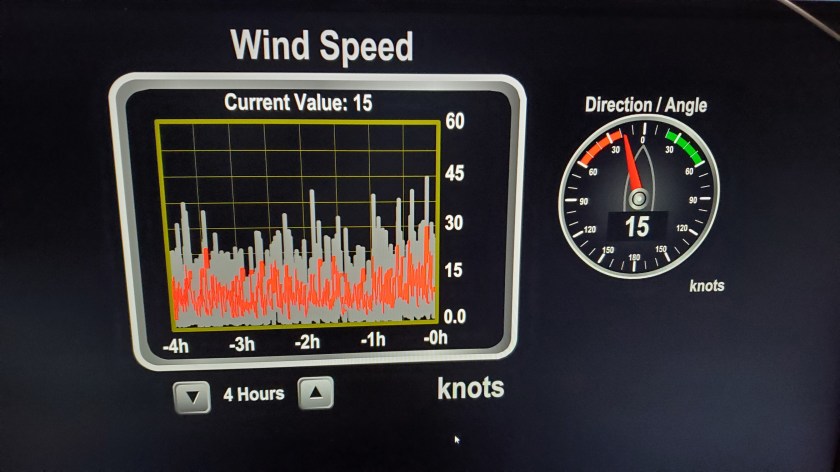
Just before midnight the winds came down a few knots, but as they say, this was the proverbial calm before the storm, as by midnight, the winds were rapidly building again. It was to last almost 24 hours, with half that time with winds above 20 knots, peaking to 40.

I was happy to go to sleep before then, but Ti was a nervous nellie, waking me up every half hour to tell me the wind was blowing, and the boat was rocking a bit (though not really). The first couple of times I got up to check everything to maintain marital bliss, if nothing else, as it was pitch black outside, with heavy rain and wind. I could see nothing. At midnight, the anchor bearing was little changed in direction or distance.
While the winds were high in this cove, there was really no swell or waves, at most a half foot, making it a little rocky, but hardly noticeable in the scheme of things.
I went back to sleep, but Ti would still wake me up a dozen times until morning; I’d reassure here and go back to sleep.
Civil twilight was about 04:00, with sunrise 45 minutes later, so that’s when I got up again, as I could no longer use the excuse to Ti that it was dark out and I couldn’t see anything.

So I was up, in the pilot house, watching as the storm peaked about 06:00 with winds gusting to 40 knots and a steady 20 knots, but for the next 6 hours, while the wind gusts came down a bit, the steady winds were higher in the 25 to 30 knot range. Thus, with that wind pressure, the anchor bearing distance oscillated between 156 and 174 feet for much of the morning, before decreasing to 110’ to 130’ by midafternoon. (and where it had been the previous evening).

Looking at the little diagram I drew and my calculations, all the catenary was out at that point, 174 feet away, and we were simply being held by our Delta anchor. As the sun got higher in the sky ,I could see shallow rocks about one boats length away behind Dauntless. That confirmed my calculation to not let out more chain. I was also ready to start the engine should I notice us dragging. However, since we had not dragged at all, I was hesitating to move and thus possibly upset the balance we had obtained.
In analyzing the track on the Coastal Explorer C-Map chart and the Maretron wind graph, it was clear that we had spent about 12 hours between that 150 and 174 feet and by mid-afternoon Sunday, 22 hours after we had initially anchored, we had moved back to the original bearing and distance of 78 feet. Monday morning, when we finally hauled anchor after 36 hours, we had moved to within 60 feet of the anchor under calm winds.

All in all, I could not have been happier with how things developed and how rock steady we were under difficult conditions.
Would I do it all over again?
It’s hard to say. I would probably turn on the radar and set the alarms the next time. That would be more effective than anchor alarms (GPS based), which I don’t use anymore, because I find them ineffective.
My Alaska friends had told me that any location that may have been more sheltered from the wind would have been more open to waves and swell.
All in all, it’s hard to try to improve upon a good outcome. As they say, sometimes it’s better to stick with the Devil we Know, versus the one we don’t.
To see a little video of this, which I have not yet uploaded on my Dauntless at Sea You Tube channel, please visit the link below and subscribe.


 Dauntless at Sea