It made me envious; I know, that’s ridiculous, but still.
Dauntless has come so far
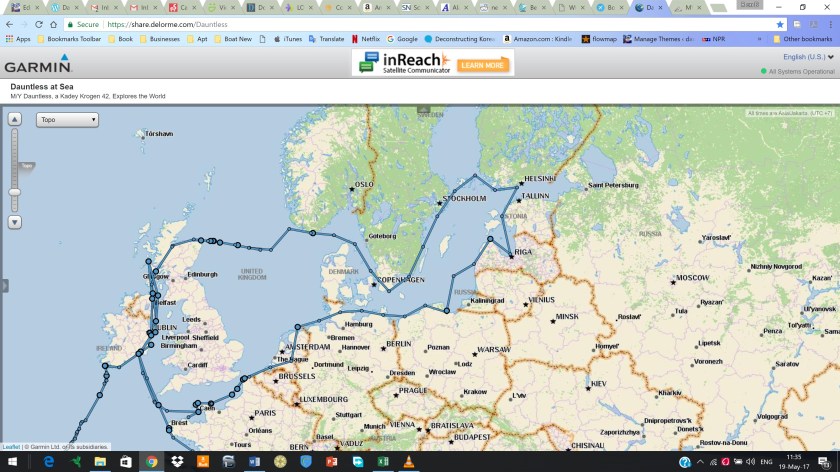
Dauntless spent two and a half years in Northern Europe because I knew we would like it. The weather, the people, the cultures all, the food, fit my number one criteria of staying off the beaten track and living well as I did so.
I Loved the Baltic, Sweden, Norway, Scotland & Ireland
That was expected. All the lands of coastal Northern Europe have a real seafaring culture. Every boat waves at you, especially fisherman. From Galicia in northwest Spain to the far eastern Baltic, it was a wonderful experience with minimal bureaucracy.
In those 2+ years, 20+ countries, 100+ stops, mostly in towns and cities, I probably spent less than 120 minutes on the formalities of checking in (Passports, boats documents, crew lists) and checking out.
No wait, there was no checking out.
The peoples, the lands, met and greatly exceeded my expectations.
Then, we headed south. 90% of all boats are south, mostly in the Mediterranean, you know, Italy, Greece, Turkey and southern France and Spain. Everyone wants to go there, so that’s a big Do Not Enter sign for me.
So, we headed south with low expectations. Little did I realize they were not low enough.
Prices trebled, temperatures doubled and bureaucracy was like a pig is slop. The first two stops in Portugal took the same amount of time as the last 100 stops of the previous two years.
And then it got worse.
In virtually every stop, 5 to 10 pieces of paper to sign to check-in; make sure you return tomorrow to fill out and sign the same papers to check-out. Don’t even mention the expense.
But you have read all of this before. Turns out Martinique was the high point of the entire Caribbean. It’s almost weird to say that they were the least bureaucratic. In fact, they were just like northern France. But that was certainly the exception.
So now, having endured all of that and more to get Dauntless a quarter of the way back around the world, I sit here with envy of Dirona.
But I realize it’s not Dirona I’m envious of, it’s being in the middle of the ocean.
I’m a traveler, so when I’m not, I’ll always be envious of those who are.
Should I have stayed in northern Europe for another year?
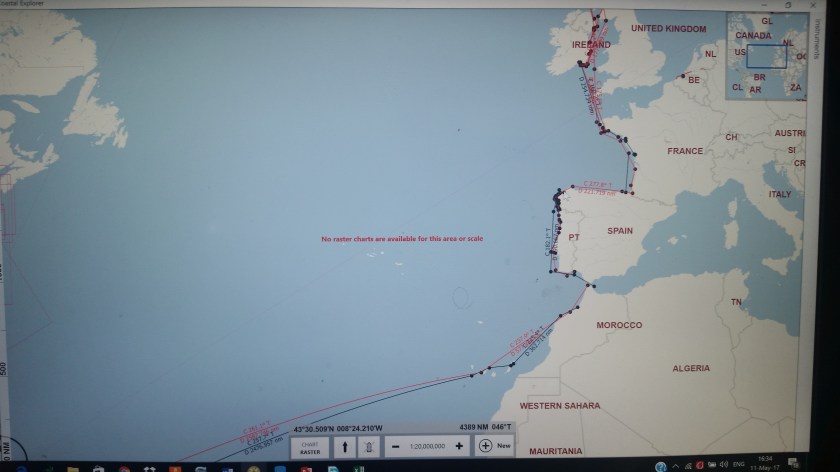
The route I ended up taking between Galicia in the Northwest corner of Spain and the Canaries.
First the additional year. I love Ireland, the people, even the weather (you never got bored). But Ireland itself is not really cruising country. Getting up and down the coasts can be a bitch, at best. I did love A Coruna though. Why not there? That was Plan B after all.
Then Schengen reared its ugly head. For those of you who still don’t know what “Schengen” is, it was the city in Luxembourg in which almost all the countries of Europe (nothing to do with E.U.) decided to have open borders in 1989. Open borders meant just that. Prior to 1991 or whenever it went into effect, one had to stop at each and every frontier and show passport. On my many drives from the Netherlands to Italy, that meant 3 border crossings. But they were pretty quick (nothing like the USA-Canada boondoggle). They never even stamped your passport. While the rule was, you were allowed in 90 days in each country, no one cared and as I said, no one stamped passports other than at airports and not even then many times.
But with Schengen and the open borders, they decided they still had to control immigration. Therefore non E.U. people could only stay 90 days out of every 180 days. So, before you could move from country to country every 90 days a stay within the rules, now, you had to leave the continent or go to the U.K. or Ireland. That’s why Dauntless was in Waterford.
Ultimately, I realized that to keep Dauntless in A Coruna for the winter would not be feasible, since I could no longer go to NYC for 3 months and then return.
By the way. So, Schengen was written to keep people from overstaying, yet today the E.U. gets about 200,000 people a month from Africa and the Middle East.
But they got Dauntless out so all is OOOKKK.
And another aside. While those morons in Washington debate who to let in. NO ONE, Dems or Republicans, talks about we have no system to track who leaves. Wouldn’t you think if we really cared, the first thing would be using one of the billion computers the government has to track people as they leave and compare that list to who came in. What a clown show!
Now, sorry for the diatribe. My route which took me down the coast of Portugal and around the corner to Gibraltar. I didn’t even see the Gibraltar Apes.
I suppose the real issue here is that we were really beaten up almost the entire trip from Porto, Portugal all the way to the Canaries. By stopping in Gibraltar, I added about another 360 miles to our trip.
I actually had a sailor in France tell me that I should go direct to the Canaries from Vigo in NW Spain. But I wanted to see Portugal and I am glad I did.
The route I should have taken
But southern Spain and Morocco, ended up being exactly what I expected, hot, dry and dry and hot.
I could have spent those weeks in the Canaries. The Canaries reminded me of everything I liked about Galicia. Great people, food and a boating culture.
If I’ve learned nothing in the last 60 years, it’s that I need 6 to 7 hours sleep on a routine basis to not get into a sleep deficit. The watches on this passage were set up to facilitate that.
In spite of the drama I like instilling in my life, for every one day of “crisis” we spend about 5 to 6 days of peaceful boredom. It’s even possible that the weekly crisis is not totally random.
Why, you wonder?
Not so much on this trip, but in the past, most of my problems were caused my me. Complacency, boredom, who knows, I decide everything is going so well, so I may aa well see what happens if I do this. This last crisis was a case in point. I was “experimenting”.
My only point here is that in spite of the appearance of the narrative, very little time is spent dealing with anything. The hardest part of a long passage is not getting bored, even more so in these conditions that virtually never changed.
So, December 23rd dawned to bright skies and easterly winds; we were feeling good.
The one lingering issue was the amount of air still in the Hydraulic steering system (which is controlled by the helm wheel or the ComNav autopilot), which caused a hellacious banging every few seconds as the auto-pilot moved fluid thru the lines. This was exacerbated by the location of my cabin directly under the pilot house.
Normally our brains filter out routine noises. I once lived next to a church steeple in a small town in Germany. Every 15 min, some combination of bells would ring: 15’ after the hour 1 gong, 30’ after 2 gongs, 45’ after 3 gongs, then 4 gongs on the hour, followed by the number of gongs based on the hour, 1 = 1, until 12.
Within a few days, I didn’t even hear it any more. But I did find it nice to be able to know the time in the middle of the night, without turning on a light. I do love Germany.
Even years later, when I would visit and sleep in the same house, after the first gong, I’d “hear” no more.
This wasn’t like that. Since the noises had no pattern, with a variable duration and frequency, my brain did not do what to make of it, so it made sure I heard everything. As the days wore on, while the noises were decreasing, they were still significant and I found myself getting less and less sleep. Three hours overnight, then an hour here, maybe a couple there.
Did that contribute to our travails on the last night? Probably a bit, maybe more, but Micah and I had the worst night of the entire trip on our last night before pulling into Martinique.
The days since our big repair had been good. In fact, Christmas, December 25th, was one of our best weather days, with winds not going over 25 knots, thus our ride was great with light rolling to 10°, worst 15°. I made our last big steak and candied sweet potatoes. We even opened a bottle of Bordeaux that my French friend PJ had given me.
Micah meticulously pours our wine
That was also our second whale sighting. There were two whales, about 30’ long cruised with us for about 15 minutes. Very nice.
The Whale Video
Error
This video doesn’t exist
Dauntless rolling along, watching this makes me miss the ocean
Error
This video doesn’t exist
I do love our Weber Q-280 grill
Our ETA to Martinique was noon on the 28th. Therefore, the night of the 27th, was our 20th night at sea since leaving the Canaries.
I started the last 24 hours by putting the last of our oil, 1.1L into the engine. I estimated that at worst, we would arrive about 1 liter low, which is normal. (and we did). But there was no point in shutting down the engine to check at this point, as I had no more oil anyway.
Just as I go to bed at 22:00, ETA in 14 hours, the starboard paravane pole bounces vertical. This necessitates stopping the boat and letting the pole fall back into position, once the rearward pressure is taken off the line to the bir
The starboard pole has never done this before in the previous 15K+ miles!
25 minutes later, it does it again. Something is not right, but I am tired and even in hindsight, it’s not totally clear to me under the circumstances what I should have done.
All evening the winds had been increasing. They were now easterly at 25 steady gusting to 40. Clearly the seas had grown, again with the annoying swells from both NE and SE and the wind driven waves from the east. Our rolls were getting substantially more, routinely to 20° and the worst, a few times an hour to 30°.
Even on a rally boat like Dauntless, a 30° roll is significant. Or I should say, it feels significant in the pilot house. If I am in the engine room, I hardly notice, even the salon is much better, but I digress.
I attributed the increased rolling to the winds and seas. It was dark out, so it’s hard to estimate seas. Also, since we were approaching the island of Martinique, the waves would start to change.
But at 02:40, all of a sudden, the boat rolled over at 15° (normal) to port, but was really slow in rolling back. This meant the opposite stabilizing bird was not working for some reason.
Sure enough, I had gotten up to see why the boat motion was different and saw right away the starboard bird being pulling along the surface.
We stopped to retrieve it. It was broken and later that morning as I looked at it, I realized the bolts that held the vane in place had come loose. That was probably the reason the pole went vertical earlier in the evening, as the bird was no longer running straight. That added a tension that eventually broke the plywood wing of the bird in half.
Now, in a strange occurrence, maybe due to lack of sleep, after we pulled the bird, we continued on with just the one port side bird deployed. I’ve run many times with only one bird. It is quite effective on a beam sea with winds that are not too strong.
But with a following sea, only one bird, is only half effective, so we rolled our way into Martinique that way.
I say strange because all that morning, I had been tripping over the extra bird that was no longer in the lazerrett. We had gotten the bird that was jammed in the lazerrett out and even cleaned up the lazerrett. So, it was sitting, inconveniently, on the port side deck. It would have taken all of 30 seconds to attach it to the starboard pole and throw it in the water.
Oh well, All’s Well that End’s Well.
And of course, as we approach the harbor of Le Marin, the only sailboat we’ve seen in 19 days decided to tack right in front of us. Much like the last idiot on our first night out of the Canaries.
Warning. Harsh language is involvedand I don’t hate all sailboats. But for the life of my with an entire ocean in front of him, why he cut across our bow is beyond me. I had been watching him for quite a while, had he delayed his tack 10 seconds or changed his course by a few degrees he would not have ended up directly in front of our bow. I had to virtually stop as to not hit him… umm, maybe that is the answer, could he have needed a new paint job?
Error
This video doesn’t exist
And my feeling were certainly exacerbated by the fact that this was only the second SV we had seen and the previous encounter, our first night out, was eerily similar.
A long day is ending, but crossing an ocean, there is no rest for the weary. This video shows the view from the fly bridge looking aft as we were topping up the hydraulic fluid after my first temporary repair.
Error
This video doesn’t exist
Of course, I had been looking at the manual for the helm and Auto-Pilot. They being connected, the Auto-Pilot has an Octopus pump which takes its direction from the ComNav AP computer. This pump then controls the rudder piston. Now that the broken hose was replaced, we had too much air in the system.
And believe it or not, the manual for the system says to just keep topping up the fluid at the upper helm station and in a few weeks, all the air would be worked out of the system.
Maybe a few weeks if we were on Jupiter, but in a few weeks of Earth time.
A Beautiful Sunset
So, two hours after getting the big repair done and getting underway again. I had cleaned up, showered and even took a nap because I was hit by a bad bout of seasickness or what until this time I had attributed to be seasick.
But now, we found the Auto-Pilot was hardly working. It would hold a heading for a few minutes, but at a certain rudder angle, it would try to move the rudder, the air in the system was not allowing it to work properly. At which point, it would decide to do a Walk-About.
Yes, I can speak Australian. I saw Crocodile Dundee.
The problem with a Walk-About in 10 to 20 foot seas is the KK designed to go with the seas. So, lying dead in the water, we bob like a cork. But underway, we do not fight the waves we go with them and underway, while turning beam to the seas, the first few rolls will be dillies, until the paravanes are totally effective again.
So, every few minutes, our heading would drift off and before you can say, here we go again, we would have a 20-degree roll. And the subsequent roll would almost always be greater unless immediate action is taken.
This at 20:00 the prospect of having to hand steer was a nonstarter, therefore, drastic action was needed.
So, I found myself once again in the hot, 100-degree engine room, on my belly, with feet dangling over the shaft that is still spinning since the boat is being pushed along my wind and current. I had decided to “bleed” the system. The Octopus pump does have three valves for each line (port, starboard and return) that can be closed to stop fluid draining from the system if need be. In this case, I opened each one in turn until it literally comes out, and I let ATF run out until I saw no more air, while Micha turned the wheel in the specified direction.
15 minutes later we were back underway. The Auto-Pilot was much more responsive, but still only at 50%. Worse, there was enough air in the copper lines, that they resonated like somebody playing the cymbals 6 inches from my head.
We decided to keep track of the number of walk-abouts. From 22:00 that night, it occurred 7 times an hour. By 02:00 it was down to 3 times and only once at 03:00.
Though when I came on at 04:00, it was still not working as well as I’d like. This ComNav does really well in bad seas. But now, with its impaired performance, we were getting into some large pendulum rolling motions. Motions that when working correctly, it has no problem stopping.
Micah was already in bed, it was dark out, but it drives me crazy when something is not working as it should (under the conditions). I decided it needed burping. So, I went to the fly bridge and totally took out the fill plug, thinking it needed more venting.
It didn’t hurt and I didn’t fall overboard.
For the next 6 days, we periodically worked the helm steering, trying to get air out of the system. Slowly, but surely, air came out and we would top up the system.
The bigger issue for me in particular was that the racket the air in the pipes would produce every few seconds. It really hindered my sleep and made out last 6 days really hard. Especially considering there were really no other issues until the last day and night, which of course, ended up being the worst night of the entire passage.
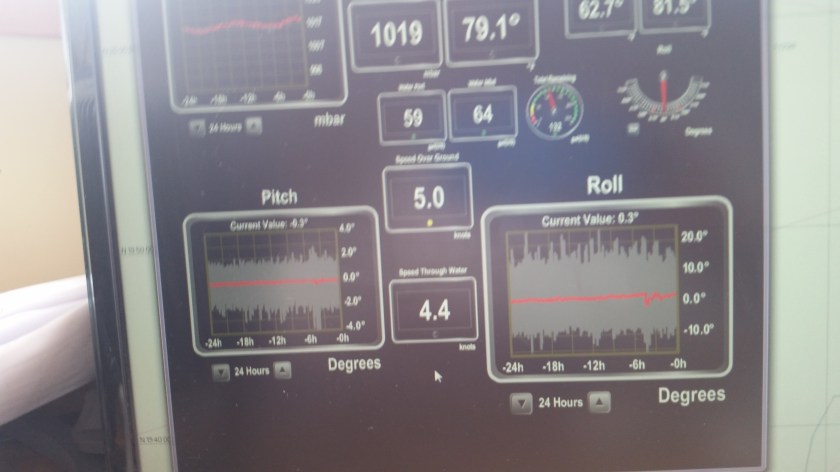
Just After the 1st Repair. It’s 13:33 this is the normal screen I run with. I’ll minimize the Maretron data (black box on left) is there is more traffic or is I have a reason to look at the chart. In this case, what’s important: winds 090 at 23 g 28; Apparent Wind Angle (How is the boat feeling the wind) is right on our stern at 180 degrees. Bottom right shows the roll and one can see the roll reduction while the boat was stopped at the same time the pitch increased. Then the roll greatly increased once we got underway again.
Error
This video doesn’t exist
This video shows the day before, Dec 21st. Even before the preventer stick broke (which you can see going form the fly beige rail to the middle of the paravane pole)
Error
This video doesn’t exist
This is from the afternoon. GIves you a nice idea of the seas. This is what we had plus or minus for 21 days.
So, as December 22nd dawned, (end of Day 13 and beginning of Day 14), the little problems that had popped up were solved quickly.
Though during the night, my last second and last preventer stick broke. It wasn’t critical, I had not used it since it was made three years ago, but still, this morning I wanted to find a real solution.
The winds had been very strong since daybreak, in the low 20’s, gusting to 35 knots.
I decided to stop the boat, just put her in idle and adjust the paravanes somehow. It nice to know that the boat will bob more than roll when stopped. While not underway, Dauntless rolls at about half the rate of our underway roll. So, we’d been rolling 10 to 20 degrees, pretty consistently, now we settle in the trough of the waves, but bob as much as roll.
Now, months later, my brain refuses to remember why I actually stopped the boat. It must have gotten superseded by the traumatic events that followed.
Autopilot disengaged, Idle, then neutral, the boat will coast to a “stop” in about three minutes. Winds and current are still pushing the boat, in this case about 1.5 knots.
Then before I did whatever I had intended to do, I decided to turn the rudder to see if it made any difference in the boat motion. Not a stupid plan; yet.
The rudder was already hard over to port. And then in an act of gross stupidity, I turned the wheel more to port. Why? Why? Why?
I knew the rudder was at or close to the stops. The steering system had had some air in the system for a long time. No matter what I did, I could not get it all out. So, I thought a little more turn couldn’t hurt.
Oh, my God, it could hurt. After turning the wheel about a quarter, I felt it go slack in my hand.
I knew exactly what happened and turned to Micah to say, “We’re fucked now”.
I knew because I’ve had this sickening sense before: pushing on brake pedal that goes all the way to the floor or turning a steering wheel and nothing happens. When a hydraulic system goes slack: clutch, brakes, steering. It means the hydraulic system has no more pressure, A hose, fitting or part has given way.
He knew from my tone that I was serious, very serious. I was so angry at myself. Had Micah done something like this, it’s an accident. For me, I knew better than anyone the consequences of over-pressurizing a system.
The Kadey Krogen has does have an emergency tiller that connects through a purposeful hole in the hatch. But I hate even manually steering the boat in a sea. To stand, sit in the stern deck and hand steer for 7 days like were some god-forsaken sailboat, fuhgeddaboudit.
But I also immediately realized I couldn’t afford the Pity Party. I also could let Micah start thinking of the consequences. Now was the time for solutions and solutions only.
When the Going Gets Tough; the Tough Get Going.
We had 200+ feet of hydraulic lines and the failure could be any place. gain, trying to control the sickening feeling in my stomach, If I’ve learned anything on this boat, it’s to always look for the easiest solution first.
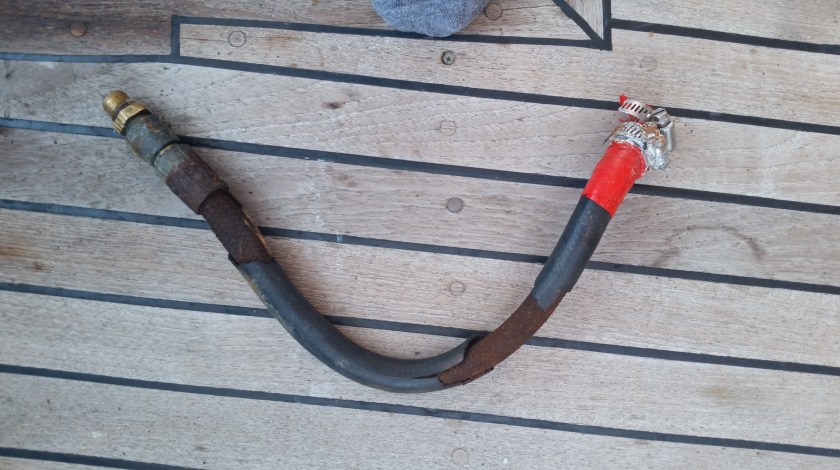
So, we’d start at the rudder piston in the lazzerrette. Open the hatch, and at this point, a wonderful sight (on a boat everything is relative), hydraulic fluid oozing from a hole in the hose just above the fitting. This hose, one of two, for the rudder piston.
First thought, let’s try easy, easy solution, rubber tape, with hose clamps around it.
Error
This video doesn’t exist
This video is after i had completed this repair and also shows how I stopped the paravane pole from bouncing by using a fender.
It worked. We got our filing funnel for the upper helm station, from which the entire system is filled with AFT, Automatic Transmission Fluid, which conveniently, both the hydraulic steering and the Borg-Warner manual transmission use for lubrication and pressure.
The system took about 2 liters of fluid. But I only had a total of 4 liters. I’m starting to think of chickens coming home to roost.
We get underway just under an hour later at 10:28. Everything is working reasonably well. You can see from the Maretron data how the boat roll is about half, while the pitch increases when dead in the water.
Coastal Explorer, our main navigation program, running on a dedicated solid state 12-volt boat computer had been acting up. For a few days, it had not been displaying AIS information, no matter what little tricks I had used in the past to “wake it up”.
Now, I knew I was still sending, which is actually far more important, as since I have had transmit capability large ships always stay away. Having seen only one ship in 13 days, the display wasn’t critical, but I wanted it working. I like everything working.
So, as a last resort, I decided to reboot everything. Everything off and on again, in order, about a 4-minute process. The log shows at 12:15 all was well.
We had been checking our repaired hose every hour, as well as topping up the fluid as needed. In the last two hours, we had put another liter into the system. The hose was leaking enough, probably a few liters every 12 to 24 hours.
Now this would have been no problem in coastal cruising. We would have just topped it off until port. I didn’t have that option. So about 7 hours after the first fix, I knew I had to find the real fix.
Two Issues I had to solve: Hose & Fluid.
For the hose, I knew I had a number of spare hydraulic hoses in two different places in the engine room. One set stored with all the extra hoses and tubing, the other set stored in the long-term spares containers on either side of the generator.
The fluid was a bigger challenge. I used the Delorme InReach to text my contact Roger, who got in touch with Ski in NC. Ski, a long-time diesel expert, had been really helpful in the past, so I needed to figure out what I could use as substitute ATF.
The answer turned out to be simple and vexing, 4 parts diesel fuel to 1 part engine oil. Yes, the engine oil of which there was not extra. The engine needed every bit of oil. Dauntless was now full of chickens. They had all come home to roost.
The offending hose, steel braid rusted to the core. I’m replacing these hoses and standardizing the fittings.
OK, first I had to clear out all those chickens. They were all over the place. Before we did anything, I found the spare hose with the correct fitting in seconds. So far so good. I then stopped the boat again and also the engine, as I wanted to check the oil level to make sure of my calculations (on a passage like this, I just fill the engine at its usual use rate, without turning it off).
Oil level was just were I expected, so I decided I could spare one liter of oil. Worse case, we would arrive in Martinique one liter low, but that’s not a big deal for a day.
I got my tools and wrenches. Getting the old fitting off the three-way control valve ended up taking me 15 minutes. I even heated it up with my kitchen torch, but I was very careful not to make my hose problem into something far bigger and unfixable.
Finally, it came out. I put pike gunk on all the new fittings, makes for a better seal and I don’t want any more leaks.
In the video Micah took, you see one time water came across the deck. That’s water that enters thru the scuppers, usually on rolls of more than 15 to 20 degrees. As I said, dead in the water, we bob more than roll, so I was only inundated with water twice in this operation which took about 40 minutes. I wanted Micah to get more pictures of the outside scene not just the top of my head, but he was nervous and I think he felt better not looking out much.
Error
This video doesn’t exist
Me on the other hand, I may not look it, but I was pretty ecstatic. I’d fucked up and was able to fix it. We now had 5 liters of substitute ATF which would be more than enough.
The finished product
Error
This video doesn’t exist
At 18:00 we were underway again. Immediately, it was apparent that I had way too much air in the system. The Auto-Pilot was acting errantly. It would work for a few minutes, but once the rudder got far enough over, there was not enough pressure to get it back. We would have to turn off the autopilot, then turn the wheel lock to lock three times until pressure built up in the system, check and top up the fluid at the upper helm station and reengaged the autopilot. This went on for a couple hours until I realized I needed to go to sleep to get ready for my 04:00 watch and the boat almost needed hand steering at this point.
That would not do. I did not do all this to have to hand steer for 7 days.
Day 14, 22 December 2016, Still 800 miles from our new destination of Martinique.
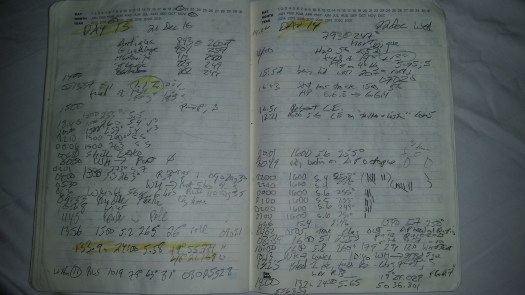
Dauntless Log for Days 13 & 14. Notice the blank lines in the middle of the right page.
The void in my log for that date, from 12:21 to 20:01 says a lot, because it says nothing.
The fuel crisis was a week behind us.
Though now I was a bit concerned out our oil supply for the engine. I had changed the oil just before we left the Canaries. That left me with only had 10 liters of oil for the trip. For coastal cruising this is more than enough, but to cross the Atlantic, to go 2500 miles without the possibility of stopping to get anything, be it food, fuel or oil, was plain stupid.
I’ve gotten in the habit of buying extra. If I need one, I get two, but in the checkout line, I decide to get another one so I end up with three. This is exactly what I did while at Deevey’s in my last days in Waterford, Ireland. In this case, I got an extra case, which the owner Mark was great about bringing to the boat. Little did I realize what that extra case of oil would mean 6 months later.
Stupid because the Ford Lehman engine consumes about 1 liter every 50 to 60 hours. I knew our passage was going to be about 500 hours, so I should have at least 10 liters on board, plus at least one oil change of 14 liters, just in case. For example, if an oil hose fails on the oil cooler, most of the oil will be in the bilge before I can turn off the engine. Thus, having the full amount of oil for the engine as “spare oil” is a necessity.
So instead of starting with 25 liters on hand, we only had 10. And now, after 13 days, 312 hours, I had already put 6 liters in the engine, so now, I’m down to only 4 liters. No problem unless there is a problem.
The day before, day 13 out of the Canaries, we had the continuing drama of the windward paravane pole bouncing vertical. As long as we immediately stopped and let the pole fall back into place no problem. But it was occurring more often, becoming annoying and running the risk of doing damage to something.
The Maretron data shows what a rolly passage it was.
Finally, at midnight, when it happened again, I got out of bed and Micah and I decided to retrieve put in place one of the preventer sticks I had made for just this purpose two years earlier.
This video shows the stick I was using.
Error
This video doesn’t exist
It broke by morning. We put the second one on, hoping it was just a defect in the wood. It lasted even less time. Finally, I got the idea to wedge a fender between the pole and the gunnel. That worked for the next 1,000 miles. In Martinique, we further refined the system and tested it under rolling seas all the way to the Pananma Canal. Now, it no longer can get out of position.
Hey, it only took 3 years and 15,000 miles. I never said I was a quick Lerner!
Error
This video doesn’t exist
This video shows the conditions on Day 13
Now I have a system that I am quite proud of: It’s very effective, simple, easy to adjust or modify and easy to use even single-handing. It takes only 1 minute to deploy the birds, and I’ve retrieved them alone in less than 3 minutes.
So, as Day 14 dawned, the issues we had had: the 5-day fuel leak, the paravane poles and the broken bird, minimum oil reserves, seemed behind us. Being on a boat in the middle of the ocean makes you self-reliant like you never thought possible. In the worst moments, I don’t tell anyone. Why? What the point? They will just worry about something they have no control of.
Problems popped up; problems were solved. The only issue was that I would get terrible seasick as soon as the crisis was resolved.
Little did I realize that my biggest test yet was just around the corner.
Since I have talked, written, about my planning process a lot, you know I like having a plan.
But there are times when a plan, any plan, has been elusive. Also, the best plans are always subject to change.
Generally, I find that the best plan, or better stated, the best initial plan, is one that stands the test of time. Having a straw man to test, If I go here, this will happen, allows me to continuously refine the plan and test it mentally with many different scenarios.
Having an initial plan also allows me to write about it, talk about it. So, my friends or anyone has a chance to ask, Uh, you’re not really planning on doing that, are you? I like, even need, questions like that. They are part of my extroverted thinking process. They make me better articulate, or think through, the what and why of the plan. And of course, there are times, I learn of significant mistakes.
Oops. Like this summer’s missing 1,000 nm. That’s about 25 days’ worth of coastal cursing. A month out of a season that may only be 5 months.
My initial plan after transiting the Panama Canal in January, was to head up the west coast ending in Southeast Alaska 6 months later. Not a terrible plan, if traveling by car!
But when the details are still an ocean away, don’t sweat, don’t worry.
Then as my Panama Canal transit got later and later, I’d make some adjustments to the west coast plan, deciding to stop in the Pacific Northwest or even Oregon if that’s as far as I got by October.
I still had not found the missing 1,000 miles, but then I still did not know they were missing.
We had a quick five day, 300 miles run from Panama City to Golfito, the southernmost port in Costa Rica.
Dauntless Initial Planning 2017 through 2020+ All Dates, destinations are tentative, but gives me frame work for the Cruise.
I could finally catch my breath. In fact, during the five-day run, though it meant two long 14 hour days and then anchoring in waters no so protected, the seas were flat and it allowed me to start seriously thinking of the coming cruise up the west coast.
And then I noticed that my little planning table had a little error. I had not accounted for the miles of Baja California. Mexico from beginning to end is 2100 nm, I had typed 1100 in what I call my “Planning Table”. I found the missing 1,000 miles.
Another factor came to my attention. A few posts ago I wrote about the expenses of Dauntless. Our expenses are very consistent, when I’m on the boat they run close to $100 per day. The only way that number changes significantly, is if I am not on Dauntless, like in the winter and if Dauntless is in a safe, secure, inexpensive location (like Waterford, Ireland).
Also, In the last weeks, I’ve realized how much I miss Northern Europe. My biggest mistake was not spending two summers in the Baltic. And to have this realization half way around the world is a bit annoying. (since there is nothing I can do about it now).
Martinique was a nice port, made nicer having endured a relatively rough three-week passage across the Atlantic from Europe. Beautiful women, French food & wine, what more can anyone ask for?
But after three weeks, Micah and I were both ready to move on. Sitting for months at a time is just not in me.
Therefore, my new, updated, improved plan allows me to take my time traveling north up the coast. I won’t have to travel in bad weather or contrary winds for a change. But it will be incumbent upon me to find good, economical places for Dauntless to winter over.
This winter that will be someplace in northern Mexico, next winter probably British Columbia and finally Southeast Alaska, maybe near Wrangell for the third winter.
Crossing the North Pacific will come next, then probably wintering over in Korea before heading south along the Chinese coast the following spring.
Exploring Southeast Asia and Vietnam will be up next.
And after that?
A return to Northern Europe; unless of course, the plan changes.
We knew it would end badly; we only hoped they would have mercy on us.
Dutch Caribbean Coast Guard Helicopter
We did our best to stay out of trouble, but when your time is up, it’s up.
Now, as we rewind the events of the last few days, it’s clear we never had a chance.
It all started innocently enough. The uneventful three-day passage from St. Vincent to Bonaire was just that uneventful. But now, it’s obvious, those strange lights we encountered was just the tip of the iceberg.
We spent an uneventful few days on Bonaire. It truly is a diver’s and snorkeling paradise, at least for anyone who has not been to Hawaii. Certainly, the most fish I have seen since… Hawaii, but that was 30 years ago,
The plan was Bonaire, then Curacao and finally Aruba, the three so-called ABC’s.
20 miles e
Dutch Caribbean Coast Guard plane
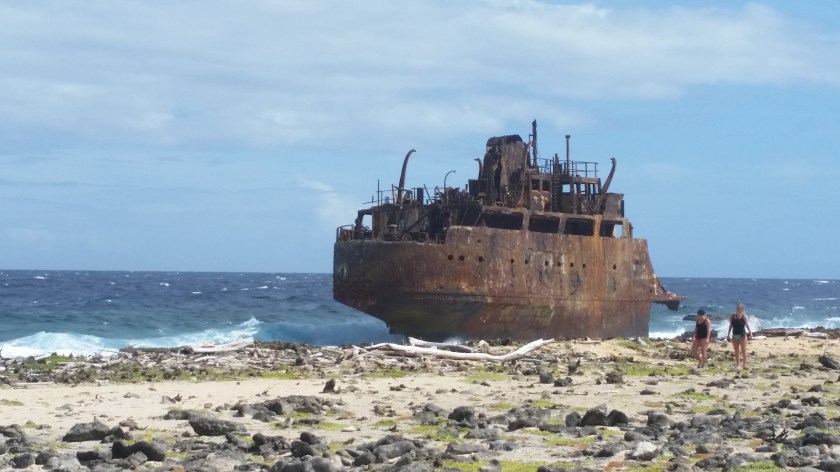
ast southeast of Curacao, there is a small island, called Kleene Curacao. It’s almost on the way, so after a long day, we figured to anchor off the windward shore. This is the island with the wreck and the old, abandoned lighthouse.
After walking around the island
, climbing the lighthouse, making photos of the wreck, upon returning to Dauntless, I heard a low droning noise that can only come from a low flying turbo prop
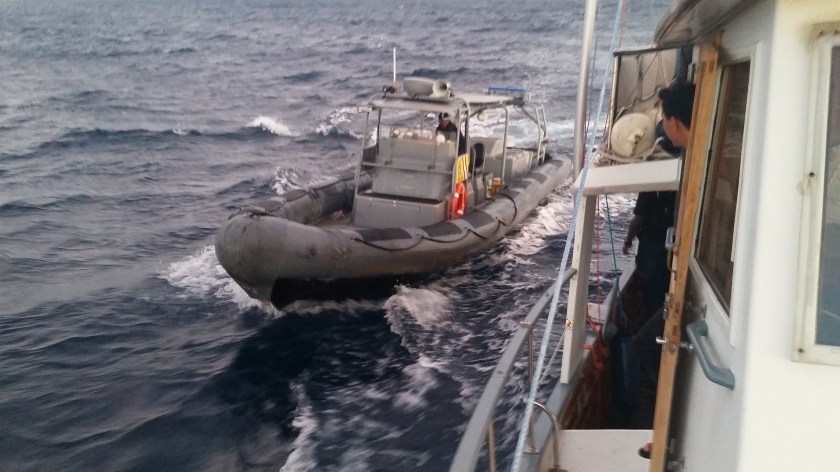
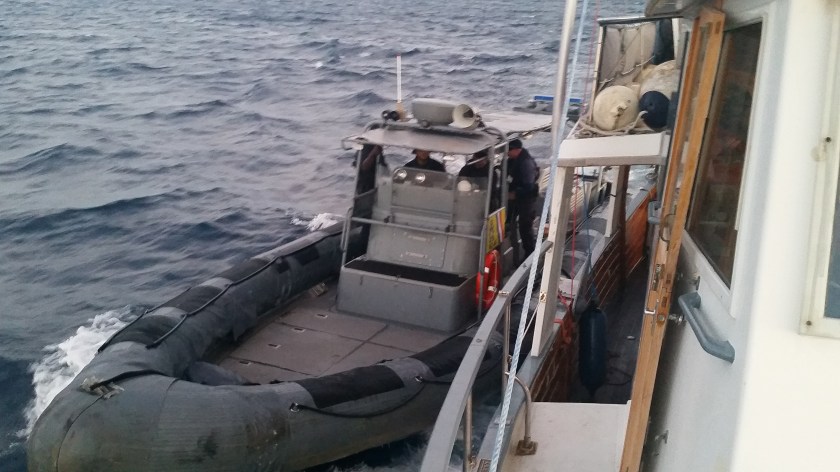
DCCG RIB Pulling up
aircraft. It was a Dutch Caribbean Coast Guard (DCCG) plane making a low (200 ft.) pass, parallel to the beach banked over to get a close look at our little Kadey Krogen.
That was interesting. This was not our little boat’s first encounter with aircraft checking us out. The Canadians off Nova Scotia, the French off the Brest Peninsula, did the same. Seeing we were clearly not a fishing boat, we never saw them again.
But this time was different.
DCCG RIB Stalking DauntlessDCCG Making the transfer
Next morning, we get underway to do the last 20 miles to Curacao. This time, a DCCG helicopter circles our boat three times. A couple hours later running parallel to the coast, just a couple miles off, the same helicopter returns and circles us again for 5 minutes.
So, it was no surprise when an hour later, we get a call on the VHF from DCCG asking us our destination.
OK, that’s simple, it’s Oranjestad, we’ll anchor just off the airport’s runway.
No, that won’t do, we are being asked to stop at customs in Bacadera, 4 miles south of Oranjestad.
No problem, that’s on the way. I tell them we’ll be there in about an hour.
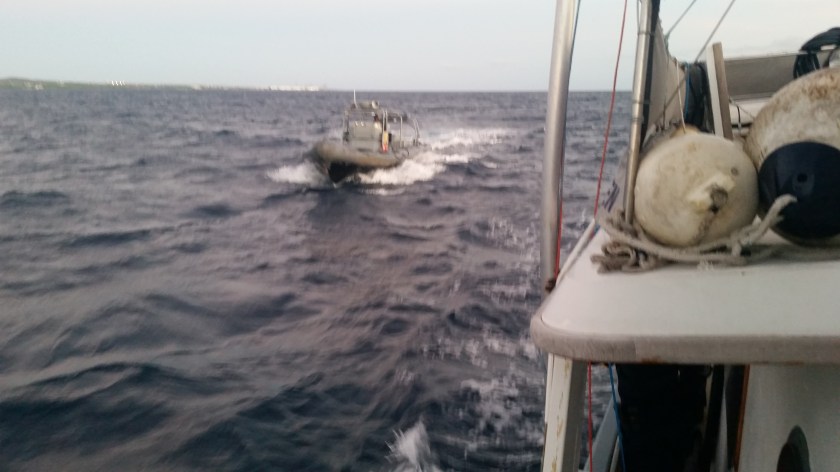
Then 20 minutes later, I’m hailed again, this time by the DCCG RIB that’s right off our stern quarter.
Initially, they seemed to want to follow me to Bacadera. OK, but then finally they asked the question that it seems everyone has been dying to ask for the last few days, what am I streaming off the paravane poles?
I told them it’s a bird to stabilize the boat and reduce rolling.
Maretron Rolling Data showing the effectiveness of the Paravane Stabilizers
Could I please retrieve them so that they may board our boat?
Of course, let’s end this drama!
They watched alertly as Micah and I went through our now well practiced, 4-minute routine: Dauntless in idle, then neutral, as boat slows I go to fly bridge, while Micah goes to side deck. After 2 minutes, boat is slowed enough for me to start retrieving poles. Then it’s just a matter of pulling birds out of water.
Once that is done, they ask me to go “Dead Slow”, and as Dauntless wallows around like stricken whale, they come alongside and three guys come on to Dauntless’ side deck.
They are really professional and even nice. They obviously are thinking we are fishing. They do a quick look around, take a picture of our passports and satisfied that we are not and have never been fishing, they prepare to leave. This time though, they let me go the steadier speed of 5 knots, which makes it easier for the RIB to pull alongside and for them to return.
They add that we do not have to stop at Customs at Bacadera, but can proceed to Oranjestad, anchor for the night and check-in the following day.
Which we did.
At which point the customs asked us why we did not check-in the night before?
I stated simply that I did as I was directed. That ended that discussion.
All in all, it was a good experience. The only frustrating part was not so much about the fishing that wasn’t but just the paperwork to check-in and then a day or two later, the same paperwork to check-out. For long term cruisers, not an issue, but for someone like me, who wants to see many places in a short time, they make it very time consuming and ultimately, I will not come back.
In fact, only a week later, closing in on Cartagena, I realized that check-in normally takes few days, check out two days and we only wanted to make a two-night stop.
(The below was written last week, while underway, midway between St. Vincent in the Grenadines and Bonaire)
It’s about time!
Don’t Let this happen to you. The wreck on the east side of Kleine Curacao
Anyone who looks at a weather map can see that the passage from the eastern Caribbean to the Dutch Antilles is pretty much the same conditions as the Atlantic from the Caries to the Caribbean.
That means strong easterly trade winds and the seas and conditions that they produce. They are trade winds, because they are produced by the global heating and not by low pressure systems, as occurs north of the tropics.
So, we are merrily rolling along. This is 42-hour point of a 70-hour trip. Do I worry about jinxing it, by writing that we had no problems? Of course, I do. But every once in a while, I feel the need to get really crazy. Hoping that Poseidon is playing with Persephone and doesn’t have the inclination to mess with Dauntless this time.
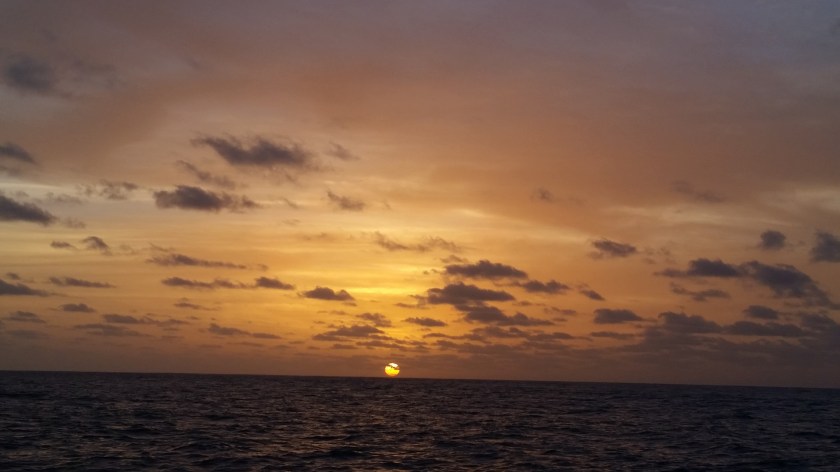
Sunset Looking Towards Bonaire
Now, if this post never gets published because we never made it. I take all the above back. But let’s assume that you are reading this in the comfort of your reading place and I am happily ensconced in Bonaire paying too much for everything and squealing like a pig as I do so.
Since I finally just published the account of an average day crossing the Atlantic in the trades, you should all know the routine my now.
And the weather is the same.
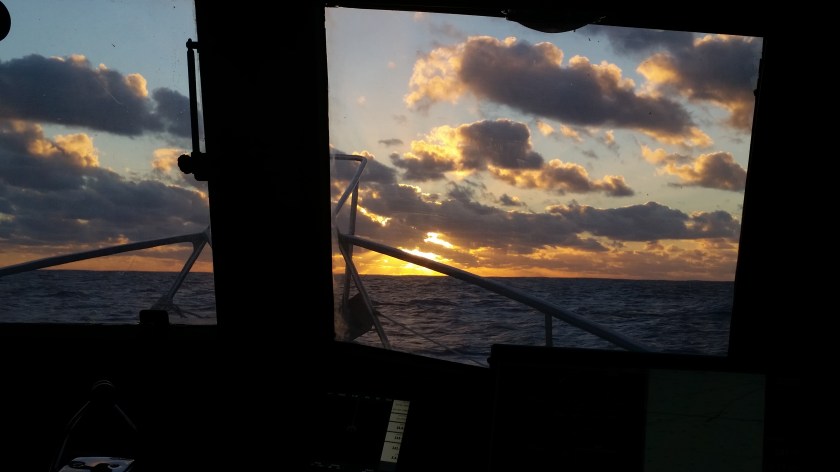
Sunrise
Easterly winds, 20 knots gusting to the low 30’s, with the direction varying from northeast to southeast.
As long as it has an easterly component, Dauntless can deal with it as we make our way west.
While the winds are about the same, the wave heights are significantly less. Thank God, no strike that, Thank Poseidon.
I guess that is the effect of the Grenadines and Antilles reducing the fetch (the distance winds blows over uninterrupted sea). There seems to also be a tidal current of 0.5 to 1 knot pushing us along. That means that yesterday, we made 156 miles in the first 24-hour period, that’s an average of 6.5 knots.
The extended length filling tube and funnel for the power steering
Our earlier Atlantic Passage, our average was 137 nm at 5.9 knots.
Yesterday, I made grilled chicken for us, with a side of pasta. I also made a tomato sauce for pasta, which we will eat today. This is something I have not made for many, many years, at least a half dozen, years.
I made this for Micah, as the time for him to return to school and get on with his life is now rapidly approaching. It’s the least I can do for his hard work and the diligence he as shown these past 8 months on Dauntless.
The three big problems we had previously: the mysterious fuel leak, paravane shenanigans and hydraulic hose failure, have all been overcome. The paravane poles have been the most interesting in that I am always tweaking the system. Sometimes my tweaks work, sometimes they don’t. But I pride myself on finding simple, inexpensive solutions and this stabilizing system is finally starting to speak for itself.
The hydraulic steering and the helm and for the ComNav Autopilot has never been quieter. Never, at last since I’ve owned the boat. And as Micah pointed out, the owner’s manual did say that one had to be patient as air would work itself out of the system in a few weeks. I did help it by rigging a Rube Goldberg looking filling tube and funnel on the upper helm. This allows the system to burp itself without the usually oily mess.
After the ABCs, we are headed to Colon and the Panama Canal, after a short visit to Columbia, where my brother is for some unknown reason. He’s never seen Dauntless, so it’s the least I can do.
Near term, once through the canal, we’ll head up to Costa Rica, where Micah will leave us and Larry, my Alaskan friend of 44 years who I met on T-3, will join me and D.
There is much to write about in my latest Atlantic Passage. We had full leaks, big seas, high winds and of course, the ever ubiquitous operator snafus. This post will go through a typical day, then address the issues that sprang up and how we dealt with them, in subsequent posts.
A Typical Day
Sunset over the Atlantic
03:35 hours, my alarm goes off, telling me it’s time to relieve Micah and it’s the start of another day. I lie in bed a few minutes, feeling the motion of the boat. What can I discern from that motion? How many times was I almost thrown out of bed last night? I brush my teeth in my forward head (sink, shower, toilet), using my knees and elbows to brace myself against the constant pitching and rolling. A dozen times an hour, we get the inevitable larger roll to starboard, as the stern literally falls into the deep trough that forms when the southeast and northwest waves trains meet under Dauntless. This also causes a large pitch up. As I put on a new tee shirt and my boat pants, either warm up pants or shorts, depending on the temperature, I slather my forearms and elbows with Neosporin. They take a beating every day with these conditions. The decks that I have traversed a thousand times are suddenly more narrow.
The Logbook showing Days 2 & 3
Lastly, before leaving my cabin, I make guess as to the conditions: wind, weather, seas. If it’s important enough to know, it’s important enough to think about it. It’s why the Socratic method of teaching works. In the darkness of the forward cabin, too many times I have convinced myself the boat is clearly spinning around like a top, or while anchored, or even docked, that the boat is moving forward at some incredible speed.
My making myself consciously think about the conditions outside while in a dark, closed cabin, the next time I have such thoughts, I will have better understanding that it’s not the boat, it’s my brain, and go back to sleep.
Looking East, Just Before Sunrise
03:45 hours, I leave my cabin, walking around the salon and galley, I’m also doing a sniff test, checking for unusual smells, our sense of smell being keener than sight or sound. Then open the hatch, down into the engine room: still sniffing, listening and looking. I check the usual suspects, the Racor filter and its vacuum (which is an indication of how clean or dirty the filter has become), then eyeball, maybe even feel the bottom of the engine mounted fuel filters to make sure of no leaks. Look at the injector pump and just around the engine for anything out of the ordinary. Even check that the amount of fan belt dust has not changed.
Sunset from the Krogen Pilot House
I put my hand on the coolant tank of the Ford Lehman diesel. It’s usually about 164°F and I can hold my hand on it about 1 second, longer means the temperature is lower, maybe 155. Shorter, and there is a problem, and I need to investigate further. I check the water maker valve settings. Making sure it is initially going to “test”.
Every other day, I would add about a liter of oil to the running engine. She consumes about 1 liter every 50 to 60 hours. So, I’d need to replace that. Then, with a last look around, I ascend into the salon and head to the pilot house to relieve Micah.
Dusk on the Coastal Explorer Navigation ProgramThe Moon watches over us
03:55. As I enter the darkened pilot house, I go to the log book to start the 04:00 entry, asking Micah what I need to know. On this passage, that’s usually nothing, No ships, no boats, no nothing. He goes off to a well-deserved sleep and I remind him to sleep as long as he wants, and that’s usually until late morning or noon.
04:00 log entry consists:
engine rpms (usually 1500 rpms),
speed (usually 5.9 knots this trip),
course (245°),
engine coolant temp (178°). (*These three instruments in the pilot house vary somewhat based on electrical issues, but it’s still important to monitor on a relative basis).
Oil pressure (*30psi, it’s actually 50 psi since I also have a mechanical gauge on the engine),
voltage (11.5 to 12.2v*). Any significant change to these three numbers does indicate a problem, since they almost never vary.
Every few hours, days, weeks, I use my Infrared temp gun to measure temperatures at the: engine coolant tank, 164°, oil filter, 156°, transmission 127° and stuffing box, 88°, for this trip. Other than the stuffing box, these numbers never vary. The stuffing box should be less than 20° warmer than the sea temperature, in this case, sea temp started at 76° and ended up at 83 in the Caribbean.
Storms to the East and South
Before getting settled in on the pilot house bench, I will usually go outside. Depending on how rough it is, I may just go to the stern deck. During this trip, the stern deck was awash constantly with water coming in and leaving by the scuppers. So I would stand on lower stair toward the bow.
Why go outside? Why go when Micah is already in the cabin, knowing to fall in the water is fatal? Because I like a few minutes of solitude, just me and Mother Nature. I like feeling the wind in my face. How is the boat really handling the seas. She talks to me, Everything is OK, just go back in the pilot house and let me handle this. Reassured, I do just that.
For the next few hours, I will read, or more usually play Bridge on the computer. Sometimes I watch Korean Dramas.
Some nights were quite dark, no moon or cloud covered. On those nights, one sees nothing. The first hint that a wave is there is the boat heeling. On full moon nights, visibility is probably greater than a quarter mile. But it’s still not good enough to see the proverbial shipping container, so I don’t bother looking.
In actuality, on the high seas, I think the greatest hazard may be sleeping whales, but since one hardly sees ones that are awake… (update – there is a 40-ft. sailboat docked opposite us, it encounters a whale, that ended up tearing the starboard rudder off. The hole was big enough that without the ability to heel the boat to port, they may have lost the boat.)
07:00 time for coffee and whatever frozen pastry I managed to save. Usually, I put the pastry in the engine room when I got up and did my engine room sniff test. The sun is coming up, giving me a look of the clouds and skies for the first time. I’ll look at what “stars” are still out. Estimate wave height and direction.
I have spoken to about a half dozen boats that crossed about the same time frame. We all noted that there were three distinct wave sets or swells. In the first week, there was a westerly swell of 10 feet, with wind driven waves from the east and southeast. After the first week, the pattern became all easterly, in that there were three wave sets, one from the NE, one E and one SE. Even my favorite weather app, Windty, at most mentions only the swell and one set of wind waves.
One of the sailors I ran into in Martinique, called these confused seas, “the bathtub”. The bathtub made for a long 21 days.
Now this wave pattern had a very interesting effect. About every 6 to 10 minutes, the SE and NE waves would meet under the stern of Dauntless, causing a very big corkscrew roll as the stern fell into the deep trough and rolled to starboard, as the bow pitched up and turned to port.
The Maretron data should these extra big rolls were about 20° to 25° to starboard, 10° to port, with a pitch up of 1.2°, followed by down pitch of 2°.
As I said, being alone, watching the sun rise, is very spiritual. One of those instances that I actually prefer to be alone.
For the rest of the day, log entries were made whenever we had a change to course or anything else.
10:00 to 18:00
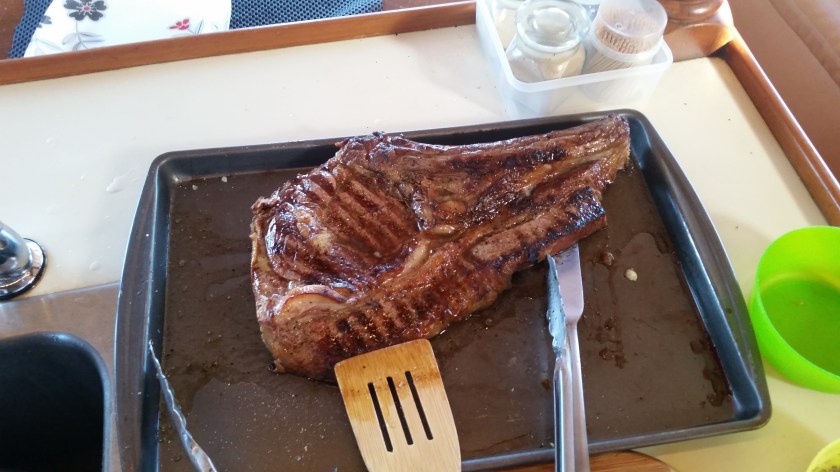
More of the same. Micah would get up by late morning. We would decide what to eat at our main meal in mid-afternoon. For the most part we ate normally, which is to say, the freezer is stocked with various meats, pork predominantly, though we had two enormous rib eye steaks that we had found irresistible while in the Las Palmas market. I made the first one (enough for about 4 people) the first week out, but saved the second for Christmas.
The boat motions coupled with a very wet stern deck made for interesting grilling on the Weber Q280, but certainly still better than grilling in minus 20°F or at 40° in a 30-mph wind on our rooftop in the Upper Eastside of New York.
We would also use this time to watch some Korean Drama. K-Dramas are the perfect way to pass a few hours each day. Too tired to do something creative like write; sometimes too mentally tried to even read, so K-Dramas came to the rescue. Captivating enough to keep one occupied during the most monotonous rolling conditions. Thank God for Korean Dramas.
When the rolling was not so bad, we used that opportunity to play a board game. I made little non-slip pads for the pieces, but even with that, conditions only allowed our games on about a third of the days.
Much of the rest of our daylight hours was spent just checking things that were easy to check during the day. Walking around the boat, feeling the tension of the stays and lines for the paravanes, as they were under the most strain.
By the way, having waited four extra days for the winds to be favorable when we left the Canaries, as we pulled out of the harbor with 12 knot winds and seas 2-3 feet, I said to Micah, maybe we won’t need the paravane stabilizers the entire trip. An hour later, I put out the windward {port) bird. A few hours later, both birds were deployed and were needed for the next 20 days until we pulled into the harbor of Martinique.
Bob Dylan was right, never trust the weatherman.
We left the Canaries with full fuel tanks, but only one water tank (150 gallons, 600 liters) full. This was purposeful, as I wanted to use the water maker to fill the empty water tank. Our Katadyn 160 water maker makes 8 to 9 gallons of water an hour, so it takes about 19 hours to fill one tank.
Micah and I use about 40 gallons per day. The Katadyn 160 is rated to make 160 gallons per day or 6.67 gallons per hour, but I have axillary water pump, pumping water through two sediment filters, before it gets to the water maker. Therefore, I have found that on this trip, it produced between 9 and 10 gallons per hour, so we ended up running it about 50% of the time. Thus, it was convenient to turn it on when I did my engine room survey at 04:00, then turn it off in the early evening. I had pickled (put a preservative in it) in June 2015, 18 months earlier. This was necessitated by the amount of organic material in the rivers and estuaries o the North Sea and Baltic, made water making difficult, if not impossible. Thus, it was with some relief upon leaving Gibraltar that once I got it running again, it ran for the next month with nary a hiccup.
14:00 Local Canaries Time, which just happens to be UTC (Universal Coordinated Time, the time of solar noon at 0° Longitude)
14:00 was the time we left the Canaries, so I used it as our “official” 24-hour point. At 14:00 each day, in addition to the above log entries, I’d note:
quantity of water,
Quantity of fuel,
Fuel feeding from and returning to which fuel tank,
fuel filters in use,
distance travelled in the last 24 hours,
24-hour average speed,
current position,
current weather, sea state,
average pitch and roll for the period
the new heading and distance to destination.
18:00 to 21:00
Evening would have Micah taking a nap below. I usually took a little nap in the pilot house in the early afternoon after Micah was up and running. So, I would use this time to walk around again before it got really dark. Feel the lines, sniff the engine room and just get ready, mentally and physically for the overnight.
While his watch started at 22:00, he would usually come up the pilot house between 20:00 and 21:00. If early enough and I was not too tired, we would watch an hour K-drama. I developed the watch schedule because Micah was flexible with his sleeping, though he did sleep a lot. I slept less, but I knew I need 6 hours of good sleep. That ended being more like 5 hours, but it worked. Though I did find myself dozing off a few times after the sun rose.
More to come: The Good, the Bad & of course, the Ugly
We do a little 400 mile trip today to Bonaire, as we say goodbye to the Grenadines and head west.
See you in three days. You can follow at: Share.Delorme.com/Dauntless
I know it’s been quiet here the last three weeks, but I have been busy.
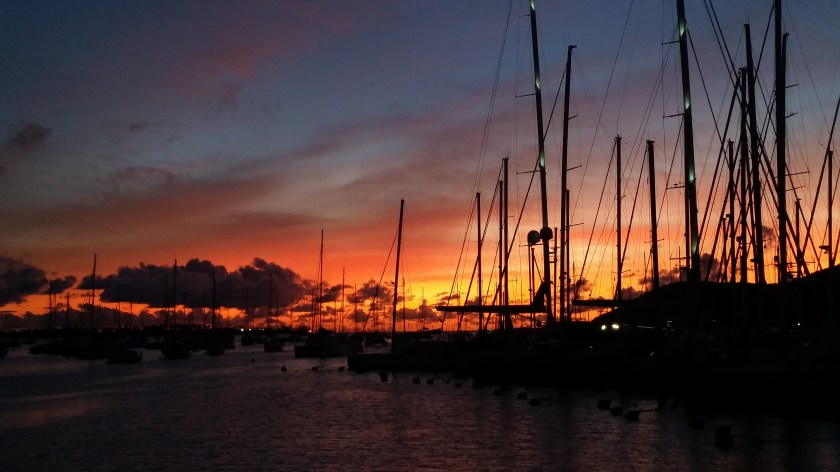
Sunset at Le Marin
I am in the process of writing a comprehensive account of our month on the Atlantic from Morocco to the Caribbean. Having very limited access to the internet, reduces my ability to upload posts and pictures.
But I have been busy. Today, Micah and I finally got everything put away as I have been re-organizing my tools, electrical stuff and miscellaneous stuff that is stored I the pilot house. It’s a lot of stuff.
It’s taken me literally two weeks to get it done. Why was it so hard?
I was spurred to action because after arriving we had some projects to do and a few things to fix or improve and during that first week, I found myself spending an inordinate amount of time trying to find various tools.
Having spent too many minutes trying to find a simple 13mm wrench, during the re-organization, I found the other 10 wrenches and 4 sockets. Yes, all 13mm. Why so many? Because I had it in my mind that I needed one, so every time I got close to a hardware store…
Sooner or later I shall have to find someone who is good at organizing. If not I may up be being the Cat Lady of the High Seas!
The picture is from last night and is yet another beautiful sunset at Le Marin on the wonderful island of Martinique.
Tomorrow we will be leaving, but just an hour south to St. Anne. We will spend a couple nights there before heading to the Grenadines later on in the week.
Every few days I post pictures in Instagram at DauntlessatSea
Some people cruise to escape the responsibilities they face on land.
Richard on Dauntless after Crossing the Atlantic Ocean
Most people cruise to enjoy nature and experience new sights, people, foods and cultures.
I cruise to solve problems.
In the past week, I have had a number of discussions with friends and fellow cruisers. Many ask, Richard, you are in a place, the eastern Caribbean, that most boaters would love to be. Why not stay longer; stop and smell the roses?
I ponder a bit, questioning in my mind why, what is so obvious to most, eludes me. Am I deficient? I know I am not stupid, but why do I push myself so?
Truth be told, I could go from island to island, bbq on the boat most days, eat out others, drink a few glasses of wine, maintain Dauntless, myself and the love of my life in the manner I’ve been accustomed to, even travel to Asia, Europe and the USA every year and never run of money.
I tell them I have a plan. Plans can be changed they respond. Yes, I think, I change plans all the time. But I always have a plan. When I do things without a plan, bad things happen.
No, nothing gets done without a plan. And yes, even crossing the Atlantic was being planned before we even found our little Krogen 42. It was being planned before I even knew Kadey Krogen’s existed. It’s what I thought about before drifting off to sleep on most nights.
So, the idea of having no plan, just going with the flow, is simply a life I cannot imagine. It would be easier for me to imagine living on Jupiter, the planet, not the city.
So, when I’m asked why not just do this the easy way? I have no problem answering, because it’s not in the plan.
There is one big caveat. I love sharing the joys of life, food, drink, laughs, experiences, with friends and loved ones. Not having a mate, a partner to share these experiences with this past year has put a damper on the cruising. If I had a mate who absolutely wanted to be in such in such place for a long time; I’d make it happen. Then I would modify the plan, but until than…
Now one of my really smart friends, knowing my answer, suggested why not do a boat trade. Surely there is someone in Alaska who would trade places with you. Let them live on your boat and you live on theirs’s in Alaska since that is your intended destination for this coming summer and next winter.
Now that has me stumped momentarily. But then, like a light bulb turning on, I understood the issue.
If my goal was just Alaska, then staying in the Caribbean for another year would be doable. Even trading boats or leaving Dauntless here for a year would be doable.
But from the beginning of the boat idea. From before the first Atlantic crossing, there was a plan, a goal and destination and everything that came before was a step towards that destination: S. Korea & Japan.
So, I cross oceans to get to the other side. I also do it because it is the ultimate problem solving puzzle. No phone, no help, it’s having a good plan and then adjusting the plan as need be.
It’s having to make do with what you have a not what you want.
It’s having to solve problems.
Throughout my life, in every endeavor I was involved with, I strived to make the system better ev, oftentimes to the detriment of my life or career. In hindsight, I should have done some things more delicately, but I don’t have any regrets. You fight the good fight or you may as well be the cow in the field eating grass.
So even as careers change and jobs end, I am still a problem solver. Cruising gives me the opportunity to solve problems. The best part is that they are problems of my own making.
I make mistakes and curse myself once in a while. I take a 1 hour job and make into a day or two, but at least I am cleaning up my own mess.
When that next destination comes into view, I pat myself on the back and say, Well done pig, well done.













 Dauntless at Sea