It’s hard to believe that I have 5+ years and 20,000+ miles under my belt. I don’t.
Why, you wonder?
Oh, the routine things, those daily tasks or almost daily takes, are easy. It was in Germany when I lost my bow thruster. That was at the beginning of our 2015 Baltic Adventure. Seems like ages ago.
So, I’m pretty good at back and filling now. I can turn Dauntless around in a 180° in two boat lengths or 85 feet. It also gives me the excuse to Just Say No. When a marina, like recently at Dana Point, gave me a slip that I thought that I may be able to get in, but never get out again, I was able to easily say no, without guilt.
They found an end “T” dock for me.
I can also change the Racor fuel filters and prime them in less than two minutes. But now, I have the wisdom that I don’t need to rush. That’s the advantage of having the two dual Racor filters in parallel. Also, by only feeding from one fuel tank at a time, it a problem or issue develops, I immediately change the tank feed and filter and then diagnose the problem. This came in handy a couple of weeks ago when I sensed a change in engine pitch. I immediately asked Larry to take the helm, while I went to the engine room. Sitting on the stringer in front of the engine, I could tell the rpms were not steady, but slowly rising and falling.
That meant a fuel or air problem.
The Racor bowl looked good, but I immediately changed to the other Racor. No change. I switched fuel tanks. The surging continued and got a bit worse. But now I thought I understood the issue. I talk Larry to increase the throttle. After a moment’s hesitation, the engine started running smoothly and normally again.
What was the problem? I’d run the fuel tank empty!
But I didn’t kill the engine because I acted immediately by changing both the filter (that at that point, probably had some air in it) and the tank. The Ford Lehman can be a PIA if you run it totally out of fuel, but I do have an auxiliary electric pump which I use just to prime the Racors and the engine mounted filters if need be. It works great, within seconds, system is pressurized and no more f…ing with that lift pump on a hot engine.
But the dingy, why that’s another matter. In 2016 we only used it a few times. Sitting in Cabo San Lucas with nothing to do, waiting for the head winds to die down, I figured I may as well make one last attempt to get the dingy going.
I spent an hour in the hot Cabo sun pumping it full of air. I’d already used another tube of 5200 to seal the back transom to the pontoons. The dingy looked pretty good. No need for a new stink’in dingy. I had looked at the local Costco the day before but saw no sign of any. (My observational powers leave a lot to be desired).
My inflatable, inflated. Looked pretty good.
Then in yet another moment of inexperience, I decided to lower the dingy to the dock, without checking the outboard.
I was feeling pretty good until the next morning. That sad picture tells the tale.
I decided that we could survive without the dingy. And in hindsight, we would’ve, could’ve, should’ve done without one.
Returning to Costco to stock up on required supplies like Danishes for yet another attempt to head north, I spotted the dingy that had eluded me the last TWO visits. They had it displayed standing vertically, on it’s tail. Of course, I couldn’t see it like that. They may as well have hung it from the ceiling. But remember, that this point, I had decided to go without. How was I going to get it to the boat in any case, so, I just bought my Danishes
Walking out of the store, I noticed these guys, presumably taxi drivers, and with my 20-word Spanish vocabulary, I never found out, but they did point me back to the store and I understood that Costco delivered.
When businesses make it easy to spend money, I’m all in. In 10 minutes, I had my dingy bought and they would deliver the next day.
The Next Day
Another hour of foot pumping, my new dingy was good to go. Now, to get the outboard working. Of course, after The First and Nearly the Last almost a year of non-use, it was a no-go.
The New Dingy
I realized I had to clean the ports in the carburetor again. No biggie, except in my inexperience, I had not done this while the outboard was on the boat or even on the dock. It was now sitting on the transom of the new dingy. I debated trying to take the carb apart while hanging off the end of the boat., but realized it was a sure way to lose a critical part. My back would have to pay the price for my brain not thinking about this before.
Another hour later, I finally was good to go and thought it would be good to take the dingy down to the fuel dock and fill up the gas can.
All went as planned and I was left with a confidence that I did not deserve.
The video of the first and nearly the last dingy trip
If you are worried about everything, you will drive yourself and crew crazy. You need to be able to separate the likely from the remote. Be vigilant, but you can’t watch everything. An hour from home, you can afford in indulge your paranoia, in the middle of the Atlantic, indulgences are not allowed. it’s “Calm & Assertive” as Caesar Milan would say.
When I would hear a noise in the middle of the night. Perhaps I was being sleeping? Did the noise wake me or was it a dream? I stay in bed in listen. Sometimes I may even open my cabin door to listen and more importantly sniff the wind! Your sense of smell may well be your most reliable tool on a boat.
Admittedly, the first year on Dauntless I was not his way. Unless she was firmly tied to a dock, I was up at every little noise or movement. I hated anchoring out because I got so little sleep. What changed? Mostly me understanding that the boat was fine, the anchor was fine, and the only problem was me.
A couple days out of New England, on the way to the Azores, on my first Atlantic Passage, a mast cleat that secured the port paravane pole let go with a sound like a pistol shot. I stopped the boat, put on a PFD (probably the last time I used it too) and went to the fly bridge to see what happened.
The quarter inch steel bolts had sheared off. I realized that it was too much tension for a cleat, but a simple clove hitch around the mast a few times would secure the two paravane pole lines with much less stress at any particular point, then ending on the cleat. I made that change in minutes and three years later, it’s still the same.
Later, Julie told me that having a problem like that and me being able to come up with a different and even better solution, gave her all the confidence to not worry about anything. And she didn’t. She had been on the boat less than I, but was more experienced. She understood right away what it took to be successful.
It took me a couple of years.
During my second Atlantic Passage, westbound from Europe, North Africa to North America, I had noticed fuel in the bilge on the first day out of the Canaries. I kept it to myself. It didn’t seem like much, probably less than a gallon, of the 700 we had onboard. To get to the Caribbean we would probably need 600 of those gallons. If push came to shove and I needed to conserve, I could probably get there on 500, even 450. In fact, at idle and in gear, 900 rpms, fuel consumption is probably 0.5gal/hr. at 3.8 knots, making the range above 5,000 nm. With these conditions, with a 20-knot wind behind us, our range would be above 6,000 nm. (at idle and in neutral, with no load on the engine, the fuel consumption is probably 0.1 gal/hr.)
Since I could see no leak on any of the connections or hoses between the fuel tanks and the engine, including the 4 fuel filters, there was not much I could do until it became obvious. It was clearly coming from the tank, but not the bottom of the tank.
I continued to run the numbers in my head, often, during those days and nights.
But I continued to say nothing. Certainly, Micah could do nothing and he worries, a lot. My job as Captain is to do the worrying and to keep my crew fat and happy.
By Day 4, Calm & Assertive was slipping away. I was getting nervous.
The big problem was that the bilge pump was pumping water out that had gotten into the bilge from the lazzerette. With large following seas, the stern deck is awash plenty of time, enough that water gets into the lazzerette. It is then dutifully pumped out. When I would look into the bilge, fuel being lighter than water, it floats on top. So, when I look in the bilge and see a gallon of liquid, which the bilge pump will pump out, it’s unclear if I’m looking at a gallon of fuel or a quarter of a cup, the rest being water. Under these conditions, the bilge pump was turning on about once an hour. So, in 24 hours, that’s about 24 gallons. If it’s mostly water no problem, but if mostly fuel I needed to know.
It was possible that I was looking at the same inch of fuel floating on top of water. So, when the pump would pump out, it was just pumping water leaving the last inch of liquid every time. I had to know what was going on.
initially on Day 4, I did the following:
I used the shop vac to vacuum out the bilge. Now if I saw fuel again, I knew it was new fuel. I turned off the bilge pump and left it off for 6 hours.
I reduced our engine rpms to 1450. Now this change would only reduce our consumption by about 0.1 gallons/hour, but we had 16 days at 24 hr./day = 384 hours. So, to save a tenth of a gallon, that’s 40 gallons over that time. I had estimated worst case scenario if it was all fuel with a little water, we were losing about 12 gallons a day, that would be 200 gallons lost. That would be a problem. Better to reduce speed now and figure it out just in case.
Six hours later, I checked the bilge hoping to see only water.
I saw water and fuel!
Wherever the fuel was coming from, it was still coming. But of the approximately 5 gallons I pulled out, there was at most an inch of fuel on top of the water. That’s less than half a gallon.
From the first time I noticed the fuel, it never seemed that much to me. From dipping the oil soak cloth (very effective in absorbing fuel and oil, but not water) to collecting the 6 gallons, all signs were a minor fuel loss, which was even decreasing. But,
The mind is its own place and can make a heaven of hell or a hell of heaven. (thanks Milton & Star Trek).
But this is why I say, worry is very destructive. Even with those facts, by the next day, that worry drove me off the deep end. By constantly checking for fuel, all it did was make me lose any objective sense of reason. I cracked.
So, I came up with another radical plan.
We needed a way to recover significant amounts of fuel:
I cut the hose (pictured) that leads from the bilge pump to the thru hull and stuck another hose onto it. This hose I now led out of the engine room, out the salon door to a large bucket on the stern deck.
The Bilge Pump hose with newly made connection. Yes, I will replace that non-stainless steel clamp
We would collect everything the bilge pump pumped out of the bilge for the next 12 hours.
We would then take the fuel that standing on top of the water, and pour it into another bucket. Then filter it and pour it back into the fuel tank, as needed. Thus, even if losing 20 gallons of fuel a day, we would probably recover 75% of that. To lose 5 gallons a day was tolerable.
Now the boat is rolling all the time as we have 10 to 16 foot waves off both stern quarters, so it was no easy task to pour one bucket into a larger bucket.
We, really Micah, did just that for 6 hours.
When I relieved Micah, he thought it was mostly water. I checked the “fuel” bucket, the one into which we were pouring the obvious fuel from the bigger bucket. After 6 hours, we had about a quarter of a gallon if that.
I looked at that, I looked at Micah and I came to my senses.
I quickly put an end to this process. It was a 5-minute job to re-connect the now two sections of bilge hose and we were back to normal.
On Day 6, all fuel stopped getting into the bilge
Did I scare it away?
The only explanation is also the most obvious explanation. Last year, in Ireland, when we opened up the port tank to seal it, it was obvious that water had dripped down from the screw holes in which the poorly installed fuel vent fitting had been placed. Now since this is one of the few design, construction issues I have ever found on the Kadey Krogen, it’s hard to complain.
I figured that what had happened is that since the tanks was totally full, the pitching movement in particular meant fuel was being pushed hard against the upper back of the tank. Just where the fuel vent is poorly installed. A few drops every dozen second will easily add up to a couple of gallons a day.
Lesson Learned: If I had to do it all over. I should have been more patient. I could have slowed a bit before doing anything else and waited a few more days. I let myself get too nervous even after I had come up with multiple estimates that the amount of fuel we were losing was not significant.
After arrival in Martinique, Dauntless still had 125 gallons of fuel. I determined that we had lost probably 5 to 1o gallons at most. I was meticulous in feeding from each tank every other day, thus the tanks should have been the same, but instead there was a 5 to 10-gallon difference.
Well, it would probably take a book I’m too lazy to write.
But as I sit here in the sweltering heat of Mexico, air conditioning or lack thereof has become my number one concern.
Having spent two years in Northern Europe, AC was the least of my concerns. So last year when cruising south, once I hit Portugal, the heat hit us at the same time. Like leaving a room that was a pleasant 68° (20°C) and entering a furnace that was in the 90°s (>32°).
Dauntless has two air conditioning (AC) systems. One for the back of the boat, like the salon and second cabin, the other, for the forward sections, the forward cabin and pilot house. Of course, neither one was working.
Somewhere in the Caribbean, finally realizing that this heat and humidity was unrelenting, I tackled the issue and in a remarkable time, got both units working. Relief at last. But this isn’t about that.
So, for the last couple months, I have luxuriated in the coolness of modern living. Now, air conditioning only works if I am at a marina and plugged into shore power or if I run the boat’s generator.
Then last week, my cool times came to an abrupt end. My aft AC stopped cooling and then started blowing hot air. That won’t work.The top of the AC strainer. The problem hose connection in the right.
The main engine strainer
Boat AC’s working using water pumped through the condenser to make cool air. (Home AC’s use air to cool the condenser).
So, when there is a problem, the first thing to check is water flow. And in fact, there was not any water flow or maybe just a dribble when it should be coming out like a water hose.
Easy fix I thought. It started well. I checked the sea strainer, which is exactly that, it strains sea water so that the water pump only gets water and not sea weed, sticks, fish and whatever got sucked into the thru hull opening. The strainer was full of crap and water was just dribbling out, when it should have been gushing out.
Oh, that was easy. But on a boat, the systems in place that makes everything run as they must, can become complicated.
I cleaned out the strainer. Put it back together and that started the last seven days of trial and error.
I hadn’t cleaned or opened the strainer in probably 4 years. It had a lot of corrosion around it. I brushed and cleaned it up as well as I could. Put it back together again, turned on the AC pump and all was well.
For about 10 minutes.
As of yesterday, the 6th day, I got the time up to two hours. It would run OK for two hours and then quit. I would need to let it rest about an hour and then do the process all over again.
Somewhere between the thru-hull and the AC water pump, air was being sucked into the system. The water pump is sucking so hard and it’s always easier to suck air than water. So even the smallest crack will allow air to be sucked in. That air then collects at the highest point in the system, at the aft AC unit, at which point the air blocks the water and the AC stops cooling.
That has been my last 7 days.
Every day I tried something new. I even made new gaskets from rubber sheets, I’ve did all sorts of things to try to fix the strainer. Sure, there has been some improvement, but it wasn’t fixed.
But I didn’t have a spare strainer. What to do?
One of my lessons learned from crossing oceans is there is always a solution.
When you are in the middle of the Atlantic, there’s no Boat US, no AAA, no nothing, only you and the odds and ends you happen to have.
I realized I did not have a spare sea strainer, but I did have two other sea strainers!
I could simply bypass the AC strainer and put a hose between one of the other strainers to the AC water pump. Then if there is still a problem, it would mean it’s the pump itself.
I’d decided to use the Generator strainer. The gen is not being used and won’t be until next summer. Also, should I mess that system up, it’s not a critical component, like the main engine.
The AC sea strainer uses 1” hose. Turns out the gen sea strainer uses ¾” hose. The gen doesn’t use much cooling water, but the AC’s use a lot.
The main engine sea strainer was 1” hose, so I decided to use that. That has enabled me to sit here a couple of hours later and write this piece in the cool comfort of the Kadey Krogen salon.
Which raises another even more important issue. The first rule of Ocean Crossing, Do No Harm. Don’t fix one problem by making another.
Only because Dauntless will spend the winter here in Huatulco, Mexico, would I consider messing with the main engine’s sea strainer.
There is always a lot of blather about single engine boats crossing oceans. Large commercial boats do it all the time, but then they are not affected by marketing.
If one looks at engine failures on single engine boats versus multi engine boats, the preponderance is a failure of one of the two engines on a multi engine boat. Why is that? On the face of it, the numbers should be exactly the same. Why aren’t they?
They are not the same because both consciously and unconsciously people take care of stuff better when they only have one versus two. Of anything.
How many times have you lost a key after having gotten extra keys made? How many times have you lost your only key?
If I was getting underway in the foreseeable future. I would never have touched the main engine’s sea strainer. Even though Dauntless is going to be here for the next 8 months, if my plan was to come back and get her ready to cross the Pacific, I would never have touched the sea strainer now.
Only because I have the luxury of knowing that: not only will I not be using the engine until next summer, even then we will be slowly moving up the coast. I have a few years and a few thousand miles of coastal cruising before setting across the North Pacific.
A boat is all about systems. A motor boat even more because it takes more complicated systems to run in a dependable manner. So, I am very careful not to mess with systems that don’t need it. Remeber, Do No Harm.
In opening up the AC sea strainer, I messed with that system. I upset something.
Turns out, in getting ready to bypass the AC strainer, I noticed the end of the outlet hose was very hard. Is it possible that when I opened the strainer, I broke the seal between this hose and the strainer nipple? Even though the two clamps were tight. (All connections to thru hulls have two clamps)
I decided before I did anything else, to cut 2″ off the end of that hose and re-attach it. I did and that solved the problem once and for all. Yesterday, the ACs worked for 12 hours with nary a problem.
So even with a solution in hand, keep trying to determine the real problem. Otherwise, it may come back to haunt you in the most inopportune time.
When I had the hydraulic hose failure in the middle of the Atlantic. I caused the problem because I turned the wheel knowing the rudder was already at its stop. Thus I did harm. This forced the fluid to go somewhere and it burst the hose at its weakest point. Luckily for me, that point was easy to find and relatively easy to replace.
But I will never do that again.
Here is the video of me replacing that hose. The seas were about 8 to 15 feet. We were stopped in the water like that for about 30 minutes, because I had to be careful not to make a small problem worse by breaking one of the fittings from the three-way coupling:
Error
This video doesn’t exist
I tried to get Micah who was holding the camera to get the overall picture and show the big waves that would approach Dauntless and then disappear under the boat. But that seemed to unnerve him. He wouldn’t look out. Oh well, it could have been worse.
So, one of my lessons learned in crossing the Atlantic: There is always an alternative, there is always a way, a bypass, a work around, but there is always a way. You just have to think about it.
Southern Costa Rica is like Vietnam, hot, 30° and humid. Maybe more humid. But that thought prompted me to check the latest obs from VVTS, Tansonnhat Int’l. Nope, their morning dew point is 77°, while it was only 72° this morning in Golfito.
My chart of the anchorage. The marks are where where my anchor is and the mooring ball
In any case, after the stress of leaving the marina for the first time in almost 4 months, it’s time to check and double check.
While still in the Caribbean, I had tried to use the generator. It ran for a minute a then shut itself off. So, we had spent a miserable night before arriving at the marina in Colon, Panama.
I’ve planned on anchoring a lot over the next three months, so a working generator was no longer an option but a necessity.
Last week I tackled the problem, having been guided what to look for from a mechanic friend on the East Coast.
In minutes, I found the suspected problem, a bad connection to the exhaust temperature sensor, and set it right. The generator than started and ran for 30 minutes, with load, no problem.
Saying goodbye to Fish Hook Marina
I was leaving in mid-afternoon, as much to save another $40, but also to get my sea sense back. We were only going a few miles to anchor, so after a hot day, in the heat of the afternoon, the generator would be called upon almost immediately.
Not being born yesterday, just before leaving the dock, I started the gen for just a few minutes, just to make sure, maybe 5 minutes.
15:00, finally ready to leave.
But Sergio, who was going to be with me for some days, then told me he had to go home.
OK
Maybe a language issue? Certainly not the first time for me.
Then the guy on the marina is throwing off the dock lines. OK. I’m sort of ready.
But what about the two pangas fishing 20 feet in front of Dauntless? No problem, they were told to get out of the way. Slowly evidently.
Once the lines are off, I need to get underway. My bow wave must have nudged them the last few feet,
Now, out of the slip and safely past the pangas, I look to my chart to check my route in and the depths.
But the chart isn’t on. Why?
Computer’s on, Coastal Explorer is running, but the magic “M” key is not bringing up the C-Map.
This kind of crap happens when rushed by other people’s schedules or perceived schedule.
I had put Dauntless in neutral not wanting to go in water I had no idea what was the depths.
Finally, I see the keyboard was turned off. Easily solved, my chart comes up and confirms that my route into the marina was good and the one to follow out
I poke along at 5 knots in no real hurry. Just happy to have the sea under my feet again.
The spot I was anchoring in is a quarter mile off the beach in front of a friend’s house I meet on the bus to Golfito. It’s a steep slope with a big 15’ tidal range. I can’t get too close, even though I have 35’ below me now.
I drop the anchor, it catches quickly like it always does (a much beloved Delta). It’s hot, very hot and humid. I’m dying. I put out 110 of chain on top of the anchor. Then I realize the mistake I made. With the steep slope, large tidal range and 100+ feet of chain out, when Dauntless swings around (we’re now facing the beach) her behind may end up high and dry. Not the first time, but I’m trying to have a year without a grounding.
I decide to throw the stern anchor in. Oh, no stern anchor. Must have been stowed for the Atlantic passage. Just then I see a mooring ball, just within reach of my short boat hook (they charge more for longer ones!)
I quickly grab the line from the mooring ball and put a short line thru it.
Worked like a charm. Dauntless soon went parallel to the beach, but that was fine.
Now I’m sweaty, almost dead for the heat, stress and whatever else.
I turn on generator to get a much-anticipated relief.
It runs for one minute then clearly can’t handle a load. It putters to a stop.
I feel like crying.
I start it again, it starts, but with no power, like before. What changed? I asked myself. Only I put the cover back on. Could it not be getting enough air?
I take the front cover off, it continues to run poorly, then stumbles, then starts running normally.
I power up all the accessories, A/C’s, Inverter Charger.
For the next few hours, with the passing of every bird and fish, I think the gen is dying, but no, it runs steadily, until I turn it off for bed.
Now, the next test, how hot will the boat become without the A/C. The water temperature is 92°. I’ve never been in such hot water; the engine room never gets below 100° and that’s only with the Inverter and Water heater working there.
Dauntless hardly moved.
Just when I was finishing my shower, a peal of thunder overhead made me think that we’d run hard aground. I flew out of the shower.
It was only Mother Nature having a little chuckle before I went to sleep.
If I’ve learned nothing in the last 60 years, it’s that I need 6 to 7 hours sleep on a routine basis to not get into a sleep deficit. The watches on this passage were set up to facilitate that.
In spite of the drama I like instilling in my life, for every one day of “crisis” we spend about 5 to 6 days of peaceful boredom. It’s even possible that the weekly crisis is not totally random.
Why, you wonder?
Not so much on this trip, but in the past, most of my problems were caused my me. Complacency, boredom, who knows, I decide everything is going so well, so I may aa well see what happens if I do this. This last crisis was a case in point. I was “experimenting”.
My only point here is that in spite of the appearance of the narrative, very little time is spent dealing with anything. The hardest part of a long passage is not getting bored, even more so in these conditions that virtually never changed.
So, December 23rd dawned to bright skies and easterly winds; we were feeling good.
The one lingering issue was the amount of air still in the Hydraulic steering system (which is controlled by the helm wheel or the ComNav autopilot), which caused a hellacious banging every few seconds as the auto-pilot moved fluid thru the lines. This was exacerbated by the location of my cabin directly under the pilot house.
Normally our brains filter out routine noises. I once lived next to a church steeple in a small town in Germany. Every 15 min, some combination of bells would ring: 15’ after the hour 1 gong, 30’ after 2 gongs, 45’ after 3 gongs, then 4 gongs on the hour, followed by the number of gongs based on the hour, 1 = 1, until 12.
Within a few days, I didn’t even hear it any more. But I did find it nice to be able to know the time in the middle of the night, without turning on a light. I do love Germany.
Even years later, when I would visit and sleep in the same house, after the first gong, I’d “hear” no more.
This wasn’t like that. Since the noises had no pattern, with a variable duration and frequency, my brain did not do what to make of it, so it made sure I heard everything. As the days wore on, while the noises were decreasing, they were still significant and I found myself getting less and less sleep. Three hours overnight, then an hour here, maybe a couple there.
Did that contribute to our travails on the last night? Probably a bit, maybe more, but Micah and I had the worst night of the entire trip on our last night before pulling into Martinique.
The days since our big repair had been good. In fact, Christmas, December 25th, was one of our best weather days, with winds not going over 25 knots, thus our ride was great with light rolling to 10°, worst 15°. I made our last big steak and candied sweet potatoes. We even opened a bottle of Bordeaux that my French friend PJ had given me.
Micah meticulously pours our wine
That was also our second whale sighting. There were two whales, about 30’ long cruised with us for about 15 minutes. Very nice.
The Whale Video
Error
This video doesn’t exist
Dauntless rolling along, watching this makes me miss the ocean
Error
This video doesn’t exist
I do love our Weber Q-280 grill
Our ETA to Martinique was noon on the 28th. Therefore, the night of the 27th, was our 20th night at sea since leaving the Canaries.
I started the last 24 hours by putting the last of our oil, 1.1L into the engine. I estimated that at worst, we would arrive about 1 liter low, which is normal. (and we did). But there was no point in shutting down the engine to check at this point, as I had no more oil anyway.
Just as I go to bed at 22:00, ETA in 14 hours, the starboard paravane pole bounces vertical. This necessitates stopping the boat and letting the pole fall back into position, once the rearward pressure is taken off the line to the bir
The starboard pole has never done this before in the previous 15K+ miles!
25 minutes later, it does it again. Something is not right, but I am tired and even in hindsight, it’s not totally clear to me under the circumstances what I should have done.
All evening the winds had been increasing. They were now easterly at 25 steady gusting to 40. Clearly the seas had grown, again with the annoying swells from both NE and SE and the wind driven waves from the east. Our rolls were getting substantially more, routinely to 20° and the worst, a few times an hour to 30°.
Even on a rally boat like Dauntless, a 30° roll is significant. Or I should say, it feels significant in the pilot house. If I am in the engine room, I hardly notice, even the salon is much better, but I digress.
I attributed the increased rolling to the winds and seas. It was dark out, so it’s hard to estimate seas. Also, since we were approaching the island of Martinique, the waves would start to change.
But at 02:40, all of a sudden, the boat rolled over at 15° (normal) to port, but was really slow in rolling back. This meant the opposite stabilizing bird was not working for some reason.
Sure enough, I had gotten up to see why the boat motion was different and saw right away the starboard bird being pulling along the surface.
We stopped to retrieve it. It was broken and later that morning as I looked at it, I realized the bolts that held the vane in place had come loose. That was probably the reason the pole went vertical earlier in the evening, as the bird was no longer running straight. That added a tension that eventually broke the plywood wing of the bird in half.
Now, in a strange occurrence, maybe due to lack of sleep, after we pulled the bird, we continued on with just the one port side bird deployed. I’ve run many times with only one bird. It is quite effective on a beam sea with winds that are not too strong.
But with a following sea, only one bird, is only half effective, so we rolled our way into Martinique that way.
I say strange because all that morning, I had been tripping over the extra bird that was no longer in the lazerrett. We had gotten the bird that was jammed in the lazerrett out and even cleaned up the lazerrett. So, it was sitting, inconveniently, on the port side deck. It would have taken all of 30 seconds to attach it to the starboard pole and throw it in the water.
Oh well, All’s Well that End’s Well.
And of course, as we approach the harbor of Le Marin, the only sailboat we’ve seen in 19 days decided to tack right in front of us. Much like the last idiot on our first night out of the Canaries.
Warning. Harsh language is involvedand I don’t hate all sailboats. But for the life of my with an entire ocean in front of him, why he cut across our bow is beyond me. I had been watching him for quite a while, had he delayed his tack 10 seconds or changed his course by a few degrees he would not have ended up directly in front of our bow. I had to virtually stop as to not hit him… umm, maybe that is the answer, could he have needed a new paint job?
Error
This video doesn’t exist
And my feeling were certainly exacerbated by the fact that this was only the second SV we had seen and the previous encounter, our first night out, was eerily similar.
A long day is ending, but crossing an ocean, there is no rest for the weary. This video shows the view from the fly bridge looking aft as we were topping up the hydraulic fluid after my first temporary repair.
Error
This video doesn’t exist
Of course, I had been looking at the manual for the helm and Auto-Pilot. They being connected, the Auto-Pilot has an Octopus pump which takes its direction from the ComNav AP computer. This pump then controls the rudder piston. Now that the broken hose was replaced, we had too much air in the system.
And believe it or not, the manual for the system says to just keep topping up the fluid at the upper helm station and in a few weeks, all the air would be worked out of the system.
Maybe a few weeks if we were on Jupiter, but in a few weeks of Earth time.
A Beautiful Sunset
So, two hours after getting the big repair done and getting underway again. I had cleaned up, showered and even took a nap because I was hit by a bad bout of seasickness or what until this time I had attributed to be seasick.
But now, we found the Auto-Pilot was hardly working. It would hold a heading for a few minutes, but at a certain rudder angle, it would try to move the rudder, the air in the system was not allowing it to work properly. At which point, it would decide to do a Walk-About.
Yes, I can speak Australian. I saw Crocodile Dundee.
The problem with a Walk-About in 10 to 20 foot seas is the KK designed to go with the seas. So, lying dead in the water, we bob like a cork. But underway, we do not fight the waves we go with them and underway, while turning beam to the seas, the first few rolls will be dillies, until the paravanes are totally effective again.
So, every few minutes, our heading would drift off and before you can say, here we go again, we would have a 20-degree roll. And the subsequent roll would almost always be greater unless immediate action is taken.
This at 20:00 the prospect of having to hand steer was a nonstarter, therefore, drastic action was needed.
So, I found myself once again in the hot, 100-degree engine room, on my belly, with feet dangling over the shaft that is still spinning since the boat is being pushed along my wind and current. I had decided to “bleed” the system. The Octopus pump does have three valves for each line (port, starboard and return) that can be closed to stop fluid draining from the system if need be. In this case, I opened each one in turn until it literally comes out, and I let ATF run out until I saw no more air, while Micha turned the wheel in the specified direction.
15 minutes later we were back underway. The Auto-Pilot was much more responsive, but still only at 50%. Worse, there was enough air in the copper lines, that they resonated like somebody playing the cymbals 6 inches from my head.
We decided to keep track of the number of walk-abouts. From 22:00 that night, it occurred 7 times an hour. By 02:00 it was down to 3 times and only once at 03:00.
Though when I came on at 04:00, it was still not working as well as I’d like. This ComNav does really well in bad seas. But now, with its impaired performance, we were getting into some large pendulum rolling motions. Motions that when working correctly, it has no problem stopping.
Micah was already in bed, it was dark out, but it drives me crazy when something is not working as it should (under the conditions). I decided it needed burping. So, I went to the fly bridge and totally took out the fill plug, thinking it needed more venting.
It didn’t hurt and I didn’t fall overboard.
For the next 6 days, we periodically worked the helm steering, trying to get air out of the system. Slowly, but surely, air came out and we would top up the system.
The bigger issue for me in particular was that the racket the air in the pipes would produce every few seconds. It really hindered my sleep and made out last 6 days really hard. Especially considering there were really no other issues until the last day and night, which of course, ended up being the worst night of the entire passage.
Just After the 1st Repair. It’s 13:33 this is the normal screen I run with. I’ll minimize the Maretron data (black box on left) is there is more traffic or is I have a reason to look at the chart. In this case, what’s important: winds 090 at 23 g 28; Apparent Wind Angle (How is the boat feeling the wind) is right on our stern at 180 degrees. Bottom right shows the roll and one can see the roll reduction while the boat was stopped at the same time the pitch increased. Then the roll greatly increased once we got underway again.
Error
This video doesn’t exist
This video shows the day before, Dec 21st. Even before the preventer stick broke (which you can see going form the fly beige rail to the middle of the paravane pole)
Error
This video doesn’t exist
This is from the afternoon. GIves you a nice idea of the seas. This is what we had plus or minus for 21 days.
So, as December 22nd dawned, (end of Day 13 and beginning of Day 14), the little problems that had popped up were solved quickly.
Though during the night, my last second and last preventer stick broke. It wasn’t critical, I had not used it since it was made three years ago, but still, this morning I wanted to find a real solution.
The winds had been very strong since daybreak, in the low 20’s, gusting to 35 knots.
I decided to stop the boat, just put her in idle and adjust the paravanes somehow. It nice to know that the boat will bob more than roll when stopped. While not underway, Dauntless rolls at about half the rate of our underway roll. So, we’d been rolling 10 to 20 degrees, pretty consistently, now we settle in the trough of the waves, but bob as much as roll.
Now, months later, my brain refuses to remember why I actually stopped the boat. It must have gotten superseded by the traumatic events that followed.
Autopilot disengaged, Idle, then neutral, the boat will coast to a “stop” in about three minutes. Winds and current are still pushing the boat, in this case about 1.5 knots.
Then before I did whatever I had intended to do, I decided to turn the rudder to see if it made any difference in the boat motion. Not a stupid plan; yet.
The rudder was already hard over to port. And then in an act of gross stupidity, I turned the wheel more to port. Why? Why? Why?
I knew the rudder was at or close to the stops. The steering system had had some air in the system for a long time. No matter what I did, I could not get it all out. So, I thought a little more turn couldn’t hurt.
Oh, my God, it could hurt. After turning the wheel about a quarter, I felt it go slack in my hand.
I knew exactly what happened and turned to Micah to say, “We’re fucked now”.
I knew because I’ve had this sickening sense before: pushing on brake pedal that goes all the way to the floor or turning a steering wheel and nothing happens. When a hydraulic system goes slack: clutch, brakes, steering. It means the hydraulic system has no more pressure, A hose, fitting or part has given way.
He knew from my tone that I was serious, very serious. I was so angry at myself. Had Micah done something like this, it’s an accident. For me, I knew better than anyone the consequences of over-pressurizing a system.
The Kadey Krogen has does have an emergency tiller that connects through a purposeful hole in the hatch. But I hate even manually steering the boat in a sea. To stand, sit in the stern deck and hand steer for 7 days like were some god-forsaken sailboat, fuhgeddaboudit.
But I also immediately realized I couldn’t afford the Pity Party. I also could let Micah start thinking of the consequences. Now was the time for solutions and solutions only.
When the Going Gets Tough; the Tough Get Going.
We had 200+ feet of hydraulic lines and the failure could be any place. gain, trying to control the sickening feeling in my stomach, If I’ve learned anything on this boat, it’s to always look for the easiest solution first.
So, we’d start at the rudder piston in the lazzerrette. Open the hatch, and at this point, a wonderful sight (on a boat everything is relative), hydraulic fluid oozing from a hole in the hose just above the fitting. This hose, one of two, for the rudder piston.
First thought, let’s try easy, easy solution, rubber tape, with hose clamps around it.
Error
This video doesn’t exist
This video is after i had completed this repair and also shows how I stopped the paravane pole from bouncing by using a fender.
It worked. We got our filing funnel for the upper helm station, from which the entire system is filled with AFT, Automatic Transmission Fluid, which conveniently, both the hydraulic steering and the Borg-Warner manual transmission use for lubrication and pressure.
The system took about 2 liters of fluid. But I only had a total of 4 liters. I’m starting to think of chickens coming home to roost.
We get underway just under an hour later at 10:28. Everything is working reasonably well. You can see from the Maretron data how the boat roll is about half, while the pitch increases when dead in the water.
Coastal Explorer, our main navigation program, running on a dedicated solid state 12-volt boat computer had been acting up. For a few days, it had not been displaying AIS information, no matter what little tricks I had used in the past to “wake it up”.
Now, I knew I was still sending, which is actually far more important, as since I have had transmit capability large ships always stay away. Having seen only one ship in 13 days, the display wasn’t critical, but I wanted it working. I like everything working.
So, as a last resort, I decided to reboot everything. Everything off and on again, in order, about a 4-minute process. The log shows at 12:15 all was well.
We had been checking our repaired hose every hour, as well as topping up the fluid as needed. In the last two hours, we had put another liter into the system. The hose was leaking enough, probably a few liters every 12 to 24 hours.
Now this would have been no problem in coastal cruising. We would have just topped it off until port. I didn’t have that option. So about 7 hours after the first fix, I knew I had to find the real fix.
Two Issues I had to solve: Hose & Fluid.
For the hose, I knew I had a number of spare hydraulic hoses in two different places in the engine room. One set stored with all the extra hoses and tubing, the other set stored in the long-term spares containers on either side of the generator.
The fluid was a bigger challenge. I used the Delorme InReach to text my contact Roger, who got in touch with Ski in NC. Ski, a long-time diesel expert, had been really helpful in the past, so I needed to figure out what I could use as substitute ATF.
The answer turned out to be simple and vexing, 4 parts diesel fuel to 1 part engine oil. Yes, the engine oil of which there was not extra. The engine needed every bit of oil. Dauntless was now full of chickens. They had all come home to roost.
The offending hose, steel braid rusted to the core. I’m replacing these hoses and standardizing the fittings.
OK, first I had to clear out all those chickens. They were all over the place. Before we did anything, I found the spare hose with the correct fitting in seconds. So far so good. I then stopped the boat again and also the engine, as I wanted to check the oil level to make sure of my calculations (on a passage like this, I just fill the engine at its usual use rate, without turning it off).
Oil level was just were I expected, so I decided I could spare one liter of oil. Worse case, we would arrive in Martinique one liter low, but that’s not a big deal for a day.
I got my tools and wrenches. Getting the old fitting off the three-way control valve ended up taking me 15 minutes. I even heated it up with my kitchen torch, but I was very careful not to make my hose problem into something far bigger and unfixable.
Finally, it came out. I put pike gunk on all the new fittings, makes for a better seal and I don’t want any more leaks.
In the video Micah took, you see one time water came across the deck. That’s water that enters thru the scuppers, usually on rolls of more than 15 to 20 degrees. As I said, dead in the water, we bob more than roll, so I was only inundated with water twice in this operation which took about 40 minutes. I wanted Micah to get more pictures of the outside scene not just the top of my head, but he was nervous and I think he felt better not looking out much.
Error
This video doesn’t exist
Me on the other hand, I may not look it, but I was pretty ecstatic. I’d fucked up and was able to fix it. We now had 5 liters of substitute ATF which would be more than enough.
The finished product
Error
This video doesn’t exist
At 18:00 we were underway again. Immediately, it was apparent that I had way too much air in the system. The Auto-Pilot was acting errantly. It would work for a few minutes, but once the rudder got far enough over, there was not enough pressure to get it back. We would have to turn off the autopilot, then turn the wheel lock to lock three times until pressure built up in the system, check and top up the fluid at the upper helm station and reengaged the autopilot. This went on for a couple hours until I realized I needed to go to sleep to get ready for my 04:00 watch and the boat almost needed hand steering at this point.
That would not do. I did not do all this to have to hand steer for 7 days.
My Friend Alfa Mike asked the following, so I thought I would share with everyone:
Richard on Dauntless in Martinique, La Marin
>Do they speak a lot of English Language in Martinique or is it all French?
The Moon & Venus watch over us on our last nightsUntil the very end, a story seaA little mishap while changing the oil just after arrivalMountain on MartiniqueDriving thru the forestMore RainforestEven made it to the Kadey Krogen pageLa Marin Marina
some English, once in a while, you need to know some basic French.
> What have you seen & experienced there?
This past weekend, we drove up north to see rain forest and volcano. Inactive of course, so not much to see.
> What have you done in the boat while there.? Repairs, upgrades?
at this point, there is still much to do. Not helped that yesterday I spent all day to do a 1 hour job. I hate working with wood, like the interior.
Working on electric in fwd bilge, adding small bilge pump.
Rewiring holding tank switch so that it can’t get turned on accidentally.
Micah patched dingy.
Rerigged paravane pole.
One pole needs to be replaced. Probably do that in Mexico or So Cal.
Also, rigged a preventer so windward pole will not go vertical when boat rolls heavily to lee side.
Finally finished 3rd 20# bottle of propane yesterday. Those 3 bottles were filled in Tallinn in July 2015. That’s 7000 miles ago. Luckily have two extra bottles that a sailboat boat gave me in northern France last summer as he was not going back to USA. I have not been able to get propane since Estonia last year, but am told I can in St Lucia. But I can wait till So Cal possibly.
Must still replace 2 hydraulic hoses and bleed system for AP and helm steering.
Complete oil change, i.e. fill engine with oil.
We’ll fuel again in St. Lucia, only to half full about 250 gal
Repair bracket for wx instruments on mast, the following winds (when we were stopped for Hydraulic line) managed to wrap paravane line around it and mangled it, because I was so happy to get one problems solved, I created another one.
Winds also broke stern flag pole. Same happened to Sweden sailboat docked next to us.
All 5 fuel filters are changed (2 Racors, 2 engine mounted and fuel polish)
Replacing all screws in rub rail is proving to be a real PIA. As they are rusted and not coming out. These are Inox screws I bought in Ireland and again in Portugal. Big f…ing mistake.
General clean up, still finding flying fish on fly bridge (where else would they be 🙂
Spent $200 on stainless steel screws.
Another $200 on oil and ATF for rudder steering
$200 on rental car for 3 days
Yes, everything is in increments of $200.
Finally took Icom VHF radio to shop, as my friend Pat in Waterford told me to do last year. It’s unfixable it seems. So, will take VHF radio from fly bridge and install in pilot house.
Is it Humid? Hot, a bit muggy, yesterday was first day without wind, so then the boat really heats up.Did I tell you I don’t like hot weather? Thus the 12 years in Alaska and two years with Dauntless in Northern Europe and now returning to first Southeast Alaska and then Japan & S. Korea.
>Now after all is said and done, In hindsight what would I have done differently?
In terms of places to go or not, it’s hard to say. Only having spent time in southern Spain and Morocco can I say that I would not have missed it. But had I not gone, how would I know that? It would have better financially and sailing wise to go direct from the bottom of Portugal to Las Palmas on Grand Canaria.
Should have spent some hard-earned money 3 years ago, to be able to use 230v, 50hz shore power to run ACs. I did try to get them to run off inverter, but the inverter produces a square sine wave and both the Splendid washer/dryer and the AC’s will not run on that.
I could have tried the transformer I use not for the water heater. It would supply 120v, but 50hz to AC. That swill probably work. But at this point, I’m not sure it’s worth the effort. Back in Southern Spain and Portugal when I was dying of the heat, I should have thought of that.
Yes, I could always run generator, by the 1 gal/hour at $5/gal fuel. Now, 8 hours is only $40 per day, but adding that to expensive marina at $55/day, that’s close to my desired cap of $100 per day.
Speaking of money. My average daily cost for all living and boat expenses is about $109 per day. Though I still have yet to update the last month, I do not think it will change significantly. This is also a few dollars below the previous year. So, all in all, the expenses are about what I expect. The proportion is also the same, 25% for each:
Fuel & oils
Marinas & docks
Food, groceries & eating out
, like cell phone, transportation, cars, trains, planes and automobiles.
> How do you like it in Martinique?
Love it. People, food could not be better. I am so lucky that I was told to head here when it became clear that I could m=not make the southing I needed to get to Barbados. It was only a 20° more southerly course, but with the large seas we had, it was not worth being beaten up.
In hindsight, Martinique is a much nicer place to clear in, eat and drink than probably anyplace in the Caribbean. Martinique is a Department (like a State) of France. Thus, it feels like France because it is France. It’s not the bureaucratic mess that Portugal, southern Spain and Morocco are.
FYI in terms of how they treat boaters:
Northern Spain, Galicia is just like northern Europe and France, as are the Cana.ries.
Southern Spain and Portugal were totally different, and not in a positive way.
I was told that it’s because of the Arab penchant for bureaucracy.
> How long do you plan to stay?
until sometime next week. Then heading south, a bit before heading west to the ABC’s
> Any comments you would like to make about the trip you just completed now that your more rested up?
Very glad I don’t have to do it again for another 18 months
OK, I’m not so young anymore; well at least not physically.
The Atlantic Analysis for 26 September 2016
Yesterday, I decided to tackle the laundry basket of papers, books, magazines and miscellaneous stuff that should have been thrown away last year. OK, actually two laundry baskets, plus a few smaller bins.
My bicycle was also part of the melee, the last time I rode it was in Sweden, last September. I really liked Sweden. If I get back to Northern Europe, it will certainly be because Sweden has much of the best cruising grounds in Northern Europe.
Poland intrigues me also, but not for the cruising, but for the people and food. Both wonderfully warm and tasty.
But, now my vision is looking west. And there will be a westward component for a long time to come. So while Sweden is only 2,000 miles away, I’ll probably put 20 times those miles before I get back there.
One of my current homepages is the Atlantic Analysis from NOAA’s Ocean Prediction Center. I don’t spend a lot of time with it, but I do like to check it out every time I am connected to the WWW.
The current map shows the large high pressure area that pretty much lives over the eastern Atlantic. That observation at 29N, 16W is the Canaries. There will be a similar pattern when we finally leave in late November and I should be able to follow that 1020mb isobar for much of the way all the way to Barbados. The Kadey Krogen was born for following seas. She must like her behind being pushed along.
Well the bicycle is attached to the wall as it was two years ago on the east bound passage. Many of the papers have been sorted and put or thrown away.
I’m doing this now because I’ll be Missing in Action (MIA) for the month of October. I’ll be in the USA and Italy, so Dauntless needs to be ready in early November. Leaving the boat for a month in southern Spain is not inexpensive. At this point it looks like my best option is to pull her out of the water and let her be on the hard for 30 days. I had previously not considered this option, but a little mishap in docking a couple weeks ago, made this option very attractive.
Yes, I have a 5-foot scar down the side of the new painted hull. F…ing annoying.
Dauntless is Wounded
I hardly spoke to myself for days!
Just writing about it is annoying so, that’s all for now folks.
I have written a lot; but getting it posted is another issue. Issues related to no internet access or most recently just related to my lack of focus.
I try to write all the time, at least every couple of days. But as I re-read my last half dozen writings, I am all over the place. I’ve written about driving in Europe in in the 70’s and 80’s, some of the most wonderful cars in my life, women, countries, Italy, Portugal, and even Dauntless.
But the problem with these writings is that simply that, they are all over the place, so for the reader, it’s a bit disconcerting. One moment he’s in Portugal and all of a sudden in Italy driving through the Alps, 30 years ago!
I wondered why have written so little and so unfocused?
Yesterday, having had a fantastic day with the family of Diogo, my new found Portuguese friend, we got back to the boat and in the ultimate downer after a wonderful day, it was hot and buggy.
Diogo and Anna at the Lobo Do Mar
Maybe for you in the Caribbean or Florida it would seem pretty good. But for me and D, who have spent the last two years in the north, basking in the sun and breeze that have made Northern Europe the vacation capital of the world, it was HOT.
How hot you wonder?
Good picture this: 30 years ago, my Trevisiana and I went to the beach in Holland in mid-August. I was now stationed in an airbase in the Netherlands and she had come for a short visit. In August, what does everyone do? We went to the beach. In Holland.
Yum Yum The Most Curious Cat I Have Ever Known
Picture this, as we parked the car, we thought it was a bit cool. Luckily, we brought sweaters for that cool night time breeze. As we walked from the car to the beach, we noticed it seemed even cooler than anticipated.
Upon gazing at the beach along the North Sea for the first time, we realized we weren’t in Kansas anymore.
Everyone was wearing overcoats! The temperature was 50F at best. Maybe colder. No wonder the Dutch took vacations in July, when the temperature is up in the 60’s. Clearly winter was over.
So now fast forward 30 years. Remember those stories of Richard and Dauntless being so happy because he had heat on the first of September as he crossed the North Sea?
Gigi before he became a real big pussy cat
Remember how the heat percolated up to the pilot house and actually defrosted (demisted) the windows of the pilot house??
So now, only a year later, early September and I’m f…ing melting. It’s 90F at 9:00 and 105F at 14:00. Yes, these are real official temperatures, not the made up crap on TV.
So I’m dying. This is the August in NYC that I have avoided for years. The heat that makes one want to jump into the river and never come out. Now, the industrial foam that goes by four times a day slaked the desire somewhat, but if it was blue water, I’d be all in.
Now, I know you are wondering, why doesn’t he just turn-on the air conditioning? Oh, it would be so simple. Maybe in my old days, you know three years ago, it would be that simple. But now? Having spent the last three summers in the North Atlantic, the North Sea and the Baltic, nothing was simple. Hot weather was this animal that you thought you had tamed. Instead you woke up day to find it eating you.
So all of a sudden, you were dying. You, everyone around you, the world. Dying in a way Al Gore never envisioned.
So being a man of action, I had been thinking day and night of solutions. Dauntless has two air conditioning units. How can we best utilize them? Yes, we do think of the environment despite of Al Gore.
Well, the first step is to get them to work! Yes, read the above; do you think in my jaunts in the North Sea I was running the air conditioning all the time? Or even once?? A Year???
The two A/c units, Fore and Aft, on Dauntless need 120 volt 60 hertz power. Period.
That power is obtained in two ways, from the shore in a country based on 120 v and 60 hertz, like the USA, or from the generator on Dauntless, aka Genny, a square shape, but with hips to get the job done, therefore a beauty in every definition of the word.
So Genny powers the circuits to get the air conditioning units to come on. But in the last few days, since I have entered this inferno, no matter how much Genny implores, both A/C units have ignored her.
The forward A/C did not even wake up, just sleeping though it all, despite my pushing her buttons with the most delicate of touches.
Now, the Aft A/C unit, taking a different tack, was all talk and no action. She blew, blew & blew, but when it came down to it, it was all hot air. I would have died in her mistral if it was up to her.
After having talked to my electrical guru in Florida, David Arnold, a true Kadey Krogen guru, who luckily for us is a well-kept secret only known to a select few, (you did not get his name from me); I set out this morning to at least solve the forward A/C issue, how did she want to be touched that would produce the action I so desperately needed??
Now, the Policy of Truth (actually not, if you listen carefully) demands that I at least tell you the middle man here who was the true maestro. The water pump, who depending on 120 v power was the key to everything. Oh, sure, without him, you can get action for a bit, but within minutes you will realize you are taking a shower with a raincoat on. In other words, No Joy; something ain’t working.
Rewind a few months, as we applied a new International undercoat (anti-foul) to Dauntless’ bottom, I noticed a thru-hull (a water intake) that had been painted over. Umm, I wonder what that was? I dutifully scrapped the old paint off and made sure it was clear. I wonder why I had not noticed?
Now a few months later, Genny, having woken up the forward and aft A/C units, was getting no satisfaction in getting the water pump to do his thing. Was he pouting having been ignored for two years? Did he just get tired of pumping his life for a bunch of women and a clueless owner??
I certainly suspected the latter. So this morning, I awoke with a plan and the first plan was to get mister water pump to put up or shut up.
But first, having this day well planned, after 60 years, I knew a thing or two and the first thing is that everyone needs a little foreplay, some more than others, even the Marina Captain, but that’s another story.
So first I checked the forward A/C and discovered that like on all boats, one thing leads to another. I discovered the containers of spares and tools that were carefully stowed under the helm, had moved enough to disturb the RJ45 connector to the forward A/C unit. This only controlled the control panel, but electrons are so picky these days, it was enough. I spent the next hour making new connections that would not come off in the next storm.
Now it was time to put Genny to work. Poor Genny, neglected in body and soul for months, no years, now she has to put out in seconds or else. Or else what, I won’t change her oil for another year or two??
So Genny never complaining (we’ll just forget about the indiscretion in Maine. But you know those Maine men, one touch, and all is right with the world. Yes, George was masterful, but you would be too if you worked at the Bath Boat Works).
Genny powered up and making hay while the sun shines, I turned on all the breakers for the 120v circuits and the two A/C units.
Like before Aft A/C was blowing air, but it seemed like hot air to me, as in not really putting her heart into it; Are you done yet? As in just the Fan working.
But the Forward A/C was on, awake and actually cool. I felt the water pump, it felt like it was actually working. I ran outside, yes, water was coming out for the first time in years!! What a glorious emission!
I got my IR temperature gun, Aft A/C 75F, Forward A/C 55F. Now that’s more like it.
For the first time in more than two years, at least one A/C was working. I was on a roll. Let’s figure out what’s going on with the Aft A/C.
I felt her all over. Oh she ooh’d and ahd’d, but nothing changed. Her coils were as cold as fish, as was the compressor. Maybe I was too abrupt in the past (sure, maybe in the middle of the night, I turned her on without realizing her buddy the water pump was not along for the ride? I never said she was not kinky! She is older after all and we all want something a little different. She had knobs to turn after all; not push buttons like the little princess, the newer, younger forward A/C.) maybe I boiled off her Freon?
So now I figured I needed to get even more kinky. Both Yes, that meant both at the same time; then one, then the other, in every combination possible and a few that have been outlawed in 28 countries and 8 states.
But mister water pump did not want to play with the Aft A/C. If she wasn’t playing, neither was he.
Umm, I ‘d dealt with this before. I have had cats you know. (maybe one day, I shall have to tell you the story of Yum Yum and Gigi, aka Blackie, aka Stockings, but I digress).
These A/C units had two relays that powered the three units: Forward A/C, Aft A/C and Water Pump. Whenever either A/C unit was turned on, the water pump would come on.
But now it wasn’t.
Easiest step, but also one not without peril, for anyone who knows digital electricity meters, they also know that all those digits don’t mean a thing. So I also had my trusty analog meter along for the ride. Why, you wonder? Because the digital meter will tell you no voltage exists if it doesn’t like the looks of it. The Analog meter has no such rules; she just tells you what is and in this case, it’s enough voltage to kill.
If I die because of the digital meter, who can I sue? OK I digress.
So now, I always check with both meters initially, so I don’t waste HOURS trying to figure out why what is supposed to be there is not when it actually is. Yes, do this at home.
In short order I figured out that of the two relays that power the whole system, one was not working. Therefore, the water pump was only coming on when the compressor of the forward A/C unit engaged.
Once I figured that out, I then tried powering the aft A/C unit and sure enough, it was more than happy to cool off my hot body.
I put a jumper to the Aft A/C directly to the terminal block that runs to the circuit breaker in the salon, thus bypassing the relay. The only issue is that if I want the Aft A/C now, I must also turn on the forward A/C to turn on the water pump.
Problems solved. Now I can focus and write and that’s just the way it is.
We’re Good to Go; but if you don’t like that book, check out “Triad” by the David Crosby and Jefferson Airplane.
It’s been an eventful few days. Now into Day 5 of our 8 day Cruising Association’s 2015 Baltic Rally, having all those sail boats around keeps you on your toes. The winds had been howling since Wednesday. Therefore it was decided to remain in Kröslin until Saturday morning.
Dauntless in Ueckermünde with the fish boat restaurant to the left, not leaving me a lot of room for the U turn
But I needed to be in Ueckermünde, the next stop and our last in Germany, Saturday morning, as Ivan my dutiful crew member was returning to Italy that day and Eve and Nigel were scheduled to come that afternoon.
Therefore I decided to leave Friday morning in spite of the winds.
And they were howling, 25 knots, gusting to 38. But at least, my position at the end of the “T” combined with the winds pushing me off the dock, made for a relatively easy launch.
Between Kröslin and Ueckermünde, there are two bridges with set opening times, a few times a day.
We got to the first bridge early, we had 45 minutes to wait. After a few anxious moments, we got a line onto a large steel piling and made a bridle from the bow cleats. Worked well and Dauntless kept her bow to the wind at about a 30° angle. Easy Peasy.
We got to the next bridge, in spite of traveling as slow as I could, we still had an hour to wait. There was a shallow anchoring area for boats waiting for the bridge. Only 7 feet of water, (D takes 4.7 ft), but it was on the windward side, so that meant if the anchor did drag, we would at least be push to deeper water closer to the channel. And the day’s winds meant there was virtually no one on the water except for us and two sailboats, one German and one Danish.
Dauntless flying the Kadey Krogen flag in Ueckermünde, Germany
Anchor out; I also have an anchor buoy, which is attached to the anchor with a very thin, but strong Amsteel line. Too strong.
An hour later, we weigh the anchor and get underway down the very narrow channels (much like the ICW in Georgia) towards Ueckermünde.
Arriving in the quaint town, my directions told me to proceed until the bridge, at which point one cannot go further and tie up along the wall close to the bridge. Sounds easy; I was calmer than usual knowing Graham and Fay of the Cruising Association would be on the dock to help tie up.
As I come into the narrow part of the channel, towards the anticipated docking spot, I turn on the power to the bow thruster. I try to minimize bow thruster use, but I will use it and would hate not to use it and hit another boat as a consequence of me being stubborn.
The 25 knot wind is now right on my stern. I know D turns well to the left and backs to the right, so I can usually do a 180° turn to the left within a 50’ circle. With not winds that is.
I pull to the right as much as I can. But leaving room for the stern to kick out to the right and still miss the restaurant boat.
All went well, until about half way through, so now I was perpendicular to the canal, the fish restaurant boat was just a couple feet from the swim platform, the dock wall just feet in front of us and the bridge, that effectively made this a dead end for us, about 50 feet away with the wind blowing us towards it.
Then the light on the bow thruster went off, which told me, it had blown the fuse.
I was actually unfazed about it, I try to minimize my bow thruster use in any case, just for reasons like this, and though the wind was now pushing me closer and closer to the bridge, it was still a boat length away.
Backing and filling like I have practiced many times, the Kadey Krogen with its large rudder swung her stern around quite smartly and we were parallel to the dock 30 seconds later.
Ivan on his last full day on Dauntless got us tied up and I thank the lucky stars for another good end to a stressful day with 25 to 38 knot winds, a narrow dock space and having to wait two hours for two bridges in winds in strong, gusty winds.
Now as for the 300 amp slow blow fuse, this had happened once before a few months after we got Dauntless. Then I did not have a spare fuse and since it powered the Inverter also, I had to resort to extreme measures. Don’t do this at home.
This time I had a spare, so I promptly found it and replaced the blown fuse. I simply assumed it had blown because I had used the bow thruster for too long or continuously.
I had also changed the engine oil while in Kröslin. With Ivan’s help it went easily, too easily.
Ivan left on the train early Saturday morning, it was sad to see him go. A great kid, and a real big help.
Eve and Nigel were there to replace him and I looked forward to leaving Germany on Sunday and entering Poland for the first time in my life and Dauntless’ too for that matter!
With a bit of a hangover from the night’s before bbq. A comment about German bbq’s. They are just that, meat on the grill. By speaking to the cook in German, I even got extra meat. Maybe too much meat. Since there was virtually no salad or other fillers, I ate a lot of meat and washed it down with a lot of white wine.
Meat, wine and great company, one cannot ask for a better life.
So, the next morning Sunday, a bit hungover, but all seemed right with the world.
The fuse was replaced, the oil had been changed, and D was really for new places. But one nagging problem. Leaving Kröslin, having to stay in a number of narrow channels for hours on end, the ComNav autopilot did not seem up to its usual precision. It was over correcting too much and also more noise than usual, usually an indication of air in the hydraulic lines.
So, we had a late morning departure planned for Ueckermünde and the two power boats would bring up the rear of our little gaggle of sail boats and the two ugly ducklings following behind.
The plan was to travel at about 5 knots which was the fastest speed for the slowest sailboat.
I knew it was going to be a slow day, very slow, in any case. While Dauntless is not fast, nor even quick, she does like to travel around 6 to 7 knots. Any slower and she starts to get ornery, below 5 knots, she gets downright rambunctious.
So I figured once I started the engine, I would be in no hurry to leave and would check the hydraulic fluid of the wheel and autopilot. So we did, but discovered no great amount of air in the steering system, in fact virtually none. That made me worry, if there was not air in the system, then why was the AP acting strangely. The day before, even though I had it set on the highest sensitivity to keep us in the very narrow channel, it was not responding fully like normal. As the heading drifted off, it was not correcting quickly. On numerous occasions we had to quickly shut it off and hand steer to get back into the 5 mile long, straight as an arrow channel. But then we would try it again and it would sort of work. And then do the same thing.
So when we get underway from Ueckermünde, while I hoped I had fixed it, I also knew I had not done anything significant and this was more like a wish and a prayer.
Well we catch up to the fleet and now, the one power boat, Tudora, a beautiful maintained older cabin cruiser, came by to tell me I had a line in the water.
Now, I had remembered that a day earlier I had seen the small, thin line that is connected to the anchor buoy had fallen in the water. I had forgotten to get it out and now, I was a bit embarrassed that another boat had to remind me.
As I pulled on the line, it was stuck; on what I didn’t know, but clearly it would not come up.
I pulled harder. No change and it did not budge an inch.
I had a brainstorm. I fastened the anchor buoy to it and let it go. I figured if it was stuck on the prop, it would trail behind the boat. Now, I was sure I had purposely not had enough line for it to reach the prop, but then …
After a few seconds the buoy bobbed the surface; at amidships.
In a flash, it all came together.
The line had been in the water when I made my U turn. I had used the bow thruster for a longer period of time, maybe 20 seconds versus just a few seconds normally.
The line had been sucked into the bow thruster, wrapped itself around the shaft, stopping the shaft from rotating and lo and behold, the fuse blew.
Sure enough, as I pulled on the line, it was clear it was emanating from the front of the boat.
Knowing that, I was not overly concerned, I don’t use it very often and now, my practice backing and filling would reward me, so in spite of my fellow travelers concerns, we’d be fine without it, until haul out at least.
What had made the day so difficult was that the autopilot was acting like never before. In the past I had had problems, significant ones at that, with the compass connected to the autopilot.
I knew how to deal with that. This wasn’t that. That was the problem.
The last few hours, the autopilot went from bad to worse. It was not even following its own commands. This to me was a more serious problem. The end result was that Eve and Nigel had had to hand steer virtually all day. The times we did try to AP, it would work for a bit, but then as the compass heading changed, first a few degrees, then 10, then 20°, nothing would happen. I would lunge for it and turn it off so we could get the boat back on track and in the channel and the gaggle we were supposed to be following.
Pulling into the dock at Swinoujscie, it was good to be tied up, but it had been a long day that ended with two major problems, the worst being an autopilot that all of a sudden wasn’t.
I went to bed that night with two issues, not the best ingredients for a good night’s sleep.
I am striving to post twice a week. Sometimes it will be more and sometimes less, but at a minimum I like to have a post out by Saturday morning. I didn’t make it this week, because I’ve been sick with the flu or something these past few days, having absolutely no energy to do anything.
It’s even one of the reasons we are still sitting in Arnhem today, Monday.
Dauntless in Arnhem
Nijmegen and Arnhem are special places for me. My ex-wife Leonie is from Nijmegen and her sisters have lived in Arnhem the past 30 years, so it’s like coming home.
So in spite of my feeling not the best, it was great to have people over every evening for dinner, since Wednesday, to see the D, aka Dauntless. Dauntless does appear to have gotten bigger in Europe, either that or all the docks and marinas are smaller.
So after entertaining the Vinks all weekend, I awoke this morning, with a goal to sit in my chair and do nothing. Doing nothing is really hard for me. That Corona ad, where the guy goes to the beach and sits with his beer watching the sunset, looks like torture to me.
So this morning, I figured, maybe I would sit in my chair in the salon and organize the two large bins I have of stuff that keeps growing, yet seems unclassifiable, so I can’t put it where it belongs. Maybe I’ll just store it and let Leonie sort it when she and her husband Martin come out in August.
Dauntless in Nijmegen
Speaking of Martin, Dauntless has three battery chargers. A Heart Inverter/Charger, A Neumar True Charge and another one with a yellow case.
The Neumar is the only one that can take shore power here at 230 volts and charge the batteries. Of course when I spent that week in Horta, we were hooked up to shore power and I tried to get it to work and for the life of me, it seemed dead. Would not even work with the generator, the way it used to. In the Azores, I was also delayed in fixing it in that I could not find that female plug that is ubiquitous in the US for computer power supplies.
I had removed the cover that says, so not remove under pain of death, and even checked the fuses and everything else I could find. Neumar sent me the wiring diagram and offered to send another selector switch. This while helpful, ended up misleading me.
Even after I came back from the US in the fall, I had a cable and plug, I had labeled it all, ground, neutral and load. Blah, blah, blah. NO luck.
But with the solar panels and not really needing much 12 v power form the batteries while at the dock, it got put to the back burner.
So finally yesterday, while I am burning our dinner on the bbq, Martin seemed fascinated with this Charger, so not to look a gift horse in the mouth, I got him the electrical meter and found a plug we could use for the 230 system.
Locking with Willie carrying 1,000 tons of sand
He gets it all wired up again and plugs it in. I said this is how far I got, but once plugged in, I never saw any power past the plug pins. He plugs it in and within a minute it starts working!
Frankly, I was as flabbergasted as I was grateful. One less thing to worry about.
B y the time I finished washing up, I was exhausted, so I got to bed early, feeling not so good, slept on and off until 09:30 and frankly did not feel that much better, thus the decision to do nothing.
So I’m looking at the Victron battery monitor and see a draw of 7 amps. Other than a phone charger plugged into a cigarette lighter outlet, there is nothing else on. I take the flashlight to check the charger, and sure enough, it is not working, but then I knew that, otherwise I would not have seen the negative 7 amps (yesterday when working it was putting 20 amps into the batteries).
The back of Willie
I check the fuel levels to write in the log and then I hear it. A slight whine. But I can’t place it. It’s not the fuel polisher, which is much nosier.
It seems to be coming from the rear section of the engine room, near the charger.
I open the salon deck panel and look down into the bilge and see a foot of water flowing rapidly, almost like a garden hose full open.
My initial panic, within seconds gives way to measured panic. At least the bilge pump is just keeping up with it as in the little time I’ve been watching it, it has not gotten higher. But this also explains why the batteries were down 220 amps this morning. That poor little pump had been keeping us afloat all night.
Of course, this was one of the topics of conversation over the weekend. I explained that while Waterford is a great place to leave the Krogen, once I’m gone for two weeks, I start getting antsy and must return within three weeks. And I gave the example of a thru hull failure that lets a lot of water into the boat that the two pumps can keep up with only so long as there is battery power. So even though I have friends in Waterford who keep an eye on Dauntless, they could go by every day and see nothing out of place, then all of a sudden, the batteries finally go flat and D sinks.
So all of this is going on in my mind in the first minute.
I see all this water rushing around, but where is it coming from? I turn off the generator thru hull, because it’s right there and I figure I ran the generator for the first time since October last evening and this started last evening, so maybe they are related.
No change in flow.
Look under the engine, see nothing, but close the main engine thru hull. No change.
I look all over the engine room, the stuffing box had been my first guess, but just it’s steady drip, drip, drip. I can’t figure out how the water is getting there. So I decide to take the chance and turn off the bilge pump and then I can see where it is coming from.
Turn it off, run over to the hatch look down and it’s the same amount of water, just sitting there sedately. Not getting deeper; now just calm.
I turn on the pump, the whirlpool starts again, turn it off, it stops.
So, I don’t have a leak, this is the water that has come from the stuffing box in the last 12 hours (I do need to tighten it, I like a drip every minute, now it’s up to every second).
I pull the hose up to get the pump out and the hose comes up without the pump. That explains that.
Two hours later, I’m sweating like a pig (it must be the flu, the boat is not even warm), but I put a new piece of hose on the pump with a new clamp. The failure was caused by the old clamp disintegrating.
At 12:30 I am finally able to sit and do nothing.
So I end up spending the next three hours trying to get my wxx3 email with yahoo to work again. It just stopped working last week.
And an hour writing this, it’s 18:30, almost time for bed.’
Another day done just like that.
Oh by the way, remember I said that I initially had the charger problem in Horta last August?
It seems pretty obvious to be now that the reason the charger did not work was that the solar panels put out enough power, the charger would not be able to see the true state of batteries with the solar panels on. Here in Arnhem yesterday, not only are we much further north, but it was also cloudy.
So I will sleep tonight knowing that I spent countless hours on that charger looking for complicated problems when the simple solution was right in front of me. All I had to do was turn off the solar panels.

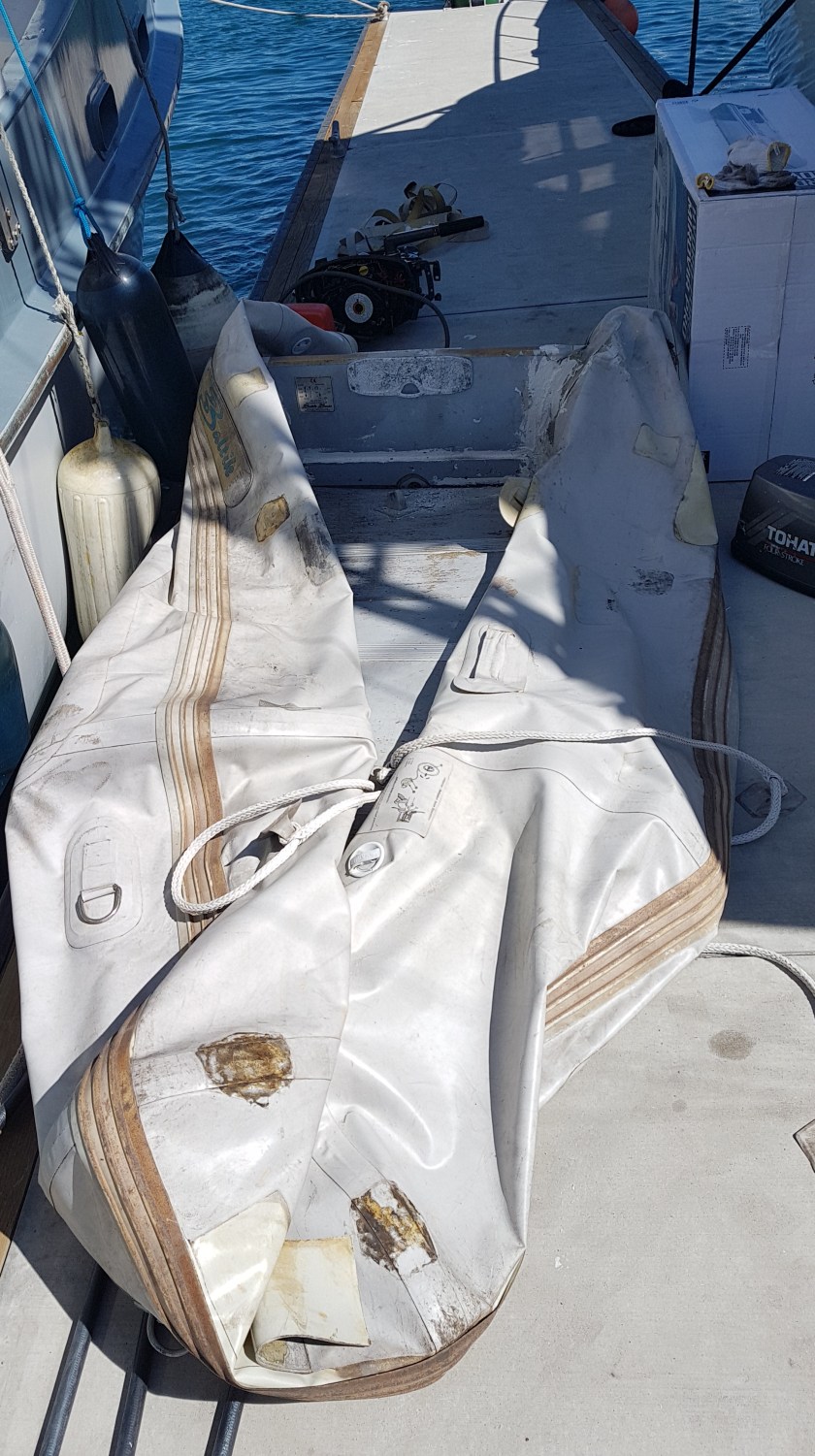


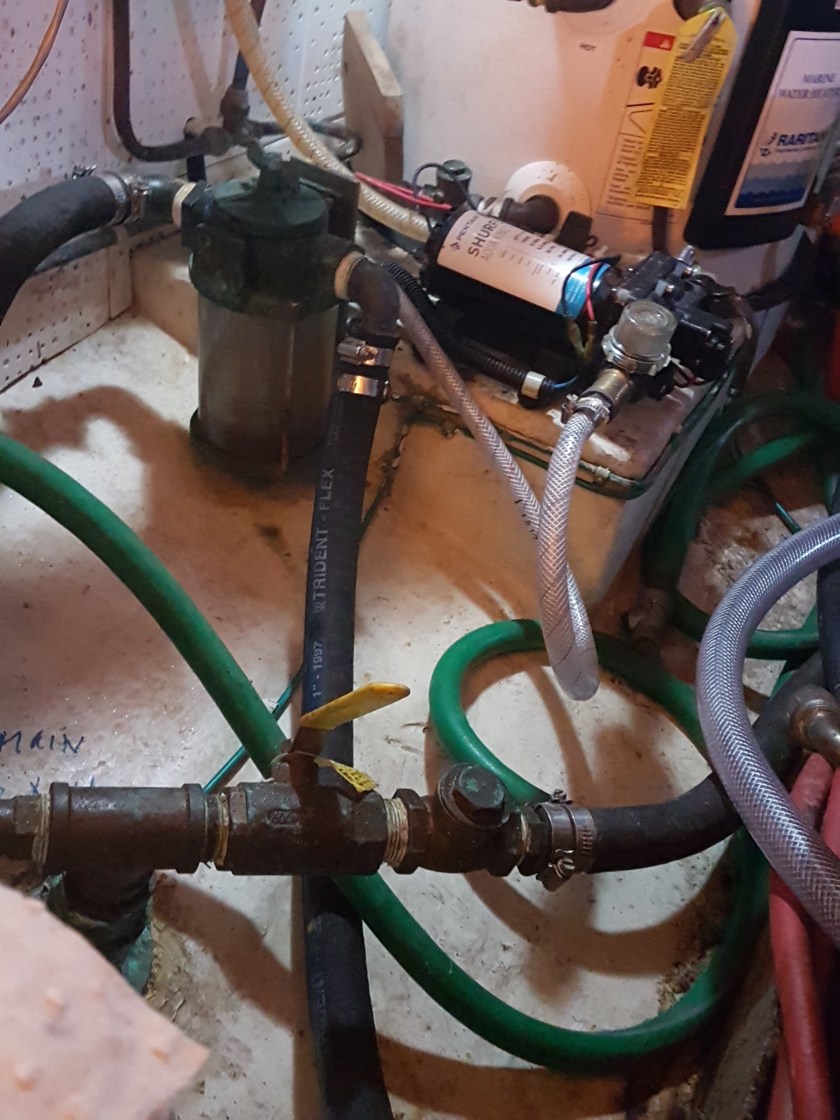


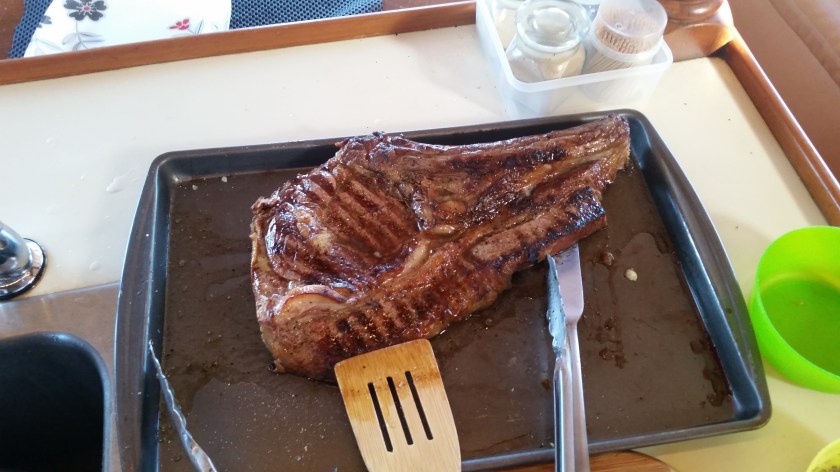


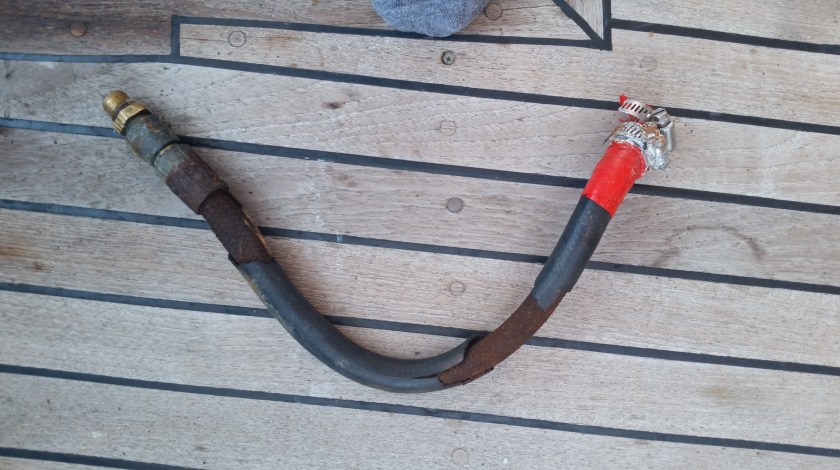
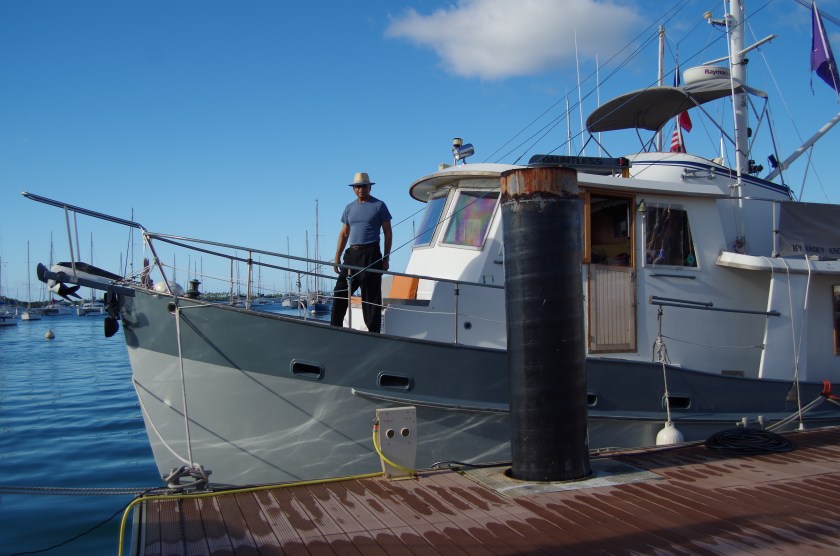




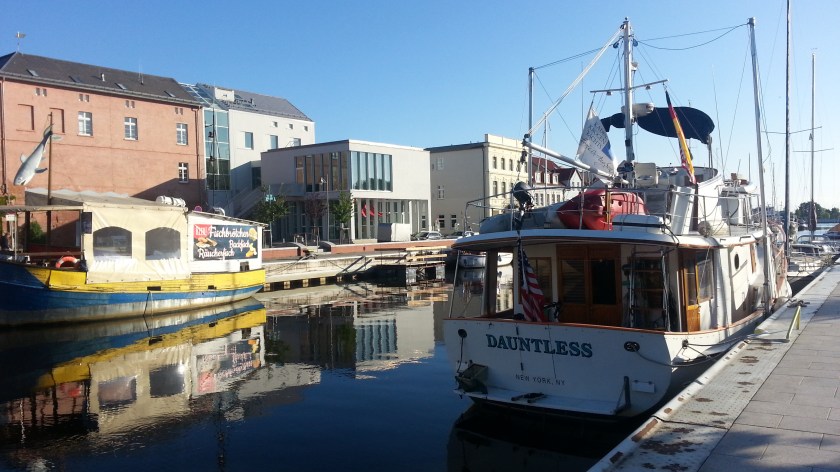

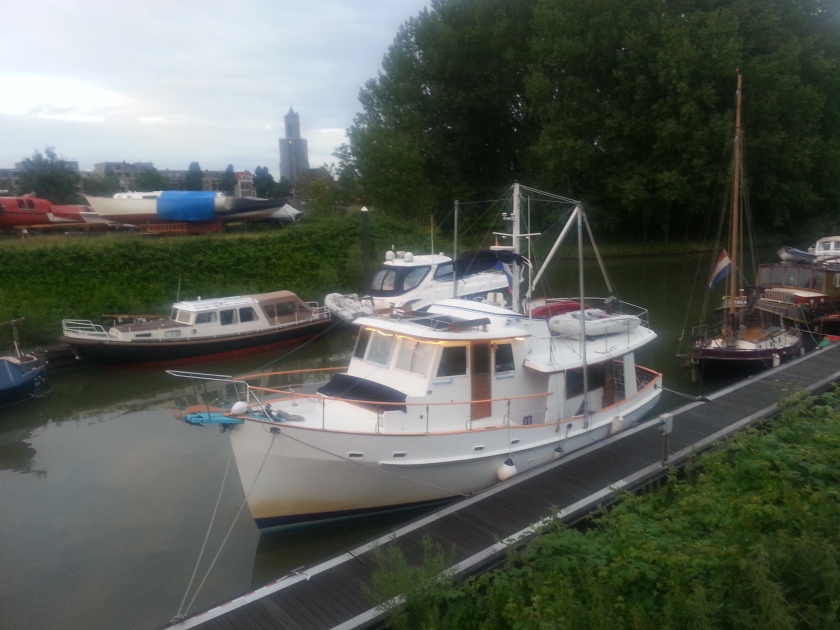
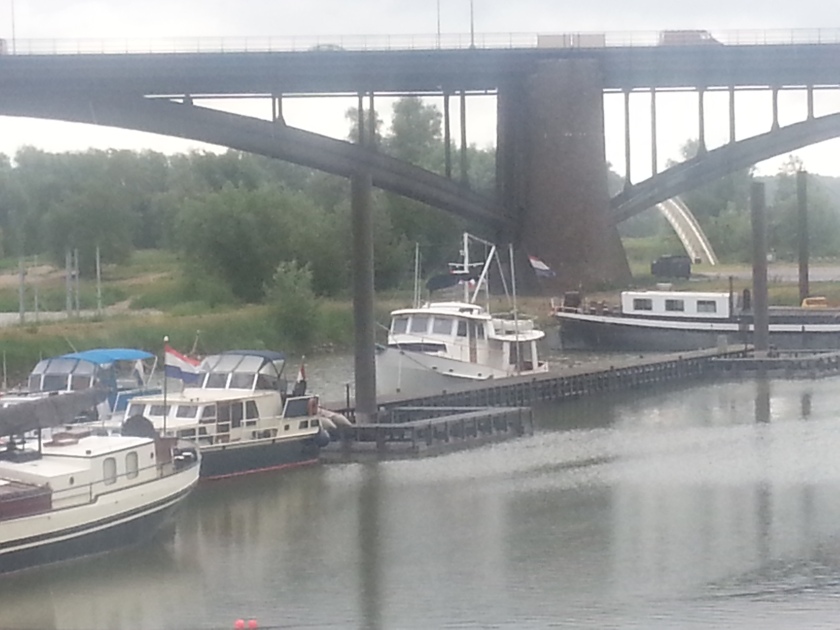
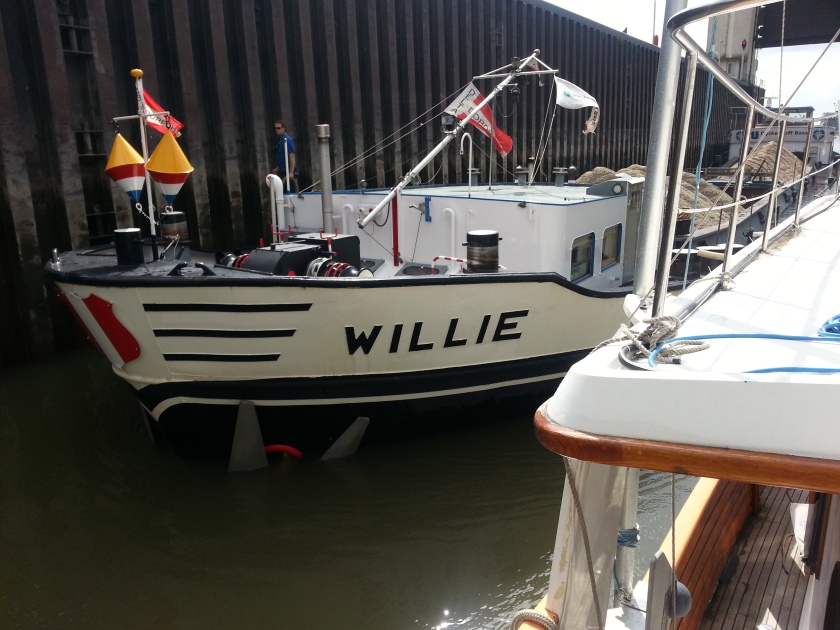
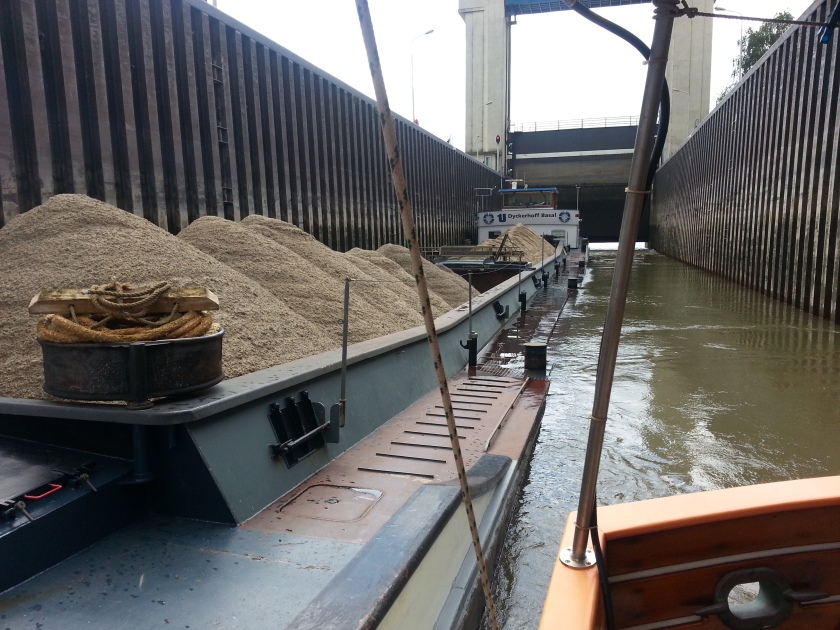
 Dauntless at Sea