A Day in the Life of an Atlantic Crossing

There is much to write about in my latest Atlantic Passage. We had full leaks, big seas, high winds and of course, the ever ubiquitous operator snafus. This post will go through a typical day, then address the issues that sprang up and how we dealt with them, in subsequent posts.

A Typical Day

Sunset over the Atlantic

03:35 hours, my alarm goes off, telling me it’s time to relieve Micah and it’s the start of another day.  I lie in bed a few minutes, feeling the motion of the boat.  What can I discern from that motion? How many times was I almost thrown out of bed last night?  I brush my teeth in my forward head (sink, shower, toilet), using my knees and elbows to brace myself against the constant pitching and rolling.  A dozen times an hour, we get the inevitable larger roll to starboard, as the stern literally falls into the deep trough that forms when the southeast and northwest waves trains meet under Dauntless.  This also causes a large pitch up.  As I put on a new tee shirt and my boat pants, either warm up pants or shorts, depending on the temperature, I slather my forearms and elbows with Neosporin.  They take a beating every day with these conditions. The decks that I have traversed a thousand times are suddenly more narrow.

The Logbook showing Days 2 & 3

Lastly, before leaving my cabin, I make guess as to the conditions: wind, weather, seas.  If it’s important enough to know, it’s important enough to think about it. It’s why the Socratic method of teaching works. In the darkness of the forward cabin, too many times I have convinced myself the boat is clearly spinning around like a top, or while anchored, or even docked, that the boat is moving forward at some incredible speed.

My making myself consciously think about the conditions outside while in a dark, closed cabin, the next time I have such thoughts, I will have better understanding that it’s not the boat, it’s my brain, and go back to sleep.
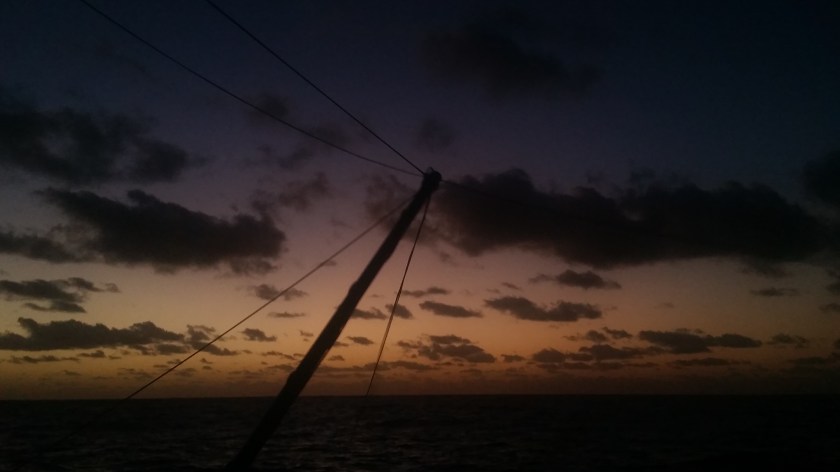
Looking East, Just Before Sunrise

03:45 hours, I leave my cabin, walking around the salon and galley, I’m also doing a sniff test, checking for unusual smells, our sense of smell being keener than sight or sound. Then open the hatch, down into the engine room: still sniffing, listening and looking.  I check the usual suspects, the Racor filter and its vacuum (which is an indication of how clean or dirty the filter has become), then eyeball, maybe even feel the bottom of the engine mounted fuel filters to make sure of no leaks.  Look at the injector pump and just around the engine for anything out of the ordinary.  Even check that the amount of fan belt dust has not changed.
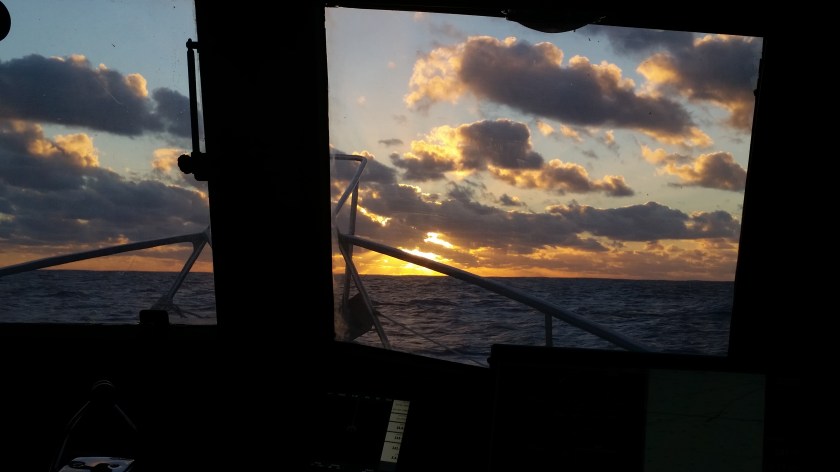
Sunset
Sunset from the Krogen Pilot House

I put my hand on the coolant tank of the Ford Lehman diesel.  It’s usually about 164°F and I can hold my hand on it about 1 second, longer means the temperature is lower, maybe 155.  Shorter, and there is a problem, and I need to investigate further.  I check the water maker valve settings.  Making sure it is initially going to “test”.

Every other day, I would add about a liter of oil to the running engine. She consumes about 1 liter every 50 to 60 hours. So, I’d need to replace that. Then, with a last look around, I ascend into the salon and head to the pilot house to relieve Micah.


Dusk
Dusk on the Coastal Explorer Navigation Program
The Moon watches over us

03:55. As I enter the darkened pilot house, I go to the log book to start the 04:00 entry, asking Micah what I need to know.  On this passage, that’s usually nothing, No ships, no boats, no nothing.  He goes off to a well-deserved sleep and I remind him to sleep as long as he wants, and that’s usually until late morning or noon.

04:00 log entry consists:

  1. engine rpms (usually 1500 rpms),
  2. speed (usually 5.9 knots this trip),
  3. course (245°),
  4. engine coolant temp (178°). (*These three instruments in the pilot house vary somewhat based on electrical issues, but it’s still important to monitor on a relative basis).
  5. Oil pressure (*30psi, it’s actually 50 psi since I also have a mechanical gauge on the engine),
  6. voltage (11.5 to 12.2v*). Any significant change to these three numbers does indicate a problem, since they almost never vary.
  7. Every few hours, days, weeks, I use my Infrared temp gun to measure temperatures at the: engine coolant tank, 164°, oil filter, 156°, transmission 127° and stuffing box, 88°, for this trip. Other than the stuffing box, these numbers never vary.  The stuffing box should be less than 20° warmer than the sea temperature, in this case, sea temp started at 76° and ended up at 83 in the Caribbean.

    Storms to the East and South
    Storms to the East and South

Before getting settled in on the pilot house bench, I will usually go outside.  Depending on how rough it is, I may just go to the stern deck.  During this trip, the stern deck was awash constantly with water coming in and leaving by the scuppers.  So I would stand on lower stair toward the bow.

Why go outside?  Why go when Micah is already in the cabin, knowing to fall in the water is fatal?  Because I like a few minutes of solitude, just me and Mother Nature.  I like feeling the wind in my face.  How is the boat really handling the seas.  She talks to me, Everything is OK, just go back in the pilot house and let me handle this. Reassured, I do just that.

For the next few hours, I will read, or more usually play Bridge on the computer.  Sometimes I watch Korean Dramas.

Some nights were quite dark, no moon or cloud covered.  On those nights, one sees nothing.  The first hint that a wave is there is the boat heeling.  On full moon nights, visibility is probably greater than a quarter mile.  But it’s still not good enough to see the proverbial shipping container, so I don’t bother looking.

In actuality, on the high seas, I think the greatest hazard may be sleeping whales, but since one hardly sees ones that are awake… (update – there is a 40-ft. sailboat docked opposite us, it encounters a whale, that ended up tearing the starboard rudder off. The hole was big enough that without the ability to heel the boat to port, they may have lost the boat.)

07:00 time for coffee and whatever frozen pastry I managed to save.  Usually, I put the pastry in the engine room when I got up and did my engine room sniff test. The sun is coming up, giving me a look of the clouds and skies for the first time.  I’ll look at what “stars” are still out.  Estimate wave height and direction.

I have spoken to about a half dozen boats that crossed about the same time frame.  We all noted that there were three distinct wave sets or swells.  In the first week, there was a westerly swell of 10 feet, with wind driven waves from the east and southeast.  After the first week, the pattern became all easterly, in that there were three wave sets, one from the NE, one E and one SE.  Even my favorite weather app, Windty, at most mentions only the swell and one set of wind waves.

One of the sailors I ran into in Martinique, called these confused seas, “the bathtub”.  The bathtub made for a long 21 days.

Now this wave pattern had a very interesting effect.  About every 6 to 10 minutes, the SE and NE waves would meet under the stern of Dauntless, causing a very big corkscrew roll as the stern fell into the deep trough and rolled to starboard, as the bow pitched up and turned to port.

The Maretron data should these extra big rolls were about 20° to 25° to starboard, 10° to port, with a pitch up of 1.2°, followed by down pitch of 2°.

As I said, being alone, watching the sun rise, is very spiritual. One of those instances that I actually prefer to be alone.

For the rest of the day, log entries were made whenever we had a change to course or anything else.

10:00 to 18:00

More of the same.  Micah would get up by late morning.  We would decide what to eat at our main meal in mid-afternoon.  For the most part we ate normally, which is to say, the freezer is stocked with various meats, pork predominantly, though we had two enormous rib eye steaks that we had found irresistible while in the Las Palmas market. I made the first one (enough for about 4 people) the first week out, but saved the second for Christmas.

The boat motions coupled with a very wet stern deck made for interesting grilling on the Weber Q280, but certainly still better than grilling in minus 20°F or at 40° in a 30-mph wind on our rooftop in the Upper Eastside of New York.

We would also use this time to watch some Korean Drama.  K-Dramas are the perfect way to pass a few hours each day.  Too tired to do something creative like write; sometimes too mentally tried to even read, so K-Dramas came to the rescue.  Captivating enough to keep one occupied during the most monotonous rolling conditions.  Thank God for Korean Dramas.

When the rolling was not so bad, we used that opportunity to play a board game. I made little non-slip pads for the pieces, but even with that, conditions only allowed our games on about a third of the days.

Much of the rest of our daylight hours was spent just checking things that were easy to check during the day.  Walking around the boat, feeling the tension of the stays and lines for the paravanes, as they were under the most strain.

By the way, having waited four extra days for the winds to be favorable when we left the Canaries, as we pulled out of the harbor with 12 knot winds and seas 2-3 feet, I said to Micah, maybe we won’t need the paravane stabilizers the entire trip.  An hour later, I put out the windward {port) bird. A few hours later, both birds were deployed and were needed for the next 20 days until we pulled into the harbor of Martinique.

Bob Dylan was right, never trust the weatherman.

We left the Canaries with full fuel tanks, but only one water tank (150 gallons, 600 liters) full.  This was purposeful, as I wanted to use the water maker to fill the empty water tank.  Our Katadyn 160 water maker makes 8 to 9 gallons of water an hour, so it takes about 19 hours to fill one tank.

Micah and I use about 40 gallons per day. The Katadyn 160 is rated to make 160 gallons per day or 6.67 gallons per hour, but I have axillary water pump, pumping water through two sediment filters, before it gets to the water maker.  Therefore, I have found that on this trip, it produced between 9 and 10 gallons per hour, so we ended up running it about 50% of the time.  Thus, it was convenient to turn it on when I did my engine room survey at 04:00, then turn it off in the early evening. I had pickled (put a preservative in it) in June 2015, 18 months earlier.  This was necessitated by the amount of organic material in the rivers and estuaries o the North Sea and Baltic, made water making difficult, if not impossible.  Thus, it was with some relief upon leaving Gibraltar that once I got it running again, it ran for the next month with nary a hiccup.

14:00 Local Canaries Time, which just happens to be UTC (Universal Coordinated Time, the time of solar noon at 0° Longitude)

14:00 was the time we left the Canaries, so I used it as our “official” 24-hour point.  At 14:00 each day, in addition to the above log entries, I’d note:

  1. quantity of water,
  2. Quantity of fuel,
  3. Fuel feeding from and returning to which fuel tank,
  4. fuel filters in use,
  5. distance travelled in the last 24 hours,
  6. 24-hour average speed,
  7. current position,
  8. current weather, sea state,
  9. average pitch and roll for the period
  10. the new heading and distance to destination.


18:00 to 21:00

Evening would have Micah taking a nap below.  I usually took a little nap in the pilot house in the early afternoon after Micah was up and running.  So, I would use this time to walk around again before it got really dark. Feel the lines, sniff the engine room and just get ready, mentally and physically for the overnight.

While his watch started at 22:00, he would usually come up the pilot house between 20:00 and 21:00. If early enough and I was not too tired, we would watch an hour K-drama.  I developed the watch schedule because Micah was flexible with his sleeping, though he did sleep a lot.  I slept less, but I knew I need 6 hours of good sleep.  That ended being more like 5 hours, but it worked.  Though I did find myself dozing off a few times after the sun rose.


More to come: The Good, the Bad & of course, the Ugly

We do a little 400 mile trip today to Bonaire, as we say goodbye to the Grenadines and head west.

See you in three days. You can follow at: Share.Delorme.com/Dauntless
 

Q & A After the Atlantic Crossing

My Friend Alfa Mike asked the following, so I thought I would share with everyone:

Richard on Dauntless in Martinique, La Marin

>Do they speak a lot of English Language in Martinique or is it all French?

The Moon & Venus watch over us on our last nights
Until the very end, a story sea
A little mishap while changing the oil just after arrival
Mountain on Martinique
Driving thru the forest
More Rainforest
More Rainforest
Even made it to the Kadey Krogen page
La Marin Marina
La Marin Marina
  • some English, once in a while, you need to know some basic French.

> What have you seen & experienced there?
This past weekend, we drove up north to see rain forest and volcano.  Inactive of course, so not much to see.
> What have you done in the boat while there.?  Repairs, upgrades?

at this point, there is still much to do.  Not helped that yesterday I spent all day to do a 1 hour job.  I hate working with wood, like the interior.

  • Working on electric in fwd bilge, adding small bilge pump.
  • Rewiring holding tank switch so that it can’t get turned on accidentally.
  • Micah patched dingy.
  • Rerigged paravane pole.
    • One pole needs to be replaced. Probably do that in Mexico or So Cal.
    • Also, rigged a preventer so windward pole will not go vertical when boat rolls heavily to lee side.
  • Finally finished 3rd 20# bottle of propane yesterday.  Those 3 bottles were filled in Tallinn in July 2015. That’s 7000 miles ago.  Luckily have two extra bottles that a sailboat boat gave me in northern France last summer as he was not going back to USA. I have not been able to get propane since Estonia last year, but am told I can in St Lucia.  But I can wait till So Cal possibly.
  • Must still replace 2 hydraulic hoses and bleed system for AP and helm steering.
  • Complete oil change, i.e. fill engine with oil.
  • We’ll fuel again in St. Lucia, only to half full about 250 gal
  • Repair bracket for wx instruments on mast, the following winds (when we were stopped for Hydraulic line) managed to wrap paravane line around it and mangled it, because I was so happy to get one problems solved, I created another one.
  • Winds also broke stern flag pole. Same happened to Sweden sailboat docked next to us.
  • All 5 fuel filters are changed (2 Racors, 2 engine mounted and fuel polish)
  • Replacing all screws in rub rail is proving to be a real PIA. As they are rusted and not coming out. These are Inox screws I bought in Ireland and again in Portugal. Big f…ing mistake.
  • General clean up, still finding flying fish on fly bridge (where else would they be 🙂
  • Spent $200 on stainless steel screws.
  • Another $200 on oil and ATF for rudder steering
  • $200 on rental car for 3 days
    Yes, everything is in increments of $200.
  • Finally took Icom VHF radio to shop, as my friend Pat in Waterford told me to do last year. It’s unfixable it seems. So, will take VHF radio from fly bridge and install in pilot house.
  • Need to still upload a billion pictures to http://dauntless.smugmug.com/

> How has the weather been?

  • Is it Humid? Hot, a bit muggy, yesterday was first day without wind, so then the boat really heats up.Did I tell you I don’t like hot weather?  Thus the 12 years in Alaska and two years with Dauntless in Northern Europe and now returning to first Southeast Alaska and then Japan & S. Korea.

>Now after all is said and done, In hindsight what would I have done differently?

  • In terms of places to go or not, it’s hard to say. Only having spent time in southern Spain and Morocco can I say that I would not have missed it.  But had I not gone, how would I know that?  It would have better financially and sailing wise to go direct from the bottom of Portugal to Las Palmas on Grand Canaria.
  • Should have spent some hard-earned money 3 years ago, to be able to use 230v, 50hz shore power to run ACs. I did try to get them to run off inverter, but the inverter produces a square sine wave and both the Splendid washer/dryer and the AC’s will not run on that.

I could have tried the transformer I use not for the water heater.  It would supply 120v, but 50hz to AC.  That swill probably work. But at this point, I’m not sure it’s worth the effort.  Back in Southern Spain and Portugal when I was dying of the heat, I should have thought of that.

Yes, I could always run generator, by the 1 gal/hour at $5/gal fuel. Now, 8 hours is only $40 per day, but adding that to expensive marina at $55/day, that’s close to my desired cap of $100 per day.

  • Speaking of money. My average daily cost for all living and boat expenses is about $109 per day.  Though I still have yet to update the last month, I do not think it will change significantly.  This is also a few dollars below the previous year.  So, all in all, the expenses are about what I expect.  The proportion is also the same, 25% for each:
    • Fuel & oils
    • Marinas & docks
    • Food, groceries & eating out
    • , like cell phone, transportation, cars, trains, planes and automobiles.

> How do you like it in Martinique?

  • Love it. People, food could not be better. I am so lucky that I was told to head here when it became clear that I could m=not make the southing I needed to get to Barbados.  It was only a 20° more southerly course, but with the large seas we had, it was not worth being beaten up.
  • In hindsight, Martinique is a much nicer place to clear in, eat and drink than probably anyplace in the Caribbean. Martinique is a Department (like a State) of France.  Thus, it feels like France because it is France.  It’s not the bureaucratic mess that Portugal, southern Spain and Morocco are.
  • FYI in terms of how they treat boaters:
    • Northern Spain, Galicia is just like northern Europe and France, as are the Cana.ries.
    • Southern Spain and Portugal were totally different, and not in a positive way.
    • I was told that it’s because of the Arab penchant for bureaucracy.

> How long do you plan to stay?

  • until sometime next week. Then heading south, a bit before heading west to the ABC’s

> Any comments you would like to make about the trip you just completed now that your more rested up?

  • Very glad I don’t have to do it again for another 18 months


Days 1 & 2 The Canaries to Barbados

After topping up the portside fuel tank, we had a quick lunch, as I was hot to trot.

La Restinga
THe Wonderful Town of La Restinga

As we pulled away from the dock of this peaceful little town, I already knew I would miss it once in the Caribbean. As we came around the protective wall of the harbor, I gave one long blast on the horn, to warn any boats entering that we were leaving and as our way of saying goodbye to a place we really liked.

One long horn blast means “attention” as in pay attention, I’m doing something you may not be able to see.  Last year in the Baltic, I noticed that the Germans always gave a long blast when entering a harbor.  Just like in the Canaries, most of the harbors have a tall jetty to protect them from the waves, but it also hides boats coming in or out. Thus, the warning.

The Island of El Hierro We say goodbye to 2+ years in Europe
The Island of El Hierro
We say goodbye to 2+ years in Europe

As we settled into our course 258°, the winds were from 120° at 15 knots, thus we had winds and waves from our port side quarter panel.  Not the best, but it could be worse.  After just a few minutes, I realized we needed to deploy at least one bird to cut the rolling which had increased to ±15°. That’s a lot.

With one bird in the water, I speed was only reduced by about 0.5 knots, but 2/3s of the roll was gone.

As I watched the sea, I also realized we had a large, 10 foot plus swell coming from the west with a period of about 10 seconds.  Not too bad, but not helpful either.

The 1st on many Sunsets at Sea

Over the next 24 hours’ conditions remained exactly the same.

wp-1483026744009.jpg
Weather data at the end of the first day. I am also recalibrating water tank fill as we use water maker

I remember writing the above.

The last words I wrote for 20 days.  Umm, I wonder why? Barbados? Stay tuned.


Four Months & 6,000 Miles for Dauntless & Her Intrepid Crew

Dauntless in the Best of Brest

The table below has our tentative cruising plan for the next four months.  While the dates are somewhat tentative, you know me, I like sticking to the plan.

Kadey Krogen in Spain and Galicia

A few explanations about the below chart:

  • The tentative arrival date is just that, but the departure date from the previous port can be derived from the required days (4th column) minus the arrival date. E.g. Departure date from GIB (Gibraltar) is 1 day before arrival at Rabat, so the 7th of November.
  • 2nd Column, Type, “C” = Coastal cruising, “P” = Passage, i.e. No Stops.

Crew consists om my Hawaiian nephew Micah who has travelled with Dauntless since Ireland and is a very flexible soul and I.

We have others joining us for various legs, though at this time, it looks like I still would like to have a couple or one person for the passage from the Canaries to the Caribbean.  If you think you have some interest in this, please email me, sooner rather than later.

I am excited about getting this new phase underway.  So much of my time, my life, my adventures have been in Europe.  I’m ready for a big change.  It will take a year to get to Alaska and another year to get to Northeast Asia.

Dauntless is as ready as she has ever been.  Unlike coming east two years ago, all is ship shape. Spare parts are stowed and organized, fuel tank vents are moved, paravanes are rigged to run more effectively and can be easily run much deeper if need be and the two air conditioning units are even working.

Here are the current winds for the mid-Atlantic. To get an approximate idea of the Dauntless’ route, visualize a line from the bottom of Spain to NE South America.  Following winds or no winds.  the se are the “Trade Winds” and are pretty constant all winter.

Windyty showing the Atlantic Ocean

Can’t ask for better than that.

We Be Ready.


Tentative Arrival Date Type of Cruise Arrival or Departure Point # of Days Rq’d Current

Crew

Additional Crew

Needed?

03-Nov-16 Rota, Spain 2
04-Nov-16 C GIB 1 3 0
08-Nov-16 P Morocco, Rabat, Mohamedia 1 4 0
14-Nov-16 P Morocco, Agadir 1 4 ?
22-Nov-16 P Canaries, Lanzarote 2 3 1 or 2
26-Nov-16 P Canaries, Gran 1 2 1 or 2
30-Nov-16 P Canaries, west 1 2 1 or 2
19-Dec-16 P Barbados 18 2 1 or 2
26-Dec-16 C Grenadines, Carriacou, Grenada 3 2 ?
05-Jan-17 P Bonaire 3 2 ?
17-Jan-17 C Curacao, Aruba 2 3
01-Feb-17 P Panama Canal, East 5 3 ?
07-Feb-17 C Panama Canal, West 3 3 ?
20-Feb-17 C Costa Rica 6 3


Dauntless Redux

The New D
The New Dauntless on a mooring in Scotland, flying her purple Kadey Krogen flag.

Just in case you missed it, here are the pictures of Dauntless, before and after her winter in Ireland.

It was a transformative time!

In the Begining. 3 years ago
In the Beginning. 3 years ago

When I get back to Dauntless in a couple of weeks, it will be time to get her wet again.

20160928_105402
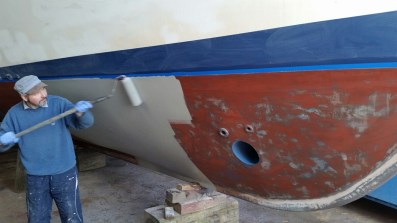
The New Dauntless, on the hard. The missing anti-foul was caused by straps of the travel lift. The green sheen is organic growth just above the anti-foul.

Then, just days later, we will take the first steps in our voyage back to North America.

I will miss Ireland.  I will miss the friends I made and the people who worked on Dauntless like she was their own.  We’ll have to make it back there some day.

Gary Mooney, the GRP and Painter, was meticulous in mixing and applying the AWLGRIP paints.
This is the layer of the undercoat for the anti-foul going on.
Gary applying the first layer of epoxy
The New Anti-Foul. The scrapes pulled off some of the undercoat.
My latest scratch/scrape
Fall 2015
Fall 2015 Dauntless is strapped down for the winter. Dauntless was hit by winds of over 100 mph this past winter while in New Ross. But since it wasnt a “named” storm, it was just another winter in the northern Atlantic and therefore boats are strapped down.
May 2015
May 2015
The Krogen out of the water

Alfa Romeo versus Kadey Krogen

Alfa Romeo Montreal alfa-romeo-montreal-1974-red

1974 Alfa Romeo Montreal
205 built in 1974
200 horsepower 2.6 litre V-8 engine
Designed by Bertone
Top speed of 137 mph (downhill!)
5-speed manual transmission
rear-wheel-drive
166 – inch length
2+2 seating configuration


Kadey Krogen 42dauntless-in-horta

1988 Kadey Krogen 42-foot Trawler Yacht
11 built in 1988
135 horsepower 6.2 litre I-6 Ford Lehman engine
Designed by James Krogen
Top speed of 9 mph (in calm winds and flat seas)
1-speed manual transmission
In-line shaft-drive
504 – inch length
2+2+2+2 sleeping configuration


A few weeks ago, I did another road trip. A quick three-day trip from Lisbon to A Coruna, 720-mile round trip.  It made me think about my travels, on land and now, by sea, and reflect on both the similarities and the differences between land and sea.

No, this isn’t one of those crazy dissimilar performance tests that Car & Driver became famous for back in the day.

As my life transitions from land to sea, I still savior those moments on the hard. Driving has always been a joy for me.  From my first trans-continental trip to midnight drives around Mt. Rainier in the middle of the night, driving has always been a skill that I continuously honed.

North America provides endless miles, from Florida to Alaska, the dessert southwest to the Gaspe Peninsula, all well-travelled roads for me.

Then Europe provided another whole different experience: unlimited Autobahns, miles of roads through hill and dale at even faster speeds. From France and Spain in the west to Romania in the east and oh so many miles just going north and south from Holland to Italy, a true cornucopia of roads, conditions and cultures. Finally add a few driving schools, including a 4-day school done by BMW driving school at the famed Nurburgring, and being a driving instructor at club events enabled me to further hone my driving skills.

What drove me to do most of these miles, these long trips with quick turn-arounds?

Women of course!  Well, maybe not all the time, but…

All these travels were done in the plethora of cars in my life: 3 BMW’s, 3 Alfa Romeos, 3 Jeeps and one Mazda, two motorcycles and many, many rental cars.

The best of the best was my Alfa Romeo Montreal. Built in 1974, never a big seller as Alfa’s only V-8 was introduced just when the first gas crisis was going on, but me oh my, what a car.

She was fast yes, but driving cars well is never about speed. It’s getting the most out of what that particular car could do.  She was perfectly balanced and so tough.

That was the Montreal. Perfectly balanced, she had no bad habits.  She felt like on rails no matter the speed or the conditions.  She went over jumps with aplomb and I’d had her brake discs red hot on a few occasions with nary a problem.

So why have I been going on and on about cars and driving?  Does it even relate to boats?  Boats are inherently much more complicated than cars. Is that it?

Driving a car well, to the best of the car’s ability and design, is about the knowledge and skill of the driver.  Ultimately, a cars performance is a function of what I can put into it.

Last year my Alaska friends, Larry and Karla, joined Dauntless to cruise from Ireland to Northern France. The crossing of the English Channel was rougher than one would like, you know with those seemingly ubiquitous 6 to 10 foot seas that Dauntless also seems to find.  Larry later told me he was a bit afraid. But after the first 12 hours he realized that Dauntless wasn’t fighting the seas, she was going with them.  No matter how big the wave, the boat seemed to ride along as the wave passed serenely beneath us.  Sure we pitched and rolled, but not in a harsh manner, just smoothly like she had been doing it her whole life.

And then my epiphany.

I understood the difference between driving the Alfa Romeo and being the Kadey Krogen skipper.

On Dauntless I am like a passenger. Oh sure, I have my Master’s license and as the Skipper I am responsible for everything that happens on board. I decide where and how to go and to do it in a safe manner.

However, this Kadey Krogen performs.

Just as the Montreal ruled the road; my Krogen does what she does as well, even better. In the last three years, I have done a number of things I would prefer not to repeat.  Has it been uncomfortable at times? Sure. Can I sometimes mitigate contrary winds and seas to get a better ride? Yes, I can do that.

But no matter what the conditions or what I do: beam sea, head sea, following sea, etc., my Krogen just does it, with never a complaint, never a groan nor shriek.

I point the boat in the direction I want to go.  Boat never says no, in fact, Dauntless says, “Sure, no problem, it’s just another day in the park for me”

And that’s what Larry meant when he said the KK just went with the seas, never fighting the waves, but being one with the environment. She does what we ask. And that’s why I have never been afraid; I’m going along for the ride.

James Krogen is the real driver.  He designed and built a boat for people like me who wanted to get off the beaten path in a boat anybody could call home.  All I do is point us in the right direction. The Krogen does the rest.

The real motto of Kadey Krogen should be: Performance is Built into Our Boats; She’ll Make You Worthy in Any Sea.

Kadey Krogen said this: “The late naval architect and designer, James S. Krogen, was a master of merging the tried and true with fresh, innovative concepts, creature comforts and convenience. His near-three decades of commercial design gave extra dimension and distinction to his offshore pleasure craft. Outstanding performance is inherent.”

Exactly.

You can visit my blog at: www.DauntlessAtSea.com

And you can track the location of Dauntless at any time at: https://share.delorme.com/Dauntless

Even the Weatherman Needs to Look Out the Window Once in a While

Being tied up in the Puerto Deportivo de Rota these last few days has been a welcome respite from the wind and waves that give Dauntless it’s gentle rocking motion.

The Full Moon Rises Over Dauntless

It has also given me a break; time to relax, while not having to plan the next day’s, week’s destinations.

So as I lay in my bed early this morning, I thought I heard the pitter patter of rain.  The more I listened, the more I was convinced it was raining. I had left the windward Dutch door in the pilot house open as the boat cools each day.  So if it was raining, I needed to get my ass out of my cozy bed and close up the boat.  But since arriving in Rota, I have not seen even one cloud in the sky.  Therefore, before going back to sleep, I convinced myself I was imagining it.

Sunset over Rota, Spain

When I awoke again, I thought it must be just after sunrise, as it was a bit dark out.

Well, it was at least an hour past sunrise as it was almost 09:00!  And the darker skies were caused by clouds, you know those things that produce RAIN!

And it had rained, not much, the decks were still damp.  As for the pilot house, whatever was wet, was now dry, so all was well.

I have some travelling to do to the USA and Italy during October, so this is our mid-cruise rest.

Cirrus over the Bay of Cadiz

Though now, I am looking down the road to November and December.  I spent the morning looking on-line for more information of boats cruising to Morocco.  Cheap fuel, coupled with an exotic location is a strong attraction for me.  An interesting post about a cruising boat to Morocco

Spanish Warship in the Bay of Cadiz

is: http://www.sailing-interlude.com/category/morocco/

As summer turns to fall, I realize it’s time to start pinning down the crew for the passage from the Canaries to the Caribbean. Before I go to Cruiser’s Forum and other sites for finding crew, I thought I throw it out there for the followers of this blog.

ARA Libertad, an Argentine Full Rigged Tall Ship docked in Cadiz

I’m looking for one person or a couple to crew Dauntless for the passage from either Morocco or the Canaries to Barbados.  This will mean about 5 weeks from the end of November through December.  It’s 18 days to Barbados and another 4 or 5 days from Morocco, plus the week spent in the Canaries.  Email me if interested.

A Wary Eye
A Wary Eye
Cats of Cadiz
Cats of Cadiz
Look I'm in Cadiz and I have the picture to prove it
Look I’m in Cadiz and I have the picture to prove it
One of the narrow streets of Cadiz
Cats
Cats


Cruising Costs for the First 112 Days

It’s the 112th day since our cruise started May 29th.

The Full Moon Rises Behind Dauntless

Dauntless now sits easily in the Puerto Deportivo de Rota. Her new grey paint scheme fits in well being only a mile SE of the big naval base in Rota, Spain.

Rota Lighthouse
Rota Lighthouse

We’ll be in this area, between Rota and Gibraltar for the next month, so this is a good opportunity to get my data updated and I’d thought I’d share with you our cruising costs so far this season.

So far, compared to last year, I’m spending about $20 less per day.  Overall costs have been about $107 per day, that’s $27 less than last year and almost all of that savings are due to the lower fuel costs. I was able to fill Dauntless with fuel in Ireland at $2.30 per gallon.  Upon my return from Scotland in June, I was able to top up the tanks again.

I should be able to get reasonably priced fuel in Gibraltar, but when I top up the tanks in the Canaries, it will be $5 per gallon fuel.  I should only need a few hundred gallons; however, the Caribbean won’t be cheap either.

Total guest contributions to expenses have been about 11%; that’s less than last year.

Overall, I am pleased that expenses are staying just below my planned budget.  I need to get more proactive about Sponsorships; but that’s another story.

Dauntless will be pretty much stationary until the end of October, as I am going to NY during the first two weeks.  Since it will be my last opportunity until spring to visit some friends in Europe, I will go to Italy during the last two weeks of October before returning to D.


Dauntless Turns 28 years-old as She Passes 5000 Hours

I really did not have time to celebrate as we were entering the inlet to Ilha de Coulatra.

Our track inbound as we depart outbound
Our track inbound as we depart outbound. A much less interesting departure

Conditions were far from ideal: a two knot current against us, 20 knot winds behind us and ocean depths shallowing from 400 feet to less than 20’; it was not the time to get the cake out.

But Dauntless handled the conditions like she always does with a nonchalance that says, if this is what you want me to do, I’ll get it done.

As you can see from our inbound track, we waggled a bit, but that was the extent of it.  We then proceeded to head up the well-marked river channel, only to discover that the marina was full.  Now in the USA, we are accustomed to a marina being full. Making reservations, calling ahead are sometimes critical and done pretty routinely.

Instead in Europe, at least in Northern Europe, first talked about in the Cruising Forum and later confirmed by experience over last two years, is that there is always space.  And if space is not readily available space will be found.  Sometimes that means sailboats will be rafted together two or three deep.  For the most part this Krogen escaped that inconvenience because of our large bow rise.

I think this difference in marina culture is more about the culture than anything else.  I mean in the north, there is a very evident culture of the sea. Thus seafarers are accommodated pretty much no matter what.  It carries over to prices also.  Throughout the North and Baltic Seas, marina prices were in the $20 to $35 range; with only Helsinki being out of the normal at $50.  Even with the two weeks I was in Helsinki last year, the average marina cost was only $25 averaged over the four months for our 42 foot (12.7m) Kadey Krogen.

The same inlet from Google

This year, as we came south, I expected prices to rise.  Prices in the west coast of France were in the $30 to $40 range and that continued into Northwest Spain, Galicia.

But as we turned south, as the temperatures got higher so did the prices.  $40 becomes the going rate and other than the little gem of Vila Franca de Xira up the river from Lisbon or the Marina do Freixo, upriver from Porto, everything costs more.

The bigger disappointment however is not so much the prices, but that’s to be expected.  Similar to what I noticed along the east coast of the Untitled States, the seafaring culture is alive and well in New England, but every place else it’s simply a commercial venture.

And that seems to be the attitude here.

Certainly I have always shown a preference for the cooler, off the beaten track places, Maine instead of the Bahamas, for instance, but none the less, the No Room in the Inn sign is a disappointment, especially since I must turn around in a small distance in a 20 knot wind.

Sunrise
Sunrise at our anchorage


Portugal Grows on Me

And not like a fungus.

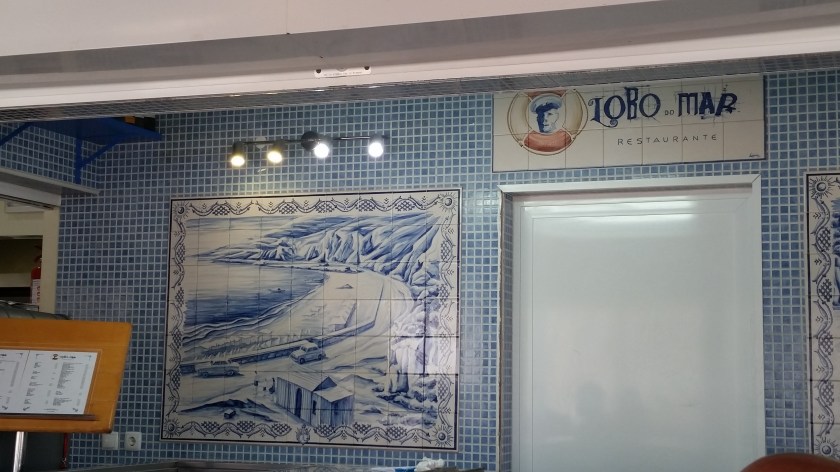
Lobo Do Mar, Seisi
Lobo Do Mar, Sesimbra

That’s a good thing.

I have three blog posts drafted, but for all three they are incomplete as each one has gone wildly off on tangents.

Very frustrating.  I like communicating.

I had an adventure this past weekend driving all the way to A Coruna and return, a total of 750 miles.  But that blog post went off about driving cars and the best car of my life.  Then, as I thought about how to resurrect it this morning, it started going off on the infamous trip to Romania in 1980.  Needless to say, I got out, of Romania that is.  But it was an experience of a lifetime and pretty much ended the few leftist thoughts that I had left after having lived in Europe the previous 4 years.

A wonderful Dinner
A wonderful Dinner

I loved the people of Romania though and it’s such a beautiful country, I must make the time to go back.  Maybe next winter, that’s winter 2017-18, when if all goes to plan, Dauntless will be in S.E. Alaska, resting up for the next leg of the journey.

So yesterday, not having to return the rental car until nightfall, I decided to check out the three marinas on the south side of the river, across from Lisbon.  I’m paying 40 Euros ($45) per night here and that’s expensive.  I really must stick to the budget this year knowing that as I go south, the prices will only go up.

Lobo Do Mar, Sesimbra, Portugal

So I drove to Setubal. No room there, but the port captain was very helpful and gave me some more ideas. Next stop Sesimbra, a smaller, vacation town. They had room, but the price was 39 Euros.  But she did give me a great recommendation for a restaurant.

Yes, when your plans are stymied, go eat.

The restaurant was Lobo Do Mar, Wolf of the Sea.  When you enter, there is a large counter of fresh fish, the counter man asks what you would like and you pick the fish or fishes you want for your dinner.

I got three mackerel type fish. Everything seems grilled on a wood fired grate and they were delicious. With a salad, I washed it down with a half-liter of Vehno Verde.

Sesimbra harbor
Sesimbra harbor

After an espresso and a dessert, the only disappointment of the afternoon, I paid the bill of 14 Euros ($15) thinking that I had finally found the real Portugal, that even my Spanish friends had told me existed, but I just couldn’t find.

Great food and wine at an inexpensive price.  Once I leave Europe, I will certainly miss it.

In the next day or so, I will check out another place, further up the river, but with a dock close to town which more often than not is not the case.

To be continued.


A Change of Plans Redux

Crossing the Bay of Biscay
Crossing the Bay of Biscay to A Coruna

Eons ago, back in February, when we first visited Galicia, the plan was to stay the winter. Off the beaten track, inexpensive, cool in summer and winter: Ideal.

Then, life happens and the best laid plans of mice and men go astray.

So, plan B was formulated.  For those of you keeping score at home, it was really the original Plan A, but then who’s counting.

Then less than two weeks ago, while in France, an English sailor on a very big, beautiful sailboat, convinced me that to linger too long in the Bay of Biscay or even in Galicia or Northern Portugal, was cruising for a bruising.

Now, I may not heed, but I always listen.  And now, having heard the same warnings yet again, I decided this needed to be one of those times I also heeded.

Thus, just last week, I bit the bullet and had to tell my three sets of friends who are coming to meet Dauntless and I over the next two months, and only weeks earlier had bought plane tickets to Spain, that they would have to change those recently bought tickets as Portugal was now the meeting point.

Galicia is out, Portugal is in.

And like most decisions, once made, it was clear to me, it was the right thing to do.

A Coruña is a wonderful town, wonderful food, beautiful people and fantastic wine.

wp-1470576383076.jpg
Vermuteria Martinez in A Coruna

We had two dinners in an absolutely great small restaurant, Vermuteria Martinez, that we had found in February.  A must stop for anyone visiting Galicia.

But I also realized it was time for me to move on.

Now, even the extra stops I had planned over the next week have been nixed.

Sometimes the past is like an anchor.

One of those real expensive anchors with the hoop, plated in gold or platinum (or certainly priced as if they are) and while you hate to part with, having cost a small fortune plus your two middle children, you come to realize that it’s time to get the fire ax and cut that chain before you are dragged down.

Galicia and Spain, so many wonderful memories, in fact, nary a bad one, but now moving to the past. It’s time to move on.

It’s time to get to Portugal.

New places, faces and spaces.

But one cannot leave A Coruña, Galicia and Spain without a bit of melancholy or even “triste”

Thus a little Charles Aznavour seems appropriate at this time.

Charles Aznavour, “Come è Triste Venezia”