I can see why satire is so effective; no, I did not sleep well, but I woke up in a far better mood and the simple fact is I am tied to the dock, so any problem is fixable. Getting across an ocean helps the perspective.
Larry, my Alaskan friend, along with his wife, Karla, is also here to help.
I had decided that I still needed to finish installing the controller and tablet dispenser for the Purasan, leak or no leak.
Another thing that happened yesterday was the forward bilge pump, while running, was not pumping any water out. So Bucket Head came to the rescue again and we could at least get the inch of water in the bilge out.
Having a leaking sanitation system into the bilge without the bilge pump working was a very unpleasant prospect, so I awoke this morning with a plan the first, I would deal with the bilge pump.
By 9:00 a.m. I had gotten the courage to take up the floor hatch covers and drive into the depths to do battle again. The bilge pump ran, but no pumping. I disconnected it from its bracket and then took off the short hose.
I put the pump into the shower sump and as I lifted the float sensor, the pump sprayed water all over the place. Well. At least one problem was partially solved. I took off the one way valve, water poured out of the hose, but blowing thru the valve showed it worked as it was supposed to (I was days past caring about where my lips were).
Putting it all back together, I once again used the hose to see if it was working and wonder of wonders, it was. I’m guessing that the day before, we may have been spraying down the bilge and I have has instances where when I do that to the shower pump, it can lose its prime. At that point, if it is running, it runs, but does not pump. Only turning it off and letting it rest, while presumably, the water for the out flow flows back into the pump, thus priming it. So when powered up again it works fine.
The bilge pump could not do that, since the one way valve is on the outtake side.
Knowing we had a working bilge pump made tackling the treatment tank far easier, as least now we could keep the forward bilge relatively clean.
So now we carefully dried the top of the processing unit and over the course of an hour, watched carefully as we flushed toilets. No leaks that I could find.
Then, within minutes I get a call from the States, it’s Raritan. I had called yesterday and left a message with the Senior Engineer, who I had talked with previously. So Brian was returning the call and I told him exactly what had happened yesterday and then today.
I was sorry I had cried “wolf”, but it was clearly not leaking now, while yesterday, I watched the fast drip of water with every flush.
Brian also helped me with a few other issues, including the solution to the one push pad issue. I had also woken this morning with a plan if only using one push pad. Brian confirmed my idea and also explained how I could set it up as before with one touch on either toilet.
This conversation led me to understand that the instructions for the second toilet which called for the two toilet option were written for people who did not have Raritan toilets already. So, now Raritan’s only crime is a poorly written installation manual, and nowadays everyone is guilty of that.
I still must calibrate the system, but at least I will be able to enjoy my dinner tonight.
And Monday, the Wallas heater install will commence. I wonder how their instructions, which I have already read many times, will work in actual execution?
Providence Rhode Island to Castletownbere, Ireland:
Morning of the Last Day
3624 nm, 6523 km.;
638 running hours
Average speed 5.7 knots
1013 gallons of fuel consumed
Average = 1.59 gal/hr.
Average 3.6 nm/gal= 1.7 km/liter
Cost of fuel $4000
Cost per nm = $1.1/nm
Stuff that broke: Four Stories and lessons Learned
The Bent Stabilizer Pole Saga
The Mast Cleat Adventure
The Auxiliary Water Pump Sediment Filter Hijinx
Water in Fuel Tanks: Not Pretty; But the Lehman keeps on Going
Other Lessons learned
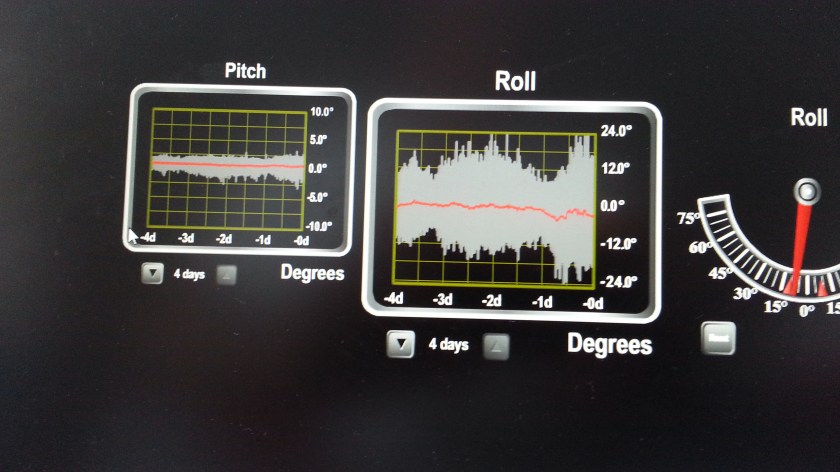
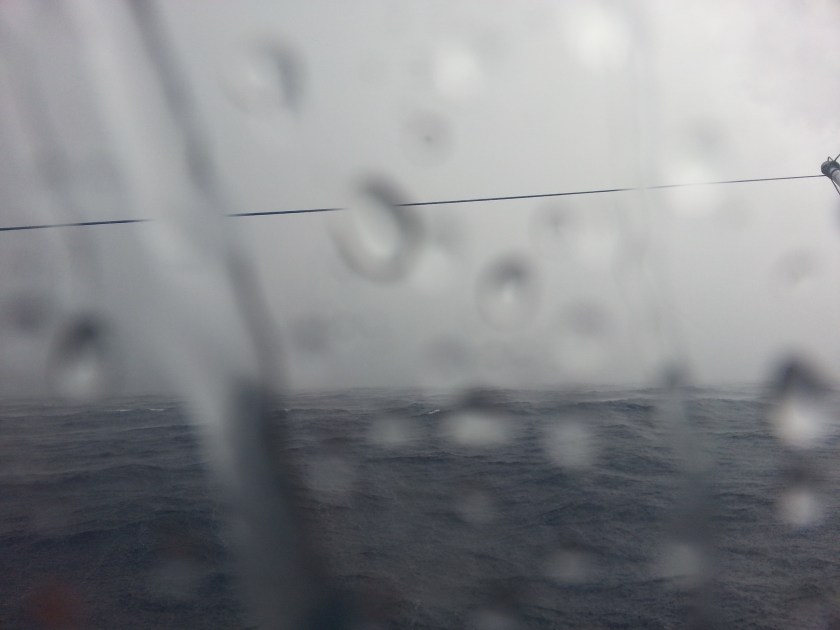
Evening of the 27th, the Storm Intensifies Again The Past 4 Days of Pitch and Roll
Food and Provisioning
Route Planning and Execution
Organization and Storage of Spare Parts
Odd and Ends
Solo Voyaging
Equipment: Must-haves, Nice-to-Haves
The crux of a successful ocean passage
I first wrote this “Post Mortem” 8 days after the end of our passage, but never published it because I realized it had morphed into many things. Thus there will soon follow a post titled, “Finding the Right Boat” and “Weather or Not”, where I talk about how to, and how not to, use a weather forecast.
Our successful ocean passage was the culmination of a planning process that started 6 years earlier and four years before we even had a boat. The success was due two major things: finding the right boat and having the right attitude. Having the right boat protects fools and drunks. Having the right attitude means you know what to except, from the best to the worst. If your plan is to call the Coast Guard under the “worst” circumstances, stay home.
During the worst of it, while I was miserable, I was not afraid. I knew the Krogen could handle it and even realized she can handle much worse.
Afternoon of the Last Day
The planning and learning process is key to a successful passage. As I had read virtually every account of small boats crossing oceans and books and stories of freighters throughout the 20th Century, I had a good sense as to what worked and what didn’t. That can’t be overstated because it speaks to our vision and that’s the first step of a successful passage. So this trip really started seven years ago, before I knew of Kadey Krogen, trawlers, or really anything.
But first, our passage is really not that special. People have done the same thing in in smaller boats, in far worse conditions, with many more handicaps. Almost everything I have learned and talk about, I first read someplace else, by someone with far more experience than I will ever have. Just remember that Columbus did the round trip more than 500 years ago, with three boats that were only 10’ to 17’ longer than Dauntless.
If you’re reading this, you probably read the details of the trip as it happened, or soon thereafter. So for this entry, I’m going to talk about what we learned in hindsight for the next ocean passage.
Stuff that broke: Three Stories and Lessons Learned
The Bent Stabilizer Pole Saga:
Error
This video doesn’t exist
An operator-induced failure.
Only a day after I left Miami with the new paravanes, while I adjusted the fore stays, I had also adjusted the up-down stays, Amsteel Blue 3/8”, which take the vertical loads of the paravane fish. I had not fully locked them tight on the horn of the cleat upon completion. I probably thought I would re-adjust them once more and then simply forgot. So, while they were wrapped in a figure 8 three times on the cleat on the mast, I had not “locked” it on the horn. Amsteel Blue is slippery enough that if not locked securely with at least 3 or 4 half hitches, they will get loose.
And that’s what happened. The Figure 8 got loose, thus letting the pole swing from its position of 45° to almost straight down, 170°. The rub rail, stopping the pole from facing straight down. This put a kink in the pole where it bent around the rub rail. Not a bad bend, but just enough to significantly weaken the pole. In trying to get the pole back to its original position, I took out the retaining bolt that would keep the pole in its cup that is attached to the gunnel. But I still couldn’t get the pole out, so I eventually got it back to position, but now, the retaining bolt was not in place. I knew it wasn’t needed because all the force on the pole is into the cup, not outward, but months later, it did contribute, if not cause the pole to subsequently bend into an “L” shape.
So on the last day of the trip during one big roll within 60 miles of Ireland, the same windward pole went vertical. However, the kink in the pole, even though very slight, allowed the paravane bird to put a force on the pole that rotated the pole 90° with the absence of the retaining bolt, so that the kink now faced aft. As soon as that happened, the force the bird put on the pole bent the pole 90°, and of course, now this allowed the pole to come out of the cup, making its retrieval even harder.
An hour later, after sitting dead in the water for that time, I had managed to get the pole up on deck. In my adrenaline rush, I never noticed how well the boat handled being left on its own, wallowing in the seas with its beam to the seas, which were running 8 to 15 feet at that time. In hindsight, we were bobbing in the ocean, with less roll than when underway.
Lesson Learned:
Replace bent stuff and all hardware before leaving on an ocean passage.
John Duffy, who had rigged the paravane system, told me to replace it, as the bend would significantly weaken it. I also probably did not mention that I had taken the retaining bolt out and had not replaced it, as the pole had rotated slightly, not allowing the bolt to be re-inserted.
The pole was replaced in Castletwonbere for 300 Euros. All the hardware is back in place.
The Mast Cleat Adventure:
A day out of Nova Scotia, as we sat in the Pilot House enjoying the world go by our living room window, we heard a noise that sounded like a gun shot. Knowing that no one on board was packin,’ I looked at the mast and saw immediately that the cleat holding the up-down line was now horizontal instead of vertical.
We chopped power to relieve the strain and I ran up to the fly bridge, though taking the time to put on my PFD (Personal Flotation Device, a life preserver). One of the two 3/8” bolts attaching the cleat to the mast had broken. Not wanting to spend a lot of time to try to re-attach the cleat, I tied the up-down line around the mast in a number of clove hitches and then tied it off to the other mast cleat. This way, much of the force on the line, instead of being transmitted to the cleat, would now be manifested in trying to squeeze the mast.
Lesson Learned:
This new system worked so well that while in Horta, I redid both up-down lines, so that they came to a three clove hitches around the mast, before being tied off on the cleat, with a final half hitch on the horn of the cleat for each line.
John Duffy in Miami designed and installed a great paravane stabilization system, which is not only relatively light-weight, but also easily adjustable and cost-effective.
While in Ireland, I also added one more feature: I had had another winch installed in Florida to assist in retrieving the paravanes. In Ireland, I also replaced the lines on the winch with 3/16” Amsteel Blue lines that I had gotten, 300 feet at a really bargain price from Parks, of Hopkins- Carter in Miami. By using this new, stronger line, it added an extra margin of safety, because it is strong enough to hold the paravanes while underway should I have a failure of the up-down line as described above. It would also allow me to retrieve the paravanes, even if the boat is not at a full standstill. This would be fast and useful, in case of emergency.
This was the first and last time I put on the PFD on this passage.
The Auxiliary Water Pump Sediment Filter Highjinx
Another operator-induced problem.
After the failure, a few days from the Azores, the pressure switch failed. After screwing with the pump for a while, I just bypassed the pressure switch and the pump went back to work. A day later the entire pump gave up the ghost. I discovered by reading the instruction manual that I had installed the pump upside down, with the electrical parts under the pump itself. Evidently, you should not do that because if the pump has minor leaks, it gets into the electronics right away.
Lesson Learned:
It behooves one to read installation instructions before the fact, not after.
THe Previous 12 Hours of rockin and rollin Before Arrival. The Scale is 24° to Each Side
Water in Fuel Tanks: Not Pretty; But the Lehman keeps on Going
On the Left,Taken from the Stbd Side Fuel Tank, a Mixture of Water and Emulsified Water and Fuel. On the Right, Fuel from the Port Tank
I have finally deduced that the water, around 5 gallons, got into the starboard fuel tank during the last 36 hours of the trip thru the fuel vent line. How do I know this? After I replaced the O-rings of the fuel caps, while the old rings were worn, there is no way a significant amount of water could have entered that way. In addition, the water was only in the starboard, lee side tank.
Up until this time, Dauntless had been in seas almost as rough, though not for this extended length of time. But even if only for 8 hours, no water had ever entered the tank before in our previous 2000! hours of cruising.
What was different this time?
A much longer time of seas on the beam, three and a half full days, with 54 out of 72 hours, being in large 15+ foot waves.
The last 12 hours, with the failure of the windward paravane pole, the boat remained heeled over to port for a longer period of time, as the recovery was slower.
While all the above was going on, for reasons that were just chance, I had been running on the port (windward) tank, which was now near empty, thus for the last 2 days of the passage, we were feeding off the port (lee) side tank.
Thus, just when the port tank was being used, the boat was heeling more to port, thus keeping the fuel vent which is at deck level under water for a significant portion of time.
My Conclusion:
The lee side tank sucked in the water thru the fuel vent. Had I been using the other tank, in all likelihood, this would not have occurred.
After Arrival. I also Changed the Scale to 32°, so This shows my Last 12 Hours of the Passage. Sorry for the poor quality. I was shaken, but not stirred.
I will move the fuel vent hose, so that this can never happen again.
In addition, I will make it a practice to use the windward tank under such conditions. I could have easily transferred fuel to the starboard tank while underway. It was just chance that I had filled the starboard tank in Horta and I therefore used that fuel first, since I knew my fuel in the port tank was good.
Other Lessons Learned
Food and Provisioning:
Maybe from reading too many books written by frugal sailors, my provisioning could have been better. I had too many things I don’t eat, like rice and beans, and not enough of what I do eat. I still have enough calories on Dauntless to feed a family in Africa for 2 years. No, I do not really know what I was thinking.
We should have had a bit more lettuce. Romaine lettuce in those packages of three lasts for a few weeks in fridge.
Eggs. Julie likes eggs. I forgot she really likes eggs.
Mayonnaise, to make egg salad with all those eggs. I like egg salad.
Route Planning and Execution:
Good job with planning. Very poor execution.
Not having the paravane stabilizers for the first 3,000 miles of cruising with Dauntless made me very sensitive to the direction of winds and waves. The Krogen handles following seas exceedingly well. Thus I carried that mentality with me on this passage. I made too much of an effort to keep the seas behind us and off the beam, thus our northeasterly course leaving Cape Cod and our southeasterly course leaving Nova Scotia.
In hindsight, it was an overreaction in both cases. That continued with my solo voyage from Horta, with the zigzag of day three, first NW, then SE then after 24 hours of stupidness, northward.
In the future, I will let the paravanes do their job and keep a course more directly (great circle route) to our destination. In fact, while I did not record the data, my feeling now is that the rolling of Dauntless is about the same with the paravanes, whether the sea is following or on the beam. Without the paravanes, there is a night and day difference.
Organization and Storage of Spare Parts:
I’m grateful that I didn’t need to use any spare parts. But the haste in which we left, meant we obtained a lot of stuff at the last minute. It was put away, with only a general idea of what was where. Had I needed anything, I would have found it eventually, maybe even by the time, the westerly winds pushed us all the way to Europe, a month or two later. At least I would not have starved.
This winter has been spent re-packing virtually all parts and tools. In addition I have a written inventory, with location, storage bin, model numbers etc. Before the next passage, it will even be computerized.
How did I decide what spare parts to take or not?
This turns out to be relatively easy. I picked those parts I could both afford and could replace myself. So, we had an extra starter, even though i had no intention to ever turn off the engine. We had an extra alternator. i did not have a spare injector pump, too expensive. Except for the fuel injector pump, I had all the other external engine stuff: injector tubes, hoses, belts, lift pump, etc. We had extra hoses, belts, etc for every critical component. Therefore, we had nothing extra for the generator, since I don’t use it underway. We had no internal engine parts, pistons, etc, becuase while I could probably replace it while docked, it was not something I could see myself replacing underway. But also, that is not a typical failure point of the engine. Internal stuff usually shows signs of wear for a long time before failure.
Odds and ends:
If I have not talked about it above, we ain’t changing it.
That means stuff like the DeLorme InReach will not be changed. We like the limitations that system imposes. I don’t need to call mom when the shit hits the fan.
Probably will add some redundancy to the ComNav Autopilot. Unlike a sail boat, we cannot tie the wheel and expect to go in any semblance of a straight line; I tried.
One of my issues has always been that in a seaway, there can be no noise of moving objects in the boat. Moving things can cause damage in and of themselves, and must be controlled. So, even at 40° of roll, every few minutes, during the worst of it, I heard no crashing or banging of stuff. Everything must be secure.
Need more recorded movies and Korean Dramas. They really help to pass the time. Yes, one can tire of just reading. When I was alone, I got really bored.
On the other hand, I did back in to computer card games. Bridge in particular, yes, I am of a generation that learned bridge.
Solo Voyaging
I hope to never do another 10 day passage alone again. But I will if I have to.
Having said that, the next passage next year, will be part of a much longer voyage and we will be pretty much under way for 18 months. With Julie working, I will need a lot more help during the many segments the trip will entail. I will put it out there on Trawler Forum seeking those who want to be a part of the experience and maybe even share some expenses and I’m sure some shenanigans.
Must-haves, Nice-to-Haves
Must Have
Nice to have
Paravane Stabilizers
Four 110W Solar Panels and two Controllers
Lexan Storm Windows
Coastal Explorer
C-Map North Atlantic and Western Europe Charts
Boat computer and router
Digital Yacht AIS Transceiver
Master’s License
Katadyn 160 Water maker
Vitrifrigo Freezer and Refrigerator
Delorme InReach text only sat phone
Splendid Vented Washer/Dryer Combo
Spare parts for the Ford Lehman SP135 Engine
Other Spare parts
Revere Off Shore Commander 4 person Life raft
Here are a few more pictures and videos. The file name incorporates the date time the file was recorded, thus 20140827_1927 means it was recorded 27 Aug 2014 at 19:27 (7:27 p.m.) hours.
A Day by Day Summary Cape Cod to Flores, the Azores, 2230 nm, 20 July to 05 Aug 2014
20 July, 06:00, we left with the tide, as had a few hours on the Narragansett River, then Buzzards Bay to the Cape Cod Canal and across the Bay, anchoring at 21:00 that night. 91 nm,
21 July, anchored in Provincetown Harbor. Very foggy, had to top up the tanks and repair VHF antennas, none of my VHF radios was working! Discovered that I had connected two antenna cables to each other, and one old Loran cable to the PH VHF, let the Shenanigans begin.
22 Jul, NO GO, Water maker not making water, changed fuel polish filter and one primary engine fuel filter. The shenanigans continue as it takes me hours to figure out I have water maker valve set to Clean, thus no water. We finally leave as fog breaks at 12:00 noon. An hour later, the one and only boat we talk to the entire trip asks if I have seen any whales, I tell him we’re headed to the Azores. He doesn’t get that answer very often. Yes, all the radios now work.
23 July, A strong S to SW winds 15 to 20 knots all night has kept us from turning more east (as many of you have noted). The great circle route does pass just south of Nova Scotia, so with the winds pushing us that way, we take it as an omen to stop. We pull into Shelburne, NS at 14:35 on the 24th. We refuel, three times I say gallons and they give me liters. Luckily, I’m not a 767. That night, when paying we realize the mistake and top up the next morning. Yes, that counts as a shenanigan.
25 July, Underway again, hopefully next stop, the Azores. Keep rpms between 1500 & 1600 for the next 5 days. The sight tubes on the tanks do not come into play until the tanks are about 1/3 down, therefore I will not have an accurate read until then. Southwest swell only 1-2 ft., light westerly winds all day and night. Water maker auxiliary pump stops working, and the water maker was not working since it lost it prime. I work on pump, pulling it out and finally just bypassing the pressure switch. All is working OK. With the light winds, we were trying to get as far south as possible, knowing the SW winds would return.
26 July, No change in weather (wx) or course, at 9:00, the water maker was stops working again. No power at all. Thought it was the relay, change relay, no change. Discover it is the tube fuse had toasted itself. I put a spade fuse in, but the wires were too small and it cooks itself within minutes. Luckily, I’m feeling all the wires as this is going on, and no other wires got even warm. I decide to go without the fuse. Never had another problem (but it doesn’t stop you from worrying about it!) and it was just now in writing this, that I remembered I was supposed to get new fuse.
27 July, Broken clouds all day with rain showers and thunderstorm, changed course to 135°, Southeast, speed is changing from 4.2 to 7.8 knots, we are clearly in the Gulf Stream eddies. We go all evening close to 8 knots. This is the first day; we did not have some minor mechanical problem to deal with!
28 July, rain showers and Thunderstorms all day, winds getting stronger, south or SW 15 to 25, at 9:00 turned off all electronics for about an hour as we passed thru one line of cells, by 10:30 we were past that and all was normal again, the winds are strong from the south, so the paravanes are really working. At 11:30, we hear a noise that sounds like a pistol hot. Not having a pistol on board, we were worried. I look to see that the 3/8” bolt for the mast cleat for the starboard paravane has sheared off. Quickly, neutral, to get pressure off of mast and I go up to fly bridge as boat is rolling around. I re tie up-down line, which transfers force from paravanes to mast, and make a hitch around mast and tie it off at the boom. This turns out to be really effective and in a few days, I retied the other cleat too. Oh, I forgot that wasn’t my first solution; my first solution was to tie it on another cleat that was on the mast. As I watched it bend that cleat as we got underway, I decided that I needed a new solution.
29 July, at 2:45 upon our watch change, I decided it was a good time to add to quarts of oil to the running engine. After much ado, it was a non-event. Much messier in a car. Scattered clouds, SW winds at 10 to 15 continue. 1080 miles to go 😮
30 July, Sct clouds, winds still SW but less than 10 kts, no whitecaps!, we stopped at noon to pull in paravanes (they slow us up about ½ knot). Took this opputunity to take a swim. The water was so blue. Also took this relatively calm period to tighten the paravane stays and the mast stays. We spent the next 30 hours without the paravanes. This was the only time all trip without them.
31 July, nice weather continues. I tell Julie that this is what I had hoped for for the entire trip. By 18:00, the southerly swell causes us to put the paravanes back out. We had also gotten an easterly wind on our bow. This was causing a pitch that coupled with the roll was becoming unpleasant, so the birds went out and the ride became ok, though still pitching.
1 Aug, another nice day, light easterly winds continue, so the ride wasn’t that smooth, but OK. Later on in the afternoon, I do what I told everyone I wouldn’t. I stopped the engine. I wanted to check the new fan belt tension, I also changed the other fuel filter and added ½ qt. oil. (I was proud of my 2 qt. guess the day before). Fan belt was fine. Before stopping the engine, I did start the Gen. why, who knows, maybe the start battery would be dead.
2 Aug, our 4th day of nice weather, Julie took a swim too. Winds are SSW at 10, so paravanes are needed. But still nice, Saw dolphins. This nice weather really helped our morale, we were more than half way and also we had stopped having a problem a day.
3 Aug, we’re making good time, 160 miles in last 24 hours. We also saw out whales today, but winds are out of NE causing again that pitch and roll.
4 Aug, Thunderstorms in the early morning, I change course to avoid them and get further south. A few hours later, we return to our easterly course, as the winds have picked up since noon. They are now up to 20 kts and the seas are building to about 6 ft., though we have kept it behind us, off the rear quarter. For the next 48 hours this would be our challenge.
Our roll has increased, winds continue 240 at 15 kts gusting to 25, and we’re rolling 15° in each direction with the paravanes. That’s not normal. We are watching the birds in the water and they are doing this little circular motion, the port bird is running next to the hull of the boat, while the Stbd bird is running three feet outside the pole. Very strange behavior. We’ve had these smaller birds on since Rhode Island, and thought we saw no difference.
At 16:00, we stop, to reposition the angle of the poles, thinking, it will help. We have a strange evening. The port pole occasionally jumps vertical, which makes us stop the boat, so it falls out again. Finally, at 23:00 I try to go to sleep. It’s hard to sleep, for the first time all voyage, and sure enough in an hour I hear the pole go vertical again, but I figure Julie can handle it and she does. An hour later, the same thing. The boat is also rolling a lot, like 15 to one side, 20 to the other, that a delta of 35°, that’s like pre-paravane numbers.
The third time it happens, I figure I better get up, as Julie has had enough practice with the shenanigans. I first try to change the AP, the boat does clearly not like some combination of something, so I do the easiest thing first. No change.
Finally at 02:00, 05 Aug, we pulled the old bird out of the lazerette and changed the port bird. Now remember, we were hesitate to do this because the boat is rolling like a.. And trying to retrieve a 40 lb. object can be dangerous.
As soon as we get underway, I see the port bird is now tracking straight AND the Starboard bird which had been coming out of the waves sideway, since it was also doing a circular thing, is now tracking straight. At 3:00 Julie goes to a well-earned bed and we power along with strong SW winds now up to 25 knots.
But I know we’ll be at Flores within 15 hours, in fact, we can see the cap cloud over the island, the boat is going well and we still have 9” of fuel in each tank (about 160 gal). At noon, we decide not to wait for port, but to change the stud bird also, the seas have continued to build and are above 6 ft. and the roll is delta 20°
At 17:30 we sight the lighthouse, of Porto do Albarnaz. While we have seen the islands on the radar for the entire day, that doesn’t count.
It was nice to see land, especially after the last hard 48 hours. But it wasn’t over.
Because of the large waves from the SW, we were not able to turn more southerly, so we had to keep a course that put us north of Flores, even though we were heading to the southern tip. I hoped that once in the lee of the island, NE of Flores, we could turn south and the wind and waves would be smaller. They were, but not at first, we had an hour after we turned on=f now going into these 8 ft. waves, being slowed to like 3 knots. It was at this point that we had a strange thing happen. We got hit by a float?? It came flying across the bow, hit the pilot house window and bounced off into the dark ocean.
3 miles, one whole hour later, we were in the lee of the island and the waves were less than half.
We anchored in 35’ water outside the Porto das Lajes, 39° 22.897’N, 31° 09.991W at 22:00
We had been anchored at Marine Stadium, just east of downtown Miami. A gorgeous site, with a clay bottom, so very good holding for the anchor. We had been here two days, so I was getting hot to trot.
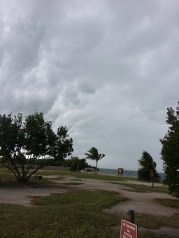
Cumulus Mammatus Not the last time I’d see them this weekend either
The National Weather Service had been forecasting a frontal passage for that day, Thursday, so I decided it was better to be underway during a storm, then anchored. With land and other boats so close by, being blown about by changing winds is far more stressful for me, then to be buttoned up in the pilot house, with wind and rain lashing the windows.
We stopped at Crandon Park Marina to fill up one of two water tanks. A nice place, with reasonable priced fuel (for southern Florida) and a really helpful, friendly staff. I could see the storm clouds building to our west as we started on the three hour, 15 nm trip south to Boca Chita.
And then it got strange.
My autopilot (ComNav) compass, a fluxgate compass (for those who care), is usually 10 degrees off of magnetic, but at least it is consistent. Consistent that is until you flush a toilet. It took me 6 months to figure out why when on autopilot the boat would make a sudden turn, as the compass heading jumped 30°. Turns out the fluxgate is located within 6 feet of the Lectsan Sanitation Processing unit, so the current thru the processing unit, is producing a magnetic field. Umm, maybe with the new generation of marine mechanics, their video games expertise has superseded the need for electro-magnetic theory. Maxwell’s & Ampere’s Laws? We don’t need no stinkin laws.
Yes, I’m looking forward to the next 30 years with unanticipated glee. Please Mister Old Person, show me how to get my thing (any electro-mechanical
device) working again. Sure, sonny, just grab this and yank here.
Sorry, I digress.
Sunset
Back to the Present
But, now with the storm bearing down on us, my autopilot compass was 90 to 180 degrees off and not steady wither. Totally worthless, and then the strangeness happened. My Raymarine GPS compass was also off by at least 40 to 80 degrees. Now that never happened before.
My Polar Navy gps was working fine, as was the Raymarine course over ground (cog), but to steer a heading, I, or actually, my crewmate for this leg of the adventure, Richard, no not me, another Richard, was steering, using the good old magnetic compass to steer by.
First, I decided to try to recalibrate the Raymarine compass, as it has always been good till now. It consists of making a number of circles. While we were circling, I figured I may as well recalibrate the ComNav also, as it also needed to do circles. After about 10 minutes and five circles, they each said they were calibrated. We continued south, into strong winds, but only 2 foot waves.
Within, a minute or two, the ComNav settled to it normal state of being, about 10° off magnetic, but it was consistent. In the meantime, the Raymarine went all wacky again. So, it’s Tango Uniform.
I was a bit disappointed to get to Boca Chita before the storm. I actually like storms at sea. There is nothing to bang into and nobody to bang into you. It’s freedom.
In this case, the winds had built to ferocious westerlies, 25 knots gusting to the low 40s. Boca Chita is a small harbor, in the shape of an square with rounded corners, about 300 feet on a side. The narrow entrance faces west, so as I entered, the wind was right behind me and I made a wide circle to the right, intending to anchor in the southwest corner. As I straightened up the boat, near the south wall, the winds were up to 45 knots (50 mph, 80 kph).
The plan was to tie a midships port line and use that as a spring, to bring the boat to a halt as it pivots against the wall as I give it full right rudder.
A great plan; the problem was the “helpers” on the dock. They are incapable of having the slightest clue about boat handling, vectors or anything remotely associated with physics (the whole universe. Now, you can mitigate this incompetence, if you are lucky enough to get someone, who will at least follow directions.
We weren’t.
We got the braniac, who decided he could halt the 40,000 lb. boat by holding the line, pulling and putting his whole 150 lbs into the effort. As the boat pulled him down the dock, he almost trips over the first cleat and is almost running as he passes the second cleat, while Dauntless is closing to within 10 feet of the corner wall, I yelled for the second time, this time even more forcibly and maybe even some expletive language, “put the fucking line on a cleat.” Somehow it sinks in, he does, and as I crank over the wheel we come to prefect stop.
Later, I see the helper and thank him. He does not invite me for a drink.
We would spend the next three days amazed that the number one maneuver to tie up was to come straight in, hit the dock with your bow with varying degrees of force, throw someone on shore a line and then have them pull the boat to the dock. If I saw it once or twice, I wouldn’t have believed it. But we saw it almost hourly.
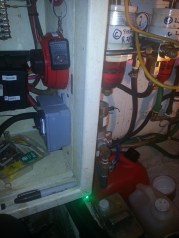
I got to put my electric fuel pump to use one again. This time, while running the generator I was also polishing my fuel and transferring it to one tank to get an accurate measurement of quantity. All off a sudden, I hear the generator lowering rpms, as its output voltage drops from 120 to about 60. I quickly, take it off line and jump into the engine room. I realize almost immediately the problem is that it is sucking air from the empty tank. I close that tank’s feed and reach for the little wireless relay remote that runs the electric fuel pump I installed with Richard’s help in Providence, RI. I switch it on, but no change on the gen, but then recognize that I must close the gravity feed, otherwise the fuel pump just pumps the fuel back to the tank, since that is easier than thru the fuel filters. As soon as I close that valve and open the valves putting the fuel pump in line, the generator goes back to its normal song. I run the electric pump for another 30 seconds, then turn it off, it’s duty well done and the three days it took to find the right fitting and install, well paid back, yet again.
My aux electric fuel pump. The red handle is normal gravity feed to filters and then engine/generatorMy wireless relay for fuel pump. The green light below, is on, when the pump is on. (just in case a Chinese satellite activates the relay)
Did I mention the first time I had to use it, I had just pulled away from the slip and in my pre start checklist, and I had turned off the fuel tank we were using?
Starving the main engine like that, as I ran the electric pump; I was happily bleeding air form the engine fuel filters, with a big grin on my face, as soon as the air was gone, I could switch the pump off immediately and the engine fired right up with nary a hiccup.
We are here in Boca Chita Key, part of the Biscayne National Park to get some work done on the boat on the cap and hand rails. I like the dock, it makes easy work and the scenery can’t be beat.
Monday, we will be heading to the Miami River, where with the help of Parks, of Hopkins Carter Marine, he put me in touch with someone who should have an affordable slip for me. Our paravanes are being fabricated as I write this and hopefully their installation will start Tuesday.
I’ll do a posting about the whole paravanes thing after the fact, so I do not have to eat any words.
Here are some pictures of Boca Chita, boats and the wild life. Enjoy
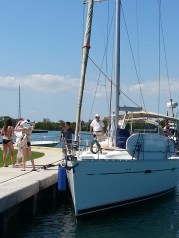
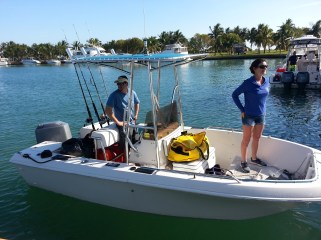
A Beneteau in No Name HarborNew FriendsSome of the wildlife
All the pictures (well, most of them) can be found at:








 Dauntless at Sea