(The below was written last week, while underway, midway between St. Vincent in the Grenadines and Bonaire)
It’s about time!
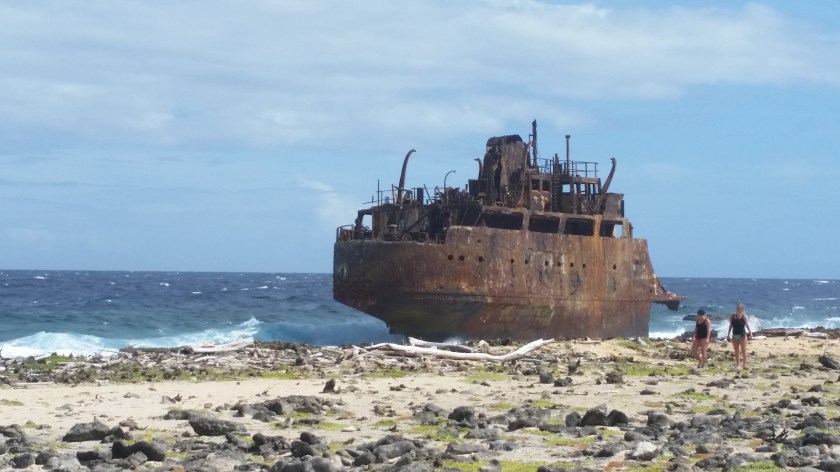
Don’t Let this happen to you. The wreck on the east side of Kleine Curacao
Anyone who looks at a weather map can see that the passage from the eastern Caribbean to the Dutch Antilles is pretty much the same conditions as the Atlantic from the Caries to the Caribbean.
That means strong easterly trade winds and the seas and conditions that they produce. They are trade winds, because they are produced by the global heating and not by low pressure systems, as occurs north of the tropics.
So, we are merrily rolling along. This is 42-hour point of a 70-hour trip. Do I worry about jinxing it, by writing that we had no problems? Of course, I do. But every once in a while, I feel the need to get really crazy. Hoping that Poseidon is playing with Persephone and doesn’t have the inclination to mess with Dauntless this time.
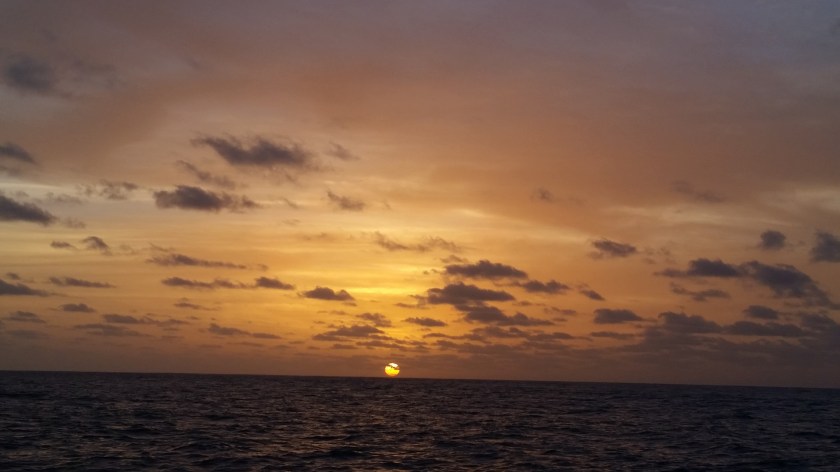
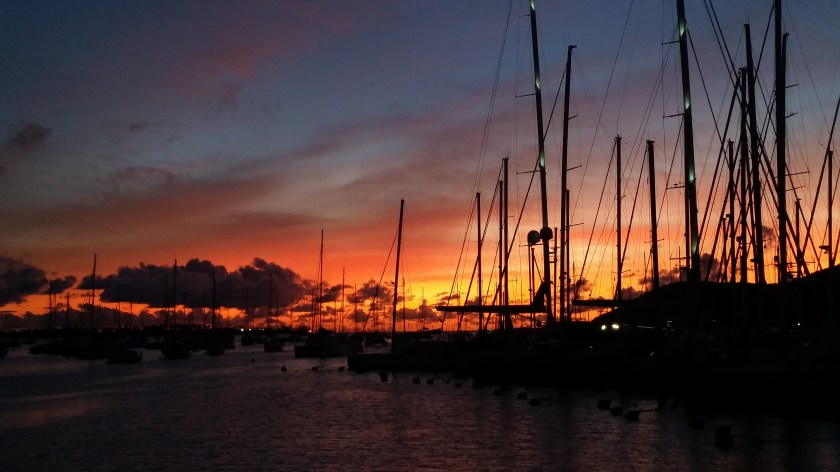
Sunset Looking Towards Bonaire
Now, if this post never gets published because we never made it. I take all the above back. But let’s assume that you are reading this in the comfort of your reading place and I am happily ensconced in Bonaire paying too much for everything and squealing like a pig as I do so.
Since I finally just published the account of an average day crossing the Atlantic in the trades, you should all know the routine my now.
And the weather is the same.
Sunrise
Easterly winds, 20 knots gusting to the low 30’s, with the direction varying from northeast to southeast.
As long as it has an easterly component, Dauntless can deal with it as we make our way west.
While the winds are about the same, the wave heights are significantly less. Thank God, no strike that, Thank Poseidon.
I guess that is the effect of the Grenadines and Antilles reducing the fetch (the distance winds blows over uninterrupted sea). There seems to also be a tidal current of 0.5 to 1 knot pushing us along. That means that yesterday, we made 156 miles in the first 24-hour period, that’s an average of 6.5 knots.
The extended length filling tube and funnel for the power steering
Our earlier Atlantic Passage, our average was 137 nm at 5.9 knots.
Yesterday, I made grilled chicken for us, with a side of pasta. I also made a tomato sauce for pasta, which we will eat today. This is something I have not made for many, many years, at least a half dozen, years.
I made this for Micah, as the time for him to return to school and get on with his life is now rapidly approaching. It’s the least I can do for his hard work and the diligence he as shown these past 8 months on Dauntless.
The three big problems we had previously: the mysterious fuel leak, paravane shenanigans and hydraulic hose failure, have all been overcome. The paravane poles have been the most interesting in that I am always tweaking the system. Sometimes my tweaks work, sometimes they don’t. But I pride myself on finding simple, inexpensive solutions and this stabilizing system is finally starting to speak for itself.
The hydraulic steering and the helm and for the ComNav Autopilot has never been quieter. Never, at last since I’ve owned the boat. And as Micah pointed out, the owner’s manual did say that one had to be patient as air would work itself out of the system in a few weeks. I did help it by rigging a Rube Goldberg looking filling tube and funnel on the upper helm. This allows the system to burp itself without the usually oily mess.
After the ABCs, we are headed to Colon and the Panama Canal, after a short visit to Columbia, where my brother is for some unknown reason. He’s never seen Dauntless, so it’s the least I can do.
Near term, once through the canal, we’ll head up to Costa Rica, where Micah will leave us and Larry, my Alaskan friend of 44 years who I met on T-3, will join me and D.
There is much to write about in my latest Atlantic Passage. We had full leaks, big seas, high winds and of course, the ever ubiquitous operator snafus. This post will go through a typical day, then address the issues that sprang up and how we dealt with them, in subsequent posts.
A Typical Day
Sunset over the Atlantic
03:35 hours, my alarm goes off, telling me it’s time to relieve Micah and it’s the start of another day. I lie in bed a few minutes, feeling the motion of the boat. What can I discern from that motion? How many times was I almost thrown out of bed last night? I brush my teeth in my forward head (sink, shower, toilet), using my knees and elbows to brace myself against the constant pitching and rolling. A dozen times an hour, we get the inevitable larger roll to starboard, as the stern literally falls into the deep trough that forms when the southeast and northwest waves trains meet under Dauntless. This also causes a large pitch up. As I put on a new tee shirt and my boat pants, either warm up pants or shorts, depending on the temperature, I slather my forearms and elbows with Neosporin. They take a beating every day with these conditions. The decks that I have traversed a thousand times are suddenly more narrow.
The Logbook showing Days 2 & 3
Lastly, before leaving my cabin, I make guess as to the conditions: wind, weather, seas. If it’s important enough to know, it’s important enough to think about it. It’s why the Socratic method of teaching works. In the darkness of the forward cabin, too many times I have convinced myself the boat is clearly spinning around like a top, or while anchored, or even docked, that the boat is moving forward at some incredible speed.
My making myself consciously think about the conditions outside while in a dark, closed cabin, the next time I have such thoughts, I will have better understanding that it’s not the boat, it’s my brain, and go back to sleep.
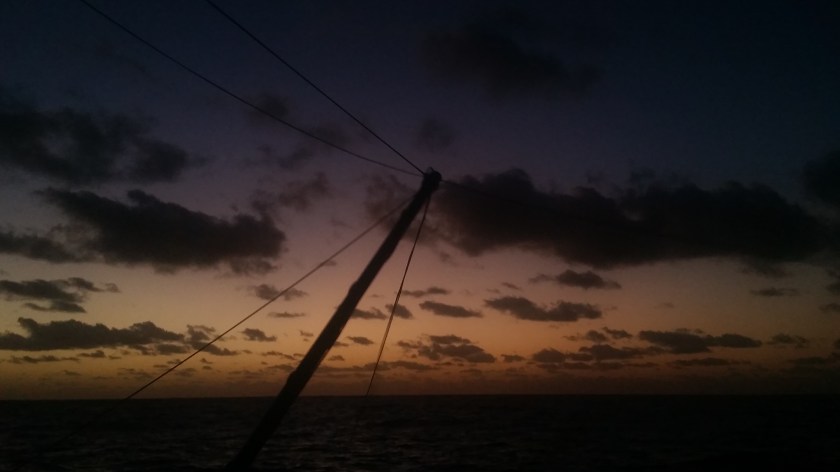
Looking East, Just Before Sunrise
03:45 hours, I leave my cabin, walking around the salon and galley, I’m also doing a sniff test, checking for unusual smells, our sense of smell being keener than sight or sound. Then open the hatch, down into the engine room: still sniffing, listening and looking. I check the usual suspects, the Racor filter and its vacuum (which is an indication of how clean or dirty the filter has become), then eyeball, maybe even feel the bottom of the engine mounted fuel filters to make sure of no leaks. Look at the injector pump and just around the engine for anything out of the ordinary. Even check that the amount of fan belt dust has not changed.
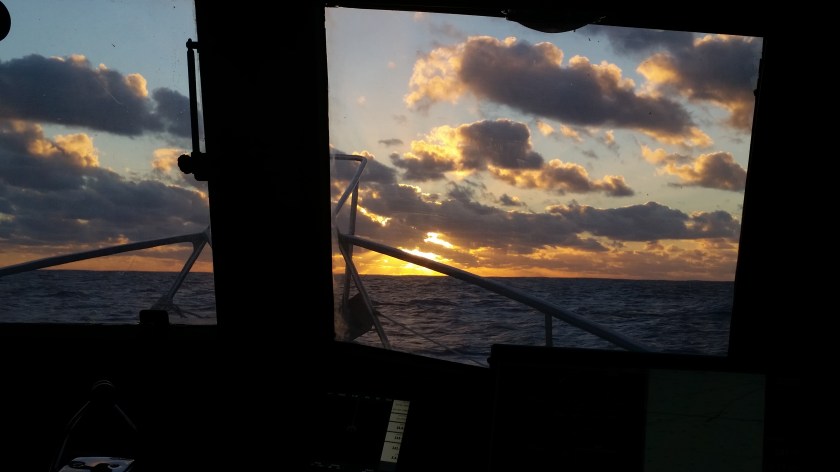
Sunset from the Krogen Pilot House
I put my hand on the coolant tank of the Ford Lehman diesel. It’s usually about 164°F and I can hold my hand on it about 1 second, longer means the temperature is lower, maybe 155. Shorter, and there is a problem, and I need to investigate further. I check the water maker valve settings. Making sure it is initially going to “test”.
Every other day, I would add about a liter of oil to the running engine. She consumes about 1 liter every 50 to 60 hours. So, I’d need to replace that. Then, with a last look around, I ascend into the salon and head to the pilot house to relieve Micah.
Dusk on the Coastal Explorer Navigation ProgramThe Moon watches over us
03:55. As I enter the darkened pilot house, I go to the log book to start the 04:00 entry, asking Micah what I need to know. On this passage, that’s usually nothing, No ships, no boats, no nothing. He goes off to a well-deserved sleep and I remind him to sleep as long as he wants, and that’s usually until late morning or noon.
04:00 log entry consists:
engine rpms (usually 1500 rpms),
speed (usually 5.9 knots this trip),
course (245°),
engine coolant temp (178°). (*These three instruments in the pilot house vary somewhat based on electrical issues, but it’s still important to monitor on a relative basis).
Oil pressure (*30psi, it’s actually 50 psi since I also have a mechanical gauge on the engine),
voltage (11.5 to 12.2v*). Any significant change to these three numbers does indicate a problem, since they almost never vary.
Every few hours, days, weeks, I use my Infrared temp gun to measure temperatures at the: engine coolant tank, 164°, oil filter, 156°, transmission 127° and stuffing box, 88°, for this trip. Other than the stuffing box, these numbers never vary. The stuffing box should be less than 20° warmer than the sea temperature, in this case, sea temp started at 76° and ended up at 83 in the Caribbean.
Storms to the East and South
Before getting settled in on the pilot house bench, I will usually go outside. Depending on how rough it is, I may just go to the stern deck. During this trip, the stern deck was awash constantly with water coming in and leaving by the scuppers. So I would stand on lower stair toward the bow.
Why go outside? Why go when Micah is already in the cabin, knowing to fall in the water is fatal? Because I like a few minutes of solitude, just me and Mother Nature. I like feeling the wind in my face. How is the boat really handling the seas. She talks to me, Everything is OK, just go back in the pilot house and let me handle this. Reassured, I do just that.
For the next few hours, I will read, or more usually play Bridge on the computer. Sometimes I watch Korean Dramas.
Some nights were quite dark, no moon or cloud covered. On those nights, one sees nothing. The first hint that a wave is there is the boat heeling. On full moon nights, visibility is probably greater than a quarter mile. But it’s still not good enough to see the proverbial shipping container, so I don’t bother looking.
In actuality, on the high seas, I think the greatest hazard may be sleeping whales, but since one hardly sees ones that are awake… (update – there is a 40-ft. sailboat docked opposite us, it encounters a whale, that ended up tearing the starboard rudder off. The hole was big enough that without the ability to heel the boat to port, they may have lost the boat.)
07:00 time for coffee and whatever frozen pastry I managed to save. Usually, I put the pastry in the engine room when I got up and did my engine room sniff test. The sun is coming up, giving me a look of the clouds and skies for the first time. I’ll look at what “stars” are still out. Estimate wave height and direction.
I have spoken to about a half dozen boats that crossed about the same time frame. We all noted that there were three distinct wave sets or swells. In the first week, there was a westerly swell of 10 feet, with wind driven waves from the east and southeast. After the first week, the pattern became all easterly, in that there were three wave sets, one from the NE, one E and one SE. Even my favorite weather app, Windty, at most mentions only the swell and one set of wind waves.
One of the sailors I ran into in Martinique, called these confused seas, “the bathtub”. The bathtub made for a long 21 days.
Now this wave pattern had a very interesting effect. About every 6 to 10 minutes, the SE and NE waves would meet under the stern of Dauntless, causing a very big corkscrew roll as the stern fell into the deep trough and rolled to starboard, as the bow pitched up and turned to port.
The Maretron data should these extra big rolls were about 20° to 25° to starboard, 10° to port, with a pitch up of 1.2°, followed by down pitch of 2°.
As I said, being alone, watching the sun rise, is very spiritual. One of those instances that I actually prefer to be alone.
For the rest of the day, log entries were made whenever we had a change to course or anything else.
10:00 to 18:00
More of the same. Micah would get up by late morning. We would decide what to eat at our main meal in mid-afternoon. For the most part we ate normally, which is to say, the freezer is stocked with various meats, pork predominantly, though we had two enormous rib eye steaks that we had found irresistible while in the Las Palmas market. I made the first one (enough for about 4 people) the first week out, but saved the second for Christmas.
The boat motions coupled with a very wet stern deck made for interesting grilling on the Weber Q280, but certainly still better than grilling in minus 20°F or at 40° in a 30-mph wind on our rooftop in the Upper Eastside of New York.
We would also use this time to watch some Korean Drama. K-Dramas are the perfect way to pass a few hours each day. Too tired to do something creative like write; sometimes too mentally tried to even read, so K-Dramas came to the rescue. Captivating enough to keep one occupied during the most monotonous rolling conditions. Thank God for Korean Dramas.
When the rolling was not so bad, we used that opportunity to play a board game. I made little non-slip pads for the pieces, but even with that, conditions only allowed our games on about a third of the days.
Much of the rest of our daylight hours was spent just checking things that were easy to check during the day. Walking around the boat, feeling the tension of the stays and lines for the paravanes, as they were under the most strain.
By the way, having waited four extra days for the winds to be favorable when we left the Canaries, as we pulled out of the harbor with 12 knot winds and seas 2-3 feet, I said to Micah, maybe we won’t need the paravane stabilizers the entire trip. An hour later, I put out the windward {port) bird. A few hours later, both birds were deployed and were needed for the next 20 days until we pulled into the harbor of Martinique.
Bob Dylan was right, never trust the weatherman.
We left the Canaries with full fuel tanks, but only one water tank (150 gallons, 600 liters) full. This was purposeful, as I wanted to use the water maker to fill the empty water tank. Our Katadyn 160 water maker makes 8 to 9 gallons of water an hour, so it takes about 19 hours to fill one tank.
Micah and I use about 40 gallons per day. The Katadyn 160 is rated to make 160 gallons per day or 6.67 gallons per hour, but I have axillary water pump, pumping water through two sediment filters, before it gets to the water maker. Therefore, I have found that on this trip, it produced between 9 and 10 gallons per hour, so we ended up running it about 50% of the time. Thus, it was convenient to turn it on when I did my engine room survey at 04:00, then turn it off in the early evening. I had pickled (put a preservative in it) in June 2015, 18 months earlier. This was necessitated by the amount of organic material in the rivers and estuaries o the North Sea and Baltic, made water making difficult, if not impossible. Thus, it was with some relief upon leaving Gibraltar that once I got it running again, it ran for the next month with nary a hiccup.
14:00 Local Canaries Time, which just happens to be UTC (Universal Coordinated Time, the time of solar noon at 0° Longitude)
14:00 was the time we left the Canaries, so I used it as our “official” 24-hour point. At 14:00 each day, in addition to the above log entries, I’d note:
quantity of water,
Quantity of fuel,
Fuel feeding from and returning to which fuel tank,
fuel filters in use,
distance travelled in the last 24 hours,
24-hour average speed,
current position,
current weather, sea state,
average pitch and roll for the period
the new heading and distance to destination.
18:00 to 21:00
Evening would have Micah taking a nap below. I usually took a little nap in the pilot house in the early afternoon after Micah was up and running. So, I would use this time to walk around again before it got really dark. Feel the lines, sniff the engine room and just get ready, mentally and physically for the overnight.
While his watch started at 22:00, he would usually come up the pilot house between 20:00 and 21:00. If early enough and I was not too tired, we would watch an hour K-drama. I developed the watch schedule because Micah was flexible with his sleeping, though he did sleep a lot. I slept less, but I knew I need 6 hours of good sleep. That ended being more like 5 hours, but it worked. Though I did find myself dozing off a few times after the sun rose.
More to come: The Good, the Bad & of course, the Ugly
We do a little 400 mile trip today to Bonaire, as we say goodbye to the Grenadines and head west.
See you in three days. You can follow at: Share.Delorme.com/Dauntless
I know it’s been quiet here the last three weeks, but I have been busy.
Sunset at Le Marin
I am in the process of writing a comprehensive account of our month on the Atlantic from Morocco to the Caribbean. Having very limited access to the internet, reduces my ability to upload posts and pictures.
But I have been busy. Today, Micah and I finally got everything put away as I have been re-organizing my tools, electrical stuff and miscellaneous stuff that is stored I the pilot house. It’s a lot of stuff.
It’s taken me literally two weeks to get it done. Why was it so hard?
I was spurred to action because after arriving we had some projects to do and a few things to fix or improve and during that first week, I found myself spending an inordinate amount of time trying to find various tools.
Having spent too many minutes trying to find a simple 13mm wrench, during the re-organization, I found the other 10 wrenches and 4 sockets. Yes, all 13mm. Why so many? Because I had it in my mind that I needed one, so every time I got close to a hardware store…
Sooner or later I shall have to find someone who is good at organizing. If not I may up be being the Cat Lady of the High Seas!
The picture is from last night and is yet another beautiful sunset at Le Marin on the wonderful island of Martinique.
Tomorrow we will be leaving, but just an hour south to St. Anne. We will spend a couple nights there before heading to the Grenadines later on in the week.
Every few days I post pictures in Instagram at DauntlessatSea
Some people cruise to escape the responsibilities they face on land.
Richard on Dauntless after Crossing the Atlantic Ocean
Most people cruise to enjoy nature and experience new sights, people, foods and cultures.
I cruise to solve problems.
In the past week, I have had a number of discussions with friends and fellow cruisers. Many ask, Richard, you are in a place, the eastern Caribbean, that most boaters would love to be. Why not stay longer; stop and smell the roses?
I ponder a bit, questioning in my mind why, what is so obvious to most, eludes me. Am I deficient? I know I am not stupid, but why do I push myself so?
Truth be told, I could go from island to island, bbq on the boat most days, eat out others, drink a few glasses of wine, maintain Dauntless, myself and the love of my life in the manner I’ve been accustomed to, even travel to Asia, Europe and the USA every year and never run of money.
I tell them I have a plan. Plans can be changed they respond. Yes, I think, I change plans all the time. But I always have a plan. When I do things without a plan, bad things happen.
No, nothing gets done without a plan. And yes, even crossing the Atlantic was being planned before we even found our little Krogen 42. It was being planned before I even knew Kadey Krogen’s existed. It’s what I thought about before drifting off to sleep on most nights.
So, the idea of having no plan, just going with the flow, is simply a life I cannot imagine. It would be easier for me to imagine living on Jupiter, the planet, not the city.
So, when I’m asked why not just do this the easy way? I have no problem answering, because it’s not in the plan.
There is one big caveat. I love sharing the joys of life, food, drink, laughs, experiences, with friends and loved ones. Not having a mate, a partner to share these experiences with this past year has put a damper on the cruising. If I had a mate who absolutely wanted to be in such in such place for a long time; I’d make it happen. Then I would modify the plan, but until than…
Now one of my really smart friends, knowing my answer, suggested why not do a boat trade. Surely there is someone in Alaska who would trade places with you. Let them live on your boat and you live on theirs’s in Alaska since that is your intended destination for this coming summer and next winter.
Now that has me stumped momentarily. But then, like a light bulb turning on, I understood the issue.
If my goal was just Alaska, then staying in the Caribbean for another year would be doable. Even trading boats or leaving Dauntless here for a year would be doable.
But from the beginning of the boat idea. From before the first Atlantic crossing, there was a plan, a goal and destination and everything that came before was a step towards that destination: S. Korea & Japan.
So, I cross oceans to get to the other side. I also do it because it is the ultimate problem solving puzzle. No phone, no help, it’s having a good plan and then adjusting the plan as need be.
It’s having to make do with what you have a not what you want.
It’s having to solve problems.
Throughout my life, in every endeavor I was involved with, I strived to make the system better ev, oftentimes to the detriment of my life or career. In hindsight, I should have done some things more delicately, but I don’t have any regrets. You fight the good fight or you may as well be the cow in the field eating grass.
So even as careers change and jobs end, I am still a problem solver. Cruising gives me the opportunity to solve problems. The best part is that they are problems of my own making.
I make mistakes and curse myself once in a while. I take a 1 hour job and make into a day or two, but at least I am cleaning up my own mess.
When that next destination comes into view, I pat myself on the back and say, Well done pig, well done.
Leaving Las Palmas Sunday morning, our next stop was planned to be Port St. Charles on the island of Barbados in the eastern Caribbean, 2636 nautical miles west.
Leaving the busy harbor of Las Palmas
The plan was to go north, around the top of Gran Canaria, then southwest between the islands as to afford some protection from the wind.
Leaving the protected harbor of Las Palmas, we encountered strong, NW winds that had produced, large seas since the current was running from south to north on the east side of Grand Canary island. As the seas built to 10 to 15 feet, it was clear that “this dog doesn’t hunt”.
So, 48 minutes into our Atlantic crossing, we turned tail and headed south.
An interesting start. Does make one a bit nervous when the plan changes in the first hour of a 400-hour trip.
We rounded the south end of the island and set the autopilot for 260° and settled in to an anticipated 16 or 17-day passage.
As the day progressed, the winds came around to the south-southeast at 12 to 16 knots and stayed that way for the next 26 hours.
Friendly dolphins escort us
The problem was with these SE winds producing 3 to 6-foot wind driven waves from the southeast, we also had a west to northwest Atlantic swell with waves 6 to 10 feet on a 10 second period. The combination produced a corkscrew pitching, though most of the roll was being eliminated by the paravanes stabilizers. It also slowed us significantly, doing only 4 to 5 knots through most of the period.
A close encounter of the annoying kind
A little after 04:00, it’s pitch dark outside, Dauntless is rolling along at 4.3 knots.
Finally, a period of calm winds.Dauntless is on standbyA cute harbor, with volcano in background
I see a radar return of a boat about a mile north of our course and pretty much on the same course. It’s a small boat, as the radar return is relatively weak and of course no AIS, the automated ship information that would have been on my navigation chart anytime an AIS equipped boat gets within 5+ miles. It also provides course and peed so it takes a lot of the guess work out. Since I’ve had it on Dauntless, big ships don’t get as close anymore.
I get the binoculars and can see his red running light as well as his stern light.
So, he is ahead and to the right of my course. OK, I turn left about 10° to put some distance between us. Over the next half hour, I realize, instead of getting further apart, he now seems to be on a direct heading towards Dauntless.
As I am looking at him again, it all becomes clear. He shines a spotlight on to his mainsail. And in this vast ocean, not having seen another boat for the last 12 hours, this guy decides to wait until we show up to tack and basically cut right in front of me. At night, with seas bouncing the boat around, he puts our two boats on a collision course.
What a fucking moron. Remember, it’s dark out. In day light, it’s much easier to understand the situation and what needs to be done. At night, with only the radar for guidance, nobody would want to purposely get so close to another boat.
I turn more to the left, south, but to my horror, within minutes I realize he is now only a quarter mile away. He shines his light on his stupid sail again. He’s telling me he has the rig
The other side of the IslandLava
ht of way, yes, he has the right to be dead too.
I’ve turned left twice, I am actually a bit afraid since my attempts to get further away, he is now closer. What don’t I understand?? Clearly, I understand neither his course nor intentions.
Again, this kind of situation is much easier to deal with in daylight, but now, only seeing two points of light, with no perspective, he could be 100 feet away, or it could be Mars and Venus.
I have to do something and do it quickly.
I no longer trust him, his course seems to be crossing ahead of Dauntless, therefore, I do the only thing I can to make sure he does not hit me. I turn sharply right, 90° right. This way, I can watch him and keep him to my left. He is going south, crossing my western track, so I will go north and once I get north of him, I will turn west.
I’m going north, he is going south and he passes me about a quarter mile to the west, on my left. In other words, if not for my right turn, he would have crossed just in front of Dauntless.
One of my rules is I never want to pass directly in front of another boat, big or small. I aim for their stern to pass behind.
After he passes, I turn again west and he turns again west now about a mile south of my course, but again on a parallel course. He’s probably going to Barbados also.
As the sun rises I can see him off to the south.
A Course Change
Finally, a few hours after day break on the second day, the winds died down (as forecast by the way) to less than 5 knots. The NW swell was still present, but without the wind driven waves, we could pull in the paravanes birds and our speed increased to 6 knots at 1500 rpms.
Now at this point we were still about 45nm ESE of the furthest west Canary Island, El Hierro, the island that Columbus set off from 500 years ago from the port of La Restinga.
Our current course was 260°, the port of La Restinga was at 289°, therefore not a big detour and when I looked more closely, it only added 6 nm to our entire trip. Thus, even though I was sure we had enough fuel for Barbados, if I would run out of fuel within sight of Barbados, I don’t think I would ever hear the end of it.
And I felt it was best to get away from my errant buddy. I’m in credulous that anyone, at night, would purposely pass in front of another boat.
Sunset in La Restinga
Thinking of the encounter a couple of hours later, I think that even though I saw his boat for quite a while, he must not have seen Dauntless, until he tacked in front of me. But still, why make the safety of your boat depend on someone else’s action? Sometimes Right of Way really means Right to Be Dead.
Seven hours later, we pull into the little harbor of La Restinga. It’s really a cute little harbor.
Docked along the wall, behind the rescue boat, the security guard came by, to help with our lines and take our information. Very nice. As I have said previously, all of a sudden, being in the Canaries, is like being in northern Spain again.
These are sea-going folk, unlike the olive and cattle people of Spain’s southeast.
Well, after we got all tied up, it turned out we cannot get fuel until Wednesday, as Tuesday was a big holiday, so just like that, we are having a two-day vacation.
For a few seconds, I briefing debated just leaving, but again, I don’t like being ridiculed and more seriously, I was meticulous in fueling at Las Palmas, so this gives me an opportunity to measure my exact fuel consumption at 1500 rpms over a 30-hour period.
My guess is that it will be 1.4 gallons per hour, ±0.1 gallon.
I’ll tell you tomorrow.
And now Wednesday night, it is tomorrow. But still no fuel. They ran out. Maybe the truck comes tomorrow. Maybe.
In any case, once having made the decision to stop for fuel, I will wait for fuel. I only need about 50 gallons, 200 liters, but it’s a cute harbor, with nice people, excellent food and wine and it’s a volcano.
Four days on the North Atlantic, 600 nm, four days, 1 hour, 35 minutes, what could go wrong?
Dauntless is ready to Leave Morocco
For one, we found the weak link on this Krogen, it’s me.
In my first year of cruising, I would get sea sick maybe a ¼ of the time. Now in my third year, it’s more like ¾.
What’s changed? Who knows? I’m older, but usually one’s body becomes more adapted. No, I think the problem is in my brain.
When conditions are rough, I know to take a remedy or put on the Scopolamine patch. Now the patch gives me a bad rash, something it did not do a couple years ago, but it’s also very effective as long as I put it on the night
Sunset over the Atlantic
before departure.
With nice cruising conditions, or I should say, relatively nice, winds and seas less than 15 knots and 3 feet (1m), respectively. In the past I never had to worry, now, if the slightest unexpected event happens, I get seasick.
Grand Canaria comes into sight
This last episode was one of the worst I’ve ever had. But I’m not 100% sure it’s “seasickness”. It’s more like my body gets a whole load of adrenaline and then when crisis is over, my body doesn’t know what to do.
Monday, the 28th, Day 1 of 4. It was great to get underway again. Having an extra week in Morocco was not needed. The Moroccans are lovely people though and even that morning the Pilot asked me if I wanted to go out with them that morning to check the inlet. I’m always up for an adventure, so of course I went. The winds had finally died down, so I was a bit surpised to see 6 to 8 foot waves at the inlet. But they were not higher, so they declared the port open.
Grand Canaries
That started the whole customs, police and immigration process. Basically, just like checking in, you leave your berth, go to the designated dock and all the above come visit. It took us about an hour to check in 3 weeks earlier, and it took about an hour to check out. If that seems like a lot, you should know that in southern Spain and all of Portugal, it always seemed to take half an hour. (the difference between northern Europe, including northern Spain and southern Europe is like night and day; it’s mind boggling).
So, Day 1 started out with our checking out. The customs or immigration lady, who checked us in with her team of three others, checked us hot. Must say, she was the hottest officer I have ever seen. But she was all business, all the time. If you have ever been to the Soviet Union, you can picture what I mean.
The process, though time consuming, was easy and extremely convenient. As we pulled away from the dock, we waved at everyone and headed to the inlet.
Those steep inlet waves test that everything on the boat is stored securely and all was so we headed southwest along the coast of Morocco. While the winds from the south were light, there was an Atlantic swell of 8 to 10 feet, with an 8 to 10 second period. Not bad, but it necessitated us having the paravanes out with the two birds in the
Las Palmas
water.
Day 1 ended after 24 hours and we did 133 nm.
Day 2 (starting Tuesday at 14:35, the second 24-hour period) started the same, light SE winds, but became stronger through the entire period. Finally, at the 47-hour point, mid-afternoon on Wednesday, the winds had increased to 25 knots. With our southwesterly course, this meant they were off our bow. This makes the course untenable as we end up burning fuel to go slower and slower, all the while pitching up and down like one of those mechanical bulls!
Our initial destination had been the Canary Island, Fuerteventura, but with these strong SE winds, we needed to head more west, like 240 degrees. Thus, our new destination became Las Palmas, on the island of Gran Canarias.
So, Day 2, 150nm, (the second 24-hour period) ended with us headed 240 degrees, with winds 160 at 21 knots gusts to 25, producing seas from the south of 4 to 8 feet.
The paravanes work most effectively with seas on the beam, so our ride was actually not so bad with a gentle rolling of 8 degrees to the lee side and 4 degrees to the windward side.
Two hours into Day 3 (Thursday, 16:50), I was in the galley, when I felt the boat motion change. I looked out the salon window to see the windward paravanes bird being dragged on top of the water, clearly broken.
At first I was really calm about it. I finished filling my water bottle. Then went to stop the boat, retrieve the pole and bird. Dauntless is quite tame when not underway, in other words, she rolls much more underway w=then when dead in the water. So, there was no big crisis.
The two spare birds are stored in the lazerette. The one that broke had been repaired in Ireland, as it had previously broken crossing the North Sea. So, I wasn’t too worried as to the cause. But as we tried to get the bird out of the lazerette, the fin of the bird became lodged under the generator exhaust hose. And the more stuck it became; the more stressed I became. I didn’t like the idea of leaving it as it, so close to the hydraulic rudder piston, but after 5 minutes of trying dislodge it, I gave up, took the bins out of the other side and got the other bird that was stored on the other side of the lazerette.
It took just another minute to replace the broken one and we were underway again, finally 20 minutes later, having spent more than half that time, trying to get the one bird out.
Underway again, all was good, but I was feeling very strange. I had to change my clothes, since I spray everything in the lazerette with various WD-40 products. After changing my clothes, I figured a shower would help. I felt very hot. I shower quickly, figuring that cooling off would make me feel better, but now, I can’t dry myself. It was a bizarre feeling. I didn’t seem able to stand or move.
I tell Micah that I will join him momentarily, figuring if I just relax for a few minutes all will be fine. As I am now sitting on my bed, still sort of wet. I finish drying myself, realize I need to rest, but want to walk around the boat, make sure all is OK. As I go to put on my shirt, I became violently ill. First time that’s happened in years, even though, I get sea sick a lot and have that miserable nauseous feeling, I don’t throw up. This time I did.
I realized I can do nothing physical. I tell Micah to make sure everything looks OK and I needed to nap.
I do and three hours later, I am up and OK.
Winds were weakening, but the westerly swell was still there, so we kept the birds in the water. Finally, when I came on watch at 04:00, I decided to pull the birds to make some time (the birds cost about 1 knot of speed).
Day 3 ends, 147 nm, with the winds SE at 10 knots and we’ve been making 6 to 7 knots the whole time.
Day 4 starts with me adding a quart of oil to the engine while underway. It had been 72 hours and the Ford Lehman uses about a quart every 50 to 60 hours. Winds of 10 knots or less allowed us to run without the paravanes for most of the period, but by early morning, the roll had increased to an annoying level. Our course had been 232 for the last 20 hours and the winds were now 210 at 10 kts, and the seas 210 with 3 to 6 foot waves. This meant we were now heading into them, but with 40 miles still to go, there was not much we could do. The waves were also causing an annoying corkscrew motion, a combination of pitch and roll, so I decided to put one bird, the windward bird, in the water.
This past year, since leaving Ireland, I have on a number of occasions, put only the windward paravanes bird in the water. It still is 80% as effective as both birds, but it reduced our speed a little less, 0.7 knots, versus 1 to 1.2 for both.
And that’s how our passage from Rabat to the Canaries ended. We pulled up just a mile from the harbor, pulled the bird and we entered the Puerto Deportivo De Las Palmas on Friday at 15:26.
Day 4, 167 nm, 25 hours, 35 minutes, average speed 6.5 knots.
Total for trip: 598 nm, 4 days, 1 hours, 35 minute, average speed 6.2 knots
Yikes, looking at this Blog, I’m still in Rota, Spain.
Like New – AgainLike New- Again
That seems like eons ago!
So, while Micah and my friend Larry explore Morocco, I will take this opportunity get caught up.
Bouncing around at anchor
Maybe my lack of writing has been a function of the cruising conditions.
Getting back to Dauntless after a month the sigh of relief was probably audible across the Atlantic. Her month on the hard went perfectly. She had shore power with no interruptions the entire time (I have thermometers for fridge and freezer, which records max and min temps).
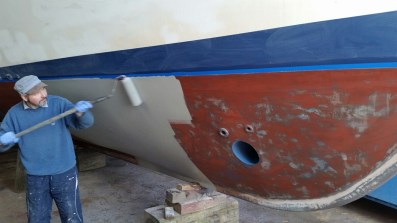
The gouge I had put into the side had been repaired
Our first spot to anchor heading into the Strait.
and painted. The anti-foul undercoat was re-applied over those sections that the straps of the travel lift had lifted off when being splashed in Ireland.
So, for less than $200 she was back in the water looking like new again.
All in all, a great relief.
But now, it was time to get underway and make some miles.
Second Anchorage. Easily found thanks to Active CaptainBusy avoiding ships
And they turned out to be tough miles. The 87 miles from Rota to Gibraltar had to be broken into three different segments. Each time the winds picked up on our bow and once they reach 15+ knots, it makes the situation pretty crappy.
Nautical miles
Time Hr:Min
Average Speed (KTS)
Reason for Stop
37
7:35
5.5
Winds on the nose, continued to increase
29
5:05
5.6
Same as above
18
3:30
5.0
Finally, in Gib
Our first stop, was a bit of desperation. Just NW of the lighthouse off Cape Trafalgar, it was not that well protected from the easterly winds, but it was better than burning fuel to go mostly up and down. We only stayed about 4 hours, but this was enough time for the winds to die down and we got underway again.
This stop also provided another example of how the “police” are about helping, not enforcing. After we were anchored about an hour, a Spanish Civil Guarda (national police) boat sidestepped themselves to within about 100 feet of Dauntless. I came out to the pilot house door, two guys came out of their boat and yelled over the wind whether I spoke Spanish. I replied only a little.
They asked, “problem”. I responded, “no, I wait for wind” They waved, said OK Adios and slowly motored off, until their wake would not rock us any more than we are already rocking.
In the more than two years of cruising in Europe. I have always found the maritime authorities were always about help if needed, but not enforcement.
Our next stop, west of the causeway at Tarifa was much better, as the Active Captain description explains. We were well out of the wave action, so the boat was pretty quiet. We stopped here at 02:00 and had a much-needed sleep. Then though I was up by 08:00, the winds were up to, so we just sat and waited. Finally, by early afternoon, the winds died down and we took off, now only 18 miles from The Rock.
The Rock from across the Bay
The last of our challenges, the 6 miles crossing the Gibraltar Bay. There are two areas for large ships to anchor on the west and east sides of the bay. We went through these areas pretty close to the anchored behemoths because it reduced our exposure to the super-fast ferries from the Ceuta on the African coast to Algeciras, the Spanish port just north of Gibraltar.
Those ferries, once spotted would be 3 or 4 miles away, but right on you within minutes. When we left Gibraltar a few days later, they would give us quite a thrill as three of them raced across the Straits seemingly aimed right at us.
is easier said than done. These past three weeks has been a nice respite from the duty and responsibilities of Master and Commander of Dauntless.
The last 10 days in Italy, at the house of my friends for 40 years, eating, drinking, sleeping, eating, drinking, sleeping, ad infinitum, lulls one in into a stupor sweeter than any chemically induced experiment.
It’s a good life and it’s obvious why it has attracted me all these years. But it’s also just as obvious, even more so, that I have structured my life in such a way that when I am in Italy, I am truly on vacation. Sure I am still like the oldest son of the family, but other than some chauffeuring duties, which I enjoy immensely, it’s just eat, drink Prosecco, nap, from morning to late night.
But all good things must come to an and, so I find myself stealing glances at the Atlantic charts. And in that incessant way that can be both annoying and gratifying, clicking on strange links.
Indirectly it also answers my questions that I had asked so many in Europe, about the seemingly overabundance of jelly fish in both the eastern Baltic and now also this year in the rivers of Lisbon in particular. Seems to be related to salinity. Oh, now I remember that the Baltic is only half as salty as the ocean. Probably much like the Chesapeake.
In 7 days, we push off from the European Continent and head for darkest Africa, OK, only Morocco, not so dark, in fact, pretty f…ing bright, but allow me some editorial license.
In less than 30 days, we then push off of Africa for the Caribbean. No embellishment needed here.
Ok, got to go, I have a delicacy or two to snack on.
A Cornucopia of delicaciesdessert – ChestnutsA Favorite SpotA Great Spot of Italian Snacks at Affordable PricesCrostini di ProsciuttoCrostini di LardoA Morning Snack
The table below has our tentative cruising plan for the next four months. While the dates are somewhat tentative, you know me, I like sticking to the plan.
Kadey Krogen in Spain and Galicia
A few explanations about the below chart:
The tentative arrival date is just that, but the departure date from the previous port can be derived from the required days (4th column) minus the arrival date. E.g. Departure date from GIB (Gibraltar) is 1 day before arrival at Rabat, so the 7th of November.
2nd Column, Type, “C” = Coastal cruising, “P” = Passage, i.e. No Stops.
Crew consists om my Hawaiian nephew Micah who has travelled with Dauntless since Ireland and is a very flexible soul and I.
We have others joining us for various legs, though at this time, it looks like I still would like to have a couple or one person for the passage from the Canaries to the Caribbean. If you think you have some interest in this, please email me, sooner rather than later.
I am excited about getting this new phase underway. So much of my time, my life, my adventures have been in Europe. I’m ready for a big change. It will take a year to get to Alaska and another year to get to Northeast Asia.
Dauntless is as ready as she has ever been. Unlike coming east two years ago, all is ship shape. Spare parts are stowed and organized, fuel tank vents are moved, paravanes are rigged to run more effectively and can be easily run much deeper if need be and the two air conditioning units are even working.
Here are the current winds for the mid-Atlantic. To get an approximate idea of the Dauntless’ route, visualize a line from the bottom of Spain to NE South America. Following winds or no winds. the se are the “Trade Winds” and are pretty constant all winter.
The New Dauntless on a mooring in Scotland, flying her purple Kadey Krogen flag.
Just in case you missed it, here are the pictures of Dauntless, before and after her winter in Ireland.
It was a transformative time!
In the Beginning. 3 years ago
When I get back to Dauntless in a couple of weeks, it will be time to get her wet again.
The New Dauntless, on the hard. The missing anti-foul was caused by straps of the travel lift. The green sheen is organic growth just above the anti-foul.
Then, just days later, we will take the first steps in our voyage back to North America.
I will miss Ireland. I will miss the friends I made and the people who worked on Dauntless like she was their own. We’ll have to make it back there some day.
Gary Mooney, the GRP and Painter, was meticulous in mixing and applying the AWLGRIP paints.This is the layer of the undercoat for the anti-foul going on.Gary applying the first layer of epoxyThe New Anti-Foul. The scrapes pulled off some of the undercoat.My latest scratch/scrapeFall 2015 Dauntless is strapped down for the winter. Dauntless was hit by winds of over 100 mph this past winter while in New Ross. But since it wasnt a “named” storm, it was just another winter in the northern Atlantic and therefore boats are strapped down.May 2015The Krogen out of the water
1974 Alfa Romeo Montreal
205 built in 1974
200 horsepower 2.6 litre V-8 engine
Designed by Bertone
Top speed of 137 mph (downhill!)
5-speed manual transmission
rear-wheel-drive
166 – inch length
2+2 seating configuration
Kadey Krogen 42
1988 Kadey Krogen 42-foot Trawler Yacht
11 built in 1988
135 horsepower 6.2 litre I-6 Ford Lehman engine
Designed by James Krogen
Top speed of 9 mph (in calm winds and flat seas)
1-speed manual transmission
In-line shaft-drive
504 – inch length
2+2+2+2 sleeping configuration
A few weeks ago, I did another road trip. A quick three-day trip from Lisbon to A Coruna, 720-mile round trip. It made me think about my travels, on land and now, by sea, and reflect on both the similarities and the differences between land and sea.
No, this isn’t one of those crazy dissimilar performance tests that Car & Driver became famous for back in the day.
As my life transitions from land to sea, I still savior those moments on the hard. Driving has always been a joy for me. From my first trans-continental trip to midnight drives around Mt. Rainier in the middle of the night, driving has always been a skill that I continuously honed.
North America provides endless miles, from Florida to Alaska, the dessert southwest to the Gaspe Peninsula, all well-travelled roads for me.
Then Europe provided another whole different experience: unlimited Autobahns, miles of roads through hill and dale at even faster speeds. From France and Spain in the west to Romania in the east and oh so many miles just going north and south from Holland to Italy, a true cornucopia of roads, conditions and cultures. Finally add a few driving schools, including a 4-day school done by BMW driving school at the famed Nurburgring, and being a driving instructor at club events enabled me to further hone my driving skills.
What drove me to do most of these miles, these long trips with quick turn-arounds?
Women of course! Well, maybe not all the time, but…
All these travels were done in the plethora of cars in my life: 3 BMW’s, 3 Alfa Romeos, 3 Jeeps and one Mazda, two motorcycles and many, many rental cars.
The best of the best was my Alfa Romeo Montreal. Built in 1974, never a big seller as Alfa’s only V-8 was introduced just when the first gas crisis was going on, but me oh my, what a car.
She was fast yes, but driving cars well is never about speed. It’s getting the most out of what that particular car could do. She was perfectly balanced and so tough.
That was the Montreal. Perfectly balanced, she had no bad habits. She felt like on rails no matter the speed or the conditions. She went over jumps with aplomb and I’d had her brake discs red hot on a few occasions with nary a problem.
So why have I been going on and on about cars and driving? Does it even relate to boats? Boats are inherently much more complicated than cars. Is that it?
Driving a car well, to the best of the car’s ability and design, is about the knowledge and skill of the driver. Ultimately, a cars performance is a function of what I can put into it.
Last year my Alaska friends, Larry and Karla, joined Dauntless to cruise from Ireland to Northern France. The crossing of the English Channel was rougher than one would like, you know with those seemingly ubiquitous 6 to 10 foot seas that Dauntless also seems to find. Larry later told me he was a bit afraid. But after the first 12 hours he realized that Dauntless wasn’t fighting the seas, she was going with them. No matter how big the wave, the boat seemed to ride along as the wave passed serenely beneath us. Sure we pitched and rolled, but not in a harsh manner, just smoothly like she had been doing it her whole life.
And then my epiphany.
I understood the difference between driving the Alfa Romeo and being the Kadey Krogen skipper.
On Dauntless I am like a passenger. Oh sure, I have my Master’s license and as the Skipper I am responsible for everything that happens on board. I decide where and how to go and to do it in a safe manner.
However, this Kadey Krogen performs.
Just as the Montreal ruled the road; my Krogen does what she does as well, even better. In the last three years, I have done a number of things I would prefer not to repeat. Has it been uncomfortable at times? Sure. Can I sometimes mitigate contrary winds and seas to get a better ride? Yes, I can do that.
But no matter what the conditions or what I do: beam sea, head sea, following sea, etc., my Krogen just does it, with never a complaint, never a groan nor shriek.
I point the boat in the direction I want to go. Boat never says no, in fact, Dauntless says, “Sure, no problem, it’s just another day in the park for me”
And that’s what Larry meant when he said the KK just went with the seas, never fighting the waves, but being one with the environment. She does what we ask. And that’s why I have never been afraid; I’m going along for the ride.
James Krogen is the real driver. He designed and built a boat for people like me who wanted to get off the beaten path in a boat anybody could call home. All I do is point us in the right direction. The Krogen does the rest.
The real motto of Kadey Krogen should be: Performance is Built into Our Boats; She’ll Make You Worthy in Any Sea.
Kadey Krogen said this: “The late naval architect and designer, James S. Krogen, was a master of merging the tried and true with fresh, innovative concepts, creature comforts and convenience. His near-three decades of commercial design gave extra dimension and distinction to his offshore pleasure craft. Outstanding performance is inherent.”













 Dauntless at Sea