One needs to have a good plan to accomplish the goal, but sometimes, life happens, plans change and maybe the goal too.
The rub is, it’s even easier to change the goal, then to make a better plan for the circumstances.
But changing goals is a slippery slope; so easy to do, but before you know it, you’ve accomplished nothing.
In 8th grade I decided I wanted to be a meteorologist. Seven years later, in my last year at the University of Washington, I hated school, I was bored and tired of not having any money. But unlike many of my college friends who dropped out, transferred or just disappeared, I persevered.
I had a goal to accomplish. Three Master’s degrees later, each one to further some career goal, I look back and am satisfied with the goals, though some of the plans to accomplish those goals should have been re-thought.
Dauntless has been in my life for 5 years now. Inexplicitly, it doesn’t seem that long at all to me at all, it still feels like yesterday or at least last year.
The goal to take a boat to Europe and then S. Korea is even older, maybe 9 years. That goal drove the search for the right boat. A boat that could not only cross oceans but do it in a manner that I could afford on my meager pension.
The original plan was to cross the North Pacific this coming summer and arrive in Yeosu, S. Korea by October 2018. Instead, I find myself agonizing over how to get up the Pacific coast of Mexico. The North Pacific seems further away than ever.
But the goal doesn’t change; though the plan must.
I now have some intrepid fellows helping me with the first and hardest, part of the cruise north. Having good crew can put a lot of wind in your sails. It also allows me further tweak the plan. Maybe I can get to San Francisco Bay sooner, rather than later. Then, I would be able to spend some of this summer and fall cruising with good weather and friends.
So maybe some baby steps are in order for the next few years, but the destination remains the same.
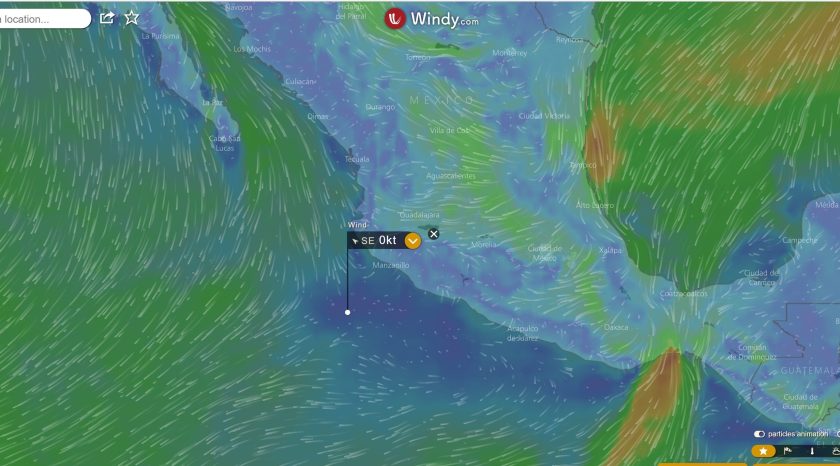
In one of my recent posts I talked about my use of Windy.com and how much I like the GUI they have developed. It’s an easy way to look at the two-main worldwide weather forecasting numerical models, the GFS and the ECMWF.
The mid-Atlantic on 11 March 2018 as depicted on Windy.com
Almost a year ago today, I wrote the post “The Atlantic is a Harsh Mistress”. This was my first reaction to the reality of what we experienced versus the anticipation of what I expected.
I had read so many accounts of boats crossing oceans. Not having any experience, myself I was not sensitive to the subtle differences of the trade wind Pacific versus the Atlantic.
Hey, it’s the trade winds, characterized by strong steady winds and large, 15 to 30-foot-long period waves.
Easy Peasey, as Micah was fond of saying.
I’d just read an account of Kadey Krogen 42 doing the much longer passage from the California to the South Pacific and Australia. Their only problem was boredom and they ran out of Coca Cola. I wouldn’t have those issues. Having lived in Europe on and off for years, I’d long ago learned it best to wean myself off American products. And boredom, not when I had countless hours of Korean Dramas and a crew mate in Micah, who also liked them as much as I.
I still vividly remember leaving Heiro, the western most island in the Canaries to small seas and steady winds. After the first hour, I found myself thinking this could be an easy three weeks. An hour later, as the seas and winds increased, I deployed one paravane stabilizer, another hour later, I deployed the second. We stayed in that configuration for the next three weeks.
It was anything but easy. The passage was characterized by three wave sets (swells).
Swell are longer period waves that develop when the wind blows over the ocean for long period of time. Thus, winds and storms, hundreds or thousands of miles away cause swell.
The primary wave set or swell was from the east, the second from the northeast and the third from the southeast. The third had the longest period (time between waves) of ?15+ seconds. The other two, were on the order of 9 to 12 seconds.
On top of this all, were the wind driven waves. These waves are created by the wind at that location and if the wind stops the waves stop also. These waves had a period of about 7 seconds.
The result of all this was that we had 12 to 15-foot waves from the east, right behind us. My Kadey Krogen loves following seas, but what made it so difficult was the other two swells with different periods hat produced a corkscrew movement. Then every 8 minutes or so, the NE and SE wave troughs would meet under the stern of Dauntless and we would do this wild corkscrew movement with first the bow pointing to heaven and then seconds later, twisting down.
It was a wonderful corkscrew if I was on a roller coaster.
Here are some videos of the experience:
Error
This video doesn’t exist
I love my boat so much.
Error
This video doesn’t exist
Error
This video doesn’t exist
Error
This video doesn’t exist
In the middle of the Atlantic,15 December 2016. The Kadey Krogen flag is now in tatters.
So that was my introduction to multiple swells. Oh, I had noticed it before in the north Atlantic, but I attributed to “rogue” waves and it was not so systematic as in the trade winds.
The result was best described by some sailors I met in Martinique who had just done the same crossing. They called it the bathtub, because the water was so disorganized.
On the far right, you can see the vertical column where “waves, swell, swell2 and swell3” can be chosen.
Looking at this data today, mid-March, it’s also apparent why the best time to cross this part of the Atlantic is in early winter, as the when we crossed in December, at least all the winds and waves had an easterly component. Now, you can see that there is a swell from the northwest, that must be very unpleasant.
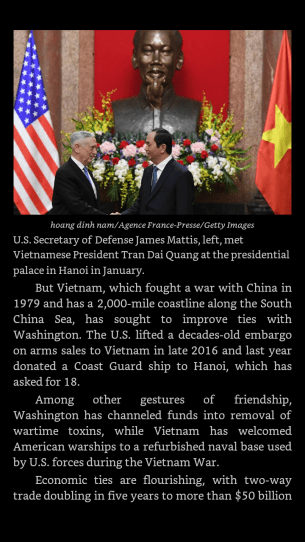
Because I know how sensitive this subject can be for Americans of my generation. I didn’t want to offend or disrespect anyone.
Disrespectful to the American veteran who was put into a shitty situation thru no fault of their own and told to fix it, without the tools to do so. Disrespectful to those who lost life and loved ones. Disrespectful to those Vietnamese, who if they survived the war years, then had 20 years of a very hard life or if lucky enough, were able to flee with only the clothes on their backs.
So, what changed? Living on and off here for the past year, I see people, no matter what their background who are truly appreciate of Americans, like Americans and just want to work hard.
I’m watching Anthony Bourdain: Parts Unknown – Hanoi. Find it someplace and you can see in pictures and sound what I am trying to explain poorly.
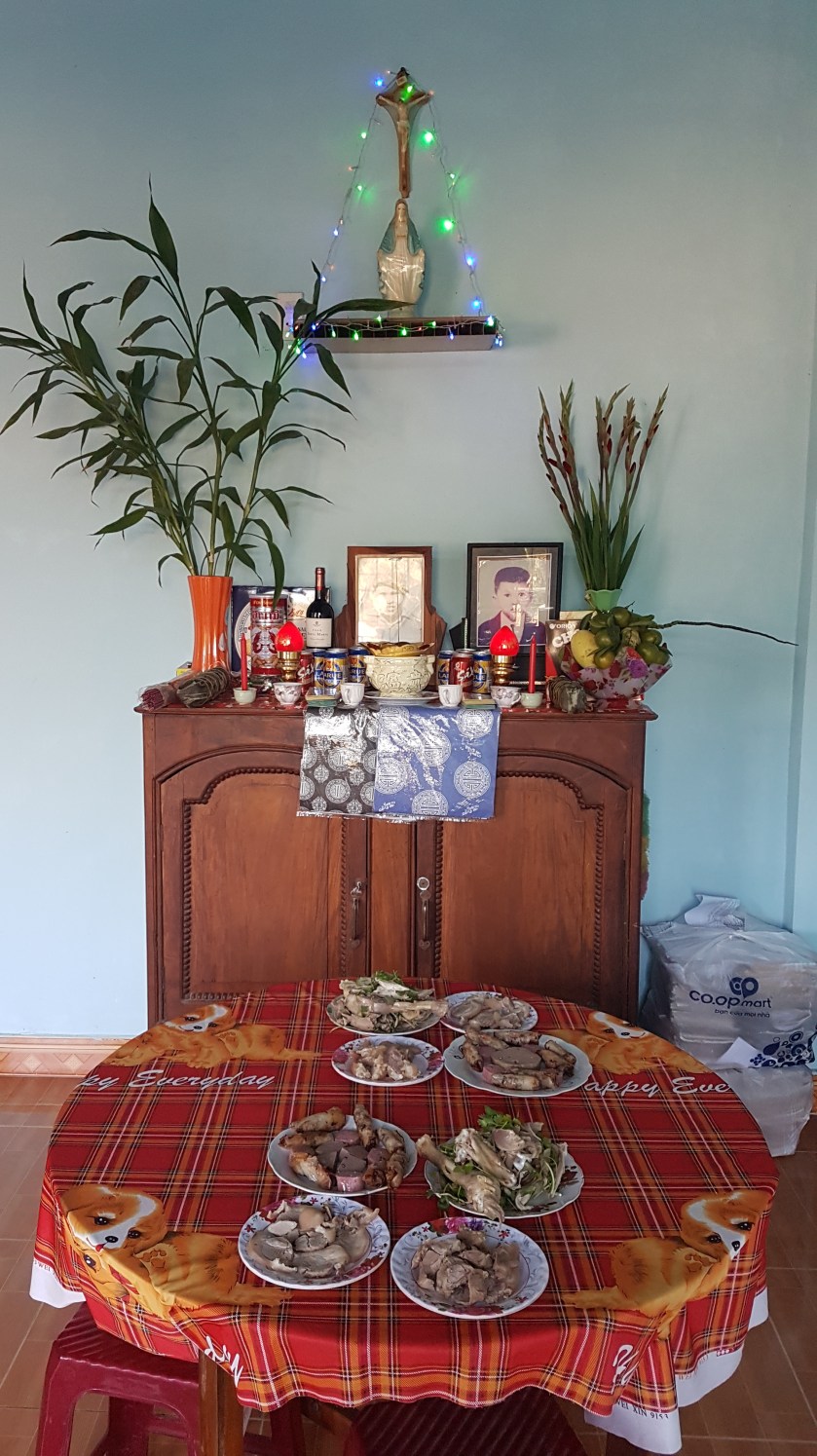
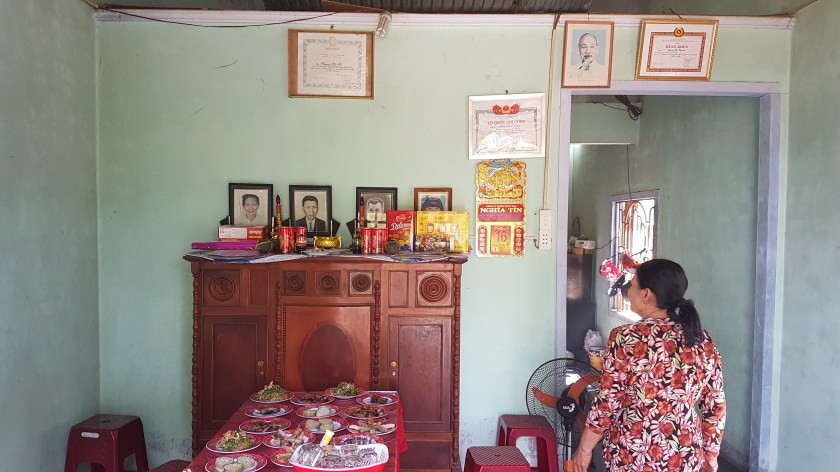
I just got back from two weeks in the country for the Tet holiday. Upcountry as some could say, in Quang Nam province, just southwest of Danang. Simply put, Tet is about remembering the dead and living. Country living here is like living in the countryside in Europe 30 years ago or the USA 50 years ago. Yes, that means we have electricity and cold running water, but everything else may be luxury.
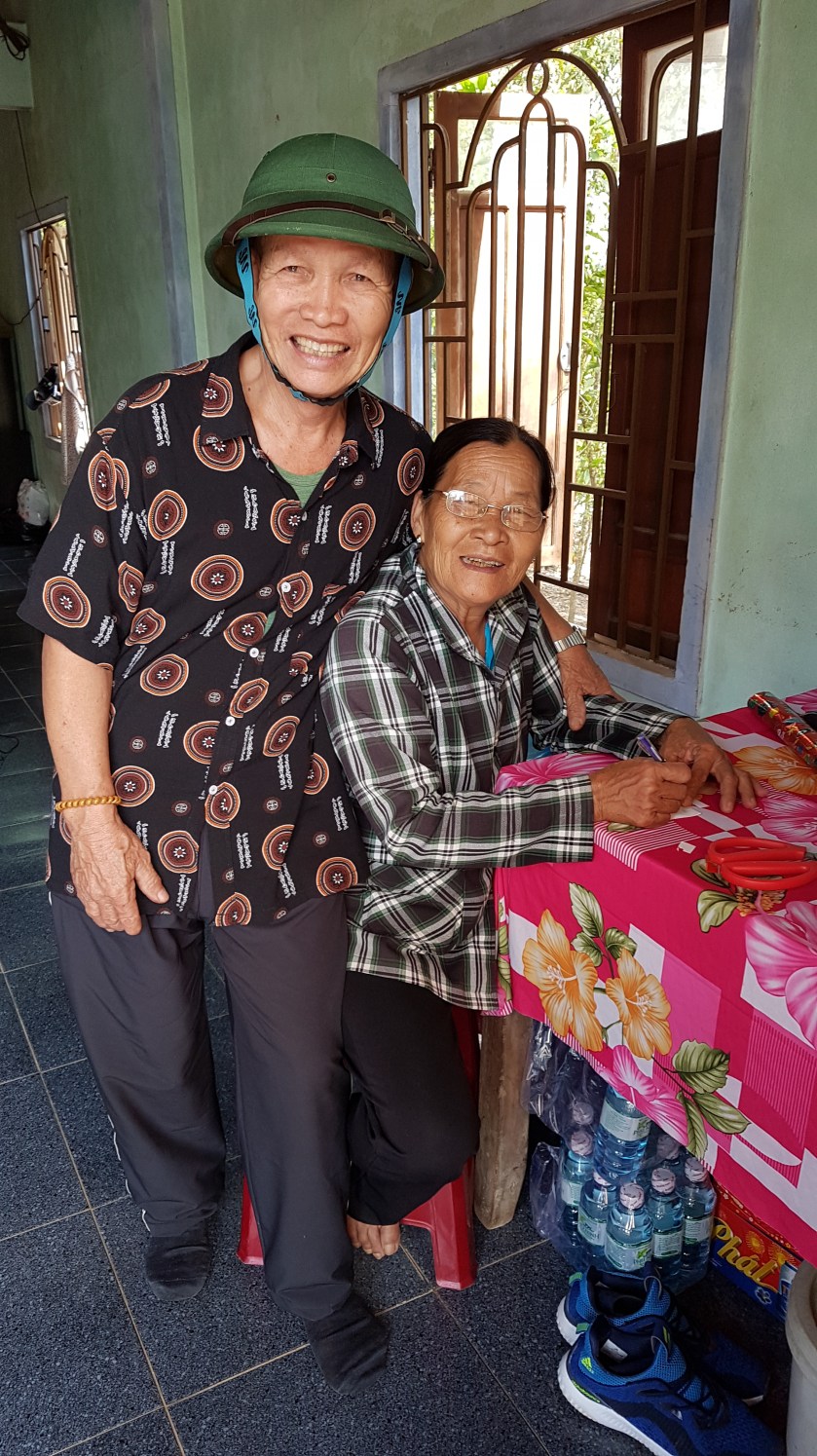
Former ARVN (left) & VC are now the best of freinds. (He had just showed me the scar of the hole in his leg when he was shot by VC) We then both looked at her and everyone laughed. (it was a bit surrealistic for me).The memorial to the father of Trinh sister’s husband. KIA during Tet 1968 while fighting with/for the Americans.
I was overwhelmed with the warmth of the people: friends, neighbors and family of Trinh’s mother and family. They would lend us motorcycles to get around. I was invited to every neighbor’s party. Everyone had to come by and drink with me. I drank a lot of beer and my new-found drink, rượu nếp, which is much like Korean makgeolli (막걸리, but a bit less effervescent.
I think Dauntless needs eyes
Now, cruising here with Dauntless is another story. A complicated story for another time.
So, after the two-week (for me) Tet Holiday, life is returning to normal. I was in the “country”. It wasn’t that conducive to writing blogs.
But I ate so well and the people are so incredible nice, former VC or not! It was both overwhelming and amazing, but this is a story for another time.
I think I finally have a plan to get Dauntless up the west coast, that I am comfortable with. Sometimes it seems like the plan comes together immediately, sometimes it takes a lot of time. The reality is that every plan takes a long time to gestate. Plans seem to come together immediately only when I’ve been thinking about them forever before putting pen to paper. However, in this case, I feel like I’ve been writing continuous plans since September, just to move Dauntless the 2200 miles to southern California.
25-Feb-18
2018 Option C
07-May-18
Huatulco
0.0
Alloc
–
0
0
Running nm
legs
Hours in transit
12-May-18
P
Roquita Island/Acapulco
1.8
5
49
5
245
245
15-May-18
P
Zihuatenjo
0.8
3
37
3
110
110
355
355
61
18-May-18
P
Caleta de Campos
0.6
3
27
3
80
80
20-May-18
P
Cabeza Negra N
0.5
2
33
2
65
65
27-May-18
P
Manzanillo
0.4
7
9
7
60
60
560
205
35
02-Jun-18
P
PV
1.6
6
38
6
230
230
08-Jun-18
P
Mazatlan or Cabo San Lucas
1.4
6
33
6
200
200
990
430
74
20-Jun-18
P
Cabo San Lucas 312
1.6
12
18
12
220
220
1,210
220
38
02-Sep-18
P
Cabo San Lucas 312
0
74
0
74
0
–
12-Sep-18
P
Turtle Bay 320
3
10
42
10
420
420
1,630
420
72
20-Sep-18
P
Baja Calif Ensenada 340
2
8
38
8
300
300
1,930
300
51
26-Sep-18
P
S.B. Channel Islands (SD +50) 310
2
6
47
6
280
280
2,210
280
48
13-Oct-18
P
SF Bay 333
2
17
18
17
300
300
2,510
300
51
This assumes that the winds and seas are favorable only 25% of the time. E.g. it requires 74 hours (3 days) from Manzanillo to Mazatlan, so I allocate at least 12 days to get there. Now, we understand that those 25% of times of favorable winds could take place in almost any combination. One day in four is the least likely, due to the nature of the synoptic weather pattern needed to disrupt the usual northwesterly winds. It’s more likely to be in chunks of 4 days out of 3 weeks or 6 days out of 5 weeks.
This means that I must have something I am not known for, patience. Even the word makes me cringe.
And even if I have a planned stop in XXX, as long as the winds stay nice, I need to keep moving north.
The intermediate places like Acapulco, etc. are possible stops if the weather turns unfavorable or whatever.
First goal is to get Dauntless to Baja California, preferably Cabo San Lucas or perhaps Ensenada, by mid-June. The fallback plan is to get at least to Mazatlán. I have a wedding in Salt Lake City June 23rd that I’d really want to attend, however getting Dauntless north safely has to be my primary goal.
Once there, I’ll leave Dauntless for the two months in summer.
I need to re-arrange my affairs a bit and see some friends, so I’ll travel to Alaska, Seattle, San Francisco and Texas.
I also need to scout some possible locations in California for Dauntless for the winter 2018-2019. Cost and security are the primary considerations. If you have any ideas or suggestions, please email me directly. I’d appreciate the input.
I’ll then return to Vietnam for two months. I’ve accepted the fact that Trinh will not have a visa for anyplace this coming summer, so I’ll be working on 2019.
Retuning in September, I’ll spend 6 weeks getting her (Dauntless, not Trinh) to her winter haven in California.
This plan offers me safety in that I like traveling a bit off shore (as opposed to near coastal) and making the 2500 nm trip into chunks of miles and time that are doable, even if I have to do some parts alone.
I’d prefer to have some crew/help, 2 people, a couple, would be ideal, 1 or 3 would be good.
As spring gets closer and closer, I’m watching the weather daily. I know what I want, but the light wind conditions may only last a couple of days, while I need a week plus.
In the last weeks, the more I have thought of this, the more I am thinking of getting north as best I can, probably well offshore.
Offshore solves a number of issues for me:
I like the open ocean
far less fishing activities, like boats and nets
more sea room, if I need to run before the storm (this is always a consideation in my planning)
getting big chunks of distance done in a short time, 3 days = 500 nm
did I say I like the ocean
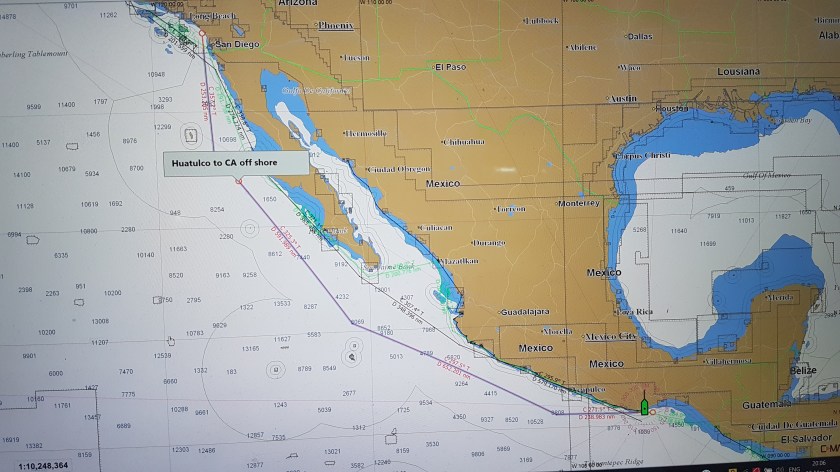
I like the GUI and data presentation of Windyty.com, so all the maps I show are from them and when I do look at weather, I look at them before anything else. This is what a great case looks like. How long it will last? Not long enough, but a few days, then with a low pressure system developing further west, would give me favorable winds for the second of two 3-day periods (the steaming distance between Huatulco and Cabo San Lucas is 900 nm or 6 days.
Now this looks great. Too bad it will last a day or two and I need 9!
This case though is far more typical, with NW winds >15 knots, even more so in the summer than now.
As I sit in my 10th floor apartment in Ho Chi Minh City, a.k.a. Saigon, the People’s Republic of Vietnam this balmy January 2018, writing these words, I think back one year. I was in Martinique, in the Lessor Antilles, luxuriating in having just completed a harder than expected crossing of the Atlantic from North Africa to North America.
Looking north from my apartment in HCMC, Vietnam
Vietnam wasn’t even on the radar and if it was, I thought it was a wave top. Impossible it imagines how different 2017 would end up.
So, how can a person who doesn’t have a clue as to where they will be in 12 months’ time write about planning?
And not only write about, but spend a good portion of every day’s waking hours thinking about The Plan? So much so that just a while ago, I found myself looking at the noonsite.com information about Taiwan.
Taiwan? wtf, he still hasn’t figured out how to get Dauntless out of Mexico, you’re thinking.
And right you are. So, I thought you would be interested in knowing or better understanding my planning process.
To understand my planning process, let’s look at my goal and some background information:
The Goal
Long term, cross the North Pacific, return to Northern Europe & complete my circumnavigation.
Short term, spend a couple of summers in Southeast Alaska.
Near term, get Dauntless to California before next winter.
Dauntless is now in the wonderful little town of Huatulco, Mexico, in the little Bahia Chahue.
Background information
In 2016, once I made the decision to return to North America, I made an elaborate plan (published in some blog post last year) to transit the Panama Canal and cruise up the west coast of North America to SE Alaska.
Looking aback at the plan now, I stayed pretty much on time and on target, only transiting the Panama Canal a couple weeks later than originally planned, until Costa Rica.
Arriving in Golfito, Costa Rica in March 2017, the wheels then came off or a more apt description, I was beached.
What happened? A perfect storm of: local bureaucracy, my nephew who cruised with me since Ireland, had to go back to school and I met this wonderful woman in faraway Vietnam.
Returning to Dauntless in June, I needed to get moving north. Costa Rica is a wonderful country that I had visited in 2004 and had really looked forward to returning. But, it turns out, it is not really cruiser friendly. The few marinas are ridiculously expensive and the paperwork of checking in and out was cumbersome and confusing.
My newfound friend, Cliff joined me and we took Dauntless from Costa Rica to Mexico. Mexico, it turns out is everything Coast Rica isn’t. Cliff had to go back to work and hurricane season had arrived, so in reaching the wonderful town of Huatulco in August, I decided that enough was enough.
The Task at Hand is to get Dauntless from southern Mexico to California, 1800 miles.
Dauntless cruises at about 6.5 to 6.8 knots. thus a 24-hr. period is 150 nm. That’s the figure I use for planning. With light winds and small seas, then the planning exercise is about planning stops after a day of cruising.
Two years ago, in the Baltic Cruise, I largely ignored the weather and planned the whole 4,000-mile trip based on cruising days of 5 to 8 hours. Usually we would stay a few days in each town or city stop. But the pacific coast of North America is a whole different creature.
Climatology tells me that the winds are predominantly from the northwest (the direct I must go) 2/3’s to ¾’s of the time. I use Jimmy Cornell’s Ocean Atlas which has pilot charts for each ocean by month. Jimmy Cornell’s Pilot Charts also tell me the secondary wind direction and currents. June thru September is 4 months, 120 days. I figure that I will have favorable winds about ¼ of those days, or 30 days. I have 1800 nm to go divided by 30 days means 60 miles per day. No bad, about what I did in the Baltic in September.
But it also means that when the winds are favorable, I must make miles. The reality of seasonal climatology is best looked at and planned for over periods longer than a few weeks. In this situation, I can easily be stuck in port 30 days waiting for the winds. Then if I’m lucky, I’ll have a good period, 5 to 10 days of southerly winds. Depending upon where we are along the coast, it means we may do 48, 72 or even 96 hours to take advantage of our good weather window.
Now in this context, when I say “weather” I really mean winds and seas. I’ve left port on many stormy days. Rain, showers do not bother me, it’s really all about the winds and seas for my little Kadey Krogen.
The effect of head winds and seas vary greatly. 5 to 7 knots are hardly noticeable and may produce small seas, less than 2 feet. Dauntless will lose a few tenths of a knot under such conditions.
Going out into the storm
As winds off the bow become stronger, it all goes down rapidly from there. 12 to 15 knots produce 3 to 5 ft. seas, pitching become unpleasant and we’ll lose more than a knot of speed. 18 + knots are untenable from a comfort level. Too much hobby horsing and probably down to 5 knots, less with any counter current. This is what happened to me off the French coast going up the English Channel to Holland. We were making 2 to 3 knots in pure misery of pitching. Because of the conditions, I finally decided to abort to Ostend, Belgium. It took another 6 hours to go 15 miles. Some of the worst 6 hours I have ever experienced. The Kadey Krogen was fine, she takes a beating and keeps on ticking. The humans inside were not as happy.
What I took out of that beating was to more carefully consider winds and seas on the bow. A 20-knot wind from the stern is fine. We had 20 days of that crossing the Atlantic last year. Even 20 knots (and resultant seas) on the beam are ok. The paravanes are most effective with beam seas. Though I tend not to venture out in such seas if I am in port. 20 knot headwinds are untenable. Stay in port. If at sea, options are reduced, but probably a change in direction is warranted.
I use Windyty.com for my forecast winds. I tend not to look at forecast seas because the accuracy is seldom good enough to use in an effective manner. Though Windyty will give you the first, second and third swells.
Now when it comes to forecast winds, for whatever reason, the forecast winds are almost always understated, though I do realize it’s possible that I only notice the over and not the under. Thus, when winds are forecast to be 12 knots, that usually means 8 to 15 knots. If 8, ok, if 15 it’s a no go. So, in this case, I will use 8 knots for the Go-No Go decision.
From Huatulco to the Channel Islands, it’s only 1800 nm in three long legs. that’s basically the distance I did between Martinique and the Panama Canal. But with much more un-favorable winds and currents.
Top speed for Dauntless is about 8.5 knots, but it’s non-factor because it’s impossible to justify the double to treble fuel consumption for 2 knots. So, my effective (long term) hurry up speed is 7.5 knots at 1800 rpms and 2 gallons/hour. Thus, I usually keep it to 1700 rpms, 6.8 to 7.0 knots and 1.6 gal/hr.
In my next post, Planning is the Mother of Anticipation, I’ll discuss the Mexican coast, what options we’ll have, crew and hurricanes.
As I flit from place to place, I wonder what drives me. After all, crossing oceans, flying from continent to continent, costs time and money.
View of the Dolomites from Budoia, Pordenone, Italy, Christmas 2017Budoia, Pordenone, Italy, Christmas 2017
“Is it worth it?” I’ve asked myself that question many times, not only since Dauntless entered my life but well before it.
Bahia Guacamaya
In the summer of 1970, I worked driving a cab in New York. Coming home day after day covered in sweat, dust and grime, in the days before air conditioning. But at the end of that long, hot, humid and dirty summer, having survived not only the weather and the traffic, but the escalating crime in the City, I took my money and bought my first car.
Of course, it was a car my father recommended. He was a master a virtually anything he was interested in doing and cars were one of his interests, so there was no thought of getting anything but what he pointed out.
Northeast Italy, December 2017
Good move. My first car was ugly, like a box and battleship grey. And only a week after getting it, I packed it up and stated the long, 3.000-mile, trip back to the University of Washington in Seattle, with nary a thought. My attitude has always been If other’s have done it, so can I. Even then, the pattern of not stopping until late into the evening, running on fumes or taking “short cuts” was apparent.
Northeast Italy, December 2017
I never thought I was particularly brave, in fact, I knew I was pretty shy and afraid of the dark.
But that didn’t matter because there was always something new to see over the next hill or around the next curve.
The 21 days on the westward crossing last December were very similar, yet so different.
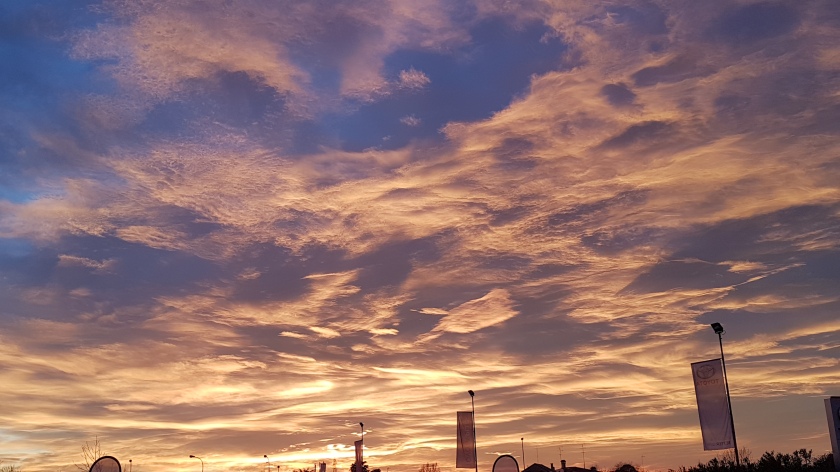
I looked forward to the day, the sunrise. What clouds would we have today? Rain or showers? The sky always had something new; something I hadn’t seen before. In my first Atlantic Passage in 2014, I had tried to avoid developing rain showers or thunderstorms. But in a boat going 6 knots, that is a futile gesture. Even more so, this last trip, I looked forward to the cleansing rain. I also didn’t want to upset the boat. She gets in a rhythm, let here stay in it without any major course changes.
The only thing I never liked was blue sky. My two years living in southern California were the worst, blue skies every day. I almost died of monotony. Even now, on the boat, I see a building storm on the horizon and I can’t look away. I’m fixated, as if watching a beautiful woman get dressed, what will the final look be? But storms are even more interesting than people, because their lifetimes can be minutes or hours.
These days, visiting my friends in Italy and Holland, the first time seeing them since my Atlantic Passage last Christmas, I’ve been able to recount the story numerous times.
Many say how brave I am. But I know better; I’m not brave at all, I’m simply curious.
As 2017 comes to a close, I find myself thinking about its beginning. Lying in bed on the morning of the first day of the new year, 1 January 2017, I luxuriated in being on a motionless bed. I thought about the last month. It was only a month ago, that I was waiting for the winds to die down so we could leave the harbor of Rabat, Morocco.
Dauntless has come so far
30 days and 3,000 miles later, we were in the New World. It was a much hard trip than I had hoped for. Watching the weather for months before our eventual departure, it was clear that the trade winds blew strong and steady from Africa all the way through the Caribbean to Central America.
I’d been hoping that I could stay in the band of lighter winds just north of the trades. It was not to be. Within hours of leaving Europe and the Canary Islands, we got hit by easterly winds for 20 to 30 knots. I wasn’t worried about Dauntless, she was made for following seas like this, but it did occur to me that these conditions meant there was no turning back.
That’s a sobering thought. In the Mid-Atlantic, with such strong winds behind us, we had to head west one way or another. There is no turning back. 200 miles west of the Canaries, no matter the issue, no fuel, no water, forgot to turn off the lights at home, no matter; one way or another you’re going west.
Always forward.
On a somewhat related note, here are a few Delta Airlines commericals that I find very motivating:
While I’m cooling my heel in Vietnam; a great place to do so, while Dauntless waits for better weather to head north this coming summer and fall, I seem to hear the sirens calling.
The problem is, after having moved south and west for the last 12 months and 7,000 miles, passing west thru the Panama Canal and up the west coast of Central America, with Alaska, the Aleutians, Japan, Korea and Taiwan in our sights, the Sirens are calling be back with a distinct Irish brogue.
Your thinking WTF, what the F do you think I’m feeling???
I’m the one who put in the miles, the time, the big ass seas and certainly the money to get where we are.
Yet, I can’t watch a Harry Potter movie, an episode of Borderland, the Fall and certainly Jack Taylor, without missing Northern Europe, Scotland and Ireland. For my tastes, certainly the best cruising since leaving New England.
Is it nostalgia?
Or just the realization that in my last 20,000 miles of cruising, the longest lasting relationships (excluding Krogenites, of course) have come from the Baltic and the Celtic areas of Galicia, Ireland and Scotland.
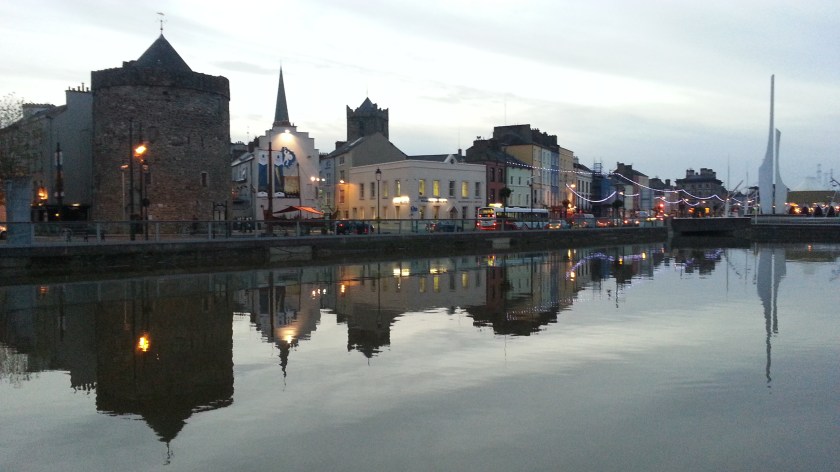
Waterford
Coincidence? or the Sirens?
I have a tendency to think it’s the latter. What else could explain my obsession with Europe, while I still have Asia and a few more oceans to cross at best??
So where do we go from here? I’ll do what I do best, think and plan.
It did get me to think about how I provisioned the boat the first time in 2014 and then, subsequently for the westbound trip, 11 months ago.
It’s hard to imagine that one year ago, Dauntless was in Rabat, Morocco and I took a quick 10 days first ever trip to Japan. But that’s yet another story.
What food did we put on the boat for our New England to Ireland passage in 2014?
There are a number of factors that had to be taken in account and planned accordingly:
Dauntless, with its 700-gallon fuel tanks, 300-gallon water tanks and a Katadyn water maker, capable of making 160 gallons of water a day (24 hours), had the range to make this 2600 nm trip easily.
With a full-size refrigerator and freezer, we did not have to cover our eggs in Vaseline like sailors of old, but our refrigerated space was not unlimited. While Romaine lettuce will last two+ weeks, did we really want to fill our fridge with bulky lettuce?
The trip should take 26 days underway. We did plan on stopping in the Azores, but I didn’t want to be required to make that stop just in case. So, we would plan on having at least 30 days’ worth of everything.
Lastly, everyone asks what happens if the engine breaks and can’t be fixed or the propeller falls off or we get hit by a meteorite? Well, if the latter, no trace would ever be found, but for the former, what was the plan? Look at a map. Let’s say we were disabled in the middle of the North Atlantic, what would I have done?
Well, I would NOT have called the Coast Guard. If you call the CG, they come and will take you off the boat. Two problems with that plan:
Dauntless can leave me; but I’m not leaving her. My life raft is on the fly bridge. When the water gets to the fly bridge, I’ll consider deploying the raft and setting off the EPIR.
Despite what you see on TV, being rescued, hoisted off a boat in the ocean has a lot of risk for both rescuers and rescues. No thanks. Maybe if I’m in the lift raft, but not from a floating boat.
So, that leaves us with what was the plan? Propeller has fallen off and is now on the bottom of the Atlantic or on its way (FYI there is a formula to determine exactly how long something takes to settle on the bottom of the ocean. For a grain of sand, it takes more than a year, for a propeller, it’s probably a 6-hour trip).
The prevailing winds are westerly, from the west. Therefore, sooner or later, those winds will push Dauntless at 1 to 2 knots towards Europe. So, the one-month trip becomes 3 or 4. Not great, but doable.
That gives me my goals for provisioning:
One month of food that will be consumed.
3 to 6 months of foods that will most likely not be eaten, but is easy to store and will keep forever.
Only get stuff I like to eat.
So that was easy. In practicality, it’s like taking a trip to Costco and buying like you won’t, can’t, be back for half a year. That’s what we did:
Fresh food for two weeks
Freezer stocked with meats, pork, beef, chicken, all things we would eat at home.
Longer term supplies consisted of those items that we do like normally, but also will last practically forever:
Peanut butter, 2 large Costco sized jars
Canned sardines, 2 dozen tins
Rice, 10 pounds Japanese
Condiments, olive oil, etc.
Canned tomatoes, 24
Canned corn, 24
Crackers, dry pasta,
Canned beans
Dauntless cooks with propane. It fires the Weber grill and the Princess three burner stove. I’ve never used the oven portion, since the Weber does well if I have to bake something.
In hindsight, I had too much canned stuff that I normally don’t eat, beans and tomatoes come to mind. On the plus side, when provisioning for last year’s Atlantic Passage, I hardly had to buy any canned things, only some canned sardines from Spain. I’m still eating the peanut butter from 2014! I finally ran out of rice this past summer.
One also must keep in mind that you need to have protein that you like, keeps forever and is easy to store. One can probably live forever on peanut butter and sardines. Rice also keeps well, though I don’t eat very much, as it took me 3 years to eat 10 pounds.
Leaving Spain last year, I did have about 6 liters of UHT milk. I don’t drink milk, but I really like it in coffee in the morning, so this was something that really went to my peace of mind, though I could easily have lived without it. (I stopped drinking milk during the 6 months I was living on the Arctic Ocean on Ice Island T3. Never drank it again, as in a glass of milk).
In hindsight, the one thing I should have had was fishing tackle. Even though I don’t fish, it’s foolish not to have the capability if crossing an ocean.
But looking at our steak we enjoyed on Christmas Day, 900 miles from Martinique, I need to go find some red meat!
My northern Europe pictures and some videos from April thru November 2016, including the painting of Dauntless in the spring and a few of my side trips to Galicia and Veneto, Italy.
Most galleries are in chronological order. The date time group is also embedded in the file name. Please forgive all the redundancy. It’s always easier to take too many pictures than not enough, though it makes sorting after the fact a real PIA.
Also, should you see anything and have a specific question, please feel free to email me.
Kadey Krogen Rendezvous 2017
Richard on Dauntless
Dauntless has come so far
Dauntless’ Second Atlantic Passage
Four Legs from Europe to the Caribbean
Leg 1 Rota Spain to Rabat, Morocco, via Gibraltar to fuel up
250 nm
50 hours total
Leg 2 Rabat Morocco to Las Palmas, the Canaries (unexpected stop)
600 nm
4 days, 1 hr., 35 min
Avg speed 6.1 knots
Leg 3 Las Palmas to Heiro, the western most island in the Canaries, Fuel top-up
172 nm
31 hours and 45 min
5.5 knots
The last & biggest leg, the only one that mattered, the Canaries to Martinique
460 hours, (19 days, 4 hours)
2582 nm
7 knots
The “Oh, BTW, you still have 2000 miles to go” leg, Martinique to Panama Canal and Mexico
460 hours, (19 days, 4 hours)
2582 nm
7 knots
Same strong easterly trade winds; same large, mixed seas
Avg roll +13°/-09° ext 22°/-10°
Overall Winds & Seas
Conditions are Very Different than the North Atlantic
Trade winds prevent turning back
Constant wind speeds of 20 to 35 knots
Direction varied over 90° from NE to SE
3 wave sets produced large 25° roll every 8 to 10 minutes for 3 weeks
NE & SE wave sets, smaller, longer period
wave heights predominate 10 to 15 feet at 8 seconds
3 different wave sets produced large 25° roll every 8 to 10 minutes for 3 weeks
First week very disconcerting to have stern fall to stbd so suddenly every periodically
Since leaving North Africa, until the Panama Canal, more than 5,000 nm and more than 60 days underway, all but two of those days required the paravane stabilizers.
Entering the Pacific and turning northwest from Panama City, in the first four days we had no need of stabilization. They call it the Pacific for a reason.
Crises In the mid-Atlantic
Fuel Loss
What Happened
Possible Solutions
What I did
What I now think I should have done (hint: Much Ado About Nothing)
Hydraulic Hose for Rudder failure
What Happened
I was screwing around
Possible Solutions
What I did
First fix did not work
Spares, spares and more spares (but not the right fitting)
What I now think I should have done
Overall Summary of My Second Atlantic Passage
Considerably harder than I had expected
I’m still organizing the data, but the big take-away, is that the fuel consumption for the last two years has been about 1.5 gal/ hr. or a little above 4nm/gal
Average cost has run between $75 to $133 per day when I’m on the boat. Even during the most recent passage, cost was $104 per day, with fuel being $80 a day.







 Dauntless at Sea