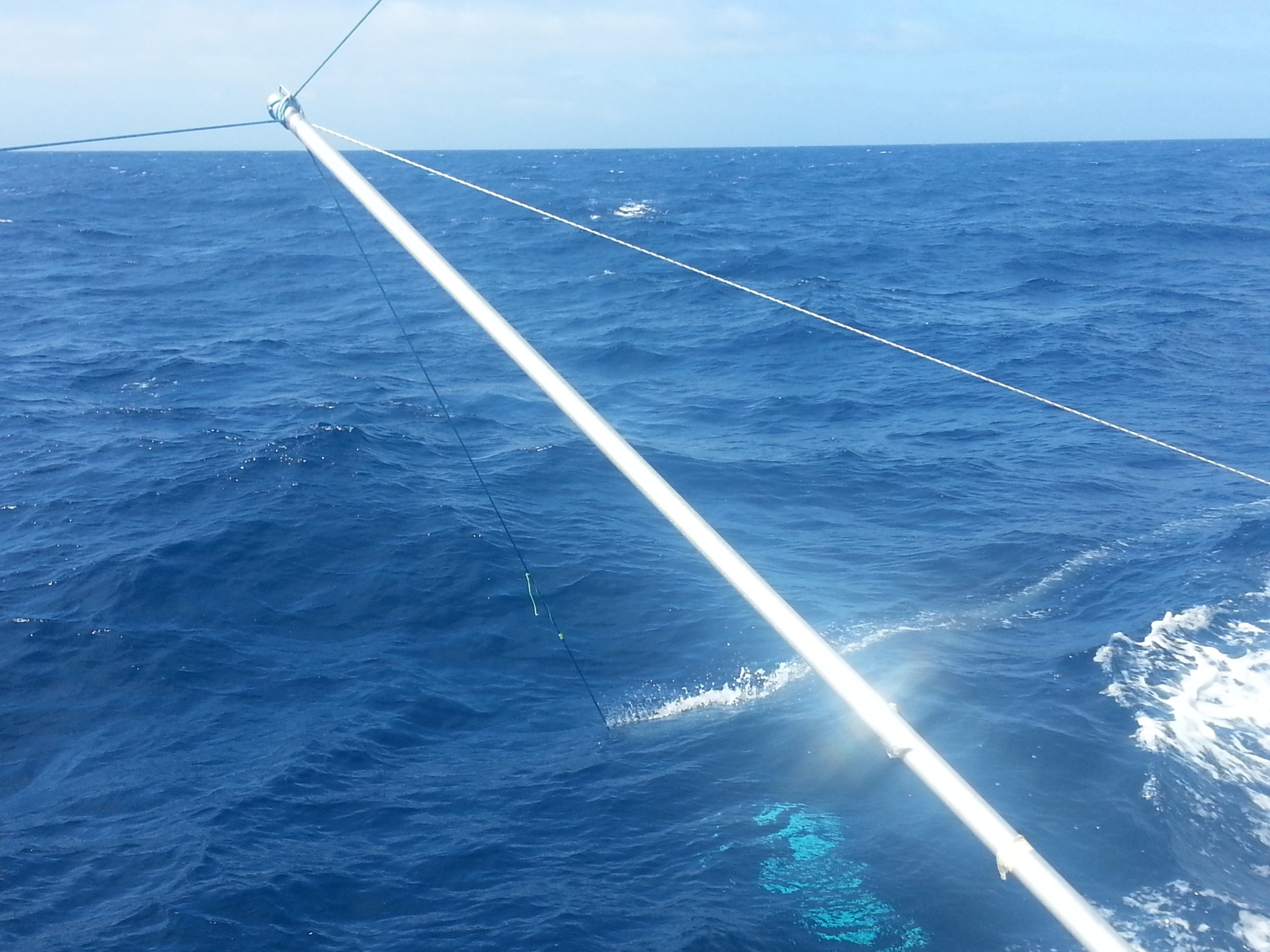
This surprised us. Having been in the Bahamas this winter, when the water as not so deep, it was so blue, like you are looking at a swimming pool. But the deeper parts, like “Tongue of the Ocean” where the water is over 5,000 feet deep, the water is a dark navy blue color.
So, one of the first things Julie and I noticed a day out of Nova Scotia, was how blue the water was. Not navy blue, but a lighter shade. It took us more than a day to get off the continental shelf where the water goes from a few hundred feet deep to over 10,000 feet.
Mid-Atlantic Blue Ocean
By day three, we were in very deep water, over 14,000 feet deep, yet the water was so blue, not dark, like you could almost see the bottom. It called to us like the Sirens of the ancient world. Many times, I felt like jumping in, the only thing stopping me, the knowledge that on the open ocean, simple acts beget tragedies.
Finally, the sun came out and we had two nice days, winds less than 10 knots, 1 to 2’ waves, really nice motoring weather. So we stopped the boat to take a swim. Left the engine running, but not in gear obviously, and tied a 40’ line to the stern, just in case of who knows what. Now, we of course did not both go in the water at the same time, we didn’t even take off our clothes at the same time, in fact, Julie waited until the next day. But as I jumped in the ocean, I could not but feel great. The water was so blue under the boat, almost sky blue, and surprisingly, so salty. It tasted much saltier than before. Julie confirmed that also when she took her swim the following day.
We did see wildlife. Not as much as along the coast though. We only saw dolphins a few times, but one group was really large, more than 30. They swam with us for only a few minutes, whereas in the past, I’ve had dolphins spend 30 to 50 minutes with us. We also had a pair of birds hitch a ride. Happily, both flew off under their own power after a much needed rest the following day.
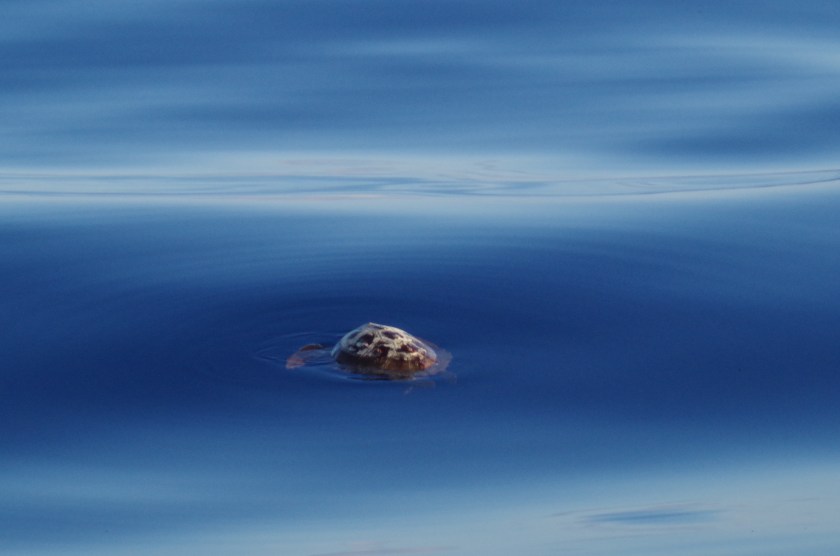
A Mid Atlantic Turtle
A few days from the Azores, we sighted what we initially thought was a float, but it turned out to be a turtle, just floating on the surface. Then an hour later, another turtle. We also had our only whale sighting, a couple of Humpbacks, maybe q quarter mile south.
Maybe the birds even helped themselves to the flying fish we would find on deck each morning. Sometimes we can see their impact 5’ or 6’ above the deck level on the salon wall or windows. They are also pretty small, just a few inches long. The flying fish we encountered in the Bahamas were much larger, but then so were the waves that night.
And just before Flores, we had a half dozen squid ranging in size from two to six inches long, on deck. I’m guessing the squid got there thru the deck scuppers as the boat rolls in the waves. The only problem was that sometimes I did not find them for a day, in which case we really did start to smell like a trawler.
I’m sorry I have not been as communicative as I would like for a number of reasons, including:
Limited Wi-Fi, or better yet, unlimited Wi-Fi, but it’s not connected to the Internet, and have only found one place where it is. So what email writing I have done is written on my cell phone, which is not conducive to this blog (I’m not swyping three pages worth)
Every day, I seem to have an hour project that takes me 10 hours to complete
After being in Horta for a week, I finally got all the small things done and the boat is ready to go
Being ready to go, I don’t want to write, I want to go, so I end up writing things like “Disappointment” which has nothing to do with this trip so I’ve decided to save it for a later date.
I’m waiting for the weather to leave. It will be 7 days to Ireland and I want the first three or four to be good, which means light winds and seas.
At this time, I am thinking of a Monday, late morning departure, as I would like to give the seas a day to calm down.
Stay tuned.
Thanks for sharing this voyage and our adventures.
.OK, Ladies and gentlemen, boys and girls, the time has finally come to get this show on the road
Dauntless is loaded, (I wish I was) and most stuff is put away, well, at least on the outside of the boat.
After more than 5 years of dreaming, hoping, wishing, planning, reading and even some arithmetic, the time has finally come to shove off.
In about 4 hours, Sunday, 20 July 2014, Dauntless, with Julie and I will depart our home away from home in Providence, Rhode Island and set our sights on the Portuguese islands of the Azores.
But before we can even go east, we must travel down the Narragansett River, then northeast through Buzzards Bay, to pass through the Cape Cod Canal in midafternoon when we will have favorable currents.
From then, we’ll see how we feel, whether to anchor one last time in North America at the tip of Cape Cod or to turn right and head east.
While our route is somewhat dependent on weather and seas, we are planning on the great circle route (course 082° T) from Cape Cod to the Azores as it takes one southeast of Nova Scotia, east along 42°N then east-southeast.
Our planned route
1900 nm, it will take 13 days, maybe 12 with the following seas we hope to have, we will pretty much be riding over the top of the Bermuda/Azores High.
We now have a Delorme InReach Satellite Phone. It will only do texts, but it does allow two way communications all the way across the ocean. You can follow our route with updates every 10 minutes and/or contact us by going to the website https://share.delorme.com/Dauntless
Once on the above page, on the left column, you click on my name, which allows you to select the other buttons above, Locate, Message, and Center. So Locate pings the phone, basically updating the map. Message allows you to send us a text message and Center, does just that, it re-centers the map.
I’ll pretty much have the InReach on until I get to winter quarters, probably in Ireland, probably at the end of September.
There have been many a day, night, that this Robert Service poem kept me going.
Oh, I’m not talking about Dauntless, or challenges of the sea, that’s the easy stuff, as is a number of things I’ve done in my life,
No, I’m talking about the tough stuff, like having a small business, and dreading the call from the bank, in which I had to cover to checks before day’s end. Teaching, being in front of 30 kids, who while they do want to learn, being teenagers, they feel their job is to really make you earn it and if you don’t come up to their expectations, they will let you know in that cruel way only teenagers can do.
Being a principal of a school that was ultimately slated to close, that was full of adults who thought they had no responsibility for that outcome.
Robert Service came into my life, in 1985, when I had moved back to Alaska for the second time. Leonie and I took many trips to the end of the road: up the Haul Road to Prudhoe Bay; down the Alaska Highway to Dawson, in the Yukon and of course down the Steese Highway to Central (where two families got into a real gun shooting feud form their respective porches) and Circle Hot Springs, The road to the Kennecott Copper Mines, where one had to leave the car and pull yourself over a river sitting in a bucket and lastly, numerous drives, many late into the night between Anchorage and Fairbanks, sometimes with temperatures below minus 40° F &C, with the car losing oil every mile because the block could not warm up enough driving 70 mph at those temps.
So many a night, I would read this poem, knowing I had no choice but to press on, that the next day would be better, sometimes it was, sometimes not.
But, it got me here, and life couldn’t be better. So I’d thought I’d share.
The Quitter
When you’re lost in the Wild, and you’re scared as a child, And Death looks you bang in the eye,
And you’re sore as a boil, it’s according to Hoyle To cock your revolver and . . . die.
But the Code of a Man says: “Fight all you can,” And self-dissolution is barred.
In hunger and woe, oh, it’s easy to blow . . . It’s the hell-served-for-breakfast that’s hard.
“You’re sick of the game!” Well, now that’s a shame. You’re young and you’re brave and you’re bright.
“You’ve had a raw deal!” I know — but don’t squeal, Buck up, do your damnedest, and fight.
It’s the plugging away that will win you the day, So don’t be a piker, old pard!
Just draw on your grit, it’s so easy to quit. It’s the keeping-your chin-up that’s hard.
It’s easy to cry that you’re beaten — and die; It’s easy to crawfish and crawl;
But to fight and to fight when hope’s out of sight — Why that’s the best game of them all!
And though you come out of each gruelling bout, All broken and battered and scarred,
Just have one more try — it’s dead easy to die, It’s the keeping-on-living that’s hard.
Rhymes of a Rolling Stones. Robert W. Service. Toronto: William Briggs, 1912; New York: Dodd Mead, 1912; London: Fisher Unwin, 1913.
After 5 years of planning, reading, thinking, asking, listening and worrying, we are just days away from leaving
Thanks to Parks and the cat, at Hopkins-Carter, I got a great deal on a whole bunch of stuff, including a Digital Yacht Class B AIS Transponder, which just went live minutes ago. http://www.hopkins-carter.com/
The computer is from Island Time PC and everything is running though that, including Wifi extender. Call Bob, he is great and always ready to help, even when I’m doing something stupid. http://islandtimepc.com/
I should have done it months ago, but it is what it is. Now, I must figure out how to get Coastal Explorer to see my Maretron Network. The rest of the programming, I figure I can learn during the next few weeks. I should be somewhat adept by the time I get to the Azores. Luckily, you don’t need much navigation to cross the Atlantic, just ask Columbus.
I will take pictures and document all the changes, hopefully in the next few days, before we leave, (though is you have been paying attention, I’ve been promising that for months).
Also, stay tuned, as I will also be giving you the Delorme Earthmate link for Dauntless. Then you can ping and even text me.
Gotta Go. Much left to do, like getting new compass to talk to ComNav and where is that Alternator and why does it have so many wires on the back?? I knew I should have taken a picture of it BEFORE I disconnected everything. EEK
Looking at today’s North Atlantic Ice situation in preparation for our journey across the Atlantic, it seems there is too much ice to take the great circle route to northern Europe. For Dauntless, the only real danger is sinking and the only real way to sink it to hit or get hit by something, be it another boat, a whale or an iceberg. We can’t make a passage through iceberg-strewn waters. Other ships we can avoid, while praying to the Poseidon that we don’t come upon a sleeping whale.
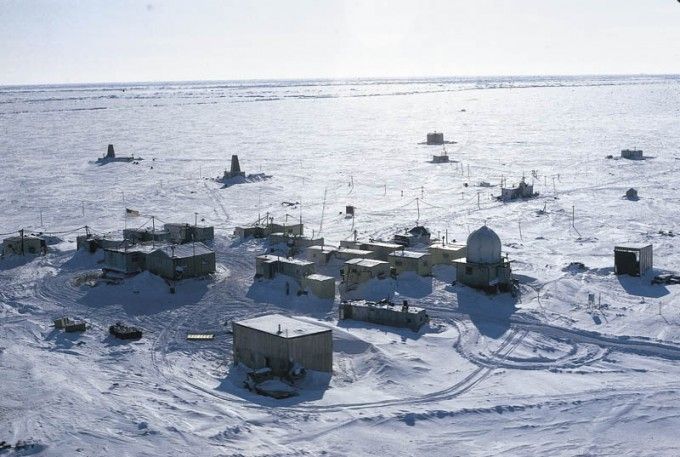
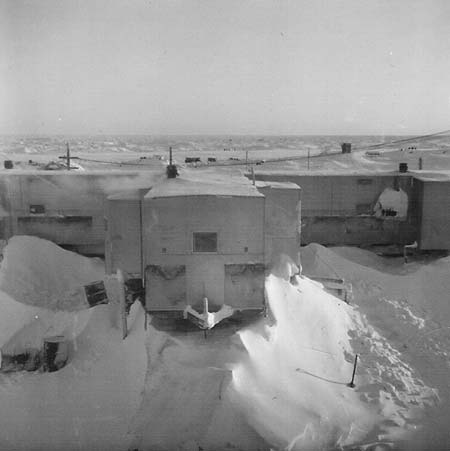
Besides my 10 years in Alaska, I also spent 6 months living and working on an iceberg: a giant, tabular block of ice, roughly 3 miles wide, 4 miles long and 80 feet thick, called Fletcher’s Ice Island T-3. I was 22 and it was my first work experience after college, unpaid except for room and board. Looking back, I think that iceberg is part of the reason I’m willing to cross the Atlantic on a 42-foot boat, and even see it as a comfortable experience. I was attracted to Alaska and the Arctic because it was a place of mystery. No cell phone in those days, and so little communication. Later, even living in Alaska 20 years later, in the 90’s meant no communication for 300 miles between Fairbanks and Anchorage. In high school, when I read Jack London’s “To Build a Fire,” I was struck by the consequences of simple mistakes. But the Arctic is full of people who survived on wits, knowing what mistakes could cost them.
I arrived on T-3 only three years after running out of gas in eastern Washington (see last blog posting). Little did I dream on that day that I would be sitting on the top of the world, literally. Well, almost the top. At the time, T-3 was about 400 miles from the North Pole. Our camp was situated on the edge of the iceberg. We were there to collect zooplankton from the ocean and make sonar maps of the bottom of the Arctic Ocean.
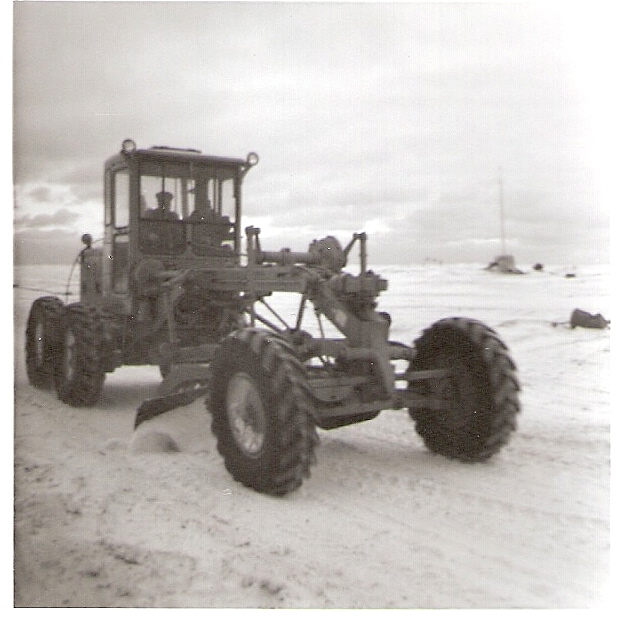
People wise, there were eight of us: 4 of us from the University of Washington (UW), a researcher from Lamont Geophysical Laboratory, Arnie Hansen from the Naval Arctic Research Laboratory (NARL), and the camp manager, Bill Hallett, and his Eskimo assistant, both also from NARL. The assistant was a master at driving our CAT and our Grader, which were the main vehicles of the camp and used to move virtually everything, including our trailers, which had to be moved twice during the summer to avoid the fate of being left on an ice pillar (see picture below). Bill himself was a remarkably resourceful man I’ll talk about later.
We UW folks split up and pretty much worked in pairs. My partner Chris and I collected zooplankton from various depths of the Arctic Ocean while the other two analyzed water chemistry. In fact, we ended up collecting the largest number of zooplankton samples the UW had ever collected.
I also, took one weather observation a day, which although it sounds meager, really helped me during the rest of my forecasting career and even today, 40 years later!!!
Our camp on T-3 consisted of about a dozen ATCO trailers, roughly the size of a 40 foot truck trailer. There used to be hundreds of these stacked up along route 509 as it crossed the Duwamish in Seattle, but looking now at Google Satellite (do they have their own actual satellite yet?), sadly they are gone. Though from above, you can still see the impressions they left on the ground after sitting for probably 30 years. They were probably last used in building the Alaska Pipeline. I’ve driven countless friends past these trailers to show them how I used to live.
So, back to T-3. I had just graduated from the UW, but had to miss my graduation to make the flight from Barrow to Resolute, NWT, Canada. From there, we flew on a Twin Otter to Eureka, where we refueled and waited to make sure the plane could receive the radio beacon that T-3 transmitted.
The UW had allowed women one year and it didn’t turn out well. Think Many Men behaving Badly Over a Couple of Women. The only women within thousands of miles. It was the winter, when the camp expanded to about 40 people: 40 men, 2 women, and did I mention guns and alcohol.
The UW in their mode of “let’s not kill people to make a point,” (remember this was back in the early 70’s before we let Political Correctness trump Common Sense) decided after that, no more women. Since I was arriving in the summer there were many less people, as the camp had to be supplied by air drops by airplane.
U.S. Air Force Alaskan Command C-130’s would fly from their home base at Elmendorf (near Anchorage), fly to NARL at Point Barrow, pick up our supplies, that had been put onto pallets and then left in the 24/7 summer sun for a day or two, and then fly 2000 miles, drop our stuff on pallets tied to big parachutes, do a wing wave and fly off to Thule, Greenland, about 1000 miles to our south southeast.
A few asides:
By the way, I stopped drinking milk for these six months. While other’s drank it sour or not. Interesting. Moving to Italy three years later, totally ended my milk drinking. Italians don’t drink milk, only babies and they don’t get it from a carton.
Another interesting tidbit that you will wonder how you could have lived so long without knowing, in Korean, the translation for breast is milk tank and fish is water meat. Sometimes literal is best.
Back to the T-3. These airdrops were scheduled for every three weeks starting in July until we got the hell out of there, when it was cold enough to build an ice runway and the C-130’s could land. We would be getting low on food at the end of three weeks, so we did not like any delays, at all. Winds too high? Drop anyway. The Air Force guys also didn’t want to have to come back, so pretty much we almost always got a drop close to schedule. Obviously, they needed to be able to see our camp and the one time they did drop with 40 knot winds, we did lose a pallet that took off across the ice never to be seen again (well, Artie, the intrepid NARL guy I mentioned, who is featured in some of the polar crossing books of the 1960’s, did retrieve our mail).
So we got deliveries and mail, but could send nothing out until the ice runway could be built. Think of a situation in which you can get a letter every 3 weeks, but there is no way to send anything out—unimaginable today. It was four months before we could get our mail out. How was anyone to know they were still loved? How mankind survived 500,000 years without cell phones if not unimaginable, is certainly cruel and unusual punishment.
So no cell phones, no fax, no games, no TV, no nothing. We did have a building, the old observatory, which was filled maybe a thousand paperbacks. That was the entertainment.
Daylight was constant by the time we got there, having flown for two days all over northern Canada (NARL didn’t trust our 30-year old DC-3 plane to fly over the ocean). The sun was up all the time. The sun was actually hot and sometimes we would be out in T-shirts, even though the air temperature on the hottest days never goes above freezing! Most days, temps were in the teens or low 20’s F.
We occasionally walked on the sea ice. Our work hut was on sea ice, because the sea ice was only 8 feet thick and we had a little derrick set up with a winch to haul nets and Nansen bottles in and out of the ocean. During the height of the summer, there were melt ponds all over, like little, or sometimes big, lakes. The blue ones were just on top of ice, but the black holes looked just like they sound, black, and I was terrified to go near them. They were black because the ice had melted all the way through to the ocean, so one was looking at the arctic ocean. Seals would occasionally pop their heads out. Falling in would have been a matter of life and death. Sea ice grows from below and melts from above. So by August we needed to keep a heat lamp on in our hole for our net, otherwise it would freeze over within hours.
The camp did have one rifle, which we took with us whenever on the sea ice in case we encountered a polar bear. Never did, much to my disappointment, but I stopped taking the rifle, because I thought I was going to shoot any bear anyway. Same reason I won’t have a weapon on the boat. I never saw a polar bear, but I did see a few seals.
As the summer wound down, much of August was cloudy, very little snow though. The arctic region is pretty much a dessert. Just windy and cold.
The first sunset was September 7th; the last sunrise was September 14th. So within a week, we went from total day to total night. Temperatures in September were often below 0°F, -17°C.
The next two months were colder still, minus 20 to 30°F with winds almost always.
We built an ice runway under those conditions that ended up having a large lake in the middle, which we found with the CAT one night. Took us 24 hours to get the CAT out.
My adventures on T-3 ended when a Markair C-130 came to pick us up in the middle of November. I arrived in Fairbanks after a direct flight form T-3 to Fairbanks International, with two dollars in my pocket. (Mark Air did not have the same fears of NARL about flying their planes directly over the top of the world, they were in a hurry, this wasn’t a government flight after all!)
What influenced me the most on this experience? Our camp manager, Bill Hallett. He was the epitome of what Alaskans were in those days. He saved the camp twice, once when a fire broke out near the generator hut and the second time, in late October, when we had all expected to have been gone a month earlier and our generator gave out. He literally rebuilt the thing within a day, as we stood by and helped as best we could, as the camp got colder and colder. With no electricity to run the heaters, they would still burn, but could not distribute the heat, thus the few feet around the heater in each trailer would be roasting, while each were below freezing and getting colder, with the outside temperature of -35°F. All we had was a single HF radio, Single Side Band, but we would go days without being able to raise anyone.
Bill understood the consequences of not being resourceful and knew there was nobody to help. No calling home when we got hungry, no helicopter taking us off the mountain, no reality-show bs with a producer holding a safety net off camera.
We had to solve our problems with what we had. That’s what Bill did, and what I aspire to do. It was as simple as that. Maybe that’s why I’m willing to cross the Atlantic in a boat that is probably similar in size to Columbus’s Nina and Pinta.
I think I’ll add some books to my Kindle.
T3 Pedestal BuildingOur GraderT-3’s drift over the Arctic Ocean from early 1950’2 to 1975 When I was there in 1973, it was just near the top of GreenlandA close up of our ATCO trailersAir Transport Command crew Departure on May 16, 1944, C-47-A 43-15665. U.S.Army Air Force * Picture taken by Arnie Hansen 1962 * Correct aircraft ID thanks to Raymond Frankwick
Sad End Notes:
Bill Hallett died in Fairbanks a few years later.
T-3 made another circuit of the arctic and then got caught in the current east of Greenland and moved south into the North Atlantic, where US Navy Ice Patrol planes watched it melt. I know this because 11 years later, in 1984, I had the small world luck that the same navy crew spent a week at Eielson AFB at my weather station. So over many beers, we toasted T-3 and all that made her special.
In the years before Dauntless, we developed a mindset of what we wanted a boat to do and how we wanted to do it. Much of it depended upon being as independent as possible, without having to be independently wealthy. And much like all of our land travels, our travels would take us off the beaten track, to the little restaurant near the Rio del Muti in Venezia, where English was not spoken, or a year earlier at the place where we knowingly ordered the specialty of the house, shark cartilage. Now, that was an experience that comes under the category of, been there, done that, won’t do it again.
But that’s who we are. Given the choice of 625 miles across Montana on Interstates 94 & 90 or the little used US 12, we’ve taken US 12 twice.
Now, I do have a history with US 12, I ran out of gas in the early morning hours taking a short cut from Missoula to the Tri-Cities in Washington. It was a good shortcut, only took 8 hours of driving overnight thru the Bitterroots and across the Continental Divide, but at that time in my life, (my first of many trans-continental car trips) it never occurred to me that there would be no gas stations open anyplace, even Lewiston, Idaho!
I ended up running out of gas about 20 miles from my girlfriend’s house in Kennewick. Now, that should be the end of it, but if you’ve been reading this blog for any length of time, you must realize there is a bit more to come. So, at 5 a.m. my car sputters to a stop in front of this typical farm/ ranch sheet metal structure, a warehouse, and wait for someone to show up. Within minutes, a young guy (in hindsight, probably my age, about 19) shows up on a motorcycle. Very helpful, we proceed to find a one quart glass jar and then in a mind that had been driving for the last 22 hours, I decide that one quart of gas is enough to get me my last 20 miles. It’s not.
8 miles later, I ran out of gas again. Still nowhere and this time with nothing close, other than a farm at the end of a drive way that must be at least a mile long.
I set out on this long walk, arriving at a barn, you know, where the windows are two feet high starting at ground level. So, I am bending over, trying to see inside, hoping I don’t get shot (City folk know that every Westerner is packing and shoots first and asks questions later) and I see a woman milking a cow. I knock on the window, hoping that’s not a shotgun by the milk bucket and knowing that she probably has never seen a brown face peering in the window at any time of day and probably never will again.
Being a farmer, this woman didn’t look shocked or even surprised, and when I told her my predicament, she went to get her husband. He then promptly took me to his pickup with the big fuel tank in the bed and drove me back to my car and asked me how much gas I wanted and whether I wanted Ethyl (Hi-test or now Premium for you young’uns) or regular. I did prefer (or better said, my engine) Hi-test, but not to be too greedy, I said half a gallon was more than enough. He gave me two; and of course, would take no money. This also started my love affair with the western US and the people who lived and worked there. I never moved back to the east coast until 1999, but then that’s another story.
So why tell this story now? This is how I deal with my angst. That was my first cross country trip in my first car, to start my second year of college with my second girlfriend.
Reflecting on this, makes me plan so that I do not let this happen on my first trip across the Atlantic, with my first boat in our second year.
And if it does, you can be assured I won’t tell the story for at least another 40 years.
That’s been me these last few months. Dauntless is now sitting on the hard (hauled out of the water) and waiting to have her bottom painted. She’s not happy; no good boat ever is having been hauled out of their element, literally as well as figuratively. She’s probably thinking, why did you fill me to almost bursting with fuel if we’re not going anyplace! Let’s get this f…ing show on the road. Umm, almost sounds like my mother.
Dauntless on the Hard at Port Edgewood
So, I thought I would be a good time to recap, thank some people who really helped and share the details of the work and the outfitting of our now antsy Kadey Krogen.
Current Plan
Version 328.4 I’ll be in Providence until mid-July, at which point, head up to Gloucester, top up the tanks and wait for a weather window to allow us to head northeast or east. If NE, then stopping at St. John’s to top up tanks again, then probably direct Iceland, or Scotland or Ireland. If the NE track is not optimum, then southeast to the Azores and on to Galicia or Portugal.
We have an InReach Sat phone, so you will be able to following our progress every 10 minutes!
Thanks to some Great Friends and Crew
We’re about ready. But this trip has only been made possible with the help and advice of a number of friends, crew and forum buddies, who have make this possible.
I’ve had three great crew mates in the last year. John, who came with me from Providence to North Carolina in November. Chantal, who was with me December and January from Florida to the Bahamas and Richard, (if you’re thinking I am talking about myself again, in the regal third person, I’m not, there really is another Richard, who by the way, just bought a beautiful 40’ Endeavor sailboat yesterday). Richard spent two months with me in Miami and really worked hard to make Dauntless shine. I learned something from each of them and they all diligent and treated Dauntless like it was theirs.
Dave Arnold also works on this boat also like it’s his own. John Gear of Kadey Krogen, who I met when Dauntless was just a gleam in our eyes and has been a real supportive friend ever since.
Parks, at Hopkins Carter Marine in Miami, found me a refuge when I needed one and I have found his store to be extremely competitive price wise with even the big marine on-line places and I have continued to make most of my purchases thru his store, this spring.
Parks, is just one of a number of friends I’ve met through Trawler Forum. Ed and Rosa, two more fantastic people, who were always available to help while I was in Miami, even while planning their own exciting trip to Cuba. Paul, my Maine friend, who also was there for me in Miami, as well as Courtney and Penny and Larry and Lena.
Larry and Lena also have a KK42 only a few months older than Dauntless. Larry has answered numerous questions, yes, some of them really obvious and he always pushes me into the right direction. Every time I do a wash and dry, I am reminded of the last minute call I made to Larry, asking if I really had to swap out my current washer dryer. He got me over my cold feet and now I have a large extra storage area under the Splendide combo, which sure came in handy as I had to pull more cables from pilot house to Engine room the other day.
Lastly, my New York friends, Samantha, Wil & Liz and Val, who were there for me when I really needed them and really did help me get this show on the road for the first time.
In the coming week, I will post the details of each major change and its effect. Also, will pass along contact info so you can watch our progress across the Atlantic.
This past week, Julie and I moved from our Manhattan apartment to an apartment in the Bronx. We love the new neighborhood, the food has been great, the people fascinating, a Bronx mix of Albanians, Russians, Bengalis and of course Hispanic, with a few extra Arabs, Black-Americans and Italian-Americans thrown in the mix to keep it interesting.
What makes Dauntless so wonderful is that my home moves with me, and Dauntless and I are preparing for a big move—to cross the Atlantic, creating an instant home in Europe.
The first issue was preparing Dauntless with everything needed to cross an ocean, and the list is somewhat overwhelming. I am usually a very decisive person, so when I dither, I have come to understand that that delay means the solution I may think consciously I have, is not as well thought out as could be, thus no final decision. So I finally accepted that the work on Dauntless would get done and me worrying about it constantly was not going to expedite the process. All I could do was make sure all the spare parts and other stuff I need, like a life raft, are ordered and on the boat in a timely manner.
I have started watching the weather over the North Atlantic every day. I have to have a sense of the patterns before even looking at forecasts. One thing became immediately obvious: my route must be dependent upon the overall weather pattern. Since Dauntless is so sloooow, moving at about ¼ the speed of an a typical low pressure system, the real issue is where the jet stream will be in July. If it’s more south than usual, I can probably go north via Iceland. If it’s where it is now, I can’t go anyplace. And if it’s moved more north, into its normal summer position, then I can go east, now whether I can go north of east or south of east will depend on the short term features.
What this all means is that my destination is now Europe, with landfall somewhere between Iceland, the Faeroes and Norway, or as far south as the Azores and Oporto Portugal. The Azores are only 12 days from Gloucester, Mass! From there I would probably go the Galicia and the NW coast of Spain.
The food is good there too. In fact, maybe I’ll start regaining the 25 pounds I’ve lost since Dauntless came into my life!
Remakes, sequels and other demonstrations of a total lack of imagination.
Poor June Allyson, Godzilla and even King Kong, at the mercy of those far stupider, less imaginative and certainly crueler than they.
Taking a respite from preparing for the challenges of the Atlantic and knowing that my cornucopia of hundreds of channels that I get on FIOS will soon be replaced with the wondrous, so 80’s, cable system of the Netherlands, I am enjoying some of my last days with TCM, Turner Classic Movies, one of the great accomplishments of the western world in the last decade of the 20th century. I’ll miss it. In the Netherlands, I will have a nice assortment of some 30 channels, with even a few American ones, like Nat Geo and of course, American reality shows that prove while we can’t bring democracy to the rest of the world, we can give them bread and circuses.
So, I decided to watch “My Man Godfrey”, with David Niven and June Allyson. Another sad remake, and almost my definition, a failure because they are trying to depict a story that worked in the 1930’s, but 20 years later, seemed so out of place. A world war will do that.
A pity to see someone like June Allyson, who always played such a brave, dutiful air force wife, relegated to the role of a brainless heiress.
Almost as sad as seeing King Kong and Godzilla put in roles in which they have no place.
Now, Eva Gabor on the other hand… a reminder of why I liked “Green Acres” so much.
As I walked down the very crowded subway platform for the “E” train at 53rd and Lex the other day, I was struck, no, not by a train, nor even by the off tune melodies of the aging musician performing at the middle of the platform, but in that moment, I saw life with a clarity that normally eludes me in the cacophony that is my mind.
I saw angst.
I saw angst in the face of the Asian college girl clutching a portfolio heading to the lower west side, maybe the Garment District?
I saw angst in the face of the two workers, clearly tired after a long day, heading home, where maybe more work waited.
As I hurried along, up the very long escalator, and much like the train tracks (of course, you all know that one of the things that makes the NYC subway system unique in the world, is that it was built on a four track system, two in every direction, an express and local track), we have two columns of people, the standers on the right and the walkers on the left. Both the up and down escalators are segmented so. There is no written rule, no signs, it’s just New Yorkers, who realize that this systems works to make all more efficient and hurry us on our way. This is the capitol of “Time is Money” after all.
As I hurry along the corridor, with the 80’s tile look, that did not exist when I was young, as the three subway lines in NYC were still somewhat separate, even though the City had owned the lines since just after WWII, I arrive on my uptown #6 train platform and it’s full of people.
Really full. I can see down the tunnel that a train is maybe two minutes away, but clearly this crowd is like 12 minutes worth ( they usually run every 4 minutes at this time of day) like we’re going to need those Japanese Platform Men that push everyone into the cars like sardines. Yes, folks, 12 minutes will fill a train like that. This ain’t the Sticks. No, this is the Big Apple, where the trains run all the time and in the middle of the night, when the time between trains does increase to 20 minutes, there will be standing room only.
So, now, as we pack into this subway car, we’re so packed in, that one does not need to hold a hand rail. We’re all so close, it’s impossible to fall. The first thing I spot is this really annoying ad by some new travel company that wants you to book air travel on their site by making fun of people on the train. The first picture shows a woman having to stand right next to a taller man. Her solution, book a trip with this annoying company and they will whisk you away from the hoi polio.
Their next picture shows a crying baby, with the same solution. Do these people even ride the subway? Did they just get off the bus from Denver or what?
It’s clear they do not ride the train, as one thing we all know, babies don’t cry on the train. They seem to love trains. They love trains so much, at 4 p.m.; the strollers are lined up with parents/nannies holding the kids up along the fence overlooking the New York Central tracks on the 97th St. overpass as the Commuter trains roar underneath entering the tunnel towards Grand Central Station.
But right now, as we leave the 53rd St. station, people still wait. There is a train right behind us, (at this time of day, they pretty much run the #6 as close together as technically feasible, maybe every two minutes) thankfully; otherwise a few more people would have tried to squeeze their way in. Next stop, 59th St., an express stop, so the same scene, as there will be loads of people who took the express from lower Manhattan, and now are transferring to the Local. We are still so crowded, as people get off, even more get on. Those by the doors have to reshuffle. Everyone understands ritual, no tourists here, they repack themselves in a way, so when their stop comes, they will be ready. Finally, at 77th St., Hunter College, more get off than get on. Upper East Side people are leaving; those getting on now are going to the Bronx. At the next two stops, 86th and 96th St., the exodus continues as the demographics of the train has transformed itself over the last half dozen stops. More baby carriages, mostly blue collared hard workers.
So I realize that while most have Angst, I have Anticipation.
I’m happy with where I am. I’m lonely at times; I miss friends, family, Julie and more friends. Did I say I’m lonely? Sometimes oppressively so.
So I am full of anticipation.
I anticipate the challenges of living in different cultures. I think about the occasions where someone will be speaking to me in Dutch and I’m trying to figure out what they are communicating. I know I only have a few seconds, before I must with give them my stupefied face, which means, I have no clue what you’re saying to me or I actually do understand the gist of what they are saying and I’ll smile and nod agreement, hoping that I did understand correctly. Most of the time I do understand the gist, if not the nuance. The other times, I’ll usually end up in the wrong place, at the wrong time or with an order of monkey brains, when all I wanted was monkey wrench.
Nowadays, if you avoid the tourist traps, which by the way are the same in every country, I’d say about 60% speak English, so it behooves me to learn Dutch better. How else can I tell them I want the kersen flap and not the apfel flap?
So, one of my goals in the coming year is to learn Dutch, improve my German, and down the road, learn Spanish so I can participate in the captivating conversations of Julie’s Spanish family and friends and even improve my Italian, to a point where I can read the newspaper (in Italy, they don’t dumb down, they smart up their newspapers).
Now, a few facts about the Netherlands you should know:
I am usually scrupulous in talking about the Netherlands and not saying Holland. But since the city I anticipate being in is in Zuid-Holland, I have occasionally used the term Holland.
The name of the country is “the Netherlands”. Most people call it Holland because in the Golden Age, Amsterdam was the most important city/harbor/are in the country (the rest of the country was pretty much underdeveloped or under water – they had not yet started poldering (making dry land using dikes and wind mills powering water pumps). Amsterdam lies in the province of Noord-Holland. Of course there is also a province called South-Holland and that was also important, as it is near the sea.
People living in the Holland sections don’t mind, those from the eastern provinces, do!
Lastly, in WWII, The Dutch found a way to unmask German spies, by letting them pronounce the word Scheveningen. The combination of the s-sound and the g- sound (which is very guttural in Dutch) is virtually impossible for anyone whose native language is not Dutch.


 And Death looks you bang in the eye,
 Update Sep 2020
 have uploaded to my smugmug account.



 Dauntless at Sea