The Great Battery Caper

After months of planning, thinking and just plain fretting, the batteries are in and Dauntless is no longer acting like a one legged duck.

Another Gorgeous Sunset

How do one legged ducks act you wonder? Without the engine running or being plugged into shore power, we had only a few minutes’ worth of electrical power.

Two of the Four New Yuasa Batteries

And I’d go to sleep, not with visions of sugar plum faeries (or better yet, leggy milf’s) dancing in my head, but with pictures of wiring diagrams and this and that.

So, having found replacement batteries in Kilmore Quay’s Kehoe Marine last month, they got four Yuasa Cargo Deep Cycle GM batteries that were of 8-D size, with 230 amp-hours each for me. Weighing in at 55 kg, or 115 lbs. each and delivered to the Kehoe boys at New Ross Boat Yard (yes, of course they are related).

Waiting for high tide, when the dock was only a few feet above the floating pontoon, we got the batteries on to the boat without dropping them into the water.

Then, the hardest part physically, getting the old batteries out.  Perhaps with the knowledge that we could not hurt them, it took us less than an hour to get them out.

I then spent the next few hours re-configuring how the batteries were connected.  I essentially made a positive and negative stud that consolidated the all the connections before they went to the batteries.

My friend Ed had given me a new article about the optimum way to connect multiple batteries that was slightly superior to the way I had the older batteries connected.  I had had 8 new battery cables made, 2 for each battery, each 2.3 meters long (about 7 feet).  This allowed the four batteries to have the exact same length cable to each from the charging source.  By having the same cable lengths, the resistance should be equal and thus each battery should get exactly the same amount of charge.

That took a few hours, with a panicked call to Dave Arnold, the electrical guru (who else would be driving around an all-electric car for the 1980’s!).

His call reaffirmed the use of the existing terminal block and Perko switch that was used to switch the start to the house batteries if needed.

Finally, after 8 hours, I was ready for the new batteries.  I rigged an Amstel line around the hand railing to the pilot house, thus we could lower the batteries into the engine room and the only struggle was to pull them into place while lowering at the same time.

Two hours later, all was in place, hooked up and ready to go.

All the boat grounds go to a common terminal, then one large cable to the boat side of the Victron battery Monitor shunt.  Then one large cable to another terminal post which has all four negative battery cables.

Positives are similar, in that the inverter/charger, the positive from the alternator and the positive from the terminal block (which has a number of inputs from the isolators and thus indirect from the other battery chargers) go to a terminal post, then all 4 battery cables are attached.

In the next days/weeks, as I physically tie the lines and organize a bit more, I will make a new electrical diagram.

Now, according to my calculations, all the rest of the year should be downhill!


A Quickie in New York

I wish!

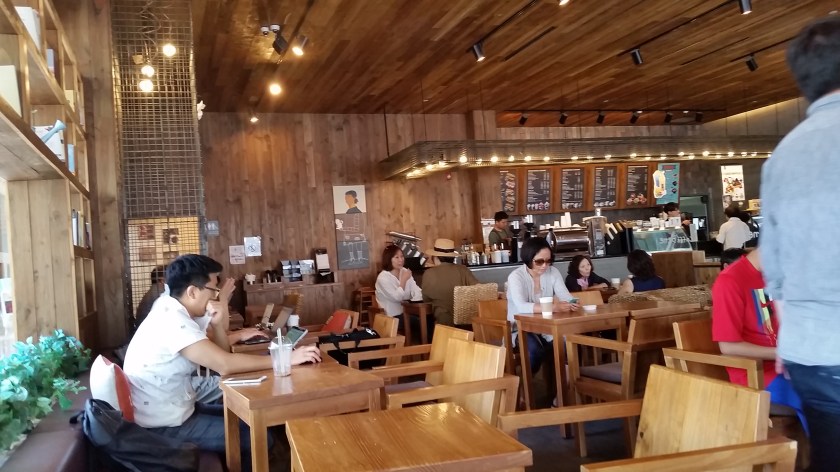
Caffebene in Ft. Lee, a really nice place to spend time
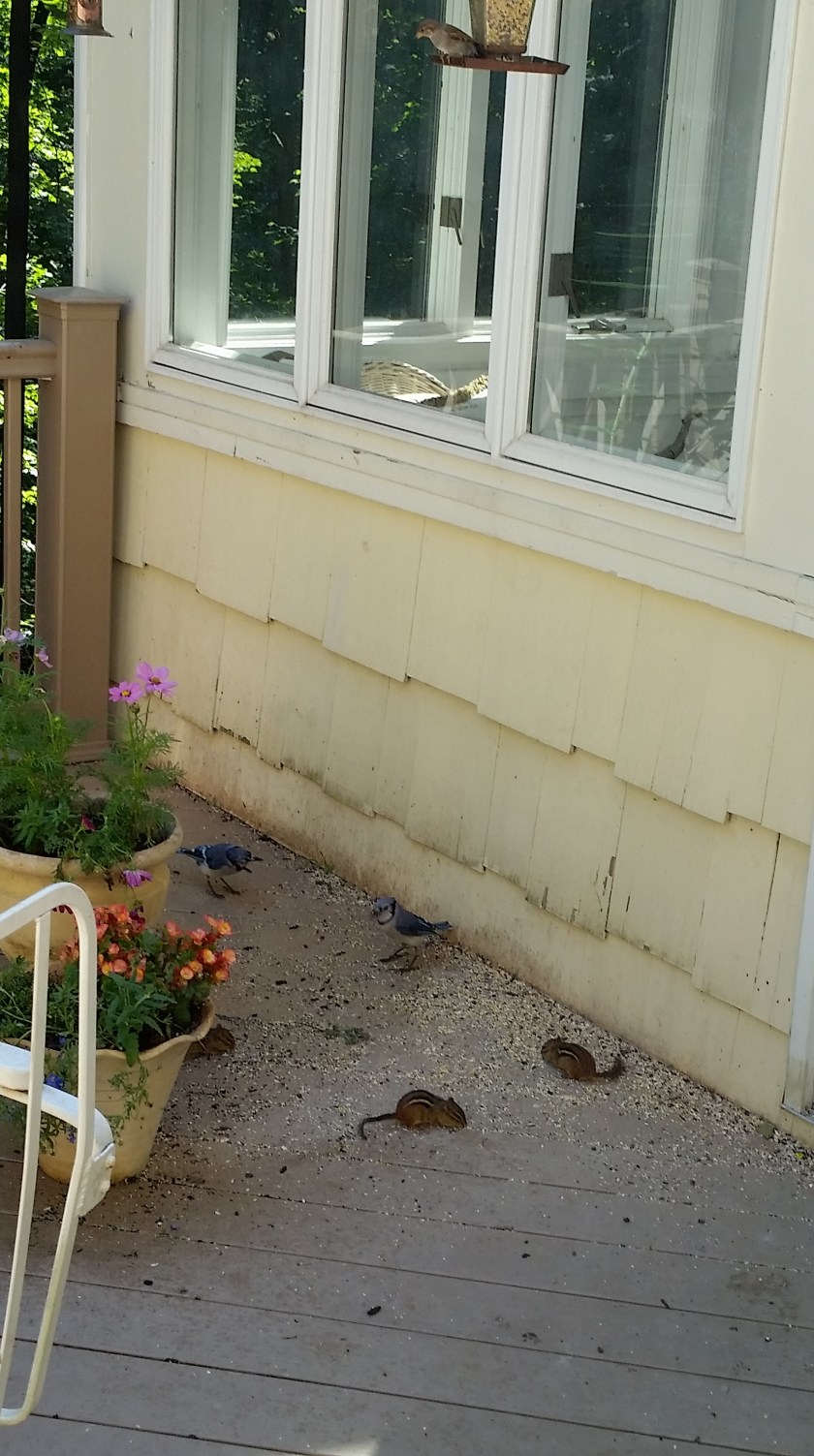
Each morning I watch the feeding frenzy of Blue Jays, Cardinals, squirrels and chipmunks.

But it was a quick trip, 5-days, to New York to tie up some loose ends.

Some lines always need a good whipping.

I also got to spend some time with some good friends, both new and old.

And best of all, I ate Korean food 3x, Japanese 2x, pizza 2x and lastly French once; best of all, I ate so well and gained no weight.  Lekker.

When I get back to Dauntless tomorrow, I’ll be doing the preparing to head south to France, Spain and Portugal for the next 5 months.

Such a short trip may seem pointless, but I leave NY today feeling much better than on arrival.  Being able to articulate my goals and reflecting on them with friends makes a big difference.

During June, having my friends Brian, Dan and Robin on Dauntless, really helped me put a focus on my goals for the coming years.  It is great to have people around as enthusiastic as I.

Then, coming to NYC, talking with friends, facilitated the final touches on the plan.  As articulated in my last post, by adding 10 months in S.E. Alaska, everything finally feels like it’s coming together.

Not having to spend all of 2017 rushing someplace will allow me to pause and smell the roses.

Having Dauntless staying put for 6 to 8 months, allows me to visit friends in Europe and probably take a trip to reconnoiter Asia.

I feel unburdened and that’s a good feeling.

So now I can concentrate on the important stuff:  What’s with these cats.  Here we have a billion-dollar company and they must Photoshop the cover for all their kitty liter bags.

Clearly Photshopped
Clearly Photoshopped

Do these people even have cats?  One would think someone in this company would think they should show some indication that they understand cats.

Must be dog people.

So, I’ll end on this poster. It fit my two cats perfectly at least in their first year as kittens.

Bad Kitties
Bad Kitties

A link to the site for T-shirt Bad Kitties T-Shirt

A Cardinal coming for breakfast

A Man with a Plan


The Atlantic Trade Winds
The Atlantic Trade Winds (click on the links below to see the winds move. Click on “Earth” in the lower left corner [of the link, not my picture] to change parameters)
Well any number of plans; the current one, 15 months to Japan, now in the 29th day since its start date.

But like all plans, a plan is good only until first contact with the enemy.  For Dauntless it’s headwinds, or better said, for Richard it’s the hobby horse ride headwinds produce on Dauntless.  The fact that we are consuming half of our fuel, just to go up and down waves, adds to the sick feeling the ride produces.

Yep, it’s a lose, lose, lose situation for all: the timeline, my wallet and my health.

Dauntless in the meantime just motors along, oblivious to my misery.

For my long range planning, other than Jimmy Cornell’s books and pilot charts, on a daily basis I pretty much only look at this: link to current Atlantic map

This shows the current surface winds over the Atlantic.  You can see that draw a line from Gibraltar to the Canaries to Barbados and the trade winds are running strong as they have all winter.  So no problems there.

wp-1466993359075.jpg
The Eastern Pacific showing strong northerly winds from British Columbia to Southern California. Ugh!

(side note, there is simply no point in looking at anything more specific for any period more than two weeks away.  Even when I was waiting to cross the North Sea from Norway to Scotland, a three-day trip, I read the marine forecast, but really only looked at this site to figure out when I would have at least a two-day window, which is what I got)

 Now, this is the problem, this is the Eastern Pacific, link to current western Pacific map

I’ve been looking at this about once a day since fall.  Only in the past month have the northerly winds let up south of Mexico and Central America.

My current 15-month plan would require me to be able to travel north from the Panama Canal to Kodiak Alaska in 170 days or about 35 miles per day.  Doable with favorable winds, but I’ve been watching and the winds are not favorable, not at all.  At this point, at best, I think a quarter of the days would be “good” cruising days and that may be too generous.

The other problem with this current plan is that I would probably be able to rush north out of Central America, but then get stuck in Mexico and the coast of the western U.S. for months on end.  Thus passing by places I would like to spend time only to be stuck in places I don’t.

So, Plan B.

I will add a year to the Cruise Plan, wintering in Southeast Alaska.

Many boaters do it, I know it somewhat, but only from the perspective of the Alaska Marine Highway (Ferry) system.

Thus I can spend more time in Central America at the height of the winter when the northerlies are strongest and I can spend 10 months in British Columbia and Southeast Alaska, some of the prettiest cruising areas in the world, full of fjords, whales, birds and bears!

The weather is not that bad and having visited Juneau and Sitka many times back in the 90’s, it will be nice to go back on my own bottom.


Why I Am Not Afraid


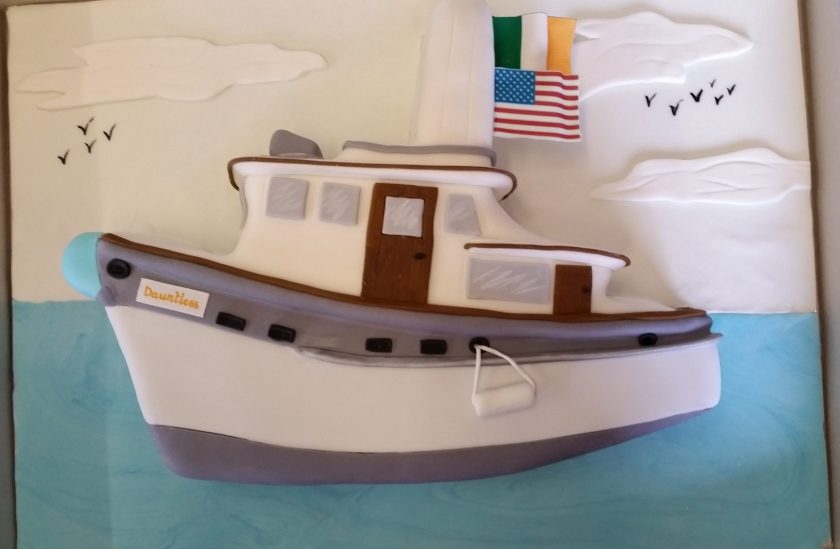
The New Dauntless As Tasty As Ever
Dauntless – As Tasty As Ever

Being in the New Ross Boat Yard daily, now in the spring, almost daily I run into people who ask me about our passage across the Atlantic.  They always ask if I was ever afraid.  Yes, inwardly I do roll my eyes, but now I have my answer down rote, I was never afraid, but certainly miserable at times.

Every once in a while, sensing they actually may want a more reasoned response, I start talking about Kadey Krogen and this KK42 and what makes her so suited to where and how we go; at least until their eyes glaze over.

Knowing almost nothing about fiberglass, other than it’s made of fiber + glass, I have been talking to Gary Mooney, the GRP (fiberglass) expert of the area who has been working on Dauntless this winter and has a lifetime of experience with it on boats and all sorts of other objects.

We’ve talked about the repairs he made on Dauntless, first there were two problems in the hull:

  1. The four-foot-long hairline crack that I put in the hull the past July in Finland.
  2. An older, badly repaired, thru-hull fitting, also in the forward bilge, that was haphazardly done and allowed water into the hull and was the source of the water in the amidships-forward compartment bulkhead.

So this got us talking about the Krogen hull, in particular, which is a cored, also called sandwich, hull:

  1. there is a layer of fiberglass,
  2. then the core, in this case, a white non-water absorbing Styrofoam like stuff,
  3. then another layer of fiberglass.
  4. This is then covered by a gelcoat layer, making the fiberglass impervious to water.
  5. Then a two-part epoxy coat is put on to protect the gel coat, Dauntless gets two coats of that,
  6. A “Tie-coat” comes next, this tie-coat allows the anti-foul paint to adhere to the epoxy,
  7. And lastly comes the anti-foul coating. I am going to try a semi-hard coating, purposely made for very slow boats like Dauntless.  It’s said to last 5 years and be smooth enough to slightly reduce fuel consumption. I’ll be happy if it lasts three years and doesn’t hurt fuel consumption.

This boat yard really caters to the commercial boats, so things like the anti-foul, are all things the fishing boats and trawlers (real ones) use and like.

So, talking of hulls with Gary, I asked him about solid fiberglass hulls.  It’s clearly touted in the USA as a “better” meaning safer solution.  He scoffed at that, saying that most of the fishing boats here use solid hulls to make them stronger in terms of cargo and heavy equipment, but it also makes them more fragile.

A cored hull has much more flexibility, thus I could hit a rock as I did and the hull flexed enough to crack both the inner and outer layers of fiberglass.  Had the hull been solid fiberglass, it’s likely it would have broken in big chunks leaving a meter-long hole in the hull.

This happened recently to a FV just off the coast. Had they not been minutes from shore, they would have sunk. I on the other hand, carried on for another 3 months totally oblivious!

A reliable source tells me that Jim Krogen was always a proponent of the cored hull (sandwich construction) and only succumbed to public perception in the mid-90’s when they changed to making solid fiberglass hulls, below the waterline.  Besides better shear strength (as my encounter with the rock showed), a cored hull also provides better acoustical and thermal insulation, when compared to solid fiberglass.  This past winter, sitting outside in the wind and rain, Dauntless was dry as a bone inside, while many other boats with solid hulls, had condensation running off the walls forming little lakes. My storm windows also helped in that regard.

Dauntless was no. 148 in the 42-foot series and was made in 1988.  Newer isn’t always better.

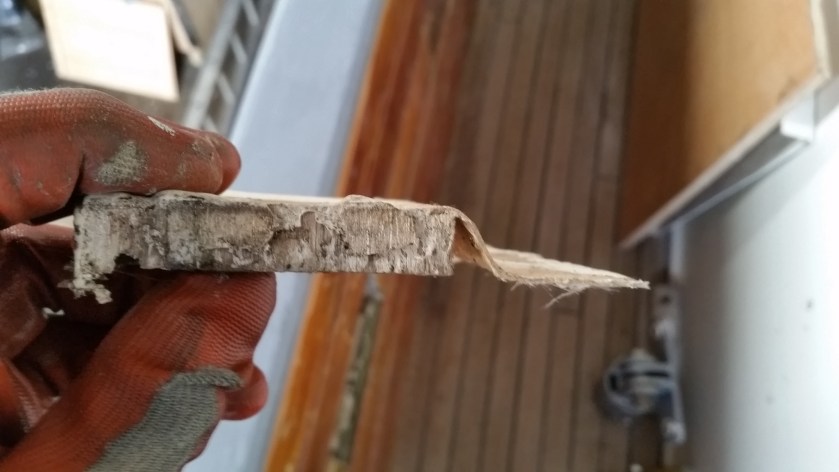
This is a cutout of the gunnel (upper hull) showing a layer of fiberglass on top of balsa squares.

Our hull above the rub rail to the cap rail, the gunnel, also has sandwich or cored construction, but in this case, the core is much thicker, made of blocks of balsa wood and has an inner and outer wall for added strength. Also, cored hulls do provide additional buoyancy. Clearly one of the reasons that when hove-to the boat bobs morthan rolls in big seas.

Which gets to the basis of why I am not afraid.The same cutout from another angle. The squares of balsa are easier to see.

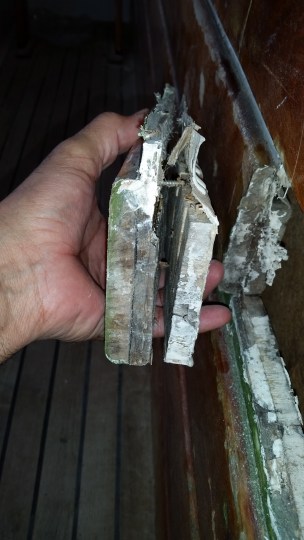
The same cutout from another angle. The squares of balsa are easier to see.It was certainly not due to my experience as a mariner!  I’m probably in the bottom 2% of experience as a mariner.

But I am probably in the top 2% of researchers and I know the difference between opinion and fact.

For 5 years before we purchased this boat, I read, I studied and I determined what capabilities a small (that I could afford) boat

needed to have to be able to travel the world, cross oceans and yet have the comforts of home. I wasn’t going to live like a monk after all.

That process of research and reading every story of ocean crossings I could find, led me to this Kadey Krogen 42.  I knew this boat could handle the worst conditions, whether I was miserable or not.

My friend Larry said it this way, when we got in those chaotic

This is what was cut out of the inner gunnel. The picture below is the piece on the right.

seas, 6-12 feet, short period, from all directions, off the coast of France last summer, Dauntless just seemed to settle in and not fight it. We were hanging on for dear life and she was just motoring along, wondering what all the fuss was about.

James Krogen knew how to design and build a boat that could do anything asked of it, be it bringing us home from a week-end jaunt or around the world.

That’s why I’m not afraid.