My northern Europe pictures and some videos from April thru November 2016, including the painting of Dauntless in the spring and a few of my side trips to Galicia and Veneto, Italy.
Most galleries are in chronological order. The date time group is also embedded in the file name. Please forgive all the redundancy. It’s always easier to take too many pictures than not enough, though it makes sorting after the fact a real PIA.
Also, should you see anything and have a specific question, please feel free to email me.
Kadey Krogen Rendezvous 2017
Richard on Dauntless
Dauntless has come so far
Dauntless’ Second Atlantic Passage
Four Legs from Europe to the Caribbean
Leg 1 Rota Spain to Rabat, Morocco, via Gibraltar to fuel up
250 nm
50 hours total
Leg 2 Rabat Morocco to Las Palmas, the Canaries (unexpected stop)
600 nm
4 days, 1 hr., 35 min
Avg speed 6.1 knots
Leg 3 Las Palmas to Heiro, the western most island in the Canaries, Fuel top-up
172 nm
31 hours and 45 min
5.5 knots
The last & biggest leg, the only one that mattered, the Canaries to Martinique
460 hours, (19 days, 4 hours)
2582 nm
7 knots
The “Oh, BTW, you still have 2000 miles to go” leg, Martinique to Panama Canal and Mexico
460 hours, (19 days, 4 hours)
2582 nm
7 knots
Same strong easterly trade winds; same large, mixed seas
Avg roll +13°/-09° ext 22°/-10°
Overall Winds & Seas
Conditions are Very Different than the North Atlantic
Trade winds prevent turning back
Constant wind speeds of 20 to 35 knots
Direction varied over 90° from NE to SE
3 wave sets produced large 25° roll every 8 to 10 minutes for 3 weeks
NE & SE wave sets, smaller, longer period
wave heights predominate 10 to 15 feet at 8 seconds
3 different wave sets produced large 25° roll every 8 to 10 minutes for 3 weeks
First week very disconcerting to have stern fall to stbd so suddenly every periodically
Since leaving North Africa, until the Panama Canal, more than 5,000 nm and more than 60 days underway, all but two of those days required the paravane stabilizers.
Entering the Pacific and turning northwest from Panama City, in the first four days we had no need of stabilization. They call it the Pacific for a reason.
Crises In the mid-Atlantic
Fuel Loss
What Happened
Possible Solutions
What I did
What I now think I should have done (hint: Much Ado About Nothing)
Hydraulic Hose for Rudder failure
What Happened
I was screwing around
Possible Solutions
What I did
First fix did not work
Spares, spares and more spares (but not the right fitting)
What I now think I should have done
Overall Summary of My Second Atlantic Passage
Considerably harder than I had expected
I’m still organizing the data, but the big take-away, is that the fuel consumption for the last two years has been about 1.5 gal/ hr. or a little above 4nm/gal
Average cost has run between $75 to $133 per day when I’m on the boat. Even during the most recent passage, cost was $104 per day, with fuel being $80 a day.
(The below was written last week, while underway, midway between St. Vincent in the Grenadines and Bonaire)
It’s about time!
Don’t Let this happen to you. The wreck on the east side of Kleine Curacao
Anyone who looks at a weather map can see that the passage from the eastern Caribbean to the Dutch Antilles is pretty much the same conditions as the Atlantic from the Caries to the Caribbean.
That means strong easterly trade winds and the seas and conditions that they produce. They are trade winds, because they are produced by the global heating and not by low pressure systems, as occurs north of the tropics.
So, we are merrily rolling along. This is 42-hour point of a 70-hour trip. Do I worry about jinxing it, by writing that we had no problems? Of course, I do. But every once in a while, I feel the need to get really crazy. Hoping that Poseidon is playing with Persephone and doesn’t have the inclination to mess with Dauntless this time.
Sunset Looking Towards Bonaire
Now, if this post never gets published because we never made it. I take all the above back. But let’s assume that you are reading this in the comfort of your reading place and I am happily ensconced in Bonaire paying too much for everything and squealing like a pig as I do so.
Since I finally just published the account of an average day crossing the Atlantic in the trades, you should all know the routine my now.
And the weather is the same.
Sunrise
Easterly winds, 20 knots gusting to the low 30’s, with the direction varying from northeast to southeast.
As long as it has an easterly component, Dauntless can deal with it as we make our way west.
While the winds are about the same, the wave heights are significantly less. Thank God, no strike that, Thank Poseidon.
I guess that is the effect of the Grenadines and Antilles reducing the fetch (the distance winds blows over uninterrupted sea). There seems to also be a tidal current of 0.5 to 1 knot pushing us along. That means that yesterday, we made 156 miles in the first 24-hour period, that’s an average of 6.5 knots.
The extended length filling tube and funnel for the power steering
Our earlier Atlantic Passage, our average was 137 nm at 5.9 knots.
Yesterday, I made grilled chicken for us, with a side of pasta. I also made a tomato sauce for pasta, which we will eat today. This is something I have not made for many, many years, at least a half dozen, years.
I made this for Micah, as the time for him to return to school and get on with his life is now rapidly approaching. It’s the least I can do for his hard work and the diligence he as shown these past 8 months on Dauntless.
The three big problems we had previously: the mysterious fuel leak, paravane shenanigans and hydraulic hose failure, have all been overcome. The paravane poles have been the most interesting in that I am always tweaking the system. Sometimes my tweaks work, sometimes they don’t. But I pride myself on finding simple, inexpensive solutions and this stabilizing system is finally starting to speak for itself.
The hydraulic steering and the helm and for the ComNav Autopilot has never been quieter. Never, at last since I’ve owned the boat. And as Micah pointed out, the owner’s manual did say that one had to be patient as air would work itself out of the system in a few weeks. I did help it by rigging a Rube Goldberg looking filling tube and funnel on the upper helm. This allows the system to burp itself without the usually oily mess.
After the ABCs, we are headed to Colon and the Panama Canal, after a short visit to Columbia, where my brother is for some unknown reason. He’s never seen Dauntless, so it’s the least I can do.
Near term, once through the canal, we’ll head up to Costa Rica, where Micah will leave us and Larry, my Alaskan friend of 44 years who I met on T-3, will join me and D.
There is much to write about in my latest Atlantic Passage. We had full leaks, big seas, high winds and of course, the ever ubiquitous operator snafus. This post will go through a typical day, then address the issues that sprang up and how we dealt with them, in subsequent posts.
A Typical Day
Sunset over the Atlantic
03:35 hours, my alarm goes off, telling me it’s time to relieve Micah and it’s the start of another day. I lie in bed a few minutes, feeling the motion of the boat. What can I discern from that motion? How many times was I almost thrown out of bed last night? I brush my teeth in my forward head (sink, shower, toilet), using my knees and elbows to brace myself against the constant pitching and rolling. A dozen times an hour, we get the inevitable larger roll to starboard, as the stern literally falls into the deep trough that forms when the southeast and northwest waves trains meet under Dauntless. This also causes a large pitch up. As I put on a new tee shirt and my boat pants, either warm up pants or shorts, depending on the temperature, I slather my forearms and elbows with Neosporin. They take a beating every day with these conditions. The decks that I have traversed a thousand times are suddenly more narrow.
The Logbook showing Days 2 & 3
Lastly, before leaving my cabin, I make guess as to the conditions: wind, weather, seas. If it’s important enough to know, it’s important enough to think about it. It’s why the Socratic method of teaching works. In the darkness of the forward cabin, too many times I have convinced myself the boat is clearly spinning around like a top, or while anchored, or even docked, that the boat is moving forward at some incredible speed.
My making myself consciously think about the conditions outside while in a dark, closed cabin, the next time I have such thoughts, I will have better understanding that it’s not the boat, it’s my brain, and go back to sleep.
Looking East, Just Before Sunrise
03:45 hours, I leave my cabin, walking around the salon and galley, I’m also doing a sniff test, checking for unusual smells, our sense of smell being keener than sight or sound. Then open the hatch, down into the engine room: still sniffing, listening and looking. I check the usual suspects, the Racor filter and its vacuum (which is an indication of how clean or dirty the filter has become), then eyeball, maybe even feel the bottom of the engine mounted fuel filters to make sure of no leaks. Look at the injector pump and just around the engine for anything out of the ordinary. Even check that the amount of fan belt dust has not changed.
Sunset from the Krogen Pilot House
I put my hand on the coolant tank of the Ford Lehman diesel. It’s usually about 164°F and I can hold my hand on it about 1 second, longer means the temperature is lower, maybe 155. Shorter, and there is a problem, and I need to investigate further. I check the water maker valve settings. Making sure it is initially going to “test”.
Every other day, I would add about a liter of oil to the running engine. She consumes about 1 liter every 50 to 60 hours. So, I’d need to replace that. Then, with a last look around, I ascend into the salon and head to the pilot house to relieve Micah.
Dusk on the Coastal Explorer Navigation ProgramThe Moon watches over us
03:55. As I enter the darkened pilot house, I go to the log book to start the 04:00 entry, asking Micah what I need to know. On this passage, that’s usually nothing, No ships, no boats, no nothing. He goes off to a well-deserved sleep and I remind him to sleep as long as he wants, and that’s usually until late morning or noon.
04:00 log entry consists:
engine rpms (usually 1500 rpms),
speed (usually 5.9 knots this trip),
course (245°),
engine coolant temp (178°). (*These three instruments in the pilot house vary somewhat based on electrical issues, but it’s still important to monitor on a relative basis).
Oil pressure (*30psi, it’s actually 50 psi since I also have a mechanical gauge on the engine),
voltage (11.5 to 12.2v*). Any significant change to these three numbers does indicate a problem, since they almost never vary.
Every few hours, days, weeks, I use my Infrared temp gun to measure temperatures at the: engine coolant tank, 164°, oil filter, 156°, transmission 127° and stuffing box, 88°, for this trip. Other than the stuffing box, these numbers never vary. The stuffing box should be less than 20° warmer than the sea temperature, in this case, sea temp started at 76° and ended up at 83 in the Caribbean.
Storms to the East and South
Before getting settled in on the pilot house bench, I will usually go outside. Depending on how rough it is, I may just go to the stern deck. During this trip, the stern deck was awash constantly with water coming in and leaving by the scuppers. So I would stand on lower stair toward the bow.
Why go outside? Why go when Micah is already in the cabin, knowing to fall in the water is fatal? Because I like a few minutes of solitude, just me and Mother Nature. I like feeling the wind in my face. How is the boat really handling the seas. She talks to me, Everything is OK, just go back in the pilot house and let me handle this. Reassured, I do just that.
For the next few hours, I will read, or more usually play Bridge on the computer. Sometimes I watch Korean Dramas.
Some nights were quite dark, no moon or cloud covered. On those nights, one sees nothing. The first hint that a wave is there is the boat heeling. On full moon nights, visibility is probably greater than a quarter mile. But it’s still not good enough to see the proverbial shipping container, so I don’t bother looking.
In actuality, on the high seas, I think the greatest hazard may be sleeping whales, but since one hardly sees ones that are awake… (update – there is a 40-ft. sailboat docked opposite us, it encounters a whale, that ended up tearing the starboard rudder off. The hole was big enough that without the ability to heel the boat to port, they may have lost the boat.)
07:00 time for coffee and whatever frozen pastry I managed to save. Usually, I put the pastry in the engine room when I got up and did my engine room sniff test. The sun is coming up, giving me a look of the clouds and skies for the first time. I’ll look at what “stars” are still out. Estimate wave height and direction.
I have spoken to about a half dozen boats that crossed about the same time frame. We all noted that there were three distinct wave sets or swells. In the first week, there was a westerly swell of 10 feet, with wind driven waves from the east and southeast. After the first week, the pattern became all easterly, in that there were three wave sets, one from the NE, one E and one SE. Even my favorite weather app, Windty, at most mentions only the swell and one set of wind waves.
One of the sailors I ran into in Martinique, called these confused seas, “the bathtub”. The bathtub made for a long 21 days.
Now this wave pattern had a very interesting effect. About every 6 to 10 minutes, the SE and NE waves would meet under the stern of Dauntless, causing a very big corkscrew roll as the stern fell into the deep trough and rolled to starboard, as the bow pitched up and turned to port.
The Maretron data should these extra big rolls were about 20° to 25° to starboard, 10° to port, with a pitch up of 1.2°, followed by down pitch of 2°.
As I said, being alone, watching the sun rise, is very spiritual. One of those instances that I actually prefer to be alone.
For the rest of the day, log entries were made whenever we had a change to course or anything else.
10:00 to 18:00
More of the same. Micah would get up by late morning. We would decide what to eat at our main meal in mid-afternoon. For the most part we ate normally, which is to say, the freezer is stocked with various meats, pork predominantly, though we had two enormous rib eye steaks that we had found irresistible while in the Las Palmas market. I made the first one (enough for about 4 people) the first week out, but saved the second for Christmas.
The boat motions coupled with a very wet stern deck made for interesting grilling on the Weber Q280, but certainly still better than grilling in minus 20°F or at 40° in a 30-mph wind on our rooftop in the Upper Eastside of New York.
We would also use this time to watch some Korean Drama. K-Dramas are the perfect way to pass a few hours each day. Too tired to do something creative like write; sometimes too mentally tried to even read, so K-Dramas came to the rescue. Captivating enough to keep one occupied during the most monotonous rolling conditions. Thank God for Korean Dramas.
When the rolling was not so bad, we used that opportunity to play a board game. I made little non-slip pads for the pieces, but even with that, conditions only allowed our games on about a third of the days.
Much of the rest of our daylight hours was spent just checking things that were easy to check during the day. Walking around the boat, feeling the tension of the stays and lines for the paravanes, as they were under the most strain.
By the way, having waited four extra days for the winds to be favorable when we left the Canaries, as we pulled out of the harbor with 12 knot winds and seas 2-3 feet, I said to Micah, maybe we won’t need the paravane stabilizers the entire trip. An hour later, I put out the windward {port) bird. A few hours later, both birds were deployed and were needed for the next 20 days until we pulled into the harbor of Martinique.
Bob Dylan was right, never trust the weatherman.
We left the Canaries with full fuel tanks, but only one water tank (150 gallons, 600 liters) full. This was purposeful, as I wanted to use the water maker to fill the empty water tank. Our Katadyn 160 water maker makes 8 to 9 gallons of water an hour, so it takes about 19 hours to fill one tank.
Micah and I use about 40 gallons per day. The Katadyn 160 is rated to make 160 gallons per day or 6.67 gallons per hour, but I have axillary water pump, pumping water through two sediment filters, before it gets to the water maker. Therefore, I have found that on this trip, it produced between 9 and 10 gallons per hour, so we ended up running it about 50% of the time. Thus, it was convenient to turn it on when I did my engine room survey at 04:00, then turn it off in the early evening. I had pickled (put a preservative in it) in June 2015, 18 months earlier. This was necessitated by the amount of organic material in the rivers and estuaries o the North Sea and Baltic, made water making difficult, if not impossible. Thus, it was with some relief upon leaving Gibraltar that once I got it running again, it ran for the next month with nary a hiccup.
14:00 Local Canaries Time, which just happens to be UTC (Universal Coordinated Time, the time of solar noon at 0° Longitude)
14:00 was the time we left the Canaries, so I used it as our “official” 24-hour point. At 14:00 each day, in addition to the above log entries, I’d note:
quantity of water,
Quantity of fuel,
Fuel feeding from and returning to which fuel tank,
fuel filters in use,
distance travelled in the last 24 hours,
24-hour average speed,
current position,
current weather, sea state,
average pitch and roll for the period
the new heading and distance to destination.
18:00 to 21:00
Evening would have Micah taking a nap below. I usually took a little nap in the pilot house in the early afternoon after Micah was up and running. So, I would use this time to walk around again before it got really dark. Feel the lines, sniff the engine room and just get ready, mentally and physically for the overnight.
While his watch started at 22:00, he would usually come up the pilot house between 20:00 and 21:00. If early enough and I was not too tired, we would watch an hour K-drama. I developed the watch schedule because Micah was flexible with his sleeping, though he did sleep a lot. I slept less, but I knew I need 6 hours of good sleep. That ended being more like 5 hours, but it worked. Though I did find myself dozing off a few times after the sun rose.
More to come: The Good, the Bad & of course, the Ugly
We do a little 400 mile trip today to Bonaire, as we say goodbye to the Grenadines and head west.
See you in three days. You can follow at: Share.Delorme.com/Dauntless
After topping up the portside fuel tank, we had a quick lunch, as I was hot to trot.
THe Wonderful Town of La Restinga
As we pulled away from the dock of this peaceful little town, I already knew I would miss it once in the Caribbean. As we came around the protective wall of the harbor, I gave one long blast on the horn, to warn any boats entering that we were leaving and as our way of saying goodbye to a place we really liked.
One long horn blast means “attention” as in pay attention, I’m doing something you may not be able to see. Last year in the Baltic, I noticed that the Germans always gave a long blast when entering a harbor. Just like in the Canaries, most of the harbors have a tall jetty to protect them from the waves, but it also hides boats coming in or out. Thus, the warning.
The Island of El Hierro We say goodbye to 2+ years in Europe
As we settled into our course 258°, the winds were from 120° at 15 knots, thus we had winds and waves from our port side quarter panel. Not the best, but it could be worse. After just a few minutes, I realized we needed to deploy at least one bird to cut the rolling which had increased to ±15°. That’s a lot.
With one bird in the water, I speed was only reduced by about 0.5 knots, but 2/3s of the roll was gone.
As I watched the sea, I also realized we had a large, 10 foot plus swell coming from the west with a period of about 10 seconds. Not too bad, but not helpful either.
The 1st on many Sunsets at Sea
Over the next 24 hours’ conditions remained exactly the same.
Weather data at the end of the first day. I am also recalibrating water tank fill as we use water maker
I remember writing the above.
The last words I wrote for 20 days. Umm, I wonder why? Barbados? Stay tuned.
Leaving Las Palmas Sunday morning, our next stop was planned to be Port St. Charles on the island of Barbados in the eastern Caribbean, 2636 nautical miles west.
Leaving the busy harbor of Las Palmas
The plan was to go north, around the top of Gran Canaria, then southwest between the islands as to afford some protection from the wind.
Leaving the protected harbor of Las Palmas, we encountered strong, NW winds that had produced, large seas since the current was running from south to north on the east side of Grand Canary island. As the seas built to 10 to 15 feet, it was clear that “this dog doesn’t hunt”.
So, 48 minutes into our Atlantic crossing, we turned tail and headed south.
An interesting start. Does make one a bit nervous when the plan changes in the first hour of a 400-hour trip.
We rounded the south end of the island and set the autopilot for 260° and settled in to an anticipated 16 or 17-day passage.
As the day progressed, the winds came around to the south-southeast at 12 to 16 knots and stayed that way for the next 26 hours.
Friendly dolphins escort us
The problem was with these SE winds producing 3 to 6-foot wind driven waves from the southeast, we also had a west to northwest Atlantic swell with waves 6 to 10 feet on a 10 second period. The combination produced a corkscrew pitching, though most of the roll was being eliminated by the paravanes stabilizers. It also slowed us significantly, doing only 4 to 5 knots through most of the period.
A close encounter of the annoying kind
A little after 04:00, it’s pitch dark outside, Dauntless is rolling along at 4.3 knots.
Finally, a period of calm winds.Dauntless is on standbyA cute harbor, with volcano in background
I see a radar return of a boat about a mile north of our course and pretty much on the same course. It’s a small boat, as the radar return is relatively weak and of course no AIS, the automated ship information that would have been on my navigation chart anytime an AIS equipped boat gets within 5+ miles. It also provides course and peed so it takes a lot of the guess work out. Since I’ve had it on Dauntless, big ships don’t get as close anymore.
I get the binoculars and can see his red running light as well as his stern light.
So, he is ahead and to the right of my course. OK, I turn left about 10° to put some distance between us. Over the next half hour, I realize, instead of getting further apart, he now seems to be on a direct heading towards Dauntless.
As I am looking at him again, it all becomes clear. He shines a spotlight on to his mainsail. And in this vast ocean, not having seen another boat for the last 12 hours, this guy decides to wait until we show up to tack and basically cut right in front of me. At night, with seas bouncing the boat around, he puts our two boats on a collision course.
What a fucking moron. Remember, it’s dark out. In day light, it’s much easier to understand the situation and what needs to be done. At night, with only the radar for guidance, nobody would want to purposely get so close to another boat.
I turn more to the left, south, but to my horror, within minutes I realize he is now only a quarter mile away. He shines his light on his stupid sail again. He’s telling me he has the rig
The other side of the IslandLava
ht of way, yes, he has the right to be dead too.
I’ve turned left twice, I am actually a bit afraid since my attempts to get further away, he is now closer. What don’t I understand?? Clearly, I understand neither his course nor intentions.
Again, this kind of situation is much easier to deal with in daylight, but now, only seeing two points of light, with no perspective, he could be 100 feet away, or it could be Mars and Venus.
I have to do something and do it quickly.
I no longer trust him, his course seems to be crossing ahead of Dauntless, therefore, I do the only thing I can to make sure he does not hit me. I turn sharply right, 90° right. This way, I can watch him and keep him to my left. He is going south, crossing my western track, so I will go north and once I get north of him, I will turn west.
I’m going north, he is going south and he passes me about a quarter mile to the west, on my left. In other words, if not for my right turn, he would have crossed just in front of Dauntless.
One of my rules is I never want to pass directly in front of another boat, big or small. I aim for their stern to pass behind.
After he passes, I turn again west and he turns again west now about a mile south of my course, but again on a parallel course. He’s probably going to Barbados also.
As the sun rises I can see him off to the south.
A Course Change
Finally, a few hours after day break on the second day, the winds died down (as forecast by the way) to less than 5 knots. The NW swell was still present, but without the wind driven waves, we could pull in the paravanes birds and our speed increased to 6 knots at 1500 rpms.
Now at this point we were still about 45nm ESE of the furthest west Canary Island, El Hierro, the island that Columbus set off from 500 years ago from the port of La Restinga.
Our current course was 260°, the port of La Restinga was at 289°, therefore not a big detour and when I looked more closely, it only added 6 nm to our entire trip. Thus, even though I was sure we had enough fuel for Barbados, if I would run out of fuel within sight of Barbados, I don’t think I would ever hear the end of it.
And I felt it was best to get away from my errant buddy. I’m in credulous that anyone, at night, would purposely pass in front of another boat.
Sunset in La Restinga
Thinking of the encounter a couple of hours later, I think that even though I saw his boat for quite a while, he must not have seen Dauntless, until he tacked in front of me. But still, why make the safety of your boat depend on someone else’s action? Sometimes Right of Way really means Right to Be Dead.
Seven hours later, we pull into the little harbor of La Restinga. It’s really a cute little harbor.
Docked along the wall, behind the rescue boat, the security guard came by, to help with our lines and take our information. Very nice. As I have said previously, all of a sudden, being in the Canaries, is like being in northern Spain again.
These are sea-going folk, unlike the olive and cattle people of Spain’s southeast.
Well, after we got all tied up, it turned out we cannot get fuel until Wednesday, as Tuesday was a big holiday, so just like that, we are having a two-day vacation.
For a few seconds, I briefing debated just leaving, but again, I don’t like being ridiculed and more seriously, I was meticulous in fueling at Las Palmas, so this gives me an opportunity to measure my exact fuel consumption at 1500 rpms over a 30-hour period.
My guess is that it will be 1.4 gallons per hour, ±0.1 gallon.
I’ll tell you tomorrow.
And now Wednesday night, it is tomorrow. But still no fuel. They ran out. Maybe the truck comes tomorrow. Maybe.
In any case, once having made the decision to stop for fuel, I will wait for fuel. I only need about 50 gallons, 200 liters, but it’s a cute harbor, with nice people, excellent food and wine and it’s a volcano.
Four days on the North Atlantic, 600 nm, four days, 1 hour, 35 minutes, what could go wrong?
Dauntless is ready to Leave Morocco
For one, we found the weak link on this Krogen, it’s me.
In my first year of cruising, I would get sea sick maybe a ¼ of the time. Now in my third year, it’s more like ¾.
What’s changed? Who knows? I’m older, but usually one’s body becomes more adapted. No, I think the problem is in my brain.
When conditions are rough, I know to take a remedy or put on the Scopolamine patch. Now the patch gives me a bad rash, something it did not do a couple years ago, but it’s also very effective as long as I put it on the night
Sunset over the Atlantic
before departure.
With nice cruising conditions, or I should say, relatively nice, winds and seas less than 15 knots and 3 feet (1m), respectively. In the past I never had to worry, now, if the slightest unexpected event happens, I get seasick.
Grand Canaria comes into sight
This last episode was one of the worst I’ve ever had. But I’m not 100% sure it’s “seasickness”. It’s more like my body gets a whole load of adrenaline and then when crisis is over, my body doesn’t know what to do.
Monday, the 28th, Day 1 of 4. It was great to get underway again. Having an extra week in Morocco was not needed. The Moroccans are lovely people though and even that morning the Pilot asked me if I wanted to go out with them that morning to check the inlet. I’m always up for an adventure, so of course I went. The winds had finally died down, so I was a bit surpised to see 6 to 8 foot waves at the inlet. But they were not higher, so they declared the port open.
Grand Canaries
That started the whole customs, police and immigration process. Basically, just like checking in, you leave your berth, go to the designated dock and all the above come visit. It took us about an hour to check in 3 weeks earlier, and it took about an hour to check out. If that seems like a lot, you should know that in southern Spain and all of Portugal, it always seemed to take half an hour. (the difference between northern Europe, including northern Spain and southern Europe is like night and day; it’s mind boggling).
So, Day 1 started out with our checking out. The customs or immigration lady, who checked us in with her team of three others, checked us hot. Must say, she was the hottest officer I have ever seen. But she was all business, all the time. If you have ever been to the Soviet Union, you can picture what I mean.
The process, though time consuming, was easy and extremely convenient. As we pulled away from the dock, we waved at everyone and headed to the inlet.
Those steep inlet waves test that everything on the boat is stored securely and all was so we headed southwest along the coast of Morocco. While the winds from the south were light, there was an Atlantic swell of 8 to 10 feet, with an 8 to 10 second period. Not bad, but it necessitated us having the paravanes out with the two birds in the
Las Palmas
water.
Day 1 ended after 24 hours and we did 133 nm.
Day 2 (starting Tuesday at 14:35, the second 24-hour period) started the same, light SE winds, but became stronger through the entire period. Finally, at the 47-hour point, mid-afternoon on Wednesday, the winds had increased to 25 knots. With our southwesterly course, this meant they were off our bow. This makes the course untenable as we end up burning fuel to go slower and slower, all the while pitching up and down like one of those mechanical bulls!
Our initial destination had been the Canary Island, Fuerteventura, but with these strong SE winds, we needed to head more west, like 240 degrees. Thus, our new destination became Las Palmas, on the island of Gran Canarias.
So, Day 2, 150nm, (the second 24-hour period) ended with us headed 240 degrees, with winds 160 at 21 knots gusts to 25, producing seas from the south of 4 to 8 feet.
The paravanes work most effectively with seas on the beam, so our ride was actually not so bad with a gentle rolling of 8 degrees to the lee side and 4 degrees to the windward side.
Two hours into Day 3 (Thursday, 16:50), I was in the galley, when I felt the boat motion change. I looked out the salon window to see the windward paravanes bird being dragged on top of the water, clearly broken.
At first I was really calm about it. I finished filling my water bottle. Then went to stop the boat, retrieve the pole and bird. Dauntless is quite tame when not underway, in other words, she rolls much more underway w=then when dead in the water. So, there was no big crisis.
The two spare birds are stored in the lazerette. The one that broke had been repaired in Ireland, as it had previously broken crossing the North Sea. So, I wasn’t too worried as to the cause. But as we tried to get the bird out of the lazerette, the fin of the bird became lodged under the generator exhaust hose. And the more stuck it became; the more stressed I became. I didn’t like the idea of leaving it as it, so close to the hydraulic rudder piston, but after 5 minutes of trying dislodge it, I gave up, took the bins out of the other side and got the other bird that was stored on the other side of the lazerette.
It took just another minute to replace the broken one and we were underway again, finally 20 minutes later, having spent more than half that time, trying to get the one bird out.
Underway again, all was good, but I was feeling very strange. I had to change my clothes, since I spray everything in the lazerette with various WD-40 products. After changing my clothes, I figured a shower would help. I felt very hot. I shower quickly, figuring that cooling off would make me feel better, but now, I can’t dry myself. It was a bizarre feeling. I didn’t seem able to stand or move.
I tell Micah that I will join him momentarily, figuring if I just relax for a few minutes all will be fine. As I am now sitting on my bed, still sort of wet. I finish drying myself, realize I need to rest, but want to walk around the boat, make sure all is OK. As I go to put on my shirt, I became violently ill. First time that’s happened in years, even though, I get sea sick a lot and have that miserable nauseous feeling, I don’t throw up. This time I did.
I realized I can do nothing physical. I tell Micah to make sure everything looks OK and I needed to nap.
I do and three hours later, I am up and OK.
Winds were weakening, but the westerly swell was still there, so we kept the birds in the water. Finally, when I came on watch at 04:00, I decided to pull the birds to make some time (the birds cost about 1 knot of speed).
Day 3 ends, 147 nm, with the winds SE at 10 knots and we’ve been making 6 to 7 knots the whole time.
Day 4 starts with me adding a quart of oil to the engine while underway. It had been 72 hours and the Ford Lehman uses about a quart every 50 to 60 hours. Winds of 10 knots or less allowed us to run without the paravanes for most of the period, but by early morning, the roll had increased to an annoying level. Our course had been 232 for the last 20 hours and the winds were now 210 at 10 kts, and the seas 210 with 3 to 6 foot waves. This meant we were now heading into them, but with 40 miles still to go, there was not much we could do. The waves were also causing an annoying corkscrew motion, a combination of pitch and roll, so I decided to put one bird, the windward bird, in the water.
This past year, since leaving Ireland, I have on a number of occasions, put only the windward paravanes bird in the water. It still is 80% as effective as both birds, but it reduced our speed a little less, 0.7 knots, versus 1 to 1.2 for both.
And that’s how our passage from Rabat to the Canaries ended. We pulled up just a mile from the harbor, pulled the bird and we entered the Puerto Deportivo De Las Palmas on Friday at 15:26.
Day 4, 167 nm, 25 hours, 35 minutes, average speed 6.5 knots.
Total for trip: 598 nm, 4 days, 1 hours, 35 minute, average speed 6.2 knots
The day to never forget started with a beautiful sunrise. As the red, then orange then yellow orb cast its glow on this arid North African landscape, little did I realize this day would be one never forgotten.
We went about our normal chores. After being in Europe for over two years, Dauntless has gotten that weathered, experienced look, that says, look out, here I come. Admittedly, the new paint scheme helps in that regard. Two years ago, every minute was a scramble to get something done, and then a half minute to undo what was just done, and another few minutes to do it again.
Moroccan FriendsDauntless in Rabat
Now, those novice jitters are gone. Spares, parts, and all the other crap that I can’t throw away is carefully stored in containers in the engine room. The virtual computerized inventory is all done. Stored in the virtual closet.
Dauntless is lying heavy in the water. Full of fuel, water, but unlike last time, with just enough food to last a family in Africa about 38 days, instead of the 400 day supply we left New England with two years ago.
So, who could have realized an innocent remark to a passing stranger would matter?
The Marina Bouregreg is a very nice marina. Situated on the River Oued Bou Regreg in the town of Sale, the capitol city of Rabat is just across the river. Rumor has it that the royal family has some boats in this marina, so security is all over, but very friendly and helpful. As marinas go, it’s by far one of the best we have been in.
So just a day after arriving, now two weeks ago, as I ambled back to our beautiful Kadey Krogen, now going on a young, but frisky 28 years old, I spotted a group of ladies also admiring her.
It’s not often one sees a boat in Europe flying the Stars and Stripes and I always like flying a large courtesy flag, so I can fly a large American flag just below. I would not want to offend the locals. In spite of the common belief in the USA, I have yet to be in a place where Americans are not admired. There are probably 10,000 pictures of Dauntless and her two American flags taken over just the last two years.
Now they girls turned out to be students at the University also taking pictures of Dauntless. After a few words it was clear that their English was very, very good.
One thing led to another and next thing we knew, we were all talking about America and Morocco in the salon of Dauntless. It was a large group, 4 girls and the 4 of us, Larry, my T-3 friend, Pierre Jean (PJ) a KK wannabe from Paris, Micah, my fake nephew and myself. An eclectic group. PJ and Larry were leaving to go back to their respective haunts, while Micah was going to Fez, a beautiful city a few hundred miles from the coast.
So, as we said our goodbyes to the students, their insistence that they make us a Moroccan dinner before leaving for the Canaries was touching. And who can say no to a group of pretty ladies; not I. A date was set and we said our goodbyes.
The day before our tentative dinner, we re-affirmed the arrangements.
It was a wonderful dinner. We really felt appreciated that these 4 Moroccans would go to such an effort of cooking all day just for us Americans.
The plan was to leave two days later, on the 24th.
But we couldn’t. the Port was closed! Nervously we wondered, why was the port closed?
Reassured by the pilots that the port would be opened the next day, we went about doing the last-minute preparations. Micah and I both decided to put on our sea-sickness patch, as it seemed two of the four days needed to get to the Canaries would not be very pleasant. I also decided that Madeira was an acceptable destination also. A few hundred miles north of the Canaries, it would increase the options on our route based on the actually winds and seas.
This situation reminded me of my crossing of the North Sea last September. I ended up taking a weather window that was only 2 days of the four needed. Turned out OK. As fall becomes winter, one’s options get worse not better. So, I felt this was doable.
The plan was that for us to even have two good days, we needed to be 250 miles west of the coast, then as the winds veer to the northwest, we could head west-southwest to Madeira or south southwest to the Canaries. The paravanes are most effective in a beam sea. Winds were forecast to be 15 to 20 behind the front (from the NW). My Rule of Thumb is to ALWAYS assume the winds will be 50% stronger and only within a 90-degree arc of the stated direction.
Thus, worse case, these NW winds could end up 270° at 30 knots. If that happened, then we head due south. It wouldn’t be fun, but I’ve seen worse.
I slept fitfully; not well at all. Finally, in the middle of the night, I decided we were not going.
The problem, my fear? There was a forecast strip of high winds from the southwest just off the coast. My plan depended on getting west of those winds before they got strong, as they were forecast to get up to 40 knots. If in the first 24 hours of leaving, if we encountered SW winds at 15 to 20 knots, no problem, we head NW and can turn SW as the winds change.
But I was ignoring my own rule of thumb. What would happen if the winds were 260° at 25 knots? I’d have to go virtually due north, which would put me back in Rota in three days!
Or even worse, the first 24 hours goes as planned, we are now 125 miles from the coast, but the strong wind band sets up also further west. Thus 40 knot southwesterly winds. We’d be back in Gibraltar before anyone could say, what the fuck just happened. And worse, it would not be a fun ride.
When one is in the middle of the Atlantic, you take what Mother Nature gives you and are grateful for it. If you complain, or even look at her the wrong way, she’ll show you very quickly that no matter how bad it is, it can always get worse.
That morning, as I went to talk to the pilots (all boats are guided into the harbor and marina on a 24/7 basis), they assured me that the harbor was now open, and he added that I would have no problem since I have a sturdy boat. That’s certainly true, but I told them I had decided to wait out this coming storm in port, rather than at sea.
Strong winds off the coast trapped us here for anther few days. We’ll get out this weekend. Saturday is still unsettled, but Monday and Tuesday, look good.
I keep on looking for excuses not to leave, but Mother Nature, continues to send warning signals that I best be on my way. Right now, the best 42 hour window is from the 13th at 0300L, putting us just off of Brest on the 14th at 22L.
A night time entry, but what else is new!
It’s the only way I can maiximize the good wind conditions as the ridge moves east .
And here is the current surface map to help you understand the wind pattern better:
Atlantic Sfc Analysis
I’ve been watching this for the last few weeks, at first just to get an idea of the timing of the systems and the strength of the winds.
Until yesterday, the prognosis (progs) seemed to indicate a thin ridge of high pressure passing eastward mid-week. Then yesterday, it showed a nice ridge (indicative of fair weather and weaker winds) on Thursday and Friday, with the high pressure area centered just west of Brest.
Now this afternoon, after the 12Z run of weather models, my ridge of high pressure has been squeezed to almost nothing. So for my 2 day trip, this now looks like a 24 hour weather window:
WNW winds down to 15 knots (map shows km/hr)
It’s for this reason, (that the progs can change significantly) I pretty much do not look at any other weather products routinely. There are a number of reasons for this, in short, they all get their weather from the same source and more importantly, the different forecast models may differ in terms of space and time; but for someone not looking at them constantly, as in a full time job, forget it. There is simply too much information to digest fine tune a forecast that much. In addition, there is no point in looking at more detailed forecasts because by now, I know what to look for.
Though if I was travelling locally, like north along the coast, then I would check the marine forecast for that area. But if was just saying what I already could deduce myself, in other words no real local conditions to consider, then I don’t bother looking at it again.
Dauntless needs a little less than two full days. 42 hours, to get from Waterford to Brest, France. So I’ve been watching for the last few weeks, whenever I have internet, to see how often a two-day window appears.
Not very often. There may have been one a few weeks ago, but since that, I’ve only seen good weather windows of about a day. Now, when I say good weather, originally I was looking only for winds on our stern at 15 knots or less. The Krogen runs really well in such conditions, rolling as she is wont to do, but the paravanes reduce most of that.
As I was watching, I had even settled for 20 knots astern, since I saw so few periods with less than 15. Also, since our course to Brest will be 160 True, winds from dead astern would be 160 +180 = 340 or northwesterlies. NW winds occur after a cold frontal passage.
So it’s easy, just wait for the front to pass and head out.
But it’s not so easy, as I learned 30 years ago while forecasting the weather for northern Europe and Germany in particular. The North Atlantic is a true spawning ground for low pressure systems. They line up like freight trains, from North America to Northern Europe. And they are moving quickly, averaging 4 times the speed of Dauntless or about 600 nm a day.
But as the fronts approach Europe, they start to weaken as they lose the upper air support that is centered over the North Atlantic. Then with the passage of the cold front, instead of the usual 2 to 3 days of high pressure with NW winds and cold temperatures that one gets in the mid-west, one gets a reprieve of only 6 hours, before the winds jump around to the south or southwest in from the of the next cold front due to arrive in about 18 hours.
It was exactly the pattern I got into in the last three days of my Atlantic Passage two years ago. But then, I wasn’t thinking of the overall pattern, but instead was just so glad to see a few rays of sunshine as the winds dropped to 15 to 18 knots.
Halleluiah
I remember making a snack thinking the worst was over. I was able to find the banging wine bottle. So as the winds picked up again in the next few hours, I hardly noticed. I was like the lobster in the pot of cold water wholeheartedly noticed the water getting hotter and hotter until it’s too late.
But unlike the lobster, I know I’ll be safe no matter what, though I may be miserable. That’s because the first step is to find and have a boat that can do what you want it to do.
As I look at the videos I shot with my phone conditions don’t look that bad. Monday morning unfolded into seas that were still less than 6 feet.
With a “normal” day cruising, we should be in Vlissingen in 12 hours.
Error
This video doesn’t exist
The https://share.delorme.com/dauntless site is pretty nifty. You can click on each circle and it tells you the time. I can also see that I made the decision to abort and head for Oostende at 21:20 Monday night. Only 12 nm away, it still took 4 and half hours to get here.
And those were the must miserable 4 hours.
The winds having built to 25 gusting to 33 knots, had built very steep, choppy waves. Only 4 to 6 ft. early in the evening, due to the proximity of land, about 10 miles off our starboard beam, the waves were coming from a multitude of directions, having bounced off the close by land.
Pierre-Jean liked hand steering; he really liked the Krogen and I let him for the most part, though as the evening progressed, I preferred being on the ComNav Autopilot because it does really well in the worst conditions. At a certain point it dawned on me that for PJ, this was a test drive. He got to drive a Krogen in conditions that 90% will never see. He was as sick as a dog, but I give him credit, he found a boat far tougher than he was. He left happy.
Dauntless Docked 3 Days later. There had Been a Sailboat 10′ in Front
Me too. PJ had left me with a bunch of wonderful French wine. And if we have one rule on Dauntless it is all sins are forgiven with wine.
With the mixed up seas, Dauntless was being hit by the tops of waves periodically. So I not fixing the two problem areas, the warped pilot house doors needed new thicker gaskets. The center pilot house window, that flips open, had a rubber flap, to stop water from directly hitting the gasket on the hinge.
I had removed that months ago, with the intent to replace it. I hadn’t. Why, because I was looking for a white rubber mat, that would fit, be inexpensive and look good. So periodically, as the pilot house got bath, water would splash down onto the helm. Only a half a cup at a time, and looking on the bright side, I was happy that the water did not stay in the ceiling, but immediately drained down to the helm!
But still, a half assed oversight on my part. So the helm was covered in wet towels.
The pilot house doors were another issue. A lot of water was coming in, maybe a quart at a time. There were a lot of times.
The Entrance to the Harbor From Shore. Just to the ld=ft of the tower you can see the two green lights that initially confused me
So for the last few hours that side of the pilot house floor was covered in soaked towels, mats and other materials so the water would not make a waterfall into the salon.
As there was no reason to move around, not so bad of a problem. But as we were minutes away from the harbor entrance, I got soaked just moving around the pilot house.
Then to add misery to discomfort, I needed the pilot house doors to see what was where and get the lines ready. So we had a 30 knot wind blowing through the pilot house it was cold, wet wind. The Krogen has a tendency to stay at whatever the water temperature is. Thus, a 55°F water temperature meant at night the pilot house was about the same. Add wind and being wet, just set the stage for a true disaster.
OK let’s set the stage. I’m a mile from the entrance to Oostende harbor. I see the red and green lights marking the channel, I also see two green lights, on the red side of the channel. I see numerous Sodium vapor lights and the orange glow they produce. With all those lights, I see no channel; only darkness and shadow.
But I have no choice. I am in 20 feet of water, winds are up to 35 knots, waves are crashing into us from all directions, and there are all sorts of sand banks close to shore with all sorts of names, meaning they have a history, i.e. “remember when poor Jacques floundered on the Grote bank?”
The wind is pushing us fiercely to the south, to the right (green in Europe) side of the channel. I am trying to keep the boat on the red side, but clearly still not seeing the entrance.
The Marina Entrance
Finally, I trust to the charts, C-Maps by Jeppesen, (did I ever tell you I was a Product Manager at Jeppesen?? you’d think I could get a discount on their charts!), aim for blackness just to the right of the last red marker and as soon as I enter the shadow, I can see the rest of the channel straight ahead and the seas flatten.
But this is big commercial channel. I need to get the paravanes in. Pierre-Jean has never done that before, so I must leave him in the pilot house, while I go to the fly bridge and winch them up. It only takes two minutes and I am thankful that all the tweaking I have done on that system works so well.
I race back down, and aim for the right channel which will bring us to one of three marinas in the harbor.
I am cold, wet and miserable. I’ve gotten only a couple hours sleep in the last 24; but this is where I am pleased with my decisions.
As we motor slowing down the channel, maybe a mile, I am conscious of the wind pushing us along. I want to reconnoiter the marina, but not get us in a position I cannot get out of.
Sure enough, as we get to the slips, mostly short (30’) finger piers, there are no “T”s and the left side of the marina which has longer docks is filled with small ferries. I am adept at making the Krogen do a circle in about a 50’ diameter without using the bow thruster. While docking I turn on the bow thruster, an electric Vetrus, but try not to use it as my experience has been bow thrusters are like banks. If you need it, it won’t be there.
So on a calm day, no current, bow thrusters work great. But this is not that kind of day.
The Dutch Boat on the right is tied to the dock right after the slip. This is where I initally docked and let PJ off. In Hindsight, I too Could have stayed there.,
I decide there is no room here. Though I keep in the back of my mind the possibility of rafting to one of the ferries.
We then proceed back to the other marinas, right near the entrance to the harbor. It is a narrow entrance that widens after the opening.
The one long dock is occupied by one of those new plastic, three story, small penis boat. Clearly American, though it says Bikini on the back and flies no flag.
Turns out there was room on the opposite side of the same dock, but that would have meant I had to go around the end of the dock to an uncertain fate and after all I went through I was not about to snatch defeat from the jaws of victory.
So we proceeded towards the third marina and a set of locks, which while closed did have a waiting dock that I could use. We looked around and did see a spot, along the inner dock, maybe 55’ long, between two sailboats. It was in cul de sac and just opposite the waiting dock.
We prepared a midships line and I tied to the waiting dock to think about what to do. The bow is facing the lock and southward, the empty 55’ spot is 100 on our left beam and the wind is coming from the stern at 20 knots.
I figured I could stay at the waiting dock until early morning, but my problem in situations like this, is that I do not sleep, anticipating the knock on the hull telling me in a foreign language that I cannot do whatever I am doing
There was also a seaweed covered wall, 50’ high, but we saw nothing to tie to.
So, I decided the spot between the two boats was feasible. But with one caveat, Pierre-Jean had to be on the dock. I would then throw him the midships line we had prepared. That way, once a line was on the dock, he could control my movement to the sailboat behind.
He was a bit dubious, maybe he thought I was going to leave him, but I liked it and it was the only way I would attempt that spot. (The waiting dock was connected to the other dock, like three sides of a box.
And it was a box I was going into to.
Plan A:
My first attempt was halfhearted. The boat was facing south, wind from our stern and I thought just maybe if I put her in reverse, I could use the bow thruster to push the bow around 180°. At about 90°, abeam the dock and piling I had just left, the wind was pushing the boat so hard, this was not going to work in a million years. I gave it full left rudder, full throttle forward to kick the stern away from the pole and pier. No problem, just a little too close.
Plan B:
Let with wind take me in forward, I’d through the line to PJ, out her in reverse and PJ could pull us into the slip. With the wind behind us, I was going too fast from the beginning. When I slowed, I had no way and no control. I backed up and got out, just narrowly missing that same f…ing pillar.
Plan C:
Just like in NY, I would parallel park. After all the above shenanigans, this turned out to be easy.
A Diagram of the Three Attempts. North is on top, and the wind is from the North
I backed into the box at an angle aiming for the empty spot but wanting to keep the bow close to the sailboat that would end up in front of us.
When I was abeam the stern of the sailboat, I threw PJ the line and he put it on a middle cleat. I yelled at him to watch the stern and I would watch the bow. He would control how far back to let the boat go.
Worked as planned as and with less drama than anything else I had attempted that night.
Dauntless on the other hand looked at me when it was all over, yawned and thought, “All in a day’s work”.
And as I thought about it, happy to be lying in my warm bed, with no new scars to deal with, I realized though the worst of it, while I was certainly unhappy; there was no noise from below. The salon, the staterooms, the engine room, nothing was banging, rolling around or otherwise out of place. Books stayed on the shelves in all three rooms, and pother than the second monitor in the pilot house that I had to re-secure, everything was battened down.
A great boat is a sea way.
I hung up all the wet things and at 3:00 a.m. took a hot shower, crawled into bed and was ever grateful that I had remember to turn on the 12 v heating pad a few hours earlier.
With that, All’s Well that Ends Well.
Food, Fuel and Fools
Having left Honfleur, Sunday morning at 8:30 a.m., we are through the lock to the Seine by 9:00 and we are cruising downstream at warp speed, 10 knots, speed over ground.
I’m finally enjoying my cup of coffee and morning croissant, though a faint order of diesel lingers on my hand.
We escaped, unscathed, so a little diesel with my coffee is acceptable.
Error
This video doesn’t exist
Monday Morning Dawns in the English Channel
We are feeding off the starboard fuel tank, little used since leaving Ireland. I want to balance the boat. I am running the fuel polisher, a larger fuel filter and water separator, which filters 90 gallons of fuel per hour. The only downside to running it while underway is that it does cause a slight reduction of fuel pressure to the engine. Though this has never been a problem.
As we exit the Seine, the color contrasts are marked. Brown mud color for the Seine outflow and blue-green for ocean water. We turn northeast, speed slows to just above 5 knots, but the current will change in our favor in the next hour.
A couple hours later, the current is favorable, but not as strong as I had hoped. At best, we are getting an extra knot. I decide I better check on the filters in the engine room.
I am surprised to see another 2” of water on the bottom (it’s a glass bowl) of the fuel polisher. I turn it off and drain the water. There is also a little water in the primary engine filter (there are two side by side. I can select either one or the other or both or none). I switch to the other filter and also drain the primary filter.
Our speed has increased to 8.4 knots. We are north and east of Le Harve and have about 170 nm to go to Vlissingen. I estimate our ETA of 04:00 Tuesday morning, using an average speed of 6 knots, which I think is on the slow side.
We are starting to roll a bit, only 8°, so we deploy the paravanes. We lose about 1/3 to ½ knots, but the roll is reduced to less than 2°.
I go check the filters again and now am dismayed to see a lot more water in both the primary engine and the fuel polisher (FP). In addition, the FP is showing a vacuum of 23”, with 10” being the point I should change it. It is full of crap and must be changed now. I am worried. It means there is far more water in that tank than I had expected. I must change them again, while underway, at least I think that should be no problem.
I switch the Racor to the other filter, and within a minute I hear the engine laboring; then die before I can do anything. I immediately think back to this morning when I had changed this filter and as I had primed it using the electric fuel pump I installed just for this purpose, I had not let the fuel spray out the top like I normally would to ensure the filter had no air. Instead, I half assed it not wanting to get more fuel on myself.
Sitting there bobbin in the English Channel was sort of peaceful. The engine room is almost cozy. It’s warm, not too hot and very little boat movement is felt. I think I should one day sleep down there, but won’t due to the little issue of possible carbon monoxide poisoning. (For that reason one should not cruise with the salon doors open).
OK, I tell Pierre-Jean to turn off the key and thus turnoff the low oil pressure buzzer. And I take my time changing the two filters and then priming all three again.
A few minutes later, all set, ask him to start the engine, it starts, I turn on the fuel polisher, the engine stops. Now, Pierre-Jean is starting to show concern in his voice. What’s happening?
I tell him, don’t worry, be happy, start the engine again. He does, it does and as I fiddle with the valves, turning off the electric priming pump, I am slow to turn on the gravity feed valve, so the engine dies once more.
A few shenanigans later. I reset everything, re-prime everything. Go to start the engine myself, because I know it will need a bit of throttle and it starts, slow at first, but within seconds, back to its normal pitch and ready to go.
While doing all this, I also decided enough of trying to see what is going on with the starboard tank, now; it was a matter of not wanting any more problems with fuel.
I switched back to the port tank, turned on the FP and it ran until docked 36 hours later. Vacuum never got above 3” no more water was seen in it or the primary engine filter.
Error
This video doesn’t exist
We were back underway. The only problem with this kind of stuff is the anxiety it causes. For those next 36 hours, every visit to the engine room was filled with dread. Would there be water? Would the filter be clogged? Did I have two tanks with water in them?
As things got ever rougher, every check increased my confidence that at least that problem was solved. That’s a huge relief.
With the paravanes out, we look like really trawler, so for the second time, we got buzzed by a French military plane. I suppose wanted to make sure we were not trawling for real.
By Sunday evening, at 18:00 the winds were from the NE at 10 knots. Going into the winds at 10 knots is not a problem, at about 14 to 15 knots it starts to become an issue. Since one is going into wind driven waves the period of the waves from the boat’s perspective is reduced, causing the boat to pitch up and down more. This up and down motion, besides being uncomfortable, also greatly reduces the speed of the boat and conversely increases fuel consumption.
Our speed was down to 5 knots, little did I realize that we would never go as fast again.
By midnight, we were down to 1.9 knots. This was partially due to a reduction in rpms because of the oncoming seas, but I made yet another mistake my not think this through.
I had the watch until midnight, and then Pierre-Jean took over until 04:00. During that time I went to by cabin to try to sleep. But we were pitching more and more and I found myself bracing by feet against the wall at the foot of our bed every few seconds. I only got about one hour sleep in the four I was off watch.
As I came back on watch at 04:00 Monday morning, winds were now NE at 15 gusts to 20; seas were only 3’, but right on our bow and very short period. We were pitching about 3° up and down and the rolling was about 4° to each side. Speed was up again with the current to 4.5 knots. But again, I was not understanding that when the current was with us, it would give us a one knot boost for about 4 hours; yet when against us, it would be a negative 4 to 5 knots for 6 hours.
The winds were acting just as forecast three days ago: Less than 12 knots on Sunday, increasing thereafter.
Monday morning, faced with these facts, I should have planned a port for an early afternoon arrival. Pierre-Jean wanted to press on; but so did I. I simply did not want to deal with another country, Belgium. Getting to the Netherlands would make my life easier; form a new phone SIM to better rail transportation. Also, we would be in protected waters so it didn’t matter what the weather did.
All the right reasons for going on, but clearly ignoring the reality.
It had been 24 hours since our departure. Fuel and fuel filters were now OK. But winds were gusting to 20 kts and I knew it was not going to get better!!!
As I look at my log, even now, I am having a hard time understanding what I was thinking. The above rationale notwithstanding, by 14:00 our speed was down again to 2.5 knots, the winds were right on our nose at 20 gusts to 25, the seas were now 4 to 6 feet and our pitching and rolling had doubled from earlier in the morning.
Now was the time to bail out and head for a harbor. We were 12 miles from Calais! Going at our glacial speed it had been off the starboard quarter for hours.
We didn’t and paid the price for the next twelve hours.
A Picture of The InReach Route. Each circle is half an hour
A reminder, you can see the details of the route and the location of Dauntless at any time for this coming summer cruise anytime at:
Providence Rhode Island to Castletownbere, Ireland:
Morning of the Last Day
3624 nm, 6523 km.;
638 running hours
Average speed 5.7 knots
1013 gallons of fuel consumed
Average = 1.59 gal/hr.
Average 3.6 nm/gal= 1.7 km/liter
Cost of fuel $4000
Cost per nm = $1.1/nm
Stuff that broke: Four Stories and lessons Learned
The Bent Stabilizer Pole Saga
The Mast Cleat Adventure
The Auxiliary Water Pump Sediment Filter Hijinx
Water in Fuel Tanks: Not Pretty; But the Lehman keeps on Going
Other Lessons learned
Evening of the 27th, the Storm Intensifies Again The Past 4 Days of Pitch and Roll
Food and Provisioning
Route Planning and Execution
Organization and Storage of Spare Parts
Odd and Ends
Solo Voyaging
Equipment: Must-haves, Nice-to-Haves
The crux of a successful ocean passage
I first wrote this “Post Mortem” 8 days after the end of our passage, but never published it because I realized it had morphed into many things. Thus there will soon follow a post titled, “Finding the Right Boat” and “Weather or Not”, where I talk about how to, and how not to, use a weather forecast.
Our successful ocean passage was the culmination of a planning process that started 6 years earlier and four years before we even had a boat. The success was due two major things: finding the right boat and having the right attitude. Having the right boat protects fools and drunks. Having the right attitude means you know what to except, from the best to the worst. If your plan is to call the Coast Guard under the “worst” circumstances, stay home.
During the worst of it, while I was miserable, I was not afraid. I knew the Krogen could handle it and even realized she can handle much worse.
Afternoon of the Last Day
The planning and learning process is key to a successful passage. As I had read virtually every account of small boats crossing oceans and books and stories of freighters throughout the 20th Century, I had a good sense as to what worked and what didn’t. That can’t be overstated because it speaks to our vision and that’s the first step of a successful passage. So this trip really started seven years ago, before I knew of Kadey Krogen, trawlers, or really anything.
But first, our passage is really not that special. People have done the same thing in in smaller boats, in far worse conditions, with many more handicaps. Almost everything I have learned and talk about, I first read someplace else, by someone with far more experience than I will ever have. Just remember that Columbus did the round trip more than 500 years ago, with three boats that were only 10’ to 17’ longer than Dauntless.
If you’re reading this, you probably read the details of the trip as it happened, or soon thereafter. So for this entry, I’m going to talk about what we learned in hindsight for the next ocean passage.
Stuff that broke: Three Stories and Lessons Learned
The Bent Stabilizer Pole Saga:
Error
This video doesn’t exist
An operator-induced failure.
Only a day after I left Miami with the new paravanes, while I adjusted the fore stays, I had also adjusted the up-down stays, Amsteel Blue 3/8”, which take the vertical loads of the paravane fish. I had not fully locked them tight on the horn of the cleat upon completion. I probably thought I would re-adjust them once more and then simply forgot. So, while they were wrapped in a figure 8 three times on the cleat on the mast, I had not “locked” it on the horn. Amsteel Blue is slippery enough that if not locked securely with at least 3 or 4 half hitches, they will get loose.
And that’s what happened. The Figure 8 got loose, thus letting the pole swing from its position of 45° to almost straight down, 170°. The rub rail, stopping the pole from facing straight down. This put a kink in the pole where it bent around the rub rail. Not a bad bend, but just enough to significantly weaken the pole. In trying to get the pole back to its original position, I took out the retaining bolt that would keep the pole in its cup that is attached to the gunnel. But I still couldn’t get the pole out, so I eventually got it back to position, but now, the retaining bolt was not in place. I knew it wasn’t needed because all the force on the pole is into the cup, not outward, but months later, it did contribute, if not cause the pole to subsequently bend into an “L” shape.
So on the last day of the trip during one big roll within 60 miles of Ireland, the same windward pole went vertical. However, the kink in the pole, even though very slight, allowed the paravane bird to put a force on the pole that rotated the pole 90° with the absence of the retaining bolt, so that the kink now faced aft. As soon as that happened, the force the bird put on the pole bent the pole 90°, and of course, now this allowed the pole to come out of the cup, making its retrieval even harder.
An hour later, after sitting dead in the water for that time, I had managed to get the pole up on deck. In my adrenaline rush, I never noticed how well the boat handled being left on its own, wallowing in the seas with its beam to the seas, which were running 8 to 15 feet at that time. In hindsight, we were bobbing in the ocean, with less roll than when underway.
Lesson Learned:
Replace bent stuff and all hardware before leaving on an ocean passage.
John Duffy, who had rigged the paravane system, told me to replace it, as the bend would significantly weaken it. I also probably did not mention that I had taken the retaining bolt out and had not replaced it, as the pole had rotated slightly, not allowing the bolt to be re-inserted.
The pole was replaced in Castletwonbere for 300 Euros. All the hardware is back in place.
The Mast Cleat Adventure:
A day out of Nova Scotia, as we sat in the Pilot House enjoying the world go by our living room window, we heard a noise that sounded like a gun shot. Knowing that no one on board was packin,’ I looked at the mast and saw immediately that the cleat holding the up-down line was now horizontal instead of vertical.
We chopped power to relieve the strain and I ran up to the fly bridge, though taking the time to put on my PFD (Personal Flotation Device, a life preserver). One of the two 3/8” bolts attaching the cleat to the mast had broken. Not wanting to spend a lot of time to try to re-attach the cleat, I tied the up-down line around the mast in a number of clove hitches and then tied it off to the other mast cleat. This way, much of the force on the line, instead of being transmitted to the cleat, would now be manifested in trying to squeeze the mast.
Lesson Learned:
This new system worked so well that while in Horta, I redid both up-down lines, so that they came to a three clove hitches around the mast, before being tied off on the cleat, with a final half hitch on the horn of the cleat for each line.
John Duffy in Miami designed and installed a great paravane stabilization system, which is not only relatively light-weight, but also easily adjustable and cost-effective.
While in Ireland, I also added one more feature: I had had another winch installed in Florida to assist in retrieving the paravanes. In Ireland, I also replaced the lines on the winch with 3/16” Amsteel Blue lines that I had gotten, 300 feet at a really bargain price from Parks, of Hopkins- Carter in Miami. By using this new, stronger line, it added an extra margin of safety, because it is strong enough to hold the paravanes while underway should I have a failure of the up-down line as described above. It would also allow me to retrieve the paravanes, even if the boat is not at a full standstill. This would be fast and useful, in case of emergency.
This was the first and last time I put on the PFD on this passage.
The Auxiliary Water Pump Sediment Filter Highjinx
Another operator-induced problem.
After the failure, a few days from the Azores, the pressure switch failed. After screwing with the pump for a while, I just bypassed the pressure switch and the pump went back to work. A day later the entire pump gave up the ghost. I discovered by reading the instruction manual that I had installed the pump upside down, with the electrical parts under the pump itself. Evidently, you should not do that because if the pump has minor leaks, it gets into the electronics right away.
Lesson Learned:
It behooves one to read installation instructions before the fact, not after.
THe Previous 12 Hours of rockin and rollin Before Arrival. The Scale is 24° to Each Side
Water in Fuel Tanks: Not Pretty; But the Lehman keeps on Going
On the Left,Taken from the Stbd Side Fuel Tank, a Mixture of Water and Emulsified Water and Fuel. On the Right, Fuel from the Port Tank
I have finally deduced that the water, around 5 gallons, got into the starboard fuel tank during the last 36 hours of the trip thru the fuel vent line. How do I know this? After I replaced the O-rings of the fuel caps, while the old rings were worn, there is no way a significant amount of water could have entered that way. In addition, the water was only in the starboard, lee side tank.
Up until this time, Dauntless had been in seas almost as rough, though not for this extended length of time. But even if only for 8 hours, no water had ever entered the tank before in our previous 2000! hours of cruising.
What was different this time?
A much longer time of seas on the beam, three and a half full days, with 54 out of 72 hours, being in large 15+ foot waves.
The last 12 hours, with the failure of the windward paravane pole, the boat remained heeled over to port for a longer period of time, as the recovery was slower.
While all the above was going on, for reasons that were just chance, I had been running on the port (windward) tank, which was now near empty, thus for the last 2 days of the passage, we were feeding off the port (lee) side tank.
Thus, just when the port tank was being used, the boat was heeling more to port, thus keeping the fuel vent which is at deck level under water for a significant portion of time.
My Conclusion:
The lee side tank sucked in the water thru the fuel vent. Had I been using the other tank, in all likelihood, this would not have occurred.
After Arrival. I also Changed the Scale to 32°, so This shows my Last 12 Hours of the Passage. Sorry for the poor quality. I was shaken, but not stirred.
I will move the fuel vent hose, so that this can never happen again.
In addition, I will make it a practice to use the windward tank under such conditions. I could have easily transferred fuel to the starboard tank while underway. It was just chance that I had filled the starboard tank in Horta and I therefore used that fuel first, since I knew my fuel in the port tank was good.
Other Lessons Learned
Food and Provisioning:
Maybe from reading too many books written by frugal sailors, my provisioning could have been better. I had too many things I don’t eat, like rice and beans, and not enough of what I do eat. I still have enough calories on Dauntless to feed a family in Africa for 2 years. No, I do not really know what I was thinking.
We should have had a bit more lettuce. Romaine lettuce in those packages of three lasts for a few weeks in fridge.
Eggs. Julie likes eggs. I forgot she really likes eggs.
Mayonnaise, to make egg salad with all those eggs. I like egg salad.
Route Planning and Execution:
Good job with planning. Very poor execution.
Not having the paravane stabilizers for the first 3,000 miles of cruising with Dauntless made me very sensitive to the direction of winds and waves. The Krogen handles following seas exceedingly well. Thus I carried that mentality with me on this passage. I made too much of an effort to keep the seas behind us and off the beam, thus our northeasterly course leaving Cape Cod and our southeasterly course leaving Nova Scotia.
In hindsight, it was an overreaction in both cases. That continued with my solo voyage from Horta, with the zigzag of day three, first NW, then SE then after 24 hours of stupidness, northward.
In the future, I will let the paravanes do their job and keep a course more directly (great circle route) to our destination. In fact, while I did not record the data, my feeling now is that the rolling of Dauntless is about the same with the paravanes, whether the sea is following or on the beam. Without the paravanes, there is a night and day difference.
Organization and Storage of Spare Parts:
I’m grateful that I didn’t need to use any spare parts. But the haste in which we left, meant we obtained a lot of stuff at the last minute. It was put away, with only a general idea of what was where. Had I needed anything, I would have found it eventually, maybe even by the time, the westerly winds pushed us all the way to Europe, a month or two later. At least I would not have starved.
This winter has been spent re-packing virtually all parts and tools. In addition I have a written inventory, with location, storage bin, model numbers etc. Before the next passage, it will even be computerized.
How did I decide what spare parts to take or not?
This turns out to be relatively easy. I picked those parts I could both afford and could replace myself. So, we had an extra starter, even though i had no intention to ever turn off the engine. We had an extra alternator. i did not have a spare injector pump, too expensive. Except for the fuel injector pump, I had all the other external engine stuff: injector tubes, hoses, belts, lift pump, etc. We had extra hoses, belts, etc for every critical component. Therefore, we had nothing extra for the generator, since I don’t use it underway. We had no internal engine parts, pistons, etc, becuase while I could probably replace it while docked, it was not something I could see myself replacing underway. But also, that is not a typical failure point of the engine. Internal stuff usually shows signs of wear for a long time before failure.
Odds and ends:
If I have not talked about it above, we ain’t changing it.
That means stuff like the DeLorme InReach will not be changed. We like the limitations that system imposes. I don’t need to call mom when the shit hits the fan.
Probably will add some redundancy to the ComNav Autopilot. Unlike a sail boat, we cannot tie the wheel and expect to go in any semblance of a straight line; I tried.
One of my issues has always been that in a seaway, there can be no noise of moving objects in the boat. Moving things can cause damage in and of themselves, and must be controlled. So, even at 40° of roll, every few minutes, during the worst of it, I heard no crashing or banging of stuff. Everything must be secure.
Need more recorded movies and Korean Dramas. They really help to pass the time. Yes, one can tire of just reading. When I was alone, I got really bored.
On the other hand, I did back in to computer card games. Bridge in particular, yes, I am of a generation that learned bridge.
Solo Voyaging
I hope to never do another 10 day passage alone again. But I will if I have to.
Having said that, the next passage next year, will be part of a much longer voyage and we will be pretty much under way for 18 months. With Julie working, I will need a lot more help during the many segments the trip will entail. I will put it out there on Trawler Forum seeking those who want to be a part of the experience and maybe even share some expenses and I’m sure some shenanigans.
Must-haves, Nice-to-Haves
Must Have
Nice to have
Paravane Stabilizers
Four 110W Solar Panels and two Controllers
Lexan Storm Windows
Coastal Explorer
C-Map North Atlantic and Western Europe Charts
Boat computer and router
Digital Yacht AIS Transceiver
Master’s License
Katadyn 160 Water maker
Vitrifrigo Freezer and Refrigerator
Delorme InReach text only sat phone
Splendid Vented Washer/Dryer Combo
Spare parts for the Ford Lehman SP135 Engine
Other Spare parts
Revere Off Shore Commander 4 person Life raft
Here are a few more pictures and videos. The file name incorporates the date time the file was recorded, thus 20140827_1927 means it was recorded 27 Aug 2014 at 19:27 (7:27 p.m.) hours.

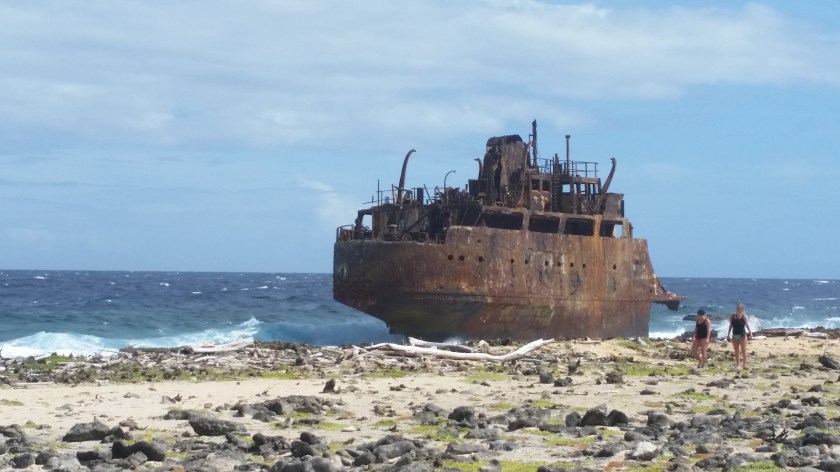
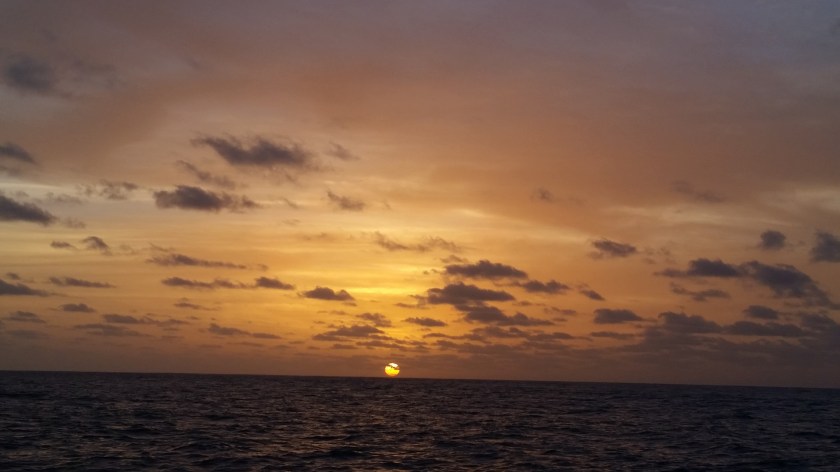


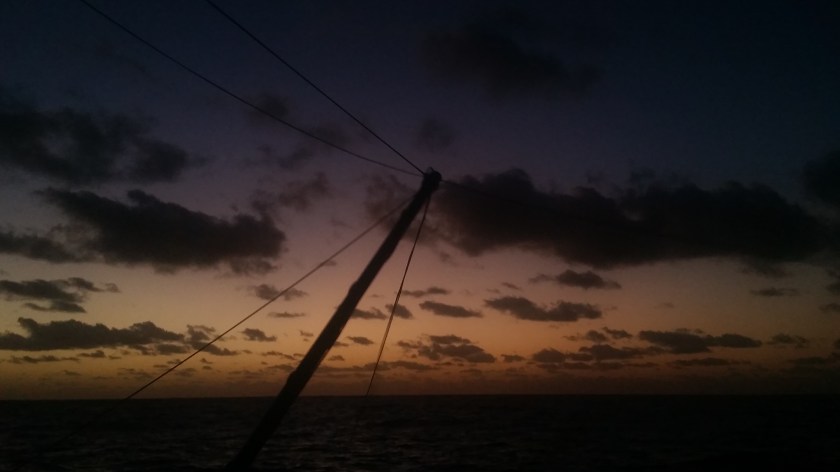
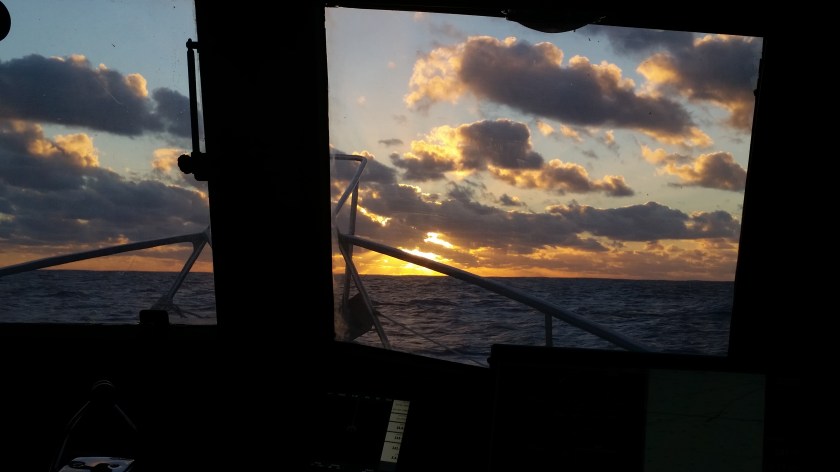



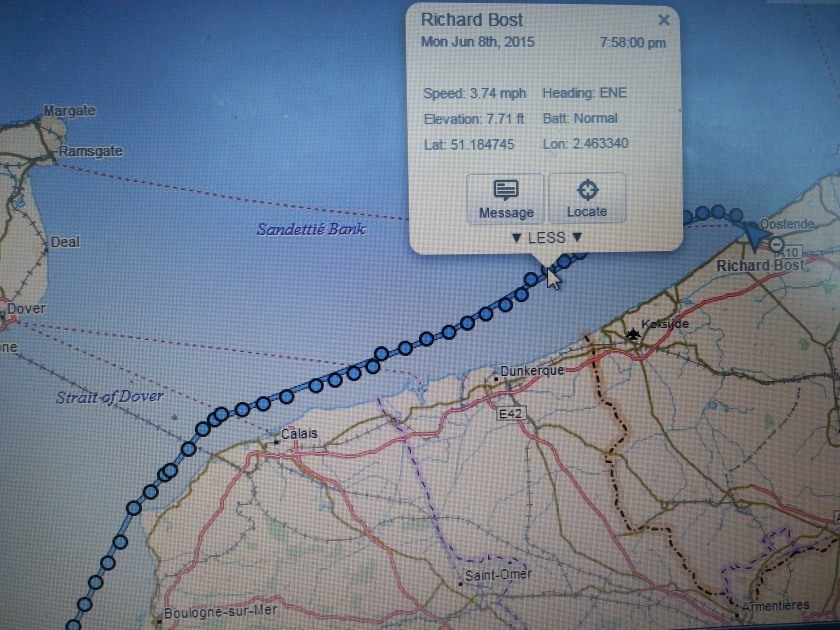
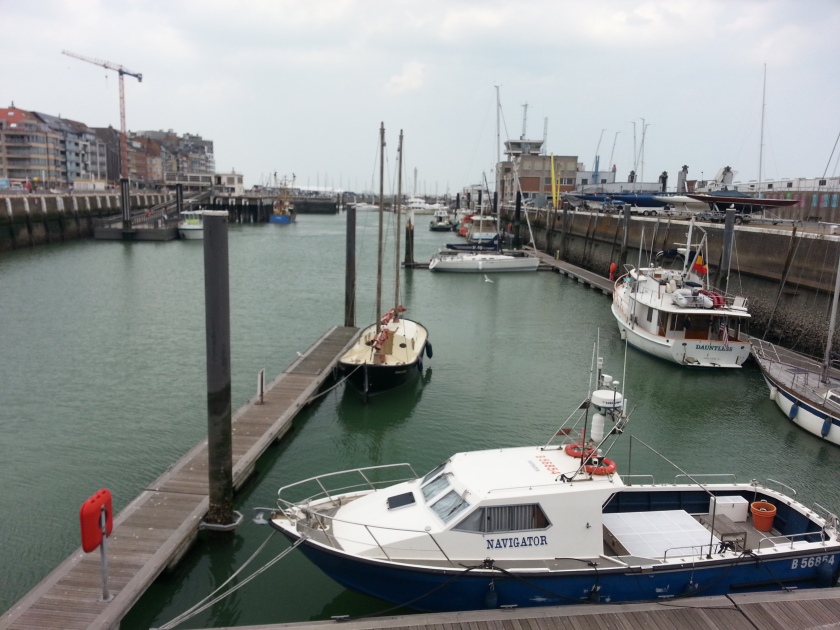
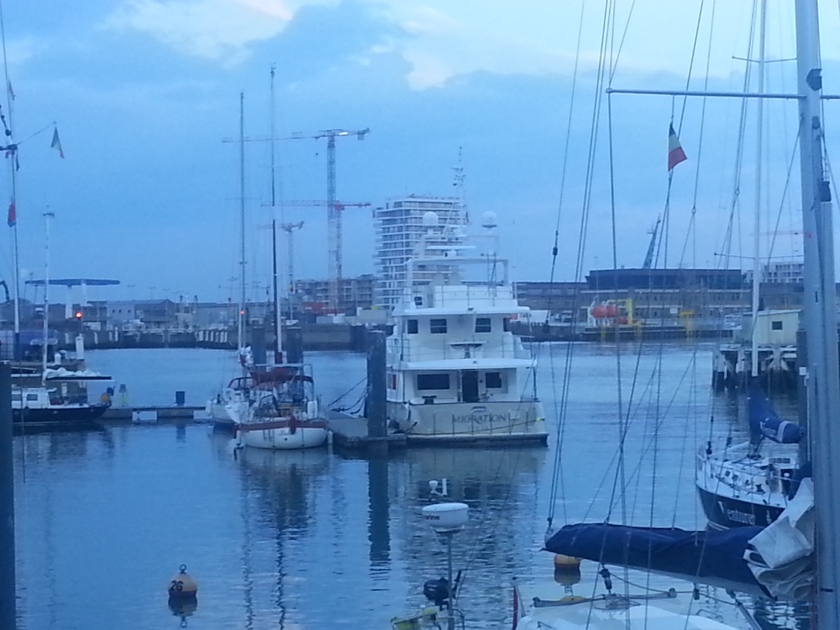
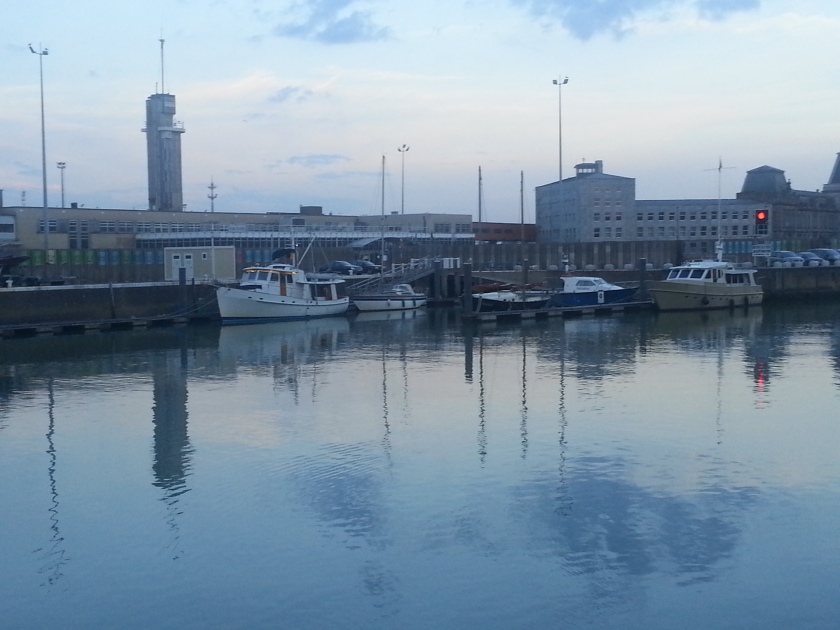
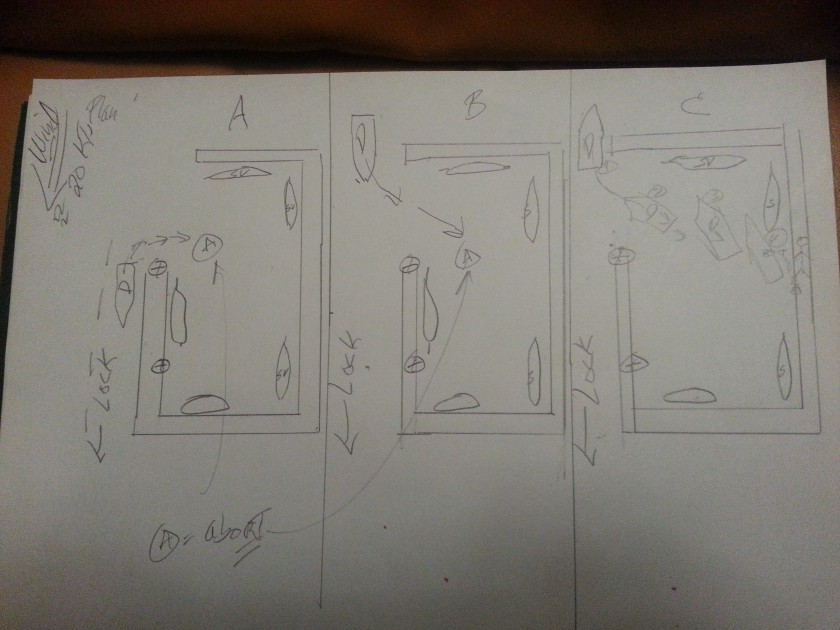

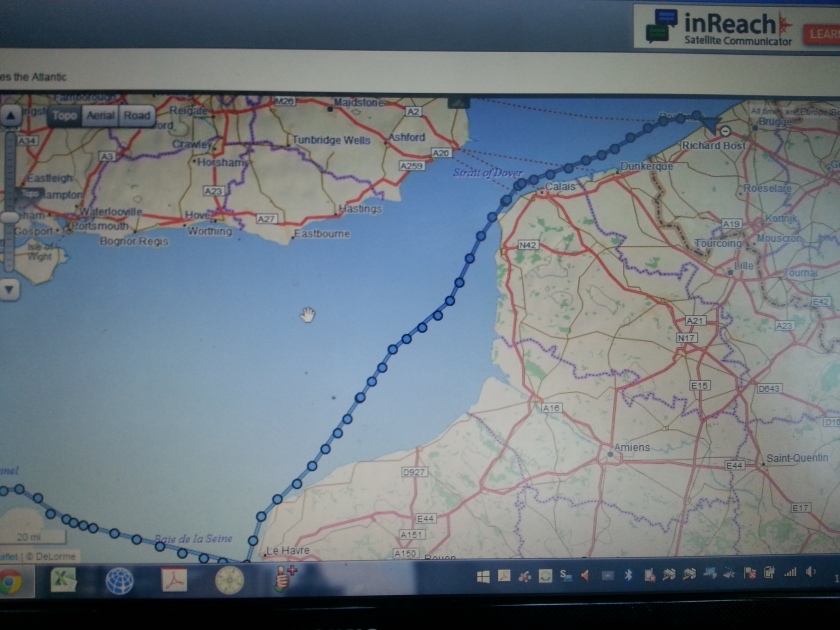

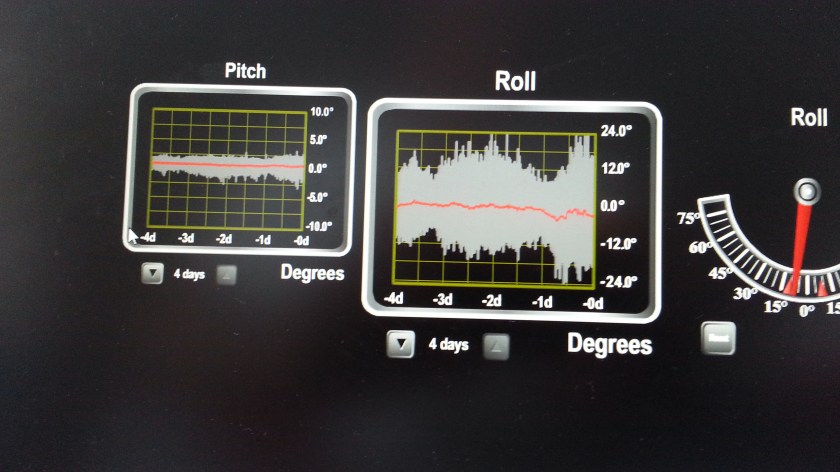


 Dauntless at Sea