The Dingy Fiasco part 1

It’s hard to believe that I have 5+ years and 20,000+ miles under my belt. I don’t.

Why, you wonder?

Oh, the routine things, those daily tasks or almost daily takes, are easy. It was in Germany when I lost my bow thruster. That was at the beginning of our 2015 Baltic Adventure. Seems like ages ago.

So, I’m pretty good at back and filling now. I can turn Dauntless around in a 180° in two boat lengths or 85 feet. It also gives me the excuse to Just Say No. When a marina, like recently at Dana Point, gave me a slip that I thought that I may be able to get in, but never get out again, I was able to easily say no, without guilt.

They found an end “T” dock for me.

I can also change the Racor fuel filters and prime them in less than two minutes. But now, I have the wisdom that I don’t need to rush. That’s the advantage of having the two dual Racor filters in parallel. Also, by only feeding from one fuel tank at a time, it a problem or issue develops, I immediately change the tank feed and filter and then diagnose the problem. This came in handy a couple of weeks ago when I sensed a change in engine pitch.  I immediately asked Larry to take the helm, while I went to the engine room. Sitting on the stringer in front of the engine, I could tell the rpms were not steady, but slowly rising and falling.

That meant a fuel or air problem.

The Racor bowl looked good, but I immediately changed to the other Racor. No change. I switched fuel tanks. The surging continued and got a bit worse.  But now I thought I understood the issue. I talk Larry to increase the throttle. After a moment’s hesitation, the engine started running smoothly and normally again.

What was the problem?  I’d run the fuel tank empty!

But I didn’t kill the engine because I acted immediately by changing both the filter (that at that point, probably had some air in it) and the tank. The Ford Lehman can be a PIA if you run it totally out of fuel, but I do have an auxiliary electric pump which I use just to prime the Racors and the engine mounted filters if need be. It works great, within seconds, system is pressurized and no more f…ing with that lift pump on a hot engine.

But the dingy, why that’s another matter. In 2016 we only used it a few times. Sitting in Cabo San Lucas with nothing to do, waiting for the head winds to die down, I figured I may as well make one last attempt to get the dingy going.

I spent an hour in the hot Cabo sun pumping it full of air. I’d already used another tube of 5200 to seal the back transom to the pontoons. The dingy looked pretty good. No need for a new stink’in dingy. I had looked at the local Costco the day before but saw no sign of any. (My observational powers leave a lot to be desired).

My inflatable, inflated. Looked pretty good.

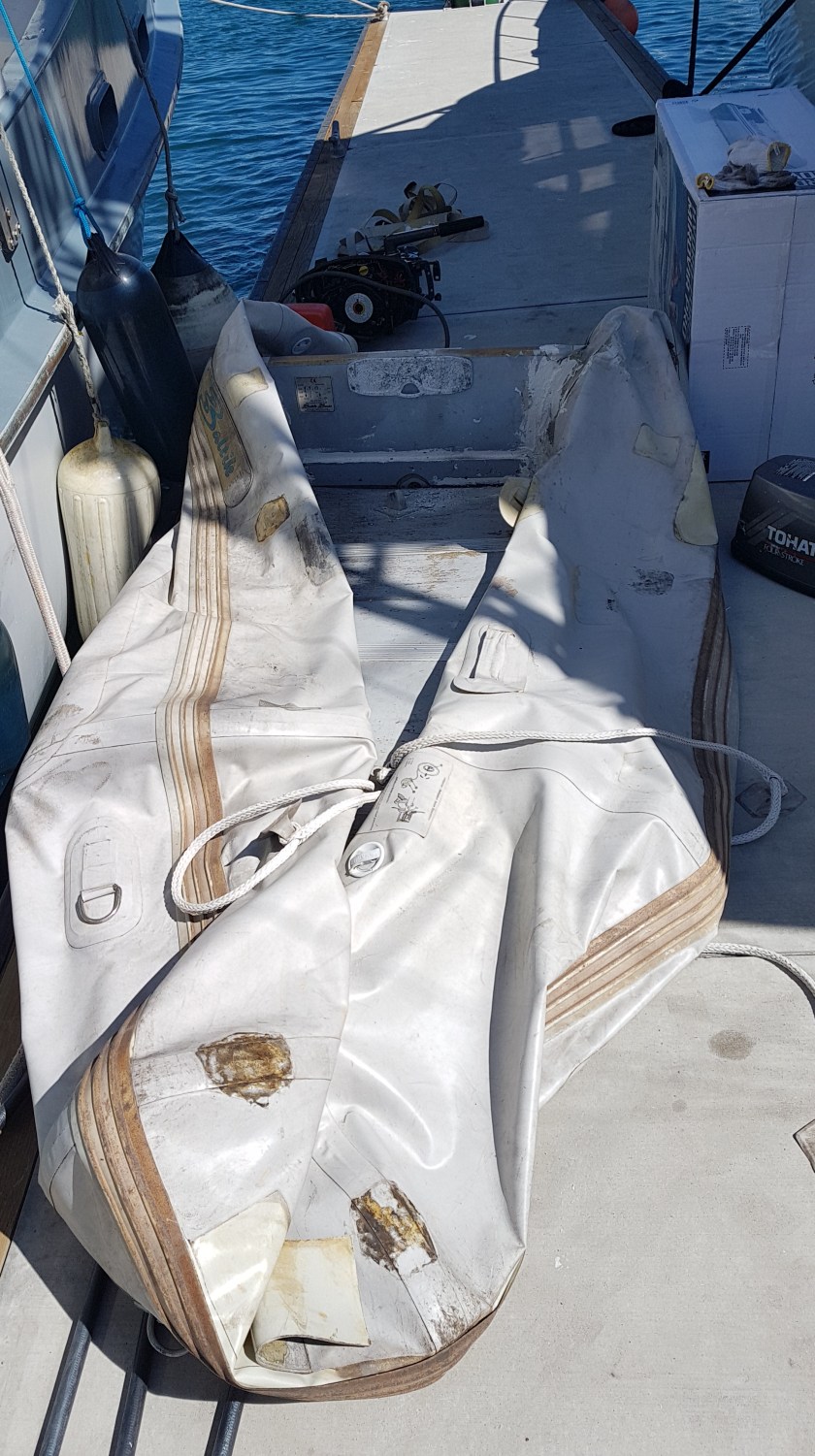
Then in yet another moment of inexperience, I decided to lower the dingy to the dock, without checking the outboard.

I was feeling pretty good until the next morning. That sad picture tells the tale.

I decided that we could survive without the dingy. And in hindsight, we would’ve, could’ve, should’ve done without one.

Returning to Costco to stock up on required supplies like Danishes for yet another attempt to head north, I spotted the dingy that had eluded me the last TWO visits. They had it displayed standing vertically, on it’s tail. Of course, I couldn’t see it like that. They may as well have hung it from the ceiling.  But remember, that this point, I had decided to go without. How was I going to get it to the boat in any case, so, I just bought my Danishes

Walking out of the store, I noticed these guys, presumably taxi drivers, and with my 20-word Spanish vocabulary, I never found out, but they did point me back to the store and I understood that Costco delivered.

When businesses make it easy to spend money, I’m all in. In 10 minutes, I had my dingy bought and they would deliver the next day.
The Next Day

Another hour of foot pumping, my new dingy was good to go. Now, to get the outboard working. Of course, after The First and Nearly the Last almost a year of non-use, it was a no-go.

The New Dingy

I realized I had to clean the ports in the carburetor again. No biggie, except in my inexperience, I had not done this while the outboard was on the boat or even on the dock. It was now sitting on the transom of the new dingy. I debated trying to take the carb apart while hanging off the end of the boat., but realized it was a sure way to lose a critical part. My back would have to pay the price for my brain not thinking about this before.

Another hour later, I finally was good to go and thought it would be good to take the dingy down to the fuel dock and fill up the gas can.

All went as planned and I was left with a confidence that I did not deserve.

The video of the first and nearly the last dingy trip

Error
This video doesn’t exist


Keys:


Anchoring at Night in Strange Places; It’s not for the Faint Hearted.

Only day’s away from completing this 2,000-mile, two-month journey, I found myself breaking yet another of my hard and fast rules I made for myself 5 years ago.  Entering yet another harbor at night, and having to anchor by radar, avoiding darkened, moored boats and mooring balls.

But like most hard and fast rules, I had to weigh the circumstances against various risks. In this case, anchoring at night was the least risky option. I’d left Channel Island Harbor at 04:00 for the 120 nm voyage to San Luis Obispo harbor. I’d planned on 19 hours. Thus, to arrive before sunset, would require me to leave the Channel Islands at midnight.

Leaving anyplace at midnight means a total disruption of my sleep cycle. I’d be starting a long trip tired and already behind my personal power curve. By leaving at 04:00, I’d be able to get a reasonable 6 hours sleep and 03:00 is on my natural wake up curve (though normally, I’d go back to sleep for another 3 hours).

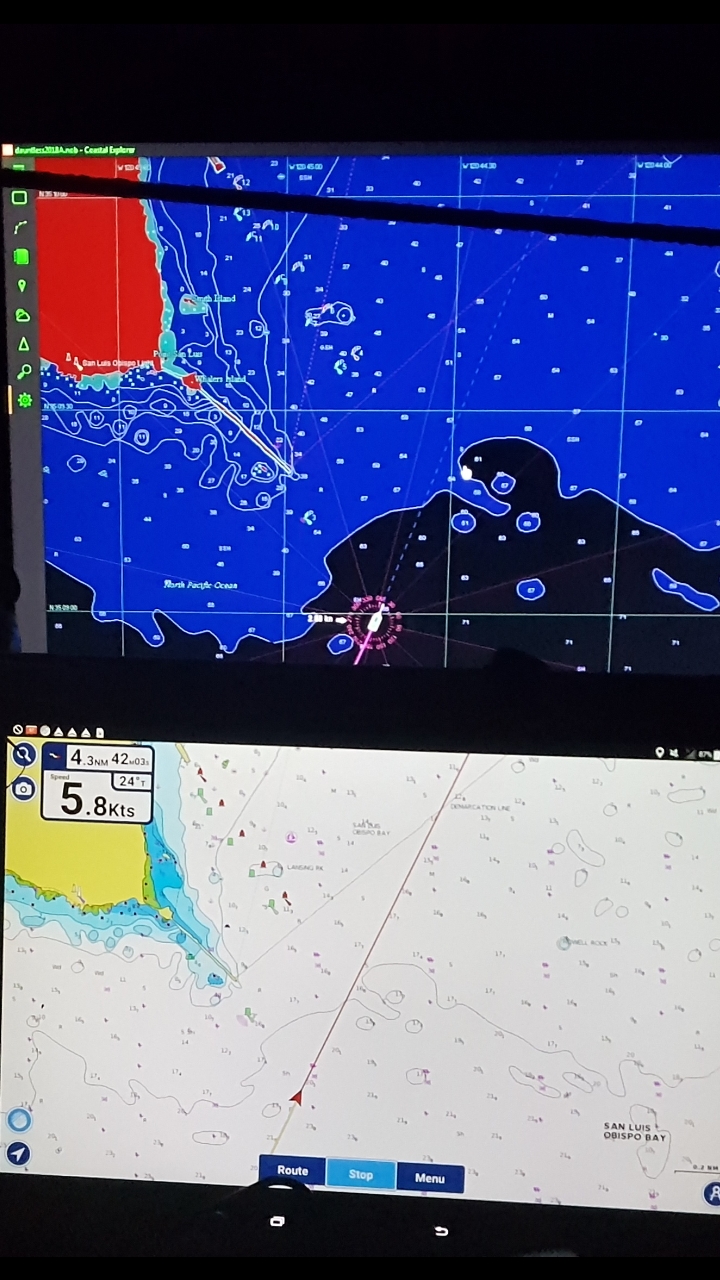
Raymarine E-80 Radar, C-Map on Coastal Explorer, Navionics chart on Samsung Tablet


Therefore, anchoring in a strange harbor at night seemed for me to be the lessor of two evils.

Let’s talk some basics. Four years ago, I hated my Raymarine E-80 Radar. I felt (and still do) that it was 1980’s technology, dressed to look like the 21st century. It was on my lest to replace at the earliest opportunity when money allowed. I had wanted a radar that I could integrate into my Coastal Explorer and C-Map chart plotter, navigation program.

San Luis Obispo harbor

Using the “Auto” settings, the E-80 will show you if the Exxon Valdez is bearing down on you, but otherwise, it either filters too much or not enough to be useful for close in maneuvering. As the miles and time increased under my belt, I learned how to best fine tune the radar using the manual settings for gain and sea state (which is basically a filter) to make it an effective tool.

Whenever I start the engine, I also turn on the: radar, navigation lights, auto pilot, VHF radios and horn.

Always.

For the first lesson in using the radar is that you must use it when the visibility is ideal, to be able to effectively and safely use it when the visibility is impaired, whether due to darkness or weather conditions (mainly fog, rain is another issue).

While underway I’m constantly checking and identifying any radar contacts visually, as well as on the navigation charts (for navigation markers, buoys, etc.).

As soon as I spot something the radar does not see, I adjust the radar, fine tuning so to speak. Normally this is just a matter of adjusting the sea state setting, though sometimes I also must fine tune the gain. E.g. I may see a fishing skiff a half mile off my starboard quarter, but it’s not showing up on the radar. I’ll have to lower the sea state setting, maybe only a few points, until the skiff shows up, but not the countless wave tops around it.  Sometimes, I’ll have to adjust the gain also.

My goal is always for the radar to show me potential hazards, without showing me wave tops. For the last couple of years, my tuning technique has been good enough to do exactly that. Forget the “auto” settings, they are hopeless.

Since I don’t get many false alarms, this also allows me to maximize the use of the two zone monitors.  For coastal cruising, like I’ve done since entering the Pacific Ocean, I set up a ring at ½ mile, that’s an 1/8 of a mile thick. Thus, if anything enters that ring you get an alarm. If you just put a circle around your boat at ½ mile, the radar will see some clutter very close to the boat and thus render the alarm, ineffective at best and annoying at worse. I make this ring go about 220° to 300° around the boat. That way it will see something approaching from the stern quarters, but not directly behind, as the radar will occasionally see a reflection of the mast, again making it ineffectual.

The second zone I set up 1 to 1.5 miles from the boat, in a much more 20° arc.

On the open ocean, well away from land, I’ll basically double these distances.

If I do get any false alarms, I adjust again. Usually it happens as the sea state gets worse (bigger seas).

For my set up, I find values of both the gain and the sea state in the 70’s to work best. In flat seas, I can lower the sea state to just above 50, but again, even changes of 1 or 2 can make a significant difference.

On this night, entering San Luis Obispo (SLO), as the seas calmed as I entered the bay that is protected from the NW through the East, I readjusted the sea state, lowering the filter values. From my charts I knew there was a mooring field, presumably with some moored boats. I adjusted the E-80 so that it would pick up objects as small as the mooring balls. Had the seas been above 2 to 3 feet, this would have been an impossibility, but if I had such seas in the harbor, I wouldn’t be stopping in any case.

This night, with strong NW winds, the harbor was well sheltered and the seas where maybe half a foot or less. Under those conditions the radar will do well.

I open and secure both pilot house doors, so that I can have quick access to looking out. I also go to the bow to scan the approach with binoculars (7×35), which I find very effective a night in poor light conditions.

Thus, I have that visual picture in my head, while checking the radar to ensure it’s seeing the same things.  Again, because I am constantly doing this in the daytime in good visibility, I have the confidence to know what the radar is telling me at night, when I must trust

Here is a short video of  it of me getting ready to enter the harbor:

Error
This video doesn’t exist

Here are some stills made 2 minutes before the above video:

The radar 2 min before I took video
Coastal Explorer using C-Maps above, Navionics on tablet below

Three years ago, going through the main shipping channels of the Kattegat to the Skagerrak over the top of Denmark, I was terrified by what my brain perceived as the massive ship about to crush Dauntless. I was outside the channel, marked m red buoy, I knew the ship had to stay in the channel. The radar told me the buoy and this massive ship were ¼ mile distant, but my brain, every time I looked at the ship, I could swear was less than 50 feet away.

My mind was so convinced this ship was towering over us, that even as I checked and rechecked the positions of the markers on the chart and the ship and marker on the radar, all showed the target as more than a quarter mile away, but my mind would just not accept it.

I only calmed down when the ship was past.  In the daytime, my mind would not have been fooled, but at night, the perspective of distance, becomes very difficult.

I realized then that if I was going to continue to travel at night and not die of a heart attack, I had to make sure I knew exactly what the radar was telling and what it wasn’t and once done, accept what it showed.

So, this night, almost midnight, as I pulled into SLO bay, the radar guided me to a large area with a diameter of about half a mile with no mooring balls, though there were a couple of boats anchored on the west edge.

No fuss; no muss,

I was anchored in 25 feet of water at 23:20 having done 120 nm in 19 hours and 30 minutes, at an average speed of 6.2 knots.

The trip from CI Hbr to SLO. The Maretron data for pitching and rolling shows I did a fair amount after I rounded the corner to head north.

The morning after:

Error
This video doesn’t exist


It Wasn’t Me; It was the Motherboard, I Swear

Dauntless doesn’t seem to have a care in the world, as she sits peacefully in Morro Bay, California.

No, I haven’t died or been in jail, I was in computer-less purgatory.

You know that place you end up when you depend on your laptop to communicate with the outside world.

And sure, a cell phone is great for talking, but if you think I’m going to write a blog post on it, as my mother would say, you have another think coming.

But a new motherboard for 500 bucks installed and at $67 battery from Amazon and my little HP Envy laptop is as good as new.

So, what did you miss? A lot really. Almost all of it too painful to even think about, let alone write about. But I do feel responsible to those of you who have spent your valuable time reading my rantings and ravings in between an adventure or so, so here are a few highlights:

  • The $1,000 to replace the leaking seals in my transmission. They still leak.
  • The reconditioned heat exchangers that started leaking 10 minutes are leaving port
  • The 60-mile detour (doesn’t sound like much in a car, but that’s 9 hours in a boat.
  • Being beaten back to Cabo San Lucas, not once, but twice. This from a person who never turns around.
  • Deciding to take the dingy 3 miles in a 30-knot wind only to discover it goes much faster downwind than up. Oh, and then I bent the prop, twice, the second time, with a belching of oil. And we were still three miles away from Dauntless, which we could not see in any case.
  • Checking into the USA with Dauntless for the first time in 4 years.
  • Being stopped by the Mexican Navy.
  • Being chased my fishing boats
  • Hobby horsing until you think you are going to die.
  • Entering yet another harbor at night, having to anchor by radar, having vowed years ago, never to do such things.

Umm, I had forgotten most of that. I’ve burned thru money this trip like a drunken sailor, but I’ve been so stressed for all the above, I’ve drunk much less than normal.

Through it all, and because of some genuine and generous friends, I was able to leave Dauntless for a week and make a quick trip to Fairbanks, Alaska, which was as as I’ve ever seen her and attend a wedding at 11,000 feet, which, left me breathless.

I hope to get back to my writing routine in the coming days. I start with the end, first.

Coming Next, Anchoring at Night in Strange Places: It’s not for the Faint Hearted.


Third Time is the Charm, I Hope

Dauntless is ready to go.

As of Tuesday evening,  we are planning to try to get to Magdalena Bay, 130nm, tomorrow. Our third try in the last 9 days.

Error
This video doesn’t exist

Though even at that, we will probably we stuck there for three days over the weekend, as another period of very strong (15 to 25 kts) winds is forecast to hit the area then.  But it’s time for new, less touristy scenery.

We’ll leave mid morning, as the winds diminish mid morning to late afternoon.
We had a few issues to deal with in the last few days, the most serious, a worn rubber “O” ring on the autopilot hydraulic pump.
With a new ring and a few hours of getting the air out of the system, we are good to go and better than before.
My Maretron weather instrument was off line due to a failed “T” connector.  After a couple hours hanging on the mast for dear life, that too has been fixed.

Lastly,  on my third trip to Costco in as many days,  the dingy finally appeared in front of my eyes.  On sale for only $500 delivered,  it was too good a deal to pass up.  Took me all afternoon to blow it up,  and then a day to fix the carb that was pouring gas all over the place,  but finally as i drove it to the fuel dock to fill the gas can,  I felt pretty good.

The New Dingy
So tomorrow we leave Dauntless in as good a shape as she has been in a long time.
Our weather window is not as open as I’d like,  but we simply must pound out the next 200 miles to get into better,  more favorable winds. Once north of Tortuga Bay,  life is better.
We’ll check out of Mexico in Ensenada and check in to USA in San Diego.

It’s then to my friend’s Mike and Adriana in the Oxnard area, hopefully by mid June.

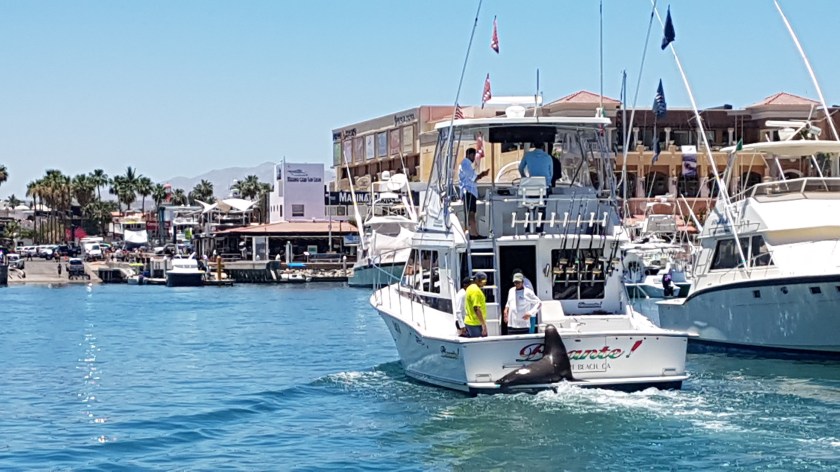
Pancho, the 12-year old Sea Lion of Cabo San Lucas

Stay tuned

Pancho again, takes lift, waiting for a free fish.

Laptop Dead as a Doornail

My HP Envy Laptop died a few weeks ago. Add poor internet connections, so I have no been able to even write about the trials and tribulations of the last 4 weeks.

As yo can see at Share.Delore.com/Dauntless I’m still in Cabo, but am planning on leaving Sunday morning before noon.

But then I tried to leave last Sunday also, but Mother Nature turned me back and made me see the error of my ways.

I’m hoping she’s in a better mood tomorrow. If not may have to start sacrificing goats or pigs or something.


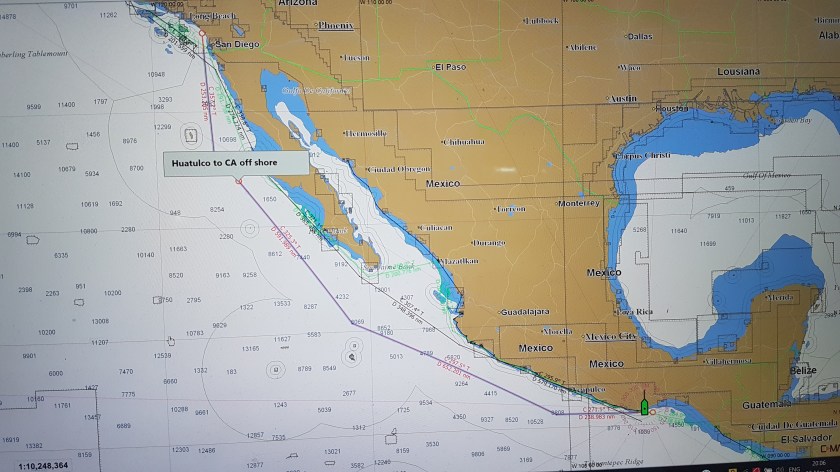
Return to Huatulco

I could call this, Mexico Just Works, at least this part.

The Bahias of Huatulco

As international trips of 3,000+ miles go, this was by far one of the easiest ever! 13 hours after wake-up at oh-dark-thirty, I was being dropped off at my hotel in Huatulco. Hotel Balcon Gueela turned out to be a really nice, comfortable place to stay while Dauntless gets her bottom painted. The sense of relief was palpable. Which got me to thinking, why such angst? I’ve travelled 24 hours to get to and from Vietnam, but other than relief that the trip was finally over, I never experienced fear before.

I’ve crossed two and a half oceans by now. I’ve spent a few too many hours being miserable, but never afraid.

HUX – Huatulco Airport

So why now, why this underlying angst in traveling to Mexico?  I’d been in a dozen of airports and train stations this past year. Why the angst now? When I arrived at baggage claim in Mexico City from my New York flight, I had 3 hours for my connecting flight to Huatulco. I assumed I’d pick up my bag, go thru customs and immigration, then recheck it for Huatulco.

That’s the routine at most ports of entry. But not here. Here upon arrival at baggage claim, I was approached by a nice, uniformed lady, who asked my point of origin and when informed it was NY, she asked to see my boarding pass with claim stub and pointed out that my bag was checked through to Huatulco. Duh. I travelled 90,000 air miles last year.  One would think I would have thought to check at some stage of this process, especially at the onset, when the bag tag was affected to my bag. It’s always nice to make sure one’s bag is going on the same trip as you are!

Though at that moment of check-in, 05:00, I was distracted by the realization that my 07:00 flight was really at 08:00.  The 7 a.m. time must have been the time I told myself to be at the airport. But somewhere in my little mind, that got fixed at the departure time. I had stayed with friend’s in Brooklyn to be close to the airport. I hadn’t slept that well because I had bad toothache (needed a root canal) and I was just nervous about he whole trip. So, I ended up leaving the house at 04:00, and was checking in, an hour later, having returned the rental car full of gas and taken the JFK tram.

So, another rookie mistake, not even confirming my flight time.

Why was I so nervous? The toothache certainly didn’t help, but still.

While there was no customs inspection (NAFTA?), I did have to go through immigration. But even this routine, simple task, seemed beyond me. First, I did not have the right form. I had a customs form, which I didn’t need, but was never given the immigration form I did need. OK, no problem, says the immigration officer, “go to that desk and complete form and return here”.

Five minutes later, he looks at my just completed form and shows me the bottom half I had not filled out. This time, he directs me to a desk closer to him, as I clearly need supervision, though more likely, he was just trying to save me time and reduce my frustration/confusion.

Third time is the charm. I get my requisite stamps and I’m off to the lounge to wait two hours. Airline lounges are pretty much the same, but I was nervous beyond words; looking over my shoulder constantly. Now, those who know me, know I am the most trusting person on the planet, possibly in the entire solar system. And naïve too, as my stint in the Bronx was to prove.

A couple hours later, walking down the air stairs, looking around at the quaint, little Huatulco airport, I felt a large load was lifted off my shoulders. The walk from the plane to the terminal, took about 4 minutes. During this walk, I noticed the baggage train was going to beat us to the terminal. My bag was on the first pass of the carousel as I walked in. I grabbed it, noticed a nice lady standing at a podium with a big sign that said, official taxis, walked up and she gave me my options for the 20-minute ride to Huatulco and my hotel. I could have a private taxi for $25 or go in the group van for $9.  I took the cheaper route.

Outside the airport. Just go to the stall number on your receipt ti find the right taxi or van. Mexico Just Works

The whole process, the entire trip from the time I got up at 03:30, left JFK to arrival at my hotel in Huatulco, could not have been easier. Everything was simple and in Mexico, helpful people always appeared just when you had that first confused look on your face. Mexico just works.

It was at that point when it finally dawned on me the reason for my angst.  What was that load that was taken off my shoulders? It was simply that I hadn’t been killed during my travel in Mexico. No, I wasn’t taking a bus through the countryside in the middle of the night, but clearly, I had been afraid. Not until I was in the familiar Huatulco, did I feel safe.

This was totally irrational, I’ve been in a million places more dangerous than the Mexico City airport!

Where did this fear come from? I’ve been thinking about this for a week now.

My “news” information is purposely limited, as I have come to understand that “news” is not as objective as I once assumed. Remember, I did say I was naïve. I had a bad experience with the print media as a high school principal in the Bronx, NY. The Chief Editor of this newspaper, told my boss, that he was directed to print a story that was nothing more than character assassination, meant to embarrass and defame me. I knew who wrote it, as it was carefully written, as to not be accountable to her, but then she was crazy and had no problem saying the most outrageous things. She wrote this kind of stuff routinely.

The end result is that I stopped reading the New York newspapers. So now, I only read the Wall Street Journal, Science News and sometimes the Guardian from England.

I certainly don’t read anything that purports to be “news” on the internet. In fact, once I discovered that there are numerous pictures of big ships in tremendous waves online that are photoshopped, I realized you can’t even trust what you see online.

Even though I avoid sensationalism, it was still in my mind that Mexico was this dangerous place that made me afraid, in a totally irrational manner.  So even a seasoned traveler like myself can get caught up in the hype with no sense of reality.  This was made all the more “unreal” to me in that my interactions with any Mexicans, in New York, the USA or even in Mexico! have been outstanding.  I’ve never had a bad experience. Ever. Can’t say that about almost any other place, even Canada (they can’t get it out of their heads that not every American has an arsenal of guns!).

And I never watch those weather shows with their drumbeat of death and destruction. Gimme a break. Get a life.


Plans and Goals

One needs to have a good plan to accomplish the goal, but sometimes, life happens, plans change and maybe the goal too.

The rub is, it’s even easier to change the goal, then to make a better plan for the circumstances.

But changing goals is a slippery slope; so easy to do, but before you know it, you’ve accomplished nothing.

In 8th grade I decided I wanted to be a meteorologist. Seven years later, in my last year at the University of Washington, I hated school, I was bored and tired of not having any money. But unlike many of my college friends who dropped out, transferred or just disappeared, I persevered.

I had a goal to accomplish. Three Master’s degrees later, each one to further some career goal, I look back and am satisfied with the goals, though some of the plans to accomplish those goals should have been re-thought.

Dauntless has been in my life for 5 years now. Inexplicitly, it doesn’t seem that long at all to me at all, it still feels like yesterday or at least last year.

The goal to take a boat to Europe and then S. Korea is even older, maybe 9 years. That goal drove the search for the right boat. A boat that could not only cross oceans but do it in a manner that I could afford on my meager pension.

The original plan was to cross the North Pacific this coming summer and arrive in Yeosu, S. Korea by October 2018. Instead, I find myself agonizing over how to get up the Pacific coast of Mexico. The North Pacific seems further away than ever.

But the goal doesn’t change; though the plan must.

I now have some intrepid fellows helping me with the first and hardest, part of the cruise north. Having good crew can put a lot of wind in your sails. It also allows me further tweak the plan. Maybe I can get to San Francisco Bay sooner, rather than later.  Then, I would be able to spend some of this summer and fall cruising with good weather and friends.

So maybe some baby steps are in order for the next few years, but the destination remains the same.


Vietnam & Americans

I’ve hesitated writing this post for months.

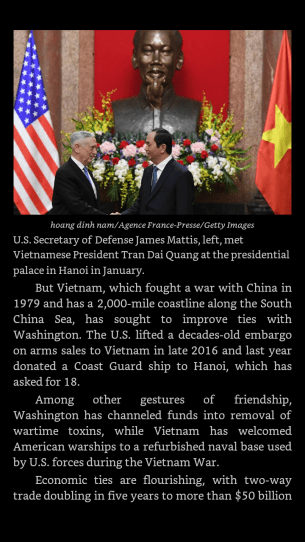
From the WSJ

Why?

Because I know how sensitive this subject can be for Americans of my generation. I didn’t want to offend or disrespect anyone.

Disrespectful to the American veteran who was put into a shitty situation thru no fault of their own and told to fix it, without the tools to do so. Disrespectful to those who lost life and loved ones. Disrespectful to those Vietnamese, who if they survived the war years, then had 20 years of a very hard life or if lucky enough, were able to flee with only the clothes on their backs.

So, what changed? Living on and off here for the past year, I see people, no matter what their background who are truly appreciate of Americans, like Americans and just want to work hard.

I’m watching Anthony Bourdain: Parts Unknown – Hanoi. Find it someplace and you can see in pictures and sound what I am trying to explain poorly.

I just got back from two weeks in the country for the Tet holiday.  Upcountry as some could say, in Quang Nam province, just southwest of Danang.  Simply put, Tet is about remembering the dead and living. Country living here is like living in the countryside in Europe 30 years ago or the USA 50 years ago.  Yes, that means we have electricity and cold running water, but everything else may be luxury.

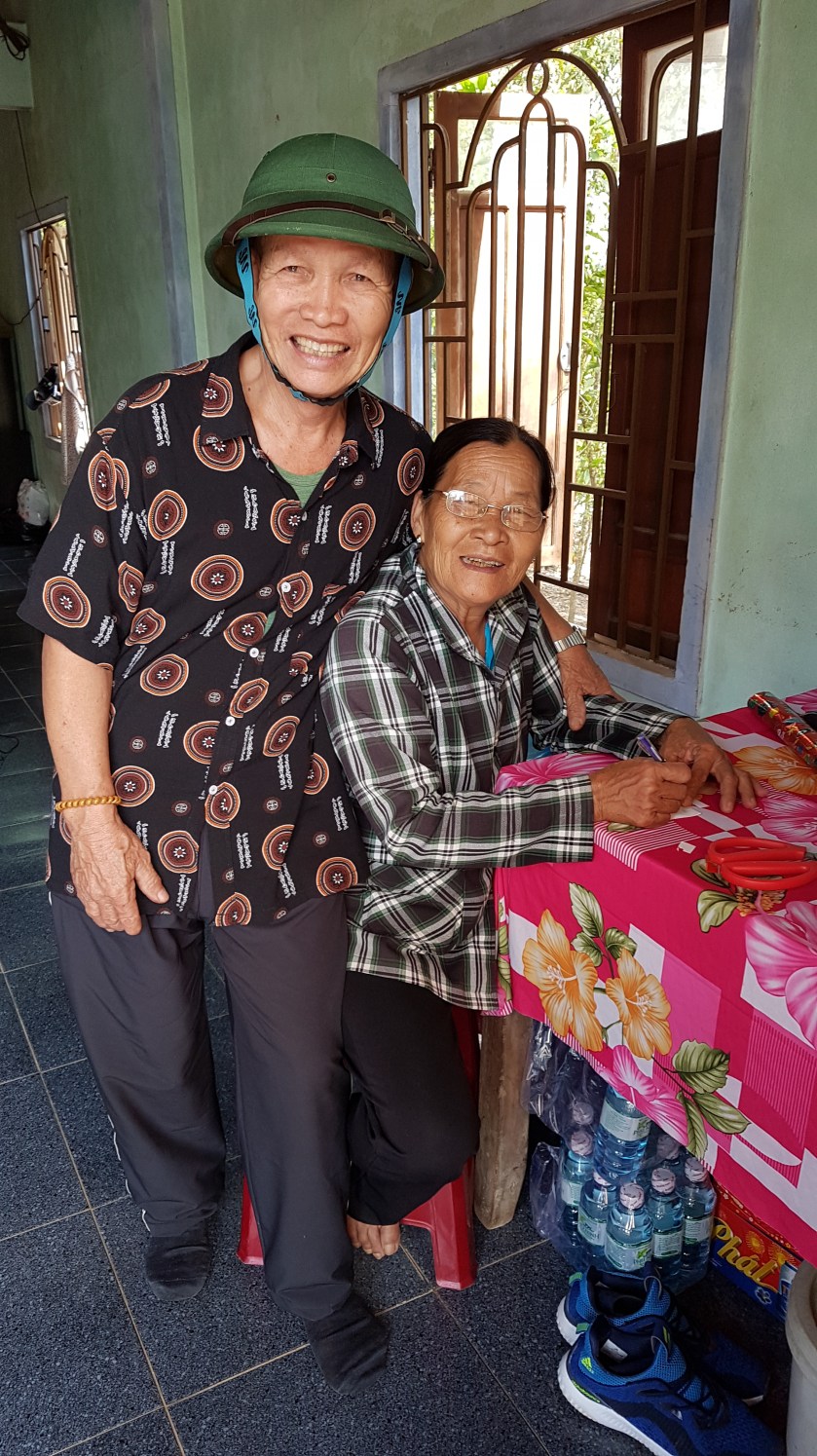
Former ARVN (left) & VC are now the best of freinds. (He had just showed me the scar of the hole in his leg when he was shot by VC) We then both looked at her and everyone laughed. (it was a bit surrealistic for me).
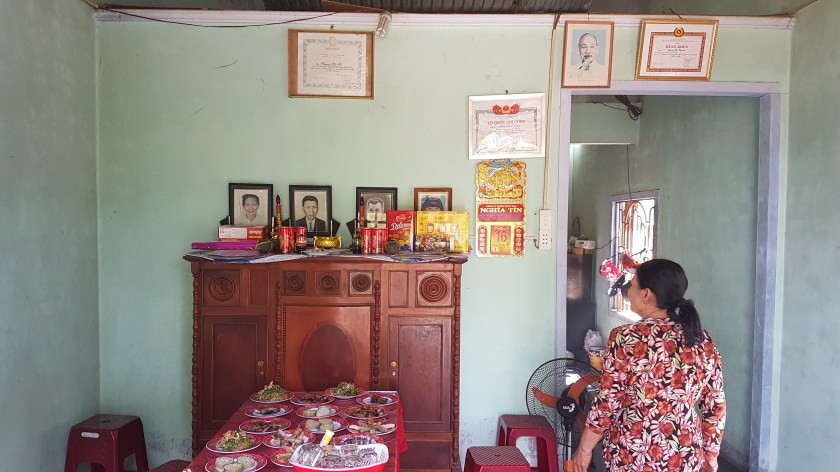
The memorial to the father of Trinh sister’s husband. KIA during Tet 1968 while fighting with/for the Americans.

I was overwhelmed with the warmth of the people: friends, neighbors and family of Trinh’s mother and family. They would lend us motorcycles to get around. I was invited to every neighbor’s party. Everyone had to come by and drink with me.  I drank a lot of beer and my new-found drink, rượu nếp, which is much like Korean makgeolli (막걸리, but a bit less effervescent.

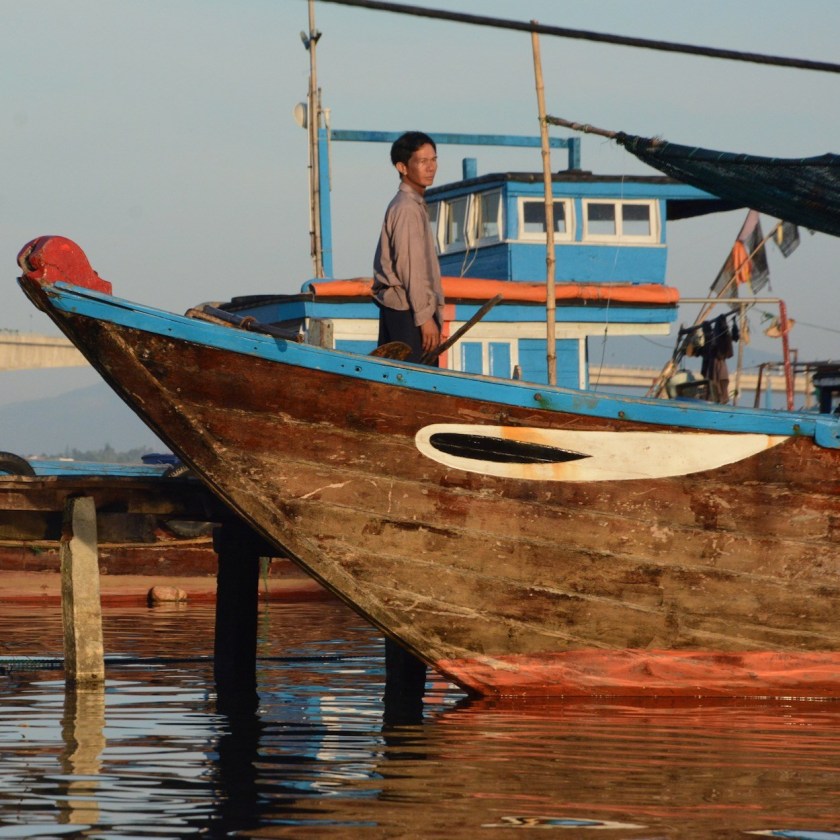
I think Dauntless needs eyes

Now, cruising here with Dauntless is another story. A complicated story for another time.

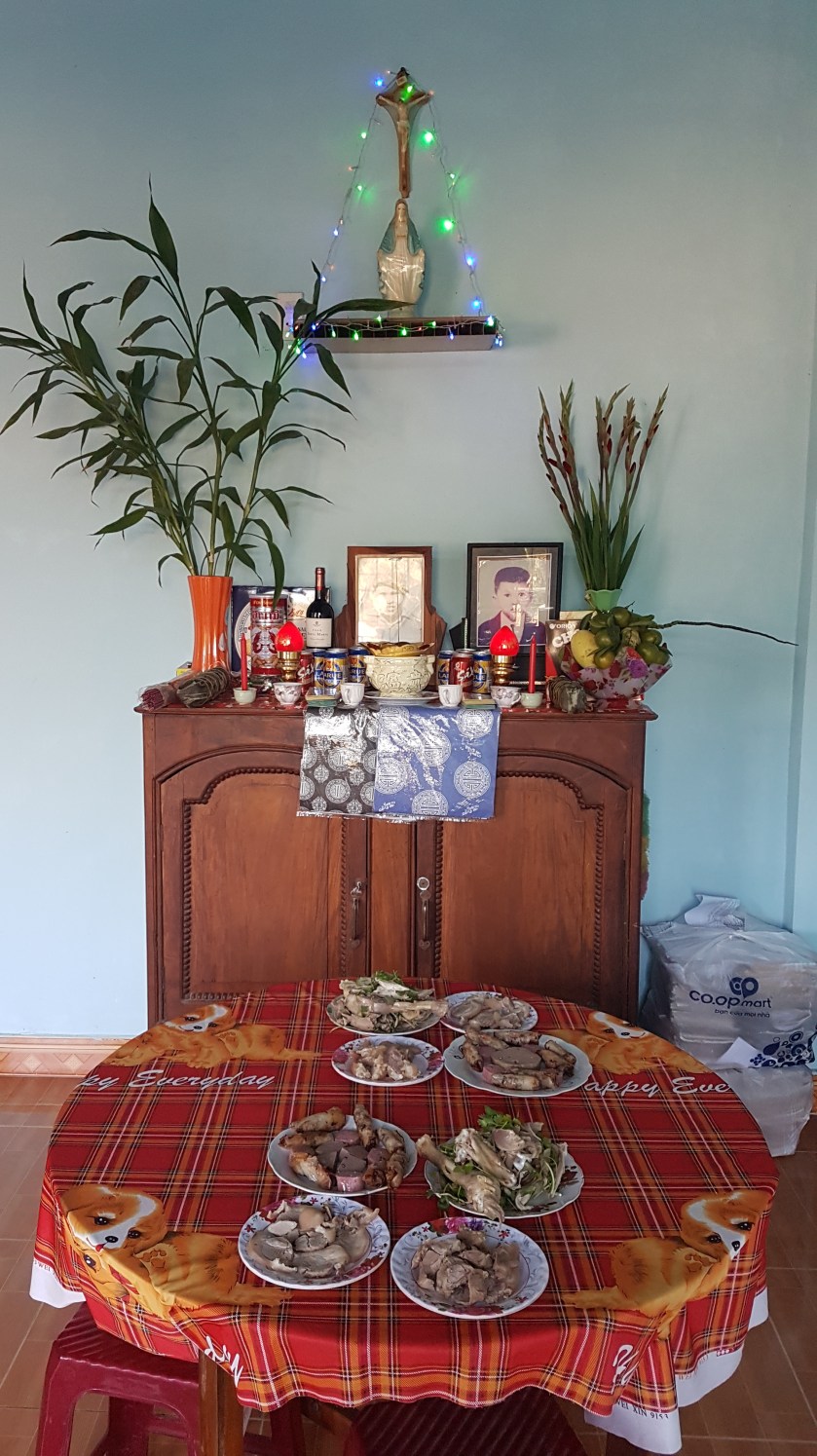
Trihn’s mother’s house and memorial dinner

The Plan Comes Together

So, after the two-week (for me) Tet Holiday, life is returning to normal. I was in the “country”. It wasn’t that conducive to writing blogs.

But I ate so well and the people are so incredible nice, former VC or not! It was both overwhelming and amazing, but this is a story for another time.

I think I finally have a plan to get Dauntless up the west coast, that I am comfortable with. Sometimes it seems like the plan comes together immediately, sometimes it takes a lot of time. The reality is that every plan takes a long time to gestate. Plans seem to come together immediately only when I’ve been thinking about them forever before putting pen to paper. However, in this case, I feel like I’ve been writing continuous plans since September, just to move Dauntless the 2200 miles to southern California.

25-Feb-18   2018 Option C  
07-May-18 Huatulco 0.0  Alloc 0 0  Running nm legs Hours in transit
12-May-18 P Roquita Island/Acapulco 1.8       5 49 5 245      245
15-May-18 P Zihuatenjo 0.8       3 37 3 110      110         355     355 61
18-May-18 P Caleta de Campos 0.6       3 27 3 80        80
20-May-18 P Cabeza Negra N 0.5       2 33 2 65        65
27-May-18 P Manzanillo 0.4       7 9 7 60        60         560     205 35
02-Jun-18 P PV 1.6       6 38 6 230      230
08-Jun-18 P Mazatlan or Cabo San Lucas 1.4       6 33 6 200      200         990     430 74
20-Jun-18 P Cabo San Lucas 312 1.6     12 18 12 220      220      1,210     220 38
02-Sep-18 P Cabo San Lucas 312 0     74 0 74 0        –
12-Sep-18 P Turtle Bay 320 3     10 42 10 420      420      1,630     420 72
20-Sep-18 P Baja Calif Ensenada 340 2       8 38 8 300      300      1,930     300 51
26-Sep-18 P S.B. Channel Islands (SD +50) 310 2       6 47 6 280      280      2,210     280 48
13-Oct-18 P SF Bay 333 2     17 18 17 300      300      2,510     300 51

This assumes that the winds and seas are favorable only 25% of the time. E.g. it requires 74 hours (3 days) from  Manzanillo to Mazatlan, so I allocate at least 12 days to get there. Now, we understand that those 25% of times of favorable winds could take place in almost any combination. One day in four is the least likely, due to the nature of the synoptic weather pattern needed to disrupt the usual northwesterly winds. It’s more likely to be in chunks of 4 days out of 3 weeks or 6 days out of 5 weeks.

This means that I must have something I am not known for, patience. Even the word makes me cringe.

And even if I have a planned stop in XXX, as long as the winds stay nice, I need to keep moving north.

The intermediate places like Acapulco, etc. are possible stops if the weather turns unfavorable or whatever.

First goal is to get Dauntless to Baja California, preferably Cabo San Lucas or perhaps Ensenada, by mid-June. The fallback plan is to get at least to Mazatlán.  I have a wedding in Salt Lake City June 23rd that I’d really want to attend, however getting Dauntless north safely has to be my primary goal.

Once there, I’ll leave Dauntless for the two months in summer.

I need to re-arrange my affairs a bit and see some friends, so I’ll travel to Alaska, Seattle, San Francisco and Texas.

I also need to scout some possible locations in California for Dauntless for the winter 2018-2019. Cost and security are the primary considerations. If you have any ideas or suggestions, please email me directly. I’d appreciate the input.

I’ll then return to Vietnam for two months. I’ve accepted the fact that Trinh will not have a visa for anyplace this coming summer, so I’ll be working on 2019.

Retuning in September, I’ll spend 6 weeks getting her (Dauntless, not Trinh) to her winter haven in California.

This plan offers me safety in that I like traveling a bit off shore (as opposed to near coastal) and making the 2500 nm trip into chunks of miles and time that are doable, even if I have to do some parts alone.

I’d prefer to have some crew/help, 2 people, a couple, would be ideal, 1 or 3 would be good.

What I Need

As spring gets closer and closer, I’m watching the weather daily.  I know what I want, but the light wind conditions may only last a couple of days, while I need a week plus.

In the last weeks, the more I have thought of this, the more I am thinking of getting north as best I can, probably well offshore.

Offshore solves a number of issues for me:

  • I like the open ocean
  • far less fishing activities, like boats and nets
  • more sea room, if I need to run before the storm (this is always a consideation in my planning)
  • getting big chunks of distance done in a short time, 3 days = 500 nm
  • did I say I like the ocean

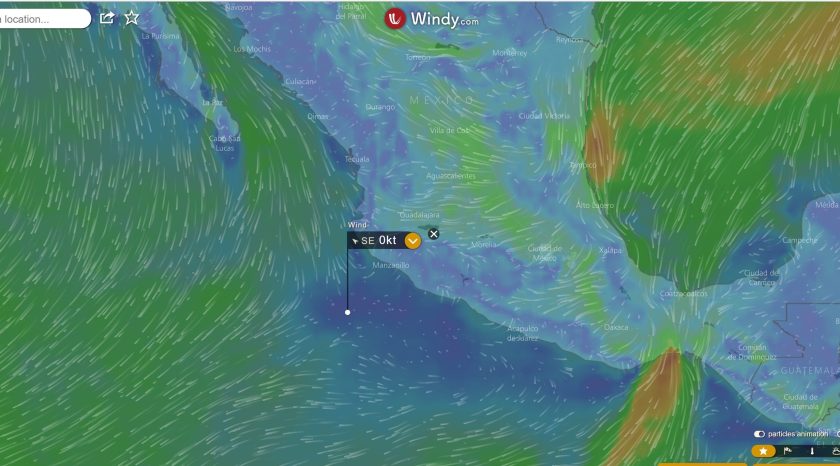
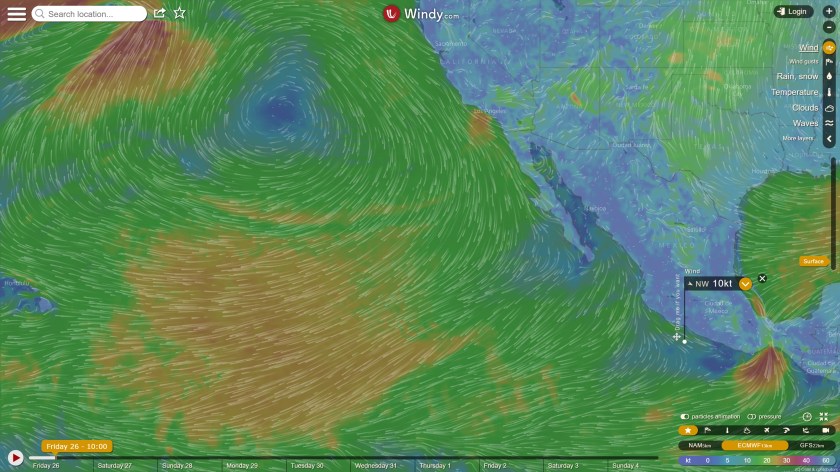
I like the GUI and data presentation of Windyty.com, so all the maps I show are from them and when I do look at weather, I look at them before anything else. This is what a great case looks like. How long it will last? Not long enough, but a few days, then with a low pressure system developing further west, would give me favorable winds for the second of two 3-day periods (the steaming distance between Huatulco and Cabo San Lucas is 900 nm or 6 days.

Now this looks great. Too bad it will last a day or two and I need 9!

This case though is far more typical, with NW winds >15 knots, even more so in the summer than now.

N NW winds = NO GO

What I’m Really Afraid Of?

Just when I thought I had the Plan, I read a story about drug driven crime spreading to the west coast of Mexico. Manzanillo, one of my planed stops, was prominently mentioned.

20180126 Win
dyty Depiction of Surface Winds

Where does that leave me? Besides the obvious, afraid!

Last summer I had a detailed plan to cruise up the coast of Mexico, stopping every night, hitting all the nice spots, with only a couple overnight passages. Let’s call that plan, the Coastal Cruise Plan. This is essentially what we had done 3 years ago in the Baltic.  I had even spent the last month alone, cruising from Stockholm all the way back to Ireland.

Last year, I had my nephew, Micah, with me from Ireland to Costa Rica.  It’s no coincidence that when he left Dauntless in March to go to law school, I lost a lot of my ambition to continue north alone. Cruising alone for me is not fun. It’s what I do when I need to get from A to B or as I did from Stockholm to Waterford.

20180126 NWS P_e_sfc_color

I am hoping that this coming summer, my girlfriend Trinh and her son, Thien, will have visas for Mexico. This is something that I must initiate this April when I return to Huatulco. If that is possible, they, with other friends who have expressed interest in joining Dauntless this summer, would make the Coastal Plan at least feasible. We would enjoy the numerous stops and towns along the coast, plus many eyes make for less stressful cruising.

A visa for the U.S. is another story and it takes forever. I’m hoping for 2019.

The Pacific coast of Mexico is not the Baltic and North Sea. The weather is not necessarily worse, but the predominant winds are from the northwest, the direction Dauntless must go. Adding to that problem, there are numerous fishing boats and nets and other boat traffic near the coast, whereas in the Baltic, there was none of that.

Lastly, safe harbors (protected from weather) on the Pacific coast of Mexico are few and far apart. North from Huatulco to Manzanillo, a distance of almost 600 miles, there are only two safe harbors. In a normal (for me) coastal cruise of 40 to 60 miles per day (6 to 9 hours), that’s 8 out of 10 nights anchored or in some port, at the mercy of the weather.

That’s a no-go.

For those of you who have read my precious comments about weather forecasts, you will know that even in the best circumstances, I don’t trust weather forecasts past three days and even at that I assume they are 50% off. That means, if the forecast is for winds from 270° at 12 knots, I plan for winds 240° to 300° at 8 to 16 knots (50% and 150% of forecast).

Therefore, to cruise an unprotected coast in any but the mildest of conditions is perilous.

I needed a plan B.  The Near Coastal Plan.

In this plan, we will take what the weather gives us. If we get four good days (favorable winds and seas) we’ll cruise until the weather becomes unfavorable. This potentially means we would take chunks of distance, 3 days, 24/7 is 450 nm. Making the entire trip into 4 chunks of 500 miles each, would get the job done and reduce time spent too close to the coast.

It would be far less fun however, but probably safer in many ways and less stressful.

Then came plan C, the Ocean Plan.

But first we talk to talk about hurricanes.

Hurricane season runs from June through October, with the highest frequency, mid-July to mid-September.

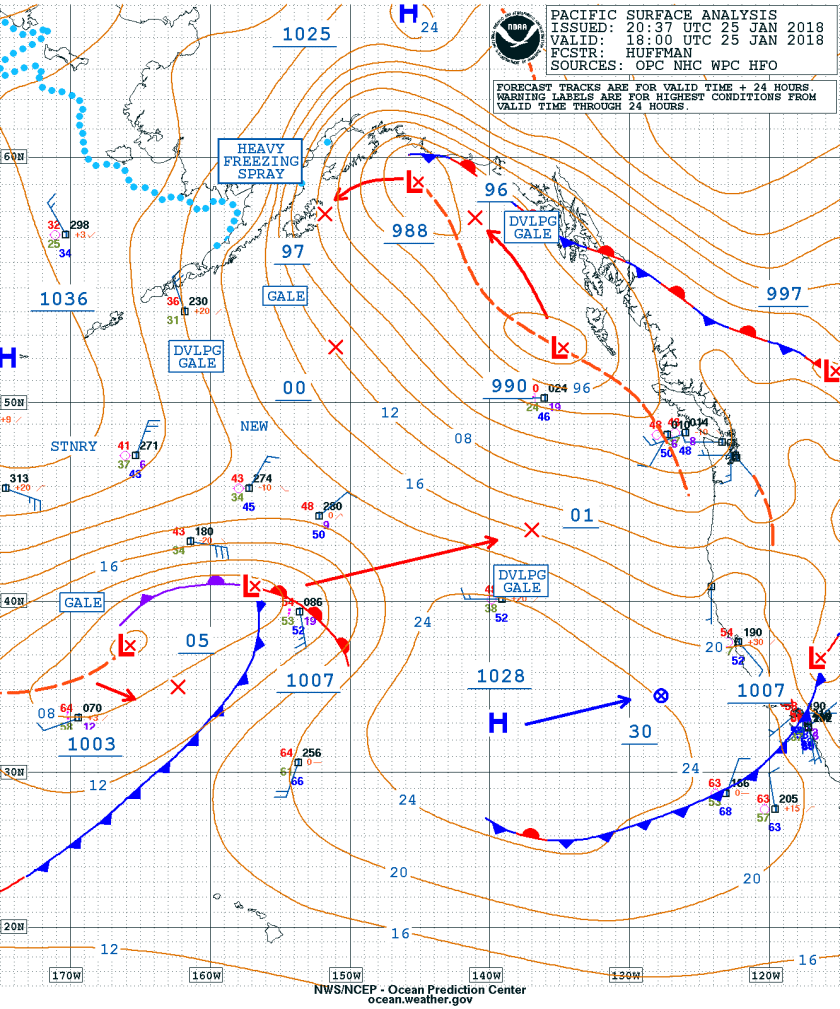
I can see an advantage in avoiding the high summer.  Looking at the Windyty depiction of the surface winds over the eastern Pacific today, you can see the big ass high pressure system that keeps the easterly trade winds over Hawaii (far left of picture) as well as the northwest winds over the west coast of California and Mexico.  Now, one of the disruptors of these winds are hurricanes.  The circulation pattern around hurricanes is far smaller than this massive high-pressure system, but a Pacific Ocean hurricane a few hundred west of Mexico, would cause southerly winds off the Mexican coast.

If it moved slowly north, maybe I could tag along??

It all depends on the situation and I’d have to figure out my escape routes, but it’s something for me to think about and plan for. It’s also significant that eastern Pacific hurricanes are weaker than Atlantic ones, with wind patterns not much stronger (if at all) than Northern Atlantic low-pressure systems in August and September (and I’ve certainly had my fun with those!).

Then the Ocean Route would entail an end around, running almost west, then curving slowly northwestward and finally northward, ending up east of Ensenada or southern California. With little winds, it would be an easy 10 to 12-day voyage, just like I did alone from the Azores to Ireland.  I’d only do this though if I saw the possibility of an extended time of light winds.

Also, time of year matters in my decision making. In the scenario just mentioned above, In May or June, I’d have plenty of time to wait or make it happen.  I may have different options later in the summer.

In September 2015, while waiting in Norway to cross the North Sea (I anticipated a 72-hour crossing), my weather windows were getting smaller and smaller. September is simply too late to be doing such a trip. But Sweden was so nice!

There had been strong northerly winds 25+ winds and driving rain, for days. I waited and waited. Finally, I saw a high-pressure ridge building into the North Sea from the English Channel, but this ridge of high pressure was also moving eastward.  But it only gave me a two-day window for a three-day trip.

Dauntless Crosses the North Sea 2015

I had to take it. It meant that I left my little port of Egersund, Norway, with 35+ knot winds from the NNW and rain. If you look at my route I took to Fraserburgh Bay, Scotland, those strong winds caused that dip in my route. Even with the paravane stabilizers, it’s just easier on the boat to put the winds and resultant seas on the starboard stern quarter. After 24 hours, as the winds died, I was able to head more westerly and on the third day, to the northwest. But that little longer route also added 12 hours to the trip and the next frontal system was right on, so my last 8 hours were in the weather again.

Would a longer, better weather window has come eventually? Sure. In the winter, under very cold air and high pressure. I couldn’t wait that long.

Dauntless in Ireland, next to a fishing boat with almost the exact same lines. There is a reason she handles the North Atlantic like she was born there.

When we decided to cruise the world or at least get away from the coast, we knew we wanted, needed a boat that that could all that and more. All the readings I did about boats and people cruising in boats all over the world, led me to Kadey Krogen.

Our little 42-foot boat was well built, extremely well designed for the worst of the worst and affordable.

Having Dauntless under my feet gives me confidence that she can handle any stupid situation I put her in.

Now, people are another matter.

.

Keys:


Planning – It Ain’t for the Faint Hearted

As I sit in my 10th floor apartment in Ho Chi Minh City, a.k.a. Saigon, the People’s Republic of Vietnam this balmy January 2018, writing these words, I think back one year.  I was in Martinique, in the Lessor Antilles, luxuriating in having just completed a harder than expected crossing of the Atlantic from North Africa to North America.

Looking north from my apartment in HCMC, Vietnam

Vietnam wasn’t even on the radar and if it was, I thought it was a wave top. Impossible it imagines how different 2017 would end up.

So, how can a person who doesn’t have a clue as to where they will be in 12 months’ time write about planning?

And not only write about, but spend a good portion of every day’s waking hours thinking about The Plan?  So much so that just a while ago, I found myself looking at the noonsite.com information about Taiwan.

Taiwan? wtf, he still hasn’t figured out how to get Dauntless out of Mexico, you’re thinking.

And right you are. So, I thought you would be interested in knowing or better understanding my planning process.

To understand my planning process, let’s look at my goal and some background information:

  • The Goal
    • Long term, cross the North Pacific, return to Northern Europe & complete my circumnavigation.
    • Short term, spend a couple of summers in Southeast Alaska.
    • Near term, get Dauntless to California before next winter.

Dauntless is now in the wonderful little town of Huatulco, Mexico, in the little Bahia Chahue.

  • Background information
    • In 2016, once I made the decision to return to North America, I made an elaborate plan (published in some blog post last year) to transit the Panama Canal and cruise up the west coast of North America to SE Alaska.
    • Looking aback at the plan now, I stayed pretty much on time and on target, only transiting the Panama Canal a couple weeks later than originally planned, until Costa Rica.
    • Arriving in Golfito, Costa Rica in March 2017, the wheels then came off or a more apt description, I was beached.
      • What happened? A perfect storm of: local bureaucracy, my nephew who cruised with me since Ireland, had to go back to school and I met this wonderful woman in faraway Vietnam.
      • Returning to Dauntless in June, I needed to get moving north. Costa Rica is a wonderful country that I had visited in 2004 and had really looked forward to returning. But, it turns out, it is not really cruiser friendly. The few marinas are ridiculously expensive and the paperwork of checking in and out was cumbersome and confusing.
    • My newfound friend, Cliff joined me and we took Dauntless from Costa Rica to Mexico. Mexico, it turns out is everything Coast Rica isn’t. Cliff had to go back to work and hurricane season had arrived, so in reaching the wonderful town of Huatulco in August, I decided that enough was enough.
  • The Task at Hand is to get Dauntless from southern Mexico to California, 1800 miles.

Dauntless cruises at about 6.5 to 6.8 knots. thus a 24-hr. period is 150 nm. That’s the figure I use for planning.  With light winds and small seas, then the planning exercise is about planning stops after a day of cruising.

Two years ago, in the Baltic Cruise, I largely ignored the weather and planned the whole 4,000-mile trip based on cruising days of 5 to 8 hours. Usually we would stay a few days in each town or city stop.  But the pacific coast of North America is a whole different creature.

Climatology tells me that the winds are predominantly from the northwest (the direct I must go) 2/3’s to ¾’s of the time. I use Jimmy Cornell’s Ocean Atlas which has pilot charts for each ocean by month. Jimmy Cornell’s Pilot Charts also tell me the secondary wind direction and currents. June thru September is 4 months, 120 days. I figure that I will have favorable winds about ¼ of those days, or 30 days. I have 1800 nm to go divided by 30 days means 60 miles per day.  No bad, about what I did in the Baltic in September.

But it also means that when the winds are favorable, I must make miles. The reality of seasonal climatology is best looked at and planned for over periods longer than a few weeks. In this situation, I can easily be stuck in port 30 days waiting for the winds. Then if I’m lucky, I’ll have a good period, 5 to 10 days of southerly winds. Depending upon where we are along the coast, it means we may do 48, 72 or even 96 hours to take advantage of our good weather window.

Now in this context, when I say “weather” I really mean winds and seas. I’ve left port on many stormy days. Rain, showers do not bother me, it’s really all about the winds and seas for my little Kadey Krogen.

The effect of head winds and seas vary greatly. 5 to 7 knots are hardly noticeable and may produce small seas, less than 2 feet. Dauntless will lose a few tenths of a knot under such conditions.

Going out into the storm

As winds off the bow become stronger, it all goes down rapidly from there. 12 to 15 knots produce 3 to 5 ft. seas, pitching become unpleasant and we’ll lose more than a knot of speed.  18 + knots are untenable from a comfort level. Too much hobby horsing and probably down to 5 knots, less with any counter current. This is what happened to me off the French coast going up the English Channel to Holland. We were making 2 to 3 knots in pure misery of pitching.  Because of the conditions, I finally decided to abort to Ostend, Belgium. It took another 6 hours to go 15 miles.  Some of the worst 6 hours I have ever experienced. The Kadey Krogen was fine, she takes a beating and keeps on ticking. The humans inside were not as happy.

What I took out of that beating was to more carefully consider winds and seas on the bow. A 20-knot wind from the stern is fine. We had 20 days of that crossing the Atlantic last year. Even 20 knots (and resultant seas) on the beam are ok. The paravanes are most effective with beam seas. Though I tend not to venture out in such seas if I am in port. 20 knot headwinds are untenable. Stay in port. If at sea, options are reduced, but probably a change in direction is warranted.

I use Windyty.com for my forecast winds.  I tend not to look at forecast seas because the accuracy is seldom good enough to use in an effective manner. Though Windyty will give you the first, second and third swells.

Now when it comes to forecast winds, for whatever reason, the forecast winds are almost always understated, though I do realize it’s possible that I only notice the over and not the under. Thus, when winds are forecast to be 12 knots, that usually means 8 to 15 knots. If 8, ok, if 15 it’s a no go.  So, in this case, I will use 8 knots for the Go-No Go decision.

From Huatulco to the Channel Islands, it’s only 1800 nm in three long legs. that’s basically the distance I did between Martinique and the Panama Canal.  But with much more un-favorable winds and currents.

Top speed for Dauntless is about 8.5 knots, but it’s non-factor because it’s impossible to justify the double to treble fuel consumption for 2 knots. So, my effective (long term) hurry up speed is 7.5 knots at 1800 rpms and 2 gallons/hour. Thus, I usually keep it to 1700 rpms, 6.8 to 7.0 knots and 1.6 gal/hr.

In my next post, Planning is the Mother of Anticipation, I’ll discuss the Mexican coast, what options we’ll have, crew and hurricanes.