The Sill at Port St. Peter, Guernsey, from the Inside
And it was a wild ride!
On the Outside Looking In. We wait for the water to rise above the sill.
Day 08 St. Helier, Jersey to Port St. Peter, Guernsey
Originally, I had planned the route in a most course fashion, just looking at the distance between the islands of Jersey and Guernsey and seeing the number “10” in my mind. 10 nm no problem; two hours.
So we set out, bright and relatively early. Only minutes into the cruise, the first bugaboo rears its ugly head. Anyone see the issue yet? Maybe you just read the previous blog? Here let me remind you, my own words from the previous blog:
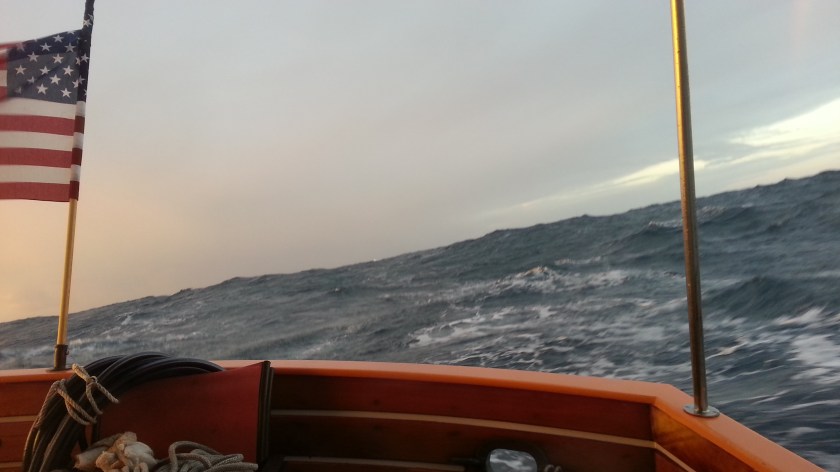
Just before landfall, the winds turned westerly and north westerly at 25 knots. That combined with the much longer fetch, we immediately saw waves a few feet higher. All of sudden we were getting 6 foot waves on the port stern quarter. That angle of incidence does make the roll more than usual, and we had one roll of 15°. But not much more than a curiosity, as the port was in sight.
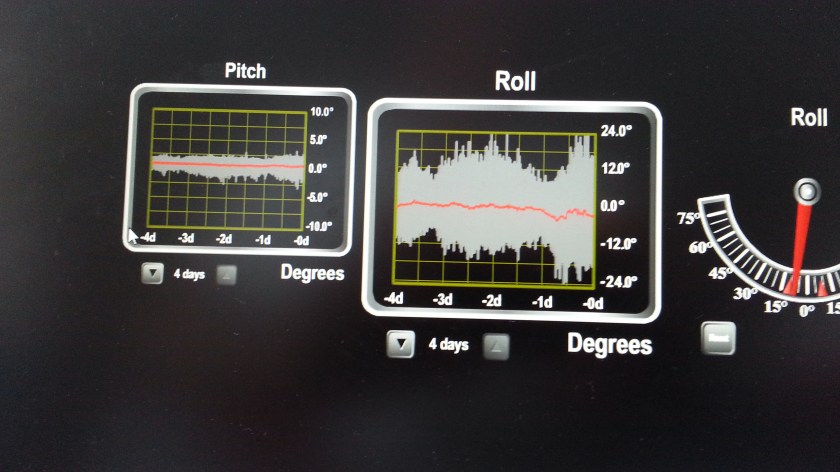
The Maretron Data for the First Hour of our Trip.
Ah yes, now, as we left port, the winds and seas were unchanged. But we were now going the opposite direction. For the first hour, the current was with us, but the winds were against, so we those nasty, steep, short period waves. The surfing safari we had the day before, now became the ride on the wild mouse. I cannot begin to tell you the number of times I actually left my feet. As I stood behind the wheel, trying to get the right combination of speed and course to reduce the pitching. A wave actually hit the anchor, we were going 1000 rpms, but I reduced it to idle after that. The Maretron data (ignore the speed thru water, as I have not been able to calibrate it) shows in that first hour the boat pitching. It’s hard to see in these pictures, but it clearly shows a series of three waves where the rhythm was such that the normal pitch up, had been 2° suddenly increases to 5° and then culminates in a 8° pitch up. Let me tell you, at 8 degrees, I’m thinking not of boat, but of an airplane, and that we should rotate now, and gear up.
I slow down even more, just above idle. After an hour, we go to the western most point of Jersey and could change course to NNW. Now the seas were 6 to 10 feet, but they were on the beam and the paravanes take care of business pretty well. As you watch the video, it may seem like a lot of rolling, 4 to 6 ° in each direction, an occasional 8° roll, BUT compared to pre-paravane days, that’s nothing, as in in the past, I simply would not have been able to take this course or I’d have had to alter course by 60°.
The extent of the pitch was new however. I had only had pitching like that once before, in Long Island Sound. In those days, seemingly eons ago (OK only 18 months), I had tried to temper the ride by reducing speed, but I never quite reduced it enough. On that occasion I had the rpm’s down to 1400, the waves were 8 to 12 feet and Dauntless would go down the face of one wave, and as we pitched upward the top of the next wave would get sheared off in the wind and go flying over the fly bridge, not even hitting the pilot house!
Error
This video doesn’t exist
Earlier that morning, I had come through the Cape Cod Canal, having spent the night anchored off of Plymouth, Mass. I must have been about a half hour behind the only other boat I saw on the water that day, another Krogen. But as we turned west into Rhode Island Sound (an extension of Long Island Sound) I lost track of him. I finally pulled into the bay to go up the Narragansett River and “Coral Bay” was already anchored there. I recognized the boat, because we had also been in the same anchorage in Maine and Steve had come by to talk. We talked again after this ordeal, but neither one of us had the strength to get the dingy down to visit. Poor Dauntless, another day in where she was ridden hard and put away wet.
So all these memories are flooding back as we slog off the coast of Jersey. Therefore I knew now to reduce the rpms to idle if necessary. An hour and half after we had left the dock, we finally turn NNW for Guernsey, I realized that from here it was 10 miles, but not even to the Port of St. Peter our destination, but to some point south of the island.
Thus, my anticipated two hours trip became 5 hours.
The French sailboat Anfre, with Christian and Matin, stopped by Dauntless. They had left after us and had taken four hours. We had a great visit though and they have helped me plan the next two days to Honfleur to better plan on the currents. Also using Coastal Explorer, I have finally figured out how to better use the current tables.
Tomorrow, we have an 8 knot current to deal with off the Cape of La Hague, check out the current gauge, Argoss-WE 500-1355. Clearly, our departure time is predicated on that, but remember the sill. Our harbor must also be open to get out.
I’m playing with the big boys now; I better get to sleep early!
FYI The Delorme InReach turned itself off yesrterday. The AIS information is up to date if I am in a port. Also, having trouble uploading pictures for this post.
We got up early to take advantage of the calm winds and little boat traffic. Dauntless rolled a bit last night on the mooring ball, so I put the paravanes out. They decreased the roll a bit, certainly dampened it, like shock absorbers on a car, but these particular fish (or birds) are made to be moving through the water for maximum effectiveness.
Cirrus South of Scilly
As we got south of the Scillies, I realized that while it was 90 nm to Plymouth, France was but 120 nm. With fair skies and still under the influence of the Azores high, it made sense to me to press on across the channel to the continent. I discussed our options with Karla and Larry and they concurred. A direct route to France also meant we could avoid the Traffic Separation Scheme (TSS) off the English Channel and the area north of Brest.
So instead of turning due east for Plymouth, we set off ESE towards the north coast of France. The port of Trebeurden is our goal, with anticipated steaming time of 22 hours.
After a few hours of beautiful weather and looking at our expected arrival time, I decided to lower the engine rpms to 1500. Not only will that save us about a half-gallon of fuel per hour, but our ETA would have been 04:00 at the faster speed, and is now, about 05:30. A better arrival time, as it will be light.
It’s 18:00 now and as the day progressed diurnal heating produced some stratocumulus clouds and winds from the WNW at 15 gusting to 23. So the almost flat seas we had in the morning, gave way to wind driven waves of 3 to 5 feet hitting Dauntless on her stern starboard quarter. We have gradually increased our rolling from plus or minus 1 to 2 degrees to +/- 4 to 6°
Still, that’s half of what it was for the last few hours of our cruise into St. Mary’s Harbor in Scilly.
For dinner, I made a tasty dinner of hamburger and crudité. The hamburger ground by my butcher in Waterford. It’s hard to imagine that I spent 8 months on and off in Waterford and now won’t be back for four months. But I did meet an Irish sailboat in St. Mary’s. We had gotten into a discussion about the “legs” on their boat which was beached on hard sand, held vertical on its keel by said legs. That gave me some ideas of how I could make that work on Dauntless. Probably just 4”x4”s with a notch for the rub rail, then bolted through the hawse pipe. A project for next winter. They were taking her to the west coast of Ireland and will winter over in Dingle, so I promised to come visit next winter.
Unlike yesterday, time today has seemed to fly by. And yes, I kept the patch on.
For the past two hours I have been watching the parade of ships heading for the TSS north of Brest. I have also managed to figure out the Raymarine radar a little better and finally noticed after two years that the gain also had an adjustment for wave state. I could keep the gain much higher, if I also adjusted the wave state. A win win. And to think, some say I’m a slow learner! (win-win turned out to be tie-tie, as I adjusted it not to see waves, turns out it also didn’t see fishing boats).
The Dauntless Helm with Radar, Chart & AIS Information
A beautifully flat day, azure sky and sea, with just some mare tails cirrus. As the afternoon and evening progressed, the winds started picking up slowly, but surely. By evening, increased westerly winds had produced 3 to 5’ waves and the roll was 6° to each side. As one of the lessons learned from the Atlantic Crossing, I now run off the tank on the windward side of the boat. The lee side seems to remain heeled for slightly longer times, so I don’t want the engine sucking water through the vents. Yes, I had not gotten around to moving the vents yet. I did think about it a lot though!
Under these conditions, it’s not an issue, and possibly only an issue under heavy seas with only paravane in the water.
I had also adjusted the ComNav Autopilot to be less sensitive, so that it made fewer corrections constantly. I will have to call them someday and discuss if my interpretation by reading between the lines of their user manual is correct. Basically, under open ocean conditions, meaning no need to keep a rigid heading constantly, I set the sea state to very high (rough seas), so that it doesn’t try to adjust heading every second. Under these conditions, I will hear it operate every few (3 to 6) seconds.
Our Planned Apprach to Trebeurden
On the other hand, under truly rough, 12+ seas, I set it to totally flat conditions, so that as soon as it senses the stern coming around it acts. Then the adjustments are almost constant, but it does a great job of steering the boat through the worst conditions. I have tried to hand steer under such conditions and frankly the ComNav does a better job. In the 20+ foot seas on the last day into Ireland, as I cowered on the bench in the pilot house, the ComNav reacted so well, I never saw any green water over the rails. Maybe I should ask them about a sponsorship!
During the early evening hours we had a little excitement as we were crossing the main eastbound traffic lanes. While not in a TSS, the ships having come around Brest in the TSS 30 miles to our west, will reenter the TSS about 30 miles to our east. Therefore they pretty much stay in the same track. Makes it easier for us, as one can figure out where the main traffic lane is and the direction ships will be heading.
We only encountered a few west bound ships, but an hour north of the east bound lanes, our AIS and Coastal Explorer showed the parade of ships heading east. They were cruising at 14 to 18 knots, while we were doing 6.5 knots. That gave me plenty of time to plan our crossing. There was only one ship that was a factor. It was a big Chinese ship that the AIS said it was doing dredging operations (something must have gotten lost in translation), but to me looked to be one of those floating dry docks. Massive bridge at the bow and a massive stern and almost nothing in between.
What it really Looked like
I adjusted our course to be perpendicular to his course and I could see that he adjusted his course a few degrees to starboard also. The picture is what CE depicted. The closest anyone got was about a mile, though later on we passed a fishing boat about a quarter mile away, but I had been watching him for more than an hour so…
By midnight winds were westerly at 15 gusting to 22, seas 4 to 6 feet and roll 7°. This kept up until we reached the harbor.
Dawn was breaking as we approached. We had to stop to get the paravanes in, while it only took a few minutes, it was disconcerting to be stopped just hundreds of feet from the large rocky outcrop. So I was much relieved to get underway again even though Dauntless hardly drifted at all.
Previously, I had carefully plotted a course into the basin based on our pilot charts, and my C-Map and Navionics charts.
The Basin Entrance with Underwater Sill
But the reality ended up being a bit different. Our planned path was full of moored boats. So on to Plan B, I kept our speed just above idle, about 4 knots, to minimize the damage if we hit anything. I picked up the three green lights our pilot charts told us meant the gate was open. But our pilot chart had also told us the gate was always open during neap tides and as I remembered seeing the waxing (light on the right) quarter moon last night, I knew it was a neap tide.
The Gate We Passed Through. D is just past the gate on the left.
Creeping slowly forward, the sign board seemed to indicate 2.5 meters, but always leery that I am missing the obvious, I was still worried about the mysterious sill. We passed over the sill into the marina basin and didn’t scrape anything, but it was an anxious moment.
A big assed catamaran was on the one available “T”. I went past him to see if we had any options, we didn’t. I turned around and headed for a slip just inside the gate. The slip is short, only 20 feet, so our rear half is hanging out.
The wind was behind us, so that was a bit of a mistake, it made the docking more stressful then it needed to be, but finally, 23 hours after engine start at St. Mary’s, we were finished with engine and had landed on the “continent” for the first time by boat.
Dauntless at DockThe Trebeurden Harbor from Above. Dauntless is docked in the basin to the left, out of the Frame.
All’s Well that Ends Well
Closeup of Our Crossing. Those are 30 minute Heading Vectors.
Maretron Data for the Previous 24 hours. The Telltale says the Highest wind was 24 Knots, but I reset that frequently.
We got up at the crack of dawn so to be able to start engine at 06:15. The last line was thrown off at 06:45 and our Summer Adventure officially began.
Today, Sunday, 24 May, 2015, I awoke to the visage of Claudia III out the salon window, quite a change from Waterford. But how did we get here?
The Krogen’s Salty Bow & a Few Irish Boats
Casting off yesterday morning, with our bow pointed into the flooding tide, Dauntless left Waterford with hardly a ripple. A little left rudder, forward gear at idle, she glided smoothly into the oncoming 2 knot current.
I can’t begin to tell you the feelings of getting underway, cleaving the bonds that tied us to a particular place. The steady purr of the engine, the big wheel turning a big rudder, Dauntless becomes frisky. Krogens are made to roam the seas and can bring their lucky owners to virtually any place they dare to go.
We had arranged to go to the New Ross Boatyard for haul out. 12 months and 4,000 miles after our last haul out, I figured it was time again. The Waterford boatyard’s lift was too narrow for our Krogen, but they recommended the New Ross Boatyard. Our departure from Waterford was predicated on two factors: the need to depart into the current and the necessity to arrive at New Ross close to high water. That meant an hour downstream against the current and then an hour upstream with the current. Turned out there was also a swing bridge to traverse, but we had three feet to spare.
On the Hard in the New Ross Boatyard
Arriving at the boat yard, with a two knot current still running, made for an exciting entrance, finally on the third attempt, Dauntless was safely cradled in the lift.
The bottom was in much better shape than I had anticipated. The previous haul out, half the anti-fouling paint was gone. This time, there were just small areas where the old ablative paint was showing through. So we, actually Karla and Larry, spent the rest of the afternoon touching up our bottom. Now it looks a bit like a moth eaten leopard, but only the fish will know.
The two zincs were half gone. I replaced the one on the rudder. The one of the shaft is a combination steel cutter attached to a clamp on zinc anode. It costs only $62. It’s the second one I’ve put on and it works wonderfully. Half eaten, it tells me it’s doing its job and no pieces of line wrapped around the shaft as had happened in the past. I got it from the Zinc Warehouse,
It’s about half gone, but I did not have a replacement, I’ll buy in bulk the next time.
We’re ready to go back in the water, but today is Sunday, so we will have a day of rest and just small jobs. I must service and grease the Ideal Windlass and probably replace one of the solar panel controllers.
Dauntless Gets a Light Touchup
The Delorme InReach is now on, and my intention is to keep it on until Dauntless returns its 2015-6 winter home October 1st. Therefore, you can find us at, https://share.delorme.com/dauntless But unlike the Atlantic Passage, since we will have somewhat normal email and cell, I have alimited plan in the number of text messages I can send or recieve. So, if you want to contact us, the best option is email, wxman22@gmail.com, or cell phone.
If there is not a current update on the InReach, either the boat has sunk or I have neglected to charge the InReach.
Thanks for coming along with us.
Dauntless as She Came Out of the WaterCutter on the left, abuts the Prop. SALCA 2000 Anode is half goneTHe Krogen’s Salty BowThe Krogen Prop and Rudder after 12 months and 4,000 milesOld and New Anodes (Zincs)
Providence Rhode Island to Castletownbere, Ireland:
Morning of the Last Day
3624 nm, 6523 km.;
638 running hours
Average speed 5.7 knots
1013 gallons of fuel consumed
Average = 1.59 gal/hr.
Average 3.6 nm/gal= 1.7 km/liter
Cost of fuel $4000
Cost per nm = $1.1/nm
Stuff that broke: Four Stories and lessons Learned
The Bent Stabilizer Pole Saga
The Mast Cleat Adventure
The Auxiliary Water Pump Sediment Filter Hijinx
Water in Fuel Tanks: Not Pretty; But the Lehman keeps on Going
Other Lessons learned
Evening of the 27th, the Storm Intensifies Again The Past 4 Days of Pitch and Roll
Food and Provisioning
Route Planning and Execution
Organization and Storage of Spare Parts
Odd and Ends
Solo Voyaging
Equipment: Must-haves, Nice-to-Haves
The crux of a successful ocean passage
I first wrote this “Post Mortem” 8 days after the end of our passage, but never published it because I realized it had morphed into many things. Thus there will soon follow a post titled, “Finding the Right Boat” and “Weather or Not”, where I talk about how to, and how not to, use a weather forecast.
Our successful ocean passage was the culmination of a planning process that started 6 years earlier and four years before we even had a boat. The success was due two major things: finding the right boat and having the right attitude. Having the right boat protects fools and drunks. Having the right attitude means you know what to except, from the best to the worst. If your plan is to call the Coast Guard under the “worst” circumstances, stay home.
During the worst of it, while I was miserable, I was not afraid. I knew the Krogen could handle it and even realized she can handle much worse.
Afternoon of the Last Day
The planning and learning process is key to a successful passage. As I had read virtually every account of small boats crossing oceans and books and stories of freighters throughout the 20th Century, I had a good sense as to what worked and what didn’t. That can’t be overstated because it speaks to our vision and that’s the first step of a successful passage. So this trip really started seven years ago, before I knew of Kadey Krogen, trawlers, or really anything.
But first, our passage is really not that special. People have done the same thing in in smaller boats, in far worse conditions, with many more handicaps. Almost everything I have learned and talk about, I first read someplace else, by someone with far more experience than I will ever have. Just remember that Columbus did the round trip more than 500 years ago, with three boats that were only 10’ to 17’ longer than Dauntless.
If you’re reading this, you probably read the details of the trip as it happened, or soon thereafter. So for this entry, I’m going to talk about what we learned in hindsight for the next ocean passage.
Stuff that broke: Three Stories and Lessons Learned
The Bent Stabilizer Pole Saga:
Error
This video doesn’t exist
An operator-induced failure.
Only a day after I left Miami with the new paravanes, while I adjusted the fore stays, I had also adjusted the up-down stays, Amsteel Blue 3/8”, which take the vertical loads of the paravane fish. I had not fully locked them tight on the horn of the cleat upon completion. I probably thought I would re-adjust them once more and then simply forgot. So, while they were wrapped in a figure 8 three times on the cleat on the mast, I had not “locked” it on the horn. Amsteel Blue is slippery enough that if not locked securely with at least 3 or 4 half hitches, they will get loose.
And that’s what happened. The Figure 8 got loose, thus letting the pole swing from its position of 45° to almost straight down, 170°. The rub rail, stopping the pole from facing straight down. This put a kink in the pole where it bent around the rub rail. Not a bad bend, but just enough to significantly weaken the pole. In trying to get the pole back to its original position, I took out the retaining bolt that would keep the pole in its cup that is attached to the gunnel. But I still couldn’t get the pole out, so I eventually got it back to position, but now, the retaining bolt was not in place. I knew it wasn’t needed because all the force on the pole is into the cup, not outward, but months later, it did contribute, if not cause the pole to subsequently bend into an “L” shape.
So on the last day of the trip during one big roll within 60 miles of Ireland, the same windward pole went vertical. However, the kink in the pole, even though very slight, allowed the paravane bird to put a force on the pole that rotated the pole 90° with the absence of the retaining bolt, so that the kink now faced aft. As soon as that happened, the force the bird put on the pole bent the pole 90°, and of course, now this allowed the pole to come out of the cup, making its retrieval even harder.
An hour later, after sitting dead in the water for that time, I had managed to get the pole up on deck. In my adrenaline rush, I never noticed how well the boat handled being left on its own, wallowing in the seas with its beam to the seas, which were running 8 to 15 feet at that time. In hindsight, we were bobbing in the ocean, with less roll than when underway.
Lesson Learned:
Replace bent stuff and all hardware before leaving on an ocean passage.
John Duffy, who had rigged the paravane system, told me to replace it, as the bend would significantly weaken it. I also probably did not mention that I had taken the retaining bolt out and had not replaced it, as the pole had rotated slightly, not allowing the bolt to be re-inserted.
The pole was replaced in Castletwonbere for 300 Euros. All the hardware is back in place.
The Mast Cleat Adventure:
A day out of Nova Scotia, as we sat in the Pilot House enjoying the world go by our living room window, we heard a noise that sounded like a gun shot. Knowing that no one on board was packin,’ I looked at the mast and saw immediately that the cleat holding the up-down line was now horizontal instead of vertical.
We chopped power to relieve the strain and I ran up to the fly bridge, though taking the time to put on my PFD (Personal Flotation Device, a life preserver). One of the two 3/8” bolts attaching the cleat to the mast had broken. Not wanting to spend a lot of time to try to re-attach the cleat, I tied the up-down line around the mast in a number of clove hitches and then tied it off to the other mast cleat. This way, much of the force on the line, instead of being transmitted to the cleat, would now be manifested in trying to squeeze the mast.
Lesson Learned:
This new system worked so well that while in Horta, I redid both up-down lines, so that they came to a three clove hitches around the mast, before being tied off on the cleat, with a final half hitch on the horn of the cleat for each line.
John Duffy in Miami designed and installed a great paravane stabilization system, which is not only relatively light-weight, but also easily adjustable and cost-effective.
While in Ireland, I also added one more feature: I had had another winch installed in Florida to assist in retrieving the paravanes. In Ireland, I also replaced the lines on the winch with 3/16” Amsteel Blue lines that I had gotten, 300 feet at a really bargain price from Parks, of Hopkins- Carter in Miami. By using this new, stronger line, it added an extra margin of safety, because it is strong enough to hold the paravanes while underway should I have a failure of the up-down line as described above. It would also allow me to retrieve the paravanes, even if the boat is not at a full standstill. This would be fast and useful, in case of emergency.
This was the first and last time I put on the PFD on this passage.
The Auxiliary Water Pump Sediment Filter Highjinx
Another operator-induced problem.
After the failure, a few days from the Azores, the pressure switch failed. After screwing with the pump for a while, I just bypassed the pressure switch and the pump went back to work. A day later the entire pump gave up the ghost. I discovered by reading the instruction manual that I had installed the pump upside down, with the electrical parts under the pump itself. Evidently, you should not do that because if the pump has minor leaks, it gets into the electronics right away.
Lesson Learned:
It behooves one to read installation instructions before the fact, not after.
THe Previous 12 Hours of rockin and rollin Before Arrival. The Scale is 24° to Each Side
Water in Fuel Tanks: Not Pretty; But the Lehman keeps on Going
On the Left,Taken from the Stbd Side Fuel Tank, a Mixture of Water and Emulsified Water and Fuel. On the Right, Fuel from the Port Tank
I have finally deduced that the water, around 5 gallons, got into the starboard fuel tank during the last 36 hours of the trip thru the fuel vent line. How do I know this? After I replaced the O-rings of the fuel caps, while the old rings were worn, there is no way a significant amount of water could have entered that way. In addition, the water was only in the starboard, lee side tank.
Up until this time, Dauntless had been in seas almost as rough, though not for this extended length of time. But even if only for 8 hours, no water had ever entered the tank before in our previous 2000! hours of cruising.
What was different this time?
A much longer time of seas on the beam, three and a half full days, with 54 out of 72 hours, being in large 15+ foot waves.
The last 12 hours, with the failure of the windward paravane pole, the boat remained heeled over to port for a longer period of time, as the recovery was slower.
While all the above was going on, for reasons that were just chance, I had been running on the port (windward) tank, which was now near empty, thus for the last 2 days of the passage, we were feeding off the port (lee) side tank.
Thus, just when the port tank was being used, the boat was heeling more to port, thus keeping the fuel vent which is at deck level under water for a significant portion of time.
My Conclusion:
The lee side tank sucked in the water thru the fuel vent. Had I been using the other tank, in all likelihood, this would not have occurred.
After Arrival. I also Changed the Scale to 32°, so This shows my Last 12 Hours of the Passage. Sorry for the poor quality. I was shaken, but not stirred.
I will move the fuel vent hose, so that this can never happen again.
In addition, I will make it a practice to use the windward tank under such conditions. I could have easily transferred fuel to the starboard tank while underway. It was just chance that I had filled the starboard tank in Horta and I therefore used that fuel first, since I knew my fuel in the port tank was good.
Other Lessons Learned
Food and Provisioning:
Maybe from reading too many books written by frugal sailors, my provisioning could have been better. I had too many things I don’t eat, like rice and beans, and not enough of what I do eat. I still have enough calories on Dauntless to feed a family in Africa for 2 years. No, I do not really know what I was thinking.
We should have had a bit more lettuce. Romaine lettuce in those packages of three lasts for a few weeks in fridge.
Eggs. Julie likes eggs. I forgot she really likes eggs.
Mayonnaise, to make egg salad with all those eggs. I like egg salad.
Route Planning and Execution:
Good job with planning. Very poor execution.
Not having the paravane stabilizers for the first 3,000 miles of cruising with Dauntless made me very sensitive to the direction of winds and waves. The Krogen handles following seas exceedingly well. Thus I carried that mentality with me on this passage. I made too much of an effort to keep the seas behind us and off the beam, thus our northeasterly course leaving Cape Cod and our southeasterly course leaving Nova Scotia.
In hindsight, it was an overreaction in both cases. That continued with my solo voyage from Horta, with the zigzag of day three, first NW, then SE then after 24 hours of stupidness, northward.
In the future, I will let the paravanes do their job and keep a course more directly (great circle route) to our destination. In fact, while I did not record the data, my feeling now is that the rolling of Dauntless is about the same with the paravanes, whether the sea is following or on the beam. Without the paravanes, there is a night and day difference.
Organization and Storage of Spare Parts:
I’m grateful that I didn’t need to use any spare parts. But the haste in which we left, meant we obtained a lot of stuff at the last minute. It was put away, with only a general idea of what was where. Had I needed anything, I would have found it eventually, maybe even by the time, the westerly winds pushed us all the way to Europe, a month or two later. At least I would not have starved.
This winter has been spent re-packing virtually all parts and tools. In addition I have a written inventory, with location, storage bin, model numbers etc. Before the next passage, it will even be computerized.
How did I decide what spare parts to take or not?
This turns out to be relatively easy. I picked those parts I could both afford and could replace myself. So, we had an extra starter, even though i had no intention to ever turn off the engine. We had an extra alternator. i did not have a spare injector pump, too expensive. Except for the fuel injector pump, I had all the other external engine stuff: injector tubes, hoses, belts, lift pump, etc. We had extra hoses, belts, etc for every critical component. Therefore, we had nothing extra for the generator, since I don’t use it underway. We had no internal engine parts, pistons, etc, becuase while I could probably replace it while docked, it was not something I could see myself replacing underway. But also, that is not a typical failure point of the engine. Internal stuff usually shows signs of wear for a long time before failure.
Odds and ends:
If I have not talked about it above, we ain’t changing it.
That means stuff like the DeLorme InReach will not be changed. We like the limitations that system imposes. I don’t need to call mom when the shit hits the fan.
Probably will add some redundancy to the ComNav Autopilot. Unlike a sail boat, we cannot tie the wheel and expect to go in any semblance of a straight line; I tried.
One of my issues has always been that in a seaway, there can be no noise of moving objects in the boat. Moving things can cause damage in and of themselves, and must be controlled. So, even at 40° of roll, every few minutes, during the worst of it, I heard no crashing or banging of stuff. Everything must be secure.
Need more recorded movies and Korean Dramas. They really help to pass the time. Yes, one can tire of just reading. When I was alone, I got really bored.
On the other hand, I did back in to computer card games. Bridge in particular, yes, I am of a generation that learned bridge.
Solo Voyaging
I hope to never do another 10 day passage alone again. But I will if I have to.
Having said that, the next passage next year, will be part of a much longer voyage and we will be pretty much under way for 18 months. With Julie working, I will need a lot more help during the many segments the trip will entail. I will put it out there on Trawler Forum seeking those who want to be a part of the experience and maybe even share some expenses and I’m sure some shenanigans.
Must-haves, Nice-to-Haves
Must Have
Nice to have
Paravane Stabilizers
Four 110W Solar Panels and two Controllers
Lexan Storm Windows
Coastal Explorer
C-Map North Atlantic and Western Europe Charts
Boat computer and router
Digital Yacht AIS Transceiver
Master’s License
Katadyn 160 Water maker
Vitrifrigo Freezer and Refrigerator
Delorme InReach text only sat phone
Splendid Vented Washer/Dryer Combo
Spare parts for the Ford Lehman SP135 Engine
Other Spare parts
Revere Off Shore Commander 4 person Life raft
Here are a few more pictures and videos. The file name incorporates the date time the file was recorded, thus 20140827_1927 means it was recorded 27 Aug 2014 at 19:27 (7:27 p.m.) hours.
That’s how long the Pilot House Reorganization has taken. It’s finally done, as these pictures will attest. I threw away four trash barrels of junk and packing material. I repacked all of my tools, spare parts and associated fasteners and bits and pieces.
Front of the Pilot House
I have listed everything and where it is and what it is packed in.
My goal was not only to know where to find stuff should I ever need it, but also to make the engine room in particular, less prone to floating debris, should a disaster ever take place.
The last step will be to organize the lists on the computer, so when the shit hits the fan, I’m not leafing thru my hand written sheets, trying to figure out what I wrote and of course, not seeing the one item I am looking for.
This also means that Dauntless is finally ready to move. Next week, she will move ¾ mile up river to the boat yards, where her nice round bottom will be cleaned and painted. A bottom I know well, as its very efficiency has allowed this entire adventure and the greater adventures to follow.
Lastly, to be more diligent than the last time, I have scheduled the next Pilot House Reorganization in my Samsung Note calendar for April 12, 2035.
Yes, you read it right. 20 years from now and if I am a lucky person, I’ll die just days before !
Starboard side under helmPort side Helm Station. Computer, Maretron, Router, AIS on upper shelf. Lower shelf has bins of my most used electrical parts
Julie and I presented an account of our Atlantic Passage to over 150 Krogen owners this past Saturday at the Krogen Rendezvous. This was the first presentation we’ve ever done of our passage and it was really well received. A bunch of folks asked me where else we were presenting and at this point, the answer is nowhere because no one has asked us yet. I’m definitely going to look for more opportunities because I like sharing how possible this is in an older boat on a limited budget.
Besides talking about our preparation, and all the books we read, here are some highlights:
Q: What is the age of Dauntless?
A: 1988, 27 years old. [Audience gasp. This reaction surprised me because it never occurred to me the age of the boat would be an issue; I just thought it was about the condition.]
Q: Did you change the oil?
Error
This video doesn’t exist
A: No! I wasn’t to stop the engine in the middle of the ocean for no stinkin’ oil change.
Q: Did you ever turn off the engine?
A: Not on purpose. [Then I went into a five-minute recount of all my shenanigans with changing the fuel filters and closing valves that should be open, and vice versa, which resulted in me killing the engine, twice!]
Q: Could you check the amount of oil you had with the engine running?
A: I had read on Trawler Forum that I may be able to check the oil level while running. Well, all I could tell was that there was some amount of oil in there, but it was not possible to get a reading. Therefore, I knew the oil consumption in the past was a quart of oil every 50-70 hours, so I just added 2 quarts every few days whether it needed it or not. When I did turn off the engine when we arrived in the Azores, the oil level was exactly where I expected it to be.
Q: What would you do differently in hindsight?
There is virtually nothing significant we would have done differently. The actual route we took is one issue, but as I rethink the rationale for the route we took, it still seems it was the best option given the ice conditions east and south of St. John’s NF. I’m disappointed we never got to see an iceberg and as our start date got pushed back to late July, maybe we should have tried to make St. John’s. In hindsight though, I was not that sure enough of the fuel consumption and Julie had a deadline to get back to work, so the Azores were still the best answer, even if it added 5 days to the passage. It does seem that had I been able to stay on the great circle route, topping up the tanks in Halifax would have allowed me to get to Ireland direct. Umm, next time.
A last thought on pictures and video from the trip: Being back in NY, having the Krogen Presentation to do and finally having fast, reliable internet connection allowed me to finally sort through the 1200 pictures and 130 videos we had taken during the trip.
While there are some really nice pictures, especially of sunsets and sunrises, I now wish I had been more meticulous in making some quality pictures and videos that told their own story each day in a systematic manner.
A note about the videos. The file date is basically the date time stamp of when it was recorded, thus, 20140728_201731 means it was recorded on July 28th, at 20:17 hours. This was on Eastern Daylight Time until the Azores at which point I changed it to GMT (which was local time).
Also the quality is not the best, but rather than not show post them, I thought they still depict the conditions and give a good day to day story of conditions.
And I’m sick. Just a cold that I felt coming on last week, but I had been feeling better and I needed to take advantage of being next to the dock and wall (instead of being rafted to fishing boats) so that I could rig the new paravane pole. It also allowed me to complete the re-rigging of the smaller lines on the winch that pull the birds and the poles up. It’s now a very easy system to deploy and retrieve when I am alone.
My first morning in Waterford, my winter quarters, somewhat nicer and warmer than Washington’s winter in Valley Forge and I probably have enough food and calories on this boat to feed a family in Africa for a year, an extended family!
It’s one of those typical northern European fall/winter day, a stale gray sky with light rain and drizzle. Probably good for me, makes me rest, as on sunny days, I have this primordial urge to hunt & gather. So instead I’m watching last night’s Jet’s game. God, they are pathetic. The poster child of what it looks like when you have an owner who cares more about appearances than winning. In other words, they make terrible choices, but instead of dealing with it, they keep on telling everyone how smart they are and there is no problem; simply ignoring the fact that the data (their record) says differently. If you refuse to reflect and admit mistakes, there is not much chance of improvement. Much like Obama, who seems to be re-inventing the Vietnam War in Syria? I wonder if he has even read books about the War. It’s the ultimate folly and hubris to think you can to run a war from the White House. All it does is annoy the enemy and get Americans killed for no reason. The Iran rescue attempt was also run from the White House. Yes, that failure still rankles me to this day. OK. Basta.
Waterford Viking Tower
I’m hoping to have Wi-Fi at some point, it will make getting my laptop online much easier and it the main reason I have not posted more in the last two weeks. I’ll just have to make a better effort to diagnose my phones hotspot issue.
I’m also finishing the Post Mortem for the Atlantic Passage. It’s a bit wordy, so it needs some editing. In the near future there are a number of issues: the Electro Scan system is having issues with the mix motor and long term, I must find and install a diesel forced air heater.
Having spent the last three weeks in fishing harbors, Castletwonbere and Dunmore East, has been really a wonderful experience for me. Ireland has five official fishing ports, and those are two of them. I’ve been tied to fishing boats most of that time and the fishermen have been great.
We Fit Right In
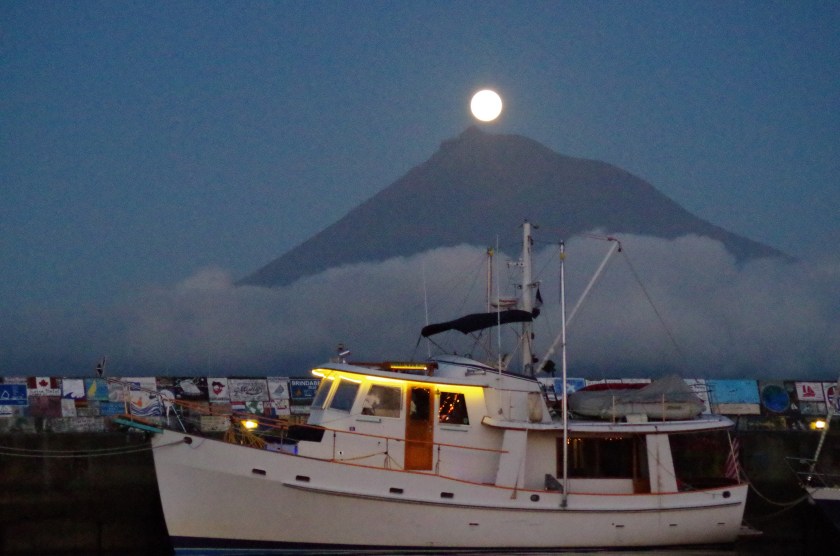
You can see in some of the photos I’ve posted the similarity between this Krogen 42 and the fishing boats. In fact, almost identical lines. I had not noticed this before in the U.S., but here is was obvious. Clearly a primary reason Dauntless is so salty and as I reflect on the passage, as uncomfortable I was at times, Dauntless was in her element and could have taken far more.
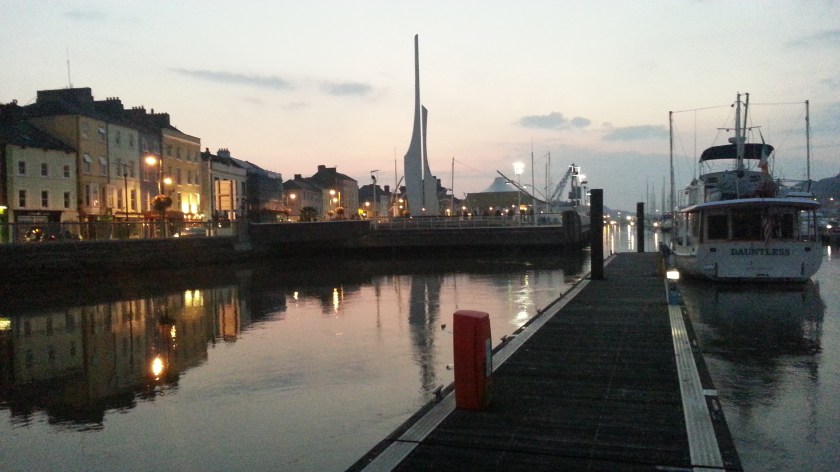
In the short time I’ve been in Ireland, I have met so many great people, interested in our passage and clearly these are communities tied to the water. Even yesterday, the person who came to fuel my boat (2400 liters, 631 U.S. gallons) loved the look of the Krogen and took many pictures of her. Now being in Waterford, this will be a little different experience. No fishing boats and we’re right downtown, I ‘m currently tied adjacent to the Viking Tower. Looking out my salon window, instead of tremendous waves, I see a mud flat between the dock and the City wall. The tidal range here is 11 to 12’. Dauntless has only 2 feet of water under her keel at low tide. The river we’re on, the River Suir, is the fastest running river in all of Europe, but it’s really a tidal estuary, but I didn’t feel the need bring that up, as I was being told about the river. I like being in river like this, as it means far less likely hood of freezing and it’s in constant flush mode.
Waterford Spire
I finally was able to recalibrate the Victron system, thanks to the help of a Victron Product Manager I met at the Amsterdam boat show. This system monitors all the current (electricity) going into and out of the batteries. It’s important to monitor because whenever the boat is not running the engine or generator (which I try to seldom use) all the power is provided by the batteries, so it critical to know how much power has been taken out of them, to a maintain long term battery health. It would be over $1,000 to replace the batteries, so I want them to last quite a few more years.
OK, let me go see if I can find hydrochloric acid for the Electro Scan and not be arrested for terroristic intentions.
Its midnight, a little more than 25 hours to go, and I see that the starboard Racor is full of crap, I switch to the Port Racor and return to the pilot house to contemplate my next moves.
Error
This video doesn’t exist
2 Days of Rolling Data
The wind had stayed steady at SW at 30 kts. I was getting used to the roll, 20° in one direction, 30° in the other, certainly the biggest rolls I’ve ever seen since having the paravanes. I needed to sleep. I reasoned that the engine was running, the Racor had done its job, and by switching to the new Racor, I reckoned it should last at worst till morning, but more than likely till my destination, only 25 hours away.
I must have gotten pretty good rest, as there are no log entries from midnight, when I switched to port Racor until 07:00 when I recorded our position and noted, “Last night for a while” . I was ready for this to end, but, like March, it was going to go out like a lion. My roll “telltale” had the biggest roll to one side overnight as 23° Not so bad. I decided to use this relatively quiet period to change the Racors and FP filters, all three.
At 7:20, I wrote in the log 7:20, with nothing else. I must have been tired, but I assume that’s when I went to change Racors, as next log entry was at 08:10 when I wrote underway again, changed all 3 Racors. The key there was underway again.
Usually I can now change all three in 15 minutes with the engine running. This took 40, as we had some drama. FP filter and right side filter were done quickly, but in priming the filter, the shenanigans began. When I first turned on fuel pump to prime right side filter, nothing happened, because it was turned off, remember I was running on left side filter. Now in hindsight, I see what I should have done, but if wishes were horses, …
But instead I opened the two valves around pump, leaving the third one open. In this configuration, the fuel pump is pumping fuel, but only in a little circle, while it laughs at me for giving it such easy work. Ok, got it, switch to right filter, close gravity feed, prime filter, it’s done and engine is still running. Pump off, gravity feed on.
Now to the left side filter. Drain, open, remove old filter, new in, all in one minute, now to prime, change engine to this filter as I turn on pump, but gravity feed is still open. So nothing happens in filter and it doesn’t fill. Engine starts to slow down, I know I only have seconds left to solve this before I kill engine in 10 foot seas.
As I turn the red handle of the gravity feed to off, so pump can fill filter and feed engine, the engine dies.
Crap. I vowed never to let this happen and it does. OK. Now being alone is a PIA, as I must leave engine room to start engine. I figure, OK, at least I can now take my time and finish job. I prime filter, turn off pump, close valves and scamper up stairs to salon and the pilot house.
Start engine. It sounds so sweet as it runs for about 10 seconds and then dies. Walk, Don’t Run, back to engine room, sit next to engine, what did I do wrong?
I have it! I let air get to engine mounted fuel filters (there are two in series right after the mechanical lift pump (fuel pump that “lifts” fuel from near bottom of engine to top of engine). The BIG lesson here is ALWAYS check similiest solutions first. (At times, I think I don’t check the simple solution first, because it can’t be that easy.)
So, all I need to do is bleed these engine mounted filters. Easy, the box end wrench is hanging right here just for this occasion (all the wrenches needed for all these jobs are hanging right there). I loosen both bleed screws (yes, book says one at a time, but I’m in a hurry).
Turn on pump, nothing. Look frantically around. See all three valves are closed, duh, open the two for the pump and turn on switch, as at that same moment, I realize I did not have to open bleed screws as all three valves were closed, in other words, nothing was open for the engine.
In the one second for that realization to hit home, the fuel is getting to the bleed screws and spraying fuel all over the hot engine. I turn off pump, reset all valves to their correct positons and get my oil soak cloths and start wiping away. I’m not that concerned, because I have not found any place on the top of the engine that is ever above 200°F and besides, if you think this is the first time I’ve done fiasco, you have another think coming.
I wipe down everything, also Racors, where I made a mess thinking they were the problem and finally at 8:19 I’m up at the wheel starting the engine again. This time it starts running, but clearly not well, but I also recognize this and know that with a little throttle, all will be fine in 20 seconds.
I’m underway again at 8:20.
Interestingly enough, even with the waves and seas, I did not seem to notice how well the Krogen handled sitting in the middle of the ocean bobbin away. Too much in crisis mode and not observation mode I suppose.
Three hours later, I check the fuel filters again and am dismayed at the amount of crap the filters are picking up, I change the FP and the port filter again. This time with no drama.
A new issue, the bilge pump has gone off 250 times in the last 24 hours. Usually it goes off 10 times, in rough weather maybe 20 to 30 times, if my stuffing box is really leaking, I’ve seen 180 times, but never this many. Now the rolling had increased to almost 20° and 30° in each direction, a delta of 50° (certainly a new record for me) and the decks were wet with water flooding in the scuppers, with the starboard deck sometimes having water flood over the cap rail (another first for me).
There are no obvious leaks anywhere either in the engine room or in the cabin, so I decide not to worry about it, since there is no obvious solution. Like the Racors, the bilge pump is doing its job.
A couple of hours later, the last act of this drama. I hear a thump, not loud, look to port and see no paravanes pole. Bad. Engine at idle and neutral, I find the top of the pole near the stern of the boat, being held there by its foreguy.
It takes me half an hour to get it out of the water and tied to the fly deck, because I have to run all over the place, loosen that line, pull here, tighten that line, pull there. Three times I have to come off the fly bridge just to rotate the pole that is hung up on the rub rail.
Also, with all the adrenaline surging thru my veins, I did not really notice how well dauntless was behaving just bobbin up and down, with really not much roll.
So I tried running without the paravanes out. My course was due north, and the winds and seas were from the southwest to west. At this point I was going to Ireland or else. Having people meeting me there was really encouraging at this point I did not want to go anywhere else.
Therefore the course we had was the course we were going to travel. Without paravanes out, it was the Dauntless of old and this course was not possible. Umm, the boat would have been fine, but not me.
So, I put the starboard pole and bird back out, not bad, not bad at all I think, but as time passed, I realized the starboard side was taking water over the rail almost constantly, since when D rolled to the right, the roll was deeper without the port bird to slow it down, but then the boat stayed longer in the starboard heeled position, allowing the next wave to essentially push Dauntless into the side of the wave as it rolled under the boat. At one point, I had two feet of water sloshing around the cockpit and side deck.
That wasn’t going to work either. I then returned to the fly bridge, to untie the bird from the top of the pole. I spent way too much time doing that and in the meantime, this caused my scariest moment of the entire passage to date. The boat underway was rolling a lot. It did not occur to me to stop the boat because my little brain was more afraid of broaching than anything else. Now you are thinking, didn’t he just talk about how little the boat rolled lying a hull, just in the paragraph above?
And the answer is YES, of course I did. But at the time, doing something and reflecting on it are two different actions, but pretty much no learning takes place without that reflection. I was too much in crisis mode to reflect on anything. So with me up on the fly bridge, I’m really seeing how big these waves are. Some are clearly at my eye level, maybe 16 feet above sea level. And they are hitting the boat on its beam. The first time the boat rolled and I’m hanging on for dear life up there, I was a bit nervous. It felt like we were over 80°, by telltale later told me it was only 38°
But again, once me and D had survived the first roll, I realized it wasn’t that bad, in fact, I just stayed seated on the port bench, bracing myself with my foot on the helm chair, as the boat rolled.
Finally I get the knot undone and I decide to throw the fish in the water with 18’ of line, tied in the amidships cleat, figuring it could not get back to the prop or rudder and it was better than nothing.
It was better than nothing. Even though an hour later, on hearing a thumping noise, and not being able to pin point it, I actually convinced myself it was the bird hitting the boat (it wasn’t) but proceeded to stop the boat, then pull this bird back out of the water, shorten the line another two feet and finally, throw it back in the water (this is actually an abbreviated account. I did a few other things, but you had to be there to understand).
Finally I told myself to get a grip and proceeded to find the wine bottle that was rolling under the desk in the second cabin thunking the wall every 30 seconds, which is exactly what I thought it was an hour before.
I had no log entries between 14:00 when I threw the bird back in the water and 01:00 the following morning when I was passing Mizen Head light house.
I did record the rolling though, for those 11 hours, the boat was rolling a delta of 24°, 36° and a whopping 61° (23+38) every so often.
That afternoon, I was wedged on the bench, playing hearts, trying to keep my mind off the sea state, the waves, and the fuel.
As evening turned to night, it was very dark, the winds were 30 knots gusting to 45 out of the due west. The waves were above 16 feet so I spent most of that time lying on the bench with my head to the port side, so I did not feel like I was standing on my head. The worst part was as the boat would be heeled far over, it was stay there a bit and then since it’s dark, the next wave hits suddenly with a big bang on the exposed starboard hull, pushing us further into the side of the wave.
Even now, it’s hard to describe my feelings. I was certainly miserable, but not really afraid. The roller coaster is probably the best analogy in that is still makes us afraid, even though we know it can not fly off the tracks. I was afraid to go to sleep. Rocky land was only 15 to 20 miles away and even though it would take hours to get there, countless boats have come to grief so near their final destination, I was not going to let that happen to me.
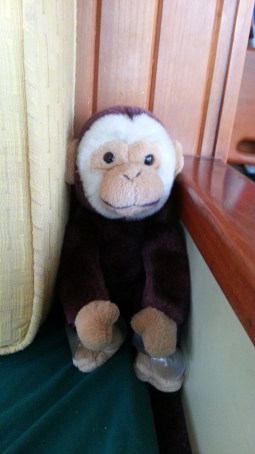
But Monkey Son still had that smile on his face, so I knew it would be OK.
Monkey Son was not worried
And it was, I had carefully planned my route using both Coastal Explorer and my Navionics app on my phone, as Navionics showed the lighthouse range colors better.
Karel had given me really clear instructions, so when I saw people standing on the dock at 01:40 in the morning of August 29th, 2014, I knew our Atlantic Passage was over.
More pictures are always being added to http://dauntless.smugmug.com/
And here are some videos that may help to give you an idea, taken just before sunset, please excuse the quality. I was hanging on for dear life.
And this lobster never imagined that over the next days the water would get hotter and hotter finally coming to a boil just hours from safety.
A 14 foot Wave
The evening before (the 24th), the light winds had ended, as the winds were now out of the south and southwest at 18 to 30 knots (kts), producing a large following sea, 8’ to 12 feet. I kept rpms low all day, starting at 1600 rpm, later being reduced to 1500, then 1400 when I realized we were still making 5.3 kts at 1400. Having the data log from the Maretron Solid State Compass, enabled me to have a good idea of actual pitch and roll. I would log it using three values: most of the time, 1/3 of the time and 1/12 of the time (this may be once a minute). So in the beginning of the day, with this following sea I logged rolls of delta 15°, 22°,25°. So delta 15° means about 5° to one direction, then 10° in the other direction, and every few rolls that would increase to 22° and then every once a minute 25°, like 10°+15° in the other direction. I had also noticed that the paravanes were less effective in following sea conditions, but since those conditions are usually pretty good under any circumstances, it was not an issue.
I had logged that the 24th ended with the yellow float that’s 17’ above the paravane bird was occasionally under water and that was a scene that I was not used to seeing.
24 hr Roll Data 27 Aug
The night of the 24th, 25th, was one of the worst nights I’d had on the passage so far. Winds were about 30° off the port quarter and the roll had increased all morning.
This was my 7th night since leaving Horta. Being alone, I knew I had to have a program of work and sleep that was effective, otherwise I would be worn down in days. As I wrote about earlier, having a system that I trusted and having an eye for light, made a difference. It meant that a quick glance around, radar, AIS was enough, to let me go back to sleep. In the course of the 9 hours of darkness, I probably woke half a dozen times, and actually slept about 6 hours. This was very effective. Days that I slept less, would probably mean that I would take a nap, less than an hour, during the afternoon.
But I was feeling great that I was more than half way. I found it best to measure the time each night, as it seemed that when darkness came, since I did sleep a bit, before long morning would be there. Surprisingly, many days did seem to go quickly, it helped that I had about 15 hours of a Korean drama that turned out pretty good. I had watched that the first 5 days out of Horta.
The winds were also veering more to the west. This meant that my following seas were becoming more on my beam, though the barometer was steady.
I played with the ComNav autopilot (AP) a bit, re-adjusting the settings, finally settling on Rudder Gain of 7, Counter rudder of 9 and Sensitivity of 9 (7,9,A). 20 minutes later, when I had the biggest roll since Horta, a delta of 35° with 25° to starboard and 10° back to port (25+10), I radically readjusted AP to 2,2,A. At 03:00 we started rolling heavily, so I promptly changed course to more easterly, to reduce the waves on the beam and tried adjusting the AP again, this time 7,7,A.
Rolling Rolling Rolling Keep them Doggies Rolling Rawhide
Dauntless and our Ford Lehman SP135 passed 3600 hours at 07:30. We had a small, impromptu celebration and I added ¾ qt. of oil to the hard working engine. I also re-adjusted the AP to 7, 9,1 and slowed to 1050 rpm which still gave us 4.4 knots and the roll was reduced to delta 15 to 18°, almost nothing.
As the morning of the 26th, progressed, the winds weakened to 10 knots and I speeded up again, back to 1600 rpm and set the course NNE. I also used this quieter time to add a little more oil to engine.
So at 20:00, the evening of the 26th, my 9th night out, even as the winds were picking up, the barometer was 1007 mb, having lost only a mb in 24 hours, my course had me heading to Land’s End (At this point Brest was 290 nm east, Land’s End was 270 nm NE and Castletownbare was 220 nm due north. I knew no matter what the winds did, I would be in one of those places within 2 to 3 days). Fuel was good, I had at least 35 gallons left in the port tank and while I had my second inkling that not all was good in my starboard tank (which had 110 gallons), I clearly wasn’t that worried about it. We were now running on that fuel. The AP was reset to 6,8,A and I went to sleep that night feeling all was right in the world.
A few hours later, Dauntless woke me as only she can. I was rolled out my pilot house bed with a roll that seemed to bring me to my feet as it felt like I was doing a somersault. As we came vertical again, I was standing on my feet. Thus would start the last 47 hours of the Atlantic Passage and would be the biggest ordeal Dauntless and I had ever faced.
The big roll to port was caused by 36 kts wind and waves from the southeast. The dew point also went up 10° (both signs indicative of a warm front) The roll that rolled me out of bed was 25° to port. The barometer had fallen suddenly to 1001 mb, and within a few hours, would be down to 996 mb. The winds were howling out of the south at 35 knots. I set the course to NNE and hoped to stay in this sector of southerly winds long enough to get me to Ireland.
Ha. What a dreamer.
Thus would begin my two days of feeling like I was tied to the front of a roller coaster and though I was pretty sure the cars would not fly off the track, I was not happy.
The southerly winds lasted only 4 hours, enough to get me 20 miles closer to the end, only 200 to go!
Rolling had increased to delta 18°, 30°, 43° In the year and a half before the paravanes, I had seen isolated rolling like this, but I never put us in a position for it to be long term. By mid-morning winds were strong out of the west and I was struggling in trying to keep a course that was as north as I could make it, without being pounded by 8’ to 10’ waves on the beam that were continuing to build.
The barometer had bottomed out at 995 mb, but this just meant that the west winds were unlikely to change direction. They did get stronger 30 kts gusting to 40 kts by midafternoon. With nothing else to really do, I logged our rate of roll and fiddled with the AP. It was now at 8,8,2 and we were heading NNE at 6.5 knots. With the AP I realized that the A(uto) setting, just meant it desensitized itself in this seaway, not what I wanted. So I reset it again to 6, 8, 1.
I watched as one of the blue cushions on the foredeck got picked up by the wind and flew off. I decided that the rest of them would just have to be on their own, as it was not worthwhile to go out on deck for them in this weather. A good decision.
The roll was pretty much the same, (15° to 35°) as I really only watching the angle of the wind on the boat, I wanted to go north, so I would adjust the course accordingly trying to keep the wind off the port quarter consistently. Again, it gave me something to do and kept my imagination from running wild (another problem of being alone). I did have one other thing that helped; I found I had the card game of Hearts on my computer, (thank you Microsoft) and I played that as much as I could. In the last days, I could use how well I played as a measure of my tiredness. I peaked at a 43% win rate, but the last day was hard and I ended the trip at 41%.
At midnight on the 27th, with only had 25 hours left, I discovered the starboard Racor was full of crap (dirt and water), so I switched to the port Racor and contemplated my next moves as the wind picked up right on my beam.
Back on course, heading due north, the winds were directly behind me, at 180° at 15 kts (written 18015). Can’t ask for any better than that. I was fat, dumb and happy.
Following Seas
I experimented a bit. I wanted to see if different speeds affected the rolling. So between 1400 rpms, which produced about 5.1 knots and 1700 rpms which produced 6.7 knots, the boat rolled about 07° in one direction. So no real difference, I did notice that with a following sea, the paravanes were less effective than I was accustomed to. With those same waves on the beam, the roll would have been less than 04°
I also played with the autopilot a bit. I must give the ComNav Autopilot credit. I do not like the way the manual is written as I find it so dumbed down, it’s almost nonsensical, but the autopilot itself works well.
Now, the big caveat, is that with the confusing manual, it took me a year to get it to work well, but it f=does a good job and it really excels under severe conditions. I had no backup for the AP and in the future I will have to address this, as this trip could not be possible without it.
So I set the AP to “auto” mode, where it decides the settings based on how rough it thinks it is. This ends up working fine until it got really rough and then I had to change it to the most sensitive setting to get it to work well.
I was disgusted looking at my track and seeing that I was only 125 nm from my position on the 21st at 7:00 a.m., that’s two days and 3 hours ago, I was pissed. If I wanted to make progress like that, I’d have a sail boat! I could have put the boat at idle, kept the course NE and I would have save a whole bunch of fuel, time and aggravation.
I’ll spend the next 24 hours being irritated at every glance at my navigation program seeing this track that did nothing other than waste time, money, fuel. Thankfully, what I didn’t know was that by adding 36 hours to this passage, I was setting myself up for a ride of the ride of a life time.
I also added 2.5 qts of oil to the engine while it’s running. It uses almost 2 qts per 100 hours, so I just guestimate.
In the middle of the night, We get hit by a 36 kts gust of wind from the west. It made the boat roll 15° and woke me up. The rest of the morning, the winds stay westerly but die down to 10 to 15 knots. This was the end of the nice weather. The barometer, was 1015 mb and starting to fall.
I’d pretty much been running off the port tank since leaving Horta. This tank was not down to 40 gallons, so it was time to start using the new fuel. As I’ve said before, I try not to run any new fuel to the engine that has not been polished (cleaned and very finely filtered). This system works well had I got the fuel earlier and then spent a day polishing it while before leaving. This issue is, I can only polish from the tank that is feeding the engine.
So now on the 24th, I figured I better see what’s going on with the fuel again. I opened both feeds, so I could polish the starboard tank, but the engine would probably still take most of its fuel from the port tank. I closed the return to the starboard tank, so as fuel was polished (filtered) it was also transferred to the port tank. The idea here is that if I have crap in the starboard tank, it stays there, hopefully.
So all day, we polish and feed from both tanks, returning fuel is all going to the starboard tank. As I go do my evening check, I am shocked to see the FP is really full of crap. What does crap look like, large flakes of black/brown material the size of a dime and smaller, plus water. Now, I had run this FP about an hour after getting the fuel on the 18th. It had rapidly clogged the filter, but this has happened before and that’s why I have the FP. So, I had put in a new filter before polishing again.
We ran like this for two days. At the end of the first day, not only did I have a dirty FP filter, but the filter feeding the engine did not look good. This was the first time, I was really concerned because I do not like that this primary engine filter collected so much crap. (the engine also has two filters in line, called the secondary filters that are actually on the engine, just before the fuel injector pump).
So after 24 hours, I switched the feel to the other filter. The next day I changed all three filters while we were running. For some reason known only to the gods, as I primed the right side filter, it was fine, but when I sent to prime the left side filter, I didn’t know what I did, but within about 20 seconds I could hear the engine starving for fuel.
Damn, I spend 4 weeks not turning off the engine and now, even worse that stopping it on its own, I let it run out of fuel, which can introduce air into the fuel lines.
What a BOZO!
Luckily, Larry and Lena, another KK42 couple, had spoken to me last summer in a most effective manner, “stop dicking around and put an electric fuel pump on so you can prime your filters in seconds. You don’t want to be using the lift pump lever with a hot engine” Since I had just worn a hole in my hand using the lift pump lever for the three days I had been trying to get the engine started, I listened and did as told. It had already helped in countless ways, in fact, I had just used it to prime the right side filter.
A clue as to what happened. Another problem with running alone, now I must extradite myself and run up to pilot house and start engine. It starts and runs for 10 seconds. Then silence, punctuated by that loud low oil pressure buzzer. Another sound you never want to here, unless you just turned off the key.
OK, what now, I open the bleed screws on the engine filters. I haven’t had to do that in ages, in fact since the electric fuel pump addition, but just maybe…
Turn on electric fuel pump, and nothing. What the hell?
Look at my valve positions again and notice that everything is closed. Umm, turn on the main line and fuel sprays out of both bleed screws onto the hot engine. Luckily, it’s diesel, which allows you to do such stuff without turning into a Molotov cocktail.
Get my little rag, wipe down the top of the engine and the filters. Run up to the Pilot House and turn the key. It starts, but slowly, then I give it some throttle and it roars to life.
Back to the engine room, make sure everything is set to run, turn on FP again and off we go.
I had done all of this early in the afternoon, the winds were still only 10 knots, but by 21:00 they were southwesterly 25 gusting to 30, as the barometer took a rapid dive to 1010 mb, losing 4 mb in 6 hours.
I had no idea that these would be the best sea conditions I would see for the next 5 days.
I had pulled in the birds for the paravanes last evening, but overnight the rolling had increased as the winds and waves increased, so at 05:30 birds went back in the water (when underway, I always keep the paravane poles out, so if I need to deploy the birds, it’s just a matter of throwing them in the water), as the rolling had increased to ±20° (again reminder this means the boat is heeling or rolling 10° in each direction, left and right, though in actuality, the waves make a difference so it’s usually 12° on the downwind side (which for the rest of this trip will be the starboard (right) side).
This was a fateful day. My Horta luck ran out. I made some really strange decisions that I would really suffer for a week later. The day had stared with strong NE winds at 20 knots. I could not travel into those winds as the boat goes very slowly, like half speed and the pitching of the bow becomes like a bucking bronco. One lesson I’ve learned about ocean travel is that since you don’t have to worry about running onto shore, you can go any direction, but in a boat that travels 6 knots normally, it’s fruitless to go into strong winds.
So therefore, I made a decision to go NW! Which would have put me in Greenland in two weeks. But an hour later I turn around and head SE. Now, SE would put me in North Africa in a week. But, remember, I could not go NE because of the winds. This little escapade cost me three hours, as I crossed the spot I was the hours earlier. I was so irritated at myself that I did not realize for a full day that I was compounding this error tenfold!
Krogen on the High Seas
Later on, someone asked if I did a “Crazy Ivan”. In the cold war days, Russian submarines, would turn suddenly and go back the way they came to check to see if anyone was following, thus earning the name, “Crazy Ivan”. No I just changed my mind a few too many times.
The winds stayed at 20 knots out of the NNE all day. I continued to motor SE towards Africa. Had I not been alone, someone, anyone, on the scene would have asked, what our goal was and as soon as I answered that question, I would have seen the folly of my ways. Decision making is the biggest casualty of single handing.
Winds continued all day, night and into the next day from the NE, finally becoming easterly by evening and weakening to 15 knots. I keep my course of ESE now aiming for Gibraltar.
A number of folks on Trawler Forum have helped me by texting me the current locations of high and low pressure centers, along with their center pressure. I then plot these positions and draw the isobars, so I have an idea of the gradient, which causes winds. The picture shows the 21 Aug, then I used it for the next two days to plot positions. I need to be on the east side of the developing low, so the southerly winds it will develop there push me north. So far, it seems to be working.
In looking at the weather maps I had created based on the positions I was texted, I am starting to understand my logic, I was determined to stay on the east side of any low pressure area. On the first map, the 21st there is this large High to the NNW of Dauntless, moving southeastward. That was producing the NE winds I encountered and at first I thought to go NW to get on its other side, but then realized it would take forever, so I turned around.
Two days later, the map shows the high already over Dauntless, with the large low pressure area building to the NW. Looking at that map now, it seems I did take a good course by trying to get to the east, as the winds built strongly from the SW over the coming days.
The east side would mean Southeasterly winds, which I wanted and which came on the 23rd.
But as I look at the maps again, I see that my idea was right on, it was my execution that was lacking. First, even looking at the positions of Dauntless on the three consecutive days, it’s like we hardly moved, yet the highs and lows moved a quarter of the way across the ocean. On the 21st, when I turned SE, I accepted the fact that the winds were going to push me to Portugal. I would have been right, had they kept up for a solid week, So, finally in hindsight, I see I should have motored slowly north that first and second day, until the winds had a southerly component, as they would have on the 23rd. then full speed ahead north
I spent much of this day experimenting with course and speed, to find the best way to mitigate the wind coming directly from the direction I wanted to go. It was slow, 3 knots, but at least I wasn’t wasting fuel and I wasn’t getting further away from my destination. I spent three hours going due east, and had a very easy ride with 6 ft. waves coming from the NE.
Finally, after a full day and a half, 34 hours after my first harebrained course change, I changed course to due NNE, into the winds, but really slow, at low (1100) rpms. The ride wasn’t bad, the roll was minor and I was going in a direction that I needed to go.
This ended up being a very good strategy for the conditions and this boat
I was roused from my slumber when I noticed a white light dead ahead, its 06:00. Turns out it was Jupiter right on top of Venus. What can I say, boys will be boys. Clearly, I’ve learned to sleep like a cat with one eye open, In the last year, I have been woken numerous times when I see a light in front of me. It’s probably happened more than a dozen times and it’s never been an earth bound object, but always the moon, sun, Venus and now, Jupiter’s been added to the list.
Second Night Out of Horta
Seas were 2 to 3 feet from the west, winds are from the NW at 8 to 13, and we’re going NE, no whitecaps and gentle rolling ±08 °
I did not see a single boat/ship. First time ever not to have seen anything, even on radar or AIS.
Since leaving Horta, I had run the fuel polisher about an hour just to check the fuel. Now, since the engine feed would feed from whatever tank I was polishing, I did not want to polish for a long time. I just wanted to make sure the engine ran on that fuel. In doing so, I did notice some gunk in the bottom of the fuel polisher. It was enough for me to decide not to use that tank as source for time being, but it wasn’t so much that I was concerned. Frankly, I just felt the Racors were doing their job so don’t fuss over it.
Again, woken from my slumber with another light dead ahead, this time the rising crescent moon at 02:20.
I’ve had my most substantial meal of the trip so far. Hormel canned chili (no beans), a can and a half of corn, a can of red kidney beans, a small Horta onion, 3 slices of American cheese, Sam Jang (Korean bean and garlic paste), Red pepper paste, garlic powder, black pepper and salt. The first day underway from Horta, I hardly ate at all, yesterday; I ate a tomato salad and some candy bars. This morning, I had a tomato and onion salad (oil and vinegar). And then my chili concoction midafternoon. I have three more portions in the freezer. I’ll end up eating them all in the next 5 days.
Winds continue to be light, less than 15 knots, so I pull the birds out of the water in late afternoon.
From my viewpoint, my course looks good. A direct course to Ireland from Horta would have been to the NE, 045°. Instead, to take advantage on the movement of the Azores high, as well as the development of a little low west of the tip of Spain, I have taken a course of 066°. There have been cumulus buildups on the horizon in all directions since morning, but around me, just scattered high clouds and for the first time, light winds, 5 to 8 knots from the west. (Spoiler alert, in 7 days this developing low would beat me like a rented mule)
We are droning along at 6 knots. The Ford Lehman engine never misses a beat, which means many times one can hardly hear it as it is so steady, our brains ignore it. When I sleep, nap at night, it feels just like being on a trans-Atlantic flight flying to Europe in the middle of the night, with the occasional moderate turbulence and the drone of the engines.
Also, these first few since leaving Horta have been thankfully uneventful. Earlier in our passage, leaving Rhode Island, Cape Cod and finally Nova Scotia, each day there were things to deal with every day. Finally after the 4th day out of NS, all systems were working and we settled into a routine.




 This was the first presentation we’ve ever done of our passage and it was really well received. A bunch of folks asked me where else we were presenting and at this point, the answer is nowhere because no one has asked us yet. I’m definitely going to look for more opportunities because I like sharing how possible this is in an older boat on a limited budget.
 And I’m sick. Just a cold that I felt coming on last week, but I had been feeling better and I needed to take advantage of being next to the dock and wall (instead of being rafted to fishing boats) so that I could rig the new paravane pole. It also allowed me to complete the re-rigging of the smaller lines on the winch that pull the birds and the poles up. It’s now a very easy system to deploy and retrieve when I am alone.






 Dauntless at Sea