An Eventful Passage

Only an hour and a half after leaving the wonderful little stop of Marina Chahue, Dauntless’ winter home, we were underway once again. I wanted nothing more than an uneventful passage. I was so appreciative of Mark and Brian stepping up and volunteering as crew, so I wanted them to have a good time too with no worries.

Beginning of Day 2, 07:53
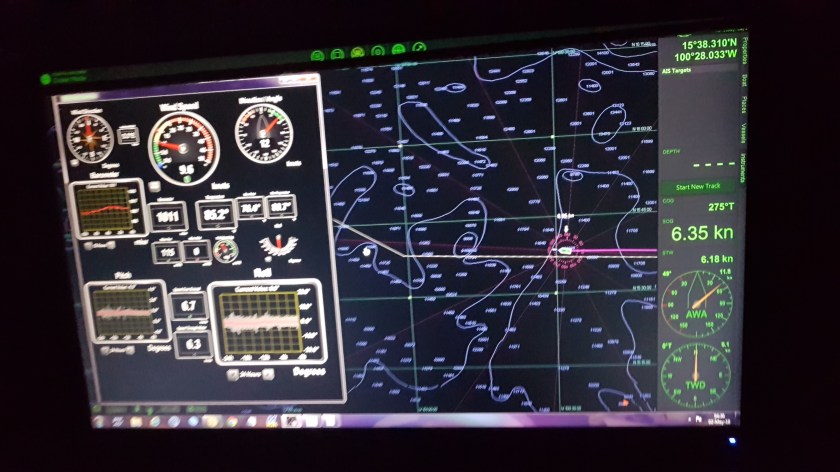
End of Day 1, First night, 04:45

Now I realize, that having a “good” time varies greatly from person to person, but in general, being on the open ocean is peaceful. It can be the epitome of serenity itself, unless there are nagging issues.

Error
This video doesn’t exist
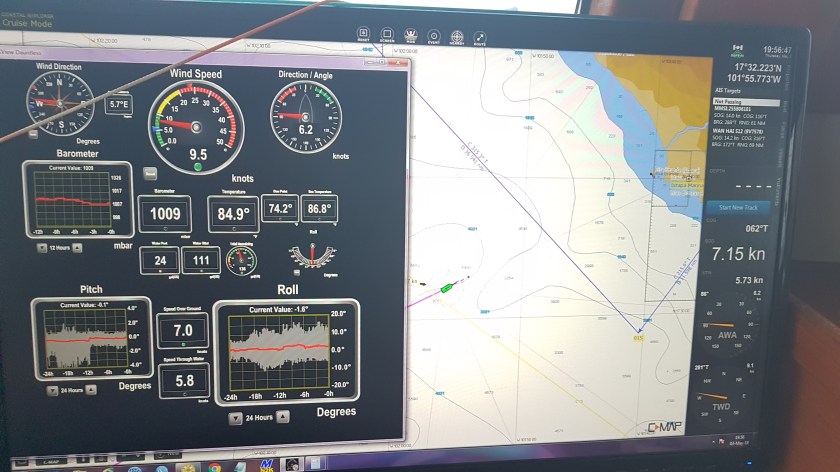
Beginning of Day 2, morning after the first night, 07:53

Dauntless was suffering from abuse. In the pervious two years, I’d ridden her hard and put her way wet. I loved this Kadey Krogen so much because I could do exactly that. The leak in the heat exchanger was the first “must stop the engine” problem I’d had since the middle of the Atlantic! That was more than 5,000 miles and 18 months ago.

End of Day 1, First night, 05:51

This boat was made to take a beating and keep on ticking. But just as rough seas bothered me far more than Dauntless, the little problems on the periphery did the same. They kept me in a state of what’s next?

We spent the next 40 hours going west. I’ll explain why in more detail in the upcoming post, Chasing Weather Forecasts, but for now it suffices to say that I wanted to be 60 miles off the coast.

We were also running a bit harder than usual; the Ford Lehman was purring along at 1800 rpms. Maybe the purr was more of a growl to me, but it was important that we make good time while we had favorable winds, in this case they were WSW at 5 knots and we were making 7 knots.

The primary reason I don’t run at 1800 rpms is the significant decrease in efficiency from 1500 to 1800 rpms. Here are my estimated numbers in a flat sea:

 Kadey Krogen 42-148 w Ford Lehman Sp135 & 4 Blade Prop
 RPMs  Gal/hr  Avg Sp Range
700  Kts nm
  1,800     2.00       7.2   2,520
  1,700     1.75       6.9   2,760
  1,600     1.55       6.6   2,981
 1,500     1.40       6.2   3,100
  1,400     1.25       5.7   3,192
  1,300     1.10       5.3   3,373


Thus, for a 16% increase in speed from 1500 rpms @ 6.2 kts, we consume 43% more fuel. That’s fuelish.

By early morning on the second day out, we turned northwest, on a heading that would parallel the coast until we could turn further north in a couple more days. Winds were still OK, from the north at 10 knots, thus on our beam, but not strong.

Error
This video doesn’t exist
Evening of the of Second Day

By the end (48 hours underway) of the second day, we had covered 320 nm for an average of 6.7 knots. The pitching and rolling had been minimal, pitch less than 3° up or down and rolling less than 5° in either direction (always greater to lee side).
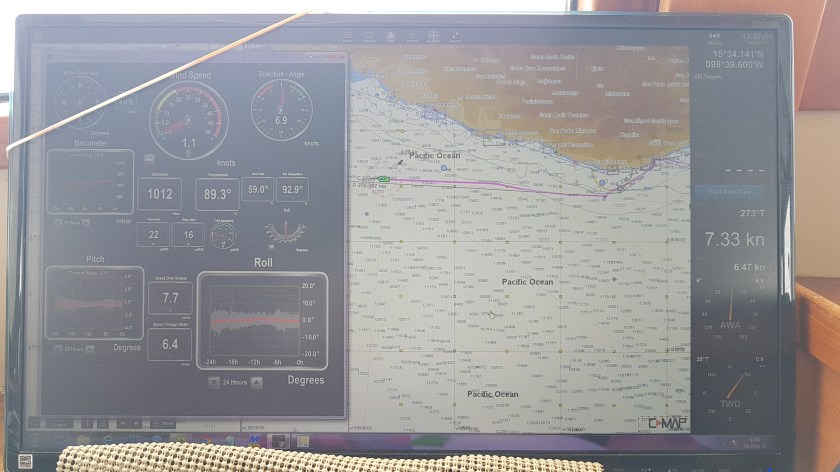
Day 2, 24 hr since departure
Evening of the of Second Day, 19:48
End of Second night, early morning, 04:25

But then it all started to change. From the beginning there was a smallish weather window, from 2 to 3 days. Now, during our third night, that window was closing. Winds picked up to 320° @ 12 knots, so only 15° off the starboard bow (our course being 304°). Pitching increased to +4 (this is downward as measured by the Maretron Solid State Compass (which the autopilot uses too since it reacts better than the flux gate compass) and a more significant, -12° (bow pitching upward).

This was getting uncomfortable. For my intrepid crew, they took it in stride, far better than I.
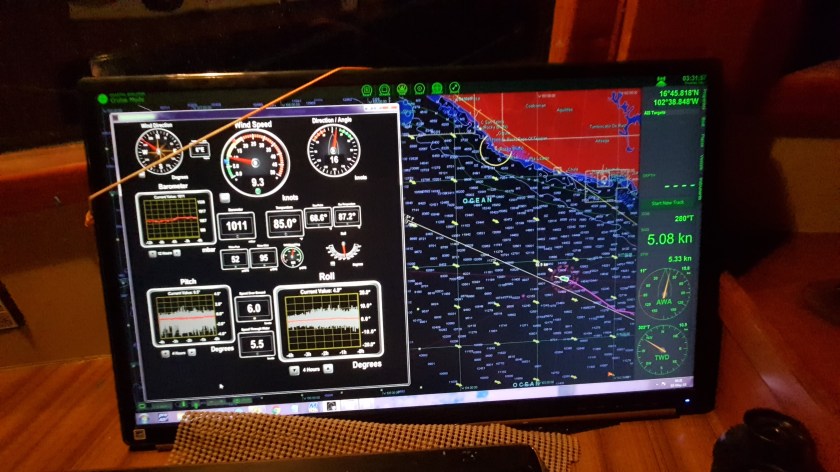
The third night, 03 May 03:32 Maretron data shows the pitch lower left graph (each unit is about 4 degrees of pitch).

Our watches were set so that I would get 6 hours sleep overnight. Brian and Mark covered 21:00 to 04:00 as they saw fit.

End of the third night, 3 hours after last picture, ride is better, but winds are picking up, now at 9 knots, but gusting to 16 ( upper row, middle, telltale on the winds)

Before going to sleep that night, I did discuss with them the issue of weather. Our weather window was not only closing, but the forecast was for increasing winds right on our nose for the foreseeable future. While I was still hoping to get to Cabo direct from here, that was still 3+ days away. 12 knots on the bow is tolerable, 15 is borderline and 18 is a no-go.

Sunrise on Day 4

They were up for it; as I went to bed that evening, I wasn’t sure I was.

I awoke 3 hours later. The boat was pounding, not constantly, but on every third pitch. Pounding to me is when the boat slams into a wave, like hitting a log. Thump.

I tried to go back to sleep. The master cabin in the Kadey Krogen is forward and the only downside is that this pitching motion is most apparent there.  However, it usually doesn’t bother me. My first experience with a corkscrew movement was a few years before Dauntless came into our lives. We were sailing (literally) with my Dutch friends, Jan and Karin, in the Outer Hebrides, west of Scotland. Anchored in a rolly harbor off of St Kilda, that night I felt, dreamt, that I was sleeping on a roller coaster. The rhythmic corkscrew motion I found almost soothing. I slept well.

But this was different. The pounding bothered me. Things break with that sudden, jarring movement (and in fact it was during these days that the pressure switch stopped working on my fresh water pump. I later discovered it only had soldered connection which came apart).

My sleep became very fitful, waking every 10 to 15 minutes, my mid seemingly wanting to figure out what was going on. Finally, I turned on the light and tried to figure out the pattern the boat was in. For 30 minutes I measured the frequency of the pounding. On virtually every third pitch, which were 8 d=seconds apart, the boat would pound hard, every 25 to 28 seconds.

I also knew that which these seas, pitching movement, unlike rolling, takes significant power. In other words, instead of going 7 knots, we were now going 5.5, but using the same fuel as if we were going 7.

At 5.5 knots, it would take 100 hours to get to Cabo, that’s 4+ days of this crap. That was impossible.

I decided to start my watch early, figure out if we could mitigate the ride and if not, determine my options.

First thing I did, after I got the lay of the land, was to reduce rpms to 1650 and change course by 10° to the west. This put the seas on the stbd bow. Weirdly, our speed just slowed a tad to 6.0 from 6.1 (we also have currents off the Mexico coast, which are both tidal and non-tidal).

Significantly our pitch was reduced by almost 50%. I liked that. Even more importantly, the pounding stopped.

I could live with these conditions.

Alas, they were not to stay.

Just before sunrise, around 05:00, the winds increased to 330° @ 12 gusting to 16. This increased the pitch +4 to -8° and the roll +10 to -9°. I further reduced the rpms to 1590. Over the next couple of hours, Mother Nature started to mock me. The winds backed around to 290°, right on our nose again.

At 08:00 the winds were steady at 300°12 to 14 knots. I knew they would only get stronger during the day (the sun heating the air and land do cause the winds after all).  This was also in line with the forecast of increasing winds over the next few days.

At 08:45, I informed the crew that we were changing course and would head to Xtapa, a little town with a nice marina just north of Zihuantanejo. This would mean a bit of backtracking. We were already north of Xtapa; however, the other alternative was Manzanillo, which was 113 nm at 330°. With the seas on our bow, increasing winds, it would take us 24 hours to get there. Whereas, Xtapa, at a heading of 065° would put the seas behind us and we should have a quick 12-hour ride. So long, because we were 70 miles offshore.

It ended up taking 14+ hours, but after pounding into the seas for 10 hours, who noticed.

Passing thru the shipping lanes, it was nice to have the Digital Yacht AIS transceiver.  It allowed us all to avoid one another.

14 hours later, at 23:00, we entered yet another unknown harbor and docked in the dark, at Marina Xtapa

What else is new.

I did get a good night’s sleep.

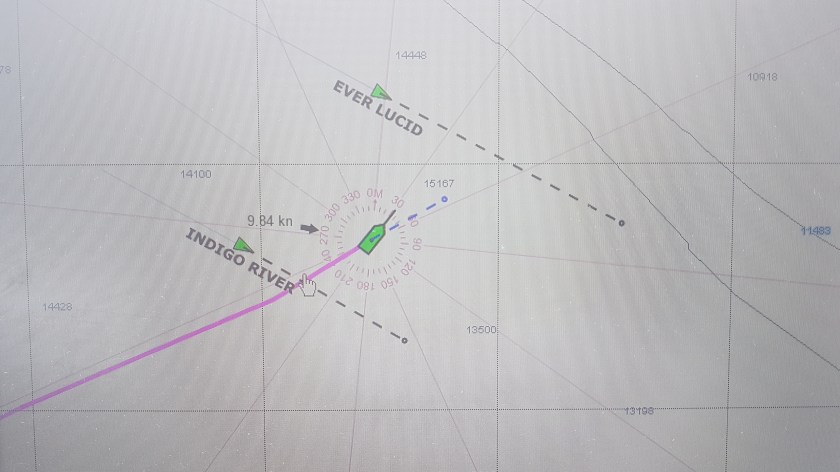
Four hours after we made the turn to head to Xtapa, we are bracketed by two freighters. Again AIS transciever makes this easy for ALL concerned.
Depiction on Coastal Explorer
Four hours after we made the turn to head to Xtapa, we are bracketed by two freighters. Again AIS transciever makes this easy for ALL concerned
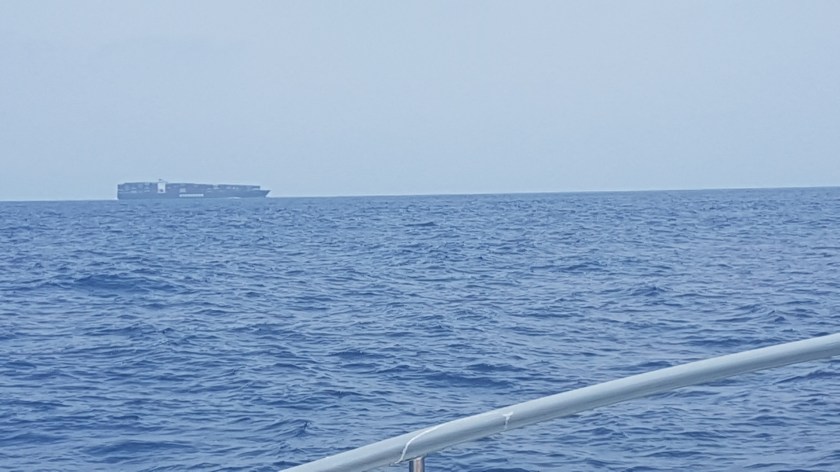
What it looks like looking out the window
The Maretron data shows how much better the ride became, though rolling continues.
The Maretron data shows the four days of Pitching and Rolling. The last day before we turned to the east was untenable with pitching as much as 20 degrees.


An Auspicious Start

Ever have those situations when the yellow/red flags are waving, and you spend all your time trying to decide if the flag is yellow or red? Instead of wondering what’s causing the flag to wave in the first place??

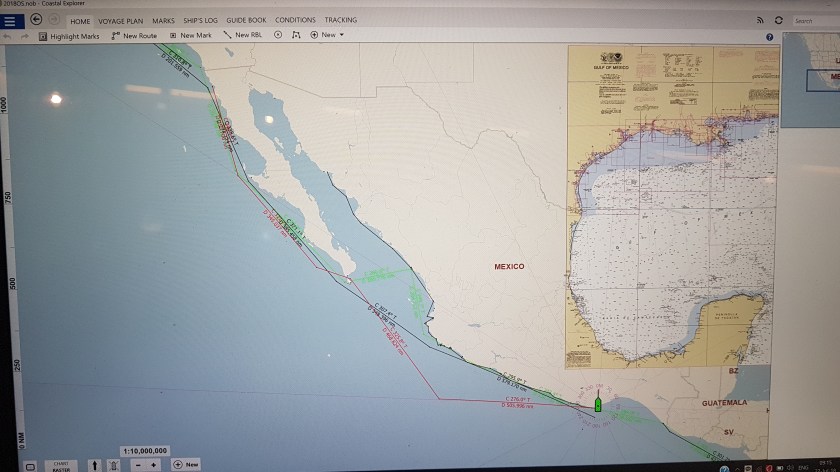
Our Intended Route in Red. Taking the time to get away from the coast seemed best for the forecast winds at the time.

Welcome to my world.

Brian and Mark arrived Sunday, the 29th of April. I was a bundle of nerves, due to:

  • The normal stress of starting a long trip,
  • The stress of having crew to keep happy,
  • I still had to check out of the port Monday morning,
  • Having decided to have the boat yard, do the transmission seals, they did not take credit card, so I must figure out a way to get $1000 in cash by Monday morning.

My Monday noon, all the problems were solved, and I was feeling pretty good. I had good, intrepid crew. We had food, wine and booze enough for however long a cruise the weather would allow.

With a crew of two, plus me, we had 205 gallons of fuel in the port tank, 210 in the stbd tank, 55 gallons of water in the port water tank and the stbd tank was empty (to be filled with the water maker while underway).

The track from the InReach at Share.Delorme.com/Dauntless
(If you go to that site, I do not know why the time is 12 hours off)

Engine start was at 12:25, we got underway 10 minutes later, clearing the breakwater at 12:45, on the way to either Can San Lucas, 950 miles northwest (7 days) or maybe even Ensenada, which was another 700 miles further north (another 5 days).

So, at the beginning of a 7 to 12-day passage, my sense of well-being lasted 20 minutes, or about 2 miles.

Clearing the breakwater, we set the course SSW to clear the coast before turning west, then WNW.

The bilge alarm sounded 20 minutes later, (a buzzer that

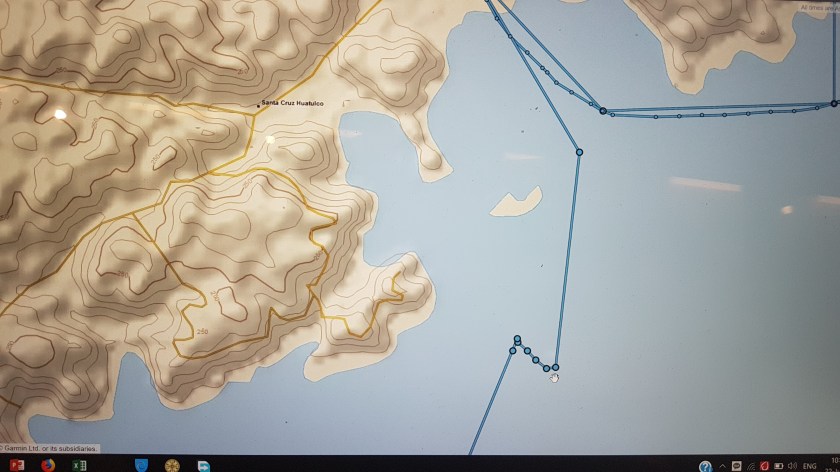
The Coastal Explorer, C-Map chart

is activated whenever the bilge pump is on), went off, and then sounded again a few minutes later. That was not normal. Thinking the stuffing box again, I left Brian at the helm, while I went to open the salon hatch to the engine room.

Stuffing box was not leaking, but I did see a pinhole leak that was spraying water from the oil heat exchanger. Umm, it’s a pinhole leak, sea water, yet the bilge pump had been on enough to pump much more water? What’s going on.

A minute later, as the engine overheat alarm sounded, it all became crystal clear. Shut down the engine, but we were less than a mile from the rocky shore.

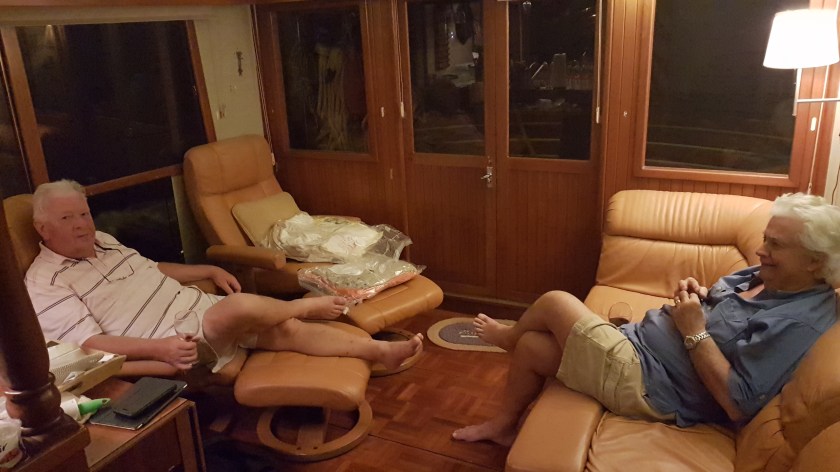
Mark and Brian relax the night before our eventful trip

The engine coolant hose (a heater hose) from the engine to the water heater had failed at the nipple to the water heater. It has dumped all our coolant into the bilge. We were 6/10ths of a mile from shore; a very rocky shore. So, first thing I did was fill the engine coolant tank with fresh water using the garden hose the first owner had installed in the engine room just after the fresh water pump. It was good to know that I had a source of fresh water for the engine that I could use in a critical situation.

If push came to shove, I’d stick the nose nozzle in the coolant fill and turn it on, to keep water in the engine if I needed to start the engine before the repair was done.  We were in 160 feet of water, so I also had the option of dropping anchor.

Lines stored behind the fly bridge ladder

Had I had a problem that was going to take longer to fix, or if I did not have fresh water available, or if I was alone, I would have let out 200 feet of anchor and chain, knowing that the anchor would set itself as the water shallowed. This is the emergency anchoring plan I always have in the back of my head while cruising near shore. In still deeper water, with no shelf, I would combine my two anchor rodes, the secondary being 50 feet of chain and 250 feet of rode (400’ of 3/8” BBB chain on the primary with 55# Delta anchor).

I also have stored behind the salon between the upper deck ladder:

  • a 500-foot line,
  • a 250’ line,
  • a couple of 50’ lines,
  • a few shorter line,
  • the stern anchor) Bruce) and it’s 300 feet of rode on a hose reel.


These lines can all be easily retrieved and used as necessary.

Had I been alone, that’s what I would have done, while turning the boat around and heading back to the marina on auto pilot. I could have then re-fit the hose, knowing I had at least 15 minutes before I needed a course correction.

But I was not alone.

With Brian at the helm, responsible for watching our drift, Mark and I proceeded to deal with our two problems, the coolant hose and the pin hole oil cooler leak.

The coolant hose was easily dealt with. Cut off the end and reattach to nipple. I then checked for leaks, as we started the engine. No leaks, so I filled the coolant tank with ¾ gallon of coolant. This all took 10 minutes.

Next to tackle the oil cooler. We first tried a quick repair; can we stop the leak enough until our next port.  No, we couldn’t, the metal at the cap end from which it was leaking was too thin. (these were the heat exchangers that had just been supposedly checked. In addition, I’m sure this was the one that was already leaking, and I told them to keep it).

Checking the situation at the helm, while we were drifting towards shore, we were drifting very slowly and again with Brian watching, I knew we would have plenty of warning should an issue arrive. Therefore, we decided to change the oil cooler.

What a PIA. But an hour later we were all done. No leaks of oil, water, or anything.

It’s on my must do list this fall to standardize all my hydraulic and oil fittings. Thus, making it easier to replace lines or bypass the coolers if need be.

We had drifted a quarter mile closer to shore, we still had a third of a mile to spare. Easy Peasy as Micah would say.

Knowing we could return to the marina easily, reduced the stress of this repair. It wasn’t “fix, or else” like it may have been in the middle of the Atlantic, like with my imaginary fuel leak.

At 14:10 we were underway again.

My peace of mind now lasted one minute.

The autopilot was not working. It thought it was working, but it wouldn’t steer correctly.

Back to the rear of the engine room, I looked at my Octopus pump, it looked ok, no major leaks, then I saw the three valves which control fluid to the pump, allowing me to change pump without draining all the hydraulic fluid from the system, were closed.

Oops.  At least that was easy.

A minute later, we were underway again, hopefully to Cabo San Lucas.

This time my peace of mind lasted a whole two hours.


Getting the Show on the Road

The best laid plans of mice and men often go astray.

Having gotten my toothache taken care of by having a root canal the first evening I was back in Huatulco, I was finally felling pretty good. The previous 5 days were a whirlwind of: pain, getting things done in NY, flying to southern Mexico and getting back to Dauntless after 8 months.

All winter I’d been watching the weather and winds off the west coast of Mexico and California. Jimmy Cornell’s World Cruising Routes and his updated Pilot Charts of the Pacific had made it clear that I would have a slog ahead, commonly known as the Baja Bash.  2,000 miles of going northwest into predominantly northwest winds of anywhere from 5 to 30 knots.

JimmyCornell Ocean Atlas Monthly Pilot Charts for all the Oceans

As mush as I love my Kadey Krogen, it has gotten me safe and sound through so much; I hate head seas.

But I had a plan. A pretty good one I thought. It was clear from the above references that I would have at best 25% of the time favorable winds. For every one day of good winds, I’d have three days of head winds. But as we all know, weather works in averages. I couldn’t exactly count on moving one day and then resting the next three. I could just as eiasily see 7 favorable days and a month of head winds.

Over the winter I had planned for slogging up the coast. Getting back to Dauntless the last week in April. I would spend May getting her a bit more ready. Fixing, replacing somethings that needed it and completing some projects stared long ago, but never completed as we cruised from Ireland to the Pacific Ocean in a little less than a year’s time.

My transmission and damper plate

This plan would have me leaving Huatulco in June as hurricane season started.

Perfect.

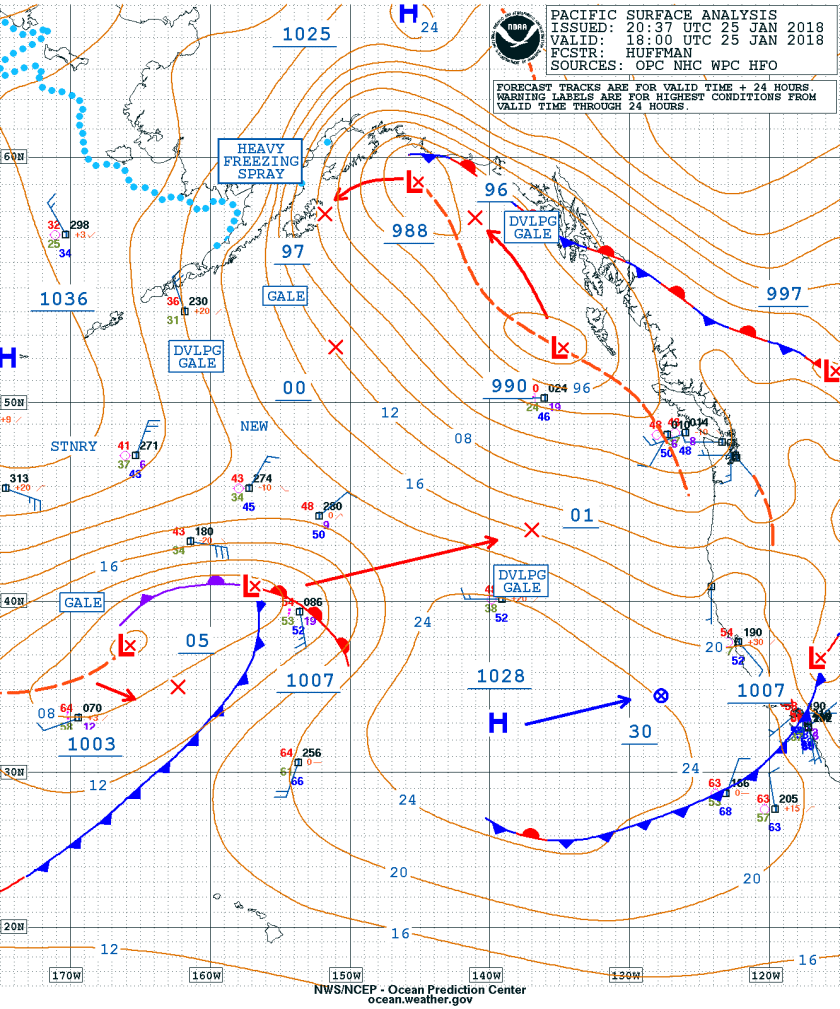
The dominate weather pattern is only disrupted by the tropical cyclone pattern of tropical depressions growing to storms and possible hurricanes. Their anti-clockwise wind pattern disrupts the dominant high-pressure system causing the NW winds off the coast. I could have days and days of winds with some southerly component.

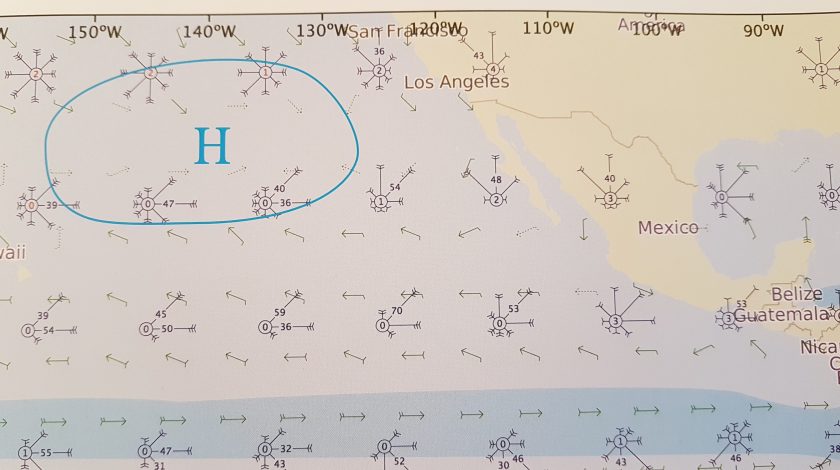
The normal position of the Pacific High. This year is has been stronger and more persistent.

The only downside of this plan was that should the strengthening tropical depression or storm head northeastward towards the coast, I’d have to have my hurricane holes laid out.  Also, single handing on this coast is difficult, as places to stop because of weather are few and far between. For example, there is no safe hurricane hole between Huatulco and Acapulco, 250 nm or two full days away.

In the previous months, I’d also sort of put it out there that I was looking for crew.  With crew and a longer weather window, we could get up the coast in some large chunks.  Maybe even get to Ensenada in a 10-day passage. That would be so wonderful.

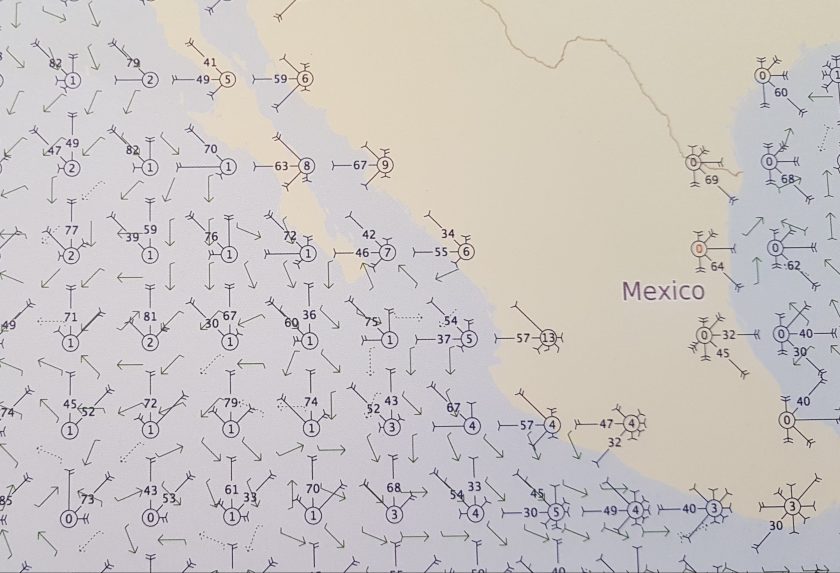
Pilot chart for the Pacific off Mexico

In March, I had gotten an email from Brian, who was volunteering himself and another friend, Mark, to help me get Dauntless north. The only caveat was, their free time was in early to mid- May.

I was very happy. I had not thought it wise to do this coast alone.  Coastal cruising is totally different than crossing oceans. In the middle of the ocean there are no fishing boats, pangas or other stupid stuff. The large freighters you may occasionally see use AIS and keep their distance (once I upgraded to an AIS transceiver in 2014).

The only downside was the weather. In May, the winds are steady and strong from the NW.  No tropical disturbances to disturb that pattern.  During the entire spring the Pacific high that generates the strong easterly trade winds over Hawaii and been doing its job too well. I seldom saw weather windows of more than a couple of days and the 25% favorable time was more like 10%.

Stuffing box wrench

I’d also be a bit rushed to get Dauntless in the water. But I was less concerned about this, as she came out of the water with just a minor transmission leak, that had grown progressively worse over the pervious 2,000 miles. So, I decided to have the boat yard in Huatulco fix the leak. This turned out to be a $1,000 mistake. With my time frame of having to leave now to best make use of my available crew, it left no time for the yard to correct what they didn’t fix.

More and more I realize that I need to do virtually everything myself on Dauntless. I hate paying someone for a half ass job, when I know that I can just as easily to my own half assed job for free!

Dauntless goes into water

I also felt time pressure because Brian had crewed with me on Dauntless two years ago from Ireland to Scotland and he had had to wait several days for the boat yard in New Ross to get everything done. I didn’t want to make him wait again. And yes, I know not to let a schedule dictate actions, but no matter what, I, as skipper feel and am responsible.

The only things that had been done was the transmission seals and I had removed all the heat exchangers, as one had a pinhole leak and I wanted them all, including my spares, checked and tested.

We ended up splashing the boat right on schedule, a couple days before Brian showed up. This whole sequence left a lot to be desired on my part.

My original plan was to do a little test run of an hour to make sure all systems were Go. But once they put Dauntless in the water, the winds were strong, against the marina, in fact, the port may have been closed, but in any case, with such winds, I wanted to only tie up once, not twice. As it was I had a hard-enough time getting the boat into her slip and at one point was 90° off. I had to rig a spring line around the piling that we were pressed against and use that to turn the boat to face the slip.

No, a test run was out. I felt lucky that I got Dauntless into the slip without damage. I didn’t want to press my luck. In hindsight, this was not the best decision, but it seemed so under the current circumstances.

Once in the slip, with the engine room bilge pump alarm was going off continuously, I was reminded that I should have checked the stuffing box while still on the dolly. Water was pouring into the boat.

After the initial cursing myself for not checking before, I realized the bilge pump was keeping up, barely.

I got my chain wrench and locking pliers and within a few minutes (unlike previous times), the nut was unlocked, and I could tighten the shaft nut my hand until most of the water stopped.

We were good to go, or so I thought.

Anchoring at Night in Strange Places; It’s not for the Faint Hearted.

Only day’s away from completing this 2,000-mile, two-month journey, I found myself breaking yet another of my hard and fast rules I made for myself 5 years ago.  Entering yet another harbor at night, and having to anchor by radar, avoiding darkened, moored boats and mooring balls.

But like most hard and fast rules, I had to weigh the circumstances against various risks. In this case, anchoring at night was the least risky option. I’d left Channel Island Harbor at 04:00 for the 120 nm voyage to San Luis Obispo harbor. I’d planned on 19 hours. Thus, to arrive before sunset, would require me to leave the Channel Islands at midnight.
Leaving anyplace at midnight means a total disruption of my sleep cycle. I’d be starting a long trip tired and already behind my personal power curve. By leaving at 04:00, I’d be able to get a reasonable 6 hours sleep and 03:00 is on my natural wake up curve (though normally, I’d go back to sleep for another 3 hours).

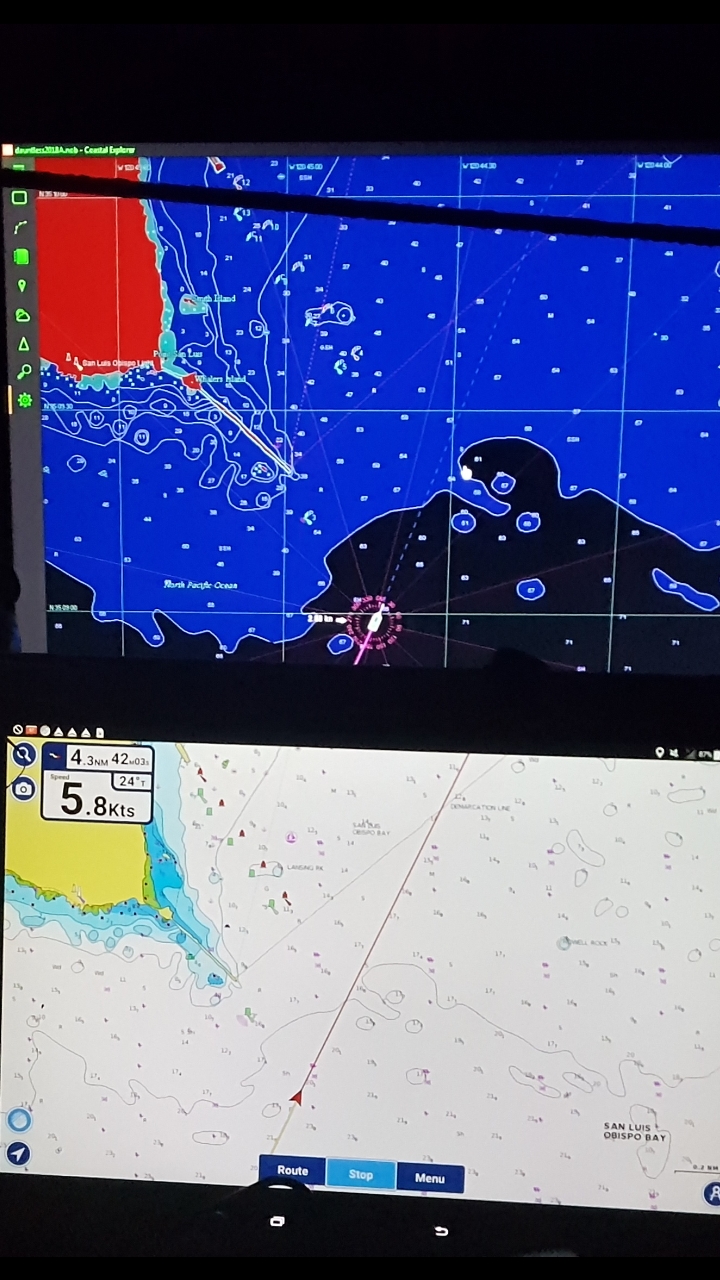
Raymarine E-80 Radar, C-Map on Coastal Explorer, Navionics chart on Samsung Tablet


Therefore, anchoring in a strange harbor at night seemed for me to be the lessor of two evils.

Let’s talk some basics. Four years ago, I hated my Raymarine E-80 Radar. I felt (and still do) that it was 1980’s technology, dressed to look like the 21st century. It was on my lest to replace at the earliest opportunity when money allowed. I had wanted a radar that I could integrate into my Coastal Explorer and C-Map chart plotter, navigation program.

San Luis Obispo harbor

Using the “Auto” settings, the E-80 will show you if the Exxon Valdez is bearing down on you, but otherwise, it either filters too much or not enough to be useful for close in maneuvering. As the miles and time increased under my belt, I learned how to best fine tune the radar using the manual settings for gain and sea state (which is basically a filter) to make it an effective tool.

Whenever I start the engine, I also turn on the: radar, navigation lights, auto pilot, VHF radios and horn.

Always.

For the first lesson in using the radar is that you must use it when the visibility is ideal, to be able to effectively and safely use it when the visibility is impaired, whether due to darkness or weather conditions (mainly fog, rain is another issue).

While underway I’m constantly checking and identifying any radar contacts visually, as well as on the navigation charts (for navigation markers, buoys, etc.).

As soon as I spot something the radar does not see, I adjust the radar, fine tuning so to speak. Normally this is just a matter of adjusting the sea state setting, though sometimes I also must fine tune the gain. E.g. I may see a fishing skiff a half mile off my starboard quarter, but it’s not showing up on the radar. I’ll have to lower the sea state setting, maybe only a few points, until the skiff shows up, but not the countless wave tops around it.  Sometimes, I’ll have to adjust the gain also.

My goal is always for the radar to show me potential hazards, without showing me wave tops. For the last couple of years, my tuning technique has been good enough to do exactly that. Forget the “auto” settings, they are hopeless.

Since I don’t get many false alarms, this also allows me to maximize the use of the two zone monitors.  For coastal cruising, like I’ve done since entering the Pacific Ocean, I set up a ring at ½ mile, that’s an 1/8 of a mile thick. Thus, if anything enters that ring you get an alarm. If you just put a circle around your boat at ½ mile, the radar will see some clutter very close to the boat and thus render the alarm, ineffective at best and annoying at worse. I make this ring go about 220° to 300° around the boat. That way it will see something approaching from the stern quarters, but not directly behind, as the radar will occasionally see a reflection of the mast, again making it ineffectual.

The second zone I set up 1 to 1.5 miles from the boat, in a much more 20° arc.

On the open ocean, well away from land, I’ll basically double these distances.

If I do get any false alarms, I adjust again. Usually it happens as the sea state gets worse (bigger seas).

For my set up, I find values of both the gain and the sea state in the 70’s to work best. In flat seas, I can lower the sea state to just above 50, but again, even changes of 1 or 2 can make a significant difference.

On this night, entering San Luis Obispo (SLO), as the seas calmed as I entered the bay that is protected from the NW through the East, I readjusted the sea state, lowering the filter values. From my charts I knew there was a mooring field, presumably with some moored boats. I adjusted the E-80 so that it would pick up objects as small as the mooring balls. Had the seas been above 2 to 3 feet, this would have been an impossibility, but if I had such seas in the harbor, I wouldn’t be stopping in any case.

This night, with strong NW winds, the harbor was well sheltered and the seas where maybe half a foot or less. Under those conditions the radar will do well.

I open and secure both pilot house doors, so that I can have quick access to looking out. I also go to the bow to scan the approach with binoculars (7×35), which I find very effective a night in poor light conditions.

Thus, I have that visual picture in my head, while checking the radar to ensure it’s seeing the same things.  Again, because I am constantly doing this in the daytime in good visibility, I have the confidence to know what the radar is telling me at night, when I must trust

Here is a short video of  it of me getting ready to enter the harbor:

Error
This video doesn’t exist

Here are some stills made 2 minutes before the above video:

The radar 2 min before I took video
Coastal Explorer using C-Maps above, Navionics on tablet below

Three years ago, going through the main shipping channels of the Kattegat to the Skagerrak over the top of Denmark, I was terrified by what my brain perceived as the massive ship about to crush Dauntless. I was outside the channel, marked m red buoy, I knew the ship had to stay in the channel. The radar told me the buoy and this massive ship were ¼ mile distant, but my brain, every time I looked at the ship, I could swear was less than 50 feet away.

My mind was so convinced this ship was towering over us, that even as I checked and rechecked the positions of the markers on the chart and the ship and marker on the radar, all showed the target as more than a quarter mile away, but my mind would just not accept it.

I only calmed down when the ship was past.  In the daytime, my mind would not have been fooled, but at night, the perspective of distance, becomes very difficult.

I realized then that if I was going to continue to travel at night and not die of a heart attack, I had to make sure I knew exactly what the radar was telling and what it wasn’t and once done, accept what it showed.

So, this night, almost midnight, as I pulled into SLO bay, the radar guided me to a large area with a diameter of about half a mile with no mooring balls, though there were a couple of boats anchored on the west edge.

No fuss; no muss,

I was anchored in 25 feet of water at 23:20 having done 120 nm in 19 hours and 30 minutes, at an average speed of 6.2 knots.

The trip from CI Hbr to SLO. The Maretron data for pitching and rolling shows I did a fair amount after I rounded the corner to head north.

The morning after:

Error
This video doesn’t exist


It Wasn’t Me; It was the Motherboard, I Swear

Dauntless doesn’t seem to have a care in the world, as she sits peacefully in Morro Bay, California.

No, I haven’t died or been in jail, I was in computer-less purgatory.

You know that place you end up when you depend on your laptop to communicate with the outside world.

And sure, a cell phone is great for talking, but if you think I’m going to write a blog post on it, as my mother would say, you have another think coming.

But a new motherboard for 500 bucks installed and at $67 battery from Amazon and my little HP Envy laptop is as good as new.

So, what did you miss? A lot really. Almost all of it too painful to even think about, let alone write about. But I do feel responsible to those of you who have spent your valuable time reading my rantings and ravings in between an adventure or so, so here are a few highlights:

  • The $1,000 to replace the leaking seals in my transmission. They still leak.
  • The reconditioned heat exchangers that started leaking 10 minutes are leaving port
  • The 60-mile detour (doesn’t sound like much in a car, but that’s 9 hours in a boat.
  • Being beaten back to Cabo San Lucas, not once, but twice. This from a person who never turns around.
  • Deciding to take the dingy 3 miles in a 30-knot wind only to discover it goes much faster downwind than up. Oh, and then I bent the prop, twice, the second time, with a belching of oil. And we were still three miles away from Dauntless, which we could not see in any case.
  • Checking into the USA with Dauntless for the first time in 4 years.
  • Being stopped by the Mexican Navy.
  • Being chased my fishing boats
  • Hobby horsing until you think you are going to die.
  • Entering yet another harbor at night, having to anchor by radar, having vowed years ago, never to do such things.

Umm, I had forgotten most of that. I’ve burned thru money this trip like a drunken sailor, but I’ve been so stressed for all the above, I’ve drunk much less than normal.

Through it all, and because of some genuine and generous friends, I was able to leave Dauntless for a week and make a quick trip to Fairbanks, Alaska, which was as as I’ve ever seen her and attend a wedding at 11,000 feet, which, left me breathless.

I hope to get back to my writing routine in the coming days. I start with the end, first.

Coming Next, Anchoring at Night in Strange Places: It’s not for the Faint Hearted.


Tet – It’s Not Only a Holiday; It’s an Adventure

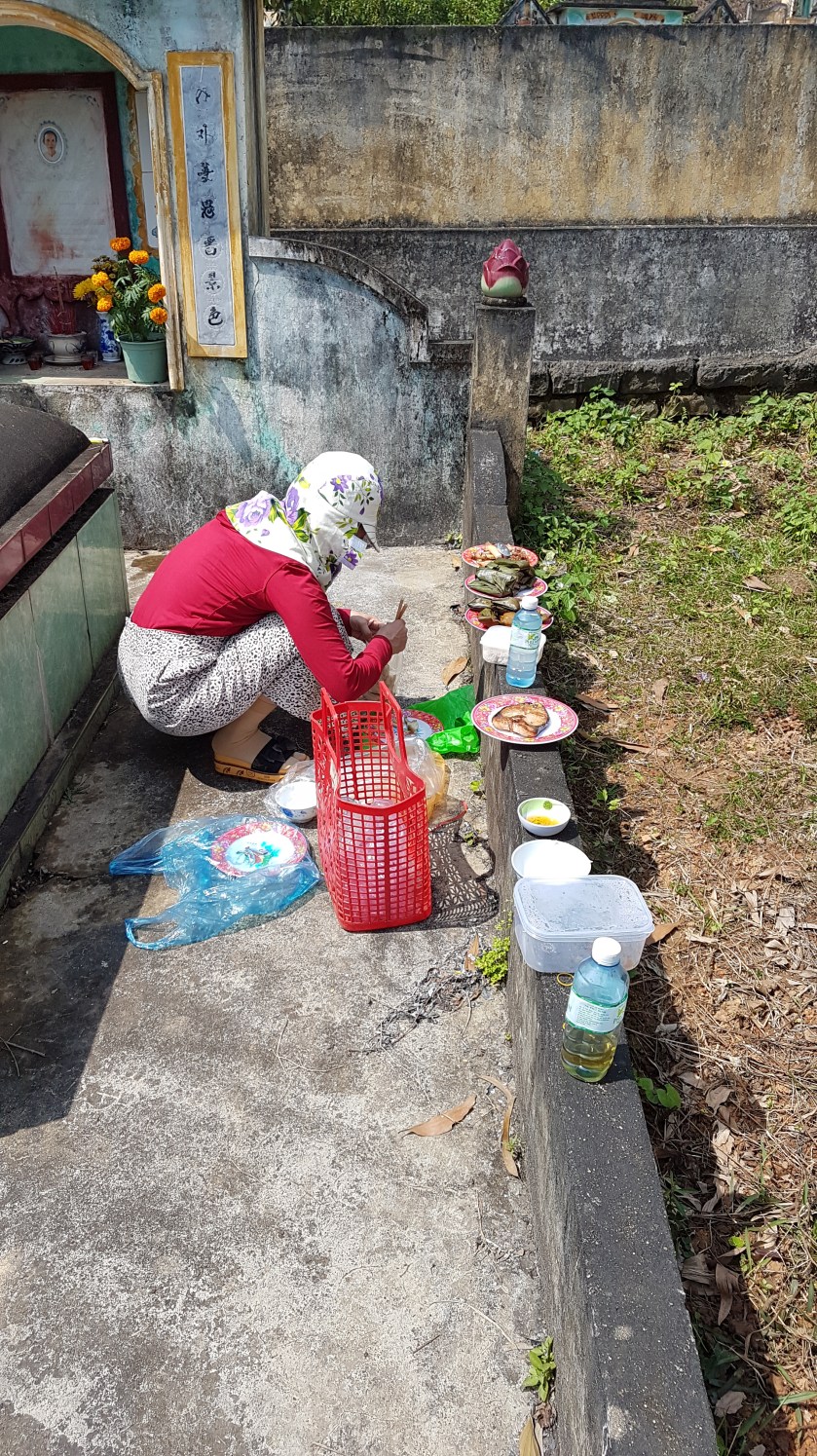
Yesterday as I was watching my girlfriend Trinh prepare the food at her grandmother’s grave, I realized how much my perspective has changed since crossing the Atlantic.

Food laid out at her grandmother’s grave

I accept a level of uncertainly, magnitudes above, what I would have been comfortable with even 10 years ago.

The cemetery is about 20 minutes from Trinh’s mother’s house, where we are staying these days of the Tet holiday. Trinh and her mother had been cooking all morning. Finally, they meticulously packed a large bad hat would sit between my legs in front of me on the motorbike.

We set off. I had been to the gravesite two days previously, so I thought I knew what was going to happen.  Upon arrival, I see the box of cookies we had left the previous visit. Obviously, her grandmother hadn’t eaten any. Yes, I was being flippant.

Incense was still burning; Trinh mentioned that her step-brother, must have just been here. I never knew she had a step brother, but what the hell, I’ve only known her for little more than a year!

Trinh proceeded to unpack the bag, which contained not only food, but plates, utensils, clothes and even money. When you’re dead who knows when you may need extra cash.

In spite of my flippancy, I really like, respect the Asian reverence for the dead and elderly. It was one of the differences (in my mind) between western and Asian cultures and a reason I became so attracted to first Korean and now Vietnamese culture.

After 15 minutes, Trinh was putting the final touches on the dinner. I watched as she meticulously spooned a little fish sauce seasoning on the two main plates, a tuna steak and a plate of sautéed squid. Looked so good, I thought it a shame to waste.  Knowing the Vietnamese don’t waste anything, I was surprised.

She poured little glasses of wine and water, giving the old water to the potted plants, and refilling the glasses with fresh water.

When everything was done, she lit the incense and did her little prayer ritual.

Then, just as I was thinking we were ready to leave, she started to undo all the work of the last 15 minutes by putting all the food back in the containers it had come it. Nothing wasted, even the little sauce, went back into its’ little bag.

(two short videos of her getting it ready, then putting it back)

Error
This video doesn’t exist
Error
This video doesn’t exist
Putting it all back

Surprised? Not really, more like bemused. After my first Atlantic crossing, I learned to not be surprised at anything. I also learned to not complain about anything. When I dared complain about the 12-foot waves, they became 18 feet.

Mother Nature taught me as only she can: Be grateful for what you have, because it can always be worse.

Oh, I can still be as miserable as I want or as the situation dictates, I just can’t express how bad it is. Can’t even think it, for who knows who is reading your thoughts nowadays.

Those three storms, each a day apart, in the North Atlantic in the last week of August 2014, re-forged my brain.

New Yorkers grow up in a culture of excellence. That’s because we complain about anything that isn’t top notch, price notwithstanding. As teacher, then principal, I took that attitude with me. I did what was best for the students and built the teachers into a successful team. I complained to the powers to be about policies and procedures that were not conducive to student learning. I was listened to. While we had a reform minded Chancellor, that was very effective; but as soon as that Chancellor left, the reactionaries returned and I was out within 6 months. My only crime was my naivety that results (graduation rate from 40% to 70% in 4 years) would speak for themselves.

Food, money, wine, water, clothes and of course money (in USD of course)

Dauntless was the crucible that helped me through that abrupt change in life.

Three years later, on the North Atlantic, heading to Ireland, this was the forge. I would become accepting of what is or else. Now, this doesn’t mean I accept just anything. More than ever it simply means that if I’m not happy with a place or situation, I need to not be there or accept that I can’t change it.

Thirty minutes after arrival at her grandmother’s grave, now, really ready to leave, I still had to ask, with a little smile on my face, but what happens if she is still hungry? Trinh answered deadpan, “she ate”.

That was that. I knew what we were having for dinner and it was quite tasty, though the tuna was a bit drier than normal!

The North Atlantic taught me not to complain; to accept. The North Atlantic opened me to the possibility to be in an Asian culture in which even when I think I understand, I don’t.

I watch, observe, but don’t judge. I assume I don’t understand the full situation at any given time. I keep my questions simple, where do you want me, when?

I never ask why. Like waves on the ocean, it is, what it is, could be better, could be worse. If you don’t like it, go somewhere else, but don’t try to change it.

Tet – It’s Not a Holiday, It’s an Adventure

Yesterday as I was watching my girlfriend Trinh prepare the food at her grandmother’s grave, I realized how much my perspective has changed since crossing the Atlantic.

Food laid out at her grandmother’s grave

I accept a level of uncertainly, magnitudes above, what I would have been comfortable with even 10 years ago.

The cemetery is about 20 minutes from Trinh’s mother’s house, where we are staying these days of the Tet holiday. Trinh and her mother had been cooking all morning. Finally, they meticulously packed a large bad hat would sit between my legs in front of me on the motorbike.

We set off. I had been to the gravesite two days previously, so I thought I knew what was going to happen.  Upon arrival, I see the box of cookies we had left the previous visit. Obviously, her grandmother hadn’t eaten any. Yes, I was being flippant.

Incense was still burning; Trinh mentioned that her step-brother, must have just been here. I never knew she had a step brother, but what the hell, I’ve only known her for little more than a year!

Trinh proceeded to unpack the bag, which contained not only food, but plates, utensils, clothes and even money. When you’re dead who knows when you may need extra cash.

In spite of my flippancy, I really like, respect the Asian reverence for the dead and elderly. It was one of the differences (in my mind) between western and Asian cultures and a reason I became so attracted to first Korean and now Vietnamese culture.

After 15 minutes, Trinh was putting the final touches on the dinner. I watched as she meticulously spooned a little fish sauce seasoning on the two main plates, a tuna steak and a plate of sautéed squid. Looked so good, I thought it a shame to waste.  Knowing the Vietnamese don’t waste anything, I was surprised.

She poured little glasses of wine and water, giving the old water to the potted plants, and refilling the glasses with fresh water.

When everything was done, she lit the incense and did her little prayer ritual.

Then, just as I was thinking we were ready to leave, she started to undo all the work of the last 15 minutes by putting all the food back in the containers it had come it. Nothing wasted, even the little sauce, went back into its’ little bag.

(two short videos of her getting it ready, then putting it back)

Error
This video doesn’t exist
Error
This video doesn’t exist
Putting it all back

Surprised? Not really, more like bemused. After my first Atlantic crossing, I learned to not be surprised at anything. I also learned to not complain about anything. When I dared complain about the 12-foot waves, they became 18 feet.

Mother Nature taught me as only she can: Be grateful for what you have, because it can always be worse.

Oh, I can still be as miserable as I want or as the situation dictates, I just can’t express how bad it is. Can’t even think it, for who knows who is reading your thoughts nowadays.

Those three storms, each a day apart, in the North Atlantic in the last week of August 2014, re-forged my brain.

New Yorkers grow up in a culture of excellence. That’s because we complain about anything that isn’t top notch, price notwithstanding. As teacher, then principal, I took that attitude with me. I did what was best for the students and built the teachers into a successful team. I complained to the powers to be about policies and procedures that were not conducive to student learning. I was listened to. While we had a reform minded Chancellor, that was very effective; but as soon as that Chancellor left, the reactionaries returned and I was out within 6 months. My only crime was my naivety that results (graduation rate from 40% to 70% in 4 years) would speak for themselves.

Food, money, wine, water, clothes and of course money (in USD of course)

Dauntless was the crucible that helped me through that abrupt change in life.

Three years later, on the North Atlantic, heading to Ireland, this was the forge. I would become accepting of what is or else. Now, this doesn’t mean I accept just anything. More than ever it simply means that if I’m not happy with a place or situation, I need to not be there or accept that I can’t change it.

Thirty minutes after arrival at her grandmother’s grave, now, really ready to leave, I still had to ask, with a little smile on my face, but what happens if she is still hungry? Trinh answered deadpan, “she ate”.

That was that. I knew what we were having for dinner and it was quite tasty, though the tuna was a bit drier than normal!

The North Atlantic taught me not to complain; to accept. The North Atlantic opened me to the possibility to be in an Asian culture in which even when I think I understand, I don’t.

I watch, observe, but don’t judge. I assume I don’t understand the full situation at any given time. I keep my questions simple, where do you want me, when?

I never ask why. Like waves on the ocean, it is, what it is, could be better, could be worse. If you don’t like it, go somewhere else, but don’t try to change it.

What I Need

As spring gets closer and closer, I’m watching the weather daily.  I know what I want, but the light wind conditions may only last a couple of days, while I need a week plus.

In the last weeks, the more I have thought of this, the more I am thinking of getting north as best I can, probably well offshore.

Offshore solves a number of issues for me:

  • I like the open ocean
  • far less fishing activities, like boats and nets
  • more sea room, if I need to run before the storm (this is always a consideation in my planning)
  • getting big chunks of distance done in a short time, 3 days = 500 nm
  • did I say I like the ocean

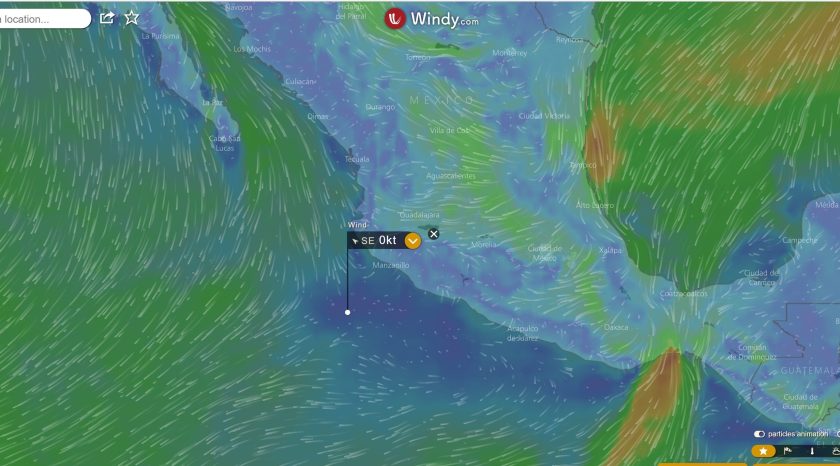
I like the GUI and data presentation of Windyty.com, so all the maps I show are from them and when I do look at weather, I look at them before anything else. This is what a great case looks like. How long it will last? Not long enough, but a few days, then with a low pressure system developing further west, would give me favorable winds for the second of two 3-day periods (the steaming distance between Huatulco and Cabo San Lucas is 900 nm or 6 days.

Now this looks great. Too bad it will last a day or two and I need 9!

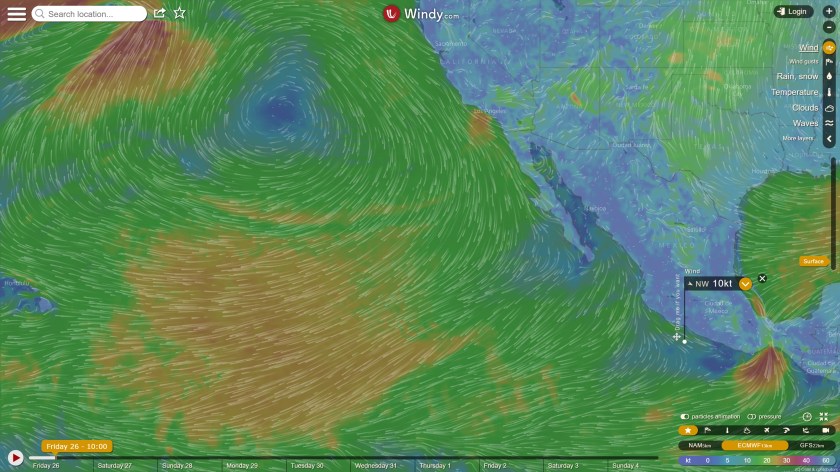
This case though is far more typical, with NW winds >15 knots, even more so in the summer than now.

N NW winds = NO GO

What I’m Really Afraid Of?

Just when I thought I had the Plan, I read a story about drug driven crime spreading to the west coast of Mexico. Manzanillo, one of my planed stops, was prominently mentioned.

20180126 Win
dyty Depiction of Surface Winds

Where does that leave me? Besides the obvious, afraid!

Last summer I had a detailed plan to cruise up the coast of Mexico, stopping every night, hitting all the nice spots, with only a couple overnight passages. Let’s call that plan, the Coastal Cruise Plan. This is essentially what we had done 3 years ago in the Baltic.  I had even spent the last month alone, cruising from Stockholm all the way back to Ireland.

Last year, I had my nephew, Micah, with me from Ireland to Costa Rica.  It’s no coincidence that when he left Dauntless in March to go to law school, I lost a lot of my ambition to continue north alone. Cruising alone for me is not fun. It’s what I do when I need to get from A to B or as I did from Stockholm to Waterford.

20180126 NWS P_e_sfc_color

I am hoping that this coming summer, my girlfriend Trinh and her son, Thien, will have visas for Mexico. This is something that I must initiate this April when I return to Huatulco. If that is possible, they, with other friends who have expressed interest in joining Dauntless this summer, would make the Coastal Plan at least feasible. We would enjoy the numerous stops and towns along the coast, plus many eyes make for less stressful cruising.

A visa for the U.S. is another story and it takes forever. I’m hoping for 2019.

The Pacific coast of Mexico is not the Baltic and North Sea. The weather is not necessarily worse, but the predominant winds are from the northwest, the direction Dauntless must go. Adding to that problem, there are numerous fishing boats and nets and other boat traffic near the coast, whereas in the Baltic, there was none of that.

Lastly, safe harbors (protected from weather) on the Pacific coast of Mexico are few and far apart. North from Huatulco to Manzanillo, a distance of almost 600 miles, there are only two safe harbors. In a normal (for me) coastal cruise of 40 to 60 miles per day (6 to 9 hours), that’s 8 out of 10 nights anchored or in some port, at the mercy of the weather.

That’s a no-go.

For those of you who have read my precious comments about weather forecasts, you will know that even in the best circumstances, I don’t trust weather forecasts past three days and even at that I assume they are 50% off. That means, if the forecast is for winds from 270° at 12 knots, I plan for winds 240° to 300° at 8 to 16 knots (50% and 150% of forecast).

Therefore, to cruise an unprotected coast in any but the mildest of conditions is perilous.

I needed a plan B.  The Near Coastal Plan.

In this plan, we will take what the weather gives us. If we get four good days (favorable winds and seas) we’ll cruise until the weather becomes unfavorable. This potentially means we would take chunks of distance, 3 days, 24/7 is 450 nm. Making the entire trip into 4 chunks of 500 miles each, would get the job done and reduce time spent too close to the coast.

It would be far less fun however, but probably safer in many ways and less stressful.

Then came plan C, the Ocean Plan.

But first we talk to talk about hurricanes.

Hurricane season runs from June through October, with the highest frequency, mid-July to mid-September.

I can see an advantage in avoiding the high summer.  Looking at the Windyty depiction of the surface winds over the eastern Pacific today, you can see the big ass high pressure system that keeps the easterly trade winds over Hawaii (far left of picture) as well as the northwest winds over the west coast of California and Mexico.  Now, one of the disruptors of these winds are hurricanes.  The circulation pattern around hurricanes is far smaller than this massive high-pressure system, but a Pacific Ocean hurricane a few hundred west of Mexico, would cause southerly winds off the Mexican coast.

If it moved slowly north, maybe I could tag along??

It all depends on the situation and I’d have to figure out my escape routes, but it’s something for me to think about and plan for. It’s also significant that eastern Pacific hurricanes are weaker than Atlantic ones, with wind patterns not much stronger (if at all) than Northern Atlantic low-pressure systems in August and September (and I’ve certainly had my fun with those!).

Then the Ocean Route would entail an end around, running almost west, then curving slowly northwestward and finally northward, ending up east of Ensenada or southern California. With little winds, it would be an easy 10 to 12-day voyage, just like I did alone from the Azores to Ireland.  I’d only do this though if I saw the possibility of an extended time of light winds.

Also, time of year matters in my decision making. In the scenario just mentioned above, In May or June, I’d have plenty of time to wait or make it happen.  I may have different options later in the summer.

In September 2015, while waiting in Norway to cross the North Sea (I anticipated a 72-hour crossing), my weather windows were getting smaller and smaller. September is simply too late to be doing such a trip. But Sweden was so nice!

There had been strong northerly winds 25+ winds and driving rain, for days. I waited and waited. Finally, I saw a high-pressure ridge building into the North Sea from the English Channel, but this ridge of high pressure was also moving eastward.  But it only gave me a two-day window for a three-day trip.

Dauntless Crosses the North Sea 2015

I had to take it. It meant that I left my little port of Egersund, Norway, with 35+ knot winds from the NNW and rain. If you look at my route I took to Fraserburgh Bay, Scotland, those strong winds caused that dip in my route. Even with the paravane stabilizers, it’s just easier on the boat to put the winds and resultant seas on the starboard stern quarter. After 24 hours, as the winds died, I was able to head more westerly and on the third day, to the northwest. But that little longer route also added 12 hours to the trip and the next frontal system was right on, so my last 8 hours were in the weather again.

Would a longer, better weather window has come eventually? Sure. In the winter, under very cold air and high pressure. I couldn’t wait that long.

Dauntless in Ireland, next to a fishing boat with almost the exact same lines. There is a reason she handles the North Atlantic like she was born there.

When we decided to cruise the world or at least get away from the coast, we knew we wanted, needed a boat that that could all that and more. All the readings I did about boats and people cruising in boats all over the world, led me to Kadey Krogen.

Our little 42-foot boat was well built, extremely well designed for the worst of the worst and affordable.

Having Dauntless under my feet gives me confidence that she can handle any stupid situation I put her in.

Now, people are another matter.

.

Keys:


Planning – It Ain’t for the Faint Hearted

As I sit in my 10th floor apartment in Ho Chi Minh City, a.k.a. Saigon, the People’s Republic of Vietnam this balmy January 2018, writing these words, I think back one year.  I was in Martinique, in the Lessor Antilles, luxuriating in having just completed a harder than expected crossing of the Atlantic from North Africa to North America.

Looking north from my apartment in HCMC, Vietnam

Vietnam wasn’t even on the radar and if it was, I thought it was a wave top. Impossible it imagines how different 2017 would end up.

So, how can a person who doesn’t have a clue as to where they will be in 12 months’ time write about planning?

And not only write about, but spend a good portion of every day’s waking hours thinking about The Plan?  So much so that just a while ago, I found myself looking at the noonsite.com information about Taiwan.

Taiwan? wtf, he still hasn’t figured out how to get Dauntless out of Mexico, you’re thinking.

And right you are. So, I thought you would be interested in knowing or better understanding my planning process.

To understand my planning process, let’s look at my goal and some background information:

  • The Goal
    • Long term, cross the North Pacific, return to Northern Europe & complete my circumnavigation.
    • Short term, spend a couple of summers in Southeast Alaska.
    • Near term, get Dauntless to California before next winter.

Dauntless is now in the wonderful little town of Huatulco, Mexico, in the little Bahia Chahue.

  • Background information
    • In 2016, once I made the decision to return to North America, I made an elaborate plan (published in some blog post last year) to transit the Panama Canal and cruise up the west coast of North America to SE Alaska.
    • Looking aback at the plan now, I stayed pretty much on time and on target, only transiting the Panama Canal a couple weeks later than originally planned, until Costa Rica.
    • Arriving in Golfito, Costa Rica in March 2017, the wheels then came off or a more apt description, I was beached.
      • What happened? A perfect storm of: local bureaucracy, my nephew who cruised with me since Ireland, had to go back to school and I met this wonderful woman in faraway Vietnam.
      • Returning to Dauntless in June, I needed to get moving north. Costa Rica is a wonderful country that I had visited in 2004 and had really looked forward to returning. But, it turns out, it is not really cruiser friendly. The few marinas are ridiculously expensive and the paperwork of checking in and out was cumbersome and confusing.
    • My newfound friend, Cliff joined me and we took Dauntless from Costa Rica to Mexico. Mexico, it turns out is everything Coast Rica isn’t. Cliff had to go back to work and hurricane season had arrived, so in reaching the wonderful town of Huatulco in August, I decided that enough was enough.
  • The Task at Hand is to get Dauntless from southern Mexico to California, 1800 miles.

Dauntless cruises at about 6.5 to 6.8 knots. thus a 24-hr. period is 150 nm. That’s the figure I use for planning.  With light winds and small seas, then the planning exercise is about planning stops after a day of cruising.

Two years ago, in the Baltic Cruise, I largely ignored the weather and planned the whole 4,000-mile trip based on cruising days of 5 to 8 hours. Usually we would stay a few days in each town or city stop.  But the pacific coast of North America is a whole different creature.

Climatology tells me that the winds are predominantly from the northwest (the direct I must go) 2/3’s to ¾’s of the time. I use Jimmy Cornell’s Ocean Atlas which has pilot charts for each ocean by month. Jimmy Cornell’s Pilot Charts also tell me the secondary wind direction and currents. June thru September is 4 months, 120 days. I figure that I will have favorable winds about ¼ of those days, or 30 days. I have 1800 nm to go divided by 30 days means 60 miles per day.  No bad, about what I did in the Baltic in September.

But it also means that when the winds are favorable, I must make miles. The reality of seasonal climatology is best looked at and planned for over periods longer than a few weeks. In this situation, I can easily be stuck in port 30 days waiting for the winds. Then if I’m lucky, I’ll have a good period, 5 to 10 days of southerly winds. Depending upon where we are along the coast, it means we may do 48, 72 or even 96 hours to take advantage of our good weather window.

Now in this context, when I say “weather” I really mean winds and seas. I’ve left port on many stormy days. Rain, showers do not bother me, it’s really all about the winds and seas for my little Kadey Krogen.

The effect of head winds and seas vary greatly. 5 to 7 knots are hardly noticeable and may produce small seas, less than 2 feet. Dauntless will lose a few tenths of a knot under such conditions.

Going out into the storm

As winds off the bow become stronger, it all goes down rapidly from there. 12 to 15 knots produce 3 to 5 ft. seas, pitching become unpleasant and we’ll lose more than a knot of speed.  18 + knots are untenable from a comfort level. Too much hobby horsing and probably down to 5 knots, less with any counter current. This is what happened to me off the French coast going up the English Channel to Holland. We were making 2 to 3 knots in pure misery of pitching.  Because of the conditions, I finally decided to abort to Ostend, Belgium. It took another 6 hours to go 15 miles.  Some of the worst 6 hours I have ever experienced. The Kadey Krogen was fine, she takes a beating and keeps on ticking. The humans inside were not as happy.

What I took out of that beating was to more carefully consider winds and seas on the bow. A 20-knot wind from the stern is fine. We had 20 days of that crossing the Atlantic last year. Even 20 knots (and resultant seas) on the beam are ok. The paravanes are most effective with beam seas. Though I tend not to venture out in such seas if I am in port. 20 knot headwinds are untenable. Stay in port. If at sea, options are reduced, but probably a change in direction is warranted.

I use Windyty.com for my forecast winds.  I tend not to look at forecast seas because the accuracy is seldom good enough to use in an effective manner. Though Windyty will give you the first, second and third swells.

Now when it comes to forecast winds, for whatever reason, the forecast winds are almost always understated, though I do realize it’s possible that I only notice the over and not the under. Thus, when winds are forecast to be 12 knots, that usually means 8 to 15 knots. If 8, ok, if 15 it’s a no go.  So, in this case, I will use 8 knots for the Go-No Go decision.

From Huatulco to the Channel Islands, it’s only 1800 nm in three long legs. that’s basically the distance I did between Martinique and the Panama Canal.  But with much more un-favorable winds and currents.

Top speed for Dauntless is about 8.5 knots, but it’s non-factor because it’s impossible to justify the double to treble fuel consumption for 2 knots. So, my effective (long term) hurry up speed is 7.5 knots at 1800 rpms and 2 gallons/hour. Thus, I usually keep it to 1700 rpms, 6.8 to 7.0 knots and 1.6 gal/hr.

In my next post, Planning is the Mother of Anticipation, I’ll discuss the Mexican coast, what options we’ll have, crew and hurricanes.


Curiosity

As I flit from place to place, I wonder what drives me. After all, crossing oceans, flying from continent to continent, costs time and money.

View of the Dolomites from Budoia, Pordenone, Italy, Christmas 2017
Budoia, Pordenone, Italy, Christmas 2017

Is it worth it?” I’ve asked myself that question many times, not only since Dauntless entered my life but well before it.

Bahia Guacamaya

In the summer of 1970, I worked driving a cab in New York. Coming home day after day covered in sweat, dust and grime, in the days before air conditioning. But at the end of that long, hot, humid and dirty summer, having survived not only the weather and the traffic, but the escalating crime in the City, I took my money and bought my first car.

Of course, it was a car my father recommended. He was a master a virtually anything he was interested in doing and cars were one of his interests, so there was no thought of getting anything but what he pointed out.

Northeast Italy, December 2017

Good move. My first car was ugly, like a box and battleship grey.  And only a week after getting it, I packed it up and stated the long, 3.000-mile, trip back to the University of Washington in Seattle, with nary a thought. My attitude has always been If other’s have done it, so can I.  Even then, the pattern of not stopping until late into the evening, running on fumes or taking “short cuts” was apparent.

Northeast Italy, December 2017

I never thought I was particularly brave, in fact, I knew I was pretty shy and afraid of the dark.

But that didn’t matter because there was always something new to see over the next hill or around the next curve.

The 21 days on the westward crossing last December were very similar, yet so different.

I looked forward to the day, the sunrise. What clouds would we have today? Rain or showers? The sky always had something new; something I hadn’t seen before. In my first Atlantic Passage in 2014, I had tried to avoid developing rain showers or thunderstorms. But in a boat going 6 knots, that is a futile gesture. Even more so, this last trip, I looked forward to the cleansing rain. I also didn’t want to upset the boat. She gets in a rhythm, let here stay in it without any major course changes.

The only thing I never liked was blue sky. My two years living in southern California were the worst, blue skies every day. I almost died of monotony.  Even now, on the boat, I see a building storm on the horizon and I can’t look away. I’m fixated, as if watching a beautiful woman get dressed, what will the final look be? But storms are even more interesting than people, because their lifetimes can be minutes or hours.

These days, visiting my friends in Italy and Holland, the first time seeing them since my Atlantic Passage last Christmas, I’ve been able to recount the story numerous times.

Many say how brave I am. But I know better; I’m not brave at all, I’m simply curious.

Always Forward

As 2017 comes to a close, I find myself thinking about its beginning. Lying in bed on the morning of the first day of the new year, 1 January 2017, I luxuriated in being on a motionless bed. I thought about the last month. It was only a month ago, that I was waiting for the winds to die down so we could leave the harbor of Rabat, Morocco.

Dauntless has come so far

30 days and 3,000 miles later, we were in the New World. It was a much hard trip than I had hoped for. Watching the weather for months before our eventual departure, it was clear that the trade winds blew strong and steady from Africa all the way through the Caribbean to Central America.

I’d been hoping that I could stay in the band of lighter winds just north of the trades. It was not to be. Within hours of leaving Europe and the Canary Islands, we got hit by easterly winds for 20 to 30 knots. I wasn’t worried about Dauntless, she was made for following seas like this, but it did occur to me that these conditions meant there was no turning back.

That’s a sobering thought.  In the Mid-Atlantic, with such strong winds behind us, we had to head west one way or another.  There is no turning back. 200 miles west of the Canaries, no matter the issue, no fuel, no water, forgot to turn off the lights at home, no matter; one way or another you’re going west.

Always forward.

On a somewhat related note, here are a few Delta Airlines commericals that I find very motivating: