Crisis in the Mid-Atlantic – The Chickens Come Home to Roost

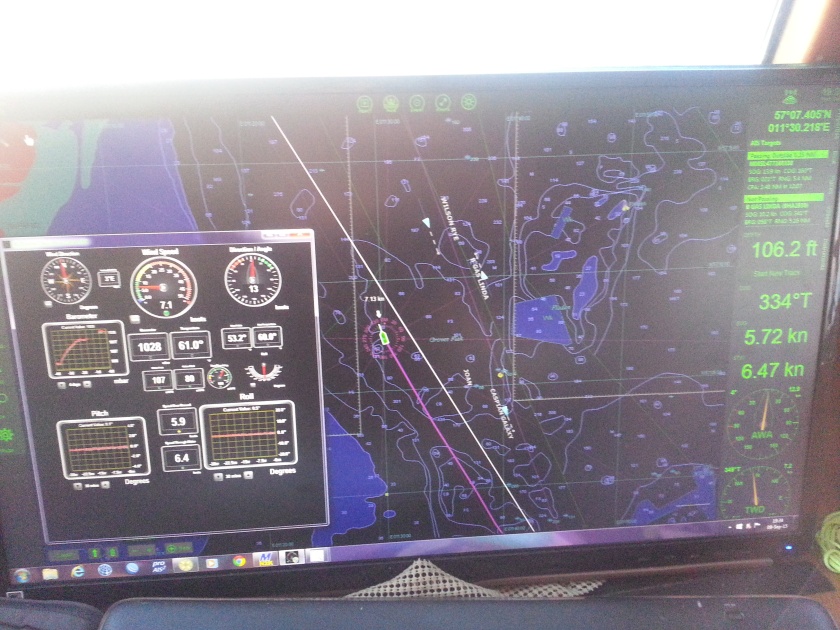
Just After the 1st Repair. It’s 13:33 this is the normal screen I run with. I’ll minimize the Maretron data (black box on left) is there is more traffic or is I have a reason to look at the chart. In this case, what’s important: winds 090 at 23 g 28; Apparent Wind Angle (How is the boat feeling the wind) is right on our stern at 180 degrees. Bottom right shows the roll and one can see the roll reduction while the boat was stopped at the same time the pitch increased. Then the roll greatly increased once we got underway again.

Error
This video doesn’t exist
 This video shows the day before, Dec 21st.  Even before the preventer stick broke (which you can see going form the fly beige rail to the middle of the paravane pole)

Error
This video doesn’t exist
 This is from the afternoon.  GIves you a nice idea of the seas. This is what we had plus or minus for 21 days.

So, as December 22nd dawned, (end of Day 13 and beginning of Day 14), the little problems that had popped up were solved quickly.

Though during the night, my last second and last preventer stick broke.  It wasn’t critical, I had not used it since it was made three years ago, but still, this morning I wanted to find a real solution.

The winds had been very strong since daybreak, in the low 20’s, gusting to 35 knots.

I decided to stop the boat, just put her in idle and adjust the paravanes somehow. It nice to know that the boat will bob more than roll when stopped. While not underway, Dauntless rolls at about half the rate of our underway roll. So, we’d been rolling 10 to 20 degrees, pretty consistently, now we settle in the trough of the waves, but bob as much as roll.

Now, months later, my brain refuses to remember why I actually stopped the boat.  It must have gotten superseded by the traumatic events that followed.

Autopilot disengaged, Idle, then neutral, the boat will coast to a “stop” in about three minutes.  Winds and current are still pushing the boat, in this case about 1.5 knots.

Then before I did whatever I had intended to do, I decided to turn the rudder to see if it made any difference in the boat motion.  Not a stupid plan; yet.

The rudder was already hard over to port. And then in an act of gross stupidity, I turned the wheel more to port. Why? Why? Why?

I knew the rudder was at or close to the stops.  The steering system had had some air in the system for a long time. No matter what I did, I could not get it all out.  So, I thought a little more turn couldn’t hurt.

Oh, my God, it could hurt.  After turning the wheel about a quarter, I felt it go slack in my hand.

I knew exactly what happened and turned to Micah to say, “We’re fucked now”.

I knew because I’ve had this sickening sense before: pushing on brake pedal that goes all the way to the floor or turning a steering wheel and nothing happens. When a hydraulic system goes slack: clutch, brakes, steering. It means the hydraulic system has no more pressure, A hose, fitting or part has given way.

He knew from my tone that I was serious, very serious.  I was so angry at myself. Had Micah done something like this, it’s an accident. For me, I knew better than anyone the consequences of over-pressurizing a system.

The Kadey Krogen has does have an emergency tiller that connects through a purposeful hole in the hatch.  But I hate even manually steering the boat in a sea.  To stand, sit in the stern deck and hand steer for 7 days like were some god-forsaken sailboat, fuhgeddaboudit.

But I also immediately realized I couldn’t afford the Pity Party. I also could let Micah start thinking of the consequences. Now was the time for solutions and solutions only.

When the Going Gets Tough; the Tough Get Going.

We had 200+ feet of hydraulic lines and the failure could be any place. gain, trying to control the sickening feeling in my stomach, If I’ve learned anything on this boat, it’s to always look for the easiest solution first.

So, we’d start at the rudder piston in the lazzerrette. Open the hatch, and at this point, a wonderful sight (on a boat everything is relative), hydraulic fluid oozing from a hole in the hose just above the fitting. This hose, one of two, for the rudder piston.

First thought, let’s try easy, easy solution, rubber tape, with hose clamps around it.

Error
This video doesn’t exist
 This video is after i had completed this repair and also shows how I stopped the paravane pole from bouncing by using a fender.

It worked. We got our filing funnel for the upper helm station, from which the entire system is filled with AFT, Automatic Transmission Fluid, which conveniently, both the hydraulic steering and the Borg-Warner manual transmission use for lubrication and pressure.

The system took about 2 liters of fluid.  But I only had a total of 4 liters. I’m starting to think of chickens coming home to roost.

We get underway just under an hour later at 10:28. Everything is working reasonably well. You can see from the Maretron data how the boat roll is about half, while the pitch increases when dead in the water.

Coastal Explorer, our main navigation program, running on a dedicated solid state 12-volt boat computer had been acting up.  For a few days, it had not been displaying AIS information, no matter what little tricks I had used in the past to “wake it up”.

Now, I knew I was still sending, which is actually far more important, as since I have had transmit capability large ships always stay away. Having seen only one ship in 13 days, the display wasn’t critical, but I wanted it working. I like everything working.

So, as a last resort, I decided to reboot everything. Everything off and on again, in order, about a 4-minute process.  The log shows at 12:15 all was well.

We had been checking our repaired hose every hour, as well as topping up the fluid as needed.  In the last two hours, we had put another liter into the system.  The hose was leaking enough, probably a few liters every 12 to 24 hours.

Now this would have been no problem in coastal cruising.  We would have just topped it off until port.  I didn’t have that option.  So about 7 hours after the first fix, I knew I had to find the real fix.

Two Issues I had to solve: Hose & Fluid.

  1. For the hose, I knew I had a number of spare hydraulic hoses in two different places in the engine room. One set stored with all the extra hoses and tubing, the other set stored in the long-term spares containers on either side of the generator.
  2. The fluid was a bigger challenge. I used the Delorme InReach to text my contact Roger, who got in touch with Ski in NC. Ski, a long-time diesel expert, had been really helpful in the past, so I needed to figure out what I could use as substitute ATF.

The answer turned out to be simple and vexing, 4 parts diesel fuel to 1 part engine oil. Yes, the engine oil of which there was not extra. The engine needed every bit of oil.  Dauntless was now full of chickens.  They had all come home to roost.
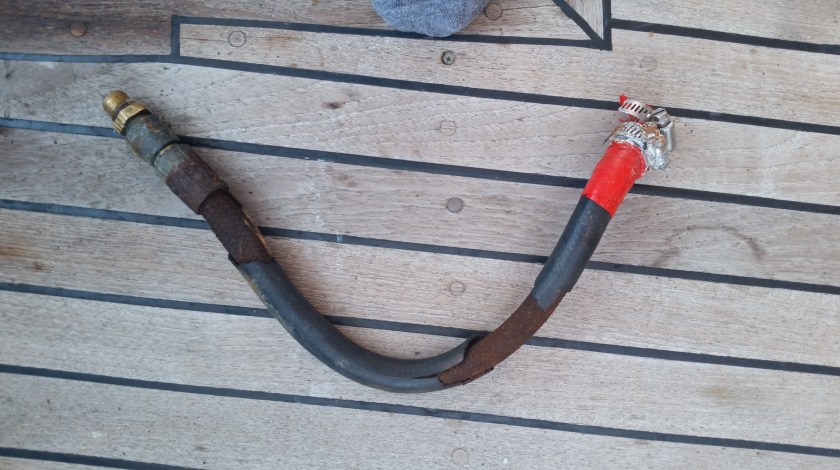
The offending hose, steel braid rusted to the core.
I’m replacing these hoses and standardizing the fittings.

OK, first I had to clear out all those chickens. They were all over the place.  Before we did anything, I found the spare hose with the correct fitting in seconds. So far so good. I then stopped the boat again and also the engine, as I wanted to check the oil level to make sure of my calculations (on a passage like this, I just fill the engine at its usual use rate, without turning it off).

Oil level was just were I expected, so I decided I could spare one liter of oil. Worse case, we would arrive in Martinique one liter low, but that’s not a big deal for a day.

I got my tools and wrenches. Getting the old fitting off the three-way control valve ended up taking me 15 minutes.  I even heated it up with my kitchen torch, but I was very careful not to make my hose problem into something far bigger and unfixable.

Finally, it came out.  I put pike gunk on all the new fittings, makes for a better seal and I don’t want any more leaks.

In the video Micah took, you see one time water came across the deck. That’s water that enters thru the scuppers, usually on rolls of more than 15 to 20 degrees.  As I said, dead in the water, we bob more than roll, so I was only inundated with water twice in this operation which took about 40 minutes.  I wanted Micah to get more pictures of the outside scene not just the top of my head, but he was nervous and I think he felt better not looking out much.

Error
This video doesn’t exist

Me on the other hand, I may not look it, but I was pretty ecstatic.  I’d fucked up and was able to fix it. We now had 5 liters of substitute ATF which would be more than enough.

The finished product

Error
This video doesn’t exist

At 18:00 we were underway again.  Immediately, it was apparent that I had way too much air in the system.  The Auto-Pilot was acting errantly.  It would work for a few minutes, but once the rudder got far enough over, there was not enough pressure to get it back.  We would have to turn off the autopilot, then turn the wheel lock to lock three times until pressure built up in the system, check and top up the fluid at the upper helm station and reengaged the autopilot. This went on for a couple hours until I realized I needed to go to sleep to get ready for my 04:00 watch and the boat almost needed hand steering at this point.

That would not do.  I did not do all this to have to hand steer for 7 days.


The Great Battery Caper

After months of planning, thinking and just plain fretting, the batteries are in and Dauntless is no longer acting like a one legged duck.

Another Gorgeous Sunset

How do one legged ducks act you wonder? Without the engine running or being plugged into shore power, we had only a few minutes’ worth of electrical power.

Two of the Four New Yuasa Batteries

And I’d go to sleep, not with visions of sugar plum faeries (or better yet, leggy milf’s) dancing in my head, but with pictures of wiring diagrams and this and that.

So, having found replacement batteries in Kilmore Quay’s Kehoe Marine last month, they got four Yuasa Cargo Deep Cycle GM batteries that were of 8-D size, with 230 amp-hours each for me. Weighing in at 55 kg, or 115 lbs. each and delivered to the Kehoe boys at New Ross Boat Yard (yes, of course they are related).

Waiting for high tide, when the dock was only a few feet above the floating pontoon, we got the batteries on to the boat without dropping them into the water.

Then, the hardest part physically, getting the old batteries out.  Perhaps with the knowledge that we could not hurt them, it took us less than an hour to get them out.

I then spent the next few hours re-configuring how the batteries were connected.  I essentially made a positive and negative stud that consolidated the all the connections before they went to the batteries.

My friend Ed had given me a new article about the optimum way to connect multiple batteries that was slightly superior to the way I had the older batteries connected.  I had had 8 new battery cables made, 2 for each battery, each 2.3 meters long (about 7 feet).  This allowed the four batteries to have the exact same length cable to each from the charging source.  By having the same cable lengths, the resistance should be equal and thus each battery should get exactly the same amount of charge.

That took a few hours, with a panicked call to Dave Arnold, the electrical guru (who else would be driving around an all-electric car for the 1980’s!).

His call reaffirmed the use of the existing terminal block and Perko switch that was used to switch the start to the house batteries if needed.

Finally, after 8 hours, I was ready for the new batteries.  I rigged an Amstel line around the hand railing to the pilot house, thus we could lower the batteries into the engine room and the only struggle was to pull them into place while lowering at the same time.

Two hours later, all was in place, hooked up and ready to go.

All the boat grounds go to a common terminal, then one large cable to the boat side of the Victron battery Monitor shunt.  Then one large cable to another terminal post which has all four negative battery cables.

Positives are similar, in that the inverter/charger, the positive from the alternator and the positive from the terminal block (which has a number of inputs from the isolators and thus indirect from the other battery chargers) go to a terminal post, then all 4 battery cables are attached.

In the next days/weeks, as I physically tie the lines and organize a bit more, I will make a new electrical diagram.

Now, according to my calculations, all the rest of the year should be downhill!


Three Days; Three Plans

Day one started absolutely gorgeous.

Evidently this is the reward for being patient and getting the things done yesterday that needed to be done:

  1. Complete bus heater installation

    Dauntless Travels over Flat seas while Richard makes his first and last selfie
    Dauntless Travels over Flat seas while Richard makes his first and last selfie
  2. Replace port side Racor fuel filter
  3. Replace both engine fuel filters
  4. Open the starboard tank, yet again and clean out
  5. Change the starboard tank vent line

By 18:00 hours all was done.  The fuel tank opening was necessitated by once again having some water in the starboard tank.  Which led to only the second engine shutdown and the first one in over two years?

Opening the inspection port, which I hate doing, was necessitated by my not having moved the fuel vent previously after cleaning the tank.  Just plain lazy on my part, and I paid the price by now having to do double the work.

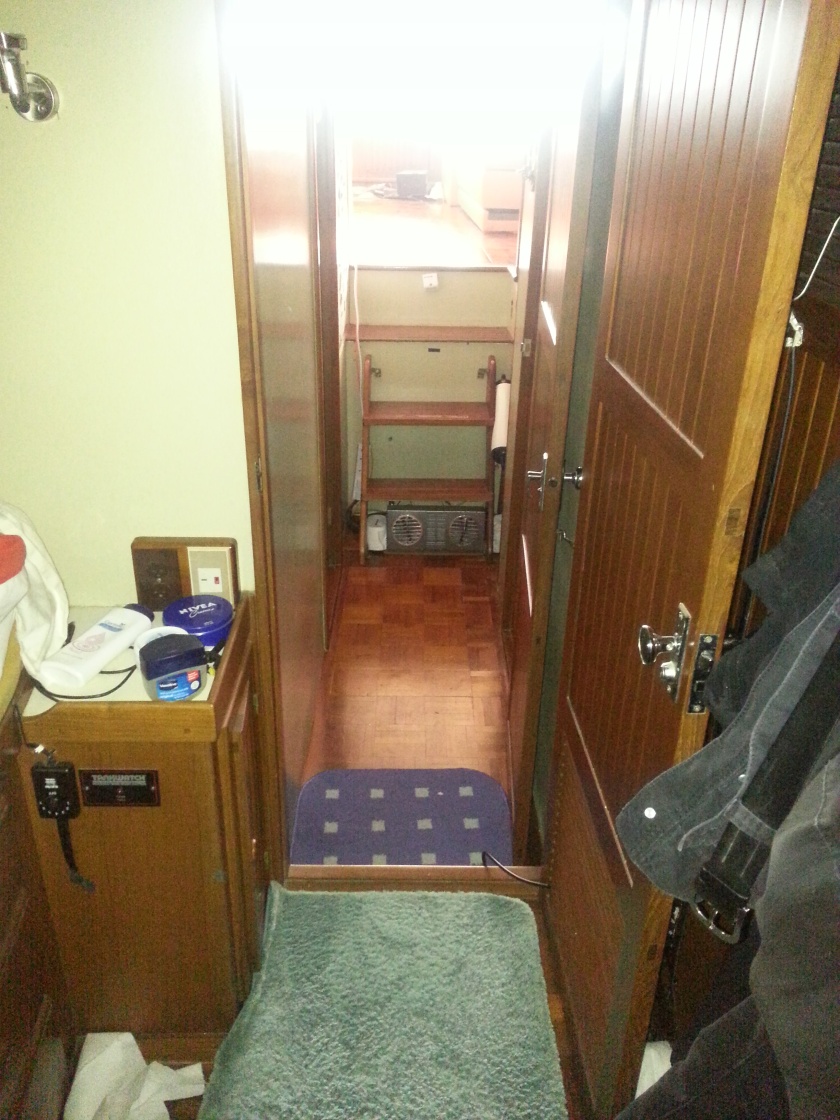
The newly installed Bus Heater under the stairs

The tank turned out to be in not bad shape, only about 1 quart of water, along with about a pint of black sludge.  When I was done, I put about 30 gallons back in the tank so it would not sit totally empty and start rusting, again.

On removing the hose for the fuel vent from the fitting, there were some drops of greenish liquid on both the fitting and the hose.  Since I’ve been suing green tinted fuel, I thought it was that, but I figured I better taste it to find out.

It was sea water, sweet and salty.  Almost refreshing.

Yep, the smoking gun was revealed.  That helped me feel better and justified moving of the vent once and for all.

So today, Wednesday, Plan A, its 190 nm to Norway, that will take 30 hours, 10 hours per day for three days, putting me into Kristiansand, Norway Friday evening.

Wanting to take advantage of the light winds I got up early, cast off and was underway before 07:00.

The next time I must open the fuel tank, I will get a helper

The day has only gotten nicer.  The winds are even less than earlier, now down to 6 knots, with flat seas, or at least as flat as we ever see.  Dauntless is motoring at its most efficient engine rpms of 1500 getting 6.1 knots.

This means a little better than 4 nm/gal (6.1nm*hr-1/1.5gal* hr-1)

We both could not be happier.

Also, I am reminded how much I love being on the water when I am not being tossed around like in a washing machine.

Plan A:  motor 12 hours today, anchor for 12, then do it twice more, so on the last day, Friday, head WNW from the northern tip of Denmark to Norway;  is being modified into Plan B.  The forecast calls for light winds today, then tomorrow continued light from the east, but getting stronger Thursday and Friday.

And while the forecast winds for Friday are going to be stronger, 15 to 20 knots, with seas building to 4 feet, since it is from the east and I would be going just north of west, it would be following sea and the KK loves following seas.

But I think I will hedge my bets.  I’d rather not take the chance on Friday’s winds.  If they are off even by just 40° it will make the trip much more miserable.


Coastal Explorer AIS depiction of the ships off Anholt Island, everyone is heading for the same point to head north. the dashed lines in front of each ship represent the distance the ship will do int he next 6 minutes.
Coastal Explorer AIS depiction of the ships off Anholt Island, everyone is heading for the same point to head north. The dashed lines in front of each ship represent the distance the ship will do int he next 6 minutes.

Mid-afternoon, I am coming upon the marker just to the east of Anholt island and it seems everyone has the same thought.  I have seen a lot of ships today, far more than I saw while in the English Channel.

And now we all seem to be chased to the same spot. the problem is these behemoths are so much bigger, like a fly compared to an eagle and they are usually going twice my speed.

It’s going to be a long night.

It’s 19:45 hrs. Evening depiction of the AIS tracks. Alongside the Maretron environmental info

And We Never Spoke of it Again

wpid-20150711_220602.jpg
The Tower in Ueckermünde

Just when you thought it safe to reenter the water…

Waking up in the now Polish town of Swinoujscie, I had two problems to solve; one more vexing than the other.

But first, let’s talk about Swinoujscie, gateway to the Baltic and until 1945, a German city, aka Swinemünde.  With the looks of an old German town, it boasts a certain charm, with a few modern touches.  One of those being an almost identical fountain in the main square to that of the Brooklyn Museum, that I had mentioned in a previous post, you know, the one that started out much like this one in  Swinoujscie, until the lawyers got involved.

So Swinoujscie, aka Swinemünde, became one of thousands of cities and towns in which whole populations were uprooted and “moved” at the war’s end.  Why because Stalin wanted half of Poland and therefore Poland moved west, but never fear, the western powers and the press don’t talk about it, better to tut tut about displaced people in third world countries, than issues they created themselves.

So on that note, let’s get back to our story.

As you recall from our previous episode, Dauntless limped into Swinoujscie, with her tail between her legs, well maybe not a tail, but a thin line that had wrapped around my bow thruster.

But I was determined to at least fix the autopilot.

If you have read our Atlantic Passage, you may remember that the autopilot was one of the most critical pieces on the boat and I had absolutely no spare anything’s for it.

Having Eve and Nigel onboard, did mitigate the loss, but even with three people, hand steering a power boat for long stretches of time is both boring and fatiguing.

Assuming there is no such thing as coincidences when it comes to mechanical problems, in other words, you change, add, replace any part of a particular system, and then that system craps out on you, there is about a 99.9% chance you whatever you did caused the problem.

So, I got out our hydraulic fluid and the handy fitting for the upper helm station and proceeded to run the system and turning the wheel to get the air out.

But little air came out.

At this point, I figured I better get serious, I got the ComNav book.

In the book I discovered a self-diagnostic the ComNav can run.  I ran it and got the ominous response “hard right rudder too slow”.

I could not find the bleed screws that were supposed to be on the hydraulic ram.  But I did not want to screw with the ram in any case, since it worked fine; it was the autopilot part that was not working.

I ran the self-test again.  Same result.

I went down into the engine room to look once again at the ComNav pump.  Maybe I could bleed it there. No, no fittings I could see for easy bleeding.

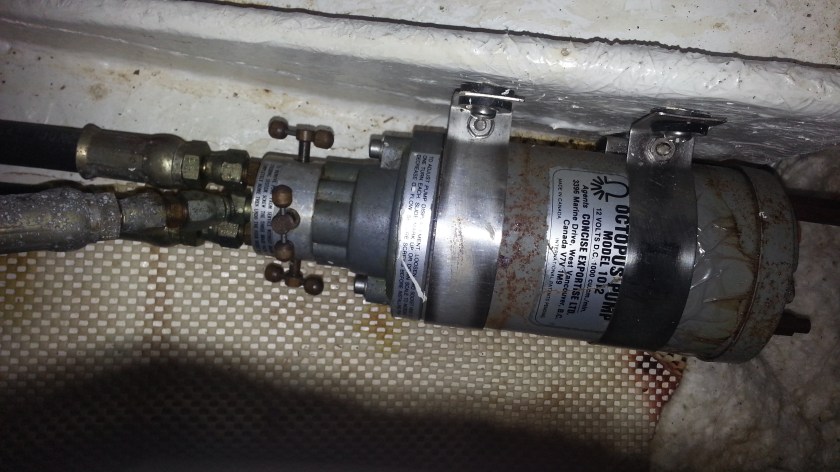
I took a picture of the pump, maybe the writing will give me a clue or I can better see bleeding screw fittings.  Nope. Nothing. Nada.

Run the self-test again.  No change, but I realize that while I can turn the wheel and the rudder responds as it should, in fact better than before with no groaning while turning it quickly, meaning I had gotten what little air there was out of the system, when I used the auto pilot control head to turn the rudder, it barely moved the rudder to the left (port).

Clearly the auto pilot was the issue, not the hydraulic steering itself.

I looked at the autopilot’s control panel.  A lot of green lights. So at least electronically, the autopilot thinks all is OK.

Back to the engine room to look at that pump again.  I crawl over to it.  I read both sets of labels on the pump.  One reads, “to remove the pump without losing fluid, close the thumb valves”

What thumb valves?  Those brass “T” handles that I occasionally play with, wondering what they do?  The ones that I had decided should be tighter, but not too tight the other day, while I was changing the main engine oil and in a moment of “let’s turn this and see what happens” madness??

I noticed the one on the left side was tight, the other two, one on top and one on the right, were close to being closed, but not tight.

Umm, could these be the valves that are to close when removing the pump?  And if so, should not they be OPEN now?

I have Eve use the autopilot control head to move the rudder, it now moves, not quickly, but better than before.  I open all three and she tries again.  Much better, almost like it’s supposed to.

We run the self-test again.  This time, rudder movement is normal.

I had changed the oil on the main engine a few days earlier.  So I was working at the back of the engine and it my spare time I was fiddling with those three T valves.  Sort of aimlessly fiddling.

So it seems my fiddling closed at least one valve and we had a few days of indifferent autopilot response, culminating in it not working at all.

The Innocent Victim
The Innocent Victim

Now all is fine. No air, valves open and the autopilot has worked better than ever.

When people ask me about crossing the Atlantic and why I like Kadey Krogen yachts, I say that quite simply I have never had a problem with the boat that was not caused my operator error.

We just passed 4000 engine hours.  That’s 2300 hours we have put on the boat in the last 28 months.

I’ve put 300+ hours since leaving Waterford two months again.

I have also been breaking down the cost of this trip during the last few days.  That will be the subject of a later post.

We love Dauntless because she never lets us down.  Now if only I could find a way to control that nut behind the wheel.

And we shall never talk of it again.

Coming up,

Leba, Gdansk and leaving Poland for the lands to the east


Unexpected Noise is Never Good

I am striving to post twice a week.  Sometimes it will be more and sometimes less, but at a minimum I like to have a post out by Saturday morning.  I didn’t make it this week, because I’ve been sick with the flu or something these past few days, having absolutely no energy to do anything.

It’s even one of the reasons we are still sitting in Arnhem today, Monday.

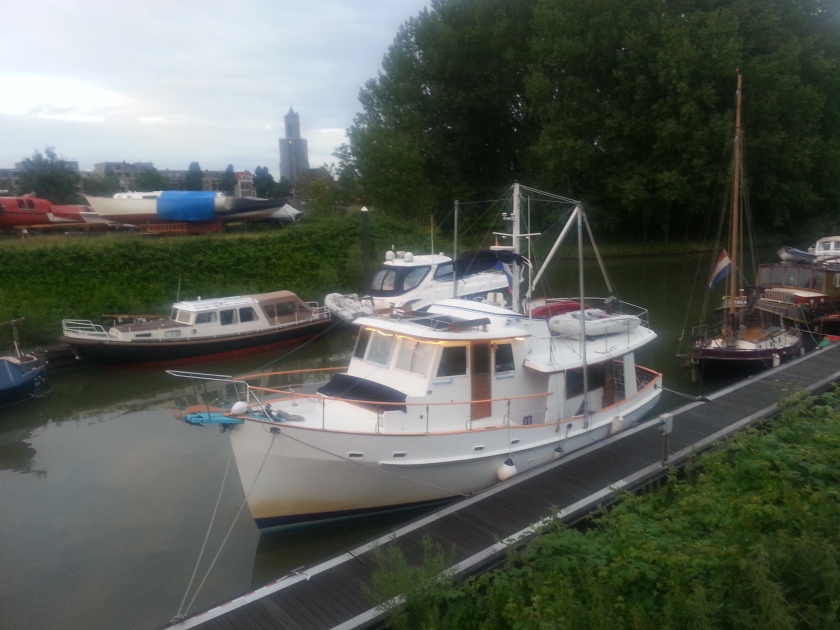
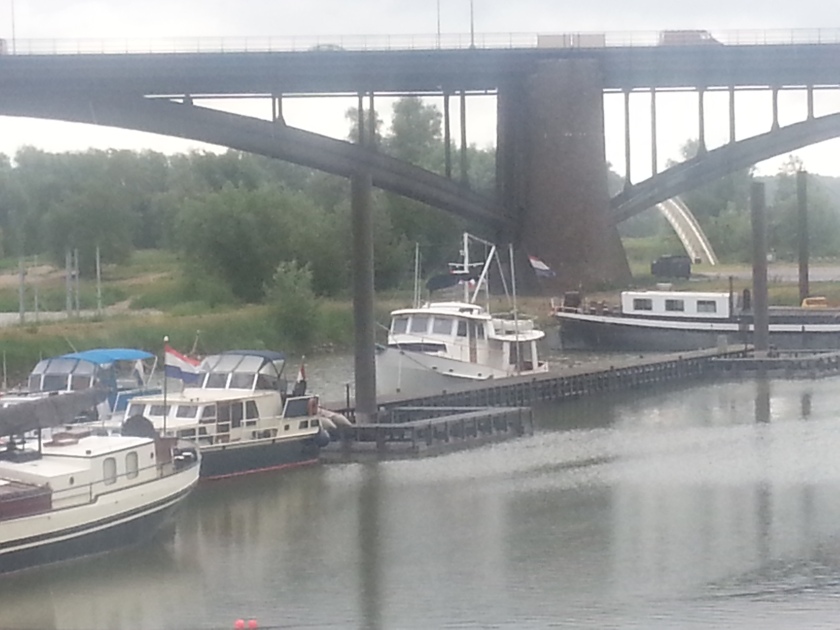
Dauntless in Arnhem
Dauntless in Arnhem

Nijmegen and Arnhem are special places for me.  My ex-wife Leonie is from Nijmegen and her sisters have lived in Arnhem the past 30 years, so it’s like coming home.

So in spite of my feeling not the best, it was great to have people over every evening for dinner, since Wednesday, to see the D, aka Dauntless.  Dauntless does appear to have gotten bigger in Europe, either that or all the docks and marinas are smaller.

So after entertaining the Vinks all weekend, I awoke this morning, with a goal to sit in my chair and do nothing.  Doing nothing is really hard for me.  That Corona ad, where the guy goes to the beach and sits with his beer watching the sunset, looks like torture to me.

So this morning, I figured, maybe I would sit in my chair in the salon and organize the two large bins I have of stuff that keeps growing, yet seems unclassifiable, so I can’t put it where it belongs.  Maybe I’ll just store it and let Leonie sort it when she and her husband Martin come out in August.

Dauntless in Nijmegen

Speaking of Martin, Dauntless has three battery chargers.  A Heart Inverter/Charger, A Neumar True Charge and another one with a yellow case.

The Neumar is the only one that can take shore power here at 230 volts and charge the batteries.  Of course when I spent that week in Horta, we were hooked up to shore power and I tried to get it to work and for the life of me, it seemed dead.  Would not even work with the generator, the way it used to.  In the Azores, I was also delayed in fixing it in that I could not find that female plug that is ubiquitous in the US for computer power supplies.

I had removed the cover that says, so not remove under pain of death, and even checked the fuses and everything else I could find.  Neumar sent me the wiring diagram and offered to send another selector switch.  This while helpful, ended up misleading me.

Even after I came back from the US in the fall, I had a cable and plug, I had labeled it all, ground, neutral and load.  Blah, blah, blah.  NO luck.

But with the solar panels and not really needing much 12 v power form the batteries while at the dock, it got put to the back burner.

So finally yesterday, while I am burning our dinner on the bbq, Martin seemed fascinated with this Charger, so not to look a gift horse in the mouth, I got him the electrical meter and found a plug we could use for the 230 system.

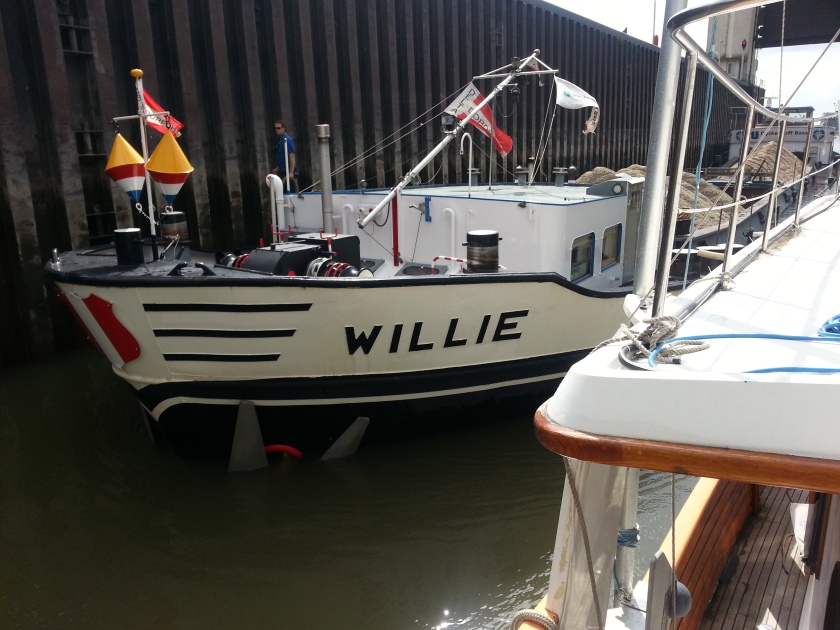
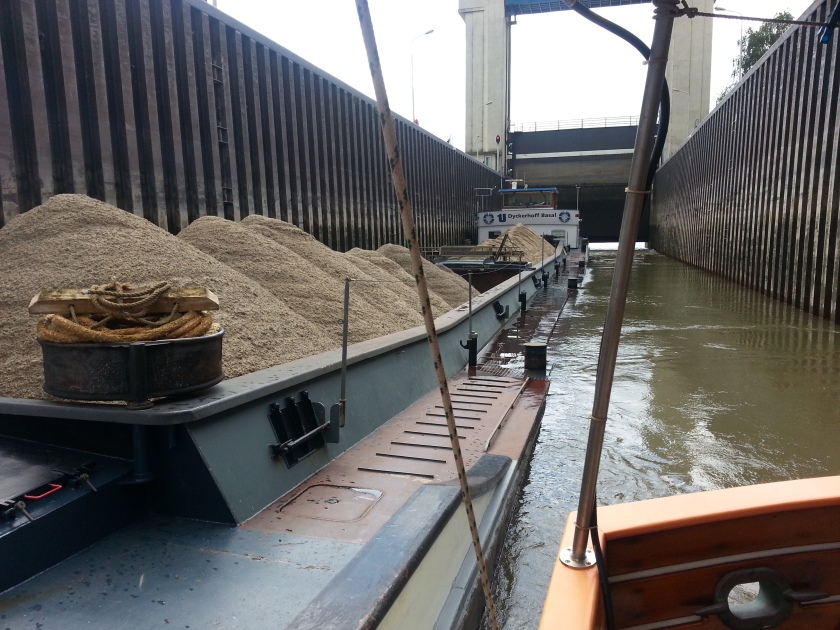
Locking with Willie carrying 1,000 tons of sand

He gets it all wired up again and plugs it in.  I said this is how far I got, but once plugged in, I never saw any power past the plug pins.  He plugs it in and within a minute it starts working!

Frankly, I was as flabbergasted as I was grateful.  One less thing to worry about.

B y the time I finished washing up, I was exhausted, so I got to bed early, feeling not so good, slept on and off until 09:30 and frankly did not feel that much better, thus the decision to do nothing.

So I’m looking at the Victron battery monitor and see a draw of 7 amps.  Other than a phone charger plugged into a cigarette lighter outlet, there is nothing else on.  I take the flashlight to check the charger, and sure enough, it is not working, but then I knew that, otherwise I would not have seen the negative 7 amps (yesterday when working it was putting 20 amps into the batteries).

The back of Willie
The back of Willie

I check the fuel levels to write in the log and then I hear it. A slight whine.  But I can’t place it. It’s not the fuel polisher, which is much nosier.

It seems to be coming from the rear section of the engine room, near the charger.

I open the salon deck panel and look down into the bilge and see a foot of water flowing rapidly, almost like a garden hose full open.

My initial panic, within seconds gives way to measured panic.  At least the bilge pump is just keeping up with it as in the little time I’ve been watching it, it has not gotten higher.  But this also explains why the batteries were down 220 amps this morning.  That poor little pump had been keeping us afloat all night.

Of course, this was one of the topics of conversation over the weekend.  I explained that while Waterford is a great place to leave the Krogen, once I’m gone for two weeks, I start getting antsy and must return within three weeks.  And I gave the example of a thru hull failure that lets a lot of water into the boat that the two pumps can keep up with only so long as there is battery power.  So even though I have friends in Waterford who keep an eye on Dauntless, they could go by every day and see nothing out of place, then all of a sudden, the batteries finally go flat and D sinks.

So all of this is going on in my mind in the first minute.

I see all this water rushing around, but where is it coming from?  I turn off the generator thru hull, because it’s right there and I figure I ran the generator for the first time since October last evening and this started last evening, so maybe they are related.

No change in flow.

Look under the engine, see nothing, but close the main engine thru hull. No change.

I look all over the engine room, the stuffing box had been my first guess, but just it’s steady drip, drip, drip.  I can’t figure out how the water is getting there. So I decide to take the chance and turn off the bilge pump and then I can see where it is coming from.

Turn it off, run over to the hatch look down and it’s the same amount of water, just sitting there sedately.  Not getting deeper; now just calm.

I turn on the pump, the whirlpool starts again, turn it off, it stops.

So, I don’t have a leak, this is the water that has come from the stuffing box in the last 12 hours (I do need to tighten it, I like a drip every minute, now it’s up to every second).

I pull the hose up to get the pump out and the hose comes up without the pump.  That explains that.

Two hours later, I’m sweating like a pig (it must be the flu, the boat is not even warm), but I put a new piece of hose on the pump with a new clamp.  The failure was caused by the old clamp disintegrating.

At 12:30 I am finally able to sit and do nothing.

So I end up spending the next three hours trying to get my wxx3 email with yahoo to work again. It just stopped working last week.

And an hour writing this, it’s 18:30, almost time for bed.’

Another day done just like that.

Oh by the way, remember I said that I initially had the charger problem in Horta last August?

It seems pretty obvious to be now that the reason the charger did not work was that the solar panels put out enough power, the charger would not be able to see the true state of batteries with the solar panels on.  Here in Arnhem yesterday, not only are we much further north, but it was also cloudy.

So I will sleep tonight knowing that I spent countless hours on that charger looking for complicated problems when the simple solution was right in front of me.  All I had to do was turn off the solar panels.


What Not to Do

All’s Well that Ends Well.  Why do I repeat that so often?  To remind myself not to think of the pain and suffering caused by my own foolish behavior.  And besides, that’s the ONLY good thing I can take out of the last two days.

A Honfleur Pistachio Ice Cream Cone
A Honfleur Pistachio Ice Cream Cone My High Point of the Last Few Days

During the past few days, I broke about every rule I had vowed never to break:

  • Don’t enter a strange harbor at night
  • Don’t back up the boat to dock
  • Don’t enter strange marina at night
  • Don’t set out on a cruise with winds in your face from the get go
  • Don’t travel with current and strong winds in the opposite direction.
  • Repair little leaks before they get to be big ones
  • Move the fuel tank vents
  • Don’t let one problem lead to others
  • Do preventive maintenance things the day BEFORE departure
  • Run the fuel polisher while in port
  • Don’t delay in changing fuel filters as needed
  • Always do a visual check that all lines are clear when leaving dock
  • Don’t get a case of “get home-itis”
  • And if any of the above develop, pull into a port in the daytime and wait it out.

I did none of that.

Let’s rewind the tape and see why that happened.

Larry and Karla were leaving Dauntless for the gay lights of Paris and by coincidence; they were being replaced by someone from Paris, Pierre-Jean who had contacted me a few months ago, as he is really interested in Kadey Krogens.

Our goal was Vlissingen, in the southwest corner of Holland, about 190 nautical miles (210 sm, 350 km), 30 hours at just above 6 knots.

I had been looking at the weather for days, http://earth.nullschool.net/#current/wind/surface/level/orthographic=-2.69,50.52,3000

This surface wind chart at earth.nullschool.net is pretty much the only thing I look at.  It goes out 4 days and by clicking on any specific point, it provides the wind direction and speed for that point.

Now, listen carefully, when you go to your favorite weather site to get a specific forecast, with all pretty colors and forecasts every minute, all you are getting is the same information in a format that has been made to look attractive.  The danger is that those more specific forecasts give the impression of significance that does NOT exist.  OK moving on.

Sunday looked to be a good weather day, light winds, but the forecast for the coming days had steadily increasing northeasterly winds from Sunday night thru the end of the forecast period on Wednesday.

NE winds was our worst case scenario, as we had to go NE.  In addition, the currents in the English Channel are very strong, 3 to 5 knots, and we had already encountered even stronger currents, contrary winds and very steep standing waves just getting to Honfleur.  After that encounter, I had vowed never again.

Never lasted only two days.

Dauntless in Honfleur

I have found that 15 knots of wind is the magic number.  Below that speed, no matter the direction, seas stay small and travel is relatively easy. Above that speed, seas start building and the direction and currents start making a big difference.

Well, my forecast was right on.  Should have been easy.

Sunday looked to be the best day, light NE winds, increasing to NE at 10 to 15 knots Monday, increasing to 25 to 35 knots Monday night through Tuesday night.

We were leaving Honfleur at 8:30, the time the bridge opened to let us out of the inner harbor.  Then one hour down the Seine we would be turning NE ward just as the currents also revered to run NE.  Our ETA to Vlissingen was 04:00 Tuesday morning.  Now this would mean the last 10 hours would be into strong winds.  Pierre-Jean and I talked about the plan and figured if it got bad, we would just pull into French or Belgium port before it got too bad. But how bad could it be?

Famous last words.

Because I had not yet moved the fuel vents, I was diligent about feeding from the windward tank, as Dauntless rolls a bit more to leeward.  Having left Waterford with full tanks, the port side tank was finally about 5 inches less than full and therefore showing up on the sight tube.  So, I decided to leave Honfleur running on the starboard tanks, to level the boat.

When we had arrived in Honfleur, two days previously, the Fuel Polisher which had been running the whole time while underway, indicated 10” of Hg, which meant it needed to be changed.  I also noticed a little water in the bottom of the bowl.   So I wrote in my log to change the FP and the port side Racor filters.

I am still mystified why I did not do this before the Sunday departure.

We must be waiting in front of the bridge for the 8:30 opening.  I had started the engine and turned on the fuel polisher for the starboard tank at 08:00, we would use the starboard side Racor, which was new.

At 08:15, I do a last minute check in the engine room and decide that I would now change the two filters, thinking better late than never, though I hated the thought of starting my day smell of diesel.

Changing the two filters took about 5 minutes, so with 10 minutes to spare, our lines are cast off and I’m backing out of the slip, with my hands smelling of fuel, even though I had washed them three times.

I must have been distracted.

As we back out, all of a sudden, the bow starts swinging quickly to the right, towards the bowsprit of the two sailboats docked perpendicular to Dauntless.  Thinking that it’s wind driven, I quickly give a burst of left full rudder in forward to push the bow to port.  That works.  OK I try backing straight again, same thing happens at which point the sailboat folks are getting concerned.   I straighten the boat again and as I go to look, Pierre-Jean yells that there is still a line tied to the end of the finger pier to our stern.  Well, that explains that. We get the line untied and I pull out finally with no drama.

No, in reality the drama was just beginning.

To be Continued


My Father’s Son

I am my father’s son.

Dauntless in the Vieux Basin Honfleur, France

I do like the finer things in life. Too bad we see these things so late in life.  When the Buddha referred to enlightenment, he probably meant just that, old enough  to be over youthful  self-centeredness to now have the vision to see those things around us as they truly are and to appreciate and be grateful for what we received from others. To recognize the things we may have distained in youth: duty, honor and respect are in actuality, the core of our being.

I suppose my thoughts have been directed this way because we are docked in the old basin in Honfleur, a day before the 6th of June,  D-day.  Even though it was 71 years ago, there are more American flags flying here then I have ever seen in all my travels in Europe over the past 40 years.  I think because along the Normandy coast, these people, or their parents, great grandparents, actually witnessed Americans dying to liberate them.

It’s more personal, not an afterthought like in the rest of Europe where they take such things for granted.

OK so let’s talk about the last few days before my editor cuts me off.

But indulge me and let be start at the end.

All’s Well that Ends Well.

I‘m wearing my blue pinstripe suit for the first time since leaving New York.  It feels good to be dressed.  Oh, I’m wearing it with a sweater and tee shirt, so it is casual, but still, I feel good. Being alone, I have fewer occasions to dress well.  I like dressing for Julie, as she does for me.  And just like clothes, she would appreciate this restaurant as much as I do.

I have just had one of the best dinners I have had in a long time, certainly since Spain and Italy, at La Gambetta in Honfleur, France.  As I sat there, watching the meticulous setting of the tables, the level of service, savored the marvelously prepared dishes, I thought of my father.

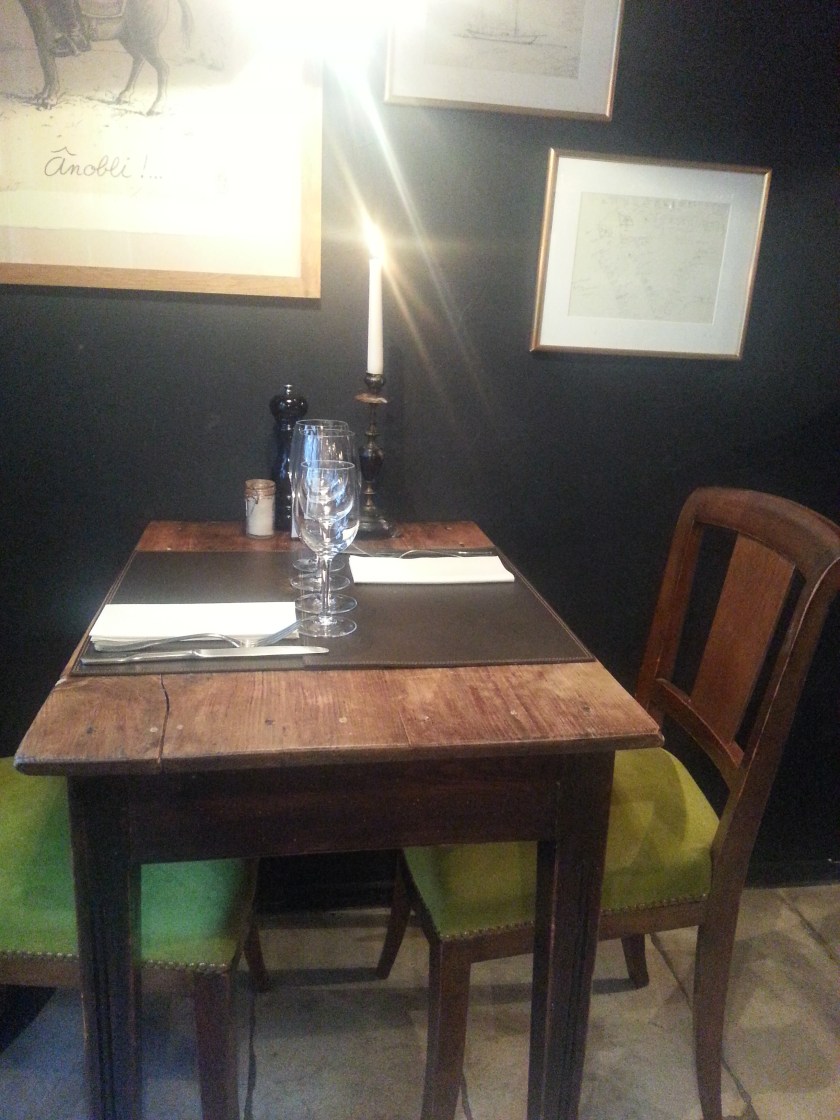
A Perfectly Set table

My father first came to France sometime in the mid-1960’s.  I think.  At least that’s when I was first aware of it.  My parents were from the generation that kids didn’t have a need to know everything.  But mom always talked about how much father loved France, clearly the food,  and the wine, as he did bring home a case of wine from the Chateau du Bost, and women.??

Maybe it is as simple as the sense of well being and caring one gets form being in a restaurant that only has a single seating all evening.  The focus is on the diners at hand, not what the future may hold.  This is the norm in most of europe and everywhere in France, Spain and Italy.  I understand more Dutch then French, yet the French always treat me well.

30 hours earlier, we had just finished docking.  Adjusting the lines took another hour.  Being on too short a finger pier is always challenging, as is the fact that our beam of 16’ is really wide for Europe. We may be the fattest boat in the harbor.  But we had come through one lock, one bridge and a night on anchor unscathed, so I was ready to celebrate.

It wasn’t till we were firmly docked, as I took my celebratory shower, I luxuriated in the sense of another job well done.  The first phase of the summer cruise was over.  Dauntless and I were on the continent.  We had dealt with the boat yard, we had dealt with the bottom paint, we had started the installation of the Wallas heater, and the bus heater.  The lazerette was clean and organized. The Electroscan had been replaced by the Purasan and the Maretron system was not only giving me the correct data, it was even talking to Coastal Explorer. I had gotten the water maker up and running with the new auxiliary pump and new switch system.  Life was good.

Larry and Karla were enounced in their cozy hotel room in Honfleur. They deserved it, as  I had worked those two like a rented mule these last three weeks.  Dauntless was never cleaner, nor brighter than the day we bought her.  It was wonderful to have old friends, Larry I met on T-3 in 1973, and I was grateful to have another 4 hands to help with all the jobs to be done.  All our visitors for the rest of the summer will benefit.

Yesterday, I had also finally gotten the tides and currents right.  We hauled anchor at 05:00, currents were changing at 06:00 and we needed that full 6  hours of favorable current to get to Honfleur (just south of Le Harve) at a reasonable time.

We made such good time, 7 to 9 knots, that an hour out of the mouth of the Seine, I could reduce the rpms to 1200 and still made 6 knots to arrive at the lock for Honfleur with time to spare.

Dauntless In Honfleur

We had had 7 to 10 knots winds on our nose all day, but less than 10 knots, even with a current that is against the wind, meant the waves were only 1 to 2 feet.  Best seas we have had for the previous three weeks.  Our 10 hour trip took 8.

And quite different than the debacle of the day before, where we did 48 miles in the first 6 hours, then took 3 hours to go the final 6 miles, and then it got worse.


Dauntless Summer Cruise 2015 Day 03 Scilly to France

We got up early to take advantage of the calm winds and little boat traffic.  Dauntless rolled a bit last night on the mooring ball, so I put the paravanes out.  They decreased the roll a bit, certainly dampened it, like shock absorbers on a car, but these particular fish (or birds) are made to be moving through the water for maximum effectiveness.

Cirrus South of Scilly

As we got south of the Scillies, I realized that while it was 90 nm to Plymouth, France was but 120 nm.   With fair skies and still under the influence of the Azores high, it made sense to me to press on across the channel to the continent.  I discussed our options with Karla and Larry and they concurred.  A direct route to France also meant we could avoid the Traffic Separation Scheme (TSS) off the English Channel and the area north of Brest.

So instead of turning due east for Plymouth, we set off ESE towards the north coast of France.  The port of Trebeurden is our goal, with anticipated steaming time of 22 hours.

After a few hours of beautiful weather and looking at our expected arrival time, I decided to lower the engine rpms to 1500.  Not only will that save us about a half-gallon of fuel per hour, but our ETA would have been 04:00 at the faster speed, and is now, about 05:30.  A better arrival time, as it will be light.

It’s 18:00 now and as the day progressed diurnal heating produced some stratocumulus clouds and winds from the WNW at 15 gusting to 23.  So the almost flat seas we had in the morning, gave way to wind driven waves of 3 to 5 feet hitting Dauntless on her stern starboard quarter.  We have gradually increased our rolling from plus or minus 1 to 2 degrees to +/- 4 to 6°

Still, that’s half of what it was  for the last few hours of our cruise into St. Mary’s Harbor in Scilly.

For dinner, I made a tasty dinner of hamburger and crudité.   The hamburger ground by my butcher in Waterford.  It’s hard to imagine that I spent 8 months on and off in Waterford and now won’t be back for four months.  But I did meet an Irish sailboat in St. Mary’s.  We had gotten into a discussion about the “legs” on their boat which was beached on hard sand, held vertical on its keel by said legs.  That gave me some ideas of how I could make that work on Dauntless.  Probably just 4”x4”s with a notch for the rub rail, then bolted through the hawse pipe.  A project for next winter.  They were taking her to the west coast of Ireland and will winter over in Dingle, so I promised to come visit next winter.

Unlike yesterday, time today has seemed to fly by.  And yes, I kept the patch on.

For the past two hours I have been watching the parade of ships heading for the TSS north of Brest.  I have also managed to figure out the Raymarine radar a little better and finally noticed after two years that the gain also had an adjustment for wave state.  I could keep the gain much higher, if I also adjusted the wave state.  A win win.  And to think, some say I’m a slow learner! (win-win turned out to be tie-tie, as I adjusted it not to see waves, turns out it also didn’t see fishing boats).

The Dauntless Helm with Radar, Chart & AIS Information

A beautifully flat day, azure sky and sea, with just some mare tails cirrus. As the afternoon and evening progressed, the winds started picking up slowly, but surely.  By evening, increased westerly winds had produced 3 to 5’ waves and the roll was 6° to each side.  As one of the lessons learned from the Atlantic Crossing, I now run off the tank on the windward side of the boat.  The lee side seems to remain heeled for slightly longer times, so I don’t want the engine sucking water through the vents.  Yes, I had not gotten around to moving the vents yet.  I did think about it a lot though!

Under these conditions, it’s not an issue, and possibly only an issue under heavy seas with only paravane in the water.

I had also adjusted the ComNav Autopilot to be less sensitive, so that it made fewer corrections constantly.  I will have to call them someday and discuss if my interpretation by reading between the lines of their user manual is correct.  Basically, under open ocean conditions, meaning no need to keep a rigid heading constantly, I set the sea state to very high (rough seas), so that it doesn’t try to adjust heading every second.  Under these conditions, I will hear it operate every few (3 to 6) seconds.

Our Planned Apprach to Trebeurden

On the other hand, under truly rough, 12+ seas, I set it to totally flat conditions, so that as soon as it senses the stern coming around it acts.  Then the adjustments are almost constant, but it does a great job of steering the boat through the worst conditions.  I have tried to hand steer under such conditions and frankly the ComNav does a better job.  In the 20+ foot seas on the last day into Ireland, as I cowered on the bench in the pilot house, the ComNav reacted so well, I never saw any green water over the rails.  Maybe I should ask them about a sponsorship!

During the early evening hours we had a little excitement as we were crossing the main eastbound traffic lanes.  While not in a TSS, the ships having come around Brest in the TSS 30 miles to our west, will reenter the TSS about 30 miles to our east.  Therefore they pretty much stay in the same track.  Makes it easier for us, as one can figure out where the main traffic lane is and the direction ships will be heading.

We only encountered a few west bound ships, but an hour north of the east bound lanes, our AIS and Coastal Explorer showed the parade of ships heading east.  They were cruising at 14 to 18 knots, while we were doing 6.5 knots.  That gave me plenty of time to plan our crossing.  There was only one ship that was a factor.  It was a big Chinese ship that the AIS said it was doing dredging operations (something must have gotten lost in translation), but to me looked to be one of those floating dry docks. Massive bridge at the bow and a massive stern and almost nothing in between.

What it really Looked like

I adjusted our course to be perpendicular to his course and I could see that he adjusted his course a few degrees to starboard also.  The picture is what CE depicted. The closest anyone got was about a mile, though later on we passed a fishing boat about a quarter mile away, but I had been watching him for more than an hour so…

By midnight winds were westerly at 15 gusting to 22, seas 4 to 6 feet and roll 7°. This kept up until we reached the harbor.

Dawn was breaking as we approached.  We had to stop to get the paravanes in, while it only took a few minutes, it was disconcerting to be stopped just hundreds of feet from the large rocky outcrop.  So I was much relieved to get underway again even though Dauntless hardly drifted at all.

Previously, I had carefully plotted a course into the basin based on our pilot charts, and my C-Map and Navionics charts.

The Basin Entrance with Underwater Sill

But the reality ended up being a bit different. Our planned path was full of moored boats. So on to Plan B, I kept our speed just above idle, about  4 knots, to minimize the damage if we hit anything.  I picked up the three green lights our pilot charts told us meant the gate was open.  But our pilot chart had also told us the gate was always open during neap tides and as I remembered seeing the waxing (light on the right) quarter moon last night, I knew it was a neap tide.

The Gate We Passed Through. D is just past the gate on the left.

Creeping slowly forward, the sign board seemed to indicate 2.5 meters, but always leery that I am missing the obvious, I was still worried about the mysterious sill.  We passed over the sill into the marina basin and didn’t scrape anything, but it was an anxious moment.

A big assed catamaran was on the one available “T”.  I went past him to see if we had any options, we didn’t.  I turned around and headed for a slip just inside the gate.  The slip is short, only 20 feet, so our rear half is hanging out.

The wind was behind us, so that was a bit of a mistake, it made the docking more stressful then it needed to be, but finally, 23 hours after engine start at St. Mary’s, we were finished with engine and had landed on the “continent” for the first time by boat.

Dauntless at Dock
Dauntless at Dock
The Trebeurden Harbor from Above
The Trebeurden Harbor from Above. Dauntless is docked in the basin to the left, out of the Frame.

All’s Well that Ends Well

Closeup of Our Crossing
Closeup of Our Crossing. Those are 30 minute Heading Vectors.


Maretron Data for the Previous 24 hours.  The Telltale says the Highest wind was  24 Knots, but I reset that frequently.
Maretron Data for the Previous 24 hours. The Telltale says the Highest wind was 24 Knots, but I reset that frequently.


Winter Work Almost Done

We took a half hour cruise yesterday, first time Dauntless has moved since my arrival October 1st.

Sunset in Waterford with the Moon and Venus Looking on.

It felt so good to be out on the water, if only on the River Suir, in front of Waterford.  As you can see from the pictures of our docking situation, I needed to wait to leave the dock until we had a current against us.

So we untied and left the dock about a half hour before low tide.  Did a few figure 8’s, just to test all the systems.

No leaks, no problems, no strange odors or noises.

The Lazarette is empty and clean for the first time thanks to Larry.

The Lexan storm windows are cleaned with new rubber gaskets applied in a far more systematic way then previously, thanks to Karla.  I like the insulation they provide in these cool climates.

D is good to go.

Current plans will be to depart Waterford early Saturday morning, as we will be going to a boatyard at New Ross, one hour down river, two hours up another river, for haul out.

Hopefully, if all goes well, we will be ready to

Waterford Sunset
Waterford Sunset

leave Tuesday at latest to begin our summer adventure.

Sunset
Sunset
Richard in an empty, clean Lazerette
Richard in an empty, clean Lazarette

A Far Better Day

I can see why satire is so effective; no, I did not sleep well, but I woke up in a far better mood and the simple fact is I am tied to the dock, so any problem is fixable.  Getting across an ocean helps the perspective.

Larry, my Alaskan friend, along with his wife, Karla, is also here to help.

I had decided that I still needed to finish installing the controller and tablet dispenser for the Purasan, leak or no leak.

Another thing that happened yesterday was the forward bilge pump, while running, was not pumping any water out.  So Bucket Head came to the rescue again and we could at least get the inch of water in the bilge out.

Having a leaking sanitation system into the bilge without the bilge pump working was a very unpleasant prospect, so I awoke this morning with a plan the first, I would deal with the bilge pump.

By 9:00 a.m. I had gotten the courage to take up the floor hatch covers and drive into the depths to do battle again.  The bilge pump ran, but no pumping.  I disconnected it from its bracket and then took off the short hose.

I put the pump into the shower sump and as I lifted the float sensor, the pump sprayed water all over the place.  Well. At least one problem was partially solved.  I took off the one way valve, water poured out of the hose, but blowing thru the valve showed it worked as it was supposed to (I was days past caring about where my lips were).

Putting it all back together, I once again used the hose to see if it was working and wonder of wonders, it was.  I’m guessing that the day before, we may have been spraying down the bilge and I have has instances where when I do that to the shower pump, it can lose its prime.  At that point, if it is running, it runs, but does not pump.  Only turning it off and letting it rest, while presumably, the water for the out flow flows back into the pump, thus priming it.  So when powered up again it works fine.

The bilge pump could not do that, since the one way valve is on the outtake side.

Knowing we had a working bilge pump made tackling the treatment tank far easier, as least now we could keep the forward bilge relatively clean.

So now we carefully dried the top of the processing unit and over the course of an hour, watched carefully as we flushed toilets.  No leaks that I could find.

Then, within minutes I get a call from the States, it’s Raritan.  I had called yesterday and left a message with the Senior Engineer, who I had talked with previously.  So Brian was returning the call and I told him exactly what had happened yesterday and then today.

I was sorry I had cried “wolf”, but it was clearly not leaking now, while yesterday, I watched the fast drip of water with every flush.

Brian also helped me with a few other issues, including the solution to the one push pad issue.  I had also woken this morning with a plan if only using one push pad.  Brian confirmed my idea and also explained how I could set it up as before with one touch on either toilet.

This conversation led me to understand that the instructions for the second toilet which called for the two toilet option were written for people who did not have Raritan toilets already.  So, now Raritan’s only crime is a poorly written installation manual, and nowadays everyone is guilty of that.

I still must calibrate the system, but at least I will be able to enjoy my dinner tonight.

And Monday, the Wallas heater install will commence.  I wonder how their instructions, which I have already read many times, will work in actual execution?


A Few Days of Electrical Hijinks

Or How to Turn a Three hour Job into Three Days

Today is sunny, the birds are singing and I hope to finish the great electrical puzzle.

A Portion of the Engine Room Electrical Panel

Its Sunday, 10 May, 2015 15:00, 3:00 p.m., 30 hours after I had written the sentence above.  Little did I realize three days ago that I would still be dealing with this tar baby.

Day 1 Friday, started out rainy, dark and damp.  I figured a good day to stay in and finish the electrical work that I had started yesterday.  Shouldn’t take me even all day, I thought.  Ha!

It was’nt complicated in what I was trying to do.  Dauntless has two electrical systems: 120 volt AC like you has at home and 12 volt DC, as your car uses.  But now it becomes complicated, because unlike a house that sits on the ground and is literally and figuratively “grounded” or a car, which sits on rubber tires and therefore is isolated from the ground; a boat is neither.  Not only that, but unlike a house, a boat is producing electricity or bringing it from the shore and making sure it doesn’t  escape is a crucial.

Why?  Because in the process of the electrons leaving the boat, going to Earth, the ground, they do not travel as free electrons, but as ions, electrically charged particles, that conduct electricity, in other words any metal on the boat in contact with water.

So this means that if the boat and its electrical systems are not grounded correctly, it will eat away at whatever metal parts it can find.  There are two ways we deal with this.  The first is to have a metal block somewhere on the outside hull that is connected to all the major grounding points inside the boat.  The second is to use sacrificial metals, in particular zinc, which is attached to the engine, and on the drive shaft, so it eats that zinc and not the engine, the prop or the drive shaft.

These systems work well when properly maintained and designed in the first place.  Dauntless actually has three electrical systems, two 120 a.c., one being connected to the Inverter and one 12 v d.c.  I discovered that the 120v systems were cross wired in a way that helps to defeat the other safeguards in the boat.  That’s bad.  It can damage equipment, but worse lead to electricity leaking into the water taking metal ions from wherever it can find them with it.  There may even be some electrocution risk, but that’s minor in the scheme of things.

So the process started Thursday, with me making a plan, looking at the old blueprint of the electrical system and making a new diagram of the changes I wanted to make.

I soon discovered that the neutral wires, those white wires in a 120v system, were not correct.  And much like an old series style Christmas tree bulbs, having one burn out, darkens them all, in this case, having one wire going to the wrong place, puts the entire system at risk.

So thus started the get neutral hunt.  Having to disconnect everything and then figure out what is connected to what.

I did that and at the same time I also changed the function of three of my upper panel breaker switches.

This is where I always get  in trouble.  By making many changes at once, while it may seem more efficient, it is only so, if and only if, everything works as planned when done.

It didn’t.

By late afternoon, I was ready to check to see if my changes worked as anticipated.  The most significant change was allowing the Inverter to give power to the hot water heater.  Completing the last connections, I turned on the inverter, got my trusty volt meter and tested the voltage going to the water heater.  1 volt! Not zero, but clearly not right.

Decided I’d finish it in the morning. Going to sleep that night, I did not have visions of sugar plum fairies, instead it was circuit diagrams and what had I missed.

The sun streaming in the windows woke me Saturday.  Had my coffee and two oatmeal cookies form Costco that I had brought back with me and kept in the freezer.

I proceeded to spend the next few hours trying to understand what was happening or not.  OK no power to the water heater, but what about the other stuff on the Inverter circuit? The outlets, the microwave, etc. Sometimes they had power, sometimes not.

The Hamburg Pulls Up Next to Dauntless

Brought my analog volt meter out.  Too many times in the past, I have been fooled by the digital meter not registering voltage for who knows what reason.  I then spent the next few hours at the upper panel, maybe the problem was just getting the electricity down to the engine room?

Like everything, at first it seemed different, but upon closer inspection, same old problem.

I had noticed that if I turned on one particular circuit that the microwave happened to be on, then the entire system had power, but if that one circuit was off, no power anywhere.

I got worried that I had some strange feedback going on, that my turning on the circuit was allowing the electricity to flow backwards.  Made no sense, but is possible, so I had to disconnect more stuff to make sure that wasn’t happening.

Earlier this morning, I heard a strange noise while in the engine room.  Almost sounded like a mixer inside my fuel tank.  Having learned the hard way that ignoring strange noises in a boat is like waving a red flag at a bull, I crawled out of the engine room to discover this behemoth in the middle of the river.  What I had heard were his bow thrusters.

Hamburg Docked in Waterford

I watched him dock across the river.

Well, at least the weather was better than the day before, so  I decided I needed a break and would do some shopping.  I went the baker and got an apple pie (I like pieces for breakfast), then the butcher, who ground for me hamburger with 20% fat, instead of their normal 5%.  Lastly to Dunn’s supermarket where I get my greens, in particular wild rocket (arugula, I think) and lamb’s lettuce.

Getting back to the boat, I fiddled with the electricity some more

Made my salad, didn’t overcook my burger on the Weber this time and it was one of my best dinners in a long time.  Even drank red wine with it.  Watched a few episodes of a new Korean Drama that I had downloaded while in NY, Cheongdamdong Alice, a really sweet drama.

So today, Sunday, I woke to gusting winds, driving rain and figured I would disconnect everything again, figure where every line goes and it has to work.

Didn’t work.  Finally, I figured maybe it was the Inverter.  Maybe I should read the manual again.  Get it out, sit down, and make a cup of tea.  Right in the introduction as it talks about how great it is and all the marvelous features, it mentions an “idle” mode.

WTF? Idle mode, I was pulling my hair out, thinking I had some crossed wires and now it tells me there is an idle mode, immediately I realize that’s why I was seeing one volt.  And then like figuring out that 2 + 2 =4, I realized the one circuit that had to be one, was the only circuit that had a load, the little display of the microwave oven! Eureka,

California a very interesting town, but I digress.

OK, easy test, I get the vacuum, plug it in to a plug on a different circuit and turn on the inverter.

Within seconds the vacuum comes on, even while the microwave circuit is off.

Three days later, the problem was solved.  Even got my water heater to work off the inverter. Takes a lot of power, but it will suffice this summer on those days we are at anchor.

Now, back to that drama.

Think I deserve a scone and some tea also.


Just What Have I Been Doing for the Last Few Months?

20150305_143615
Packed Storage Bins

Since December, besides travelling to England, Italy, Spain and the U.S., I have been organizing tools and spare parts.  I am making a computerized list of each part, their storage location, as well as any significant information, such as model number, etc.

Having also reorganized my tools and fasteners, clamps, etc., my life will be so much easier, and as an added bonus, I was able to throw away two garbage cans of packing materials.

Though I am returning to Dauntless today, I shall return to NY at the end of April for two weeks. Dauntless will be hauled out and have her bottom painted again while I am in NY.  Then I will be joined by Larry, a friend of over 40 years, who I met on T-3.  With that extra set of hands, we will complete the last of the winter projects.

What’s left to be done:

  1. Replacing the Raritan toilet processing tank,
  2. Installation of the Wallas DT40 heater
  3. Installation of a 30,000 BTU “Bus” heater, which will use engine heat to heat the two cabins while underway,
  4. Recommissioning the Katadyn water maker
  5. General clean up

In my Next post, I will publish the updated Cruise Plan.

On another topic.

I made a new post on my other blog, Refeldtions, titled Another World Leader Appreciates the United States of America.

A great story that was in yesterday’s Opinion page of the Wall Street Journal, 21 March 2015, President Sisi of Egypt tells of a different reality than we are accustomed to hearing, day in and day out.

I thought it was important to share. If interested, the link is:  richardbost.wordpress.com