Work on the Mast

During the last week on Dauntless, getting her ready for the winter without me, tears all around, I realized how sweet it was to work under a roof. 

Error
This video doesn’t exist

Looking aft with the mast down, under the roof of the Vallejo City Marina

I loved it so much, I changed my project priorities a bit.  I figured it made the most sense to do those things that are difficult to do under normal circumstances.  It is such a pleasure to sit on the fly bridge, out of the hot blazing sun or the cold wet rain. With the mast down, I didn’t have to wrap one arm around the mast and hold on for dear life. Under such ideal conditions, I realized I had to get all the things done I had been contemplating for years.

Four years ago, getting Dauntless ready for her first ocean crossing, I took what was given. Unlike the Lexan storm windows which were done in the last hours, the Maretron system and instruments on the mast were completed with days to spare.

One thing that has sunk into my dense brain is if I don’t have a clue as to what I am doing, then at least do the simple solutions instead of making complicated ones. To that end, I mounted the Maretron instruments on an existing antenna arch that extended forward and was above the radar.

It was the simplest solution and worked well enough for four years, but now, I wanted to make it better. I have felt that the weather instrument that measures all the normal weather parameters, including wind speed and direction, is not in a clear air stream with winds from the stern. As you know, this Kadey Krogen loves following winds and seas, therefore if the data is being affected under such conditions, it’s not ideal.

The other issue that is also related to stern winds is that every once in a while, lines related to the paravanes, get enough slack that over time, being blown forward, like 21 days in following winds and seas, that they were easily snagged on those weather instruments or the bracket itself. In the first years, more than once, after deploying the paravanes, I discovered that the weather instrument arch was carrying the weight of the paravanes. Not good. (Though it does confirm the forces on the paravane system are as expected).

Just too many times, that antenna arch has been seconds from disaster. Time to get rid of it. The Maretron cable that runs inside the mast must also be replaced. So, the Maretron WSO and GPS will be mounted on the spreaders. In addition, I will mount my Wi-Fi extender antenna and I hope to also move my current AIS antenna to the spreader. Currently it’s mounted on the cowling of the fly bridge near the helm. It’s too low. Many times, it will not see big ships until 5 or 6 miles away. At the Dauntless speed of 6 knots and big ships possible speed of 20 knots, that still gives me more than a 10-minute warning, but that antenna should be maximized just on principal.
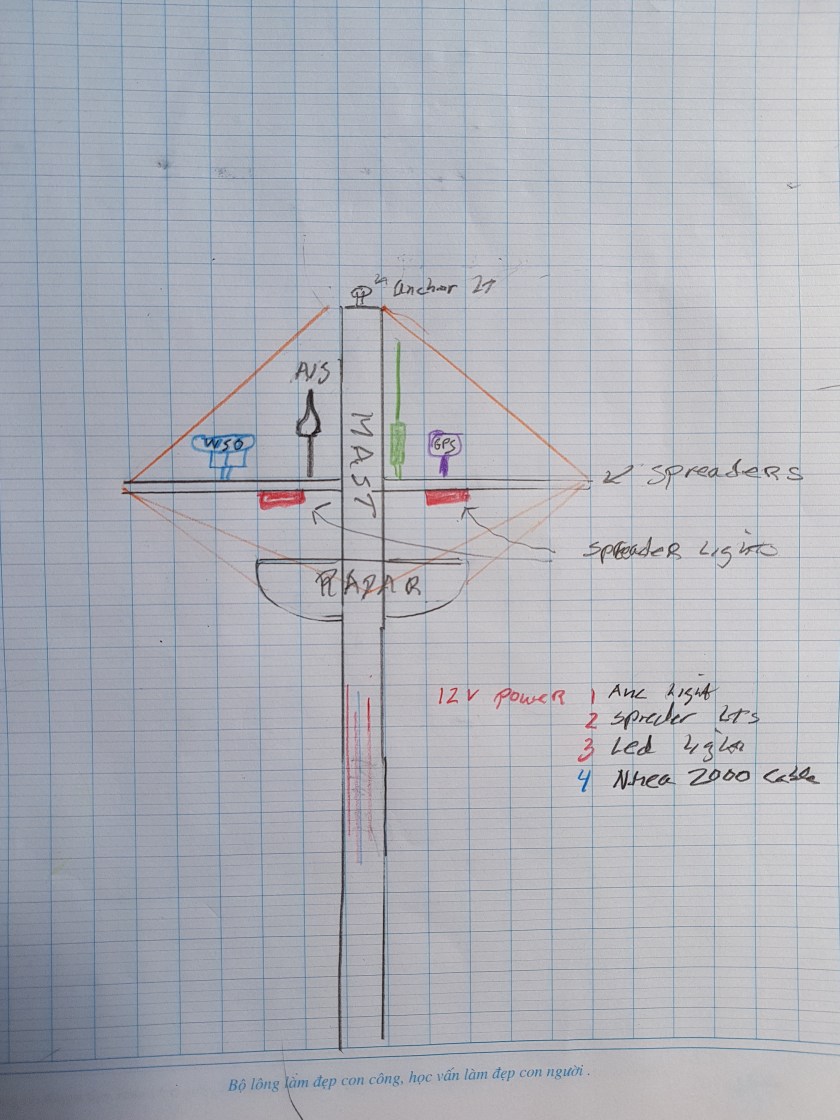
Plan for the Mast Spreaders
March 2019

I also need to remount the two Chinese LED spreader lights. The lights themselves, bought 5 years ago on Amazon for $20 each, have been great, but the mounting hardware is mild steel that rusts badly. I have a way to mount them directly to the spreaders, without the steel hardware. Since I am doing that, I will also change the electrics a bit and add an electrical circuit to power a LED stripe that I will also mount on the mast.

Now, your thinking, while I have eliminated one protuberance, I have made the spreaders much more complicated. That’s true. But I have a plan.

I will also add a 1/16th Amsteel line from the top of the mast to the end of each spreader, then forward to the front of the radar arch. Looking aft from the bow, this will look like a triangle. Looking from either side, this will look almost like an obtuse triangle.

Now, I have not added this yet. This will happen in March when I return to Dauntless, but in my mind’s eye, I see this little line as making it much more difficult for a loop of any line to become snagged around the spreaders, radar arch or the mast itself.

We’ll see.


Hundreds of Males, Too Few Females.

I was looking forward to this project, as I like working on the electrical things and I just wanted to also tidy up the wires and the things I’d done over the last couple of years.
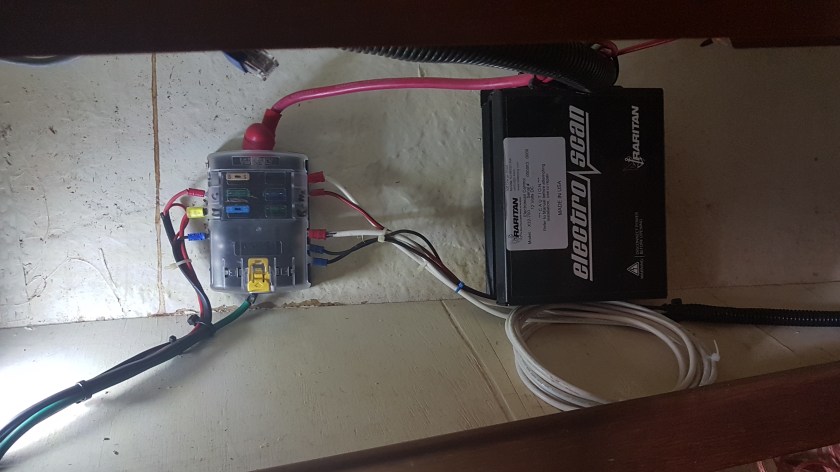
I needed to put new female spade connectors on the gauges and switches in the forward head. I also needed to replace the little bilge pump and replace the float switch for the big Rule 200 bilge pump in the forward bilge.

Cleaning up my cabin. This fuse and terminal block is for the forward head and bilge. The Raritan black box is for the old ElectroScan that I replaced with a Purisan.. This was the easy part. I had no corrosion here.

So, I get my two trays of electric connectors, with hundreds of pieces and what do I find: hundreds of males and a half dozen  females.  Sociologists warn of impending disaster when the male to female numbers reach 52% to 48% respectively in society. Because those single males unable to find mates wreak havoc on the society.

All those rogue elephants in Africa, male. Nuff said.

Female spade connectors are needed to connect a wire to the switch or instrument. I need about a dozen just for the forward head. The current connections are all corroded considerably. I know why, but don’t think I’ll mention it, other than to say, my not wanting to throw anything away can be dangerous.

Amazon will deliver the females on Tuesday.

So, I could tackle the paravane bird holders. I’ve tried various things in the last 4 years. Some have been a bit more effective than others, but in the last weeks I’ve gotten tired of stepping over them on the side deck. With the paravane pole taken down, there is not way to secure them.

In normal use, even if I think I won’t need the paravane stabilizers, I will deploy the poles only.  This allows me to deploy the birds without having to go the flybridge again. So, I need a method to secure them, with or without the poles in place.

This has been an ongoing issue. Each half-assed system I make, breaks sooner rather than later.

My solution is very simple, net and won’t get in the way, in the narrow deck space. I must say, that I think my time in Vietnam has enabled me to see simpler solutions. The Vietnamese make do with whatever they have, which is fractions of what we Americans are accustomed to.

The New paravane bird holder, suing eye hooks and 1/16″ Amsteel. Another view
The New paravane bird holder, suing eye hooks and 1/16″ Amsteel

It’s a thrifty culture and probably what I need in my reduced earning years.

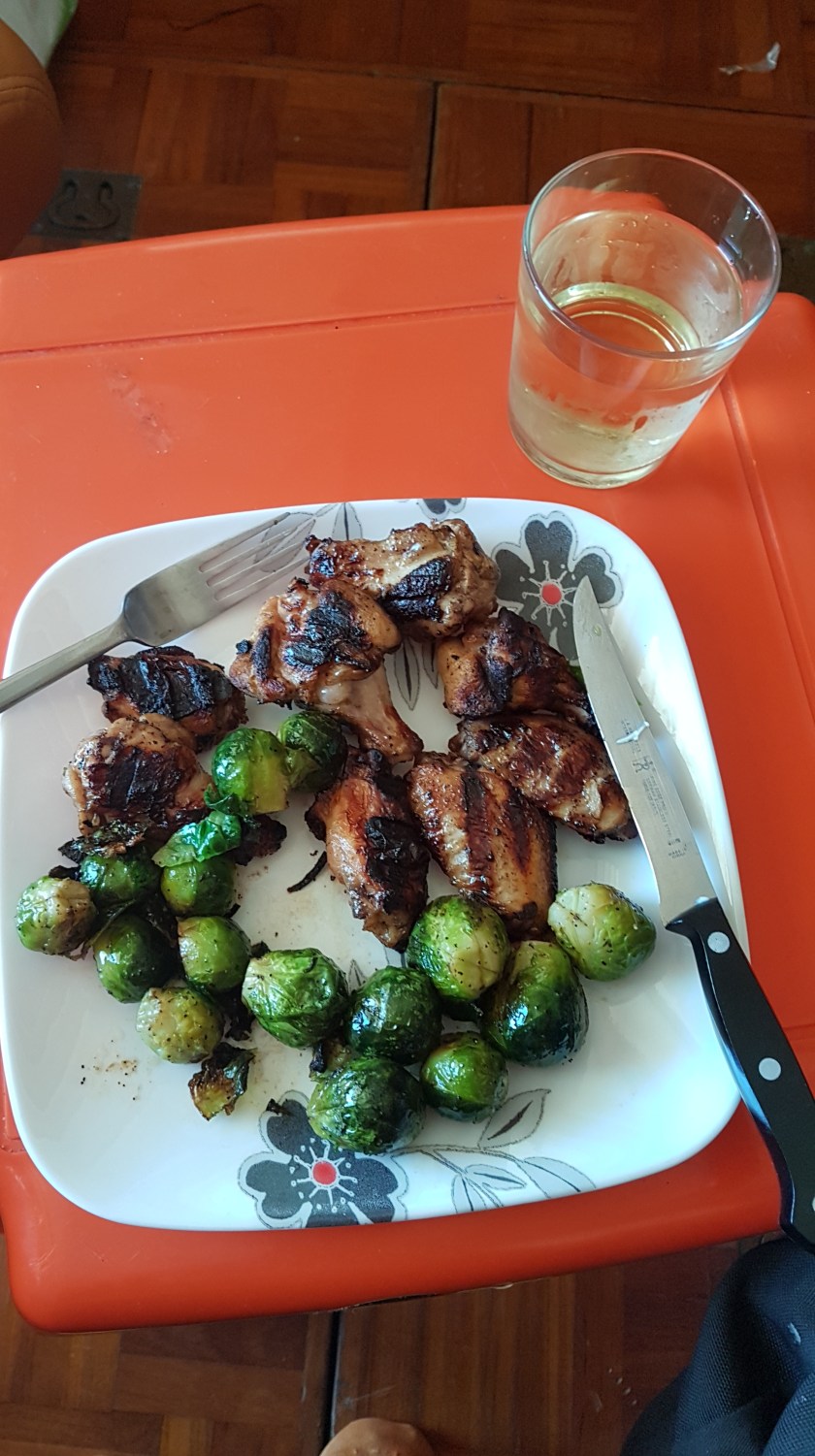
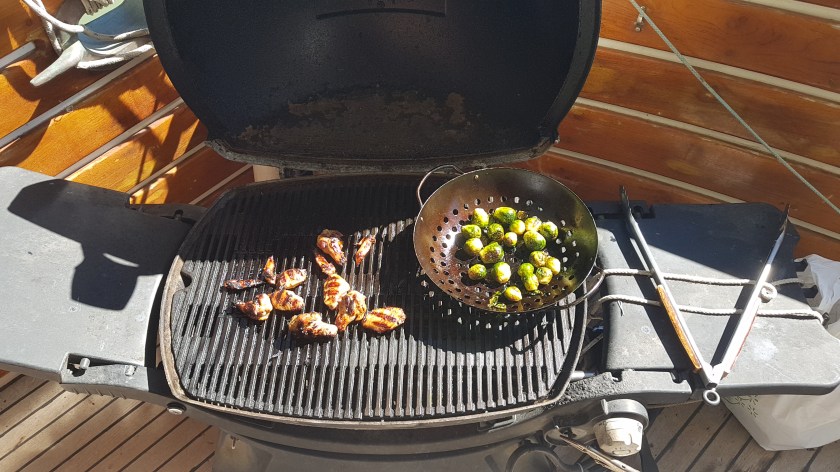
To that end, I have also really tried to limit my going out for dinner. Thus, my chicken and brussels sprouts for dinner today. Very good.

My plated dinner, chicken and Brussels sprouts.
My dinner cooking, chicken and Brussels sprouts


Two Types of Boaters

Two More Projects Down; 37 to Go

Now, there are two types of boaters.

There are those who have few parts, but they are well organized and whenever they need something, they always have just what they need. Best of all, they have very few extra pieces, everything being stored in a few 2-liter containers.

Then, there is the boater who every marine store, big box store and Amazon loves. They have literally hundreds if not thousands of parts: plumbing connectors, electrical wires of all sizes, butt connectors, spade connectors, every connector under the sun; except for the one they need.

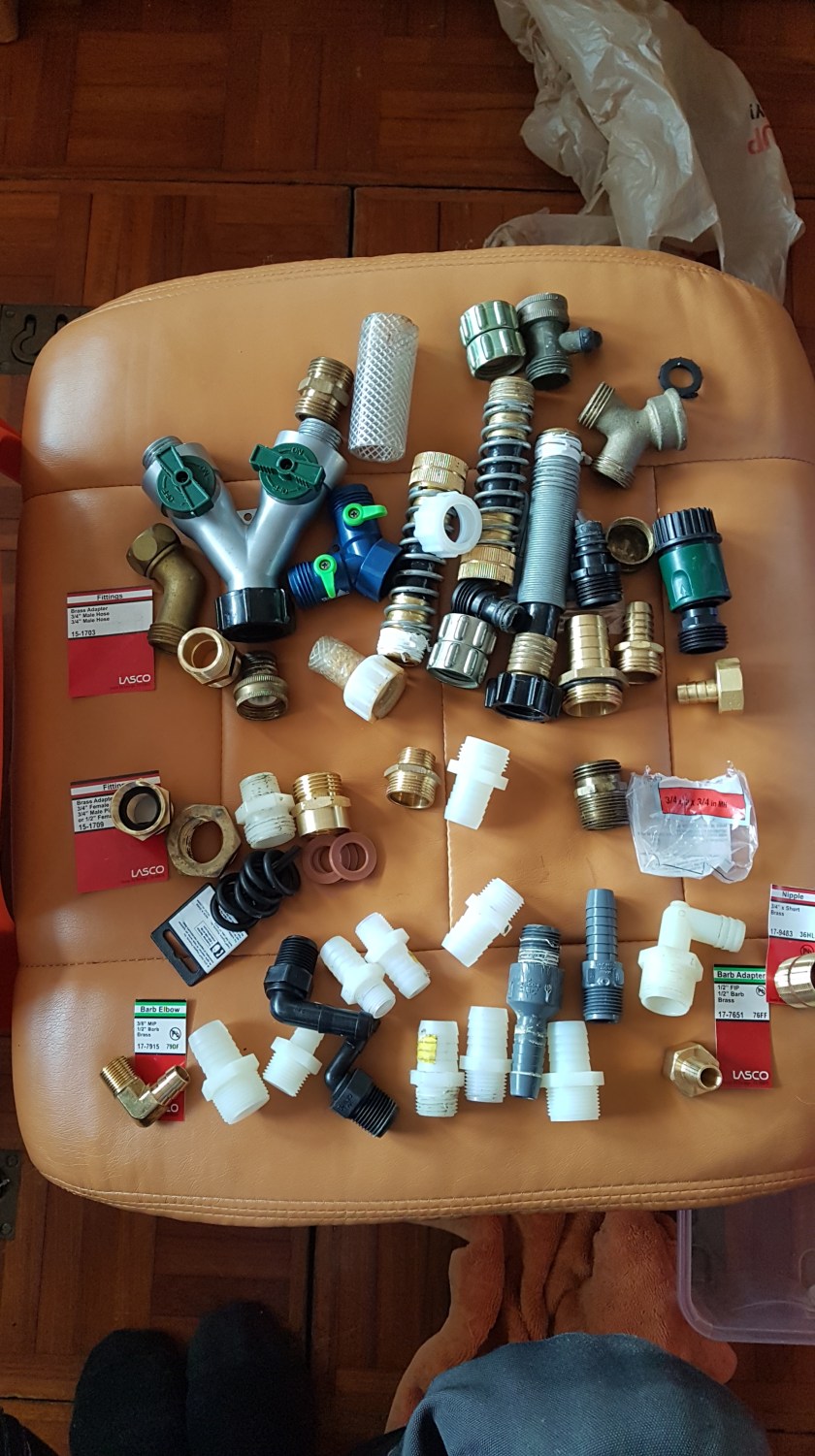
All threaded NPT

I’m in the latter group.

So, my little, very little, dock filter project, took three days and 4 trips to Home Depot, Wal-Mart and Ace hardware. Why, you wonder with the plethora of things I already have on board?

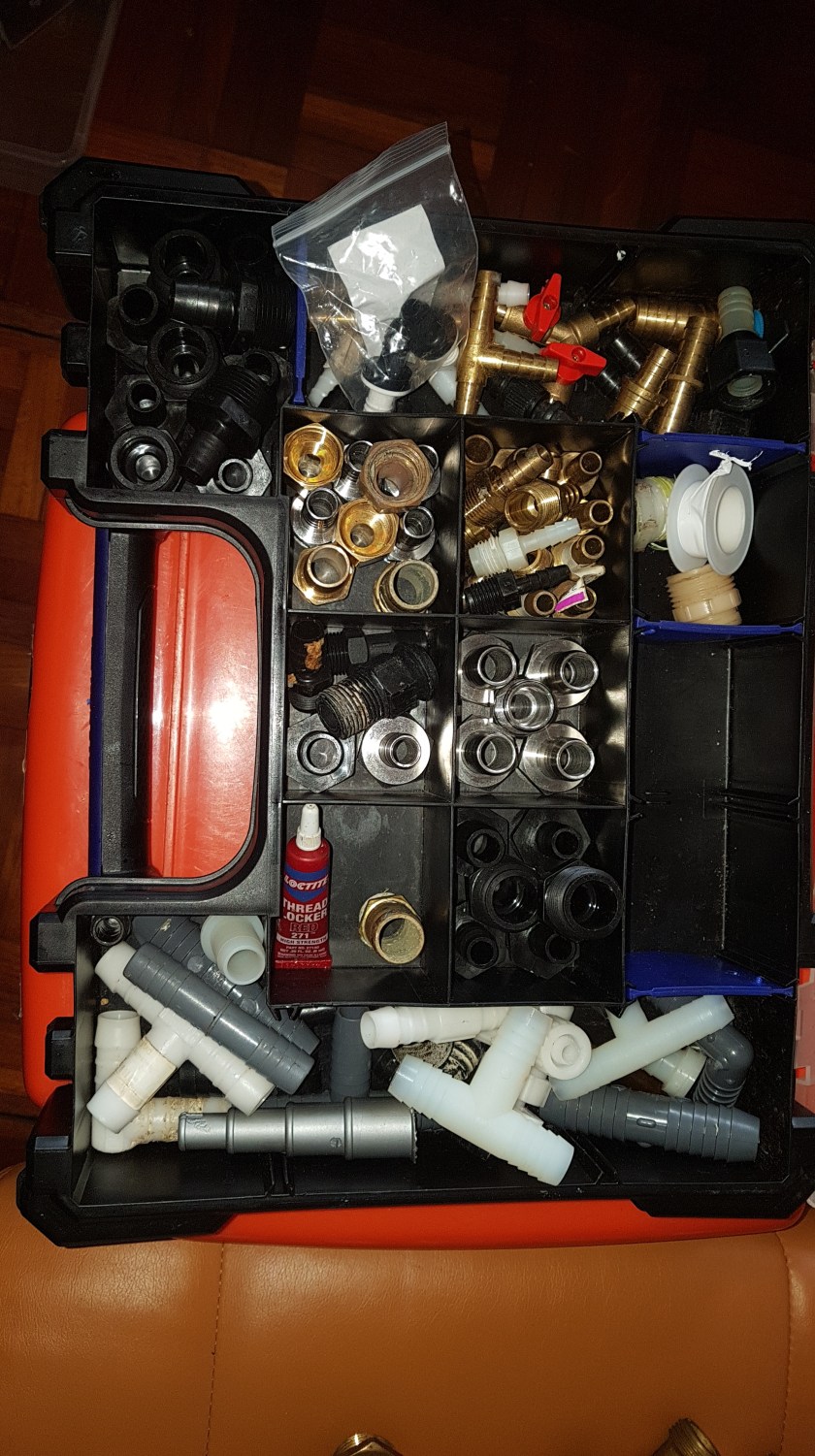
An assortment of hose barbs and NPT connectors

Well, it’s like this. I have 100 feet of ½” clear braided nylon tubing. I also have about 25 feet of 3/8” of the same, as well as 50’ of 1 inch. The water filter I bought used ¾” fittings. I didn’t want to use ½ inch. I also needed ¾” NPT to Hose thread.  I had a nice variety and quaintly of stainless steel ¾” hose barbs to ¾” NPT, and many ½” barbs, but alas no ¾” tubing.

I will spare myself the embarrassment of the Rube Goldberg setup I made first, then second, finally third, but with too many connectors of different sizes, it was difficult to not have a joint leaking.

Finally, I bit the bullet and went back to HD for the umpteenth time and bought a ¾” NPT male/female water heater hose of two feet.

Thus, my dock water household filter was installed in a manner that I’m happy with. Even got a quick disconnect to work that I’ve been carrying around for 4 years. I also took the time to re-organize all my hose and pipe fittings.

Now as you look at the pictures, while it may seem relatively organized, I seem to have soooo many ¾” fittings for who knows what, since I have few ¾” anythings on board.

An assortment of Hose thread (top), hose to NPT and all NPT (middle) and hose barbs (bottom)

The dock water filter was certainly not a necessity, as I have gotten along fine without it for these 5 years. But I am on a self-imposed deadline, getting the stuff done that is at best superfluous and at worst a waste of money. For next year, with Trinh here, she’ll ask me how I managed all these years without it, not having a good answer, she’ll tell me to save my money.

I’ve already calculated that I will save $500 per month. I feel richer already.

I did have a much bigger and serious problem, that I have worked around, but had to be fixed.

My Heart Inverter/Charger has not been charging for the last few months. I could tap it and it would wake up and start to charge, but sometimes within minutes, sometimes within hours, it would revert to not charging.  So, I knew it was an internal relay problem. But I hate disconnecting it from the 930 amp-hours of batteries.

Also, I could work around it relatively easily, as I have another charger, a Neumar, that charges only, but will work on any voltage, which made the time in Europe very easy. It’s on circuit 1 and as you have read, in this marina, I only am connected to circuit 2.
When I left Dauntless in July, I left her connected to circuit 1 and therefore the Neumar was charging.
But now, being on the boat, circuit 2 is more convenient. I didn’t want to do another work around like I did for the washer and water heater. I needed the Heart Inverter/Charger to work as it is supposed to.

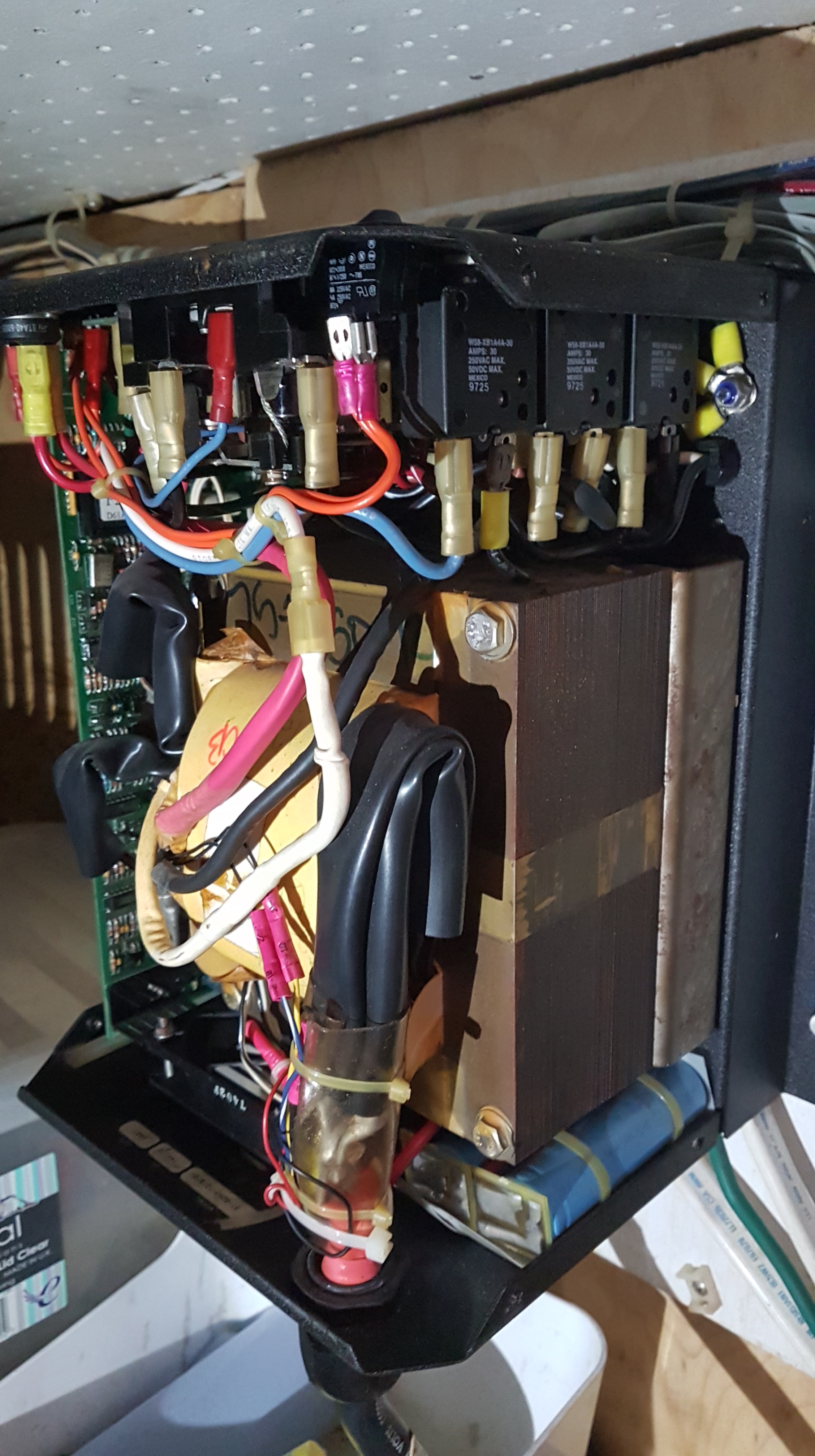
So, I depowered everything, turned off all external power and disconnected the batteries (at the 300-amp fuse). Open the Inverter case and sprayed a lot of contact cleaner on everything, especially the two sets of points that make up the charger relay.

I also tightened the female spade connections on the circuit breaker for the charger (on the upper right of the picture). They didn’t feel loose, but still, couldn’t hurt and a loose connection like that, while very simple, can cause havoc or worse.

I let it dry for an hour, re-connected everything and powered her up. This time, I didn’t have to tap it and it worked as it should. Battery voltage slowly worked its way up to 14.04 v and stayed there for a while as the amperage came down. But even after 24 hours, voltage was 13.78 v, while the amperage was still about + 4 amps.

49 hours later, the voltage as stabilized around 13.70 and the amps going into the batteries stays a little positive, even if it is only +0.4 amps.

Very happy. Now, when I leave the boat this winter, I will leave it on that inverter charger.

I also ate some great Korean food this past weekend, as I had a great day in San Jose with some wonderful Korean friends.

Korean food in San Jose


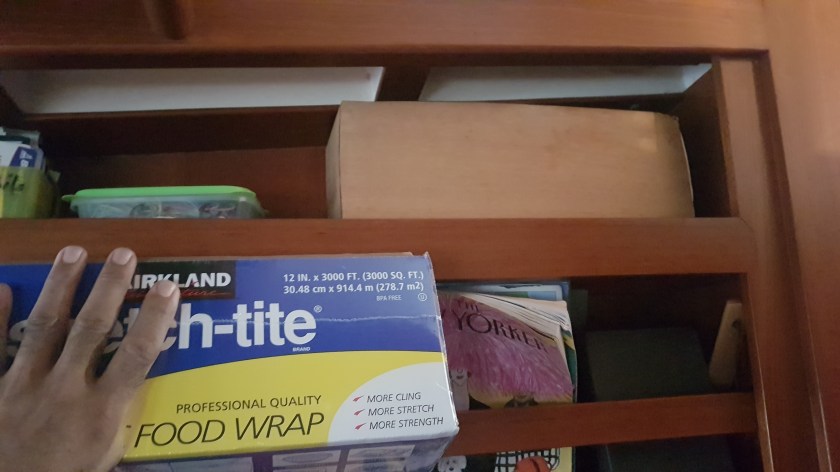
And I did go to Costco, since my 3000 feet of plastic wrap which as lasted me 5 years ran out yesterday. While at Costco I bought romaine lettuce, Brussel’s spouts and rack of lamb.

The new box and old box (with wood veneer)


Coming up next, a hundred males, only a few females; nothing good can come from that.

Still Plugging Away in Vallejo, But a New Tale of Adventure and Woe on the High Seas

My fresh water replumbing job was 75% done yesterday, today it’s 50% and even that took a couple of hours. Suffice to say that the floor of closet now looks like Charlie Kruger took to it with a chain saw. No pictures, since many who read this are carpenters or at last know how to work wood and the pictures are not fit for a mature audience.

My beloved grill already for another 5 years

But it does bring back some painful memories. My first wife had asked me many, many times to repaint some chairs we had. Finally, I did. I laid the yellow paint on nice and thick, so the old color would not show through. I was pleased, though they took days to dry. Finally, I presented my masterpieces and she asked me about those drip marks. What drip marks? They weren’t there when I put them to dry. I hope she’s not reading this and cringing.

I stuck to things mechanical and electrical after that.

Who looks at the bottom of the closet anyway?

I have finished some small things though. I replaced both burners and the electric igniter  on my Weber Q300 grill. That grill has spent 5 years on the ocean. I’ve been quite pleased with it.

I also installed the new thermostat in my Raritan water heater. I did notice in my travel this week that both the thermostat and heating element are available at your local Home Depot for roughly half the price. It’s expensive to print the word “marinized” on the box.

The tangle around the prop that was removed today

Last, but not least, I had a diver come by to check my bottom. Well, Dauntless’ bottom. And sure enough, I had a little collection of lines around my prop. I’m so happy. Coming up the California coast, I thought I felt a slightest of vibrations. Almost like a shudder every few seconds. It would not have been noticeable to anyone else and Larry didn’t feel it, but I knew. Even wanting to be wrong about it, I knew. I was worried that I had tweaked the prop. Worse yet I thought I had tweaked it by doing something stupid. Yes, even stupider than the last stupid thing.

We were underway from Ensenada to San Diego, eagerly anticipating the celebration with fireworks and fire boats that was sure to wait us in the old U.S. of A. It had been 4 years after all.

This shows the Maretron Data of Pitch (left) and Roll (right). You can see where I deployed the paravane because the roll was reduced by more than half at about the 28 minutes ago mark. You can see that it also reduced the pitch, but that is not to be expected. It happened this time because of the combination of NW swell and West wind waves as were headed NNW.

The wind was light, 10 knots from the west on our port beam. With the added Pacific swell from the northwest, the boat’s rolling had increased as the day wore on. By early afternoon, the roll was 10° to starboard and about 5° to windward or port. But occasionally the roll increased to 15° & 10°. That’s a difference of 25° and usually is the point where I really notice the roll and so I will put one or both paravane birds out. In this case, I just put the windward bird out. That would dampen the roll about 50% and we only lost 0.4 knots. A good price to pay for a nicer ride.

This picture I took as the boat slowed down, so the bird was back under the water.

Suddenly, close to the USA-Mexico border, the ride of the boat abruptly changed. It became very smooth. I jumped up from the pilot house settee to look at the paravane and see that we had snagged hundreds of feet of line connected to pots, I guessed. I estimated hundreds of feet, since I could see at least 100 feet strung in the air, then to the bird which was well out of the water.

I chopped the power, the boat slowing quickly. But now, the line of the pots was snagged on the bird, but stopped dead in the water, with the pole vertical, we had all the dead weight of whatever that line was attached to.

I got the not so bright idea to go in reverse. Possibly, the line would un-snag itself at that point. It’s worked in the past, but no luck this time.

Larry and I heaved and heaved and got the line up to the bird, at which point, we cut the snagged line away. This line also had several floats on it. Once cut away, the floats and line and floating right next to the hull amidships.

Until now we had done almost everything right. I just needed to be a little patient.  But patience is not a virtue I have been gifted with. I decided to go forward to get away from the floats. Yes, by running over them. Sounds stupid even in the writing. Sure enough, within seconds the line was in the prop. I stopped the motor and cursed at my stupidity.

That done, I put her in reverse, as I have unwound lines that way also. In this case, no and hell no. There came a hellish scream, which I attributed to a float being wound around the prop scrapping the hull.

Wow, as I write this, details came back that I totally forgot about!

I went in the water. I lowered the swim ladder, climbed down the ladder to the lowest rung and stood there, while Larry handed me the boat hook. I was able to snag the line using the boat hook, since it was about 10 feet under the water.

We got that line up to the boat and cut it.

I then backed up again and we were free.

But from then on, I felt this slight shudder. Had I tweaked the prop? I didn’t know until today.

I do have a SALCA cutter anode (model 2000, 2″ diameter) on the shaft, just in front of the prop. I’m sure it has saved me many times and even this time, may have helped. But that pile of lines now on the dock, was wrapped around the prop since San Diego.

In thinking about this incident, I also realize that the paravanes were well designed for incidents like this. I’m sure that is the most force put on that pole and lines since installation. The 3/8” Amsteel Blue line fore guy did its job. To stop the roll suddenly and slow the boat so abruptly, there must have been thousands of pounds of force to the aft on that line. It’s tied off permanently at the bow hawsepipe and cleat. I have it doing 4 turns over the cap rail, with a clove hitch before it’s tied off on a cleat. Thus, the cleat never really sees significant force, even under these circumstances.

Thank you, John Duffy in Miami, for doing such a great job with the paravanes.

I think I’ll have a celebratory drink, since I missed the fireworks and fireboats in San Diego.\

And I’m looking for a decently priced Hookah outfit. I need to be even more self reliant.


Things I Must Do on Dauntless

Upon waking up this Monday morning, as I was organizing my day, thinking about what I wanted/needed to do, I thought about this blog and what to write. I’d like to finish writing about the events of the trip to Vallejo. But as time passes, so does emotion of the events, making it harder to write about in an interesting way. Thus, the main casualty of losing my laptop for almost two months is insightful writing.

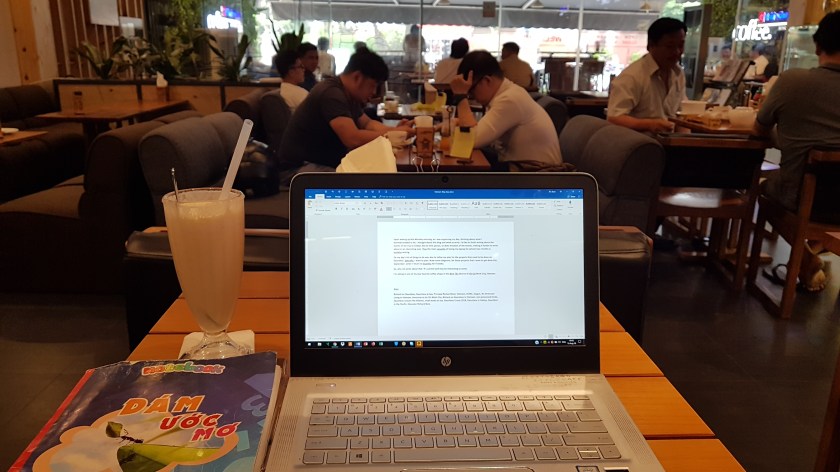
This morning in HCMC, writing this post

On my day’s list of things to do was also to refine my plan for the projects that need to be done on Dauntless. Specially, I want to plan, draw some diagrams, for those projects that I want to get done this September, when I return to Dauntless for 4 weeks.

So, why not write about that. It’s current and may be interesting to some.

I’m sitting in one of my two favorite coffee chops in the Bình Tân district of Hồ Chí Minh City, Vietnam. I come here when I want coffee, or a yogurt blended with orange juice, and that’s what I’m drinking today. The other shop I like, when I want a fruit smoothie, usually avocado.

I’m alone, so it’s a good time to write. My girlfriend Trinh (pronounced like Din), is working. Doing my three-month hiatus bringing Dauntless north, she expanded her sub-contracting job and now has 9 people working for her producing marking and ink pens.

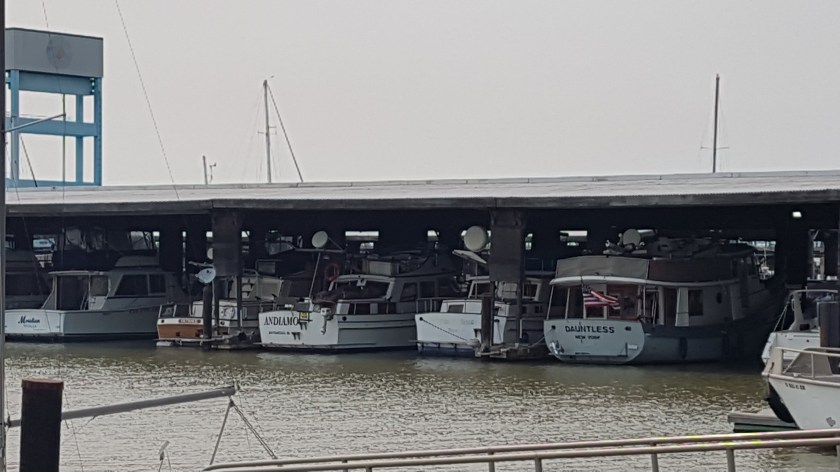
Dauntless under cover in Vallejo

I can’t complain; I do like women who like work. Ultimately, my breakup with Julie was because she picked work over me and D. Why it will be different next time is not in the scope of this post, but one day I’ll write about it. I will say it’s more a cultural thing than a personality thing.  I’ll see Trinh later this morning and afternoon.

During the time on Dauntless, I started to make a list of the things that needed to be done on Dauntless at some point. I hate lists, as they remind me of all the stuff I still must do, but in this case, it’s needed.

Dauntless under cover in Vallejo

My biggest problem when cruising alone (in the sense of not having a long-term partner with me) is that when I arrive wherever, I’m tired. I don’t have the will or desire to sit for the next X number of days and fix, repair, replace, modify what needs to be done.

Of course, I’m fixing things that must be fixed, but no more. I may do some half-assed job just to get going, but I know I must come back and modify it.

One of the big attractions of the marina in Vallejo is that I am in a covered slip. I don’t have to worry about working in the rain or worse, in the sun. I’m looking forward to it.

My current list of projects includes everything that must be done before September 2019, once in Southeast Alaska. Obviously, some things are more critical than others, e.g. I don’t need the diesel heater until Alaska. Other things are conveniences, but on a boat, conveniences are important. So, one of my first projects next month will be to move my fresh water tank selector valve so I don’t have to go under the floor in the guest cabin every xxxing time to change water tanks. Along with that, I will also clean out the water tanks and reseal the inspection ports and install a baffle on the Maretron ultrasonic sending unit. This should be a day’s worth of work. If Trinh was with me, probably half-a-day, since she’s always busy like a bee. I’m more like a sloth, so it will probably actually take two to three days.

Here’s the current Dauntless Project List:

System Item  Problem/Issue/Goal Notes, parts? Est Completion
Engine Change Oil

R&R Impeller Cover


Been leaking for 2 years


Done 6663.88 hrs.

April 2019

H2O Move tank valves

Reseal tank fittings

Replace lines, one-way valves,

Check and redo all clamps

Place caps on Maretron tubes

Make external filter system for tank fill

September
Water Pump pressure switch Adjust ?
Mount Spare pump?
Transmission Real seal leak Check engine alignment?? ?? April 2019
Fuel Sight tubes Put LED strip behind tubes

Bundle wires on port side

Watermaker R&R Seals with kit

Add three-way intake valve

September
Generator Oil & filter

Install Battery

Check remote start switch

Install Perko switch to house?

Check Charger to Gen


Nice not to have to get out jumper cables?

September
Bow Thruster R&R broken gear Would be nice to use again, OTOH I’ve done wo for 3 yrs.
VHF’s ICOM 304 Internal relay?

Handheld

Chinese handheld

Send back to ICOM

Needs battery

Figure it out

September

April 2019

April 2019

Salon Hatches Add hinges to middle two Get someone who knows wood September
Outside Hull R&R rub rail

Touch up paint

Cap Rail refinish

With Stainless steel (CI Hbr) September

April 2019

2019

Ext Doors Touch up, Tung oil 2019
Fly Bridge Water ingress Where? Rail fittings? 2019
Windlass & Anchor Lube windlass

Re-mark Anchor chain

September

2019

Solar Panels Re-wire controllers, fuses, switches

Add array over dingy

Replace terminal blocks and fuse holder September
Purisan Controller corroded Return to Raritan September
Pilot House Electrical Add capacity Run additional cable, pos and neg from ER distribution Sept or April
Paravanes Get two new 28”, Use current as spares

Make holder

Reduce excess lines

April 2019
Boom Winch R&R April 2019
Mast Make New Bracket for Instruments

Get 25’ NMEA 2000 cable

Re-attach spreader lights

September
Diesel Heater Complete Wallas installation 2019
Hookah Face mask and compressor 2019
Hydraulic Fittings

Octopus Pump & Capilano piston

Standardize all fittings

Rebulid

Spare?? 2018 -2019


I’m tired just wiring this list. I think I’ll rest now.


Getting the Show on the Road

The best laid plans of mice and men often go astray.

Having gotten my toothache taken care of by having a root canal the first evening I was back in Huatulco, I was finally felling pretty good. The previous 5 days were a whirlwind of: pain, getting things done in NY, flying to southern Mexico and getting back to Dauntless after 8 months.

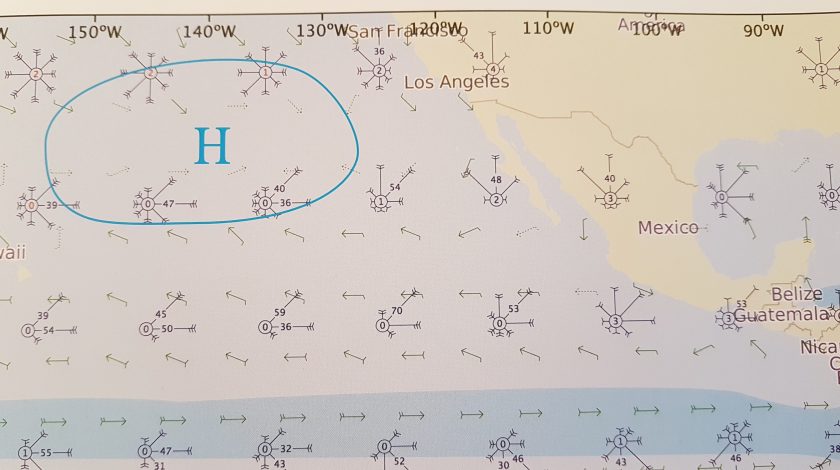
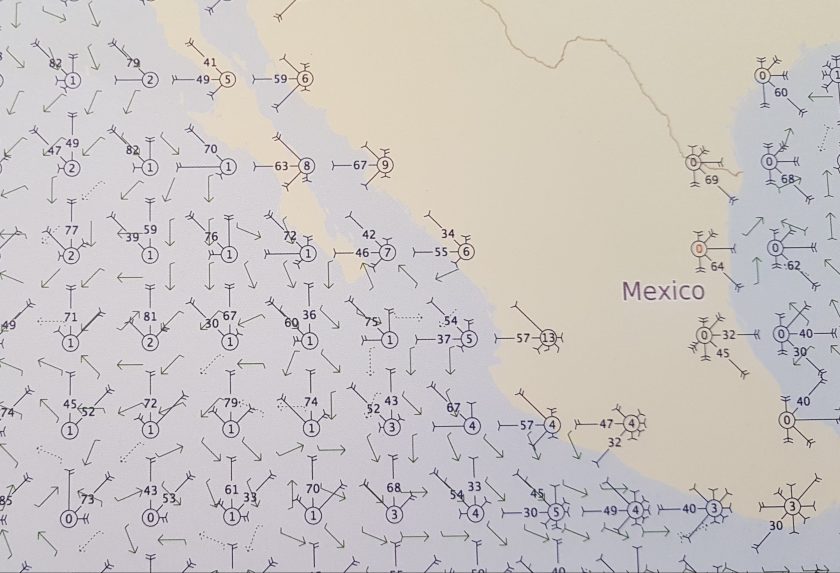
All winter I’d been watching the weather and winds off the west coast of Mexico and California. Jimmy Cornell’s World Cruising Routes and his updated Pilot Charts of the Pacific had made it clear that I would have a slog ahead, commonly known as the Baja Bash.  2,000 miles of going northwest into predominantly northwest winds of anywhere from 5 to 30 knots.

JimmyCornell Ocean Atlas Monthly Pilot Charts for all the Oceans

As mush as I love my Kadey Krogen, it has gotten me safe and sound through so much; I hate head seas.

But I had a plan. A pretty good one I thought. It was clear from the above references that I would have at best 25% of the time favorable winds. For every one day of good winds, I’d have three days of head winds. But as we all know, weather works in averages. I couldn’t exactly count on moving one day and then resting the next three. I could just as eiasily see 7 favorable days and a month of head winds.

Over the winter I had planned for slogging up the coast. Getting back to Dauntless the last week in April. I would spend May getting her a bit more ready. Fixing, replacing somethings that needed it and completing some projects stared long ago, but never completed as we cruised from Ireland to the Pacific Ocean in a little less than a year’s time.

My transmission and damper plate

This plan would have me leaving Huatulco in June as hurricane season started.

Perfect.

The dominate weather pattern is only disrupted by the tropical cyclone pattern of tropical depressions growing to storms and possible hurricanes. Their anti-clockwise wind pattern disrupts the dominant high-pressure system causing the NW winds off the coast. I could have days and days of winds with some southerly component.

The normal position of the Pacific High. This year is has been stronger and more persistent.

The only downside of this plan was that should the strengthening tropical depression or storm head northeastward towards the coast, I’d have to have my hurricane holes laid out.  Also, single handing on this coast is difficult, as places to stop because of weather are few and far between. For example, there is no safe hurricane hole between Huatulco and Acapulco, 250 nm or two full days away.

In the previous months, I’d also sort of put it out there that I was looking for crew.  With crew and a longer weather window, we could get up the coast in some large chunks.  Maybe even get to Ensenada in a 10-day passage. That would be so wonderful.

Pilot chart for the Pacific off Mexico

In March, I had gotten an email from Brian, who was volunteering himself and another friend, Mark, to help me get Dauntless north. The only caveat was, their free time was in early to mid- May.

I was very happy. I had not thought it wise to do this coast alone.  Coastal cruising is totally different than crossing oceans. In the middle of the ocean there are no fishing boats, pangas or other stupid stuff. The large freighters you may occasionally see use AIS and keep their distance (once I upgraded to an AIS transceiver in 2014).

The only downside was the weather. In May, the winds are steady and strong from the NW.  No tropical disturbances to disturb that pattern.  During the entire spring the Pacific high that generates the strong easterly trade winds over Hawaii and been doing its job too well. I seldom saw weather windows of more than a couple of days and the 25% favorable time was more like 10%.

Stuffing box wrench

I’d also be a bit rushed to get Dauntless in the water. But I was less concerned about this, as she came out of the water with just a minor transmission leak, that had grown progressively worse over the pervious 2,000 miles. So, I decided to have the boat yard in Huatulco fix the leak. This turned out to be a $1,000 mistake. With my time frame of having to leave now to best make use of my available crew, it left no time for the yard to correct what they didn’t fix.

More and more I realize that I need to do virtually everything myself on Dauntless. I hate paying someone for a half ass job, when I know that I can just as easily to my own half assed job for free!

Dauntless goes into water

I also felt time pressure because Brian had crewed with me on Dauntless two years ago from Ireland to Scotland and he had had to wait several days for the boat yard in New Ross to get everything done. I didn’t want to make him wait again. And yes, I know not to let a schedule dictate actions, but no matter what, I, as skipper feel and am responsible.

The only things that had been done was the transmission seals and I had removed all the heat exchangers, as one had a pinhole leak and I wanted them all, including my spares, checked and tested.

We ended up splashing the boat right on schedule, a couple days before Brian showed up. This whole sequence left a lot to be desired on my part.

My original plan was to do a little test run of an hour to make sure all systems were Go. But once they put Dauntless in the water, the winds were strong, against the marina, in fact, the port may have been closed, but in any case, with such winds, I wanted to only tie up once, not twice. As it was I had a hard-enough time getting the boat into her slip and at one point was 90° off. I had to rig a spring line around the piling that we were pressed against and use that to turn the boat to face the slip.

No, a test run was out. I felt lucky that I got Dauntless into the slip without damage. I didn’t want to press my luck. In hindsight, this was not the best decision, but it seemed so under the current circumstances.

Once in the slip, with the engine room bilge pump alarm was going off continuously, I was reminded that I should have checked the stuffing box while still on the dolly. Water was pouring into the boat.

After the initial cursing myself for not checking before, I realized the bilge pump was keeping up, barely.

I got my chain wrench and locking pliers and within a few minutes (unlike previous times), the nut was unlocked, and I could tighten the shaft nut my hand until most of the water stopped.

We were good to go, or so I thought.

What I’ve Been Up To

I know it’s been quiet here the last three weeks, but I have been busy.

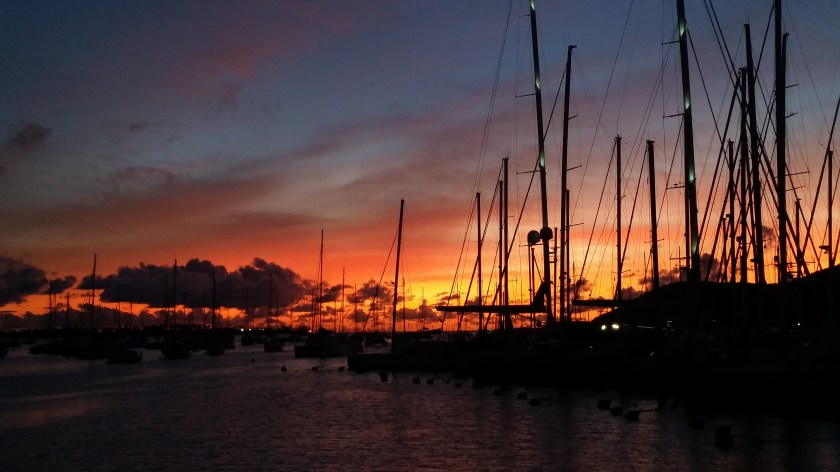
Sunset at Le Marin
Sunset at Le Marin

I am in the process of writing a comprehensive account of our month on the Atlantic from Morocco to the Caribbean.  Having very limited access to the internet, reduces my ability to upload posts and pictures.

But I have been busy. Today, Micah and I finally got everything put away as I have been re-organizing my tools, electrical stuff and miscellaneous stuff that is stored I the pilot house.  It’s a lot of stuff.

It’s taken me literally two weeks to get it done.  Why was it so hard?

I was spurred to action because after arriving we had some projects to do and a few things to fix or improve and during that first week, I found myself spending an inordinate amount of time trying to find various tools.

Having spent too many minutes trying to find a simple 13mm wrench, during the re-organization, I found the other 10 wrenches and 4 sockets. Yes, all 13mm.  Why so many? Because I had it in my mind that I needed one, so every time I got close to a hardware store…

Sooner or later I shall have to find someone who is good at organizing.  If not I may up be being the Cat Lady of the High Seas!

The picture is from last night and is yet another beautiful sunset at Le Marin on the wonderful island of Martinique.

Tomorrow we will be leaving, but just an hour south to St. Anne.  We will spend a couple nights there before heading to the Grenadines later on in the week.

Every few days I post pictures in Instagram at DauntlessatSea


Why I Am Not Afraid


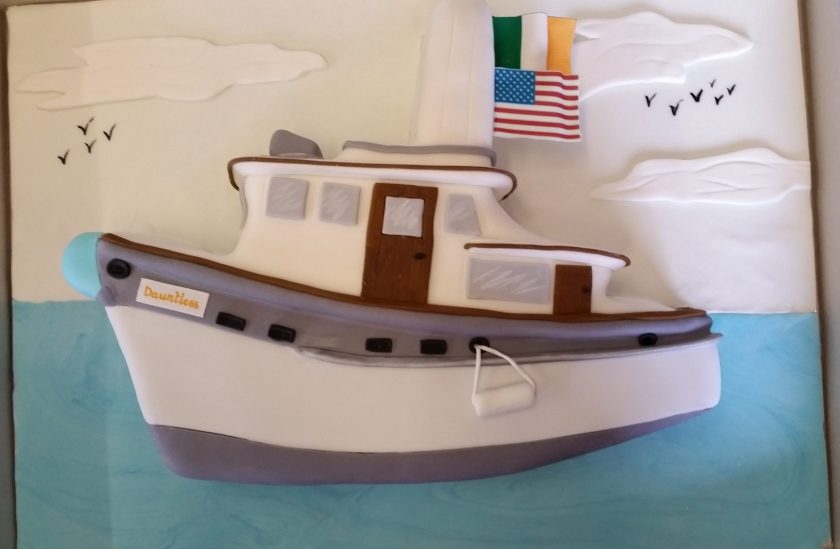
The New Dauntless As Tasty As Ever
Dauntless – As Tasty As Ever

Being in the New Ross Boat Yard daily, now in the spring, almost daily I run into people who ask me about our passage across the Atlantic.  They always ask if I was ever afraid.  Yes, inwardly I do roll my eyes, but now I have my answer down rote, I was never afraid, but certainly miserable at times.

Every once in a while, sensing they actually may want a more reasoned response, I start talking about Kadey Krogen and this KK42 and what makes her so suited to where and how we go; at least until their eyes glaze over.

Knowing almost nothing about fiberglass, other than it’s made of fiber + glass, I have been talking to Gary Mooney, the GRP (fiberglass) expert of the area who has been working on Dauntless this winter and has a lifetime of experience with it on boats and all sorts of other objects.

We’ve talked about the repairs he made on Dauntless, first there were two problems in the hull:

  1. The four-foot-long hairline crack that I put in the hull the past July in Finland.
  2. An older, badly repaired, thru-hull fitting, also in the forward bilge, that was haphazardly done and allowed water into the hull and was the source of the water in the amidships-forward compartment bulkhead.

So this got us talking about the Krogen hull, in particular, which is a cored, also called sandwich, hull:

  1. there is a layer of fiberglass,
  2. then the core, in this case, a white non-water absorbing Styrofoam like stuff,
  3. then another layer of fiberglass.
  4. This is then covered by a gelcoat layer, making the fiberglass impervious to water.
  5. Then a two-part epoxy coat is put on to protect the gel coat, Dauntless gets two coats of that,
  6. A “Tie-coat” comes next, this tie-coat allows the anti-foul paint to adhere to the epoxy,
  7. And lastly comes the anti-foul coating. I am going to try a semi-hard coating, purposely made for very slow boats like Dauntless.  It’s said to last 5 years and be smooth enough to slightly reduce fuel consumption. I’ll be happy if it lasts three years and doesn’t hurt fuel consumption.

This boat yard really caters to the commercial boats, so things like the anti-foul, are all things the fishing boats and trawlers (real ones) use and like.

So, talking of hulls with Gary, I asked him about solid fiberglass hulls.  It’s clearly touted in the USA as a “better” meaning safer solution.  He scoffed at that, saying that most of the fishing boats here use solid hulls to make them stronger in terms of cargo and heavy equipment, but it also makes them more fragile.

A cored hull has much more flexibility, thus I could hit a rock as I did and the hull flexed enough to crack both the inner and outer layers of fiberglass.  Had the hull been solid fiberglass, it’s likely it would have broken in big chunks leaving a meter-long hole in the hull.

This happened recently to a FV just off the coast. Had they not been minutes from shore, they would have sunk. I on the other hand, carried on for another 3 months totally oblivious!

A reliable source tells me that Jim Krogen was always a proponent of the cored hull (sandwich construction) and only succumbed to public perception in the mid-90’s when they changed to making solid fiberglass hulls, below the waterline.  Besides better shear strength (as my encounter with the rock showed), a cored hull also provides better acoustical and thermal insulation, when compared to solid fiberglass.  This past winter, sitting outside in the wind and rain, Dauntless was dry as a bone inside, while many other boats with solid hulls, had condensation running off the walls forming little lakes. My storm windows also helped in that regard.

Dauntless was no. 148 in the 42-foot series and was made in 1988.  Newer isn’t always better.

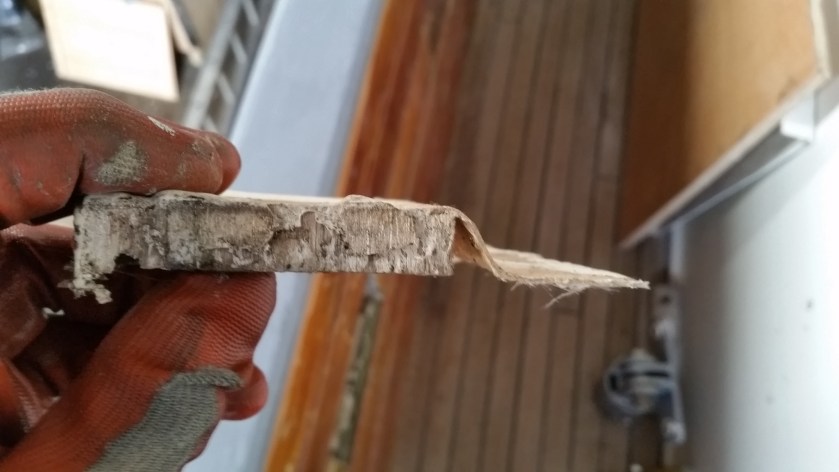
This is a cutout of the gunnel (upper hull) showing a layer of fiberglass on top of balsa squares.

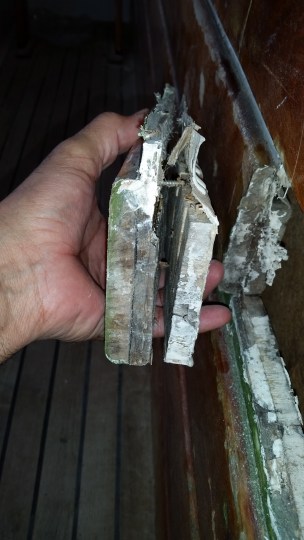
Our hull above the rub rail to the cap rail, the gunnel, also has sandwich or cored construction, but in this case, the core is much thicker, made of blocks of balsa wood and has an inner and outer wall for added strength. Also, cored hulls do provide additional buoyancy. Clearly one of the reasons that when hove-to the boat bobs morthan rolls in big seas.

Which gets to the basis of why I am not afraid.The same cutout from another angle. The squares of balsa are easier to see.

The same cutout from another angle. The squares of balsa are easier to see.It was certainly not due to my experience as a mariner!  I’m probably in the bottom 2% of experience as a mariner.

But I am probably in the top 2% of researchers and I know the difference between opinion and fact.

For 5 years before we purchased this boat, I read, I studied and I determined what capabilities a small (that I could afford) boat

needed to have to be able to travel the world, cross oceans and yet have the comforts of home. I wasn’t going to live like a monk after all.

That process of research and reading every story of ocean crossings I could find, led me to this Kadey Krogen 42.  I knew this boat could handle the worst conditions, whether I was miserable or not.

My friend Larry said it this way, when we got in those chaotic

This is what was cut out of the inner gunnel. The picture below is the piece on the right.

seas, 6-12 feet, short period, from all directions, off the coast of France last summer, Dauntless just seemed to settle in and not fight it. We were hanging on for dear life and she was just motoring along, wondering what all the fuss was about.

James Krogen knew how to design and build a boat that could do anything asked of it, be it bringing us home from a week-end jaunt or around the world.

That’s why I’m not afraid.