Peoples & Cultures are Neither Homogeneous nor Heterogeneous

In my post, How Fresh is Fresh? I wrote about my first trip overseas to Italy. What an eye opener that was. But as I reflect on the different cultures I’ve experienced, I realize my first true culture shock happened in the USA, when I arrived in Seattle in the fall of 1969.

Birds of a feather flock together and still squabble.

Seattle was not as I had expected.

I spent my first 18 years growing up in the heart of the City, New York, not even Brooklyn, nor the many towns of Queens, let alone the Bronx, but New York (Manhattan, for the uninitiated). Being in the heart of it all, makes one think they know it all and have seen it all. I certainly wouldn’t be the first New Yorker accused of a little hubris, especially coming from the heart of the heart, Greenwich Village. New York is nothing if not multi-cultural, and Greenwich Village was its soul.

In those days, Greenwich Village was the inexpensive refuge for people of all creeds, regions, colors, races, sexual preference and artists. The place for “different” people, my parents settled there because there were few places an inter-racial couple could live peacefully at that time, even in Greater New York and the rent in the West Village for our two-bedroom apartment was only $50 per month. Even communists were welcome, as Alger Hiss rented the top floor apartment in our little four story, four apartment building, when he got out of jail. A very nice man by the way. Our upstairs neighbors were two men, they would be called a couple now-a-days, but in the Greenwich Village of the ‘50’s, labels were neither needed or desired. They were simply two nice mean and neighbors for me.  I learned to take people at face value, as I wanted to be taken. My brother and I just knew them as them as the good men who would make pancakes for us occasionally; like uncles, in fact better than my true uncles who I never met until I was 50 years old!

Fast forward to 1969, I found myself in Seattle, having decided pretty much on my own that I was going to the University of Washington (UW). (Which is a tale for another time of independent kids who involve their parents only on the periphery). Once I was accepted to the UW in the spring of ’69, I looked up all the information I could find about Seattle.

I knew its population was about 500,000. New York’s was 8 million, but Manhattan was only 2 million, therefore I figured Seattle is roughly a quarter the size of New York.  From that factual conclusion, I made some interesting assumptions.

I figured life in Seattle would be like living in New York, if I never went north of 57th street or left the City (any place out of Manhattan). Therefore, I’d be giving up my occasional trips to the Bronx Zoo, Coney Island and going to Mets’ games. But then I figured one has to make some sacrifices to be able to attend a university.

My one quarter the size assumption, implied the quantity of everything I was used to: shops, movie theaters, buses, stores, delicatessens, etc., would be reduced to 25%. So, instead of having a choice of 20 delicatessens, I’d have a choice of 5. No problem I thought, nor did I think quality would be reduced to levels last seen on the Oregon trail in a Conestoga wagon.

Now, the UW knew the out of state kids would have some adjusting to do, so they had come a week earlier. Thus, I bonded with the other out of state kids in the dormitory and one in particular who was from Long Island. He wasn’t even from the City, yet even he could tell something was amiss here.

Bad food, bad coffee, bad everything; not even one delicatessen and the buses stop running at 11 p.m. The bagels that were sold in Safeway appeared to have been made months earlier by people who had never eaten a bagel but had once seen a picture of one (meaning it was round).

Who knew people lived like this? This chubby high school kid lost 20 pounds in 6 weeks.

In the early days, still thinking that civilization would return as I knew it, I’d ask for those things common to New York. In the summer everyone drinks ice coffee. But not in Seattle in 1969, when I asked for an iced coffee, the waitress had no idea what I was talking about. Somehow, the culture of strong coffee mixed with ice in the summer time never made it past Chicago (If it even got that far).

Another time, when asked how I liked my coffee, I replied, with that New York classic, “regular”, meaning with milk and sugar. They gave it to me black, well not really black, as I could see the spoon at the bottom of the cup. The coffee was an undrinkable, light brown concoction, of hot water and coffee flavor.

I survived, but it was my first eye opener, that when one leaves home (however large or small that “home” may be), one has to leave assumptions behind. Nothing was basic, even the telephone operator for my monthly collect call home, usually misunderstood my telephone prefix “Oregon” for “Argon”.

While I consider myself a life-long learner, I never said I was a fast learner. But as life went on, I learned to dump more and more assumptions so that I’d arrive at my new home naked with eyes open.  From there one can make the case that there are no true assumptions. Assumptions by definition are conclusions based on spotty data. Good luck with that.

In the next two decades, I found myself in many varied places: Alaska, Colorado, Southern California, Italy and Germany, even the Arctic Ice Cap for half a year. Assumptions melted like a popsicle on a hot summer day. One of the aspects of European life that I like so much is the absence of urban sprawl. In some places more than others, particularity so in Germany.

I ended up living in Germany twice, in small German towns, around 2,000 inhabitants. One day while trying to follow a conversation with my neighbor’s daughter and her boyfriend, who was from the next town up the road about 5 km away, I realized he was speaking in a dialect that was even different than the Rhineland Pfalz dialect I was accustomed to and could reasonably decipher. I asked why his speech was so different. Then I learned that was because his town, which I drove thru twice a day, was a “Catholic town”, as opposed to the Lutheran town I was living in.

And because of this difference, there was much less interaction with this neighboring town, than with other towns.

Who knew?

Well, seemingly everyone but me. To this day, I have no idea if this pattern of towns based on region was a regional thing, a local thing, a national thing, or anything at all, (certainly local people have their own biases, which you must be aware of), but I do know never to make any assumptions about anything.

During that same stint, I met a German meteorologist, who was from Northern Germany, but was now teaching meteorology to pilots in Bavaria (southeastern Germany). We met for work, became friends and I visited him often. He told me that when he moved from the north some years earlier, no one would sell him a house simply because he was not local. He began making weather forecasts for the local farmers and after a few years they did accept him enough so that he was able to buy a house.

My take-away from this, just like the different town thing, was that the label “German”, as most labels, is not helpful in understanding personal interactions that take place on an everyday basis on a small scale.

I thought an of interesting way to look at these differences in macro and micro cultures using numbers.

Think of a number line from zero to 10, we’ll call it the Homogenous population.  If we have a population of 1000 evenly spaced between zero and 10, every number is 0.01 or 1/100th apart in absolute numbers. Now, take a different population of numbers, this time from zero to 10,000, which we’ll call the Heterogenous population. Divide by 1,000 again, and every number is now 10 units apart in absolute numbers.  Therefore, to the Heterogenous population, the Homogenous population seems much closer in value in absolute terms, and the Small population looks at the big population and sees far more diversity, since the range is not zero to 10, but zero to 10,000.

But looking at both populations from within, on a relative scale, Homogenous sees a difference of 0.01/10 =0.001; while Heterogenous sees the same result, 10/10,000=0.001. Therefore, even in populations that seem homogeneous to an outsider, to those inside the population the perceived differences are just as great as in a population that is viewed as heterogeneous.

My point is that perceived differences are in the eye of the beholder and that the differences one sees are as great to the Homogenous group as to the Heterogeneous group.

We cannot make the false assumption that populations that seem homogeneous to us, like Germans or Koreans or Italians or Chinese or Vietnamese or anyone for that matter, are in fact, homogenous, because for them, inside that population, they see diversity that we are not trained to see.

Or let’s put it even another way.

I believe that Queens County is the most diverse county in the USA based on the number of different languages spoken at home based on the last census.

So, if I am having a coffee in Queens, let’s say the neighborhood of Astoria, it’s likely that at a nearby table there sits: a Bengali, a Greek, an African-American and a Korean. While they may all speak different languages at home, may be both female and male and of different religions, creeds and colors, they will all know what a “Regular” coffee is.


s

Catastrophizing at Sea

I’m currently visiting my friends for 40+ years in northeastern Italy, in a little town called Budoia. At the very foot of the Dolomites (a portion of the Alps), I first came here while stationed at Aviano Air Base in 1976.

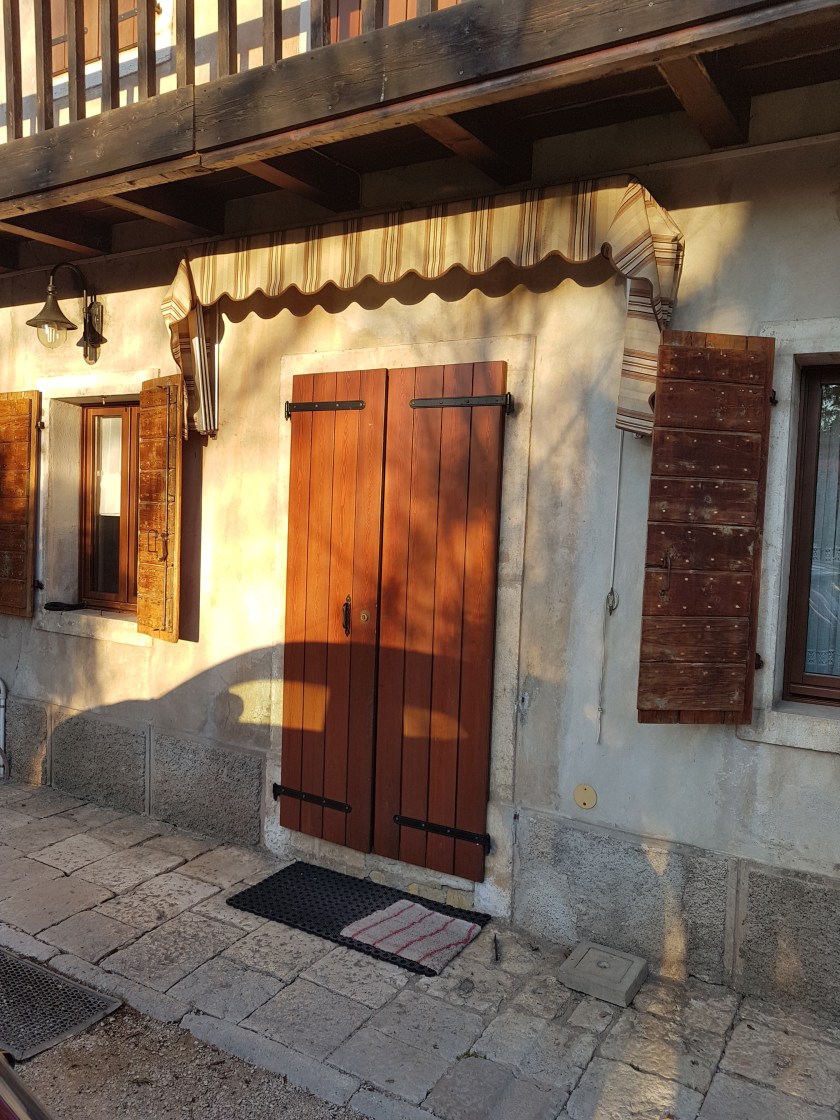
The front of the house and the church
Budoia, (PN) in NE Italy.

Last night, while returning relatively late, it turned out, in spite of having all the keys to the doors, the shutters were also inadvertently locked. Now, these shutters are not the dainty kind we see on so many houses to give them that “homey” feel.

No, these shutters, like the house, were built in the 1800’s to keep the brigands out and to withstand a siege. So, the one door that I knew was kept unbolted at night and that I had the key for, was behind the brigand proof shutters. I know, I tried, not even a millimeter of give on those shutters.

I had already tried the other two doors, one in front, one in back, all bolted. I had even tried the door that is not used. Upon unlocking it, it seemed to give a millimeter or so, but is was clear that either the furniture in front of it was completing blocking it or it too was bolted. In any case, I quickly gave up and returned once more to the shutters.

The shutter when closed

Was it possible there was something I was not understanding in their opening? The matriarch of the house, knew I was coming back at this hour and had acknowledged not to lock me out, so I wondered what I was missing?

It was cold, already, 28° or -2°C. I couldn’t sleep in the car. My cell phone was dead, but I did have car charger and cable, I plugged it in and called the house. No answer.

I then tried her mobile number and minutes later after I successfully completed the “who is this? (It’s me) and why are you calling me at this hour? (the shutters are locked)” interrogation, I saw her coming down the stairs.

A half hour later, warm and cozy in my bed, was I ever so grateful to be in bed and to not have had to implement contingency plan number XYZ. But that got me to thinking, what was XYZ?

Normally open

In my ten minutes of trying to solve the problem, trying every door a couple of times, even the windows, trying all sorts of key like objects in the lock of the shutters, all the while not thinking of the cold and me with no overcoat, (since I came from Vietnam). I realized never spent any time on “what if I can’t get in?”

What if I could not rouse the occupant? What if; then what?

No, I was totally focused on solving the problem.

While it’s impossible to cross an ocean in a small boat and not have some issues, in my two plus ocean passages, I’ve only had one problem that could have been, more than an inconvenience. That was when I burst the hydraulic line 1,000 miles from land in the middle of the Atlantic in 10 to 15-foot seas.

The hose that broke feed the hydraulic ram for the rudder. Without this hose, no steering and no autopilot. My Kadey Krogen does have an emergency tiller that attached to the top of the rudder post thru an opening in the deck, with a 6-foot lever arm. But this would mean standing, sitting, suffering on the aft deck for 7 straight days and nights.

I shudder even now just thinking about it.

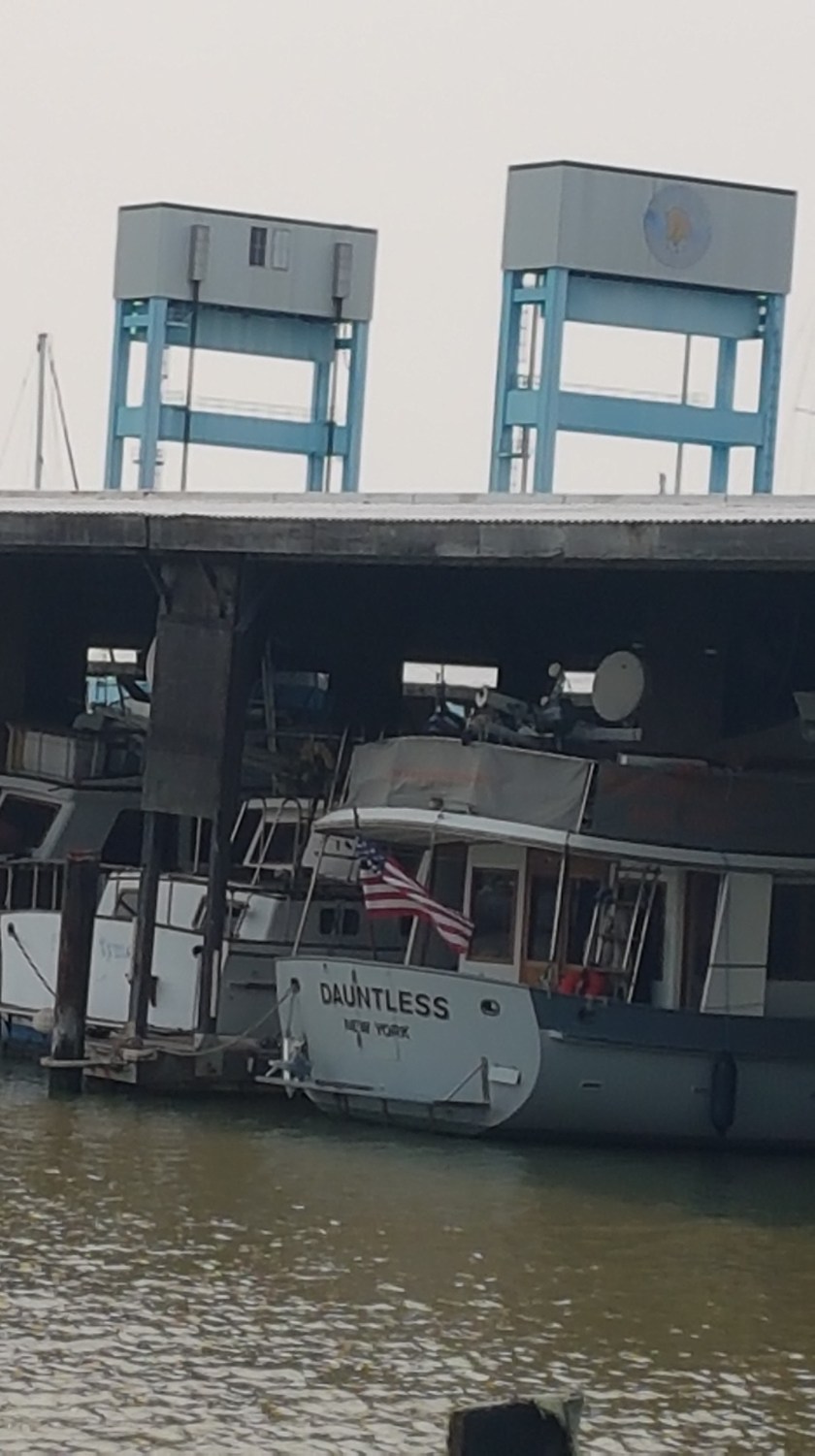
As mariner’s who motor instead of sail know, a boat at constant rudder angle, will not go in a straight line. Wave action pushes the bow a little bit each time and the boat will be noticeably turning within 30 seconds in any kind of seas, thus requiring constant rudder adjustments. The primary reason an autopilot, to maintain a constant heading, is much required. More than likely Dauntless would arrive in Martinique minus any human crew, as we would have decided that swimming was better.

When this hose broke, my first thought wasn’t how we would now get to Martinique, it was how to solve the immediate problem. Just like last night, I didn’t spend any time on “what-ifs”. Oh, over the years I have some very general contingency plans, such as, engine stops, and I can’t get it going again for whatever reason, the prevailing winds will eventually blow the boat to land (as this wouldn’t happen in the Southern Ocean, that’s another reason not to go there!). Therefore, we have enough canned goods, water and peanut butter to last for months.

Many people have asked me what makes me able to cross oceans while other far more experienced sailors don’t. As I was reminded last night, one of the keys is the ability to focus on the problem at hand and not to catastrophize the problem. Don’t think of more problems when as you try to fix one.

When my helm wheel went slack in my hands in the middle of the Atlantic, I allowed myself one indulgence, I cursed at myself for being so stupid, but then it was to the task on hand. Let’s not spend any time on what-if I can’t fix it, let’s just fix it.

Another way to look at is Optimist versus Pessimist. The optimist sees possibilities, the pessimist sees barriers.

Not may pessimists cross oceans, maybe not even in planes!

You can check out my post about this here: Crisis in the Mid- Atlantic


,


I’m So Lazy

Since I’ve been back in HCMC, I don’t even do the little I have to do.

My Orange Juice and Yogurt today (cost $1.80)

What do I really have to do?

I’d like to get my electronic Dauntless logs up to date. I’ve been stalled in August 2017 for the longest time. I need to re-organize my hard drive on my laptop, so I only have one current directory that I keep backed up, with other files, music and pictures, stored on my external drives.

Not exactly the most onerous tasks. So, why aren’t they getting done?

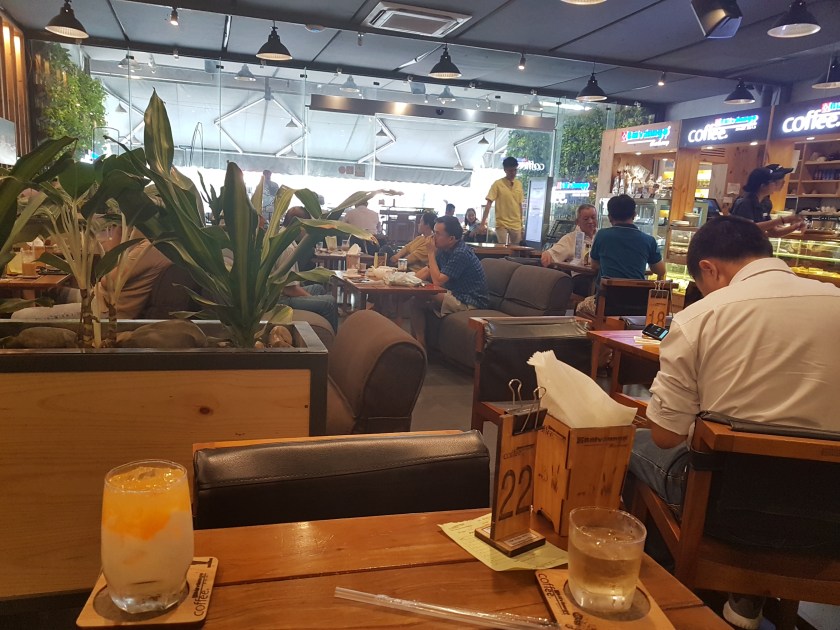
Fundamentally, I think I’m simply too much of an extravert to sit home and be productive. I’m writhing this post now, while sitting in one of my two favorite cafes, in this case, Coffee Bui Van Ngo, about an 8-minute drive on the motorbike from my house.

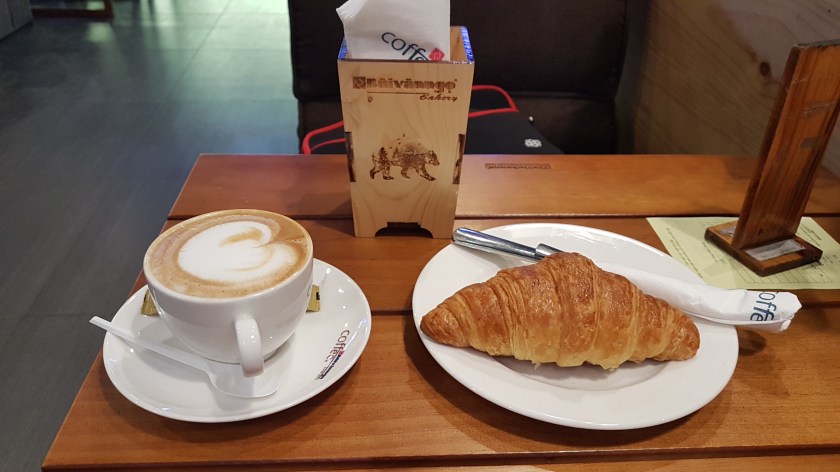
Sometimes I get Cappuccino, as I find it as good as in Italy
(undrinkable in USA)

I’m enjoying a yogurt with ice and orange juice. Usually I get it blended but decided to get wild today and try it this way. I’d already had my coffee at home. Vietnam is one of the few places where I find almost anyplace, I go the coffee is as good as I make at home.

In fact, New Yorkers would feel this is the one place they would feel at home in regard to coffee. The normal coffee is very strong, with milk and sugar; what New Yorker’s call “regular”.

I was 19 years old, driving across the country for the first time with my first car returning to the University of Washington for my second year.

When i want an Avocado Smoothie, I go to this cafe. (cost $0.90)

I stopped late in the evening in Montana, just south of Missoula, to get a cup of coffee since I was planning on driving thru the night, on my way to Kennewick, Washington. When I asked for a coffee to go, I was asked how I wanted it and I told her “regular”. She gave me a funny look, but minutes later my coffee in a container and bag arrived and I was on my way. Always pressed for time, I got underway before trying it down the road.

Black and bitter. Ugh.

That’s how I discovered that not everyone drank “regular” coffee.

That got added to the list of Things Aren’t Like This in NY. Already on the list was the shocking discovery that the buses stopped running in Seattle at 11:00 p.m. 10 years later, I discovered it was the same in London, as we found ourselves with scores of others trying to find a taxi.

How anyplace that calls itself a major city has a transportation system that goes to sleep makes one understand why people like cars so much.

But today, no tilting at windmills, the Vietnamese coffee is rich, strong and creamy. Perfect over ice, as most Vietnamese have it. The ice dilutes it to a perfect state, still very strong .

So, getting out of the house seems to give me purpose.

The owner and his girl at my smoothie place

Being around people is part of that process.

Though, on Dauntless, I do get restive, but there is always something physical for me to do, which I really enjoy. In a perfect world, Dauntless would be a not too far drive away. Much like when she was in providence , Rhode Island. Living in upper Manhattan, I could drive to Dauntless in about 4 hours. Stay a few days, get some work done and return home for the long weekend.

Even now, If I was anyplace in the States, I’d consider flying to her in Vallejo, staying  5 or 6 days, then home again. Round trip plane tickets can be had for around $300.  I’d do that.

But a trans-Pacific flight is a horse of a different color. 15 hours from the west coast to Northeast Asia for a connecting flight of 4 to 6 hours to Saigon. Sometimes it ends up being two red-eyes. One is bad enough.

I’ll just have to be more disciplined and get out more.


Work on the Mast

During the last week on Dauntless, getting her ready for the winter without me, tears all around, I realized how sweet it was to work under a roof. 

Error
This video doesn’t exist

Looking aft with the mast down, under the roof of the Vallejo City Marina

I loved it so much, I changed my project priorities a bit.  I figured it made the most sense to do those things that are difficult to do under normal circumstances.  It is such a pleasure to sit on the fly bridge, out of the hot blazing sun or the cold wet rain. With the mast down, I didn’t have to wrap one arm around the mast and hold on for dear life. Under such ideal conditions, I realized I had to get all the things done I had been contemplating for years.

Four years ago, getting Dauntless ready for her first ocean crossing, I took what was given. Unlike the Lexan storm windows which were done in the last hours, the Maretron system and instruments on the mast were completed with days to spare.

One thing that has sunk into my dense brain is if I don’t have a clue as to what I am doing, then at least do the simple solutions instead of making complicated ones. To that end, I mounted the Maretron instruments on an existing antenna arch that extended forward and was above the radar.

It was the simplest solution and worked well enough for four years, but now, I wanted to make it better. I have felt that the weather instrument that measures all the normal weather parameters, including wind speed and direction, is not in a clear air stream with winds from the stern. As you know, this Kadey Krogen loves following winds and seas, therefore if the data is being affected under such conditions, it’s not ideal.

The other issue that is also related to stern winds is that every once in a while, lines related to the paravanes, get enough slack that over time, being blown forward, like 21 days in following winds and seas, that they were easily snagged on those weather instruments or the bracket itself. In the first years, more than once, after deploying the paravanes, I discovered that the weather instrument arch was carrying the weight of the paravanes. Not good. (Though it does confirm the forces on the paravane system are as expected).

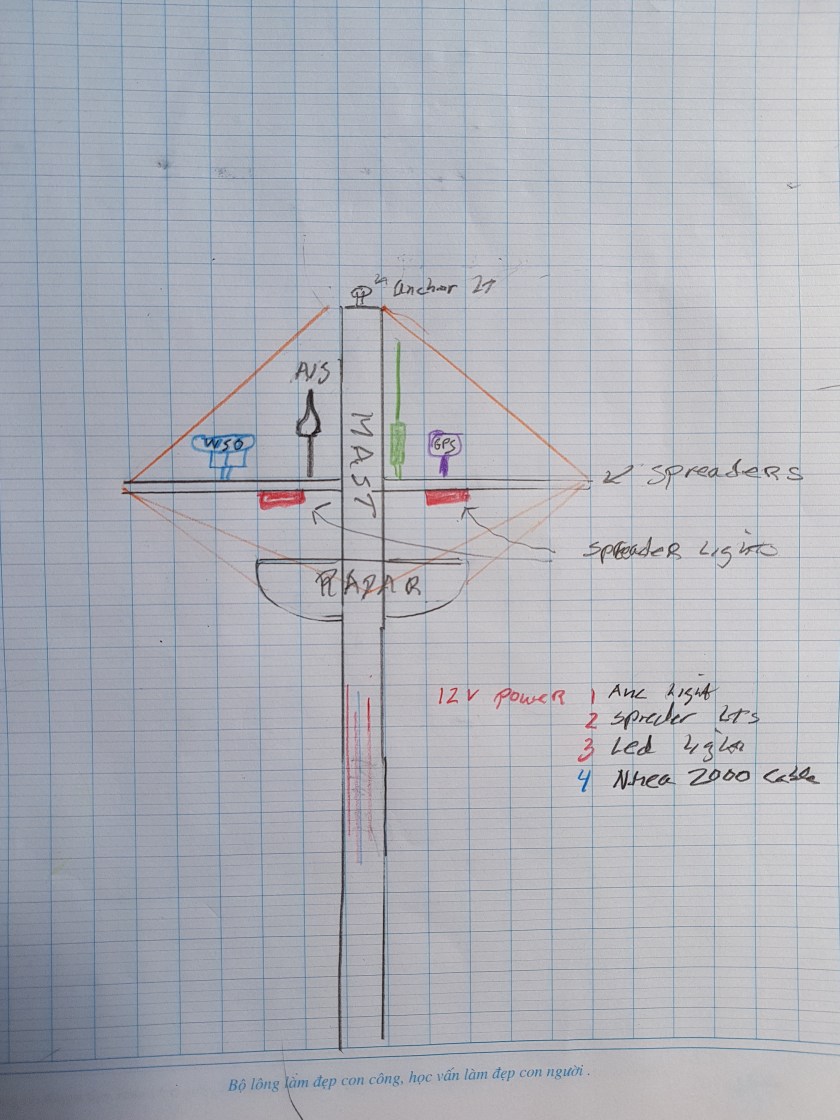
Just too many times, that antenna arch has been seconds from disaster. Time to get rid of it. The Maretron cable that runs inside the mast must also be replaced. So, the Maretron WSO and GPS will be mounted on the spreaders. In addition, I will mount my Wi-Fi extender antenna and I hope to also move my current AIS antenna to the spreader. Currently it’s mounted on the cowling of the fly bridge near the helm. It’s too low. Many times, it will not see big ships until 5 or 6 miles away. At the Dauntless speed of 6 knots and big ships possible speed of 20 knots, that still gives me more than a 10-minute warning, but that antenna should be maximized just on principal.

Plan for the Mast Spreaders
March 2019

I also need to remount the two Chinese LED spreader lights. The lights themselves, bought 5 years ago on Amazon for $20 each, have been great, but the mounting hardware is mild steel that rusts badly. I have a way to mount them directly to the spreaders, without the steel hardware. Since I am doing that, I will also change the electrics a bit and add an electrical circuit to power a LED stripe that I will also mount on the mast.

Now, your thinking, while I have eliminated one protuberance, I have made the spreaders much more complicated. That’s true. But I have a plan.

I will also add a 1/16th Amsteel line from the top of the mast to the end of each spreader, then forward to the front of the radar arch. Looking aft from the bow, this will look like a triangle. Looking from either side, this will look almost like an obtuse triangle.

Now, I have not added this yet. This will happen in March when I return to Dauntless, but in my mind’s eye, I see this little line as making it much more difficult for a loop of any line to become snagged around the spreaders, radar arch or the mast itself.

We’ll see.


Teamwork

It’s 20:30 hours. I had a glorious day in all aspects. The weather could not have been better, 72°, light breeze. Dauntless is under the roof, no problems with sun or rain. Of the two projects I started out this morning to get done: one’s done and the other two are almost done.

this picture was taken just 5 hours before my departure. I was so enamored with the sunset that I really did not look at the situation.
Notice the solar panel array on the port side stern of the sail boat in front of me.

But this evening, I felt a disquiet. My project list is not even a quarter done and I’m leaving for the winter in 5 days.

Then I realized it’s not about progress on the projects, days left, or anything else. It’s that I’m alone.

But even that is not so simple. In fact, my happy meter is well above my “normal”. Boat wise, relationship wise, career wise, pretty much everything, I’m quite happy about.  So why the grumpy face and thoughts?

I’m not feeling lonely; but something is still missing.

Then it occurred to me. My entire life, from as early as I can remember, has been about teamwork. Working with others to a common purpose.

I can’t even begin to tell you the times I sacrificed personal accolades for the sake of the team.

All my successes in life can be attributed to building and nourishing successful teams.

Even when I started my teaching career, I did not become a successful classroom teacher until I realized that I needed to make the students in each class understand that they were a team and needed to help each other for their own learning, not for me.

As a high school principal, it was harder, because professionals in education have never been taught anything about teamwork, but the successes we had were all because the entire staff was working together for the good of our students. Sure, there were a few bad apples, but despite them, we got a lot of kids to college and success that would not have happened otherwise.

Then, I look at the other side. Even though I was quite successful selling cars, I hated it. The General Manager at a very successful dealership once made the comment to all in our sales meeting that, “Bost, probably tells everyone that he is a lawyer” I wondered how he knew, though I didn’t pick lawyer, I just never told anyone I sold cars.

While I was successful there, I was a duck out of the water.

With my project list for Dauntless, the list would feel less daunting if my teammate was here. Teammates don’t let you get overwhelmed with small stuff and they convince you the big stuff isn’t so big.

Even better, teammates give you that Cesar Milan nudge or click, that gets you off the obsession and back on track.

That’s what I miss. Otherwise it’s too easy to go around in circles or become obsessed about the unimportant.

In teaching, once I realized that I had to convince the students that they are a learning team. One time, I noticed one of my special colored pencils was missing from my grade book, that was open on the first row of desks. I used color codes for different types of work. I was irritated about it and started complaining to the class about my missing pencil.

In a New York minute, which in this case was probably 30 seconds, one of the students calls out, “OK, we get it Mr. Bost, now can we move on”

I snapped out of it. It was the nudge I needed.

(A couple of days later, in walking around a different class, I saw my pencil in front of one of my problematic students. Without a word and I just took it back.  Months later I finally got that student to start working and she passed with a 72 out of 100 on the NY State Regents.  She worked hard, finally. How we got there, is another story, I’ll save for the book).

And I wouldn’t have spent 3 hours on the Maretron power problem without checking the fuse from the very beginning.

Oh Richard, since you know the circuit had power until you shorted it, why don’t you check that fuse once again?

Oh yeah, that’s probably better than spending the next three hours on this connector!


Maretron or Not

For a little, non-electronic boat, I sure love my Maretron data. I have 9 modules:

  • two to communicate with everything else, (USB, IPG) and the N2K Viewer
  • two for the fresh water tanks, (TLM),
  • one solid state compass, (SSC),
  • one GPS, (GPS),
  • one depth sounder with paddle wheel and lastly, (DST),
  • the love of my life, my (WSO), the weather instrument.

The solid sate compass seems to work better with my ComNav autopilot. In addition, it gives me the roll and pitch data I often quote in my blog.

The weather instrument is also solid state with ultrasonic wind measurement.  Considering I installed the system myself over 4 years and 20,000 miles ago, I’ve had few problems.

A glorious day in Vallejo, under a roof, with the mast down, facing aft

Coming west across the Atlantic, the constant winds behind us and to the side, from 15 to 35 knots for 528 hours or 22 days (No, I didn’t stop to change the oil) took a toll on my connections on the mast. Everything still worked, but occasionally, if a line got caught it would put enough strain to disrupt the connection until I freed it.

So, one of my projects now is to redo all the connections in the system. I  also now slather everything in dielectric grease. So much so, that I almost put it on my pancakes the other morning.

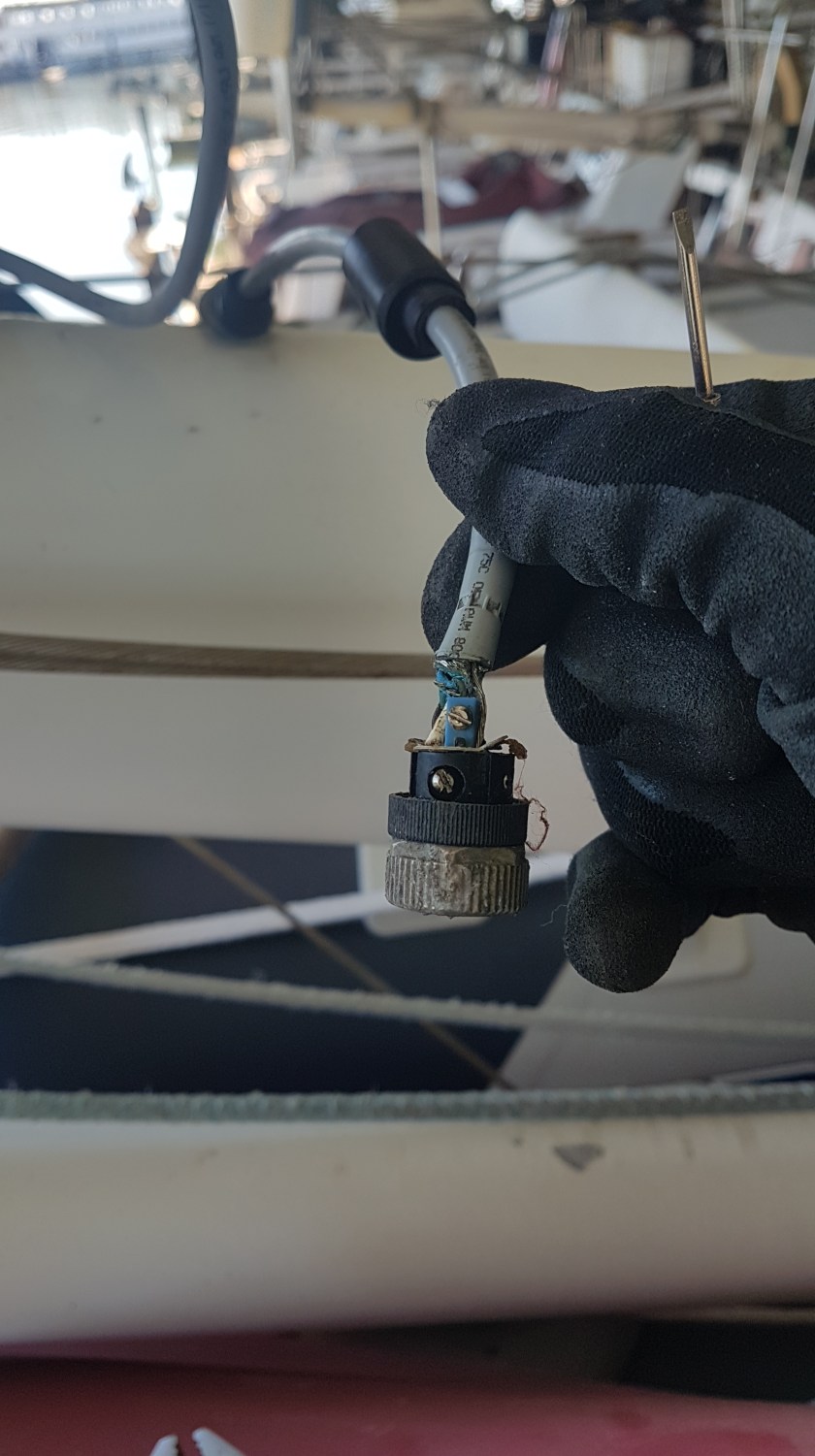
One of the offending connectors

So, the day started out so very well. Sitting on deck, with the mast down, Dauntless under a roof, protecting us from the elements and sun, I thought about climbing up the mast in Cabo San Lucas, in hot, 95° sun, holding on the mast with one hand, while trying to tighten the 5 little wires inside the plug just under the WSO.

I was in hog heaven. I carefully tool the plug apart, unattached the 5 little wires, and recut them all and trimmed them. Now, I knew power was still on the system.  Before I started any of this, I wanted to make sure that it was only the WSO that was incommunicado.  So, just as I was thinking that I would have to be careful in cutting the positive power line, meaning not to cut it with the ground wire at the SAME time; I did exactly that. The little spark, showed me that I’d f..ed up.

Sure enough, when I go below to check, now the whole Maretron system has no data.

Had I shorted out something serious? Was there a fuse in the system? If so, where was it?? Who the hell installed this system?? Oh, it was me!

Let me check the computer cabinet. Open cabinet and what do I see, the fuse block that I put in 4 years ago and even nicely labeled at that.

It went downhill from there.

To check the fuses, I had to pull them, to do that I needed to power down the whole system. That done, I pulled each fuse and looked at it very carefully. Very carefully (for those of you who already know the answer, don’t spoil it for your dear ones who are also reading this).

They all looked good. I powered the system back up. That takes a few minutes because the modem and router have to be booted up before the computer otherwise everyone gets confused.

At this point, I noticed that the little light for the Maretron circuit was not lit on the router until I turned on the computer. I hadn’t noticed that before. (and in the future, I will explain that issue).

No change. I went back to the fly bridge. One of dozens of trips I would make over the next couple of hours. I figured I had screwed up the wiring of the plug. I took it all apart again. I convinced myself that possibly the ground shield covering was touching one of the data lines. I put it all back together again, rebooted the entire system and alas. No joy.

At this point, I’d spent an hour on this. I pulled the fuses again. They still looked good. I even held them up to the light. But finally, just to be sure, I changed the 5-amp fuse that powered the Maretron system. Surely now, it would work.

Still No Joy. Now, more than ever I was convinced it was the plug. The plug was the only thing I had worked on.

Back to the flybridge. Took plug apart again. Put it back together again. Rinse and repeat.

I got my electric meter out (finally you think), check the plug for the umpteenth time. No power.

I go online and check the Maretron site. It tells me I should see 60 and 120 ohms between certain lines. I see exactly that. But still no power. I must have shorted something else out. Where did I install the power tap?

Oh, I remembered where the power tap was because it’s in the port side pilot house wire race that is so full of wires I have trouble getting the teak panel back in place.

Other than no power, the continuity on the plug and lines tested correctly.

I’ve been working on this for three hours now. I return to the computer and fuse block.

I finally decide to test for power in the fuse block. Umm, the Maretron circuit has no power here.

I pull that fuse and check it. No circuit. I check the old fuse I had pulled out, no circuit.

I got fuse number three and checked it, a circuit.

I stick it in and low and behold, power.

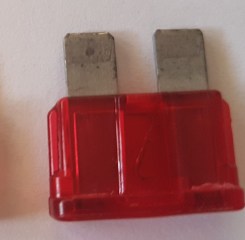
Two hours earlier I had replaced a bad fuse with another bad fuse. Both fuses showed no sign that they were open. Both had very clear “Z” wire that wasn’t broken.

One of the offending fuses


Hundreds of Males, Too Few Females.

I was looking forward to this project, as I like working on the electrical things and I just wanted to also tidy up the wires and the things I’d done over the last couple of years.
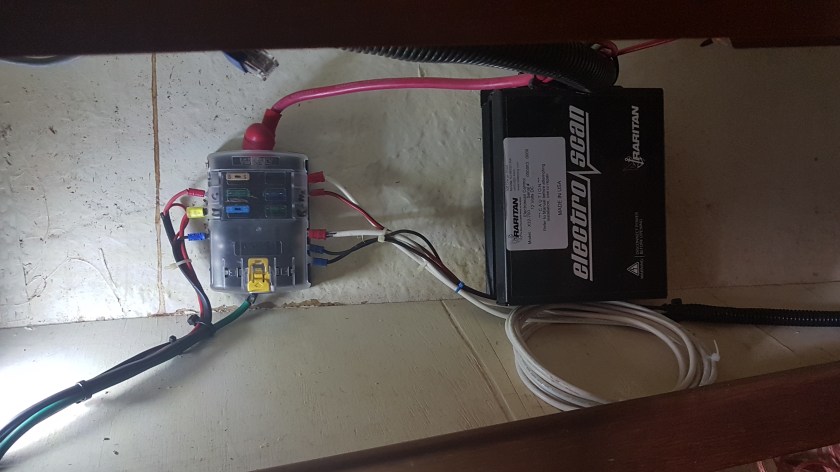
I needed to put new female spade connectors on the gauges and switches in the forward head. I also needed to replace the little bilge pump and replace the float switch for the big Rule 200 bilge pump in the forward bilge.

Cleaning up my cabin. This fuse and terminal block is for the forward head and bilge. The Raritan black box is for the old ElectroScan that I replaced with a Purisan.. This was the easy part. I had no corrosion here.

So, I get my two trays of electric connectors, with hundreds of pieces and what do I find: hundreds of males and a half dozen  females.  Sociologists warn of impending disaster when the male to female numbers reach 52% to 48% respectively in society. Because those single males unable to find mates wreak havoc on the society.

All those rogue elephants in Africa, male. Nuff said.

Female spade connectors are needed to connect a wire to the switch or instrument. I need about a dozen just for the forward head. The current connections are all corroded considerably. I know why, but don’t think I’ll mention it, other than to say, my not wanting to throw anything away can be dangerous.

Amazon will deliver the females on Tuesday.

So, I could tackle the paravane bird holders. I’ve tried various things in the last 4 years. Some have been a bit more effective than others, but in the last weeks I’ve gotten tired of stepping over them on the side deck. With the paravane pole taken down, there is not way to secure them.

In normal use, even if I think I won’t need the paravane stabilizers, I will deploy the poles only.  This allows me to deploy the birds without having to go the flybridge again. So, I need a method to secure them, with or without the poles in place.

This has been an ongoing issue. Each half-assed system I make, breaks sooner rather than later.

My solution is very simple, net and won’t get in the way, in the narrow deck space. I must say, that I think my time in Vietnam has enabled me to see simpler solutions. The Vietnamese make do with whatever they have, which is fractions of what we Americans are accustomed to.

The New paravane bird holder, suing eye hooks and 1/16″ Amsteel. Another view
The New paravane bird holder, suing eye hooks and 1/16″ Amsteel

It’s a thrifty culture and probably what I need in my reduced earning years.

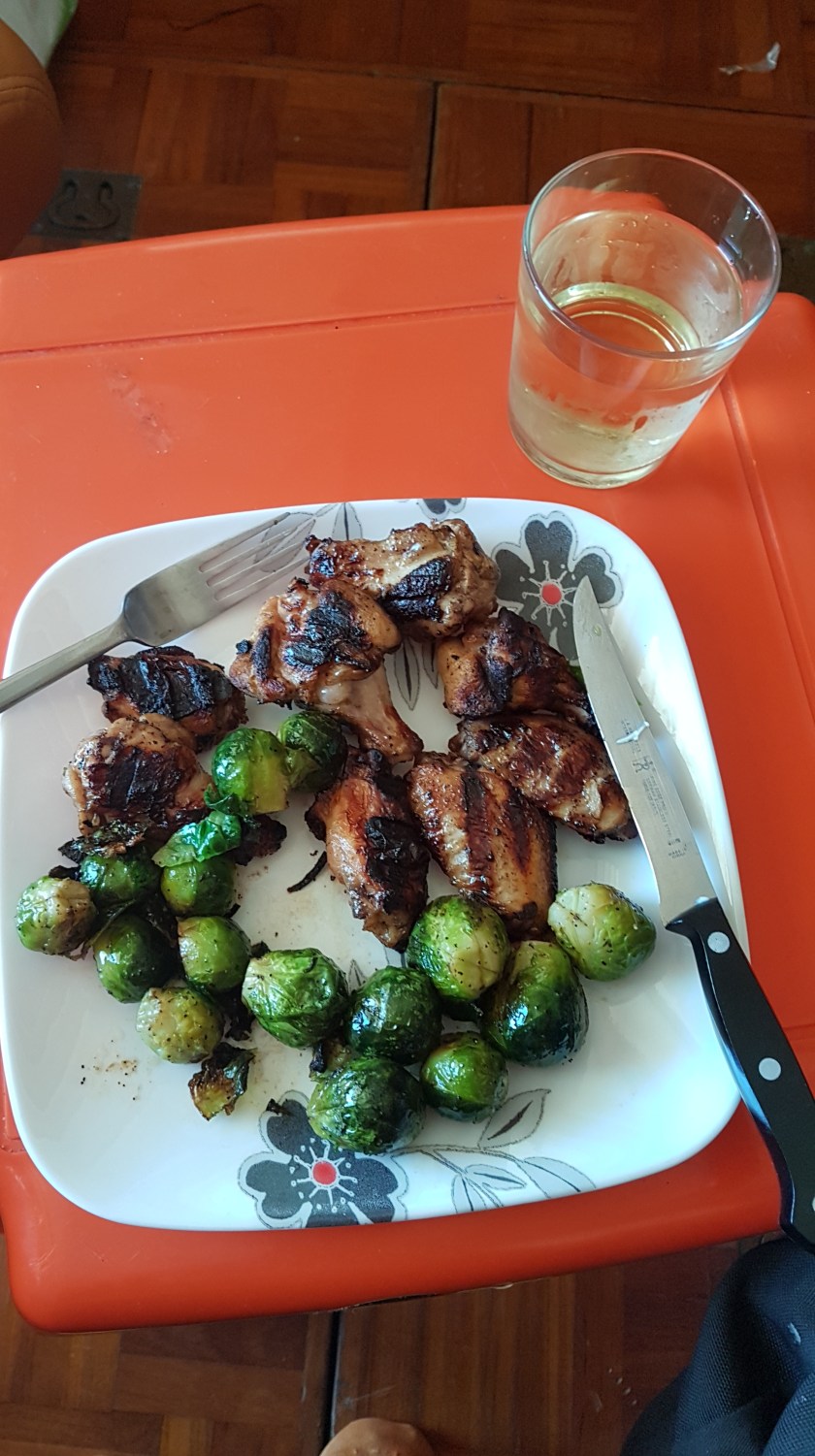
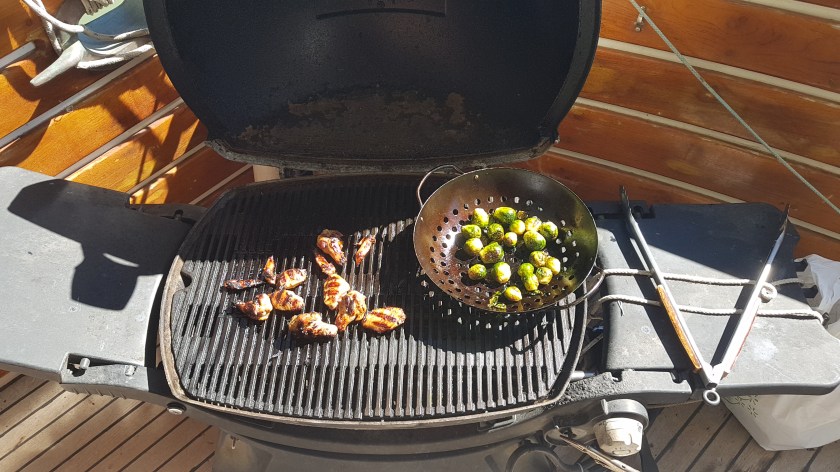
To that end, I have also really tried to limit my going out for dinner. Thus, my chicken and brussels sprouts for dinner today. Very good.

My plated dinner, chicken and Brussels sprouts.
My dinner cooking, chicken and Brussels sprouts


Two Types of Boaters

Two More Projects Down; 37 to Go

Now, there are two types of boaters.

There are those who have few parts, but they are well organized and whenever they need something, they always have just what they need. Best of all, they have very few extra pieces, everything being stored in a few 2-liter containers.

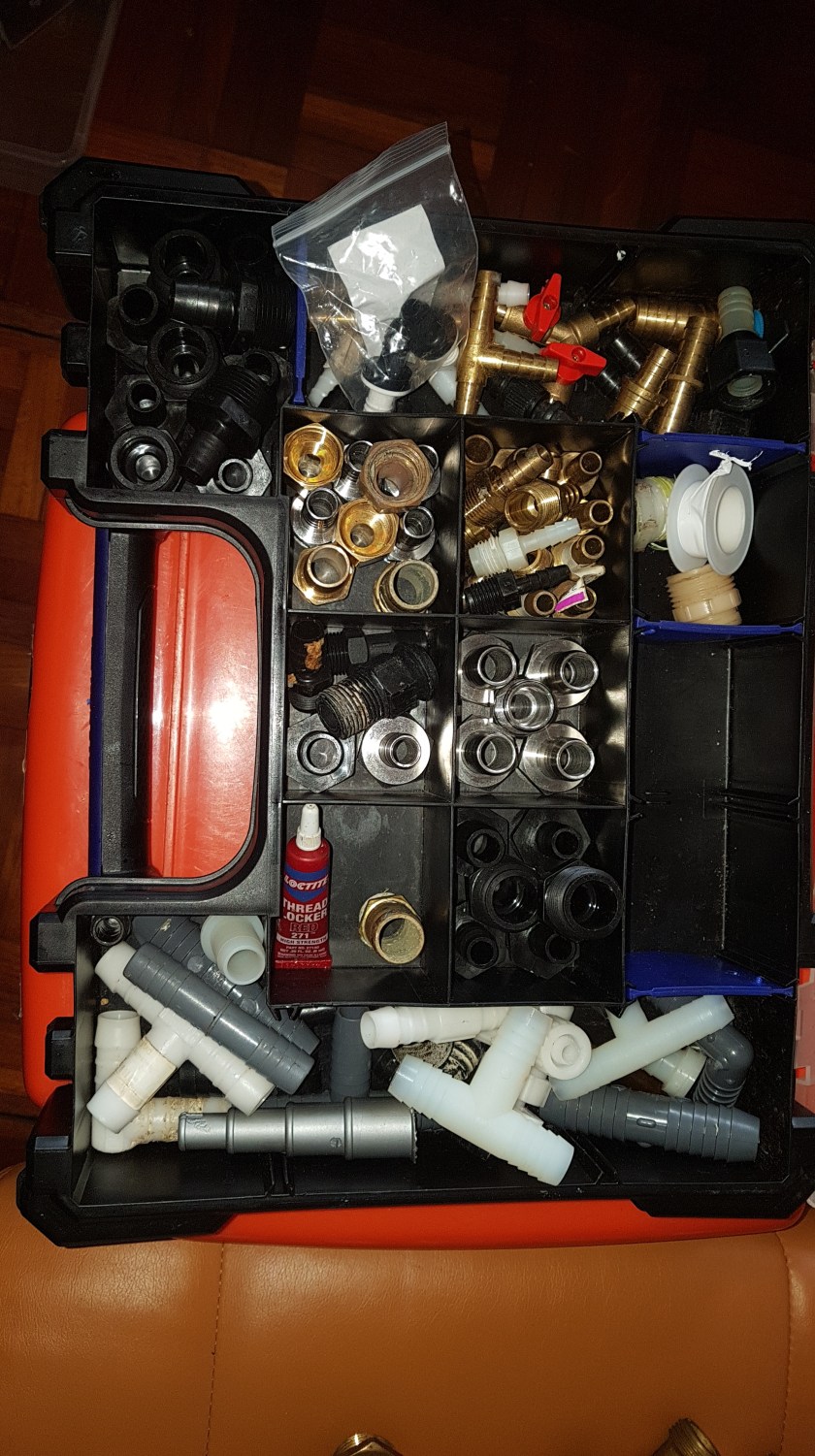
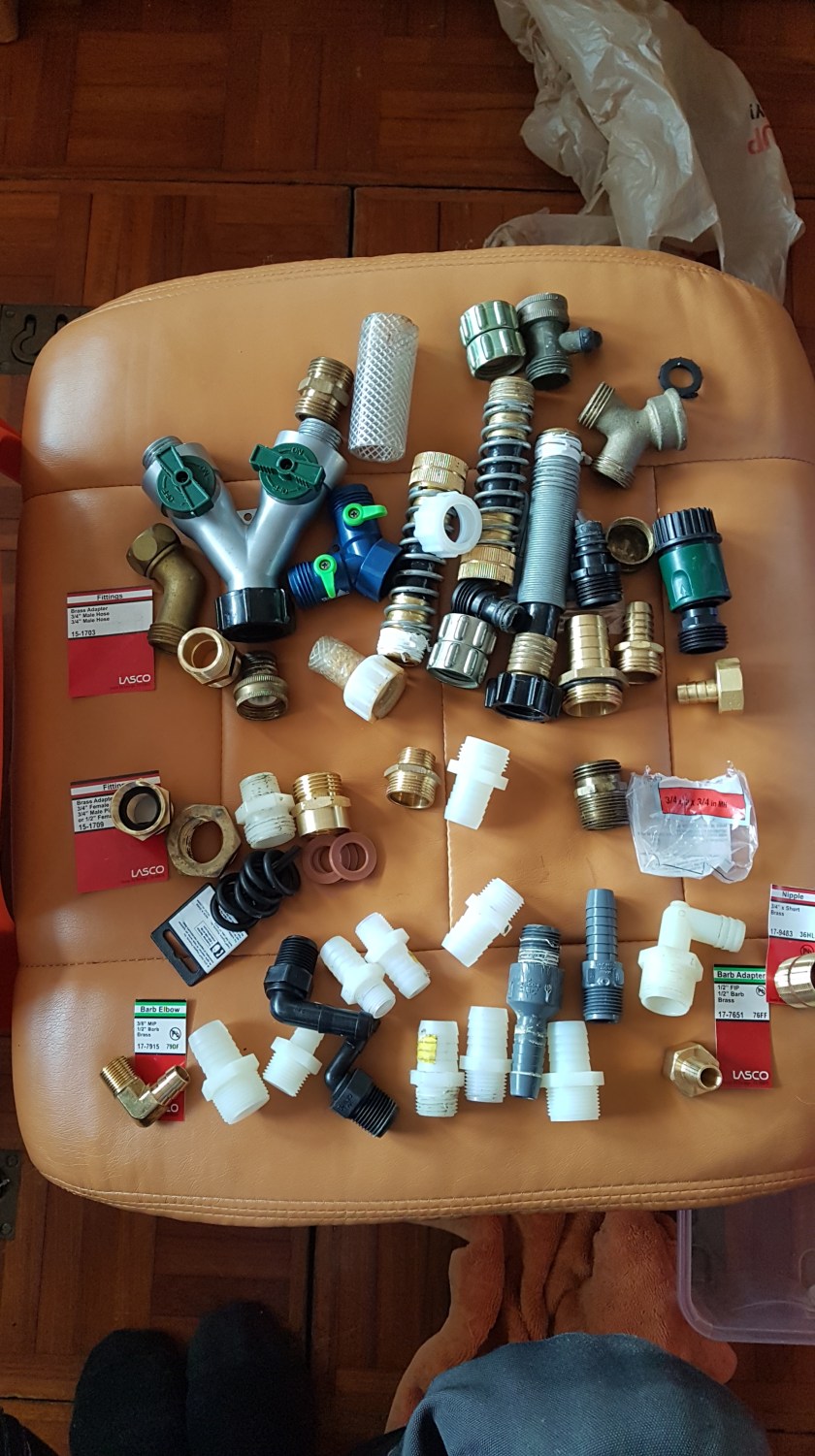
Then, there is the boater who every marine store, big box store and Amazon loves. They have literally hundreds if not thousands of parts: plumbing connectors, electrical wires of all sizes, butt connectors, spade connectors, every connector under the sun; except for the one they need.

All threaded NPT

I’m in the latter group.

So, my little, very little, dock filter project, took three days and 4 trips to Home Depot, Wal-Mart and Ace hardware. Why, you wonder with the plethora of things I already have on board?

An assortment of hose barbs and NPT connectors

Well, it’s like this. I have 100 feet of ½” clear braided nylon tubing. I also have about 25 feet of 3/8” of the same, as well as 50’ of 1 inch. The water filter I bought used ¾” fittings. I didn’t want to use ½ inch. I also needed ¾” NPT to Hose thread.  I had a nice variety and quaintly of stainless steel ¾” hose barbs to ¾” NPT, and many ½” barbs, but alas no ¾” tubing.

I will spare myself the embarrassment of the Rube Goldberg setup I made first, then second, finally third, but with too many connectors of different sizes, it was difficult to not have a joint leaking.

Finally, I bit the bullet and went back to HD for the umpteenth time and bought a ¾” NPT male/female water heater hose of two feet.

Thus, my dock water household filter was installed in a manner that I’m happy with. Even got a quick disconnect to work that I’ve been carrying around for 4 years. I also took the time to re-organize all my hose and pipe fittings.

Now as you look at the pictures, while it may seem relatively organized, I seem to have soooo many ¾” fittings for who knows what, since I have few ¾” anythings on board.

An assortment of Hose thread (top), hose to NPT and all NPT (middle) and hose barbs (bottom)

The dock water filter was certainly not a necessity, as I have gotten along fine without it for these 5 years. But I am on a self-imposed deadline, getting the stuff done that is at best superfluous and at worst a waste of money. For next year, with Trinh here, she’ll ask me how I managed all these years without it, not having a good answer, she’ll tell me to save my money.

I’ve already calculated that I will save $500 per month. I feel richer already.

I did have a much bigger and serious problem, that I have worked around, but had to be fixed.

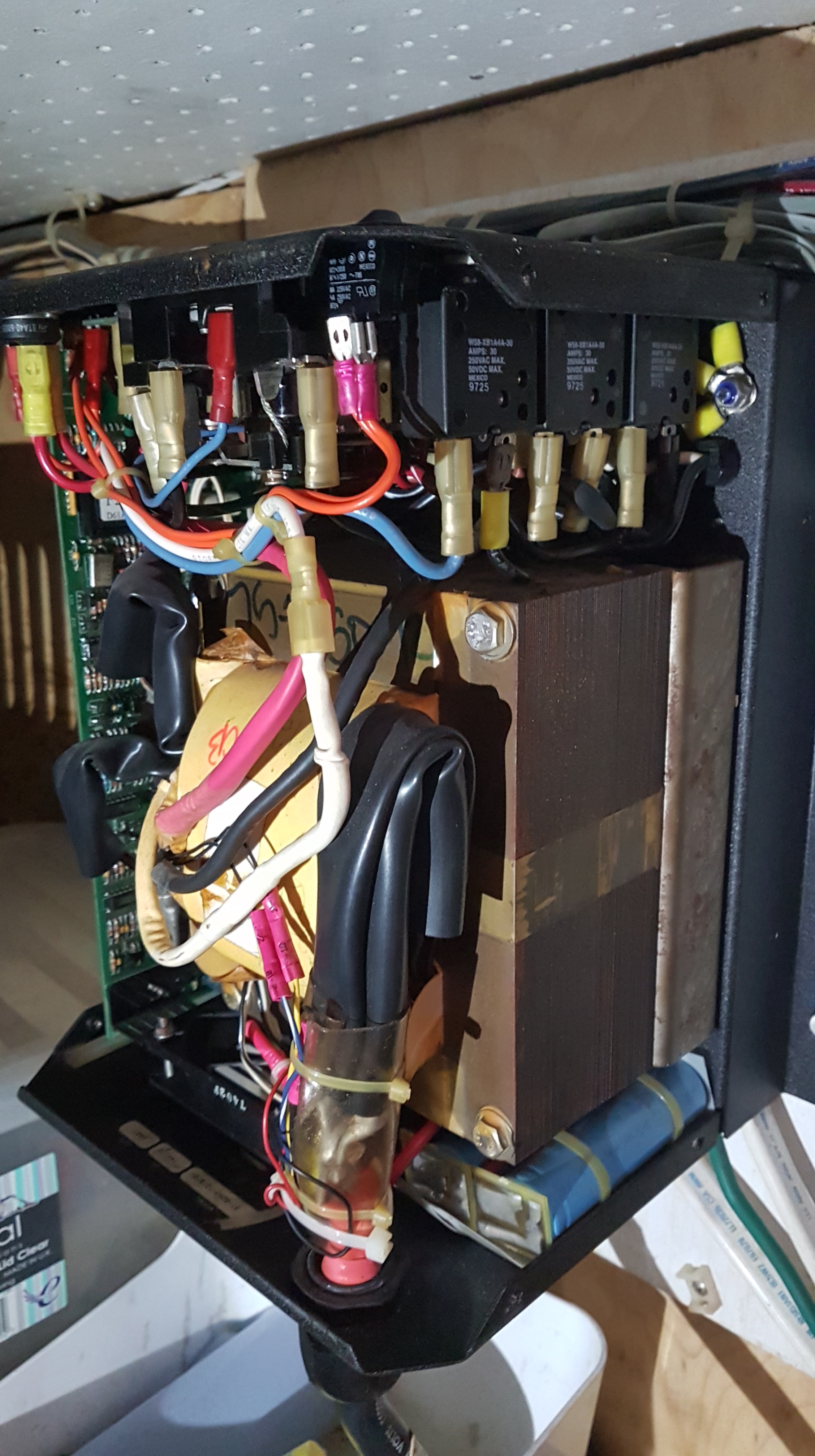
My Heart Inverter/Charger has not been charging for the last few months. I could tap it and it would wake up and start to charge, but sometimes within minutes, sometimes within hours, it would revert to not charging.  So, I knew it was an internal relay problem. But I hate disconnecting it from the 930 amp-hours of batteries.

Also, I could work around it relatively easily, as I have another charger, a Neumar, that charges only, but will work on any voltage, which made the time in Europe very easy. It’s on circuit 1 and as you have read, in this marina, I only am connected to circuit 2.
When I left Dauntless in July, I left her connected to circuit 1 and therefore the Neumar was charging.
But now, being on the boat, circuit 2 is more convenient. I didn’t want to do another work around like I did for the washer and water heater. I needed the Heart Inverter/Charger to work as it is supposed to.

So, I depowered everything, turned off all external power and disconnected the batteries (at the 300-amp fuse). Open the Inverter case and sprayed a lot of contact cleaner on everything, especially the two sets of points that make up the charger relay.

I also tightened the female spade connections on the circuit breaker for the charger (on the upper right of the picture). They didn’t feel loose, but still, couldn’t hurt and a loose connection like that, while very simple, can cause havoc or worse.

I let it dry for an hour, re-connected everything and powered her up. This time, I didn’t have to tap it and it worked as it should. Battery voltage slowly worked its way up to 14.04 v and stayed there for a while as the amperage came down. But even after 24 hours, voltage was 13.78 v, while the amperage was still about + 4 amps.

49 hours later, the voltage as stabilized around 13.70 and the amps going into the batteries stays a little positive, even if it is only +0.4 amps.

Very happy. Now, when I leave the boat this winter, I will leave it on that inverter charger.

I also ate some great Korean food this past weekend, as I had a great day in San Jose with some wonderful Korean friends.

Korean food in San Jose


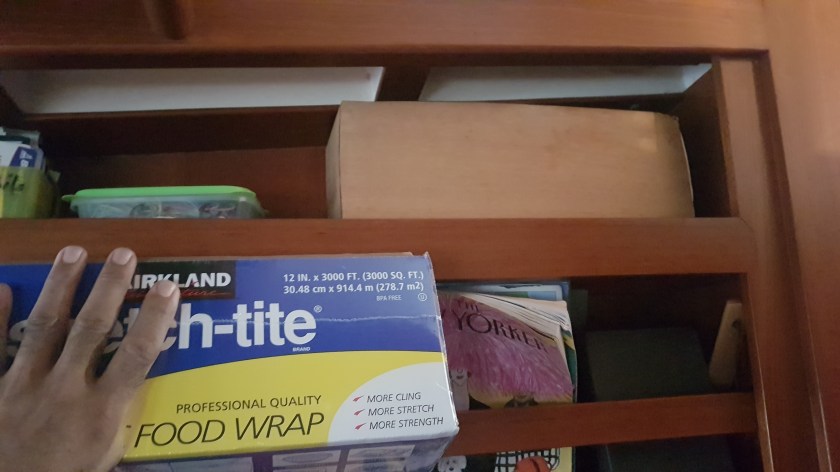
And I did go to Costco, since my 3000 feet of plastic wrap which as lasted me 5 years ran out yesterday. While at Costco I bought romaine lettuce, Brussel’s spouts and rack of lamb.

The new box and old box (with wood veneer)


Coming up next, a hundred males, only a few females; nothing good can come from that.

Still Plugging Away in Vallejo, But a New Tale of Adventure and Woe on the High Seas

My fresh water replumbing job was 75% done yesterday, today it’s 50% and even that took a couple of hours. Suffice to say that the floor of closet now looks like Charlie Kruger took to it with a chain saw. No pictures, since many who read this are carpenters or at last know how to work wood and the pictures are not fit for a mature audience.

My beloved grill already for another 5 years

But it does bring back some painful memories. My first wife had asked me many, many times to repaint some chairs we had. Finally, I did. I laid the yellow paint on nice and thick, so the old color would not show through. I was pleased, though they took days to dry. Finally, I presented my masterpieces and she asked me about those drip marks. What drip marks? They weren’t there when I put them to dry. I hope she’s not reading this and cringing.

I stuck to things mechanical and electrical after that.

Who looks at the bottom of the closet anyway?

I have finished some small things though. I replaced both burners and the electric igniter  on my Weber Q300 grill. That grill has spent 5 years on the ocean. I’ve been quite pleased with it.

I also installed the new thermostat in my Raritan water heater. I did notice in my travel this week that both the thermostat and heating element are available at your local Home Depot for roughly half the price. It’s expensive to print the word “marinized” on the box.

The tangle around the prop that was removed today

Last, but not least, I had a diver come by to check my bottom. Well, Dauntless’ bottom. And sure enough, I had a little collection of lines around my prop. I’m so happy. Coming up the California coast, I thought I felt a slightest of vibrations. Almost like a shudder every few seconds. It would not have been noticeable to anyone else and Larry didn’t feel it, but I knew. Even wanting to be wrong about it, I knew. I was worried that I had tweaked the prop. Worse yet I thought I had tweaked it by doing something stupid. Yes, even stupider than the last stupid thing.

We were underway from Ensenada to San Diego, eagerly anticipating the celebration with fireworks and fire boats that was sure to wait us in the old U.S. of A. It had been 4 years after all.

This shows the Maretron Data of Pitch (left) and Roll (right). You can see where I deployed the paravane because the roll was reduced by more than half at about the 28 minutes ago mark. You can see that it also reduced the pitch, but that is not to be expected. It happened this time because of the combination of NW swell and West wind waves as were headed NNW.

The wind was light, 10 knots from the west on our port beam. With the added Pacific swell from the northwest, the boat’s rolling had increased as the day wore on. By early afternoon, the roll was 10° to starboard and about 5° to windward or port. But occasionally the roll increased to 15° & 10°. That’s a difference of 25° and usually is the point where I really notice the roll and so I will put one or both paravane birds out. In this case, I just put the windward bird out. That would dampen the roll about 50% and we only lost 0.4 knots. A good price to pay for a nicer ride.

This picture I took as the boat slowed down, so the bird was back under the water.

Suddenly, close to the USA-Mexico border, the ride of the boat abruptly changed. It became very smooth. I jumped up from the pilot house settee to look at the paravane and see that we had snagged hundreds of feet of line connected to pots, I guessed. I estimated hundreds of feet, since I could see at least 100 feet strung in the air, then to the bird which was well out of the water.

I chopped the power, the boat slowing quickly. But now, the line of the pots was snagged on the bird, but stopped dead in the water, with the pole vertical, we had all the dead weight of whatever that line was attached to.

I got the not so bright idea to go in reverse. Possibly, the line would un-snag itself at that point. It’s worked in the past, but no luck this time.

Larry and I heaved and heaved and got the line up to the bird, at which point, we cut the snagged line away. This line also had several floats on it. Once cut away, the floats and line and floating right next to the hull amidships.

Until now we had done almost everything right. I just needed to be a little patient.  But patience is not a virtue I have been gifted with. I decided to go forward to get away from the floats. Yes, by running over them. Sounds stupid even in the writing. Sure enough, within seconds the line was in the prop. I stopped the motor and cursed at my stupidity.

That done, I put her in reverse, as I have unwound lines that way also. In this case, no and hell no. There came a hellish scream, which I attributed to a float being wound around the prop scrapping the hull.

Wow, as I write this, details came back that I totally forgot about!

I went in the water. I lowered the swim ladder, climbed down the ladder to the lowest rung and stood there, while Larry handed me the boat hook. I was able to snag the line using the boat hook, since it was about 10 feet under the water.

We got that line up to the boat and cut it.

I then backed up again and we were free.

But from then on, I felt this slight shudder. Had I tweaked the prop? I didn’t know until today.

I do have a SALCA cutter anode (model 2000, 2″ diameter) on the shaft, just in front of the prop. I’m sure it has saved me many times and even this time, may have helped. But that pile of lines now on the dock, was wrapped around the prop since San Diego.

In thinking about this incident, I also realize that the paravanes were well designed for incidents like this. I’m sure that is the most force put on that pole and lines since installation. The 3/8” Amsteel Blue line fore guy did its job. To stop the roll suddenly and slow the boat so abruptly, there must have been thousands of pounds of force to the aft on that line. It’s tied off permanently at the bow hawsepipe and cleat. I have it doing 4 turns over the cap rail, with a clove hitch before it’s tied off on a cleat. Thus, the cleat never really sees significant force, even under these circumstances.

Thank you, John Duffy in Miami, for doing such a great job with the paravanes.

I think I’ll have a celebratory drink, since I missed the fireworks and fireboats in San Diego.\

And I’m looking for a decently priced Hookah outfit. I need to be even more self reliant.


Plugging Away in Vallejo

Having dedicated these days to the three dozen items on my winter to-do checklist, I hardly have time to write this blog. So, I’ll just have to add this to the list.

So, I figured I’d make goal, nice and high,  like 25%.

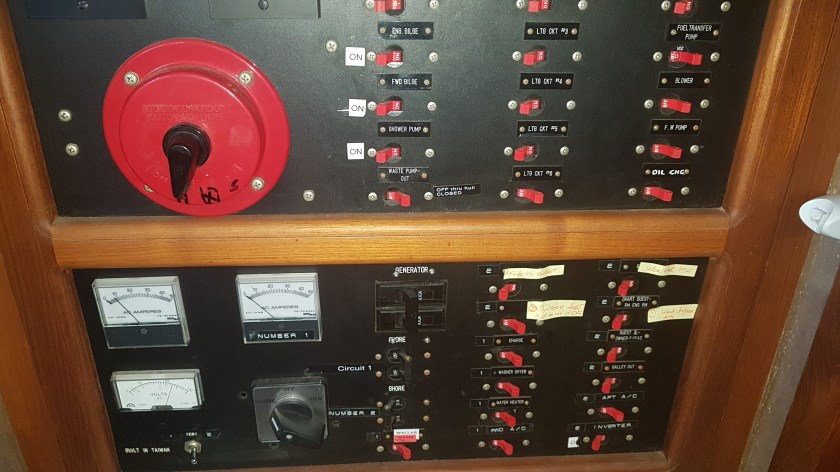
My salon electrical panel

What? You were expecting 110%?

I’m not one of those super achievers who when they want to paint the engine room, they take everything out, like engine, genny and all that crap glued to the walls.  Eek. Even writing that sends chills down my spine.

I have done a few things on the list. Maybe more than a few. Of course, I had to write a review for the local donut place. Well, not so local, but good donuts are worth the time.

The back of the salon electrical panel. the breaker I had the problem getting the screw back in was near the top of the picture middle column.

This wonderful marina  with covered dock, only supplies me one 30-amp circuit. It quickly became tiresome for me to change the dock plug from one circuit to the other, when I want to turn on the water heater or Splendid washer-dryer. So, in consultation with that Krogen guru, Dave Arnold, who pointed out  a far simpler method to power those items from the circuit that they are not on, from what I had originally devised. I proceeded to put a simple jumper off the breaker in the salon two days ago.

But then today, in a sure sign of mission creep, I decided to idiot proof my little setup.

In normal times, I run either two 30-amp lines to the boat or one 50 amp to a splitter that makes it into two 30’s for the boat. My main charger/inverter is on circuit 2, with most of the primary everyday stuff in the boats like the outlets and salon A/C. On Circuit 1, are the step children: washer dryer, water heater, chargers two and three and forward A/C unit.

So here, the dock power is plugged into circuit 2. In it’s previous life, this Kadey Krogen used to be a heavy 120v user, almost everything except for the navigation lights, radio and radar were household 120v.

Dauntless was going to be a cruising boat, not a dock queen, so from the beginning, my goal was to reduce that 120V dependence. First to go were the Subzero fridge and freezer; then thanks to Amazon, all the lights and/or bulbs were replaced by 12v LEDs. Boat computer, LCD monitors (Samsung 24”, there is at least one particular model that will work on 12v and in fact, works to about 11.5 v) and everything else in the pilot house are 12 votls.

The only 120v items that remain are one salon wall light that also serves as a 120v power tell tale and the older appliances that are not sued that often and thus not efficient to change such as the Raritan water heater, the Splendide washer dryer combo, the two A/C units and the microwave. That’s it.

This is the first time in months, I’ve needed the 120v water heater, as it also uses engine coolant to heat the water. But it’s cold up here and that first night back, taking a cold shower was enough for me to decide I needed a better plan. Replacing the heating element had been on my list of things to do for a while, as measured in years. While in Cabo I realized the water, heater was not working on electrical power. But, since I was seldom stopped long enough for the water to get cold, I didn’t need it until now.

So, the first day back, it was number one project. Of course, I had to get an inch and a half socket, but once that was done, it was all done, and we were good to go

Except we weren’t. Still no hot water.

Get the electric meter, umm should have done this first, only to discover that the problem was the thermostat. Well, that was easily bypassed. Now for the first time in a long time I had electrically heated hot water. I just had to remember to turn off the breaker after an hour or so.

Now I had the problem of having to move the dock plug every time I wanted to make hot water. I don’t like messing with the dock plug. If I’m moving it once a day, that’s a sure way to have some other issues. I needed a better solution.

So, two days ago, I made a jumper from a non-used breaker on circuit 2 to the water heater breaker on circuit 1.

I now had power to the water heater from circuit 2. Life was good.

I always want to make it better though, even if that has often not served me very well. A primary reason I’ve had few careers in my life, especially in Education, where there are too many adults who like the system just the way it is, words and promises notwithstanding.

But obvious solutions are sometimes not as simple as it seems. Thus, today I spent a couple of hours just trying to get one little screw back into the breaker. It was one of those old, straight cut, very short screws that were popular in the 60’s.  I tried grease, even glue, to get it to stay on the tip of the screw driver. I had only taken it out because I wanted to disconnect the line that was there. I knew it was going to an outlet that is not used, but I wanted to make sure that if I had power to both circuits 1 & 2, that I would not be feeding power where it was unexpected.

I just thought it better to remove the second lead from the load side of the breaker. Now, the breaker has only one load, no matter what.  On the picture, it’s the second breaker in the middle column in the lower part.

After doing that, it was easy to also add a jumper for the washer dryer. Those breakers were on the outside column, about a million times easier to access and that only took a few minutes.

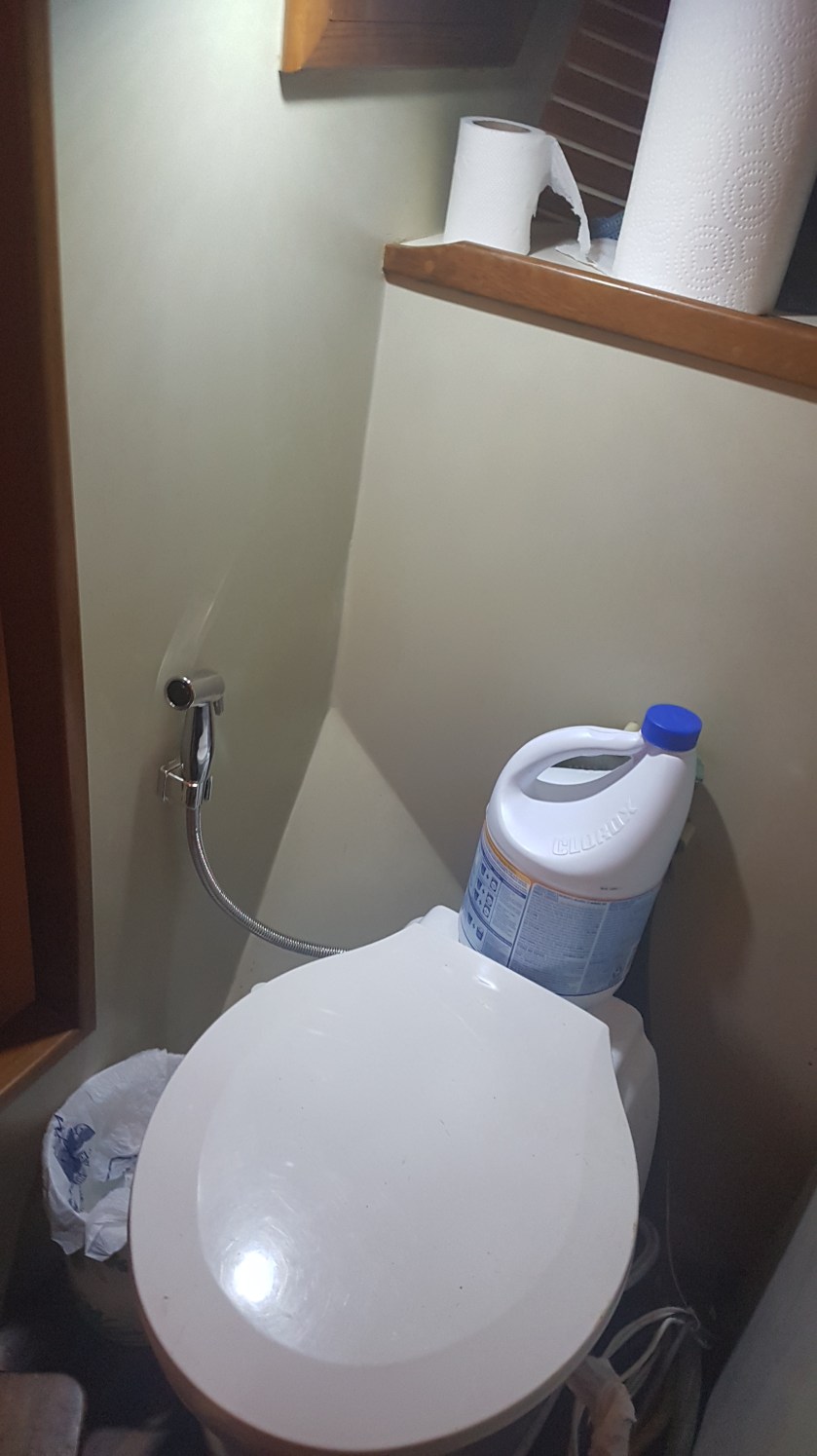
My new head water nozzle

My other little projects that were on the list was to add little water nozzles by each toilet.  It’s an eastern Asian thing and virtually every toilet in Vietnam has one, even the toilets that don’t have a commode. I also find it far more practical than a French bidet. Besides cleaning all sorts of things,  it can also be used to fight fires or water fights with mutinous crew!

What more can one ask for?

The Second head water nozzle

The Dauntless Winter Home

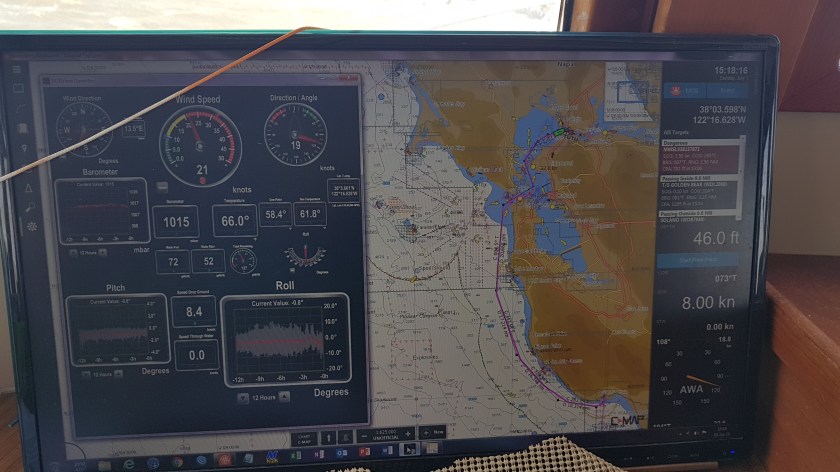
CE Chart showing my route from Santa Cruz to Vallejo. Maretron data shows winds, and other environmental parameters

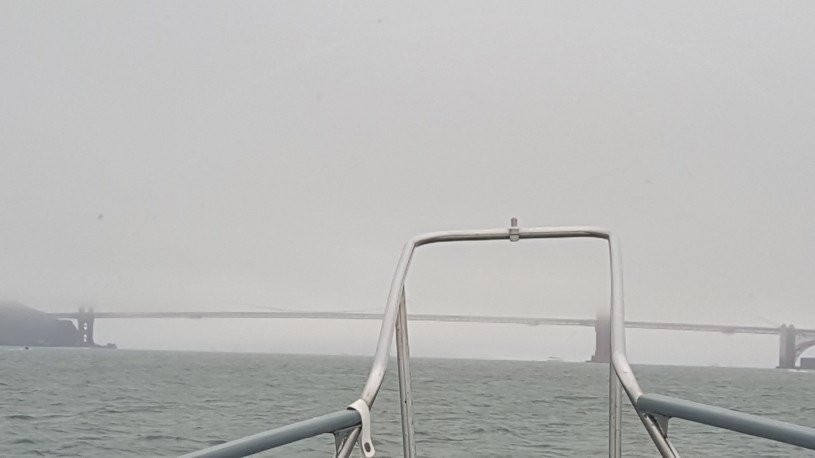
Passing under the Golden Gate, I felt the chapter coming to the end. Like turning the page and seeing only a short paragraph remaining.

As I made my course eastward under the bridge, the winds picked up as forecast to westerly at 20 to 25 knots. I was happy to have just gotten up the coast before the band of strong northwesterly winds had reasserted itself.

Error
This video doesn’t exist

I also knew now that no matter what the winds did, my ride to Vallejo would be relatively smooth and it was. The picture shows the Maretron data with winds as high as 32 knots, but the roll reduced over what it was on the ocean.

After a few hours of motoring up the channel, Fly Wright was there to greet me.

Fly Wright meets us

I had to dock outside my covered slip that first night, as I had to lower the mast and the paravane poles.

With many hands helping, the mast the poles were easy to lower, though I wondered how I managed to do it myself a few times.

We had a great dinner that evening at the Sardine Can, a good restaurant near my slip. The next day, I moved Dauntless to her winter home. She’ll be there, out of the sun and rain until next spring, when we continue our northward trek.

The winds were blowing

This time I remembered to change the oil right away. I also had a long list of items to do before I flew away.

My winter Home Maretron Data shows the summary of the previous two days coming up the coast from Morro Bay.

I’ll be back to her in September to commence a long list of projects that hopefully will be done by spring.


The Golden Gate

On the 63rd day since getting underway from Huatulco, 2300 hard miles ago, I got up for the last day at 02:00.

The Golden Gate Bridge dead ahead

70 gallons of fuel would be more than enough to get Dauntless the last leg to San Francisco Bay and Vallejo.

Checking the current tables, I had to get to the Golden Gate by 13:00. Then the current would push me the last 40 miles to Vallejo at plus 2 or 3 knots. To make that happen, I had to depart by 03:00, planning 10 hours for that 65 nm.

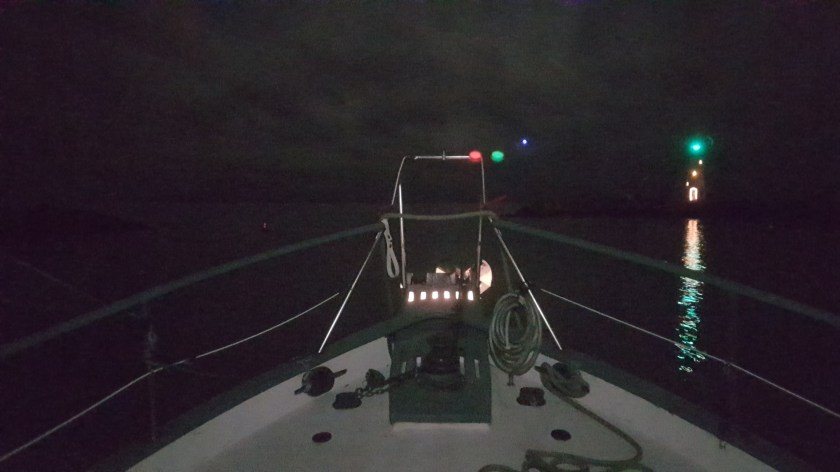
02:33 Engine start. We (Dauntless and I) were underway at 02:45, with scattered clouds and southerly winds.

I had about an hour of cruising WSW, before I could head NW. After a few hours, just after sunrise, I was able to go on my final course of 340°. The winds stayed southerly at 12 to 16 knots for the rest of the morning. Just enough time for me to get into San Francisco Bay.

Videos I took that morning: 

Error
This video doesn’t exist
Error
This video doesn’t exist
Error
This video doesn’t exist

A brown day with wild fire smoke

At noon, 12:00, I was entering the Golden Gate channel. My goal of the last 10 months was in sight.

Leaving Santa Cruz Channel

And it was an impressive sight. To be looking at the Golden Gate Bridge from the Pacific on my own bottom. How many people can say that?

I was proud: of my accomplishments, of my determination to complete these goals, of this Kadey Krogen that was so strongly and safely built.

We could not have come up with a better name, Dauntless, determined, never give up.

First Glimpses


All of the pictures  Dauntless moving north from Mexico to California 2018 can be seen here in ascending chronological order. Please note that most pictures have the date and time they were taken in the picture/file name.

All the Dauntless directories are here, Dauntless Pictures