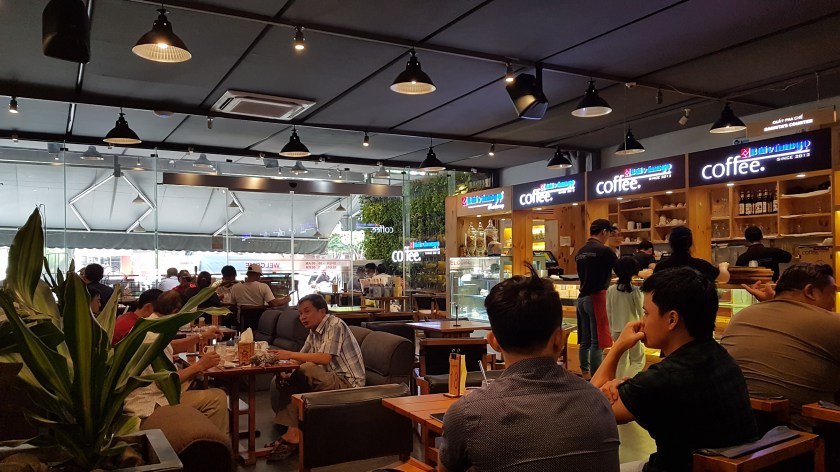
I have two favorite cafés in Ho Chi Minh City, Bui Van Ngo Coffee is larger, fancier and also has some baked goods. Café Thuy Moc is smaller, homier and they make killer smoothies, my favorite being Sinh To Bo, an avocado smoothie. They are also on a busy street corner that I can watch fascinated how crossing traffic manages to crisscross in a smooth ballet of traffic.
Sunday morning, 08:00, at Bui Van Ngo Coffee in Binh Tan, HCMC, Vietnam
Sunday mornings both places are full, which goes to my observation that about 40% to 50% of the population have Sunday off, at least partially.
I haven’t been to China yet, but having spent time in Korea, Japan and Vietnam, the Vietnamese work the most. Japan and Korea (South Korea of course) being closer to a more western life style with more time off. My friend Sam, married to Bac, who wrote the book, For Two Cows I Ain’t Half Bad, remarks that when he arrived in Vietnam in the late 1960’s, the Vietnamese had a life style that had hardly changed in the last few thousand years. 90% of the population were agrarian, farmers, and farmers are renown the world over for one thing, they just want the powers to be to leave them alone.
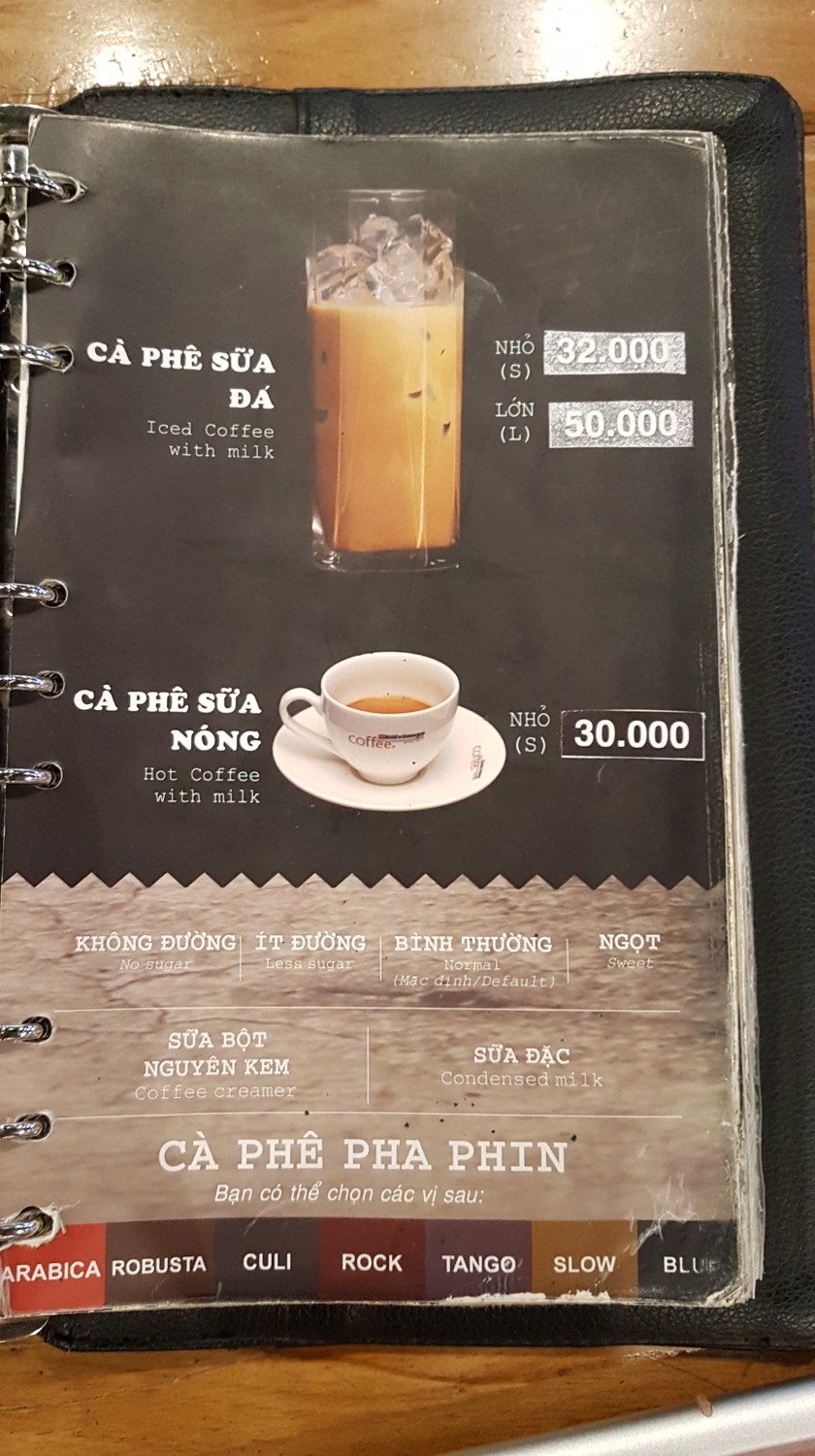
A page from the menu of the popular cafe
I blame the U.S. State Department for most of the post WW2 debacles. Full of ivy league graduates who think they know everything, but, know nothing about the places in which they are supposed to be experts. They lurch from one fiasco to another. Acting when they should sit on their hands and being still when they should act. How is Iraq any different than Vietnam? Ok, basta, enough.
Café Thuy Moc, smaller. The owners, the couple on the left and their one year old daughter, who just learned to walk on the right.
Having been on Dauntless for the last three months, the first week back in Vietnam was a bit strange. Probably jet lag as much as anything, though I did, or I should say, Trinh did, change my apartment for a house. I like my new neighborhood better, it is less industrial, than the previous one. Even though I had a 10th floor apartment the amount of dust that filtered in every day was astounding. Most probably from the large apartment complexes being constructed nearby. Now, almost no dust.
My German neighbor back in the day said I had an empfindlich stomach. Google does a good job of translating that to mean: sensitive, delicate, touchy. That’s certainly my stomach. But it really likes Vietnamese cuisine. Maybe even more than I do. I was surprised these last months being in the USA and Mexico as to how much I missed the food and as to how much I didn’t like most of the offerings in the U.S.
Coming up, Foods to Die for
Update, I just recently discovered cappuccino in Vietnam. My hard and fast rule is never, ever get a cappuccino outside of Italy, as it is just awatered down, over milked version fo the real thing.
But coffee in Vietnam is always strong and good, so I thought I’d spend the big bucks, 49,000 VND or about $2.20 US and give it a try.
I’m so glad I did. As good as in Italy. Perfect in fact.
Thanks Vietnam
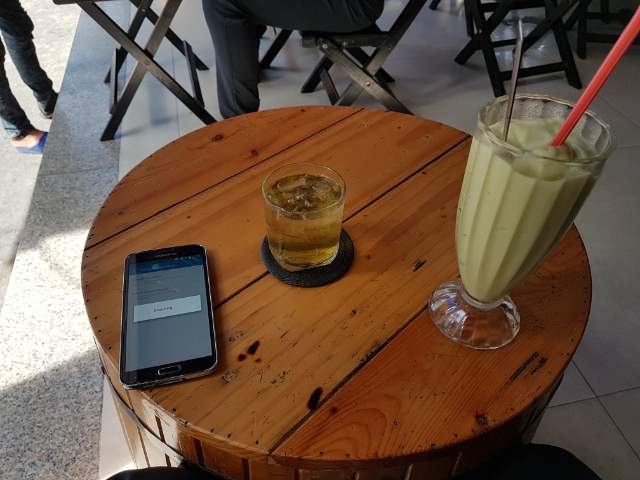
cappuccinoSinh To Bo at Café Thuy Moc Avocado smoothie
Ever have those situations when the yellow/red flags are waving, and you spend all your time trying to decide if the flag is yellow or red? Instead of wondering what’s causing the flag to wave in the first place??
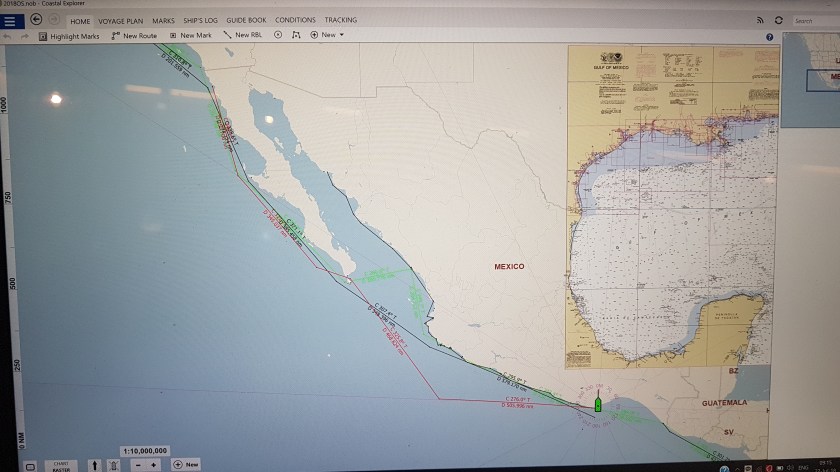
Our Intended Route in Red. Taking the time to get away from the coast seemed best for the forecast winds at the time.
Welcome to my world.
Brian and Mark arrived Sunday, the 29th of April. I was a bundle of nerves, due to:
The normal stress of starting a long trip,
The stress of having crew to keep happy,
I still had to check out of the port Monday morning,
Having decided to have the boat yard, do the transmission seals, they did not take credit card, so I must figure out a way to get $1000 in cash by Monday morning.
My Monday noon, all the problems were solved, and I was feeling pretty good. I had good, intrepid crew. We had food, wine and booze enough for however long a cruise the weather would allow.
With a crew of two, plus me, we had 205 gallons of fuel in the port tank, 210 in the stbd tank, 55 gallons of water in the port water tank and the stbd tank was empty (to be filled with the water maker while underway).
The track from the InReach at Share.Delorme.com/Dauntless (If you go to that site, I do not know why the time is 12 hours off)
Engine start was at 12:25, we got underway 10 minutes later, clearing the breakwater at 12:45, on the way to either Can San Lucas, 950 miles northwest (7 days) or maybe even Ensenada, which was another 700 miles further north (another 5 days).
So, at the beginning of a 7 to 12-day passage, my sense of well-being lasted 20 minutes, or about 2 miles.
Clearing the breakwater, we set the course SSW to clear the coast before turning west, then WNW.
The bilge alarm sounded 20 minutes later, (a buzzer that
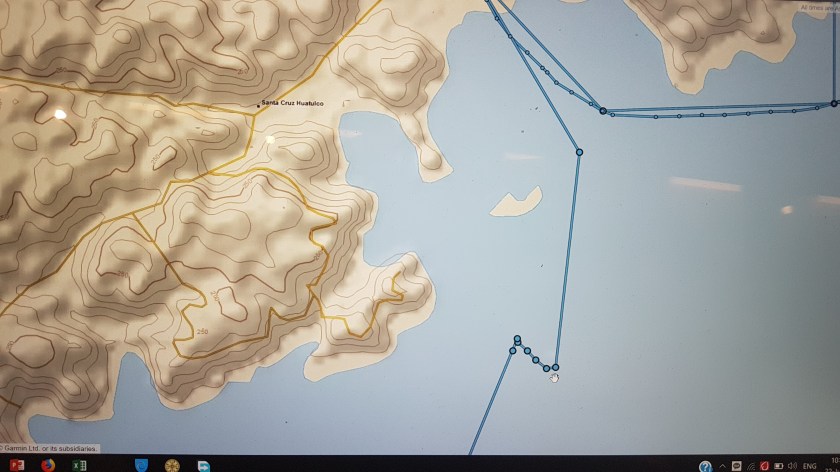
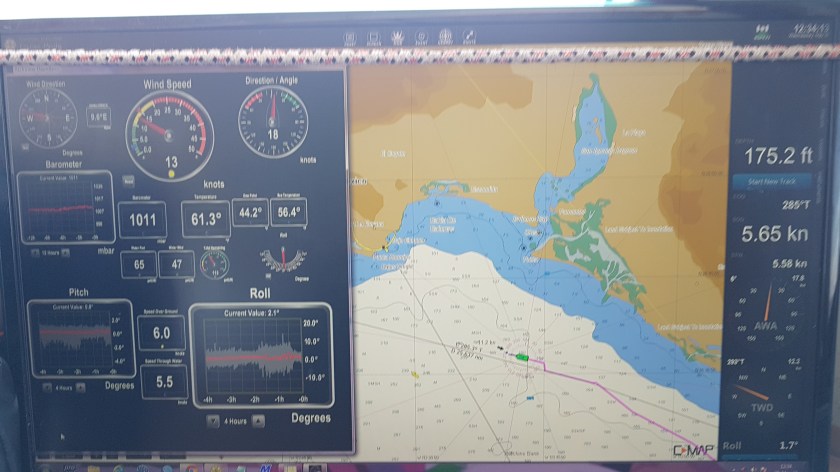
The Coastal Explorer, C-Map chart
is activated whenever the bilge pump is on), went off, and then sounded again a few minutes later. That was not normal. Thinking the stuffing box again, I left Brian at the helm, while I went to open the salon hatch to the engine room.
Stuffing box was not leaking, but I did see a pinhole leak that was spraying water from the oil heat exchanger. Umm, it’s a pinhole leak, sea water, yet the bilge pump had been on enough to pump much more water? What’s going on.
A minute later, as the engine overheat alarm sounded, it all became crystal clear. Shut down the engine, but we were less than a mile from the rocky shore.
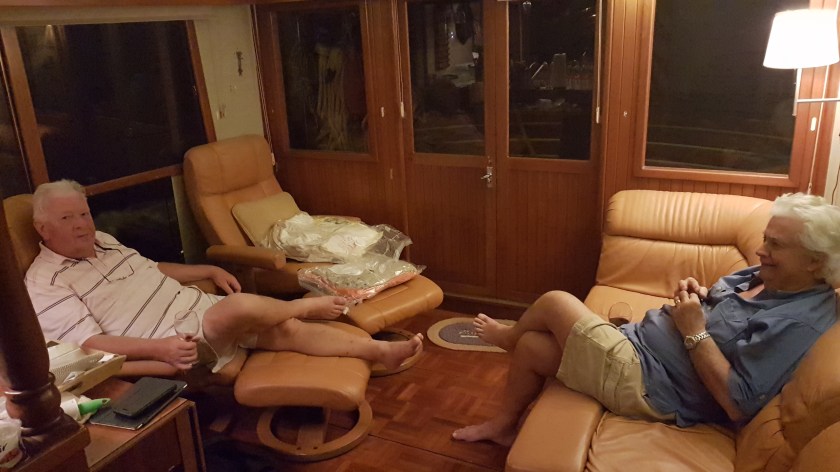
Mark and Brian relax the night before our eventful trip
The engine coolant hose (a heater hose) from the engine to the water heater had failed at the nipple to the water heater. It has dumped all our coolant into the bilge. We were 6/10ths of a mile from shore; a very rocky shore. So, first thing I did was fill the engine coolant tank with fresh water using the garden hose the first owner had installed in the engine room just after the fresh water pump. It was good to know that I had a source of fresh water for the engine that I could use in a critical situation.
If push came to shove, I’d stick the nose nozzle in the coolant fill and turn it on, to keep water in the engine if I needed to start the engine before the repair was done. We were in 160 feet of water, so I also had the option of dropping anchor.
Lines stored behind the fly bridge ladder
Had I had a problem that was going to take longer to fix, or if I did not have fresh water available, or if I was alone, I would have let out 200 feet of anchor and chain, knowing that the anchor would set itself as the water shallowed. This is the emergency anchoring plan I always have in the back of my head while cruising near shore. In still deeper water, with no shelf, I would combine my two anchor rodes, the secondary being 50 feet of chain and 250 feet of rode (400’ of 3/8” BBB chain on the primary with 55# Delta anchor).
I also have stored behind the salon between the upper deck ladder:
a 500-foot line,
a 250’ line,
a couple of 50’ lines,
a few shorter line,
the stern anchor) Bruce) and it’s 300 feet of rode on a hose reel.
These lines can all be easily retrieved and used as necessary.
Had I been alone, that’s what I would have done, while turning the boat around and heading back to the marina on auto pilot. I could have then re-fit the hose, knowing I had at least 15 minutes before I needed a course correction.
But I was not alone.
With Brian at the helm, responsible for watching our drift, Mark and I proceeded to deal with our two problems, the coolant hose and the pin hole oil cooler leak.
The coolant hose was easily dealt with. Cut off the end and reattach to nipple. I then checked for leaks, as we started the engine. No leaks, so I filled the coolant tank with ¾ gallon of coolant. This all took 10 minutes.
Next to tackle the oil cooler. We first tried a quick repair; can we stop the leak enough until our next port. No, we couldn’t, the metal at the cap end from which it was leaking was too thin. (these were the heat exchangers that had just been supposedly checked. In addition, I’m sure this was the one that was already leaking, and I told them to keep it).
Checking the situation at the helm, while we were drifting towards shore, we were drifting very slowly and again with Brian watching, I knew we would have plenty of warning should an issue arrive. Therefore, we decided to change the oil cooler.
What a PIA. But an hour later we were all done. No leaks of oil, water, or anything.
It’s on my must do list this fall to standardize all my hydraulic and oil fittings. Thus, making it easier to replace lines or bypass the coolers if need be.
We had drifted a quarter mile closer to shore, we still had a third of a mile to spare. Easy Peasy as Micah would say.
Knowing we could return to the marina easily, reduced the stress of this repair. It wasn’t “fix, or else” like it may have been in the middle of the Atlantic, like with my imaginary fuel leak.
At 14:10 we were underway again.
My peace of mind now lasted one minute.
The autopilot was not working. It thought it was working, but it wouldn’t steer correctly.
Back to the rear of the engine room, I looked at my Octopus pump, it looked ok, no major leaks, then I saw the three valves which control fluid to the pump, allowing me to change pump without draining all the hydraulic fluid from the system, were closed.
Oops. At least that was easy.
A minute later, we were underway again, hopefully to Cabo San Lucas.
This time my peace of mind lasted a whole two hours.
The best laid plans of mice and men often go astray.
Having gotten my toothache taken care of by having a root canal the first evening I was back in Huatulco, I was finally felling pretty good. The previous 5 days were a whirlwind of: pain, getting things done in NY, flying to southern Mexico and getting back to Dauntless after 8 months.
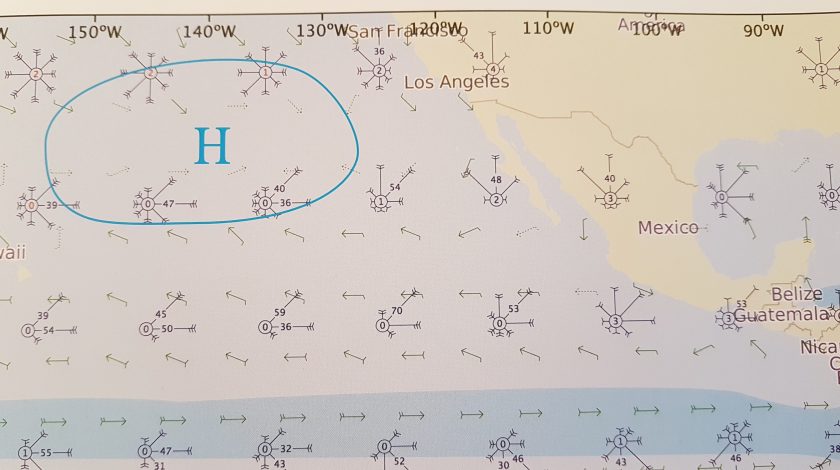
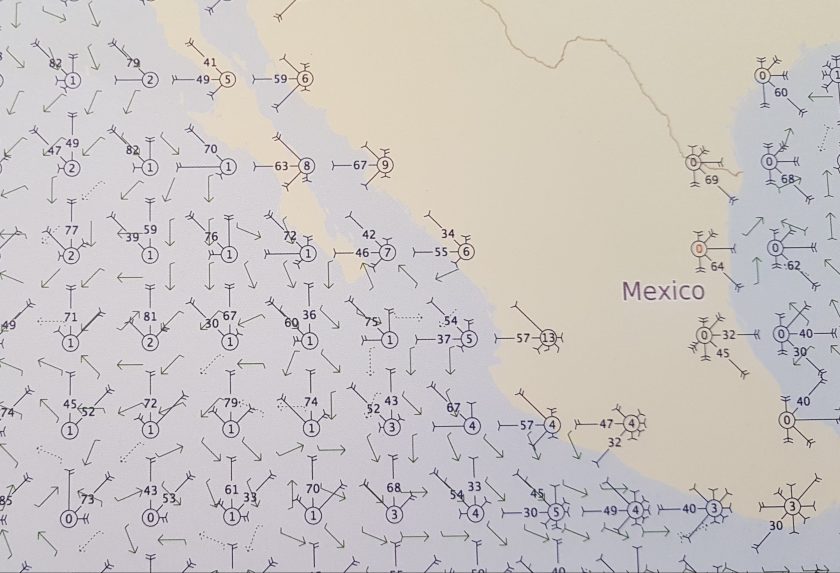
All winter I’d been watching the weather and winds off the west coast of Mexico and California. Jimmy Cornell’s World Cruising Routes and his updated Pilot Charts of the Pacific had made it clear that I would have a slog ahead, commonly known as the Baja Bash. 2,000 miles of going northwest into predominantly northwest winds of anywhere from 5 to 30 knots.
JimmyCornell Ocean Atlas Monthly Pilot Charts for all the Oceans
As mush as I love my Kadey Krogen, it has gotten me safe and sound through so much; I hate head seas.
But I had a plan. A pretty good one I thought. It was clear from the above references that I would have at best 25% of the time favorable winds. For every one day of good winds, I’d have three days of head winds. But as we all know, weather works in averages. I couldn’t exactly count on moving one day and then resting the next three. I could just as eiasily see 7 favorable days and a month of head winds.
Over the winter I had planned for slogging up the coast. Getting back to Dauntless the last week in April. I would spend May getting her a bit more ready. Fixing, replacing somethings that needed it and completing some projects stared long ago, but never completed as we cruised from Ireland to the Pacific Ocean in a little less than a year’s time.
My transmission and damper plate
This plan would have me leaving Huatulco in June as hurricane season started.
Perfect.
The dominate weather pattern is only disrupted by the tropical cyclone pattern of tropical depressions growing to storms and possible hurricanes. Their anti-clockwise wind pattern disrupts the dominant high-pressure system causing the NW winds off the coast. I could have days and days of winds with some southerly component.
The normal position of the Pacific High. This year is has been stronger and more persistent.
The only downside of this plan was that should the strengthening tropical depression or storm head northeastward towards the coast, I’d have to have my hurricane holes laid out. Also, single handing on this coast is difficult, as places to stop because of weather are few and far between. For example, there is no safe hurricane hole between Huatulco and Acapulco, 250 nm or two full days away.
In the previous months, I’d also sort of put it out there that I was looking for crew. With crew and a longer weather window, we could get up the coast in some large chunks. Maybe even get to Ensenada in a 10-day passage. That would be so wonderful.
Pilot chart for the Pacific off Mexico
In March, I had gotten an email from Brian, who was volunteering himself and another friend, Mark, to help me get Dauntless north. The only caveat was, their free time was in early to mid- May.
I was very happy. I had not thought it wise to do this coast alone. Coastal cruising is totally different than crossing oceans. In the middle of the ocean there are no fishing boats, pangas or other stupid stuff. The large freighters you may occasionally see use AIS and keep their distance (once I upgraded to an AIS transceiver in 2014).
The only downside was the weather. In May, the winds are steady and strong from the NW. No tropical disturbances to disturb that pattern. During the entire spring the Pacific high that generates the strong easterly trade winds over Hawaii and been doing its job too well. I seldom saw weather windows of more than a couple of days and the 25% favorable time was more like 10%.
Stuffing box wrench
I’d also be a bit rushed to get Dauntless in the water. But I was less concerned about this, as she came out of the water with just a minor transmission leak, that had grown progressively worse over the pervious 2,000 miles. So, I decided to have the boat yard in Huatulco fix the leak. This turned out to be a $1,000 mistake. With my time frame of having to leave now to best make use of my available crew, it left no time for the yard to correct what they didn’t fix.
More and more I realize that I need to do virtually everything myself on Dauntless. I hate paying someone for a half ass job, when I know that I can just as easily to my own half assed job for free!
Dauntless goes into water
I also felt time pressure because Brian had crewed with me on Dauntless two years ago from Ireland to Scotland and he had had to wait several days for the boat yard in New Ross to get everything done. I didn’t want to make him wait again. And yes, I know not to let a schedule dictate actions, but no matter what, I, as skipper feel and am responsible.
The only things that had been done was the transmission seals and I had removed all the heat exchangers, as one had a pinhole leak and I wanted them all, including my spares, checked and tested.
We ended up splashing the boat right on schedule, a couple days before Brian showed up. This whole sequence left a lot to be desired on my part.
My original plan was to do a little test run of an hour to make sure all systems were Go. But once they put Dauntless in the water, the winds were strong, against the marina, in fact, the port may have been closed, but in any case, with such winds, I wanted to only tie up once, not twice. As it was I had a hard-enough time getting the boat into her slip and at one point was 90° off. I had to rig a spring line around the piling that we were pressed against and use that to turn the boat to face the slip.
No, a test run was out. I felt lucky that I got Dauntless into the slip without damage. I didn’t want to press my luck. In hindsight, this was not the best decision, but it seemed so under the current circumstances.
Once in the slip, with the engine room bilge pump alarm was going off continuously, I was reminded that I should have checked the stuffing box while still on the dolly. Water was pouring into the boat.
After the initial cursing myself for not checking before, I realized the bilge pump was keeping up, barely.
I got my chain wrench and locking pliers and within a few minutes (unlike previous times), the nut was unlocked, and I could tighten the shaft nut my hand until most of the water stopped.
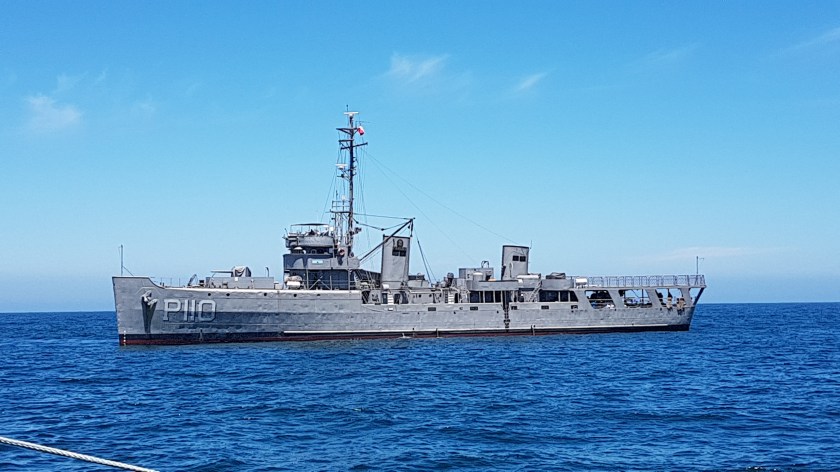
Splashed a hundred feet off our bow. Thick black smoke poured from the funnel of the WWII vintage ship as she pushed thru the seas at her full speed of 18 knots.
Which was still double the speed this Kadey Krogen could do. In fact, the only time we would ever see even 15 knots, would be if we went over a waterfall.
Keeping a watchful eye on us
My little imagination had to settle down; returning to reality, I knew why we were being stopped. An hour before, a panga had crossed our bow about one half mile ahead. Seeing our paravane stabilizers deployed, I’m sure he reported that we were fishing or trawling. We do look like a trawler after all.
Therefore, I was not surprised an hour later when the grey shape of a warship appeared on the horizon.
Watching the radar track, they were aiming for us, so I was ready for their call. They hailed us as “the fishing vessel”. We changed to a working channel on the VHF and they requested that we stop for an inspection.
Error
This video doesn’t exist
ARM Farias
From this start to finish, the Mexican Navy was the epitome of professionalism and courtesy. It’s simply the nature of Mexicans as I’ve experienced in all my encounters these last months. No matter where or when, even in New York.
The ship was the ARM Farias, P110, a minesweeper built in Alameda, California in 1942 as the USS Starling (AM-64) and sold to Mexico in 1973.
Asked to heave to, making no way, our ride became very rolly, as the paravanes need to be moving to stabilize the boat. So, I asked to make some way and that request was granted. Larry and I then watched for the next half hour as the Farias deployed their skiff (an 18-foot panga), which then motored over to us.
Stopped just south of Ballenas Bay
We had retrieved our lee side paravane pole and bird, so the panga could offload on that side. The boarding party consisted of about 6 and the lieutenant in command spoke good English. He proceeded to tell us the same boiler plate language that had been said when we were initially stopped, essentially that since we were in Mexican territorial waters, they requested that we agree to an inspection (yes, it was a request that could not be denied, but it’s still nice to be asked, even when we all know what the response must be, “Yes, of course”.
Obvious as soon as they were aboard that we were not fishing, the lieutenant then proceeded to go through an inspection checklist. This did take more than 40 minutes, as they recorded serial numbers of many of the electronic devices on board, even cell phones and radios. I got the impression that this recording of such information was to demonstrate that the inspection had been carried out.
He also did look in our living areas, in the drawers under the bed and in various storage compartments. Almost everything is stored in large plastic containers and tubs. He asked me to open one that was stored in the passageway, under the washing machine. It contained my winter coats. That was the only and only container I had to open, which I was grateful for since we’d probably still be there if I had to open the 20 odd containers of spare parts in the engine room.
I asked if their ship was a minesweeper and they confirmed my guess, adding that is was built in 1942.
I told them they should ask Trump for a new ship. They thought this was very funny. I was serious. If we can spend billions for a wall, the least we could do is give the countries the tools they need to stop any illegal activities. That we don’t, just shows what a farce this whole secure the borders act is.
At the end of the inspection, they did ask, phrased as, “our commander asks if you have a new Mexican flag? As the one you have is too frayed”
In this picture you can see that half the red portion of the flag is gone
This also didn’t surprise me, as having decent national or courtesy flags can be an issue worldwide. And in fact, I did nave a new flag (remember, on a boat, if you need one, you need two) and they were pleased when I replaced it.
So, ended our stop by the Mexican Navy. Very nice, polite and friendly, I thanked them for keeping us all safe.
As the winds finally let up after 10 days to let us get out of the tourist hell that is Cabo San Lucas, I was optimistic that having a functional dingy would give us increased stopping opportunities.
Our peaceful anchorage in spite of 25 knot winds
One of the key factors in deciding to burn money staying at the marina in Cabo for $100 per day was the lack of a serviceable dingy. Though, the reviews for anchoring outside the harbor, were mixed at best.
Leaving Cabo, the plan was to get a few days up the coast to wait out the next forecast period of strong northwesterly winds that preclude any movement north. Our goal was Magdalena Bay, a very large bay, similar to San Francisco Bay.
We had decided to bypass the anchorage off the Magdalena Bay entrance, as it did not look as protected as San Carlos, point another 12 miles north through a meandering, narrow channel. We were also looking forward to getting the taste of Cabo out of our systems be visiting a real Mexican town again.
Thus, the die was cast for Puerto San Lucas.
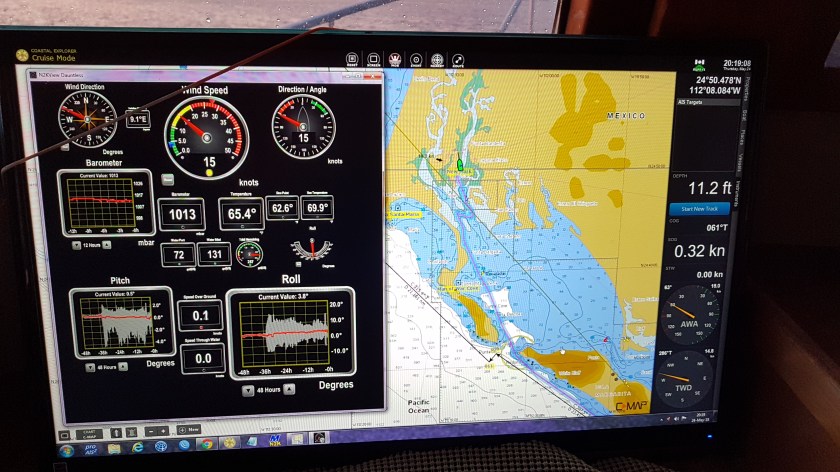
the channel to Puerto San Lucas in Magdalena Bay
As we were passing the anchorage, heading up channel, we heard a call on the VHF, weak, but readable, in Spanish, telling us something. Again, my Spanish stinks, so I wasn’t sure what was being said, but I guessed it was about Puerto San Lucas and we’d figure it out when we got there. I’d already made the decision that the anchorage at Magdalena Bay was too open for my likes.
12 miles and two hours later, as we approached Puerto San Lucas, we got the call again. This time, it was loud and clear that the port was closed due to the anticipated high winds. I suspected that, so we told them we were going to head a couple miles further north to anchor in the lee of the mangroves. That was met with happy approval, since it was clear in the tone of the conversation, that the port captain didn’t like telling us the port was closed to us.
We proceeded north another few miles which put us right on the edge of the charted area of both the C-Map and Navionics charts. Going very slowly as the water shallowed, at one point, I did let us get out of the channel and had to rapidly reverse to avert the 17th grounding of my career (but who’s counting?)
Video of us approaching out anchorage
Error
This video doesn’t exist
Still shot of us approaching anchorageDauntless at anchor, north of P San Lucas
Anchored in about 10 feet of water, with 100 feet of chain and snubber for the anticipated winds, we were quite content. The winds were already 15 to 20, gusting to the high 20’s, but with no fetch, the seas were very small, less than half a foot, and Dauntless was rock steady.
We did swing around overnight due to the current, but my 55-pound Delta anchor has never dragged since I got it 4 years ago. I don’t even bother with an anchor alarm anymore, but I admit that’s because I have given up on Drag Queen probably because it turns itself off due to poor reception in my cabin and more importantly, I don’t anchor off lee shores.
Having sleep like a baby, the previous two nights having been spent underway, we woke up full of piss and vinegar. Time to take the dingy to Puerto San Lucas and check out the action, well more like, check out the food.
Now, not being totally stupid, I decided to go upwind for a bit to see how well the dingy and its puny 5 hp outboard could handle the conditions. As you can see from the video, all looked great, though the winds were blowing 20 to 25 knots.
The view from the dingy on our reconnaissance lap
Did I do the math? No. Puerto San Lucas was about 2.5 to 3 miles away; downwind.
But we set off with the winds to our back, the only concern was where we could land the dingy. Not knowing that location was mistake number #1.
Mistake #2 was I have two handheld VHF radios. The primary one, the ICOM, battery could no longer charge, so that was on the list of things to replace. The secondary one, the Chinese whatever, would take real rocket scientist to figure out how to use, thus it was relegated to some storage container someplace where I put things I don’t feel like dealing with.
Video of our test lap
Error
This video doesn’t exist
Besides, why would we possibly need a radio.
Twenty minutes later, zipping right along, maybe a half mile upwind of town, wondering where we could land the dingy. We see a man cast fishing, standing in about 1 to 2 feet of water maybe a few hundred feet from shore. Let’s head there.
As we get closer, we finally realize we are running of water. Umm, those rocks look so close. I reach to unlatch the outboard, so it can tilt upwards and as I fiddle with the lever, ge-clunk, the prop hits a rock or two and we are in half a foot of water.
We get out the oars, yes, I remembered to take them, only to realize we are hard aground, as the wind continues to push us towards shore.
I jump out, to get us turned around, Larry starts to row. Some minutes later, we are in deeper water, enough to start the outboard.
Rule #1, when running aground, follow the same route out as you followed in. Mistake #3, not following Rule #1. We were further to the west than our track in.
Getting the outboard started we decided to head back to Dauntless. The outboard had a bad vibration; I’d bent the prop. That, the 25 knot headwinds with the now 1 to 2-foot seas it produced, along with a heavier dingy and two people, meant that our downwind speed of probably 5 to 6 knots, was now about 2 knots.
Every minute we would be splashed by a breaking wave. We couldn’t see Dauntless at all. I knew where she was, but clearly, we were more than 2 miles away. That meant, we had an hour of this.
That’s when we went aground again. This time coupled with a belching of very black motor oil, like the Exxon Valdez had passed through. I thought I had totaled the outboard, as in the prop hitting a solid object was enough to break a connecting rod inside the motor.
But the motor started up and we seemed to crawl northwards. I didn’t know where the oil (about a cup worth) had come from, but I expected the motor to quit at any moment. The winds and seas were too strong to row again. Even with the outboard still running, we were doing at best 2 knots.
We discussed contingency plans.
We decided to head north until the boat came into sight and hope the motor lasted long enough. I kept on asking Larry if he thought we were making any progress. That guy fishing was still quite visible, while Dauntless was no where to be seen. This went on for the next 30 minutes, until it was obvious that we were making progress. Though I wondered for how long. The outboard was clearly on its last legs, shaking itself to death with no oil.
We decided that if the outboard quit, we would have to head west to the shore, about 1 mile away. We could not go upwind, but if we angled across the wind, we should be able to make shore. At that point, we would get out and walk along the shore in deep enough water to drag the dingy north. Once NW of Dauntless, we would row to her.
We were cold and wet, but having a plan that was at least feasible, made me feel slightly better. Though I was feeling miserable that I was subjecting Larry to this fiasco. That was making me feel worse. When I’m alone and fuck up, I deal with it. But I hate for others to suffer because of my actions. This is why I like being alone many times. I don’t feel stressed nor responsible for anyone else. If I torture myself, so be it, I deserved it.
The Kadey Krogen came into sight after about 40 minutes since we stared heading back. She blended well into the background. The outboard sounded worse than ever. I pictured it quitting within feel of Dauntless. With these winds and waves, no way could we have rowed to her. Even if we were 100 feet away, we would probably have to row to shore, a half mile away, and do our drag up the coast to get upwind of her.
I crossed my fingers and toes.
About this time, we saw a panga heading south. But it was about a half mile to our east and by the time we saw it, it was well south of us. Had I seen it earlier, I would have waved it down. He could have towed us to Dauntless in 10 minutes. But it wasn’t to be. I was reminded how stupid it was, especially under such conditions, to venture forth without a radio.
For 30 minutes we watched Dauntless get bigger and bigger. I prayed to Poseidon, Circe and whoever would listen to just get there. Finally, as I bumped into the swim platform and Larry grabbed ahold, I breathed a sigh of relief. We’d made it.
Getting the dingy rigged to the winch line, I decided to see if the outboard would start. No, it was done. I was grateful it kept on going that last hour.
I’ve written before about the “having two keys”. There have been countless times when I have lost a key but had duplicates someplace. Whereas I can never remember having lost a key when it was my only one. I wondered if I was more careless than usual because I knew I had another outboard in the future? My friend Mike had promised to give me his spare 15 hp outboard when I got to Southern California.
One never knows, but everything is connected, even when you think it isn’t.
The following day, leaving for Magdalena Bay anchorage, to give us a better head start the next day.
It’s hard to believe that I have 5+ years and 20,000+ miles under my belt. I don’t.
Why, you wonder?
Oh, the routine things, those daily tasks or almost daily takes, are easy. It was in Germany when I lost my bow thruster. That was at the beginning of our 2015 Baltic Adventure. Seems like ages ago.
So, I’m pretty good at back and filling now. I can turn Dauntless around in a 180° in two boat lengths or 85 feet. It also gives me the excuse to Just Say No. When a marina, like recently at Dana Point, gave me a slip that I thought that I may be able to get in, but never get out again, I was able to easily say no, without guilt.
They found an end “T” dock for me.
I can also change the Racor fuel filters and prime them in less than two minutes. But now, I have the wisdom that I don’t need to rush. That’s the advantage of having the two dual Racor filters in parallel. Also, by only feeding from one fuel tank at a time, it a problem or issue develops, I immediately change the tank feed and filter and then diagnose the problem. This came in handy a couple of weeks ago when I sensed a change in engine pitch. I immediately asked Larry to take the helm, while I went to the engine room. Sitting on the stringer in front of the engine, I could tell the rpms were not steady, but slowly rising and falling.
That meant a fuel or air problem.
The Racor bowl looked good, but I immediately changed to the other Racor. No change. I switched fuel tanks. The surging continued and got a bit worse. But now I thought I understood the issue. I talk Larry to increase the throttle. After a moment’s hesitation, the engine started running smoothly and normally again.
What was the problem? I’d run the fuel tank empty!
But I didn’t kill the engine because I acted immediately by changing both the filter (that at that point, probably had some air in it) and the tank. The Ford Lehman can be a PIA if you run it totally out of fuel, but I do have an auxiliary electric pump which I use just to prime the Racors and the engine mounted filters if need be. It works great, within seconds, system is pressurized and no more f…ing with that lift pump on a hot engine.
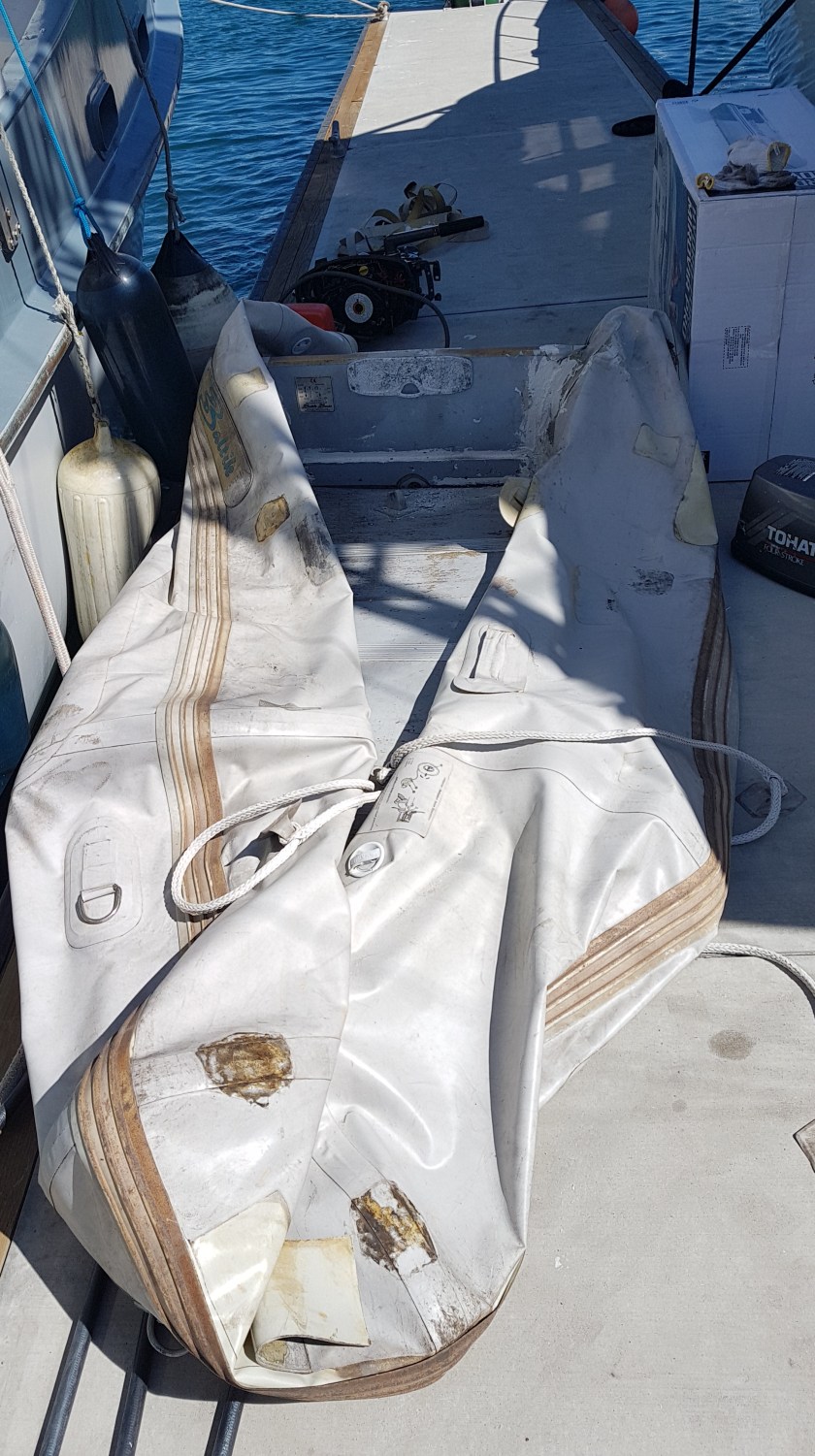
But the dingy, why that’s another matter. In 2016 we only used it a few times. Sitting in Cabo San Lucas with nothing to do, waiting for the head winds to die down, I figured I may as well make one last attempt to get the dingy going.
I spent an hour in the hot Cabo sun pumping it full of air. I’d already used another tube of 5200 to seal the back transom to the pontoons. The dingy looked pretty good. No need for a new stink’in dingy. I had looked at the local Costco the day before but saw no sign of any. (My observational powers leave a lot to be desired).
My inflatable, inflated. Looked pretty good.
Then in yet another moment of inexperience, I decided to lower the dingy to the dock, without checking the outboard.
I was feeling pretty good until the next morning. That sad picture tells the tale.
I decided that we could survive without the dingy. And in hindsight, we would’ve, could’ve, should’ve done without one.
Returning to Costco to stock up on required supplies like Danishes for yet another attempt to head north, I spotted the dingy that had eluded me the last TWO visits. They had it displayed standing vertically, on it’s tail. Of course, I couldn’t see it like that. They may as well have hung it from the ceiling. But remember, that this point, I had decided to go without. How was I going to get it to the boat in any case, so, I just bought my Danishes
Walking out of the store, I noticed these guys, presumably taxi drivers, and with my 20-word Spanish vocabulary, I never found out, but they did point me back to the store and I understood that Costco delivered.
When businesses make it easy to spend money, I’m all in. In 10 minutes, I had my dingy bought and they would deliver the next day.
The Next Day
Another hour of foot pumping, my new dingy was good to go. Now, to get the outboard working. Of course, after The First and Nearly the Last almost a year of non-use, it was a no-go.
The New Dingy
I realized I had to clean the ports in the carburetor again. No biggie, except in my inexperience, I had not done this while the outboard was on the boat or even on the dock. It was now sitting on the transom of the new dingy. I debated trying to take the carb apart while hanging off the end of the boat., but realized it was a sure way to lose a critical part. My back would have to pay the price for my brain not thinking about this before.
Another hour later, I finally was good to go and thought it would be good to take the dingy down to the fuel dock and fill up the gas can.
All went as planned and I was left with a confidence that I did not deserve.
The video of the first and nearly the last dingy trip
Only day’s away from completing this 2,000-mile, two-month journey, I found myself breaking yet another of my hard and fast rules I made for myself 5 years ago. Entering yet another harbor at night, and having to anchor by radar, avoiding darkened, moored boats and mooring balls.
But like most hard and fast rules, I had to weigh the circumstances against various risks. In this case, anchoring at night was the least risky option. I’d left Channel Island Harbor at 04:00 for the 120 nm voyage to San Luis Obispo harbor. I’d planned on 19 hours. Thus, to arrive before sunset, would require me to leave the Channel Islands at midnight.
Leaving anyplace at midnight means a total disruption of my sleep cycle. I’d be starting a long trip tired and already behind my personal power curve. By leaving at 04:00, I’d be able to get a reasonable 6 hours sleep and 03:00 is on my natural wake up curve (though normally, I’d go back to sleep for another 3 hours).
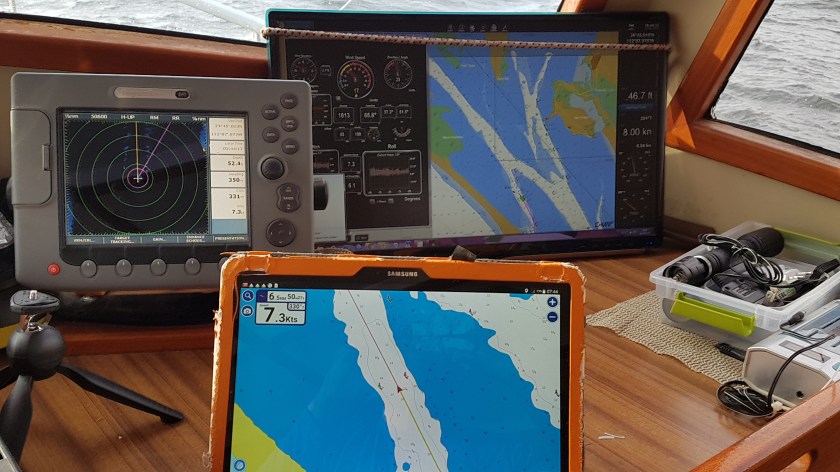
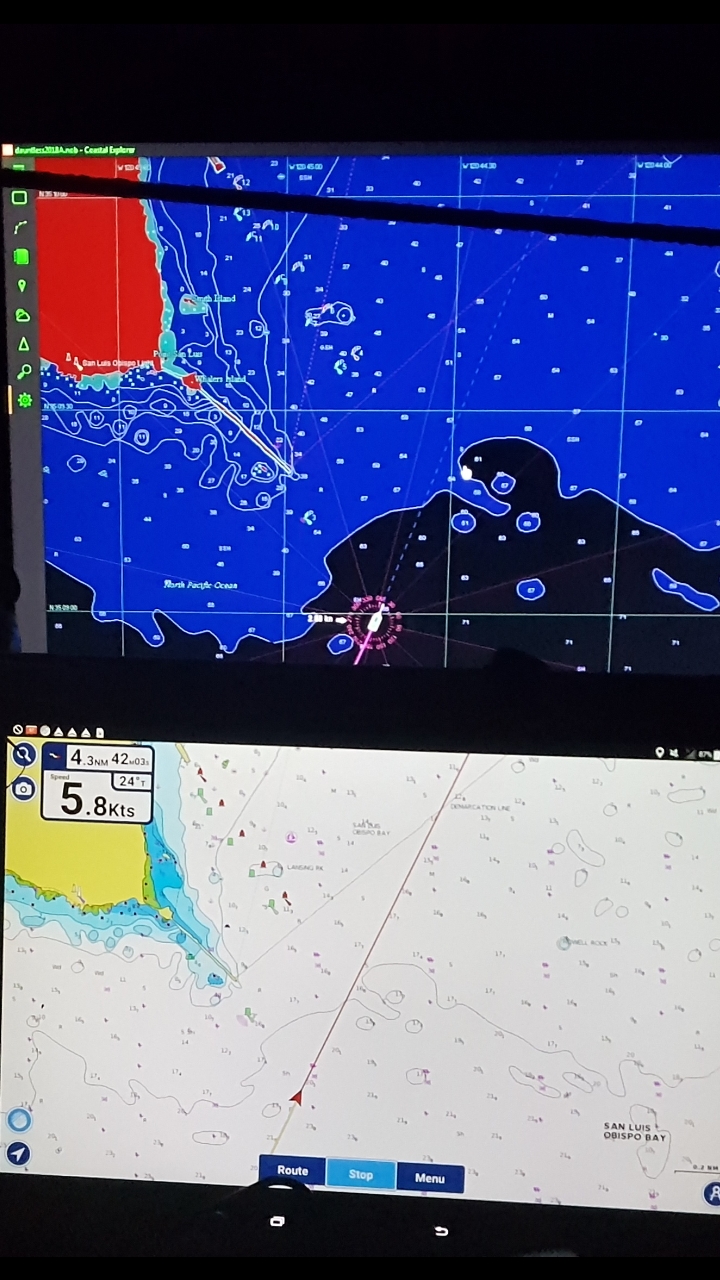
Raymarine E-80 Radar, C-Map on Coastal Explorer, Navionics chart on Samsung Tablet
Therefore, anchoring in a strange harbor at night seemed for me to be the lessor of two evils.
Let’s talk some basics. Four years ago, I hated my Raymarine E-80 Radar. I felt (and still do) that it was 1980’s technology, dressed to look like the 21st century. It was on my lest to replace at the earliest opportunity when money allowed. I had wanted a radar that I could integrate into my Coastal Explorer and C-Map chart plotter, navigation program.
San Luis Obispo harbor
Using the “Auto” settings, the E-80 will show you if the Exxon Valdez is bearing down on you, but otherwise, it either filters too much or not enough to be useful for close in maneuvering. As the miles and time increased under my belt, I learned how to best fine tune the radar using the manual settings for gain and sea state (which is basically a filter) to make it an effective tool.
Whenever I start the engine, I also turn on the: radar, navigation lights, auto pilot, VHF radios and horn.
Always.
For the first lesson in using the radar is that you must use it when the visibility is ideal, to be able to effectively and safely use it when the visibility is impaired, whether due to darkness or weather conditions (mainly fog, rain is another issue).
While underway I’m constantly checking and identifying any radar contacts visually, as well as on the navigation charts (for navigation markers, buoys, etc.).
As soon as I spot something the radar does not see, I adjust the radar, fine tuning so to speak. Normally this is just a matter of adjusting the sea state setting, though sometimes I also must fine tune the gain. E.g. I may see a fishing skiff a half mile off my starboard quarter, but it’s not showing up on the radar. I’ll have to lower the sea state setting, maybe only a few points, until the skiff shows up, but not the countless wave tops around it. Sometimes, I’ll have to adjust the gain also.
My goal is always for the radar to show me potential hazards, without showing me wave tops. For the last couple of years, my tuning technique has been good enough to do exactly that. Forget the “auto” settings, they are hopeless.
Since I don’t get many false alarms, this also allows me to maximize the use of the two zone monitors. For coastal cruising, like I’ve done since entering the Pacific Ocean, I set up a ring at ½ mile, that’s an 1/8 of a mile thick. Thus, if anything enters that ring you get an alarm. If you just put a circle around your boat at ½ mile, the radar will see some clutter very close to the boat and thus render the alarm, ineffective at best and annoying at worse. I make this ring go about 220° to 300° around the boat. That way it will see something approaching from the stern quarters, but not directly behind, as the radar will occasionally see a reflection of the mast, again making it ineffectual.
The second zone I set up 1 to 1.5 miles from the boat, in a much more 20° arc.
On the open ocean, well away from land, I’ll basically double these distances.
If I do get any false alarms, I adjust again. Usually it happens as the sea state gets worse (bigger seas).
For my set up, I find values of both the gain and the sea state in the 70’s to work best. In flat seas, I can lower the sea state to just above 50, but again, even changes of 1 or 2 can make a significant difference.
On this night, entering San Luis Obispo (SLO), as the seas calmed as I entered the bay that is protected from the NW through the East, I readjusted the sea state, lowering the filter values. From my charts I knew there was a mooring field, presumably with some moored boats. I adjusted the E-80 so that it would pick up objects as small as the mooring balls. Had the seas been above 2 to 3 feet, this would have been an impossibility, but if I had such seas in the harbor, I wouldn’t be stopping in any case.
This night, with strong NW winds, the harbor was well sheltered and the seas where maybe half a foot or less. Under those conditions the radar will do well.
I open and secure both pilot house doors, so that I can have quick access to looking out. I also go to the bow to scan the approach with binoculars (7×35), which I find very effective a night in poor light conditions.
Thus, I have that visual picture in my head, while checking the radar to ensure it’s seeing the same things. Again, because I am constantly doing this in the daytime in good visibility, I have the confidence to know what the radar is telling me at night, when I must trust
Here is a short video of it of me getting ready to enter the harbor:
Error
This video doesn’t exist
Here are some stills made 2 minutes before the above video:
The radar 2 min before I took videoCoastal Explorer using C-Maps above, Navionics on tablet below
Three years ago, going through the main shipping channels of the Kattegat to the Skagerrak over the top of Denmark, I was terrified by what my brain perceived as the massive ship about to crush Dauntless. I was outside the channel, marked m red buoy, I knew the ship had to stay in the channel. The radar told me the buoy and this massive ship were ¼ mile distant, but my brain, every time I looked at the ship, I could swear was less than 50 feet away.
My mind was so convinced this ship was towering over us, that even as I checked and rechecked the positions of the markers on the chart and the ship and marker on the radar, all showed the target as more than a quarter mile away, but my mind would just not accept it.
I only calmed down when the ship was past. In the daytime, my mind would not have been fooled, but at night, the perspective of distance, becomes very difficult.
I realized then that if I was going to continue to travel at night and not die of a heart attack, I had to make sure I knew exactly what the radar was telling and what it wasn’t and once done, accept what it showed.
So, this night, almost midnight, as I pulled into SLO bay, the radar guided me to a large area with a diameter of about half a mile with no mooring balls, though there were a couple of boats anchored on the west edge.
No fuss; no muss,
I was anchored in 25 feet of water at 23:20 having done 120 nm in 19 hours and 30 minutes, at an average speed of 6.2 knots.
The trip from CI Hbr to SLO. The Maretron data for pitching and rolling shows I did a fair amount after I rounded the corner to head north.
Dauntless doesn’t seem to have a care in the world, as she sits peacefully in Morro Bay, California.
No, I haven’t died or been in jail, I was in computer-less purgatory.
You know that place you end up when you depend on your laptop to communicate with the outside world.
And sure, a cell phone is great for talking, but if you think I’m going to write a blog post on it, as my mother would say, you have another think coming.
But a new motherboard for 500 bucks installed and at $67 battery from Amazon and my little HP Envy laptop is as good as new.
So, what did you miss? A lot really. Almost all of it too painful to even think about, let alone write about. But I do feel responsible to those of you who have spent your valuable time reading my rantings and ravings in between an adventure or so, so here are a few highlights:
The $1,000 to replace the leaking seals in my transmission. They still leak.
The reconditioned heat exchangers that started leaking 10 minutes are leaving port
The 60-mile detour (doesn’t sound like much in a car, but that’s 9 hours in a boat.
Being beaten back to Cabo San Lucas, not once, but twice. This from a person who never turns around.
Deciding to take the dingy 3 miles in a 30-knot wind only to discover it goes much faster downwind than up. Oh, and then I bent the prop, twice, the second time, with a belching of oil. And we were still three miles away from Dauntless, which we could not see in any case.
Checking into the USA with Dauntless for the first time in 4 years.
Being stopped by the Mexican Navy.
Being chased my fishing boats
Hobby horsing until you think you are going to die.
Entering yet another harbor at night, having to anchor by radar, having vowed years ago, never to do such things.
Umm, I had forgotten most of that. I’ve burned thru money this trip like a drunken sailor, but I’ve been so stressed for all the above, I’ve drunk much less than normal.
Through it all, and because of some genuine and generous friends, I was able to leave Dauntless for a week and make a quick trip to Fairbanks, Alaska, which was as as I’ve ever seen her and attend a wedding at 11,000 feet, which, left me breathless.
I hope to get back to my writing routine in the coming days. I start with the end, first.
Coming Next, Anchoring at Night in Strange Places: It’s not for the Faint Hearted.
As of Tuesday evening, we are planning to try to get to Magdalena Bay, 130nm, tomorrow. Our third try in the last 9 days.
Error
This video doesn’t exist
Though even at that, we will probably we stuck there for three days over the weekend, as another period of very strong (15 to 25 kts) winds is forecast to hit the area then. But it’s time for new, less touristy scenery.
We’ll leave mid morning, as the winds diminish mid morning to late afternoon.
We had a few issues to deal with in the last few days, the most serious, a worn rubber “O” ring on the autopilot hydraulic pump.
With a new ring and a few hours of getting the air out of the system, we are good to go and better than before.
My Maretron weather instrument was off line due to a failed “T” connector. After a couple hours hanging on the mast for dear life, that too has been fixed.
Lastly, on my third trip to Costco in as many days, the dingy finally appeared in front of my eyes. On sale for only $500 delivered, it was too good a deal to pass up. Took me all afternoon to blow it up, and then a day to fix the carb that was pouring gas all over the place, but finally as i drove it to the fuel dock to fill the gas can, I felt pretty good.
The New Dingy
So tomorrow we leave Dauntless in as good a shape as she has been in a long time.
Our weather window is not as open as I’d like, but we simply must pound out the next 200 miles to get into better, more favorable winds. Once north of Tortuga Bay, life is better.
We’ll check out of Mexico in Ensenada and check in to USA in San Diego.
It’s then to my friend’s Mike and Adriana in the Oxnard area, hopefully by mid June.
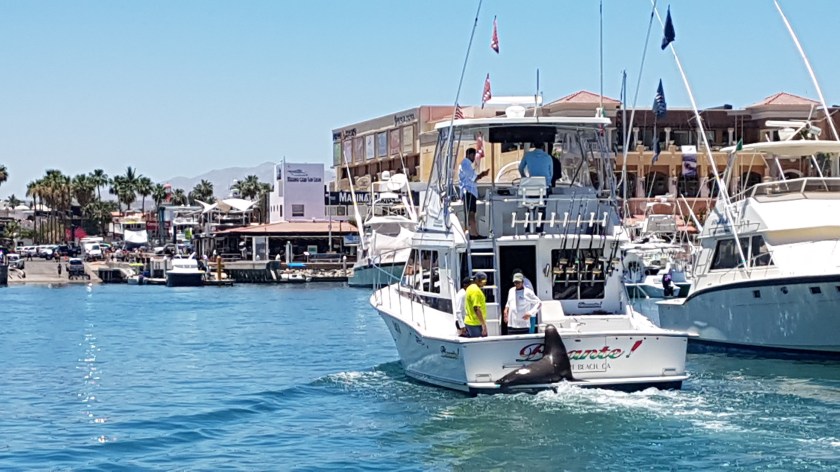
Pancho, the 12-year old Sea Lion of Cabo San Lucas
Stay tuned
Pancho again, takes lift, waiting for a free fish.
My HP Envy Laptop died a few weeks ago. Add poor internet connections, so I have no been able to even write about the trials and tribulations of the last 4 weeks.
As yo can see at Share.Delore.com/Dauntless I’m still in Cabo, but am planning on leaving Sunday morning before noon.
But then I tried to leave last Sunday also, but Mother Nature turned me back and made me see the error of my ways.
I’m hoping she’s in a better mood tomorrow. If not may have to start sacrificing goats or pigs or something.
I could call this, Mexico Just Works, at least this part.
The Bahias of Huatulco
As international trips of 3,000+ miles go, this was by far one of the easiest ever! 13 hours after wake-up at oh-dark-thirty, I was being dropped off at my hotel in Huatulco. Hotel Balcon Gueela turned out to be a really nice, comfortable place to stay while Dauntless gets her bottom painted. The sense of relief was palpable. Which got me to thinking, why such angst? I’ve travelled 24 hours to get to and from Vietnam, but other than relief that the trip was finally over, I never experienced fear before.
I’ve crossed two and a half oceans by now. I’ve spent a few too many hours being miserable, but never afraid.
HUX – Huatulco Airport
So why now, why this underlying angst in traveling to Mexico? I’d been in a dozen of airports and train stations this past year. Why the angst now? When I arrived at baggage claim in Mexico City from my New York flight, I had 3 hours for my connecting flight to Huatulco. I assumed I’d pick up my bag, go thru customs and immigration, then recheck it for Huatulco.
That’s the routine at most ports of entry. But not here. Here upon arrival at baggage claim, I was approached by a nice, uniformed lady, who asked my point of origin and when informed it was NY, she asked to see my boarding pass with claim stub and pointed out that my bag was checked through to Huatulco. Duh. I travelled 90,000 air miles last year. One would think I would have thought to check at some stage of this process, especially at the onset, when the bag tag was affected to my bag. It’s always nice to make sure one’s bag is going on the same trip as you are!
Though at that moment of check-in, 05:00, I was distracted by the realization that my 07:00 flight was really at 08:00. The 7 a.m. time must have been the time I told myself to be at the airport. But somewhere in my little mind, that got fixed at the departure time. I had stayed with friend’s in Brooklyn to be close to the airport. I hadn’t slept that well because I had bad toothache (needed a root canal) and I was just nervous about he whole trip. So, I ended up leaving the house at 04:00, and was checking in, an hour later, having returned the rental car full of gas and taken the JFK tram.
So, another rookie mistake, not even confirming my flight time.
Why was I so nervous? The toothache certainly didn’t help, but still.
While there was no customs inspection (NAFTA?), I did have to go through immigration. But even this routine, simple task, seemed beyond me. First, I did not have the right form. I had a customs form, which I didn’t need, but was never given the immigration form I did need. OK, no problem, says the immigration officer, “go to that desk and complete form and return here”.
Five minutes later, he looks at my just completed form and shows me the bottom half I had not filled out. This time, he directs me to a desk closer to him, as I clearly need supervision, though more likely, he was just trying to save me time and reduce my frustration/confusion.
Third time is the charm. I get my requisite stamps and I’m off to the lounge to wait two hours. Airline lounges are pretty much the same, but I was nervous beyond words; looking over my shoulder constantly. Now, those who know me, know I am the most trusting person on the planet, possibly in the entire solar system. And naïve too, as my stint in the Bronx was to prove.
A couple hours later, walking down the air stairs, looking around at the quaint, little Huatulco airport, I felt a large load was lifted off my shoulders. The walk from the plane to the terminal, took about 4 minutes. During this walk, I noticed the baggage train was going to beat us to the terminal. My bag was on the first pass of the carousel as I walked in. I grabbed it, noticed a nice lady standing at a podium with a big sign that said, official taxis, walked up and she gave me my options for the 20-minute ride to Huatulco and my hotel. I could have a private taxi for $25 or go in the group van for $9. I took the cheaper route.
Outside the airport. Just go to the stall number on your receipt ti find the right taxi or van. Mexico Just Works
The whole process, the entire trip from the time I got up at 03:30, left JFK to arrival at my hotel in Huatulco, could not have been easier. Everything was simple and in Mexico, helpful people always appeared just when you had that first confused look on your face. Mexico just works.
It was at that point when it finally dawned on me the reason for my angst. What was that load that was taken off my shoulders? It was simply that I hadn’t been killed during my travel in Mexico. No, I wasn’t taking a bus through the countryside in the middle of the night, but clearly, I had been afraid. Not until I was in the familiar Huatulco, did I feel safe.
This was totally irrational, I’ve been in a million places more dangerous than the Mexico City airport!
Where did this fear come from? I’ve been thinking about this for a week now.
My “news” information is purposely limited, as I have come to understand that “news” is not as objective as I once assumed. Remember, I did say I was naïve. I had a bad experience with the print media as a high school principal in the Bronx, NY. The Chief Editor of this newspaper, told my boss, that he was directed to print a story that was nothing more than character assassination, meant to embarrass and defame me. I knew who wrote it, as it was carefully written, as to not be accountable to her, but then she was crazy and had no problem saying the most outrageous things. She wrote this kind of stuff routinely.
The end result is that I stopped reading the New York newspapers. So now, I only read the Wall Street Journal, Science News and sometimes the Guardian from England.
I certainly don’t read anything that purports to be “news” on the internet. In fact, once I discovered that there are numerous pictures of big ships in tremendous waves online that are photoshopped, I realized you can’t even trust what you see online.
Even though I avoid sensationalism, it was still in my mind that Mexico was this dangerous place that made me afraid, in a totally irrational manner. So even a seasoned traveler like myself can get caught up in the hype with no sense of reality. This was made all the more “unreal” to me in that my interactions with any Mexicans, in New York, the USA or even in Mexico! have been outstanding. I’ve never had a bad experience. Ever. Can’t say that about almost any other place, even Canada (they can’t get it out of their heads that not every American has an arsenal of guns!).
And I never watch those weather shows with their drumbeat of death and destruction. Gimme a break. Get a life.
Being in the New Ross Boat Yard daily, now in the spring, almost daily I run into people who ask me about our passage across the Atlantic. They always ask if I was ever afraid. Yes, inwardly I do roll my eyes, but now I have my answer down rote, I was never afraid, but certainly miserable at times.
Every once in a while, sensing they actually may want a more reasoned response, I start talking about Kadey Krogen and this KK42 and what makes her so suited to where and how we go; at least until their eyes glaze over.
Knowing almost nothing about fiberglass, other than it’s made of fiber + glass, I have been talking to Gary Mooney, the GRP (fiberglass) expert of the area who has been working on Dauntless this winter and has a lifetime of experience with it on boats and all sorts of other objects.
We’ve talked about the repairs he made on Dauntless, first there were two problems in the hull:
The four-foot-long hairline crack that I put in the hull the past July in Finland.
An older, badly repaired, thru-hull fitting, also in the forward bilge, that was haphazardly done and allowed water into the hull and was the source of the water in the amidships-forward compartment bulkhead.
So this got us talking about the Krogen hull, in particular, which is a cored, also called sandwich, hull:
there is a layer of fiberglass,
then the core, in this case, a white non-water absorbing Styrofoam like stuff,
then another layer of fiberglass.
This is then covered by a gelcoat layer, making the fiberglass impervious to water.
Then a two-part epoxy coat is put on to protect the gel coat, Dauntless gets two coats of that,
A “Tie-coat” comes next, this tie-coat allows the anti-foul paint to adhere to the epoxy,
And lastly comes the anti-foul coating. I am going to try a semi-hard coating, purposely made for very slow boats like Dauntless. It’s said to last 5 years and be smooth enough to slightly reduce fuel consumption. I’ll be happy if it lasts three years and doesn’t hurt fuel consumption.
This boat yard really caters to the commercial boats, so things like the anti-foul, are all things the fishing boats and trawlers (real ones) use and like.
So, talking of hulls with Gary, I asked him about solid fiberglass hulls. It’s clearly touted in the USA as a “better” meaning safer solution. He scoffed at that, saying that most of the fishing boats here use solid hulls to make them stronger in terms of cargo and heavy equipment, but it also makes them more fragile.
A cored hull has much more flexibility, thus I could hit a rock as I did and the hull flexed enough to crack both the inner and outer layers of fiberglass. Had the hull been solid fiberglass, it’s likely it would have broken in big chunks leaving a meter-long hole in the hull.
This happened recently to a FV just off the coast. Had they not been minutes from shore, they would have sunk. I on the other hand, carried on for another 3 months totally oblivious!
A reliable source tells me that Jim Krogen was always a proponent of the cored hull (sandwich construction) and only succumbed to public perception in the mid-90’s when they changed to making solid fiberglass hulls, below the waterline. Besides better shear strength (as my encounter with the rock showed), a cored hull also provides better acoustical and thermal insulation, when compared to solid fiberglass. This past winter, sitting outside in the wind and rain, Dauntless was dry as a bone inside, while many other boats with solid hulls, had condensation running off the walls forming little lakes. My storm windows also helped in that regard.
Dauntless was no. 148 in the 42-foot series and was made in 1988. Newer isn’t always better.
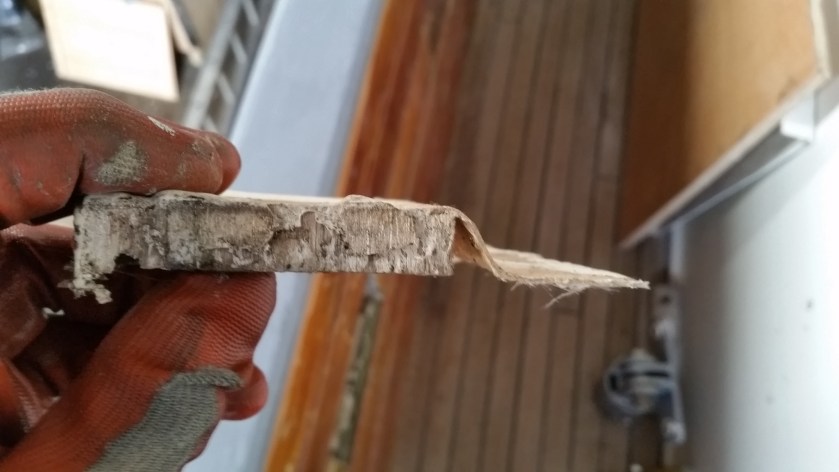
This is a cutout of the gunnel (upper hull) showing a layer of fiberglass on top of balsa squares.
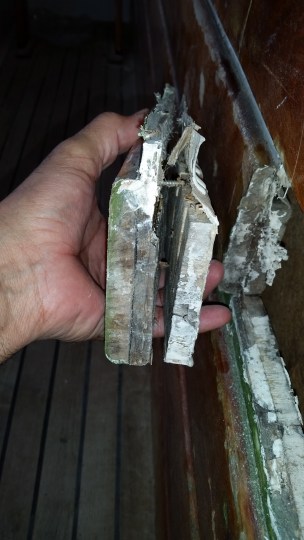
Our hull above the rub rail to the cap rail, the gunnel, also has sandwich or cored construction, but in this case, the core is much thicker, made of blocks of balsa wood and has an inner and outer wall for added strength. Also, cored hulls do provide additional buoyancy. Clearly one of the reasons that when hove-to the boat bobs morthan rolls in big seas.
Which gets to the basis of why I am not afraid.
The same cutout from another angle. The squares of balsa are easier to see.It was certainly not due to my experience as a mariner! I’m probably in the bottom 2% of experience as a mariner.
But I am probably in the top 2% of researchers and I know the difference between opinion and fact.
For 5 years before we purchased this boat, I read, I studied and I determined what capabilities a small (that I could afford) boat
needed to have to be able to travel the world, cross oceans and yet have the comforts of home. I wasn’t going to live like a monk after all.
That process of research and reading every story of ocean crossings I could find, led me to this Kadey Krogen 42. I knew this boat could handle the worst conditions, whether I was miserable or not.
My friend Larry said it this way, when we got in those chaotic
This is what was cut out of the inner gunnel. The picture below is the piece on the right.
seas, 6-12 feet, short period, from all directions, off the coast of France last summer, Dauntless just seemed to settle in and not fight it. We were hanging on for dear life and she was just motoring along, wondering what all the fuss was about.
James Krogen knew how to design and build a boat that could do anything asked of it, be it bringing us home from a week-end jaunt or around the world.



















 Dauntless at Sea