Dauntless Starts Moving North

Central America Cruise Summary Day 1
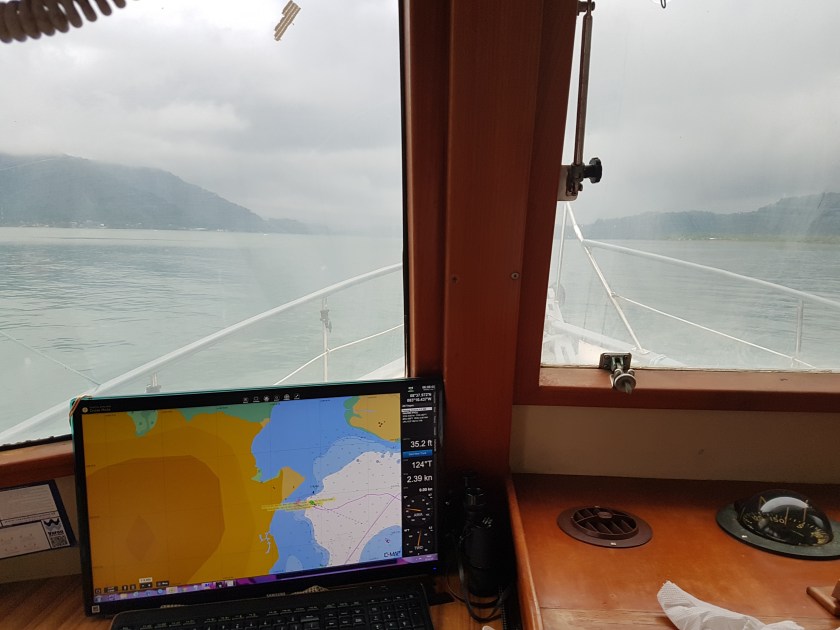
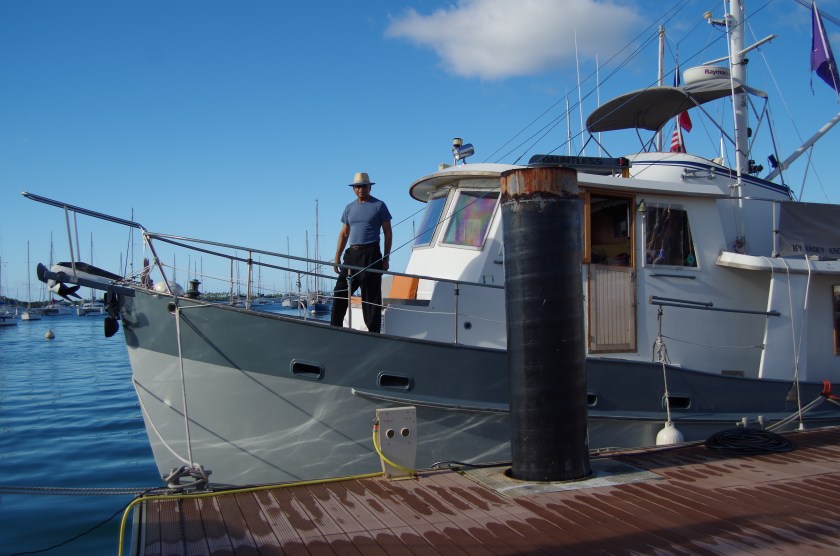
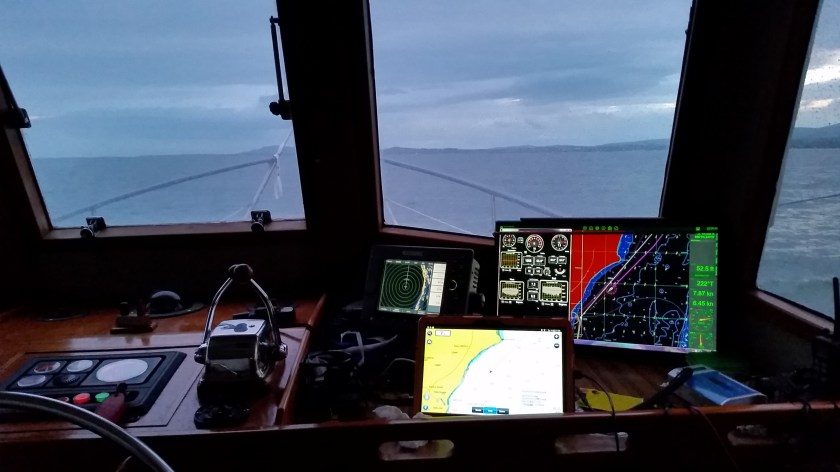
The View from the Krogen Pilothouse as we head out

Monday, 17 July 2017.  Up at the crack of dawn. I had told Sergio, we were leaving at 06:00.  I hadn’t heard from him in two days, so… that normally means he changed his mind.  I can’t begin to tell you the number of times I’ve corresponded with people who are so excited, over time and frequently, only to have them disappear or to tell me they have to wash their cat the day of departure.

So far, the score is 1, who turned up as promised to 7 no-shows.  Mind you, all these people contacted me first!

Chantal, the one who did show was great. Even left her alone on Dauntless for a week in the Bahamas. Oh well.

My friends who have joined me have all been great and they made the 2016 Cruise of the Baltic, the Baltic Republics, Poland, Sweden and Finland, so enjoyable.

I start with all this because it influenced my decision to leave, on a day that I simply should have stayed put.

I was anxious to get this show on the road. I was burning days and hadn’t even move a mile north, yet had almost 2000 miles to go.

So, when I realized Sergio was going to be a no-show, I wasn’t unhappy.  Being alone is actually far less stressful for me is many ways:

  • I’m not responsible for someone else’s life
  • I don’t have to feed them or explain how not to screw up the toilet
  • I don’t have to worry about them getting home safe and sound
  • I can run around in the middle of the night, as I did last night, checking on strange noises, naked.

Yes, many advantages.

I now use Windyty.com as my main weather source while outside the USA.

It indicated light winds, 3 to 5 kts, Monday, increasing a bit Tuesday and much more on Wednesday. Therefore, it seemed Monday was the best day and I wanted to go in any case.

But when I got up, I could see a large thunderstorm to the west and it had been producing strong winds and rain all night.  It was an extensive area, probably 15 miles by 10 miles.  I don’t mid traveling in such conditions, however this storm produced strong, 12 kts westerly winds.  Since I had to go west, then SW, then NW, that was not good.

And now I did what I tell everyone NEVER to do.  Never ever. I got fixated on the forecast, 3 kt winds, thinking the seas will be small.  Totally ignoring the fact that this storm had produced relatively strong winds, 10 to 18 knots for the last 12 hours.

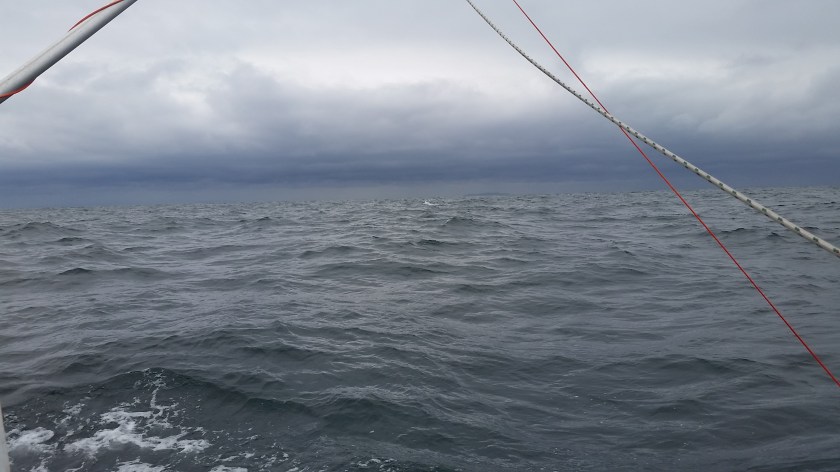
As you see in the picture, I take off into this storm and immediately I notice 3 to 5-foot waves that I’m going into. Up and down we go.  I slow up to 1400 rpm, and press on.  I should have turned around and gone back to my peaceful, sheltered anchorage.  I didn’t.

Two hours later as I turn the corner finally getting out of the Bay of Golfito, to head NW, I discover a significant swell, from the south to southwest 4 to 6 feet.  Now the boat really started to roll. Of course, in my idleness, I did not stow everything well, in fact the salon was a mess.

I deployed one paravane stabilizer bird, then half an hour later, the other.
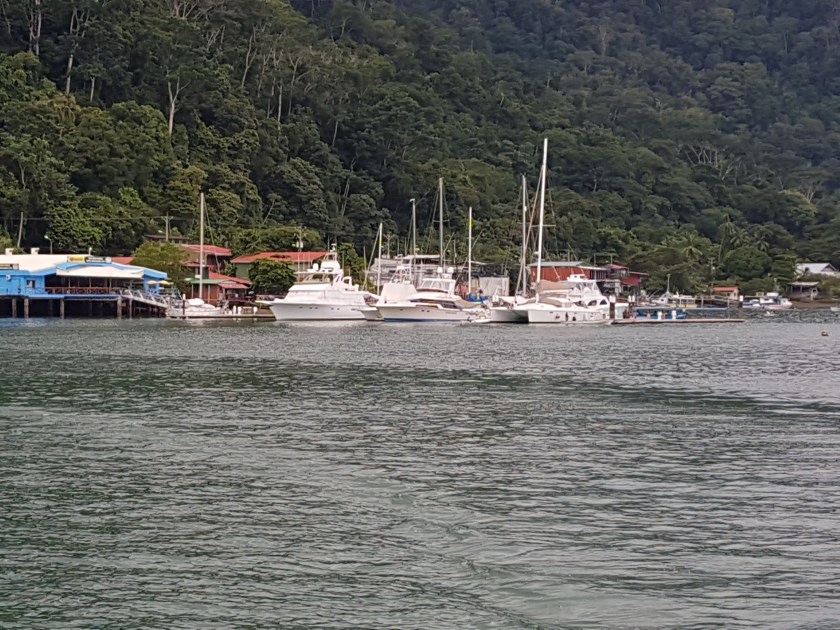
Fishhook Marina
A Great Place for Man & Boat

The roll was never so bad, only about 8° in each direction and the extreme rolls where just over 12°.  These numbers are half of what we put up with for 21 days crossing the Atlantic 6 months earlier, but still.  But having furniture roll around the salon is always disconcerting.

The ride didn’t ameliorate until the last 1.5 hours when I turned NE to go to Bahia Drake. An anchorage that given its’ 3-star rating was clearly over-optimistic.

Rolling Down the Road

Day’s Cruise Summary: Engine start, 05:52, stop 17:29; 11 hrs:15 min underway (uw), distance 62.2 nautical miles (nm), average speed 5.6 knots (kt)


Just When You Thought It Was Safe to Go Back in the Water

I left the marina finally.

Just as i anchored it started to rain

Southern Costa Rica is like Vietnam, hot, 30° and humid.  Maybe more humid.  But that thought prompted me to check the latest obs from VVTS, Tansonnhat Int’l. Nope, their morning dew point is 77°, while it was only 72° this morning in Golfito.

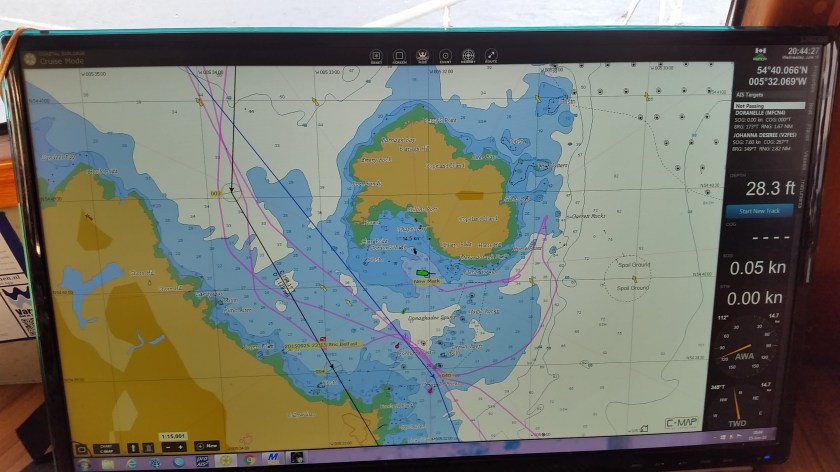
My chart of the anchorage. The marks are where where my anchor is and the mooring ball

In any case, after the stress of leaving the marina for the first time in almost 4 months, it’s time to check and double check.

While still in the Caribbean, I had tried to use the generator.  It ran for a minute a then shut itself off. So, we had spent a miserable night before arriving at the marina in Colon, Panama.

I’ve planned on anchoring a lot over the next three months, so a working generator was no longer an option but a necessity.

Last week I tackled the problem, having been guided what to look for from a mechanic friend on the East Coast.

In minutes, I found the suspected problem, a bad connection to the exhaust temperature sensor, and set it right.  The generator than started and ran for 30 minutes, with load, no problem.

Saying goodbye to Fish Hook Marina

I was leaving in mid-afternoon, as much to save another $40, but also to get my sea sense back.  We were only going a few miles to anchor, so after a hot day, in the heat of the afternoon, the generator would be called upon almost immediately.

Not being born yesterday, just before leaving the dock, I started the gen for just a few minutes, just to make sure, maybe 5 minutes.

15:00, finally ready to leave.

But Sergio, who was going to be with me for some days, then told me he had to go home.

OK

Maybe a language issue? Certainly not the first time for me.

Then the guy on the marina is throwing off the dock lines. OK.  I’m sort of ready.

But what about the two pangas fishing 20 feet in front of Dauntless?  No problem, they were told to get out of the way. Slowly evidently.

Once the lines are off, I need to get underway.  My bow wave must have nudged them the last few feet,

Now, out of the slip and safely past the pangas, I look to my chart to check my route in and the depths.

But the chart isn’t on. Why?

Computer’s on, Coastal Explorer is running, but the magic “M” key is not bringing up the C-Map.

This kind of crap happens when rushed by other people’s schedules or perceived schedule.

I had put Dauntless in neutral not wanting to go in water I had no idea what was the depths.

Finally, I see the keyboard was turned off.  Easily solved, my chart comes up and confirms that my route into the marina was good and the one to follow out

I poke along at 5 knots in no real hurry. Just happy to have the sea under my feet again.

The spot I was anchoring in is a quarter mile off the beach in front of a friend’s house I meet on the bus to Golfito.  It’s a steep slope with a big 15’ tidal range. I can’t get too close, even though I have 35’ below me now.

I drop the anchor, it catches quickly like it always does (a much beloved Delta). It’s hot, very hot and humid.  I’m dying.  I put out 110 of chain on top of the anchor.  Then I realize the mistake I made. With the steep slope, large tidal range and 100+ feet of chain out, when Dauntless swings around (we’re now facing the beach) her behind may end up high and dry.  Not the first time, but I’m trying to have a year without a grounding.

I decide to throw the stern anchor in.  Oh, no stern anchor.  Must have been stowed for the Atlantic passage. Just then I see a mooring ball, just within reach of my short boat hook (they charge more for longer ones!)

I quickly grab the line from the mooring ball and put a short line thru it.

Worked like a charm.  Dauntless soon went parallel to the beach, but that was fine.

Now I’m sweaty, almost dead for the heat, stress and whatever else.

I turn on generator to get a much-anticipated relief.

It runs for one minute then clearly can’t handle a load. It putters to a stop.

I feel like crying.

I start it again, it starts, but with no power, like before. What changed? I asked myself.  Only I put the cover back on.  Could it not be getting enough air?

I take the front cover off, it continues to run poorly, then stumbles, then starts running normally.

I power up all the accessories, A/C’s, Inverter Charger.

For the next few hours, with the passing of every bird and fish, I think the gen is dying, but no, it runs steadily, until I turn it off for bed.

Now, the next test, how hot will the boat become without the A/C.  The water temperature is 92°.  I’ve never been in such hot water; the engine room never gets below 100° and that’s only with the Inverter and Water heater working there.

Dauntless hardly moved.

Just when I was finishing my shower, a peal of thunder overhead made me think that we’d run hard aground. I flew out of the shower.

It was only Mother Nature having a little chuckle before I went to sleep.

Q & A After the Atlantic Crossing

My Friend Alfa Mike asked the following, so I thought I would share with everyone:

Richard on Dauntless in Martinique, La Marin

>Do they speak a lot of English Language in Martinique or is it all French?

The Moon & Venus watch over us on our last nights
Until the very end, a story sea
A little mishap while changing the oil just after arrival
Mountain on Martinique
Driving thru the forest
More Rainforest
More Rainforest
Even made it to the Kadey Krogen page
La Marin Marina
La Marin Marina
  • some English, once in a while, you need to know some basic French.

> What have you seen & experienced there?
This past weekend, we drove up north to see rain forest and volcano.  Inactive of course, so not much to see.
> What have you done in the boat while there.?  Repairs, upgrades?

at this point, there is still much to do.  Not helped that yesterday I spent all day to do a 1 hour job.  I hate working with wood, like the interior.

  • Working on electric in fwd bilge, adding small bilge pump.
  • Rewiring holding tank switch so that it can’t get turned on accidentally.
  • Micah patched dingy.
  • Rerigged paravane pole.
    • One pole needs to be replaced. Probably do that in Mexico or So Cal.
    • Also, rigged a preventer so windward pole will not go vertical when boat rolls heavily to lee side.
  • Finally finished 3rd 20# bottle of propane yesterday.  Those 3 bottles were filled in Tallinn in July 2015. That’s 7000 miles ago.  Luckily have two extra bottles that a sailboat boat gave me in northern France last summer as he was not going back to USA. I have not been able to get propane since Estonia last year, but am told I can in St Lucia.  But I can wait till So Cal possibly.
  • Must still replace 2 hydraulic hoses and bleed system for AP and helm steering.
  • Complete oil change, i.e. fill engine with oil.
  • We’ll fuel again in St. Lucia, only to half full about 250 gal
  • Repair bracket for wx instruments on mast, the following winds (when we were stopped for Hydraulic line) managed to wrap paravane line around it and mangled it, because I was so happy to get one problems solved, I created another one.
  • Winds also broke stern flag pole. Same happened to Sweden sailboat docked next to us.
  • All 5 fuel filters are changed (2 Racors, 2 engine mounted and fuel polish)
  • Replacing all screws in rub rail is proving to be a real PIA. As they are rusted and not coming out. These are Inox screws I bought in Ireland and again in Portugal. Big f…ing mistake.
  • General clean up, still finding flying fish on fly bridge (where else would they be 🙂
  • Spent $200 on stainless steel screws.
  • Another $200 on oil and ATF for rudder steering
  • $200 on rental car for 3 days
    Yes, everything is in increments of $200.
  • Finally took Icom VHF radio to shop, as my friend Pat in Waterford told me to do last year. It’s unfixable it seems. So, will take VHF radio from fly bridge and install in pilot house.
  • Need to still upload a billion pictures to http://dauntless.smugmug.com/

> How has the weather been?

  • Is it Humid? Hot, a bit muggy, yesterday was first day without wind, so then the boat really heats up.Did I tell you I don’t like hot weather?  Thus the 12 years in Alaska and two years with Dauntless in Northern Europe and now returning to first Southeast Alaska and then Japan & S. Korea.

>Now after all is said and done, In hindsight what would I have done differently?

  • In terms of places to go or not, it’s hard to say. Only having spent time in southern Spain and Morocco can I say that I would not have missed it.  But had I not gone, how would I know that?  It would have better financially and sailing wise to go direct from the bottom of Portugal to Las Palmas on Grand Canaria.
  • Should have spent some hard-earned money 3 years ago, to be able to use 230v, 50hz shore power to run ACs. I did try to get them to run off inverter, but the inverter produces a square sine wave and both the Splendid washer/dryer and the AC’s will not run on that.

I could have tried the transformer I use not for the water heater.  It would supply 120v, but 50hz to AC.  That swill probably work. But at this point, I’m not sure it’s worth the effort.  Back in Southern Spain and Portugal when I was dying of the heat, I should have thought of that.

Yes, I could always run generator, by the 1 gal/hour at $5/gal fuel. Now, 8 hours is only $40 per day, but adding that to expensive marina at $55/day, that’s close to my desired cap of $100 per day.

  • Speaking of money. My average daily cost for all living and boat expenses is about $109 per day.  Though I still have yet to update the last month, I do not think it will change significantly.  This is also a few dollars below the previous year.  So, all in all, the expenses are about what I expect.  The proportion is also the same, 25% for each:
    • Fuel & oils
    • Marinas & docks
    • Food, groceries & eating out
    • , like cell phone, transportation, cars, trains, planes and automobiles.

> How do you like it in Martinique?

  • Love it. People, food could not be better. I am so lucky that I was told to head here when it became clear that I could m=not make the southing I needed to get to Barbados.  It was only a 20° more southerly course, but with the large seas we had, it was not worth being beaten up.
  • In hindsight, Martinique is a much nicer place to clear in, eat and drink than probably anyplace in the Caribbean. Martinique is a Department (like a State) of France.  Thus, it feels like France because it is France.  It’s not the bureaucratic mess that Portugal, southern Spain and Morocco are.
  • FYI in terms of how they treat boaters:
    • Northern Spain, Galicia is just like northern Europe and France, as are the Cana.ries.
    • Southern Spain and Portugal were totally different, and not in a positive way.
    • I was told that it’s because of the Arab penchant for bureaucracy.

> How long do you plan to stay?

  • until sometime next week. Then heading south, a bit before heading west to the ABC’s

> Any comments you would like to make about the trip you just completed now that your more rested up?

  • Very glad I don’t have to do it again for another 18 months


Four Months & 6,000 Miles for Dauntless & Her Intrepid Crew

Dauntless in the Best of Brest

The table below has our tentative cruising plan for the next four months.  While the dates are somewhat tentative, you know me, I like sticking to the plan.

Kadey Krogen in Spain and Galicia

A few explanations about the below chart:

  • The tentative arrival date is just that, but the departure date from the previous port can be derived from the required days (4th column) minus the arrival date. E.g. Departure date from GIB (Gibraltar) is 1 day before arrival at Rabat, so the 7th of November.
  • 2nd Column, Type, “C” = Coastal cruising, “P” = Passage, i.e. No Stops.

Crew consists om my Hawaiian nephew Micah who has travelled with Dauntless since Ireland and is a very flexible soul and I.

We have others joining us for various legs, though at this time, it looks like I still would like to have a couple or one person for the passage from the Canaries to the Caribbean.  If you think you have some interest in this, please email me, sooner rather than later.

I am excited about getting this new phase underway.  So much of my time, my life, my adventures have been in Europe.  I’m ready for a big change.  It will take a year to get to Alaska and another year to get to Northeast Asia.

Dauntless is as ready as she has ever been.  Unlike coming east two years ago, all is ship shape. Spare parts are stowed and organized, fuel tank vents are moved, paravanes are rigged to run more effectively and can be easily run much deeper if need be and the two air conditioning units are even working.

Here are the current winds for the mid-Atlantic. To get an approximate idea of the Dauntless’ route, visualize a line from the bottom of Spain to NE South America.  Following winds or no winds.  the se are the “Trade Winds” and are pretty constant all winter.

Windyty showing the Atlantic Ocean

Can’t ask for better than that.

We Be Ready.


Tentative Arrival Date Type of Cruise Arrival or Departure Point # of Days Rq’d Current

Crew

Additional Crew

Needed?

03-Nov-16 Rota, Spain 2
04-Nov-16 C GIB 1 3 0
08-Nov-16 P Morocco, Rabat, Mohamedia 1 4 0
14-Nov-16 P Morocco, Agadir 1 4 ?
22-Nov-16 P Canaries, Lanzarote 2 3 1 or 2
26-Nov-16 P Canaries, Gran 1 2 1 or 2
30-Nov-16 P Canaries, west 1 2 1 or 2
19-Dec-16 P Barbados 18 2 1 or 2
26-Dec-16 C Grenadines, Carriacou, Grenada 3 2 ?
05-Jan-17 P Bonaire 3 2 ?
17-Jan-17 C Curacao, Aruba 2 3
01-Feb-17 P Panama Canal, East 5 3 ?
07-Feb-17 C Panama Canal, West 3 3 ?
20-Feb-17 C Costa Rica 6 3


Alfa Romeo versus Kadey Krogen

Alfa Romeo Montreal alfa-romeo-montreal-1974-red

1974 Alfa Romeo Montreal
205 built in 1974
200 horsepower 2.6 litre V-8 engine
Designed by Bertone
Top speed of 137 mph (downhill!)
5-speed manual transmission
rear-wheel-drive
166 – inch length
2+2 seating configuration


Kadey Krogen 42dauntless-in-horta

1988 Kadey Krogen 42-foot Trawler Yacht
11 built in 1988
135 horsepower 6.2 litre I-6 Ford Lehman engine
Designed by James Krogen
Top speed of 9 mph (in calm winds and flat seas)
1-speed manual transmission
In-line shaft-drive
504 – inch length
2+2+2+2 sleeping configuration


A few weeks ago, I did another road trip. A quick three-day trip from Lisbon to A Coruna, 720-mile round trip.  It made me think about my travels, on land and now, by sea, and reflect on both the similarities and the differences between land and sea.

No, this isn’t one of those crazy dissimilar performance tests that Car & Driver became famous for back in the day.

As my life transitions from land to sea, I still savior those moments on the hard. Driving has always been a joy for me.  From my first trans-continental trip to midnight drives around Mt. Rainier in the middle of the night, driving has always been a skill that I continuously honed.

North America provides endless miles, from Florida to Alaska, the dessert southwest to the Gaspe Peninsula, all well-travelled roads for me.

Then Europe provided another whole different experience: unlimited Autobahns, miles of roads through hill and dale at even faster speeds. From France and Spain in the west to Romania in the east and oh so many miles just going north and south from Holland to Italy, a true cornucopia of roads, conditions and cultures. Finally add a few driving schools, including a 4-day school done by BMW driving school at the famed Nurburgring, and being a driving instructor at club events enabled me to further hone my driving skills.

What drove me to do most of these miles, these long trips with quick turn-arounds?

Women of course!  Well, maybe not all the time, but…

All these travels were done in the plethora of cars in my life: 3 BMW’s, 3 Alfa Romeos, 3 Jeeps and one Mazda, two motorcycles and many, many rental cars.

The best of the best was my Alfa Romeo Montreal. Built in 1974, never a big seller as Alfa’s only V-8 was introduced just when the first gas crisis was going on, but me oh my, what a car.

She was fast yes, but driving cars well is never about speed. It’s getting the most out of what that particular car could do.  She was perfectly balanced and so tough.

That was the Montreal. Perfectly balanced, she had no bad habits.  She felt like on rails no matter the speed or the conditions.  She went over jumps with aplomb and I’d had her brake discs red hot on a few occasions with nary a problem.

So why have I been going on and on about cars and driving?  Does it even relate to boats?  Boats are inherently much more complicated than cars. Is that it?

Driving a car well, to the best of the car’s ability and design, is about the knowledge and skill of the driver.  Ultimately, a cars performance is a function of what I can put into it.

Last year my Alaska friends, Larry and Karla, joined Dauntless to cruise from Ireland to Northern France. The crossing of the English Channel was rougher than one would like, you know with those seemingly ubiquitous 6 to 10 foot seas that Dauntless also seems to find.  Larry later told me he was a bit afraid. But after the first 12 hours he realized that Dauntless wasn’t fighting the seas, she was going with them.  No matter how big the wave, the boat seemed to ride along as the wave passed serenely beneath us.  Sure we pitched and rolled, but not in a harsh manner, just smoothly like she had been doing it her whole life.

And then my epiphany.

I understood the difference between driving the Alfa Romeo and being the Kadey Krogen skipper.

On Dauntless I am like a passenger. Oh sure, I have my Master’s license and as the Skipper I am responsible for everything that happens on board. I decide where and how to go and to do it in a safe manner.

However, this Kadey Krogen performs.

Just as the Montreal ruled the road; my Krogen does what she does as well, even better. In the last three years, I have done a number of things I would prefer not to repeat.  Has it been uncomfortable at times? Sure. Can I sometimes mitigate contrary winds and seas to get a better ride? Yes, I can do that.

But no matter what the conditions or what I do: beam sea, head sea, following sea, etc., my Krogen just does it, with never a complaint, never a groan nor shriek.

I point the boat in the direction I want to go.  Boat never says no, in fact, Dauntless says, “Sure, no problem, it’s just another day in the park for me”

And that’s what Larry meant when he said the KK just went with the seas, never fighting the waves, but being one with the environment. She does what we ask. And that’s why I have never been afraid; I’m going along for the ride.

James Krogen is the real driver.  He designed and built a boat for people like me who wanted to get off the beaten path in a boat anybody could call home.  All I do is point us in the right direction. The Krogen does the rest.

The real motto of Kadey Krogen should be: Performance is Built into Our Boats; She’ll Make You Worthy in Any Sea.

Kadey Krogen said this: “The late naval architect and designer, James S. Krogen, was a master of merging the tried and true with fresh, innovative concepts, creature comforts and convenience. His near-three decades of commercial design gave extra dimension and distinction to his offshore pleasure craft. Outstanding performance is inherent.”

Exactly.

You can visit my blog at: www.DauntlessAtSea.com

And you can track the location of Dauntless at any time at: https://share.delorme.com/Dauntless

Even the Weatherman Needs to Look Out the Window Once in a While

Being tied up in the Puerto Deportivo de Rota these last few days has been a welcome respite from the wind and waves that give Dauntless it’s gentle rocking motion.

The Full Moon Rises Over Dauntless

It has also given me a break; time to relax, while not having to plan the next day’s, week’s destinations.

So as I lay in my bed early this morning, I thought I heard the pitter patter of rain.  The more I listened, the more I was convinced it was raining. I had left the windward Dutch door in the pilot house open as the boat cools each day.  So if it was raining, I needed to get my ass out of my cozy bed and close up the boat.  But since arriving in Rota, I have not seen even one cloud in the sky.  Therefore, before going back to sleep, I convinced myself I was imagining it.

Sunset over Rota, Spain

When I awoke again, I thought it must be just after sunrise, as it was a bit dark out.

Well, it was at least an hour past sunrise as it was almost 09:00!  And the darker skies were caused by clouds, you know those things that produce RAIN!

And it had rained, not much, the decks were still damp.  As for the pilot house, whatever was wet, was now dry, so all was well.

I have some travelling to do to the USA and Italy during October, so this is our mid-cruise rest.

Cirrus over the Bay of Cadiz

Though now, I am looking down the road to November and December.  I spent the morning looking on-line for more information of boats cruising to Morocco.  Cheap fuel, coupled with an exotic location is a strong attraction for me.  An interesting post about a cruising boat to Morocco

Spanish Warship in the Bay of Cadiz

is: http://www.sailing-interlude.com/category/morocco/

As summer turns to fall, I realize it’s time to start pinning down the crew for the passage from the Canaries to the Caribbean. Before I go to Cruiser’s Forum and other sites for finding crew, I thought I throw it out there for the followers of this blog.

ARA Libertad, an Argentine Full Rigged Tall Ship docked in Cadiz

I’m looking for one person or a couple to crew Dauntless for the passage from either Morocco or the Canaries to Barbados.  This will mean about 5 weeks from the end of November through December.  It’s 18 days to Barbados and another 4 or 5 days from Morocco, plus the week spent in the Canaries.  Email me if interested.

A Wary Eye
A Wary Eye
Cats of Cadiz
Cats of Cadiz
Look I'm in Cadiz and I have the picture to prove it
Look I’m in Cadiz and I have the picture to prove it
One of the narrow streets of Cadiz
Cats
Cats


The Smell of Nothing

Was never so sweet.

How do I know it will be better tomorrow?  The weatherman told me of course.
How do I know it will be better tomorrow? The weatherman told me of course.

Just picked up 2411 liters, 637 gallons, of gas oil, a.k.a diesel.  That’s 4533 pounds of fuel, added to the 400 pounds she already had.  Dauntless now sits a few inches lower than before, but looks ready to go.

And the engine room smells as sweet as ever, with no fuel smell, just the smell of new batteries and cables.

Now you wonder why all the fuss?  Isn’t re-fueling supposed to be easy and routine?  Well, if you are driving a car I suppose it is.  I’ve filled cars with fuel thousands of times. But on Dauntless it’s been less than 30 times and on Dauntless, nothing is ever routine.

A few of the shenanigans that have taken place while fueling:

  • Being showered by a volcano of fuel at the Portsmouth, NH fish dock.  Luckily, no fishing boat was waiting as I showered and got out of my fuel soaked clothes.
  • Succumbing to the fear expressed by my friends about running out of fuel, I purposely overfilled the tanks by about 10 gallons before leaving Rhode Island.  This was soon followed by the little fuel runoff coming from the port side tank, a few of those extra gallons soon were in the bilge.
  • The most recent leak last summer that lead to the New Ross Experience.  Much like the Jimi Hendrix Experience in Seattle, but more expensive.

And after each debacle, the next fueling are filled with dread; what will happen next?

So, as you can see, I have every reason to be elated about smelling nothing in the engine room.

Best of all, the 637 gallons cost half of what I paid to fill the tanks two years ago in the fall of 2014.

Tomorrow, with a full fuel and water load, Dauntless is ready to take care of business as we head south for France, Spain & Portugal.

Dauntless faces south; Brian Boru north.
Dauntless faces the Brian Boru. Tomorrow they say goodbye for a long time; hopefully not forever.


The Great Battery Caper

After months of planning, thinking and just plain fretting, the batteries are in and Dauntless is no longer acting like a one legged duck.

Another Gorgeous Sunset

How do one legged ducks act you wonder? Without the engine running or being plugged into shore power, we had only a few minutes’ worth of electrical power.

Two of the Four New Yuasa Batteries

And I’d go to sleep, not with visions of sugar plum faeries (or better yet, leggy milf’s) dancing in my head, but with pictures of wiring diagrams and this and that.

So, having found replacement batteries in Kilmore Quay’s Kehoe Marine last month, they got four Yuasa Cargo Deep Cycle GM batteries that were of 8-D size, with 230 amp-hours each for me. Weighing in at 55 kg, or 115 lbs. each and delivered to the Kehoe boys at New Ross Boat Yard (yes, of course they are related).

Waiting for high tide, when the dock was only a few feet above the floating pontoon, we got the batteries on to the boat without dropping them into the water.

Then, the hardest part physically, getting the old batteries out.  Perhaps with the knowledge that we could not hurt them, it took us less than an hour to get them out.

I then spent the next few hours re-configuring how the batteries were connected.  I essentially made a positive and negative stud that consolidated the all the connections before they went to the batteries.

My friend Ed had given me a new article about the optimum way to connect multiple batteries that was slightly superior to the way I had the older batteries connected.  I had had 8 new battery cables made, 2 for each battery, each 2.3 meters long (about 7 feet).  This allowed the four batteries to have the exact same length cable to each from the charging source.  By having the same cable lengths, the resistance should be equal and thus each battery should get exactly the same amount of charge.

That took a few hours, with a panicked call to Dave Arnold, the electrical guru (who else would be driving around an all-electric car for the 1980’s!).

His call reaffirmed the use of the existing terminal block and Perko switch that was used to switch the start to the house batteries if needed.

Finally, after 8 hours, I was ready for the new batteries.  I rigged an Amstel line around the hand railing to the pilot house, thus we could lower the batteries into the engine room and the only struggle was to pull them into place while lowering at the same time.

Two hours later, all was in place, hooked up and ready to go.

All the boat grounds go to a common terminal, then one large cable to the boat side of the Victron battery Monitor shunt.  Then one large cable to another terminal post which has all four negative battery cables.

Positives are similar, in that the inverter/charger, the positive from the alternator and the positive from the terminal block (which has a number of inputs from the isolators and thus indirect from the other battery chargers) go to a terminal post, then all 4 battery cables are attached.

In the next days/weeks, as I physically tie the lines and organize a bit more, I will make a new electrical diagram.

Now, according to my calculations, all the rest of the year should be downhill!


A Man with a Plan


The Atlantic Trade Winds
The Atlantic Trade Winds (click on the links below to see the winds move. Click on “Earth” in the lower left corner [of the link, not my picture] to change parameters)
Well any number of plans; the current one, 15 months to Japan, now in the 29th day since its start date.

But like all plans, a plan is good only until first contact with the enemy.  For Dauntless it’s headwinds, or better said, for Richard it’s the hobby horse ride headwinds produce on Dauntless.  The fact that we are consuming half of our fuel, just to go up and down waves, adds to the sick feeling the ride produces.

Yep, it’s a lose, lose, lose situation for all: the timeline, my wallet and my health.

Dauntless in the meantime just motors along, oblivious to my misery.

For my long range planning, other than Jimmy Cornell’s books and pilot charts, on a daily basis I pretty much only look at this: link to current Atlantic map

This shows the current surface winds over the Atlantic.  You can see that draw a line from Gibraltar to the Canaries to Barbados and the trade winds are running strong as they have all winter.  So no problems there.

wp-1466993359075.jpg
The Eastern Pacific showing strong northerly winds from British Columbia to Southern California. Ugh!

(side note, there is simply no point in looking at anything more specific for any period more than two weeks away.  Even when I was waiting to cross the North Sea from Norway to Scotland, a three-day trip, I read the marine forecast, but really only looked at this site to figure out when I would have at least a two-day window, which is what I got)

 Now, this is the problem, this is the Eastern Pacific, link to current western Pacific map

I’ve been looking at this about once a day since fall.  Only in the past month have the northerly winds let up south of Mexico and Central America.

My current 15-month plan would require me to be able to travel north from the Panama Canal to Kodiak Alaska in 170 days or about 35 miles per day.  Doable with favorable winds, but I’ve been watching and the winds are not favorable, not at all.  At this point, at best, I think a quarter of the days would be “good” cruising days and that may be too generous.

The other problem with this current plan is that I would probably be able to rush north out of Central America, but then get stuck in Mexico and the coast of the western U.S. for months on end.  Thus passing by places I would like to spend time only to be stuck in places I don’t.

So, Plan B.

I will add a year to the Cruise Plan, wintering in Southeast Alaska.

Many boaters do it, I know it somewhat, but only from the perspective of the Alaska Marine Highway (Ferry) system.
Thus I can spend more time in Central America at the height of the winter when the northerlies are strongest and I can spend 10 months in British Columbia and Southeast Alaska, some of the prettiest cruising areas in the world, full of fjords, whales, birds and bears!

The weather is not that bad and having visited Juneau and Sitka many times back in the 90’s, it will be nice to go back on my own bottom.


Southbound and Down

Day 16 – 19 Scotland to S.E. Ireland, Kilmore Quay

Evening at sea with the winds behind us.

We are running before the wind.

Our planned stop, at a marina just north of Dublin, has been scrubbed. With northerly winds increasing in strength, it seems best to continue due south, instead of turning southwest towards shore.  Winds are 18 gusting to 30.

Chart showing us driving around Copeland Island looking for a less windy place to anchor

We left Scotland on Day 17, late morning to take advantage of the strong, 1 to 3 knot, currents.  The plan was to travel until evening, then anchor off of Copeland Island, just to the southeast of Belfast, Northern Ireland.

By that evening the winds were strong out of the NE and as you can see from the picture of our chart, we drove around quite a bit to try to find the most sheltered spot to anchor.

Copeland Island from Dauntless

The idea was that we would wait out and sleep the 5 or 6 hours until he tide turned again.  With shallow water and rocks surrounding this island, it was a stressful half hour.

Finally finding the most sheltered place we could with winds only 12 to 15 knots, we anchored in 33 feet of water. I put out 260 feet of chain and added my new nylon

Looking west towards Ireland

snubber.

It turned out to not be pretty good anchorage, but with my house battery bank totally shot, I had to run the generator all night.  In my cabin, I can hardly hear it, but just the thought of the inefficiency and waste led to a fitful sleep.  With a ETD of 03:00, at 02:00 I decided, let’s get this show on the road, got up and hauled anchor.  The anchor had found about 50 pounds of kelp/seaweed, so it took a bit to get that off, but we were finally underway towards Dublin at 03:13.

Running at night
Running at Dusk

As the morning became day, the winds got stronger from the due north.

Running due south now, with the wind right behind us, the rolling is cut in half again.  A much nicer ride, and actually more direct for our destination of Waterford.

To have gone southwest towards Dublin, only to have to spend a few hours tomorrow going southeast, again with strong northerly winds, was a fool’s errand.

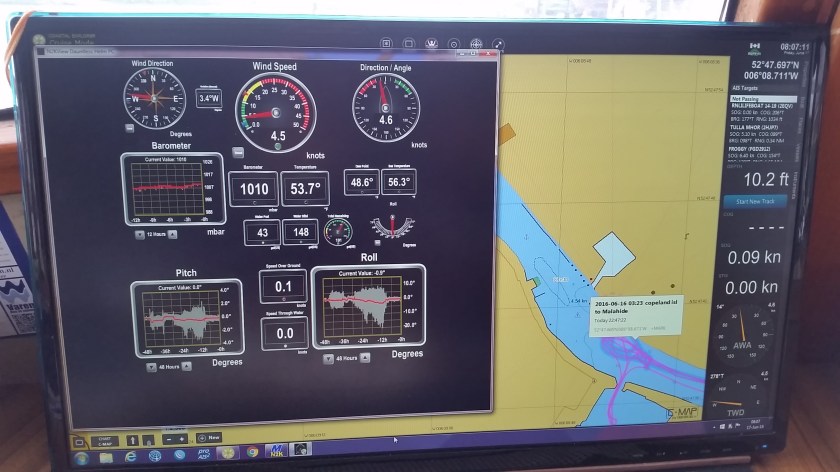
THe Maretron Data shows the last three days of rolling, the second and longest, being the worst.
The Maretron Data shows the last three days of rolling, the second and longest, being the worst.

I do a lot of errands.  I am trying to less foolish ones.

With the change of crew last weekend, Brian leaving, Dan & Robin arriving, I have had less time to write.  Brian is an experienced and accomplished Kadey Krogen boater.  He has a new KK48, so our boats have a lot in common.  It’s interesting to see both the similarities and the differences. A Compare and Contrast, in teacher talk.

Arklow Dock
Arklow Dock

I think we both learned a lot from each other and I really appreciated his perspective on the capabilities of my “old” boat.

As the day went on, the conditions became worse, confirming our decision to run though the entire day south.

Approaching the shoal area south of Kilmore Quay

At the worst, winds for much of the afternoon evening were 18 knots gusting to 28 to 31.  Seas were a bit lumpy in that there were 6 to 8 foot waves from the northeast, along with the northerly seas.  Not a great ride, but certainly better than 3 weeks ago, when I was heading into the same winds and waves.

We got to Arklow about 23:00 and tied to a concrete dock.  Finally shutting down the engine at 23:31

A Real Trawler leaves Kilmore Quay

Scotland to Arklow: 28.7 hours, 177 nm, plus 6 hours at anchor, averaging a little more than 6 knots.

The worst was behind us and I was looking forward to our net nightly stops, Kilmore Quay, New Ross, as the Kehoe boys, Stephen and Michael will put on a bbq for us and finally Waterford, where my spot from last fall is waiting for us.

Glad I kept the gate key.

The Chart and Maretron data at the dock at Arklow


D-Day – Day Zero

After 8 months of waiting, repair and refit, Dauntless got underway to day a little after noon.  The first three hours are going down the river Barrow and the Suir.  Leaving just after high water, we got a little boost of about a knot (1.2mph).wp-1464382705779.jpg

But although we are only going 7 knots, I’m feeling nervous. As I slalom down the river, I actually slow a bit, just a hundred rpms, maybe half a knot, just so I can feel comfortable again.

Much like getting off the plane in Venice, Frankfurt or Amsterdam, picking up the rental car, leaving the airport and immediate being on the Autostrada, Autobahn or AutoRoute, I start off in the slow lane, maybe going 60 to 70 mph, until I get my senses up to speed.  This means checking the rear view mirror very carefully, that car coming up may be going double my speed or more.  The speck in the mirror can quickly become a problem if I get in the way.

With time, minutes, maybe a half hour, I’m up to speed.  Now the issue is can I stand the buzzing this little economy car makes at 100 mph?

In my most recent trip to Spain, I had one of the worst cars ever.  Maybe if I drove it off a cliff, it would hit 100 mph, but I have my doubts about that too.  So I was bemused to hear this car being touted on the radio ads as having an “over-efficient” engine.  You have to hand to those marketing people, they can even change the laws of the universe.

One last comment about cars, slow ones at that.  While you may be thinking, good, it’s safer that way, the opposite is the reality. With a slow car, since it takes so long to get up to speed, whatever speed that is, the tendency is to simply not slow as much whenever possible, whether that be for the curve at the bottom of the hill or trying to get past a slow moving truck (in Europe they never go faster than 50 mph!)  A wonderful idea you may also think, but then driving becomes an ordeal of passing moving roadblocks and the box of corn flakes now costs $8 since it took a week to go the distance from NNYC to Chicago.

So after going a bit slower for a bit, maybe an hour, I was back in the rhythm of Dauntless and pushed the speed up to 8 knots, what with the river current.

Ireland was having its second summer like day since August 1976, so it was wonderful cruising.  Even the little one-foot chop that was on the south coast as I headed for Kilmore Quay was enjoyable.

But best of all was the deep blue water, and as you watch the little waves break, the water is so clear.

Coming into Kilmore Quay was quite tricky, and Michael at the boat yard even drew me a map to emphasize not to deviate from the plan.  And when the water beneath my newly skinned and painted keel got down to only 2 and a half feet, I was thankful for the guidance.

There was one space left on the end of the dock, the hammerhead, and happily the people on the English sailboat in from of the spot were there to grab my lines.  That takes much of the stress out of docking.

Well, I’ll have another chance tomorrow; that’s after I back out of here!

Today’s trip: 35 nm, 5 hours and 30 minutes, average speed, 6.5 knots.

Tomorrow, Kilmore Quay to Arklow.

Why I Am Not Afraid


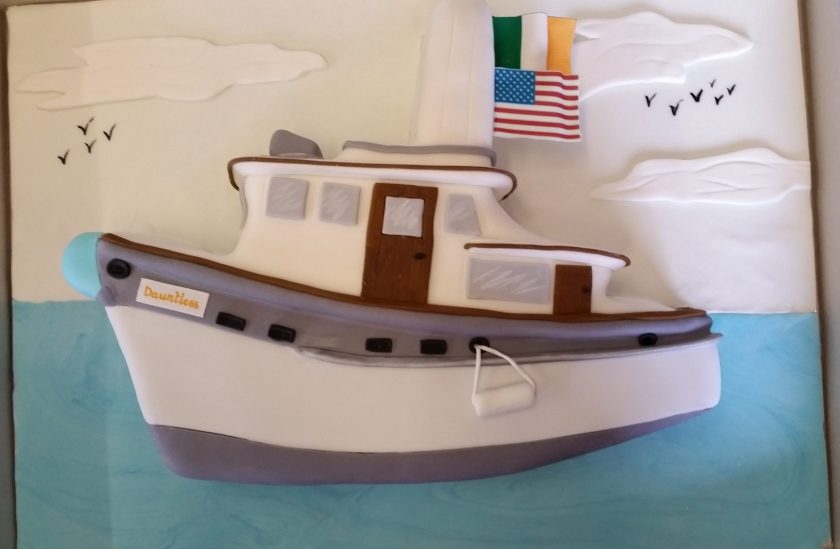
The New Dauntless As Tasty As Ever
Dauntless – As Tasty As Ever

Being in the New Ross Boat Yard daily, now in the spring, almost daily I run into people who ask me about our passage across the Atlantic.  They always ask if I was ever afraid.  Yes, inwardly I do roll my eyes, but now I have my answer down rote, I was never afraid, but certainly miserable at times.

Every once in a while, sensing they actually may want a more reasoned response, I start talking about Kadey Krogen and this KK42 and what makes her so suited to where and how we go; at least until their eyes glaze over.

Knowing almost nothing about fiberglass, other than it’s made of fiber + glass, I have been talking to Gary Mooney, the GRP (fiberglass) expert of the area who has been working on Dauntless this winter and has a lifetime of experience with it on boats and all sorts of other objects.

We’ve talked about the repairs he made on Dauntless, first there were two problems in the hull:

  1. The four-foot-long hairline crack that I put in the hull the past July in Finland.
  2. An older, badly repaired, thru-hull fitting, also in the forward bilge, that was haphazardly done and allowed water into the hull and was the source of the water in the amidships-forward compartment bulkhead.

So this got us talking about the Krogen hull, in particular, which is a cored, also called sandwich, hull:

  1. there is a layer of fiberglass,
  2. then the core, in this case, a white non-water absorbing Styrofoam like stuff,
  3. then another layer of fiberglass.
  4. This is then covered by a gelcoat layer, making the fiberglass impervious to water.
  5. Then a two-part epoxy coat is put on to protect the gel coat, Dauntless gets two coats of that,
  6. A “Tie-coat” comes next, this tie-coat allows the anti-foul paint to adhere to the epoxy,
  7. And lastly comes the anti-foul coating. I am going to try a semi-hard coating, purposely made for very slow boats like Dauntless.  It’s said to last 5 years and be smooth enough to slightly reduce fuel consumption. I’ll be happy if it lasts three years and doesn’t hurt fuel consumption.

This boat yard really caters to the commercial boats, so things like the anti-foul, are all things the fishing boats and trawlers (real ones) use and like.

So, talking of hulls with Gary, I asked him about solid fiberglass hulls.  It’s clearly touted in the USA as a “better” meaning safer solution.  He scoffed at that, saying that most of the fishing boats here use solid hulls to make them stronger in terms of cargo and heavy equipment, but it also makes them more fragile.

A cored hull has much more flexibility, thus I could hit a rock as I did and the hull flexed enough to crack both the inner and outer layers of fiberglass.  Had the hull been solid fiberglass, it’s likely it would have broken in big chunks leaving a meter-long hole in the hull.

This happened recently to a FV just off the coast. Had they not been minutes from shore, they would have sunk. I on the other hand, carried on for another 3 months totally oblivious!

A reliable source tells me that Jim Krogen was always a proponent of the cored hull (sandwich construction) and only succumbed to public perception in the mid-90’s when they changed to making solid fiberglass hulls, below the waterline.  Besides better shear strength (as my encounter with the rock showed), a cored hull also provides better acoustical and thermal insulation, when compared to solid fiberglass.  This past winter, sitting outside in the wind and rain, Dauntless was dry as a bone inside, while many other boats with solid hulls, had condensation running off the walls forming little lakes. My storm windows also helped in that regard.

Dauntless was no. 148 in the 42-foot series and was made in 1988.  Newer isn’t always better.

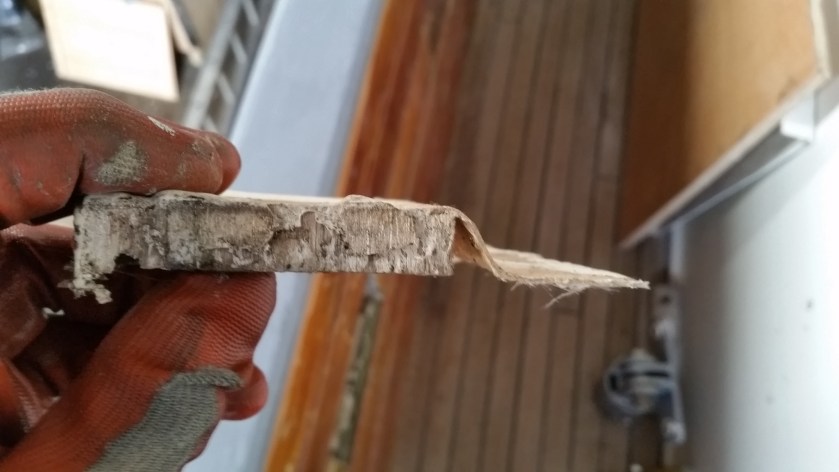
This is a cutout of the gunnel (upper hull) showing a layer of fiberglass on top of balsa squares.

Our hull above the rub rail to the cap rail, the gunnel, also has sandwich or cored construction, but in this case, the core is much thicker, made of blocks of balsa wood and has an inner and outer wall for added strength. Also, cored hulls do provide additional buoyancy. Clearly one of the reasons that when hove-to the boat bobs morthan rolls in big seas.

Which gets to the basis of why I am not afraid.The same cutout from another angle. The squares of balsa are easier to see.

The same cutout from another angle. The squares of balsa are easier to see.It was certainly not due to my experience as a mariner!  I’m probably in the bottom 2% of experience as a mariner.

But I am probably in the top 2% of researchers and I know the difference between opinion and fact.

For 5 years before we purchased this boat, I read, I studied and I determined what capabilities a small (that I could afford) boat

needed to have to be able to travel the world, cross oceans and yet have the comforts of home. I wasn’t going to live like a monk after all.

That process of research and reading every story of ocean crossings I could find, led me to this Kadey Krogen 42.  I knew this boat could handle the worst conditions, whether I was miserable or not.

My friend Larry said it this way, when we got in those chaotic

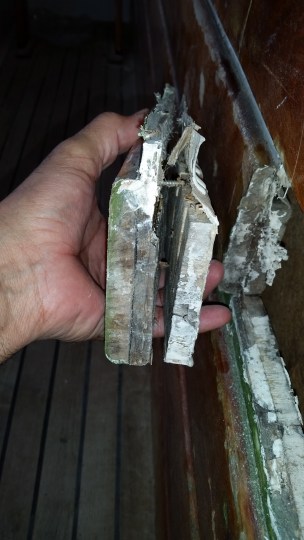
This is what was cut out of the inner gunnel. The picture below is the piece on the right.

seas, 6-12 feet, short period, from all directions, off the coast of France last summer, Dauntless just seemed to settle in and not fight it. We were hanging on for dear life and she was just motoring along, wondering what all the fuss was about.

James Krogen knew how to design and build a boat that could do anything asked of it, be it bringing us home from a week-end jaunt or around the world.

That’s why I’m not afraid.