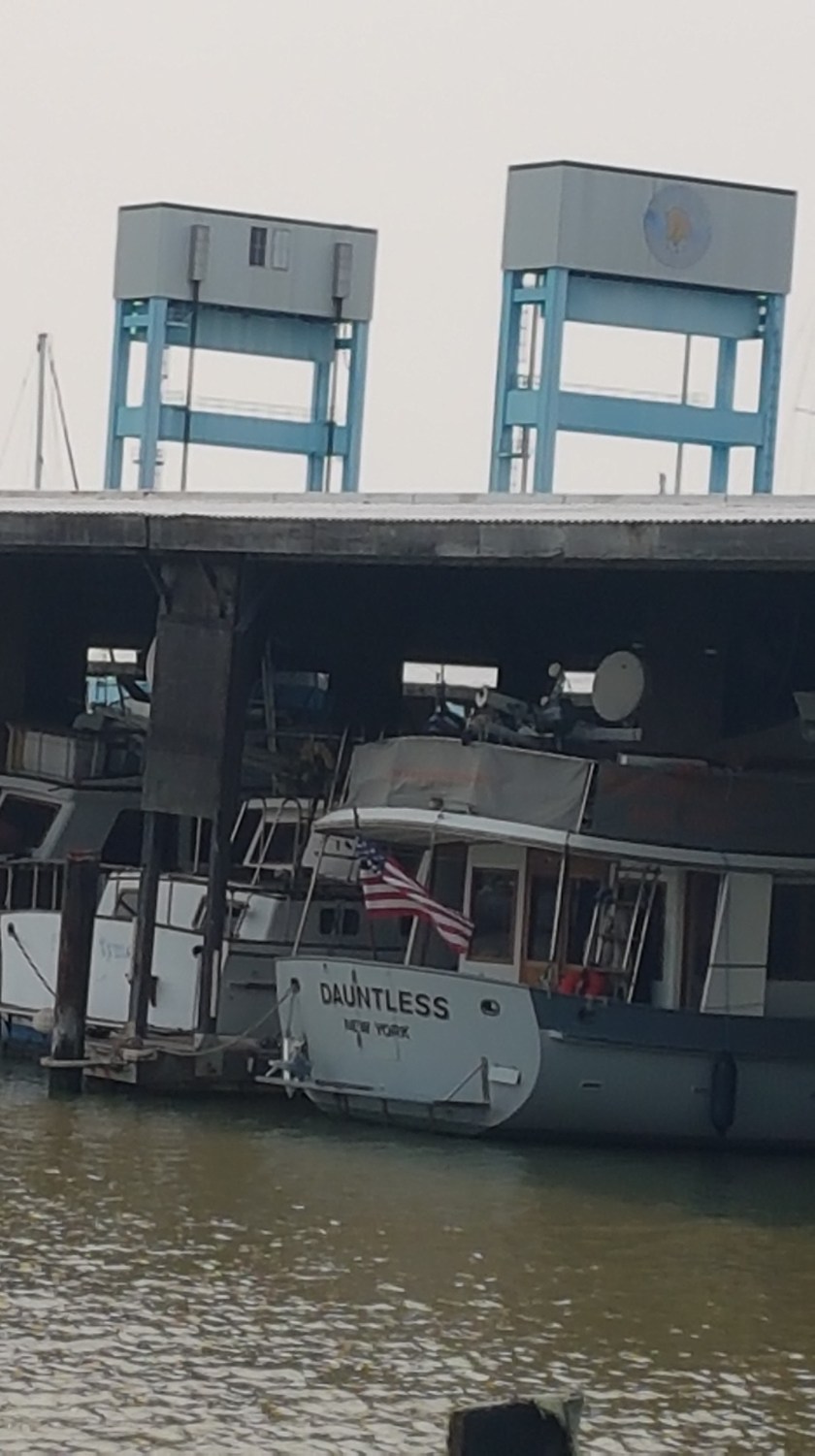
During the last week on Dauntless, getting her ready for the winter without me, tears all around, I realized how sweet it was to work under a roof.
Error
This video doesn’t exist
Looking aft with the mast down, under the roof of the Vallejo City Marina
I loved it so much, I changed my project priorities a bit. I figured it made the most sense to do those things that are difficult to do under normal circumstances. It is such a pleasure to sit on the fly bridge, out of the hot blazing sun or the cold wet rain. With the mast down, I didn’t have to wrap one arm around the mast and hold on for dear life. Under such ideal conditions, I realized I had to get all the things done I had been contemplating for years.
Four years ago, getting Dauntless ready for her first ocean crossing, I took what was given. Unlike the Lexan storm windows which were done in the last hours, the Maretron system and instruments on the mast were completed with days to spare.
One thing that has sunk into my dense brain is if I don’t have a clue as to what I am doing, then at least do the simple solutions instead of making complicated ones. To that end, I mounted the Maretron instruments on an existing antenna arch that extended forward and was above the radar.
It was the simplest solution and worked well enough for four years, but now, I wanted to make it better. I have felt that the weather instrument that measures all the normal weather parameters, including wind speed and direction, is not in a clear air stream with winds from the stern. As you know, this Kadey Krogen loves following winds and seas, therefore if the data is being affected under such conditions, it’s not ideal.
The other issue that is also related to stern winds is that every once in a while, lines related to the paravanes, get enough slack that over time, being blown forward, like 21 days in following winds and seas, that they were easily snagged on those weather instruments or the bracket itself. In the first years, more than once, after deploying the paravanes, I discovered that the weather instrument arch was carrying the weight of the paravanes. Not good. (Though it does confirm the forces on the paravane system are as expected).
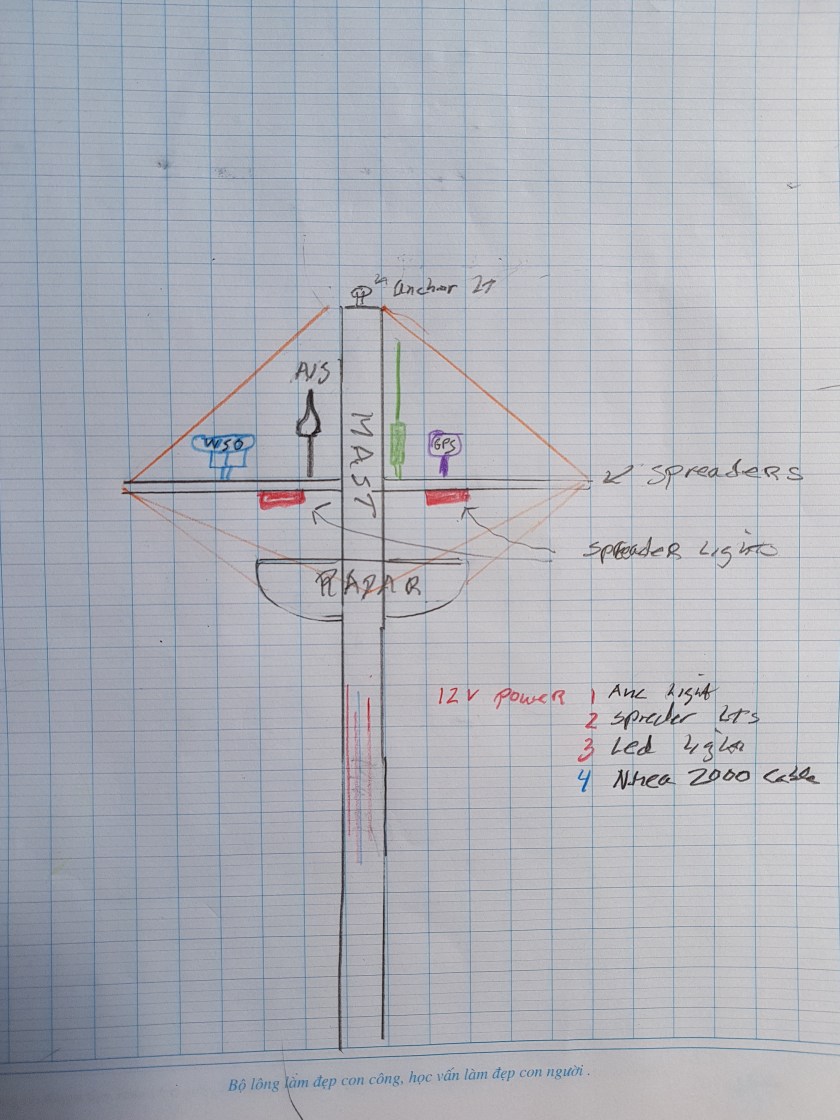
Just too many times, that antenna arch has been seconds from disaster. Time to get rid of it. The Maretron cable that runs inside the mast must also be replaced. So, the Maretron WSO and GPS will be mounted on the spreaders. In addition, I will mount my Wi-Fi extender antenna and I hope to also move my current AIS antenna to the spreader. Currently it’s mounted on the cowling of the fly bridge near the helm. It’s too low. Many times, it will not see big ships until 5 or 6 miles away. At the Dauntless speed of 6 knots and big ships possible speed of 20 knots, that still gives me more than a 10-minute warning, but that antenna should be maximized just on principal.
Plan for the Mast Spreaders March 2019
I also need to remount the two Chinese LED spreader lights. The lights themselves, bought 5 years ago on Amazon for $20 each, have been great, but the mounting hardware is mild steel that rusts badly. I have a way to mount them directly to the spreaders, without the steel hardware. Since I am doing that, I will also change the electrics a bit and add an electrical circuit to power a LED stripe that I will also mount on the mast.
Now, your thinking, while I have eliminated one protuberance, I have made the spreaders much more complicated. That’s true. But I have a plan.
I will also add a 1/16th Amsteel line from the top of the mast to the end of each spreader, then forward to the front of the radar arch. Looking aft from the bow, this will look like a triangle. Looking from either side, this will look almost like an obtuse triangle.
Now, I have not added this yet. This will happen in March when I return to Dauntless, but in my mind’s eye, I see this little line as making it much more difficult for a loop of any line to become snagged around the spreaders, radar arch or the mast itself.
It’s 20:30 hours. I had a glorious day in all aspects. The weather could not have been better, 72°, light breeze. Dauntless is under the roof, no problems with sun or rain. Of the two projects I started out this morning to get done: one’s done and the other two are almost done.
this picture was taken just 5 hours before my departure. I was so enamored with the sunset that I really did not look at the situation. Notice the solar panel array on the port side stern of the sail boat in front of me.
But this evening, I felt a disquiet. My project list is not even a quarter done and I’m leaving for the winter in 5 days.
Then I realized it’s not about progress on the projects, days left, or anything else. It’s that I’m alone.
But even that is not so simple. In fact, my happy meter is well above my “normal”. Boat wise, relationship wise, career wise, pretty much everything, I’m quite happy about. So why the grumpy face and thoughts?
I’m not feeling lonely; but something is still missing.
Then it occurred to me. My entire life, from as early as I can remember, has been about teamwork. Working with others to a common purpose.
I can’t even begin to tell you the times I sacrificed personal accolades for the sake of the team.
All my successes in life can be attributed to building and nourishing successful teams.
Even when I started my teaching career, I did not become a successful classroom teacher until I realized that I needed to make the students in each class understand that they were a team and needed to help each other for their own learning, not for me.
As a high school principal, it was harder, because professionals in education have never been taught anything about teamwork, but the successes we had were all because the entire staff was working together for the good of our students. Sure, there were a few bad apples, but despite them, we got a lot of kids to college and success that would not have happened otherwise.
Then, I look at the other side. Even though I was quite successful selling cars, I hated it. The General Manager at a very successful dealership once made the comment to all in our sales meeting that, “Bost, probably tells everyone that he is a lawyer” I wondered how he knew, though I didn’t pick lawyer, I just never told anyone I sold cars.
While I was successful there, I was a duck out of the water.
With my project list for Dauntless, the list would feel less daunting if my teammate was here. Teammates don’t let you get overwhelmed with small stuff and they convince you the big stuff isn’t so big.
Even better, teammates give you that Cesar Milan nudge or click, that gets you off the obsession and back on track.
That’s what I miss. Otherwise it’s too easy to go around in circles or become obsessed about the unimportant.
In teaching, once I realized that I had to convince the students that they are a learning team. One time, I noticed one of my special colored pencils was missing from my grade book, that was open on the first row of desks. I used color codes for different types of work. I was irritated about it and started complaining to the class about my missing pencil.
In a New York minute, which in this case was probably 30 seconds, one of the students calls out, “OK, we get it Mr. Bost, now can we move on”
I snapped out of it. It was the nudge I needed.
(A couple of days later, in walking around a different class, I saw my pencil in front of one of my problematic students. Without a word and I just took it back. Months later I finally got that student to start working and she passed with a 72 out of 100 on the NY State Regents. She worked hard, finally. How we got there, is another story, I’ll save for the book).
And I wouldn’t have spent 3 hours on the Maretron power problem without checking the fuse from the very beginning.
Oh Richard, since you know the circuit had power until you shorted it, why don’t you check that fuse once again?
Oh yeah, that’s probably better than spending the next three hours on this connector!
For a little, non-electronic boat, I sure love my Maretron data. I have 9 modules:
two to communicate with everything else, (USB, IPG) and the N2K Viewer
two for the fresh water tanks, (TLM),
one solid state compass, (SSC),
one GPS, (GPS),
one depth sounder with paddle wheel and lastly, (DST),
the love of my life, my (WSO), the weather instrument.
The solid sate compass seems to work better with my ComNav autopilot. In addition, it gives me the roll and pitch data I often quote in my blog.
The weather instrument is also solid state with ultrasonic wind measurement. Considering I installed the system myself over 4 years and 20,000 miles ago, I’ve had few problems.
A glorious day in Vallejo, under a roof, with the mast down, facing aft
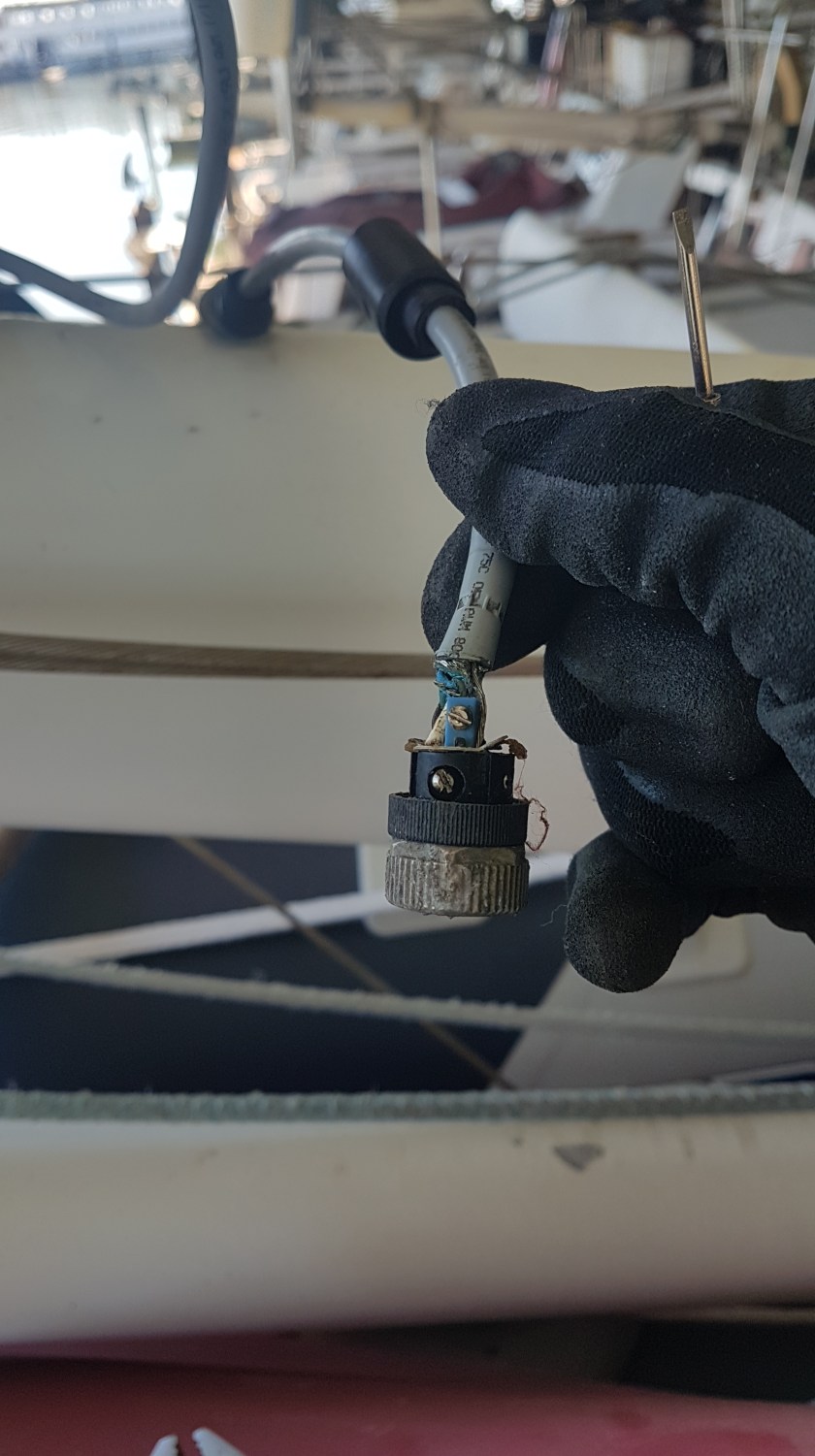
Coming west across the Atlantic, the constant winds behind us and to the side, from 15 to 35 knots for 528 hours or 22 days (No, I didn’t stop to change the oil) took a toll on my connections on the mast. Everything still worked, but occasionally, if a line got caught it would put enough strain to disrupt the connection until I freed it.
So, one of my projects now is to redo all the connections in the system. I also now slather everything in dielectric grease. So much so, that I almost put it on my pancakes the other morning.
One of the offending connectors
So, the day started out so very well. Sitting on deck, with the mast down, Dauntless under a roof, protecting us from the elements and sun, I thought about climbing up the mast in Cabo San Lucas, in hot, 95° sun, holding on the mast with one hand, while trying to tighten the 5 little wires inside the plug just under the WSO.
I was in hog heaven. I carefully tool the plug apart, unattached the 5 little wires, and recut them all and trimmed them. Now, I knew power was still on the system. Before I started any of this, I wanted to make sure that it was only the WSO that was incommunicado. So, just as I was thinking that I would have to be careful in cutting the positive power line, meaning not to cut it with the ground wire at the SAME time; I did exactly that. The little spark, showed me that I’d f..ed up.
Sure enough, when I go below to check, now the whole Maretron system has no data.
Had I shorted out something serious? Was there a fuse in the system? If so, where was it?? Who the hell installed this system?? Oh, it was me!
Let me check the computer cabinet. Open cabinet and what do I see, the fuse block that I put in 4 years ago and even nicely labeled at that.
It went downhill from there.
To check the fuses, I had to pull them, to do that I needed to power down the whole system. That done, I pulled each fuse and looked at it very carefully. Very carefully (for those of you who already know the answer, don’t spoil it for your dear ones who are also reading this).
They all looked good. I powered the system back up. That takes a few minutes because the modem and router have to be booted up before the computer otherwise everyone gets confused.
At this point, I noticed that the little light for the Maretron circuit was not lit on the router until I turned on the computer. I hadn’t noticed that before. (and in the future, I will explain that issue).
No change. I went back to the fly bridge. One of dozens of trips I would make over the next couple of hours. I figured I had screwed up the wiring of the plug. I took it all apart again. I convinced myself that possibly the ground shield covering was touching one of the data lines. I put it all back together again, rebooted the entire system and alas. No joy.
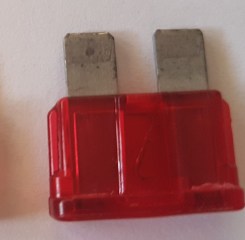
At this point, I’d spent an hour on this. I pulled the fuses again. They still looked good. I even held them up to the light. But finally, just to be sure, I changed the 5-amp fuse that powered the Maretron system. Surely now, it would work.
Still No Joy. Now, more than ever I was convinced it was the plug. The plug was the only thing I had worked on.
Back to the flybridge. Took plug apart again. Put it back together again. Rinse and repeat.
I got my electric meter out (finally you think), check the plug for the umpteenth time. No power.
I go online and check the Maretron site. It tells me I should see 60 and 120 ohms between certain lines. I see exactly that. But still no power. I must have shorted something else out. Where did I install the power tap?
Oh, I remembered where the power tap was because it’s in the port side pilot house wire race that is so full of wires I have trouble getting the teak panel back in place.
Other than no power, the continuity on the plug and lines tested correctly.
I’ve been working on this for three hours now. I return to the computer and fuse block.
I finally decide to test for power in the fuse block. Umm, the Maretron circuit has no power here.
I pull that fuse and check it. No circuit. I check the old fuse I had pulled out, no circuit.
I got fuse number three and checked it, a circuit.
I stick it in and low and behold, power.
Two hours earlier I had replaced a bad fuse with another bad fuse. Both fuses showed no sign that they were open. Both had very clear “Z” wire that wasn’t broken.
I was looking forward to this project, as I like working on the electrical things and I just wanted to also tidy up the wires and the things I’d done over the last couple of years.
I needed to put new female spade connectors on the gauges and switches in the forward head. I also needed to replace the little bilge pump and replace the float switch for the big Rule 200 bilge pump in the forward bilge.
Cleaning up my cabin. This fuse and terminal block is for the forward head and bilge. The Raritan black box is for the old ElectroScan that I replaced with a Purisan.. This was the easy part. I had no corrosion here.
So, I get my two trays of electric connectors, with hundreds of pieces and what do I find: hundreds of males and a half dozen females. Sociologists warn of impending disaster when the male to female numbers reach 52% to 48% respectively in society. Because those single males unable to find mates wreak havoc on the society.
All those rogue elephants in Africa, male. Nuff said.
Female spade connectors are needed to connect a wire to the switch or instrument. I need about a dozen just for the forward head. The current connections are all corroded considerably. I know why, but don’t think I’ll mention it, other than to say, my not wanting to throw anything away can be dangerous.
Amazon will deliver the females on Tuesday.
So, I could tackle the paravane bird holders. I’ve tried various things in the last 4 years. Some have been a bit more effective than others, but in the last weeks I’ve gotten tired of stepping over them on the side deck. With the paravane pole taken down, there is not way to secure them.
In normal use, even if I think I won’t need the paravane stabilizers, I will deploy the poles only. This allows me to deploy the birds without having to go the flybridge again. So, I need a method to secure them, with or without the poles in place.
This has been an ongoing issue. Each half-assed system I make, breaks sooner rather than later.
My solution is very simple, net and won’t get in the way, in the narrow deck space. I must say, that I think my time in Vietnam has enabled me to see simpler solutions. The Vietnamese make do with whatever they have, which is fractions of what we Americans are accustomed to.
The New paravane bird holder, suing eye hooks and 1/16″ Amsteel. Another viewThe New paravane bird holder, suing eye hooks and 1/16″ Amsteel
It’s a thrifty culture and probably what I need in my reduced earning years.
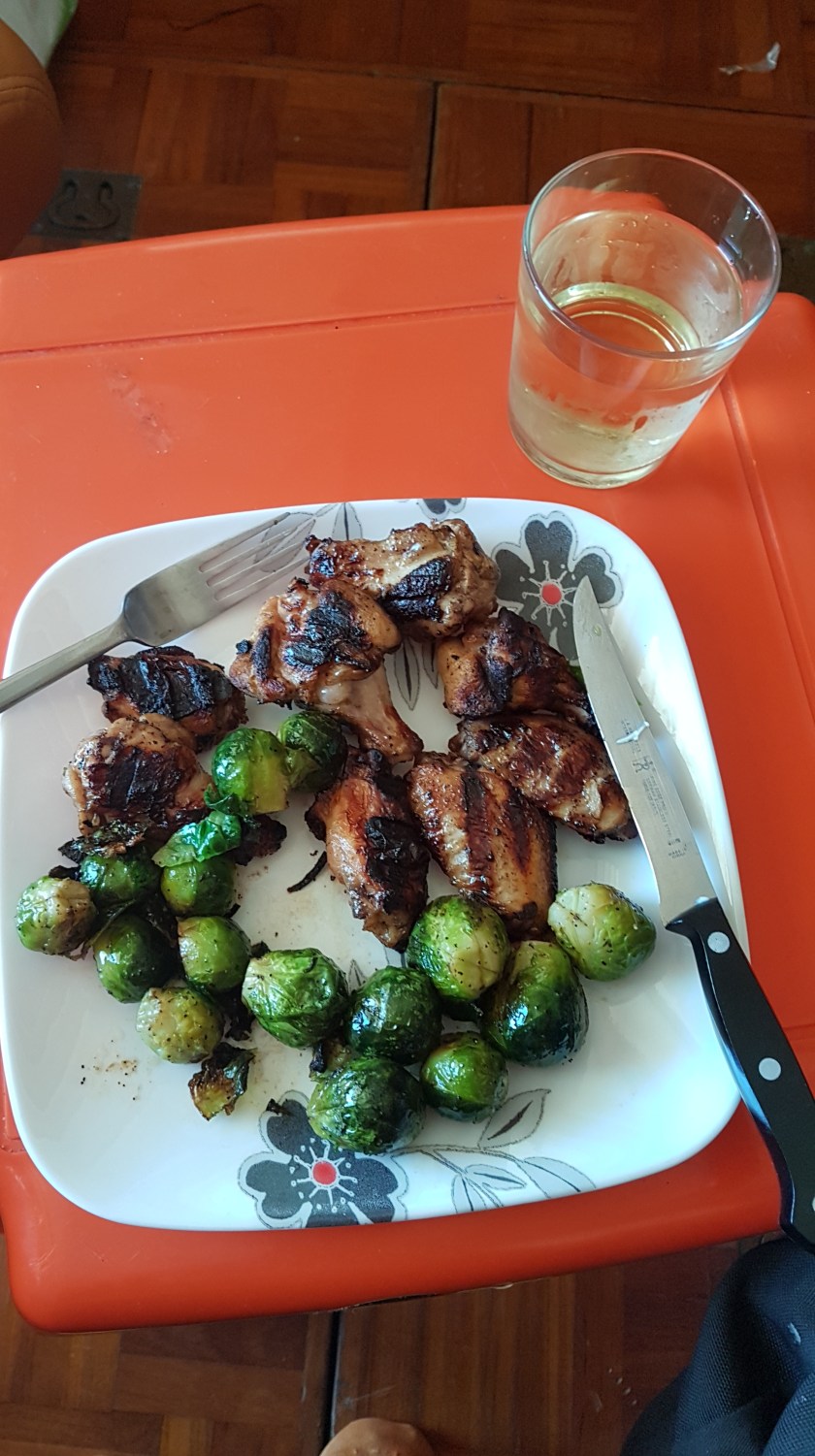
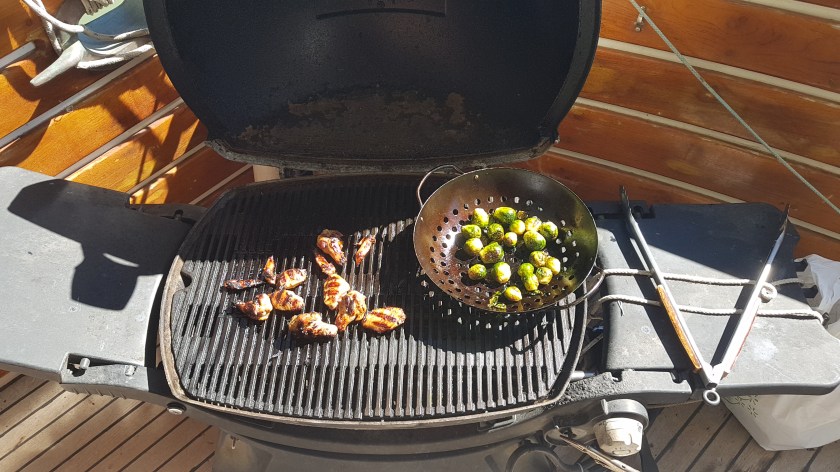
To that end, I have also really tried to limit my going out for dinner. Thus, my chicken and brussels sprouts for dinner today. Very good.
My plated dinner, chicken and Brussels sprouts.My dinner cooking, chicken and Brussels sprouts
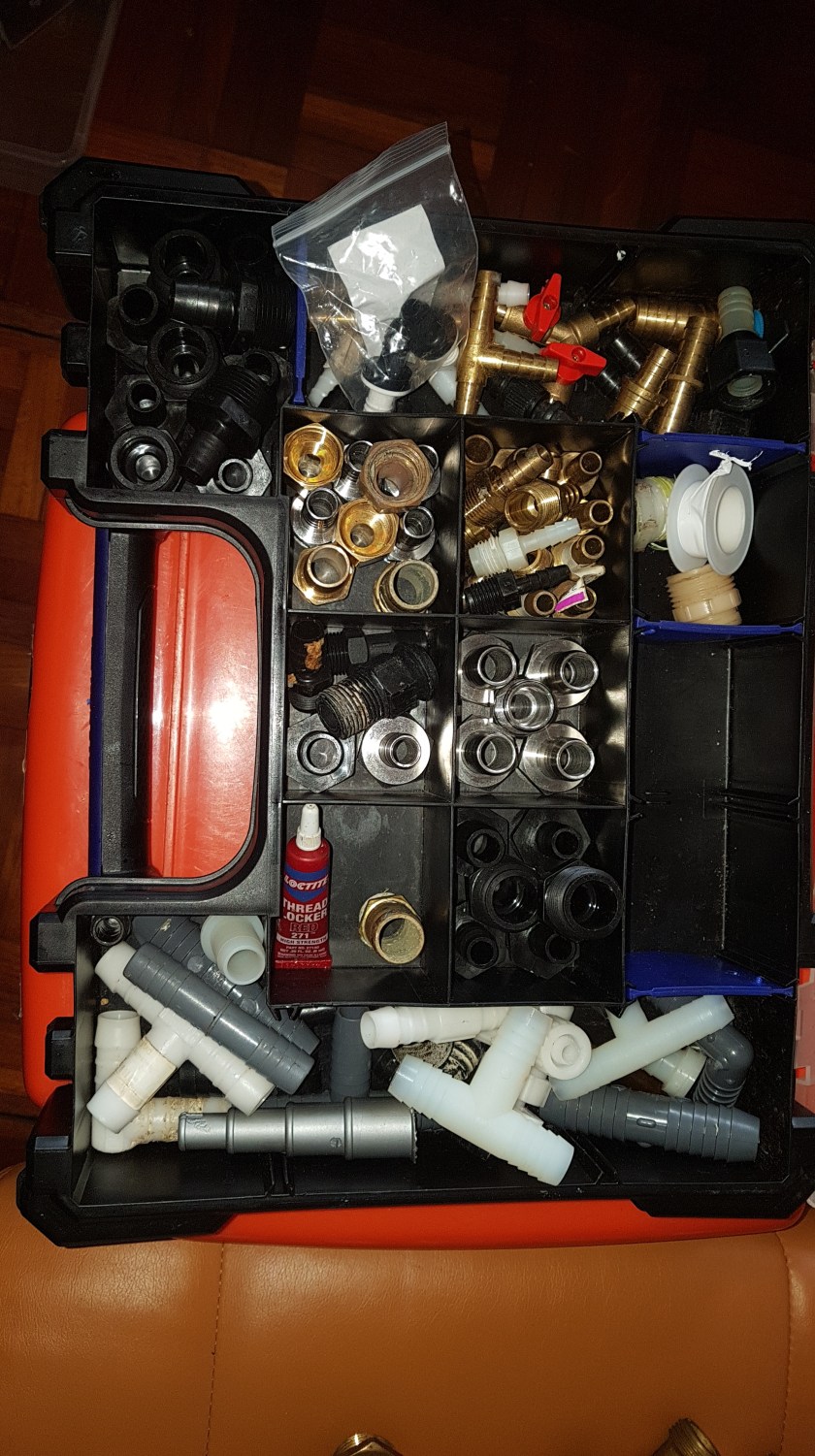
There are those who have few parts, but they are well organized and whenever they need something, they always have just what they need. Best of all, they have very few extra pieces, everything being stored in a few 2-liter containers.
Then, there is the boater who every marine store, big box store and Amazon loves. They have literally hundreds if not thousands of parts: plumbing connectors, electrical wires of all sizes, butt connectors, spade connectors, every connector under the sun; except for the one they need.
All threaded NPT
I’m in the latter group.
So, my little, very little, dock filter project, took three days and 4 trips to Home Depot, Wal-Mart and Ace hardware. Why, you wonder with the plethora of things I already have on board?
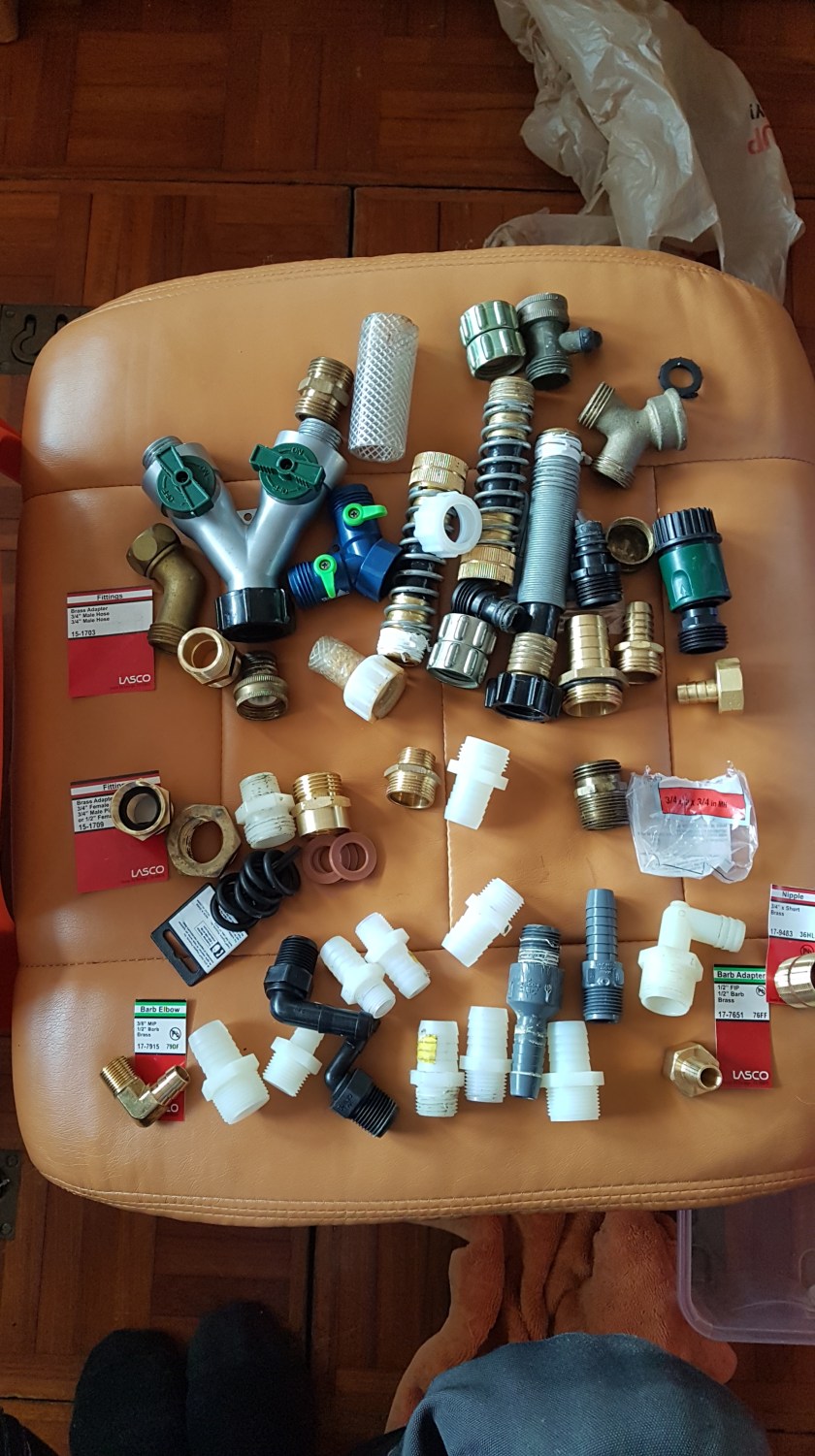
An assortment of hose barbs and NPT connectors
Well, it’s like this. I have 100 feet of ½” clear braided nylon tubing. I also have about 25 feet of 3/8” of the same, as well as 50’ of 1 inch. The water filter I bought used ¾” fittings. I didn’t want to use ½ inch. I also needed ¾” NPT to Hose thread. I had a nice variety and quaintly of stainless steel ¾” hose barbs to ¾” NPT, and many ½” barbs, but alas no ¾” tubing.
I will spare myself the embarrassment of the Rube Goldberg setup I made first, then second, finally third, but with too many connectors of different sizes, it was difficult to not have a joint leaking.
Finally, I bit the bullet and went back to HD for the umpteenth time and bought a ¾” NPT male/female water heater hose of two feet.
Thus, my dock water household filter was installed in a manner that I’m happy with. Even got a quick disconnect to work that I’ve been carrying around for 4 years. I also took the time to re-organize all my hose and pipe fittings.
Now as you look at the pictures, while it may seem relatively organized, I seem to have soooo many ¾” fittings for who knows what, since I have few ¾” anythings on board.
An assortment of Hose thread (top), hose to NPT and all NPT (middle) and hose barbs (bottom)
The dock water filter was certainly not a necessity, as I have gotten along fine without it for these 5 years. But I am on a self-imposed deadline, getting the stuff done that is at best superfluous and at worst a waste of money. For next year, with Trinh here, she’ll ask me how I managed all these years without it, not having a good answer, she’ll tell me to save my money.
I’ve already calculated that I will save $500 per month. I feel richer already.
I did have a much bigger and serious problem, that I have worked around, but had to be fixed.
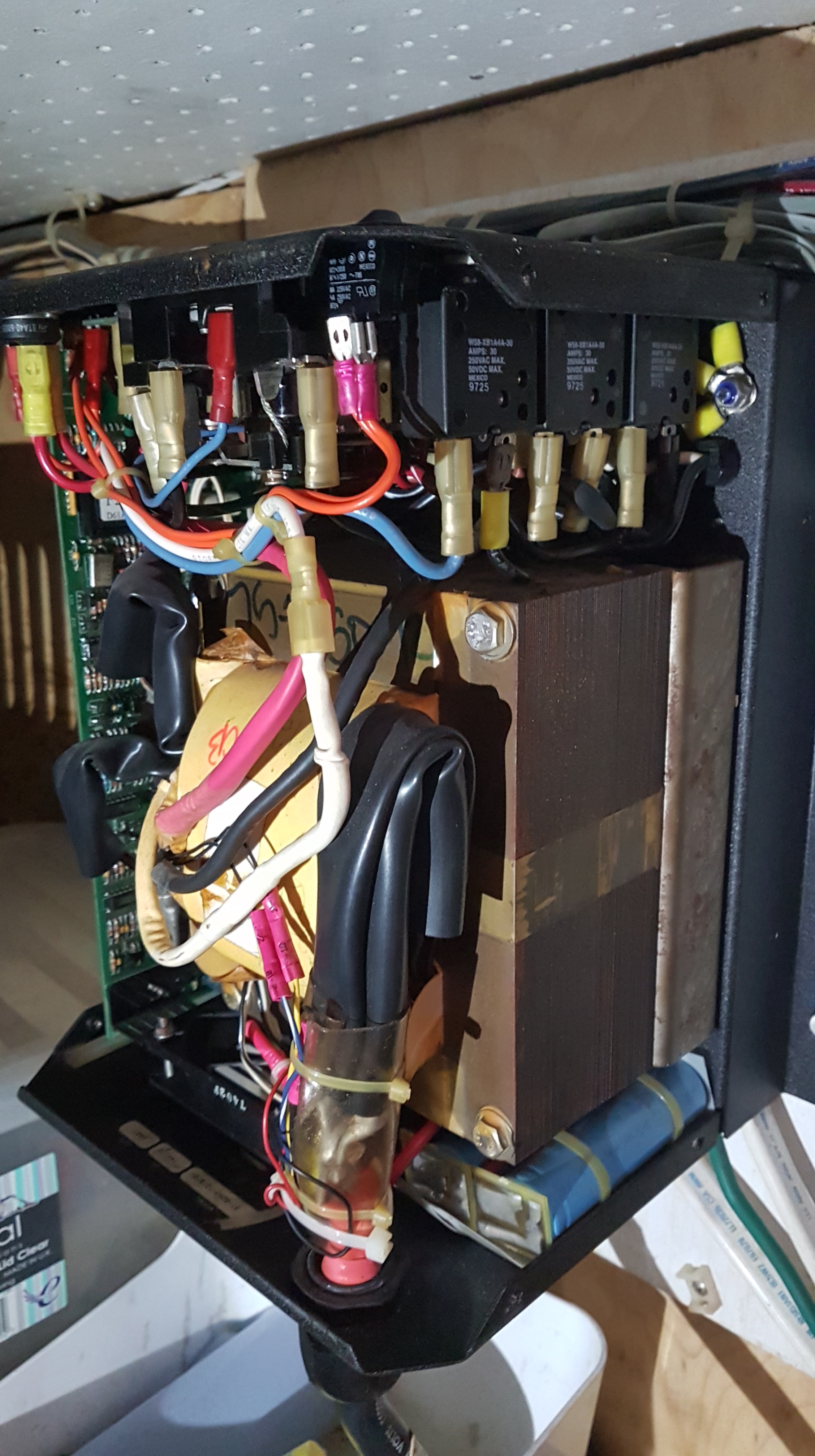
My Heart Inverter/Charger has not been charging for the last few months. I could tap it and it would wake up and start to charge, but sometimes within minutes, sometimes within hours, it would revert to not charging. So, I knew it was an internal relay problem. But I hate disconnecting it from the 930 amp-hours of batteries.
Also, I could work around it relatively easily, as I have another charger, a Neumar, that charges only, but will work on any voltage, which made the time in Europe very easy. It’s on circuit 1 and as you have read, in this marina, I only am connected to circuit 2. When I left Dauntless in July, I left her connected to circuit 1 and therefore the Neumar was charging. But now, being on the boat, circuit 2 is more convenient. I didn’t want to do another work around like I did for the washer and water heater. I needed the Heart Inverter/Charger to work as it is supposed to.
So, I depowered everything, turned off all external power and disconnected the batteries (at the 300-amp fuse). Open the Inverter case and sprayed a lot of contact cleaner on everything, especially the two sets of points that make up the charger relay.
I also tightened the female spade connections on the circuit breaker for the charger (on the upper right of the picture). They didn’t feel loose, but still, couldn’t hurt and a loose connection like that, while very simple, can cause havoc or worse.
I let it dry for an hour, re-connected everything and powered her up. This time, I didn’t have to tap it and it worked as it should. Battery voltage slowly worked its way up to 14.04 v and stayed there for a while as the amperage came down. But even after 24 hours, voltage was 13.78 v, while the amperage was still about + 4 amps.
49 hours later, the voltage as stabilized around 13.70 and the amps going into the batteries stays a little positive, even if it is only +0.4 amps.
Very happy. Now, when I leave the boat this winter, I will leave it on that inverter charger.
I also ate some great Korean food this past weekend, as I had a great day in San Jose with some wonderful Korean friends.
Korean food in San Jose
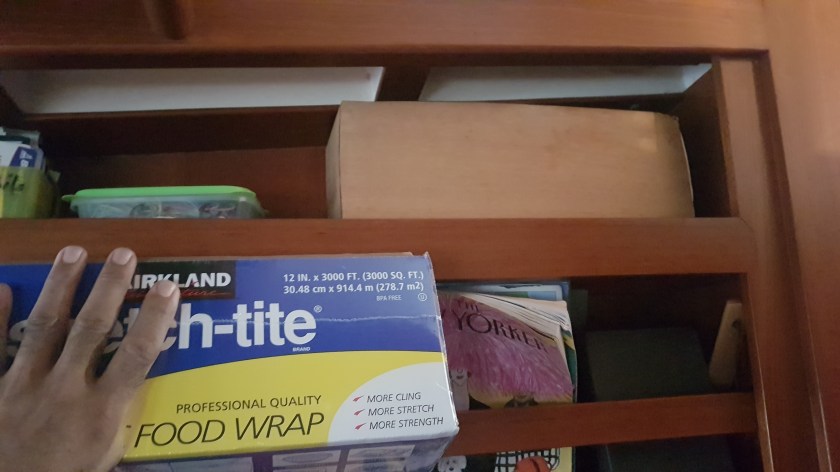
And I did go to Costco, since my 3000 feet of plastic wrap which as lasted me 5 years ran out yesterday. While at Costco I bought romaine lettuce, Brussel’s spouts and rack of lamb.
The new box and old box (with wood veneer)
Coming up next, a hundred males, only a few females; nothing good can come from that.
My fresh water replumbing job was 75% done yesterday, today it’s 50% and even that took a couple of hours. Suffice to say that the floor of closet now looks like Charlie Kruger took to it with a chain saw. No pictures, since many who read this are carpenters or at last know how to work wood and the pictures are not fit for a mature audience.
My beloved grill already for another 5 years
But it does bring back some painful memories. My first wife had asked me many, many times to repaint some chairs we had. Finally, I did. I laid the yellow paint on nice and thick, so the old color would not show through. I was pleased, though they took days to dry. Finally, I presented my masterpieces and she asked me about those drip marks. What drip marks? They weren’t there when I put them to dry. I hope she’s not reading this and cringing.
I stuck to things mechanical and electrical after that.
Who looks at the bottom of the closet anyway?
I have finished some small things though. I replaced both burners and the electric igniter on my Weber Q300 grill. That grill has spent 5 years on the ocean. I’ve been quite pleased with it.
I also installed the new thermostat in my Raritan water heater. I did notice in my travel this week that both the thermostat and heating element are available at your local Home Depot for roughly half the price. It’s expensive to print the word “marinized” on the box.
The tangle around the prop that was removed today
Last, but not least, I had a diver come by to check my bottom. Well, Dauntless’ bottom. And sure enough, I had a little collection of lines around my prop. I’m so happy. Coming up the California coast, I thought I felt a slightest of vibrations. Almost like a shudder every few seconds. It would not have been noticeable to anyone else and Larry didn’t feel it, but I knew. Even wanting to be wrong about it, I knew. I was worried that I had tweaked the prop. Worse yet I thought I had tweaked it by doing something stupid. Yes, even stupider than the last stupid thing.
We were underway from Ensenada to San Diego, eagerly anticipating the celebration with fireworks and fire boats that was sure to wait us in the old U.S. of A. It had been 4 years after all.
This shows the Maretron Data of Pitch (left) and Roll (right). You can see where I deployed the paravane because the roll was reduced by more than half at about the 28 minutes ago mark. You can see that it also reduced the pitch, but that is not to be expected. It happened this time because of the combination of NW swell and West wind waves as were headed NNW.
The wind was light, 10 knots from the west on our port beam. With the added Pacific swell from the northwest, the boat’s rolling had increased as the day wore on. By early afternoon, the roll was 10° to starboard and about 5° to windward or port. But occasionally the roll increased to 15° & 10°. That’s a difference of 25° and usually is the point where I really notice the roll and so I will put one or both paravane birds out. In this case, I just put the windward bird out. That would dampen the roll about 50% and we only lost 0.4 knots. A good price to pay for a nicer ride.
This picture I took as the boat slowed down, so the bird was back under the water.
Suddenly, close to the USA-Mexico border, the ride of the boat abruptly changed. It became very smooth. I jumped up from the pilot house settee to look at the paravane and see that we had snagged hundreds of feet of line connected to pots, I guessed. I estimated hundreds of feet, since I could see at least 100 feet strung in the air, then to the bird which was well out of the water.
I chopped the power, the boat slowing quickly. But now, the line of the pots was snagged on the bird, but stopped dead in the water, with the pole vertical, we had all the dead weight of whatever that line was attached to.
I got the not so bright idea to go in reverse. Possibly, the line would un-snag itself at that point. It’s worked in the past, but no luck this time.
Larry and I heaved and heaved and got the line up to the bird, at which point, we cut the snagged line away. This line also had several floats on it. Once cut away, the floats and line and floating right next to the hull amidships.
Until now we had done almost everything right. I just needed to be a little patient. But patience is not a virtue I have been gifted with. I decided to go forward to get away from the floats. Yes, by running over them. Sounds stupid even in the writing. Sure enough, within seconds the line was in the prop. I stopped the motor and cursed at my stupidity.
That done, I put her in reverse, as I have unwound lines that way also. In this case, no and hell no. There came a hellish scream, which I attributed to a float being wound around the prop scrapping the hull.
Wow, as I write this, details came back that I totally forgot about!
I went in the water. I lowered the swim ladder, climbed down the ladder to the lowest rung and stood there, while Larry handed me the boat hook. I was able to snag the line using the boat hook, since it was about 10 feet under the water.
We got that line up to the boat and cut it.
I then backed up again and we were free.
But from then on, I felt this slight shudder. Had I tweaked the prop? I didn’t know until today.
I do have a SALCA cutter anode (model 2000, 2″ diameter) on the shaft, just in front of the prop. I’m sure it has saved me many times and even this time, may have helped. But that pile of lines now on the dock, was wrapped around the prop since San Diego.
In thinking about this incident, I also realize that the paravanes were well designed for incidents like this. I’m sure that is the most force put on that pole and lines since installation. The 3/8” Amsteel Blue line fore guy did its job. To stop the roll suddenly and slow the boat so abruptly, there must have been thousands of pounds of force to the aft on that line. It’s tied off permanently at the bow hawsepipe and cleat. I have it doing 4 turns over the cap rail, with a clove hitch before it’s tied off on a cleat. Thus, the cleat never really sees significant force, even under these circumstances.
Thank you, John Duffy in Miami, for doing such a great job with the paravanes.
I think I’ll have a celebratory drink, since I missed the fireworks and fireboats in San Diego.\
And I’m looking for a decently priced Hookah outfit. I need to be even more self reliant.
Having dedicated these days to the three dozen items on my winter to-do checklist, I hardly have time to write this blog. So, I’ll just have to add this to the list.
So, I figured I’d make goal, nice and high, like 25%.
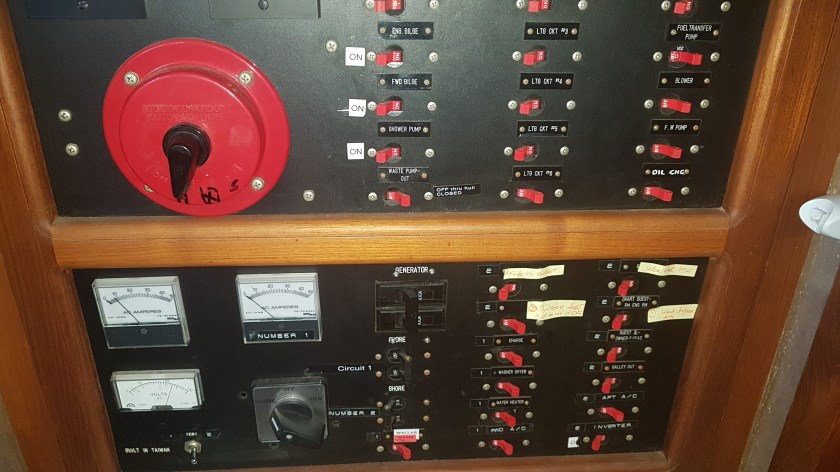
My salon electrical panel
What? You were expecting 110%?
I’m not one of those super achievers who when they want to paint the engine room, they take everything out, like engine, genny and all that crap glued to the walls. Eek. Even writing that sends chills down my spine.
I have done a few things on the list. Maybe more than a few. Of course, I had to write a review for the local donut place. Well, not so local, but good donuts are worth the time.
The back of the salon electrical panel. the breaker I had the problem getting the screw back in was near the top of the picture middle column.
This wonderful marina with covered dock, only supplies me one 30-amp circuit. It quickly became tiresome for me to change the dock plug from one circuit to the other, when I want to turn on the water heater or Splendid washer-dryer. So, in consultation with that Krogen guru, Dave Arnold, who pointed out a far simpler method to power those items from the circuit that they are not on, from what I had originally devised. I proceeded to put a simple jumper off the breaker in the salon two days ago.
But then today, in a sure sign of mission creep, I decided to idiot proof my little setup.
In normal times, I run either two 30-amp lines to the boat or one 50 amp to a splitter that makes it into two 30’s for the boat. My main charger/inverter is on circuit 2, with most of the primary everyday stuff in the boats like the outlets and salon A/C. On Circuit 1, are the step children: washer dryer, water heater, chargers two and three and forward A/C unit.
So here, the dock power is plugged into circuit 2. In it’s previous life, this Kadey Krogen used to be a heavy 120v user, almost everything except for the navigation lights, radio and radar were household 120v.
Dauntless was going to be a cruising boat, not a dock queen, so from the beginning, my goal was to reduce that 120V dependence. First to go were the Subzero fridge and freezer; then thanks to Amazon, all the lights and/or bulbs were replaced by 12v LEDs. Boat computer, LCD monitors (Samsung 24”, there is at least one particular model that will work on 12v and in fact, works to about 11.5 v) and everything else in the pilot house are 12 votls.
The only 120v items that remain are one salon wall light that also serves as a 120v power tell tale and the older appliances that are not sued that often and thus not efficient to change such as the Raritan water heater, the Splendide washer dryer combo, the two A/C units and the microwave. That’s it.
This is the first time in months, I’ve needed the 120v water heater, as it also uses engine coolant to heat the water. But it’s cold up here and that first night back, taking a cold shower was enough for me to decide I needed a better plan. Replacing the heating element had been on my list of things to do for a while, as measured in years. While in Cabo I realized the water, heater was not working on electrical power. But, since I was seldom stopped long enough for the water to get cold, I didn’t need it until now.
So, the first day back, it was number one project. Of course, I had to get an inch and a half socket, but once that was done, it was all done, and we were good to go
Except we weren’t. Still no hot water.
Get the electric meter, umm should have done this first, only to discover that the problem was the thermostat. Well, that was easily bypassed. Now for the first time in a long time I had electrically heated hot water. I just had to remember to turn off the breaker after an hour or so.
Now I had the problem of having to move the dock plug every time I wanted to make hot water. I don’t like messing with the dock plug. If I’m moving it once a day, that’s a sure way to have some other issues. I needed a better solution.
So, two days ago, I made a jumper from a non-used breaker on circuit 2 to the water heater breaker on circuit 1.
I now had power to the water heater from circuit 2. Life was good.
I always want to make it better though, even if that has often not served me very well. A primary reason I’ve had few careers in my life, especially in Education, where there are too many adults who like the system just the way it is, words and promises notwithstanding.
But obvious solutions are sometimes not as simple as it seems. Thus, today I spent a couple of hours just trying to get one little screw back into the breaker. It was one of those old, straight cut, very short screws that were popular in the 60’s. I tried grease, even glue, to get it to stay on the tip of the screw driver. I had only taken it out because I wanted to disconnect the line that was there. I knew it was going to an outlet that is not used, but I wanted to make sure that if I had power to both circuits 1 & 2, that I would not be feeding power where it was unexpected.
I just thought it better to remove the second lead from the load side of the breaker. Now, the breaker has only one load, no matter what. On the picture, it’s the second breaker in the middle column in the lower part.
After doing that, it was easy to also add a jumper for the washer dryer. Those breakers were on the outside column, about a million times easier to access and that only took a few minutes.
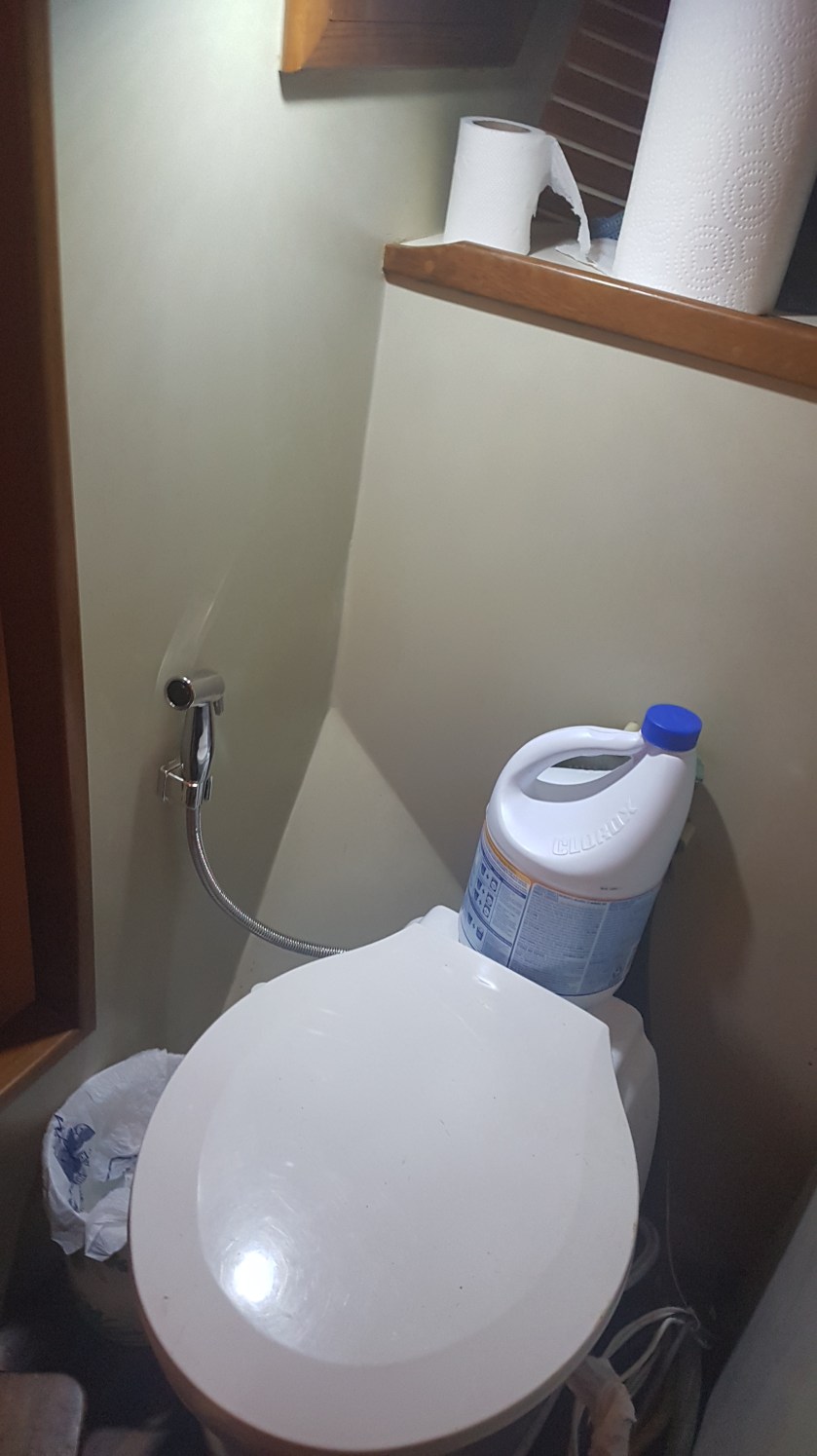
My new head water nozzle
My other little projects that were on the list was to add little water nozzles by each toilet. It’s an eastern Asian thing and virtually every toilet in Vietnam has one, even the toilets that don’t have a commode. I also find it far more practical than a French bidet. Besides cleaning all sorts of things, it can also be used to fight fires or water fights with mutinous crew!
Despite my accomplishments this past year, another 2500 miles behind me, the Golden Gate in front of me, the Baja bash, Panama Canal, the Atlantic Ocean, behind me, I wonder if I did not make some big mistake.
Anchored in Finland.
For not the first time, I wondered about my sudden decision to flee northern Europe two years ago. I loved northern Europe. I loved Ireland. I loved the peoples and the cultures.
I lived for 4 years in Germany and still visit relatively often. The Germans certainly have some interesting attributes. Some of which I even like a lot.
In 2015, I was reminded just like 30 years ago, the different personalities the Germans are along the north coast. These are the people who have known “Auslander”, (from an outside land), for thousands of years. They are not the Germans of the much more insular interior, one meets south of Hamburg down to the Alps.
I dwell on this because stupid Google, out of the blue the other day, sends me my pictures of years ago and says, “don’t you want to post these?”
It reminded me yet again of how great the cruising was along the north coast of Europe, Scandinavia, the Baltic and North Seas. The cruising is the best I’ve yet encountered, with thousands of miles of protected skärgärd cruising. With the wind blowing 20+ knots, 100 meters away, you are cruising or anchored with nary a ripple of waves.
Cuxhaven, Germany
All the peoples who inhabit the environs along the coast are sea faring folk. Much like the Celtic culture along the west coast of Europe, from Galicia in NW Spain to Scotland, The North Sea and particularly the Baltic had the Hanseatic League. From Hamburg to Tallinn, they controlled trade and influenced culture from Germany to Russia.
This seafaring culture manifests itself in boat friendly, stranger friendly ways. No matter how small the port, or how many boats are already there, they will find room for you. In the more formal marinas, like Tallinn and Cuxhaven, the American flag was being put up on the yardarm of the marina even as I checked-in. And even check-in itself was a 5-minute process, with reasonable rates, about $0.25 per foot in Holland to $1.00 per foot in Helsinki. Overall average for marina overnights ended up being less than $0.50 a foot for my 4 months in the Baltic and North Seas.
All these experiences were exactly the opposite in southern Europe, by the way. 30-minute check-ins, filing out endless forms, each time, $1.00 per foot was best price and it went up to $2.00.
I was also reminded with much regret that the $1,000 ten-day stay I had at Cabo San Lucas was the same cost of one year! in Waterford, Ireland. Sure, Waterford could not boast like Cabo of having only 7 days a year with rain, but I am sure they can boast that they have at least 7 days a year with sun.
So, all these fond memories really made me question my decision of leaving Europe in 2016. Stupid Google also reminded me of my great trip to Galicia to scope out a winter home for Dauntless the following year. Food, people and marina in A Coruna were fantastic. I could stay there for $500 per month year around. Had I stayed another year as planned, I would still have some options. I could return to the Baltic the following summer or just stay in Northern Spain and Western France. I would have also saved so much money.
Oh Regrets. What would life be without them?
Probably a hell of a lot better!
I acknowledge that 2016 was a traumatic year for me. I often wonder if unexpected life changes led me to make some hasty, irrevocable decisions? It certainly seems so to me when I think and think and think about it.
It would have been just as easy to fly between Ireland or Spain and Vietnam. I picture myself escaping the heat a humidity of Vietnam for the damp coolness of Atlantic Europe.
One key factor drove my decision to leave for the Pacific, the availability of crew. My Hawaiian nephew wanted to take a year off from school before he went to law school. He thought exploring Europe, North Africa and the Caribbean via Dauntless would be ideal. He spent almost a year with Dauntless and I.
He was indispensable. Not only as a great, hardworking, vigilant crew mate, but also as a smart, interesting companion for the boring passage between Europe and the Panama Canal. I couldn’t have come that distance without him.
Dauntless is in Vallejo, California now. I’ll return to her next week for a month of getting her in ship shape. Next spring, I’ll return and weather permitting get her up to the Pacific Northwest by June, then British Columbia and Southeast Alaska for the summer.
Ending up in one of the wonderful, little towns of Southeast Alaska. Which one, will depend on several factors, Dauntless taking second stage for now.
By next year at this time, my life will take another turn, as I gain both a First and Second Mate on Dauntless. We’ll end up staying in Southeast Alaska only a little longer than originally planned. Visa requirements for my wife-to-be and her son require us to live in the United States, so SE AK is the perfect place to settle down for a while and catch a few fish and enjoy the fantastic scenery and wildlife.
What would have happened had Dauntless still been in Europe now? I would truly have a mess on my hands. Instead of struggling with a 2500 trip, I would be looking at 10,000+ miles. Eek!!
Everything happens for a reason. Two years ago, I had no idea I’d fall in love with the love of my life, yet again (ok, I’ve had a lot of lives). Or that she would be in Vietnam or that I’d spend all my free time with her in Vietnam. Or that SE Alaska, then so far away, now so close, would be the perfect place for a variety or reasons.
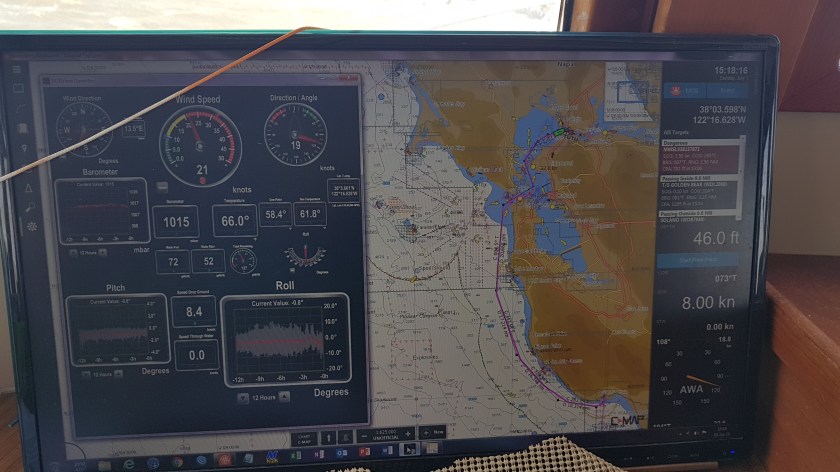
CE Chart showing my route from Santa Cruz to Vallejo. Maretron data shows winds, and other environmental parameters
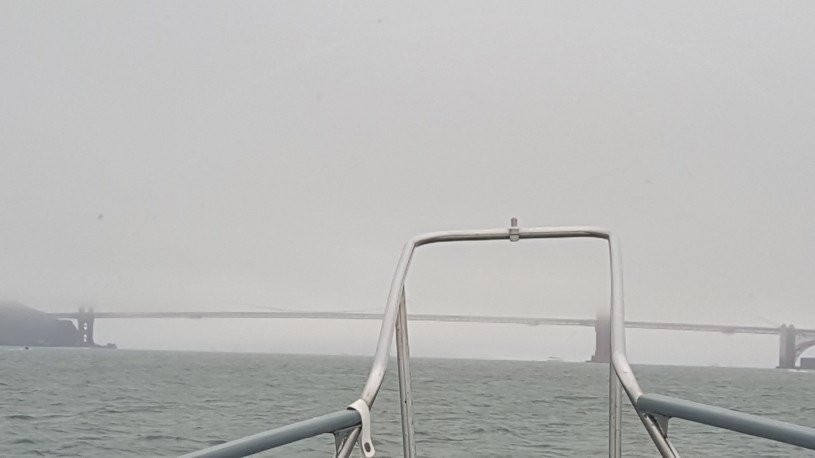
Passing under the Golden Gate, I felt the chapter coming to the end. Like turning the page and seeing only a short paragraph remaining.
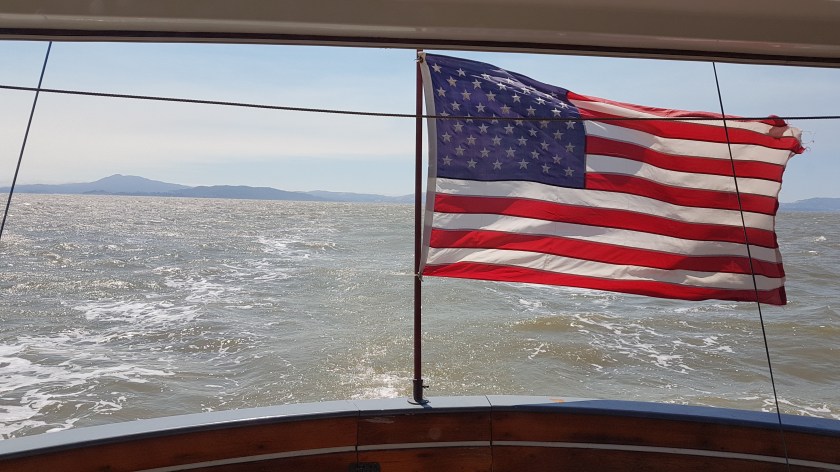
As I made my course eastward under the bridge, the winds picked up as forecast to westerly at 20 to 25 knots. I was happy to have just gotten up the coast before the band of strong northwesterly winds had reasserted itself.
Error
This video doesn’t exist
I also knew now that no matter what the winds did, my ride to Vallejo would be relatively smooth and it was. The picture shows the Maretron data with winds as high as 32 knots, but the roll reduced over what it was on the ocean.
After a few hours of motoring up the channel, Fly Wright was there to greet me.
Fly Wright meets us
I had to dock outside my covered slip that first night, as I had to lower the mast and the paravane poles.
With many hands helping, the mast the poles were easy to lower, though I wondered how I managed to do it myself a few times.
We had a great dinner that evening at the Sardine Can, a good restaurant near my slip. The next day, I moved Dauntless to her winter home. She’ll be there, out of the sun and rain until next spring, when we continue our northward trek.
The winds were blowing
This time I remembered to change the oil right away. I also had a long list of items to do before I flew away.
My winter Home Maretron Data shows the summary of the previous two days coming up the coast from Morro Bay.
I’ll be back to her in September to commence a long list of projects that hopefully will be done by spring.
On the 63rd day since getting underway from Huatulco, 2300 hard miles ago, I got up for the last day at 02:00.
The Golden Gate Bridge dead ahead
70 gallons of fuel would be more than enough to get Dauntless the last leg to San Francisco Bay and Vallejo.
Checking the current tables, I had to get to the Golden Gate by 13:00. Then the current would push me the last 40 miles to Vallejo at plus 2 or 3 knots. To make that happen, I had to depart by 03:00, planning 10 hours for that 65 nm.
02:33 Engine start. We (Dauntless and I) were underway at 02:45, with scattered clouds and southerly winds.
I had about an hour of cruising WSW, before I could head NW. After a few hours, just after sunrise, I was able to go on my final course of 340°. The winds stayed southerly at 12 to 16 knots for the rest of the morning. Just enough time for me to get into San Francisco Bay.
Videos I took that morning:
Error
This video doesn’t exist
,
Error
This video doesn’t exist
,
Error
This video doesn’t exist
A brown day with wild fire smoke
At noon, 12:00, I was entering the Golden Gate channel. My goal of the last 10 months was in sight.
Leaving Santa Cruz Channel
And it was an impressive sight. To be looking at the Golden Gate Bridge from the Pacific on my own bottom. How many people can say that?
I was proud: of my accomplishments, of my determination to complete these goals, of this Kadey Krogen that was so strongly and safely built.
We could not have come up with a better name, Dauntless, determined, never give up.
First Glimpses
All of the pictures Dauntless moving north from Mexico to California 2018 can be seen here in ascending chronological order. Please note that most pictures have the date and time they were taken in the picture/file name.
I still needed to get Dauntless out of this harbor safely.
Leaving Morro Bay at 01:42 Dauntless is near the top of the horseshoe on the CE, C-Map chart. From left to right: Raymarine E-80 radar, probably set at 1/8 mile, Samsung LCD 24″ monitor showing Coastal Explorer C-Map, below, Samsung 12″ tablet showing Navionics chart. .
After a close call, like I just had, it’s easy to relax your guard, but it’s still dark, in a narrow channel lined with boats, piers, infrastructure and even sleeping otters.
For 30 minutes I threaded my way thru the horseshoe shaped channel.
At exactly 02:00 I passed the outer marker and set my course to the northwest. ETA to Santa Cruz marina was 19:00
Video of us leaving Morro Bay:
Error
This video doesn’t exist
I took a few deep breaths, regretting that that I didn’t have a sheep, goat, first born son or even a chicken to sacrifice to Poseidon. Did a few Hail Mary’s and settled in for the rest of the night?
Windy.com had depicted a very narrow inverted trough moving off the coast during this 36-hour period. What that meant was that now, 02:00, winds were light from the land (the nightly land breeze) but would strengthen rapidly during the early morning hours. Then stay strong, 20+ knots out of the south for the next 24 hours, before the dominant high-pressure system, which had dominated the weather in the eastern Pacific for like forever, or much of the spring and summer so far, would bring back the strong northerly winds.
This meant I had until noon the following day to get thru the Golden Gate. After that, winds would be 20+ from the north.
I kept the rpms up, 1700, boat speed varied between 6.3 to 7.3 knots due to the coastal current. With no current, the speed should have been about 7 to 7.2 knots at 1700 rpms.
Pitch and roll were ok, pitch was a few degrees up and down, roll +5° to-8°, the Krogen had an easy motion. There was a swell from the NW at 4 to 8 feet and wind waves from the SE at 1 to 3 feet.
It felt so good to have the wind behind me. I could open the pilot house door without the fear of the wind grabbing it from my hand. I could stand there and just watch the ocean and the sky. I love the ocean as a fish loves water.
By noon, winds had picked up to 15 knots, still from the SE. I estimated the NW swell now at 8 to 10 feet. (which meant my earlier estimate of 4 to 8’, made in the dark, was probably understated).
Video of us underway at 13:22:
Error
This video doesn’t exist
By 14:00 the winds had increased from the south and were now, 180° at 19 gusts to 25 knots. Pitch and roll had doubled: pitch was +4°/-8° & roll +11°/-11°. That roll was at a point I would deploy the paravane stabilizers, however in this instance two factors mitigated against it:
It would take a knot off my speed and
I had just passed many fishing boats. I got tired of fishing trawlers buzzing me because they thought I was stealing their fish. In the heavily regulated fishing industry in the USA, it’s not as much of a problem, but I’d just spent 4 years outside the USA.
At 19:00 I entered Santa Cruz harbor. Was tied up at 19:19.
We did 121 nm, 17 hrs:42 min, at an average speed of 6.84 knots.
I had a nice dinner with my new-found cruising friends, Ralph and Kristen.
By 21:00 I was tucked into bed, with the alarm set for 02:00 and my last day of the 2018 Baja Bash.
Larry had returned to Alaska also, so when I got back to Dauntless on the 24th. I’d be taking her the last 400 miles of this 2000+ mile trip to Vallejo on my own. I had a plane ticket to leave Sacramento on 3 July to Austin.
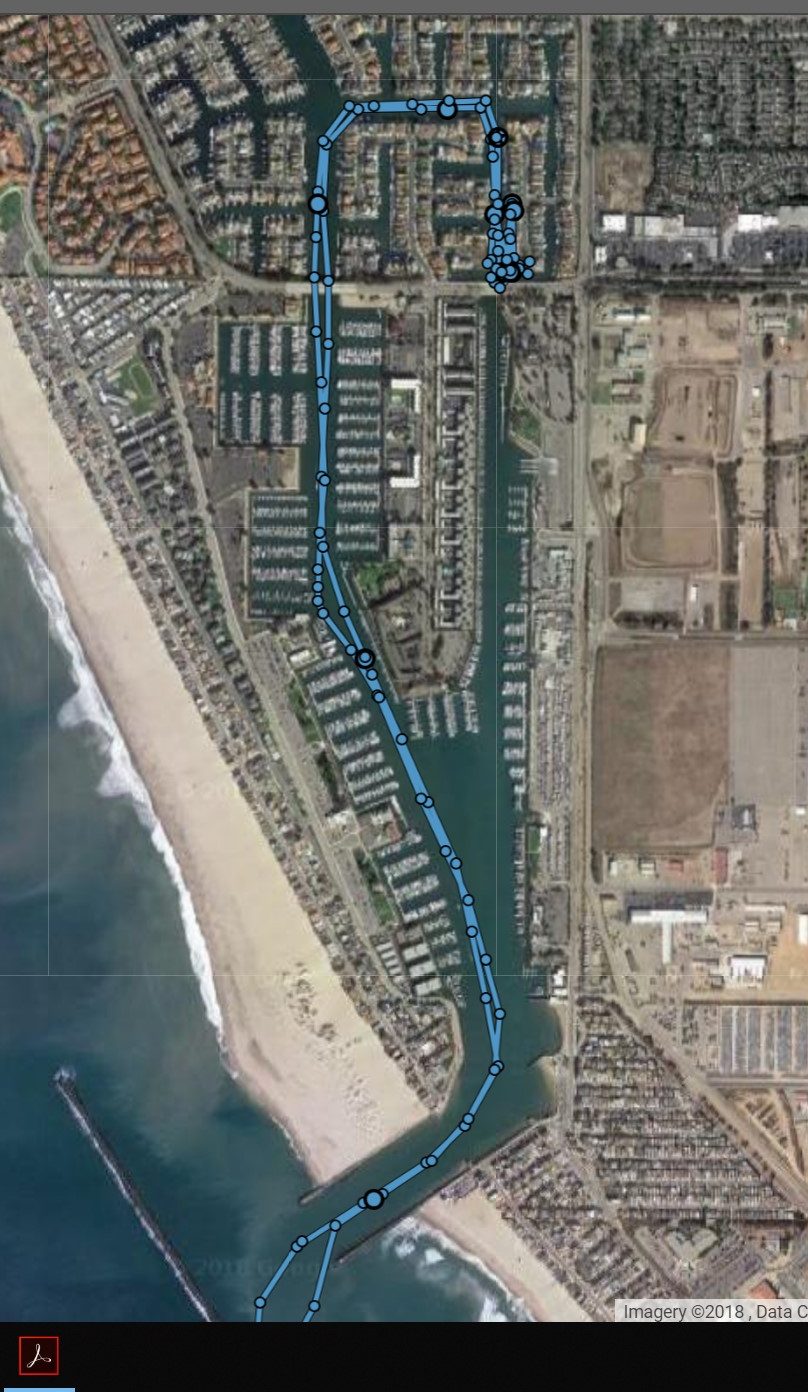
My route thru Channel Isl Harbor
Assuming I had to arrive on the 2nd, I had 8 days to get to Vallejo. Ray, one of my boat mates in the new marina had kindly offered to give me a ride to the airport at 0h dark-30, so, I was back on the clock.
The first leg was critical, 70 nm to Point Conception. Winds had been light or southerly for two days, while I was in Salt Lake City, now, my day of departure, Monday they were forecast to increase from the west as the day progressed. (This is the way I use weather forecasts, looking at the trend, but not necessarily believing the specifics). 70 miles is 12 hours steaming time. I wanted to get around Point Conception before 16:00, otherwise as winds picked up on the bow, we would go slower and slower and I would become ever more miserable, yet again.
Therefore, I planned my departure from Kyoko’s dock at 04:00.
I never sleep well before embarking on any kind of trip, be it, by plane, train, automobile or boat. Thus, I was up just after 3 and figured I may as well get this show on the road.
I have a standard departure procedure. One that I adhere to since pulling away from the dock in the Chesapeake, 4 years ago, only to have the engine stop two minutes later from no fuel. At that time, I dropped the anchor in emergency mode (pulling the chain out of the wildcat and letting the anchor freefall) to stop our drift into nearby boats. Once that was done, I headed to the engine room to see what happened. A quick glance showed both fuel tank feeds were closed. Since I had just opened one, it was clear to me that in my mindset to “open” a closed valve, I had closed the one that was open. So much for check lists.
Getting Underway at 04:07
Way back then, I still did not have my auxiliary fuel pump installed, so of course it took 10 minutes of lift pump masturbation to get the air out and everyone happy again.
Consequently, I follow a standard start up routine, which consists of:
Engine room check, smelling and looking for obvious leaks and confirming fuel feed and Racor use.
Engine start
Turn on breakers for:
Running lights
VHF radio
Radar
Auto Pilot
“Loran” that’s the breaker used for my USB ports now
Horn
Check Anchor light is off
The boat computer, modems, router, Maretron system, two Samsung LCD displays are all 12 volt and on a separate breaker that is not on the pilot house system. They were already on, as that system takes a few minutes to boot up, as the router can be picky.
Now, on this night, I had already taken one spring line off before I went to sleep. In hindsight, that was probably a mistake, as it got me out of my routine.
Channel Isl Hbr overhead docking
03:30 I did my engine room check. I was also out of my routine because my engine room bilge pump was off and had been for the 10 days I was on this dock. With the little leak I had from the transmission, while no significant oil would be discharged, it would still make an embarrassing oil sheen, would not be nice for Kyoko and Mike, who had so graciously given me this spot. I could easily wait until we were off-shore.
03:43 Engine start. To this day, it is unclear to me what I was thinking. But I didn’t turn on the Auto Pilot or the Radar. More likely I did, but in any case, I untied from the dock, without realizing that neither was on.
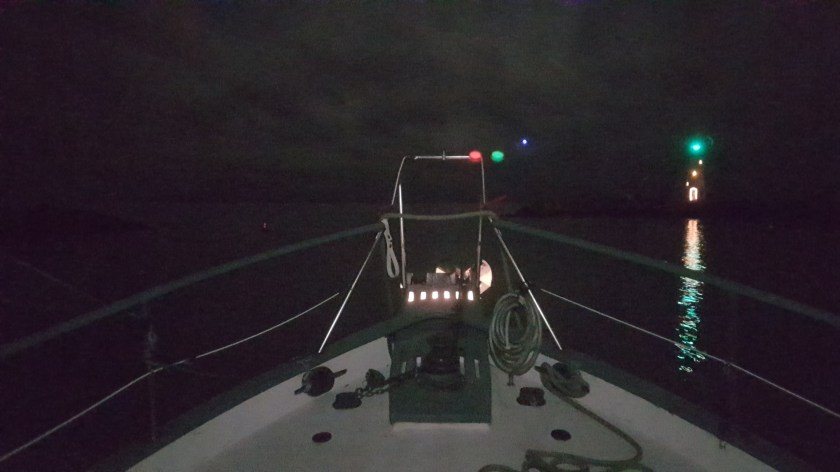
03:52 Free from the dock and underway. I make the 90° turn to starboard to clear the dock, at which point I realize the Radar is not on. It’s dark. I don’t travel without the radar in the daytime, let alone now. But what to do.
These fairways were relatively wide, maybe 150 feet, but with boats and/or docks on either side. To return to Kyoko’s dock, I would have to do a 180° to port, then a 270° to dock bow facing out, as I was. In the dark, alone, that did not appeal to me. I also did not want to dock bow in, tie on the port side, as all my lines were on the stbd side. Again, being alone, limited my options. I decided to press on and look for a convenient place to stop to be bel to diagnose and solve the electrical issue.
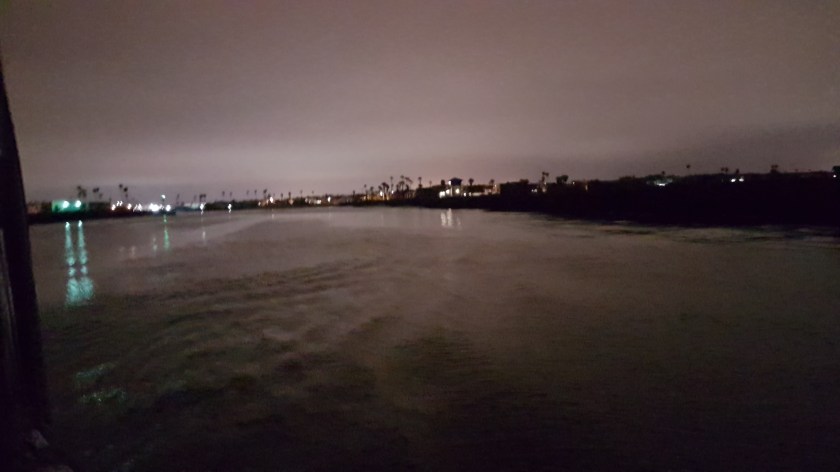
In hindsight, I should have turned around and docked bow in. As it turned out, where I did decide to dock had a current that was vexing. At least this was a dock I knew. But at the time, I was more concerned about hitting something and felt it would be better someplace else. There must be some fuel dock or some such on the 40 minute it would take to go thru the channels and harbor to the sea.
My abrupt stop of video and boat for that matter is because while approaching the bridge, I was sure it was the same bridge I had come under two weeks earlier. But then, it that moment of panic, I thought maybe in the dark, I had made a wrong turn. I didn’t, but that’s what being in the dark will do for you.
Error
This video doesn’t exist
So, I slowed to inch under the bridge. I then proceeded to spend 15 minutes trying to back in a dock. With no current, it would have been easy, but in this case, there was a current, pushing the boat and especially the bow to port, so as I backed I’d end up almost perpendicular to the dock. After 3 or 4 attempts, I gave up and decided it would be easier to just go bow in around the corner. It was, and I did.
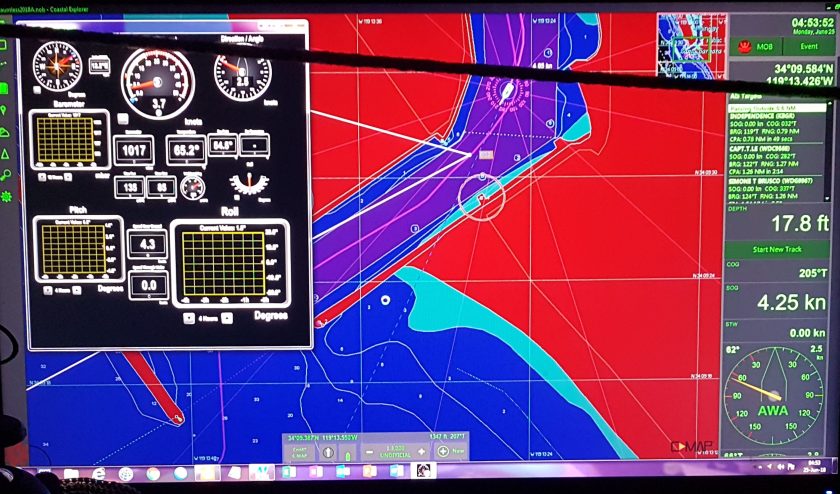
Coastal Explorer and Maretron data laving CI hbr
Just tied to midships. The boat secure, I was able to get under the helm to see why I had no power to the radar and autopilot.
Pilot house voltage has been an issue since day 1. I need to run a bigger or additional line and ground to the pilot house. When on long cruises, once the batteries are fully charged, the voltage at the batteries goes to 12.85v or thereabouts. The problem is that voltage in the pilot house is down to the low 12v. The Raymarine radar display will blink out momentarily when the voltage dips below 12. This usually happens when the auto pilot commands a longer turn. It gets annoying. So, since I never got around to running the additional wires, I instead did my normal half-assed fix of jumping from one buss to the other. The pilot house electrical panel has three separate busses. It used to be two, but sometime a couple years ago, I thought I had a fix for the radar by making a third buss. It sort of worked.
But coming north with Larry the radar display (not the transmitter or computer, only the display) started blinking again. I added another jumper. Worked great. But then upon arrival, I redid in a different way. Why? who knows!!
That different way is what was not working. I realized right away why the autopilot wasn’t getting power. So, I put it back the way it was, and all was good. That took 5 minutes. The additional docking took 45 minutes.
That delay would bite me in the ass later that afternoon. Once I got out to sea, the winds were light from the south or southwest. I was headed 280°, just north of west. Winds out of the south were good, east better. Late in the morning the winds started to turn to 280° at 06 kts, right on the nose. 3 hours later at 14:00 they were 28012 g 15 kts, pitching had increased to 12° up and down and speed was reduced by one knot.
Underway again
Error
This video doesn’t exist
I was able to make the turn to the NNW, 340° at 16:00. Winds had already increased to 290° 14 g 20. The turn took the winds and seas off the bow to the port forward quarter, much better than dead ahead. I was grateful for my early morning start.
The rest of the day was a piece of cake. Winds stayed 300° 15 g 20 for the rest of the evening. We were pitching and rolling, but it was tolerable. I didn’t jump overboard as I have been tempted to do when going into ahead sea.
And now you know the rest of the story.
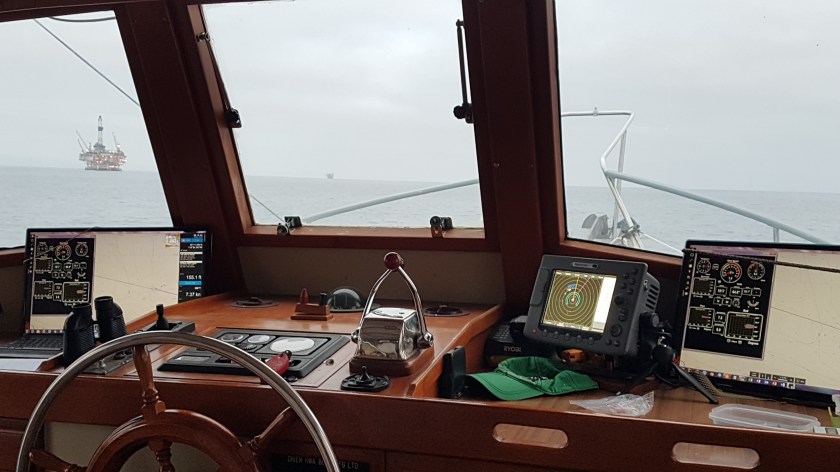
Passing an Oil Platform south of Santa Barbara
I arrived in off Avila Beach in San Luis Obispo Bay around 22:00 and anchored that night using the radar. But then you already knew that.



 I was looking forward to this project, as I like working on the electrical things and I just wanted to also tidy up the wires and the things I’d done over the last couple of years.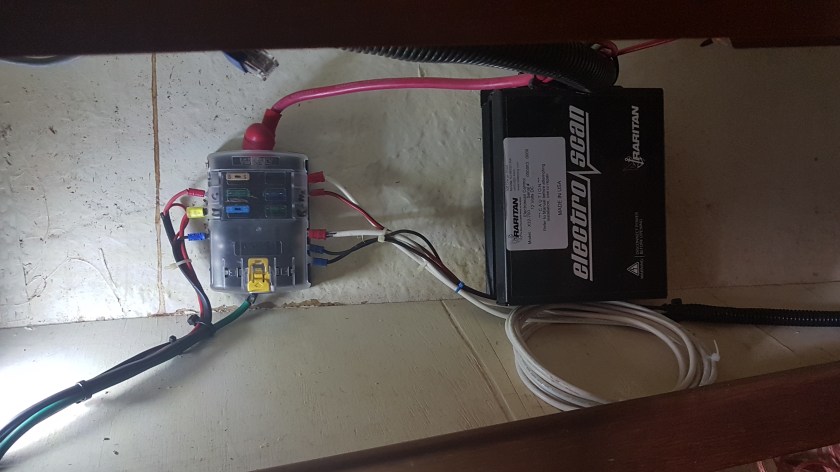

















 Dauntless at Sea