I’m an eclectic person, who grew up in New York, lived overseas for many years and have a boat, Dauntless, a 42 foot Kadey Krogen trawler yacht. Dauntless enables me to not only live in many different parts of the world, but to do it in a way that is interesting, affordable, with the added spice of a challenge.
Dauntless also allows me to be in touch with nature. As the boat glides through the ocean, you have a sense of being part of a living organism. When dolphins come to frolic, they stay longer if you are out there talking to them, watching them. Birds come by, sometimes looking for a handout; sometimes grateful to find a respite from their long journey.
I grew up on the New York waterfront, in the West Village, when everything west of Hudson St. was related to shipping and cargo from around the world. For a kid, it was an exciting place of warehouses, trucks, and working boats of all kinds: tugs and the barges and ships, cargo and passenger, they were pushing around.
My father was an electrical engineer, my mother an intellectual, I fell in between.
I have always been attracted to Earth’s natural processes, the physical sciences. I was in 8th grade when I decided to be a Meteorologist.
After my career in meteorology, my natural interest in earth sciences: geology, astronomy, geography, earth history, made it a natural for me to become a science teacher in New York City, when I moved back to the Big Apple. Teaching led to becoming a high school principal to have the power to truly help kids learn and to be successful not only in school but in life.
Dauntless is in western Europe now. In May and June, I will be wrapping up the last two years in northern Europe, heading south to spend the rest of the year in Spain & Portugal.
Long term, I’m planning on returning to North American in the fall of 2017 and from there continuing to head west until we’re in Northeast Asia, Japan and South Korea, where we will settle for a bit.
But now, my future lies not in NY or even Europe, but back to the water, where at night, when the winds die down, there is no noise, only the silence of the universe. I feel like I am at home, finally.
As I walked to the car, crossing Pelham Parkway, I really was struck by how pretty the Bronx is.
Pelham Parkway turning green
Now, I have been told by some about the Bronx, and working here for five years, and now living here, if only part time, I can certainly appreciate it, but still I’ve always had my doubts.
My friend Sam, a big Bronx booster and the only person I know who was born, raised and still living in the Bronx, would periodically rant and rave about its attributes. But like most New Yorkers, I attributed it to a passing delusion.
But I always liked her enthusiasm and she was more right than I. Sometimes I should listen better also.
As I got in the car, connected my IPod, that had been “lost” for the previous week, I also realized that that last night’s funk was as much about having to listen to NY radio for a few yours. How such a big city can have so little choice in radio listening is simply pathetic. We are such a big city, so there are no real “local” stations, but instead virtually every station is owned by some big corporation, run by the bean counters.
Sad to think that the place where playing rock albums on WNEW-NY actually started in the ‘60’s has now reverted to the planned world of a Disney Land.
So here is a song or two that works well on a sunny day.
And for those Double Bass Fans, Agnes Obel’s AventineOneRepublic’s Counting Stars
I’m returning to Dauntless in a few days. I have spent my time in NYC getting the final pieces for the heater installation, but I’m leaving with a little cloud over me.
180 st. Depot in the Bronx
Why? A number of reasons:
It started with my visit to our roof top apartment in Manhattan. It’s been rented since August and the renter has been great, but the plants did far more poorly this winter than the winter before, which was just as cold, if not even worse. I think it was that the plants suffered last summer, and therefore did not start the winter in the condition they should have.
Then it was on to the next project, the upgrade of our home computer.
Well, I could cross the Atlantic, but even after a week of trying, I still have not been able to get my 7 year old desktop computer to run Windows 7. It had been running XP. I spent three days trying to get it to run XP again. No luck. Then finally, yesterday, I bowed to the inevitable and put Vista on it.
Yes, I got Vista to work, but at the cost of having to reinstall all my old programs, etc.
The Courtyard of Our Apartment Building in the Bronx. They do take care of it.
Stupid. I should have left it alone and in another year or two replaced it.
I also would like to start our summer cruise in three weeks, yet there seems so much to still do.
Lastly, I would have liked to see a few more friends while here; but it was not to be, hopefully in the fall.
So, I’m left with this sense of not having accomplished much of what I had wanted for this trip. Like having a pebble in your shoe; irritating, but not deadly.
Yes, while it certainly takes persistence to cross an ocean, I’m referring to a difference type of persistence, persistence as it relates to weather forecast skill.Reading this article this morning from the April 17, 2015 edition of Science News, I thought it would illustrate the impact persistence has on a weather forecast.
Onshore hurricanes in a slump
Record-breaking nine years have elapsed since last Category 3 or stronger hurricane made landfall in the United States.
No major hurricanes have slammed into the coast of the United States since Hurricane Wilma in 2005. The gap in these hurricanes making landfall is the longest in recorded history and is incredibly rare, researchers report.
Many hurricanes in recent years have reached Category 3 or above while out to sea, but they’ve all fizzled into weaker storms before coming ashore. The landfall drought is probably a temporary run of good luck rather than a climate shift. The researchers estimate that there’s a 61 percent chance the drought will continue through this year.
I have promised to publish a post about weather and weather forecasting. That post will be titled, Weather or Not, but this is not that.
This is more a little teaser, an appetizer. The above quote was taken from the most recent on-line edition of Science News, an absolutely wonderful magazine that now comes out every other week, as the on-line portion has gotten bigger.
Having read SN for more than 20 years, I’ve always looked forward to what juicy bits it would contain each week.
I’ve quoted the above portion because it highlights something that I will talk about extensively in my post, the power of persistence. So as the article above talks about how rare it is for the U.S. not to have a Cat 3, or greater, hurricane landfall; we have already gone 9 seasons without one.
These researchers still prognosticate that there is still an above even chance, 61%, that we will not have a landfall this upcoming season also.
I’m sure that’s predicated on the power of persistence. So even though this is far out of the ordinary, (no landfall), persistence is still hard to beat when it comes to forecasting.
In my upcoming post, Weather or Not, I will discuss the impact of persistence on a forecast, how to evaluate the quality of a weather forecast, how a forecaster can be right 95% of the time; but still not make good forecasts! and most of all, how you, the cruiser, should or should not use said forecast.
Providence Rhode Island to Castletownbere, Ireland:
Morning of the Last Day
3624 nm, 6523 km.;
638 running hours
Average speed 5.7 knots
1013 gallons of fuel consumed
Average = 1.59 gal/hr.
Average 3.6 nm/gal= 1.7 km/liter
Cost of fuel $4000
Cost per nm = $1.1/nm
Stuff that broke: Four Stories and lessons Learned
The Bent Stabilizer Pole Saga
The Mast Cleat Adventure
The Auxiliary Water Pump Sediment Filter Hijinx
Water in Fuel Tanks: Not Pretty; But the Lehman keeps on Going
Other Lessons learned
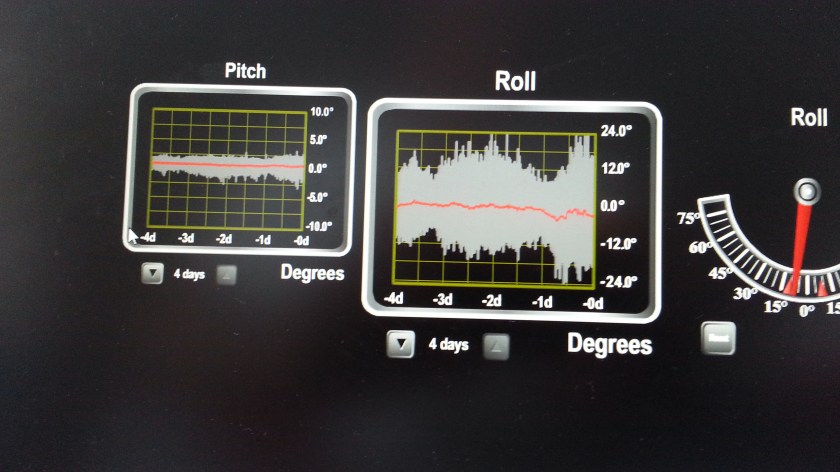
Evening of the 27th, the Storm Intensifies Again The Past 4 Days of Pitch and Roll
Food and Provisioning
Route Planning and Execution
Organization and Storage of Spare Parts
Odd and Ends
Solo Voyaging
Equipment: Must-haves, Nice-to-Haves
The crux of a successful ocean passage
I first wrote this “Post Mortem” 8 days after the end of our passage, but never published it because I realized it had morphed into many things. Thus there will soon follow a post titled, “Finding the Right Boat” and “Weather or Not”, where I talk about how to, and how not to, use a weather forecast.
Our successful ocean passage was the culmination of a planning process that started 6 years earlier and four years before we even had a boat. The success was due two major things: finding the right boat and having the right attitude. Having the right boat protects fools and drunks. Having the right attitude means you know what to except, from the best to the worst. If your plan is to call the Coast Guard under the “worst” circumstances, stay home.
During the worst of it, while I was miserable, I was not afraid. I knew the Krogen could handle it and even realized she can handle much worse.
Afternoon of the Last Day
The planning and learning process is key to a successful passage. As I had read virtually every account of small boats crossing oceans and books and stories of freighters throughout the 20th Century, I had a good sense as to what worked and what didn’t. That can’t be overstated because it speaks to our vision and that’s the first step of a successful passage. So this trip really started seven years ago, before I knew of Kadey Krogen, trawlers, or really anything.
But first, our passage is really not that special. People have done the same thing in in smaller boats, in far worse conditions, with many more handicaps. Almost everything I have learned and talk about, I first read someplace else, by someone with far more experience than I will ever have. Just remember that Columbus did the round trip more than 500 years ago, with three boats that were only 10’ to 17’ longer than Dauntless.
If you’re reading this, you probably read the details of the trip as it happened, or soon thereafter. So for this entry, I’m going to talk about what we learned in hindsight for the next ocean passage.
Stuff that broke: Three Stories and Lessons Learned
The Bent Stabilizer Pole Saga:
Error
This video doesn’t exist
An operator-induced failure.
Only a day after I left Miami with the new paravanes, while I adjusted the fore stays, I had also adjusted the up-down stays, Amsteel Blue 3/8”, which take the vertical loads of the paravane fish. I had not fully locked them tight on the horn of the cleat upon completion. I probably thought I would re-adjust them once more and then simply forgot. So, while they were wrapped in a figure 8 three times on the cleat on the mast, I had not “locked” it on the horn. Amsteel Blue is slippery enough that if not locked securely with at least 3 or 4 half hitches, they will get loose.
And that’s what happened. The Figure 8 got loose, thus letting the pole swing from its position of 45° to almost straight down, 170°. The rub rail, stopping the pole from facing straight down. This put a kink in the pole where it bent around the rub rail. Not a bad bend, but just enough to significantly weaken the pole. In trying to get the pole back to its original position, I took out the retaining bolt that would keep the pole in its cup that is attached to the gunnel. But I still couldn’t get the pole out, so I eventually got it back to position, but now, the retaining bolt was not in place. I knew it wasn’t needed because all the force on the pole is into the cup, not outward, but months later, it did contribute, if not cause the pole to subsequently bend into an “L” shape.
So on the last day of the trip during one big roll within 60 miles of Ireland, the same windward pole went vertical. However, the kink in the pole, even though very slight, allowed the paravane bird to put a force on the pole that rotated the pole 90° with the absence of the retaining bolt, so that the kink now faced aft. As soon as that happened, the force the bird put on the pole bent the pole 90°, and of course, now this allowed the pole to come out of the cup, making its retrieval even harder.
An hour later, after sitting dead in the water for that time, I had managed to get the pole up on deck. In my adrenaline rush, I never noticed how well the boat handled being left on its own, wallowing in the seas with its beam to the seas, which were running 8 to 15 feet at that time. In hindsight, we were bobbing in the ocean, with less roll than when underway.
Lesson Learned:
Replace bent stuff and all hardware before leaving on an ocean passage.
John Duffy, who had rigged the paravane system, told me to replace it, as the bend would significantly weaken it. I also probably did not mention that I had taken the retaining bolt out and had not replaced it, as the pole had rotated slightly, not allowing the bolt to be re-inserted.
The pole was replaced in Castletwonbere for 300 Euros. All the hardware is back in place.
The Mast Cleat Adventure:
A day out of Nova Scotia, as we sat in the Pilot House enjoying the world go by our living room window, we heard a noise that sounded like a gun shot. Knowing that no one on board was packin,’ I looked at the mast and saw immediately that the cleat holding the up-down line was now horizontal instead of vertical.
We chopped power to relieve the strain and I ran up to the fly bridge, though taking the time to put on my PFD (Personal Flotation Device, a life preserver). One of the two 3/8” bolts attaching the cleat to the mast had broken. Not wanting to spend a lot of time to try to re-attach the cleat, I tied the up-down line around the mast in a number of clove hitches and then tied it off to the other mast cleat. This way, much of the force on the line, instead of being transmitted to the cleat, would now be manifested in trying to squeeze the mast.
Lesson Learned:
This new system worked so well that while in Horta, I redid both up-down lines, so that they came to a three clove hitches around the mast, before being tied off on the cleat, with a final half hitch on the horn of the cleat for each line.
John Duffy in Miami designed and installed a great paravane stabilization system, which is not only relatively light-weight, but also easily adjustable and cost-effective.
While in Ireland, I also added one more feature: I had had another winch installed in Florida to assist in retrieving the paravanes. In Ireland, I also replaced the lines on the winch with 3/16” Amsteel Blue lines that I had gotten, 300 feet at a really bargain price from Parks, of Hopkins- Carter in Miami. By using this new, stronger line, it added an extra margin of safety, because it is strong enough to hold the paravanes while underway should I have a failure of the up-down line as described above. It would also allow me to retrieve the paravanes, even if the boat is not at a full standstill. This would be fast and useful, in case of emergency.
This was the first and last time I put on the PFD on this passage.
The Auxiliary Water Pump Sediment Filter Highjinx
Another operator-induced problem.
After the failure, a few days from the Azores, the pressure switch failed. After screwing with the pump for a while, I just bypassed the pressure switch and the pump went back to work. A day later the entire pump gave up the ghost. I discovered by reading the instruction manual that I had installed the pump upside down, with the electrical parts under the pump itself. Evidently, you should not do that because if the pump has minor leaks, it gets into the electronics right away.
Lesson Learned:
It behooves one to read installation instructions before the fact, not after.
THe Previous 12 Hours of rockin and rollin Before Arrival. The Scale is 24° to Each Side
Water in Fuel Tanks: Not Pretty; But the Lehman keeps on Going
On the Left,Taken from the Stbd Side Fuel Tank, a Mixture of Water and Emulsified Water and Fuel. On the Right, Fuel from the Port Tank
I have finally deduced that the water, around 5 gallons, got into the starboard fuel tank during the last 36 hours of the trip thru the fuel vent line. How do I know this? After I replaced the O-rings of the fuel caps, while the old rings were worn, there is no way a significant amount of water could have entered that way. In addition, the water was only in the starboard, lee side tank.
Up until this time, Dauntless had been in seas almost as rough, though not for this extended length of time. But even if only for 8 hours, no water had ever entered the tank before in our previous 2000! hours of cruising.
What was different this time?
A much longer time of seas on the beam, three and a half full days, with 54 out of 72 hours, being in large 15+ foot waves.
The last 12 hours, with the failure of the windward paravane pole, the boat remained heeled over to port for a longer period of time, as the recovery was slower.
While all the above was going on, for reasons that were just chance, I had been running on the port (windward) tank, which was now near empty, thus for the last 2 days of the passage, we were feeding off the port (lee) side tank.
Thus, just when the port tank was being used, the boat was heeling more to port, thus keeping the fuel vent which is at deck level under water for a significant portion of time.
My Conclusion:
The lee side tank sucked in the water thru the fuel vent. Had I been using the other tank, in all likelihood, this would not have occurred.
After Arrival. I also Changed the Scale to 32°, so This shows my Last 12 Hours of the Passage. Sorry for the poor quality. I was shaken, but not stirred.
I will move the fuel vent hose, so that this can never happen again.
In addition, I will make it a practice to use the windward tank under such conditions. I could have easily transferred fuel to the starboard tank while underway. It was just chance that I had filled the starboard tank in Horta and I therefore used that fuel first, since I knew my fuel in the port tank was good.
Other Lessons Learned
Food and Provisioning:
Maybe from reading too many books written by frugal sailors, my provisioning could have been better. I had too many things I don’t eat, like rice and beans, and not enough of what I do eat. I still have enough calories on Dauntless to feed a family in Africa for 2 years. No, I do not really know what I was thinking.
We should have had a bit more lettuce. Romaine lettuce in those packages of three lasts for a few weeks in fridge.
Eggs. Julie likes eggs. I forgot she really likes eggs.
Mayonnaise, to make egg salad with all those eggs. I like egg salad.
Route Planning and Execution:
Good job with planning. Very poor execution.
Not having the paravane stabilizers for the first 3,000 miles of cruising with Dauntless made me very sensitive to the direction of winds and waves. The Krogen handles following seas exceedingly well. Thus I carried that mentality with me on this passage. I made too much of an effort to keep the seas behind us and off the beam, thus our northeasterly course leaving Cape Cod and our southeasterly course leaving Nova Scotia.
In hindsight, it was an overreaction in both cases. That continued with my solo voyage from Horta, with the zigzag of day three, first NW, then SE then after 24 hours of stupidness, northward.
In the future, I will let the paravanes do their job and keep a course more directly (great circle route) to our destination. In fact, while I did not record the data, my feeling now is that the rolling of Dauntless is about the same with the paravanes, whether the sea is following or on the beam. Without the paravanes, there is a night and day difference.
Organization and Storage of Spare Parts:
I’m grateful that I didn’t need to use any spare parts. But the haste in which we left, meant we obtained a lot of stuff at the last minute. It was put away, with only a general idea of what was where. Had I needed anything, I would have found it eventually, maybe even by the time, the westerly winds pushed us all the way to Europe, a month or two later. At least I would not have starved.
This winter has been spent re-packing virtually all parts and tools. In addition I have a written inventory, with location, storage bin, model numbers etc. Before the next passage, it will even be computerized.
How did I decide what spare parts to take or not?
This turns out to be relatively easy. I picked those parts I could both afford and could replace myself. So, we had an extra starter, even though i had no intention to ever turn off the engine. We had an extra alternator. i did not have a spare injector pump, too expensive. Except for the fuel injector pump, I had all the other external engine stuff: injector tubes, hoses, belts, lift pump, etc. We had extra hoses, belts, etc for every critical component. Therefore, we had nothing extra for the generator, since I don’t use it underway. We had no internal engine parts, pistons, etc, becuase while I could probably replace it while docked, it was not something I could see myself replacing underway. But also, that is not a typical failure point of the engine. Internal stuff usually shows signs of wear for a long time before failure.
Odds and ends:
If I have not talked about it above, we ain’t changing it.
That means stuff like the DeLorme InReach will not be changed. We like the limitations that system imposes. I don’t need to call mom when the shit hits the fan.
Probably will add some redundancy to the ComNav Autopilot. Unlike a sail boat, we cannot tie the wheel and expect to go in any semblance of a straight line; I tried.
One of my issues has always been that in a seaway, there can be no noise of moving objects in the boat. Moving things can cause damage in and of themselves, and must be controlled. So, even at 40° of roll, every few minutes, during the worst of it, I heard no crashing or banging of stuff. Everything must be secure.
Need more recorded movies and Korean Dramas. They really help to pass the time. Yes, one can tire of just reading. When I was alone, I got really bored.
On the other hand, I did back in to computer card games. Bridge in particular, yes, I am of a generation that learned bridge.
Solo Voyaging
I hope to never do another 10 day passage alone again. But I will if I have to.
Having said that, the next passage next year, will be part of a much longer voyage and we will be pretty much under way for 18 months. With Julie working, I will need a lot more help during the many segments the trip will entail. I will put it out there on Trawler Forum seeking those who want to be a part of the experience and maybe even share some expenses and I’m sure some shenanigans.
Must-haves, Nice-to-Haves
Must Have
Nice to have
Paravane Stabilizers
Four 110W Solar Panels and two Controllers
Lexan Storm Windows
Coastal Explorer
C-Map North Atlantic and Western Europe Charts
Boat computer and router
Digital Yacht AIS Transceiver
Master’s License
Katadyn 160 Water maker
Vitrifrigo Freezer and Refrigerator
Delorme InReach text only sat phone
Splendid Vented Washer/Dryer Combo
Spare parts for the Ford Lehman SP135 Engine
Other Spare parts
Revere Off Shore Commander 4 person Life raft
Here are a few more pictures and videos. The file name incorporates the date time the file was recorded, thus 20140827_1927 means it was recorded 27 Aug 2014 at 19:27 (7:27 p.m.) hours.
I love being up before sunrise. It’s my chance to see the world before it wakes up.
Contrails Just Before Sunrise over Waterford
Those half dozen contrails are airliners that left the NE U.S. last night. The groggy passengers just now being woken for their early morning juice and coffee. As the cabin crew scurries down the aisle, with their drink cart, the smell of freshly warmed bread waifs through the cabin.
Now, the warm rolls are for the Business Class passengers. One must admire the airlines ingenuity. Business Class was born when more and more companies in a cost cutting mode back in the early ‘90’s stopped employees flying on company paid travel from flying First Class.
The airlines that scrambled the best and were the most adaptive survived. Since most of their revenues came from those business people flying on someone else’ dime. Thus, Business Class was born.
I miss the time I was flying on someone else’s money. But not too much; well truth be told, not at all. It was only for a short time during the last 30 years, all the rest of the time, money spent on my travel, mostly to Europe to see friends, came out of my pocket and meant that I had to do without something else.
But, in watching those contrails this morning, I also remembered the numerous times I’d be looking out the aircraft window and wishing I was “down there”.
Sunrise over Waterford
And that’s pretty much the story of my life, always wishing to be somewhere else.
Dauntless changed everything. The world now passes by my living room window. Feeling wistful like a gypsy before; now I am truly a gypsy and loving every minute of it.
Thanks for coming along for the ride.
Coming soon to a theater near you: the Post Mortem, Finding the Right Boat, Weather or Not, Hijinks on the High Seas, It’s Showtime Two.
That’s how long the Pilot House Reorganization has taken. It’s finally done, as these pictures will attest. I threw away four trash barrels of junk and packing material. I repacked all of my tools, spare parts and associated fasteners and bits and pieces.
Front of the Pilot House
I have listed everything and where it is and what it is packed in.
My goal was not only to know where to find stuff should I ever need it, but also to make the engine room in particular, less prone to floating debris, should a disaster ever take place.
The last step will be to organize the lists on the computer, so when the shit hits the fan, I’m not leafing thru my hand written sheets, trying to figure out what I wrote and of course, not seeing the one item I am looking for.
This also means that Dauntless is finally ready to move. Next week, she will move ¾ mile up river to the boat yards, where her nice round bottom will be cleaned and painted. A bottom I know well, as its very efficiency has allowed this entire adventure and the greater adventures to follow.
Lastly, to be more diligent than the last time, I have scheduled the next Pilot House Reorganization in my Samsung Note calendar for April 12, 2035.
Yes, you read it right. 20 years from now and if I am a lucky person, I’ll die just days before !
Starboard side under helmPort side Helm Station. Computer, Maretron, Router, AIS on upper shelf. Lower shelf has bins of my most used electrical parts
Well folks, as we get closer and closer to summer, the moss in growing under my feet, so it’s getting time to move on. As initially planned a few years ago, this summer will be spent in the Baltic. The attached picture shows the tentative route from our departure from Waterford in late May to our return in early October.
Summer 2015 Baltic Cruise Plan
As planned, this voyage will be about 4100 nm with 72 legs spread over 130 days. A bit ambitious, but that’s us. While some of the major stops: Holland, last two weeks in June; East Germany, 4 July; Gdansk, 18 July; Riga, 24 July; Tallinn, 30 July & 15 Aug; Helsinki, 6 Aug; are hard wired in, pretty much everything in between is open and will be determined based on weather, seas and moods.
Our usual mode of travel is about 6.5 knots, consuming 1.5 gal/hr. or 4.2nm/gal (2 liters/km) so the total cruise will need about 1000 gallons, 4000 liters, of fuel. So will need to pick up about 300 gallons along the way, to get back to the UK, Ireland with near empty tanks.
Normally we like cruising one day, then stopping at the same place for two nights. By cruising every other day, it keeps the batteries up and in hot water for about half that time. I am in the process of putting the water heater and washer on the Inverter circuit. Thus we’ll have hot water on the non-motoring days.
For charts, I am using the Jepp C-Map charts running on Coastal Explorer, plus Navionics on my tablet and smart phone. I looking for some large scale paper charts to facilitate the long range planning.
Though we will have cell phone coverage most places, I will have our Delorme InReach running and on Dauntless 24/7 to keep a running track of our trip. I will also attempt to take better pictures, videos and document the trip better.
I really appreciate the postings of Dockhead and Carstenb on Cruisers Forum. Their information and enthusiasm about the Baltic have been contagious.
As always, I’m open to suggestions, but keep in mind that some places are locked and loaded and that no trip is ever perfect.
If anyone knows the price of fuel at the Brusnichnoye Lock on the Saimaa Canal, I’d love that information, but I won’t need to know it until the very end of July. That far eastern jaunt will probably be eliminated in any case, unless fuel is 33 cents a liter, as I do need to cut down some miles.
Waterford is by pencil point. Look at the strong gradient.
That’s what we’ve been doing all night. Winds have been 20 gusting to 35 since yesterday afternoon. Waterford is in a relatively sheltered spot in Ireland, so I’m guessing the winds are really howling in the north and west.
During the night, it was like I was sleeping in one of those rocking cribs. Really nice; made even nicer knowing I am tied to a dock that isn’t going anywhere. It even made me think about why I don’t miss our beautiful Manhattan apartment with the roof top garden oasis, we built a few years ago. I did the design and found a carpenter to do all the hard work. The apartment is now rented; we may sell it this summer. But lying in bed last night, feeling the rocking motion of the water, brought home to me how close I am to nature here and how comforting that is. So while I miss my NY friends; the apartment Julie and I loved so much for 7 years, less so.
Our Manhattan Roof Top Garden & Oasis
Fundamentally, maybe that’s why in the middle of the Atlantic, thousands of miles from anywhere, we were at peace. In fact, the lure of the blue ocean, to just jump in, was unbelievably strong. Never something to fear, we embraced it. The ocean was also noticeably saltier than near the coast.
Back to now, these winds would have been much more stressful if we were on anchor. I would have gotten only a few hours’ sleep, at most.
The main reason for lack of sleep on anchor is that in spite of the various anchor alarms I use (alarms that use GPS and sound an alarm if we move a specified distance). On numerous occasions, I have convinced myself that we are moving laterally. I don’t think I have ever been right either, but the feeling is so strong, I must get out of bed, and run to the pilot house, prepared to fire up the engine at the first sign of danger. Being in a dark forward cabin is one of the factors that cause this. It has certainly made me even more aware of the dangers of vertigo that pilots face in dark, FIR conditions. And the only cure trusts your instruments and not your brain.
So for the last few hours I have been finishing the pilot house reorganization. 90% of the stuff is put away and I’ve just been doing the odds and ends today. I’m writing this post now, sitting in the salon, because while in the pilot house not long ago, I realized I was getting sea sick!
Yes, tied to a dock, going no place, I was getting sea sick. Maybe I just needed a little water, but that is usually the first sign. 20 minutes later, I’m fine now. I think having my head under the helm station for an inordinate amount of time was the culprit. But we are also bouncing in a non-rhythmic way. Since Dauntless is tied to a floating dock, under such conditions, the lines pull on the dock, resulting in a jarring motion.
I’ll adjust the lines again. I let you know the results.
Drip, drip drip. There was a leak somewhere and i was determined to find it.
The bilge pumps had not turned on, so that made it easier. The leak was not into the bilge.
Living for the most part on a boat, it is amazing how my senses have become much keener. I see, hear and small things, like never before.
In New York, Julie has a group of people who really help her live in and appreciate the moment. Dauntless has done that for me.
During the night, I noticed the water pump cycling on for a few seconds. Now I was sleeping, so it was unclear to me how often this was happening, but I probably heard it five times in the course of the night.
I would hear it, then go back to sleep. I wondered if I heard it because I was already awake or did it waken me? I think the latter; otherwise I would hardly have been sleeping. Much like when sleeping in the pilot house, I would awake whenever a light appeared in front of me. The rising of Venus, Jupiter and the Moon always woke me without fail.
So this morning, I decided to tackle this problem before doing anything else, even getting dressed. There was a leak and I would find it before getting distracted.
So there I was with my LED flashlight, my cozy slippers and nothing else. Grateful no one could see me, for I am sure it was a comical sight.
Deciding to start at the bow, I looked at the forward shower and sure enough, drip, drip, drip. I opened the faucet and closed it again, tighter. The drip stopped.
Problem solved. Yes, sometimes, it’s as simple as that.
In fact, as I understand Dauntless better and she understands me, problems tend to be simple.
Why? because we found the right boat of the right brand, Kadey Krogen, that was optimized for what we wanted to do with her.
I’m debating whether to write more extensively about the systematic process we went through to find this boat and be where we are today.
I haven’t posted much in the last weeks, because, at least in my mind, I haven’t done much.
I got back from NY last Tuesday and promptly got a cold. That forced me to rest and by drinking a lot of
Umm Ja Cha
I feel almost like new again.
I’m in the last stages of the big reorganization, or probably better described, the first organization. Hey, I’m slow sometimes. It’s taken me two years to figure out, what I need where.
Spare parts
I have also firmed up our cruising plan for July and August. June and September is more vague, but I am planning on leaving Waterford May 25th.
Mary in one of her more resigned moods, wearing my hat.
That’s my mother’s birthday, so it’s fitting, as Dauntless has replaced my mother, in so many ways.
Since December, besides travelling to England, Italy, Spain and the U.S., I have been organizing tools and spare parts. I am making a computerized list of each part, their storage location, as well as any significant information, such as model number, etc.
Having also reorganized my tools and fasteners, clamps, etc., my life will be so much easier, and as an added bonus, I was able to throw away two garbage cans of packing materials.
Though I am returning to Dauntless today, I shall return to NY at the end of April for two weeks. Dauntless will be hauled out and have her bottom painted again while I am in NY. Then I will be joined by Larry, a friend of over 40 years, who I met on T-3. With that extra set of hands, we will complete the last of the winter projects.
What’s left to be done:
Replacing the Raritan toilet processing tank,
Installation of the Wallas DT40 heater
Installation of a 30,000 BTU “Bus” heater, which will use engine heat to heat the two cabins while underway,
Recommissioning the Katadyn water maker
General clean up
In my Next post, I will publish the updated Cruise Plan.
On another topic.
I made a new post on my other blog, Refeldtions, titled Another World Leader Appreciates the United States of America.
A great story that was in yesterday’s Opinion page of the Wall Street Journal, 21 March 2015, President Sisi of Egypt tells of a different reality than we are accustomed to hearing, day in and day out.
I thought it was important to share. If interested, the link is: richardbost.wordpress.com
So far, as I learn something new every day; I’m sure to keep on learning and even on my last day on Earth, I know I’ll learn something new; like how I die!
Having kicked the cans down the road of Greece and the Ukraine, we can now talk about boats again.
So, what have I learned up to now living on Dauntless in Northern Europe:
Waterford has turned out to far exceed my expectations and at this point, it is hard to think that I could find a better place anywhere in Europe for next year. I have 10 minute walk to the bus that whisks me to the airport in Dublin for only 20 Euros. In NYC, it takes 90 minutes to go 12 miles and that includes three train changes, which means many staircases, up and down. (We got a man to the moon 50 years ago, but NYC still cannot keep an escalator running more than a day or two before it breaks down for three months).
The Waterford City Marina, being right downtown, has given me the best of all worlds. On one hand, I am five minutes from downtown and only a 15 min walk to my favorite bakery and butcher. Yet the dock itself is very secure with a gate that is electronically activated, but it also has a chain and lock, making it really secure. The first few times I left Dauntless for any length of time, I was really nervous, but now only a little bit.
The people in Ireland are very nice, like Midwesterners, but with a NY attitude, meaning they are loud, talk fast and curse a lot, and really nice in doing it and helpful all the time.
Having Julie in NY, Dublin is only a 6 hour plane ride away and the tickets are about 60% of the cost of flying to the continent. So it’s terribly convenient and already, while I like exploring new places, for our next and last winter in Europe, I will be hard pressed to find someplace that has all that Waterford and Ireland offer.
I’m fluent in the language, for the most part. There have been a few times, that not understanding something and having them repeat it three times, I am still clueless and just hope for the best at that point. The first time this happened, one of the passengers on the bus could tell that I did not understand and explained in words I could understand.
I haven’t gotten run over yet crossing the street, only because I look in both directions three, that’s 3 times, before I step off the curb. And every time I do, I think of all of those who thought crossing the Atlantic was dangerous. I’m far more likely to die crossing the street here.
The Lexan storm windows that Julie, Richard and I made and installed in the last days and hours in Rhode Island, have really made a difference. While on the ocean they gave us peace of mind, since I have been here, I am so pleased that they really insulate the boat. Dauntless is far warmer, having the double pane up. In addition, I so not have any condensation problems, as the glass windows stay just warm enough. Two of the storm windows in the pilot house are 4 inches short, and it that one spot, I do get some condensation on really cold days. Well, I did, but have not seen any in two months.
Even without the Wallas heater, this Krogen stays warm and dry. I have been using a little 2000 watt electric heater when I am on the boat. But I have been so pleased that I do not have the dampness and condensation problems I have read about by many who live on their boats in the winter.
I have like 10 lines on the boat, all 5/8” thick. The Fastnet boat docked behind me, a steel boat used to ferry crew to the oil platforms, about the same size as Dauntless, has 4 lines, and they are not even ½”, probably 3/8”.
I suppose that’s the difference between docking a boat that is also our home and a work boat.







 Dauntless at Sea