We are in for a period of really cold weather, at least for Southeast Alaska, with temperatures going down to zero (F) by early next week and staying in the single digits for a week or more.
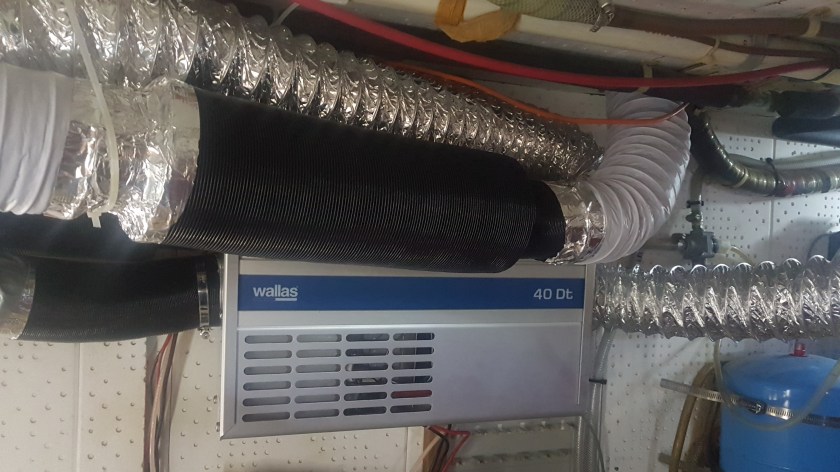
I’ve had to turn up my Wallas heater, no longer content to leave it on the minimum setting. On its thermostat scale of 1 to 5, 1 being the minimum, I now run it at 2 to 3 at night and 4 to 5 in the day. That keeps the salon in the mid-60s in the day and the forward cabin mid-50’s at night. That OK to sleep, since I also have a heating pad that takes the chill off the bed before bedtime.
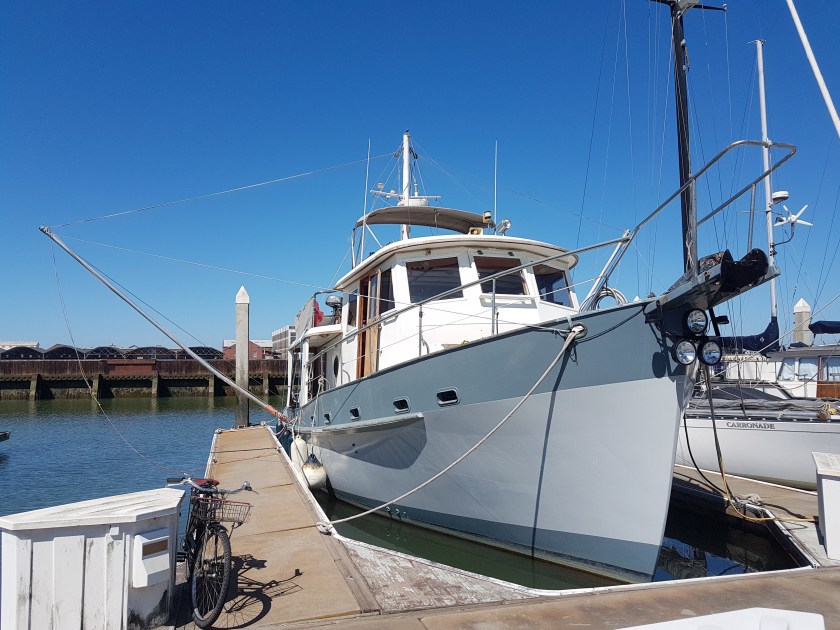
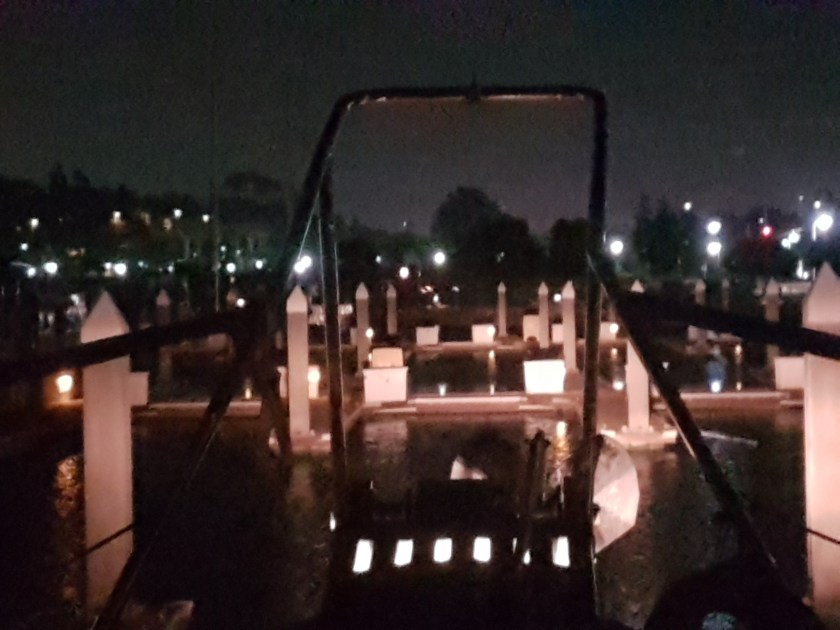
Looking over the bow
A heating pad is a requirement if you are living in a cold winter climate. Before the heating pad came into my life, when I would return to the boat after some week’s absence, that first night was so cold. I could never tell if the bed was wet or just cold. (It was just cold).
We are still hooked up to dock water. Dauntless is located at the far end of the dock. The harbor keeps a valve open at the end of the dock to keep the water from freezing. It’s been successful so far.
We had a little cold spell a few weeks ago and I made the mistake of not running the water in the boat all night. The first night, my water hose and filter froze. Now, for the last 5 days since this cold spell, I have kept the midships head sink running water on and now even turn on the forward head sink. I also have the hose that is connected to the dock water running under the boat, so just a few feet are exposed to the cold air.
Our water tanks are full with about 250 gallons of water, so that is our fallback position if we lose dock water.
Our Wallas DT40 heater in the engine room
I had taken our storm windows off while the boat was in Mexico. Never needed them for wave protection, but they acted wonderfully in not allowing any condensation on the pilot house windows during the winter. Once the wind stops blowing, I will pull them out of storage and ready them to put back up. The pilot house is very cold now, near 38°F. My curtain keeps the cold air there as the salon is almost 70.
My bigger issue is that we will be taking the boat out again in February when halibut season opens, and I want to stop the condensation on the windows.
+++++++
On a different note, I have uploaded another YouTube piece on my trip from California to Alaska. The first 15 minutes of the video are interesting, after that it gets dark and hard to see anything.
Dauntless at Sea Goes North to Alaska Vlog 07, 30 June 2019 An Unexpected Stop
In addition, Tee has uploaded a video with English subtitles about catching crab. She makes good videos unlike your truly. Her latest video on her channel
My first wife was a vegetarian. While I wasn’t, I did eat less mean than previously and tried not to cook meat that produced smoke (like hamburger) in the house. Therefore, since the mid-‘70’s, I’ve had a BBQ grill no matter where I lived.
Whether in Fairbanks, Alaska, Italy, Germany or now, on Dauntless, I’ve always had a grill. Since the early ‘80’s, when I lived alone in Southern California, I came to appreciate the convenience of a gas-powered grill.
For 30 years, I’d always buy the cheapest two or three burner BBQ I could find. They would typically last half a dozen years before it was time for a replacement. Sometimes that replacement could be hastened, as when moving to a new house in Fairbanks, the grill was packed in the back of the pickup and at some point, fell out.
Oops.
Fast forward a decade, living in a typically small one-bedroom apartment in New York (Manhattan to the uninitiated), I had only a little hibachi that we would put on the windowsill of our apartment to use.
We wanted a real terrace or patio, so we could have a real BBQ grill again. Though we were able to satisfy our craving for burnt meat as we did BBQ almost every weekend on my mother’s apartment terrace in Brooklyn’s Brighton Beach/Coney Island.
So, we started looking for a new rental apartment in New York and going to listing of an apartment building that I had actually looked at one year earlier, on 57th St. We really like the location and the building, though the apartment itself had a weird layout, as did its terrace.
The Weber Q-280 in the summer of 2014
In talking to the real estate agent, Dennis Daniel, (for anyone looking for a place in NY), he convinced us that we should and could buy an apartment in New York instead of renting. He was a true master in terms of helping us understand what we really wanted and then helping us recognize it when we saw it.
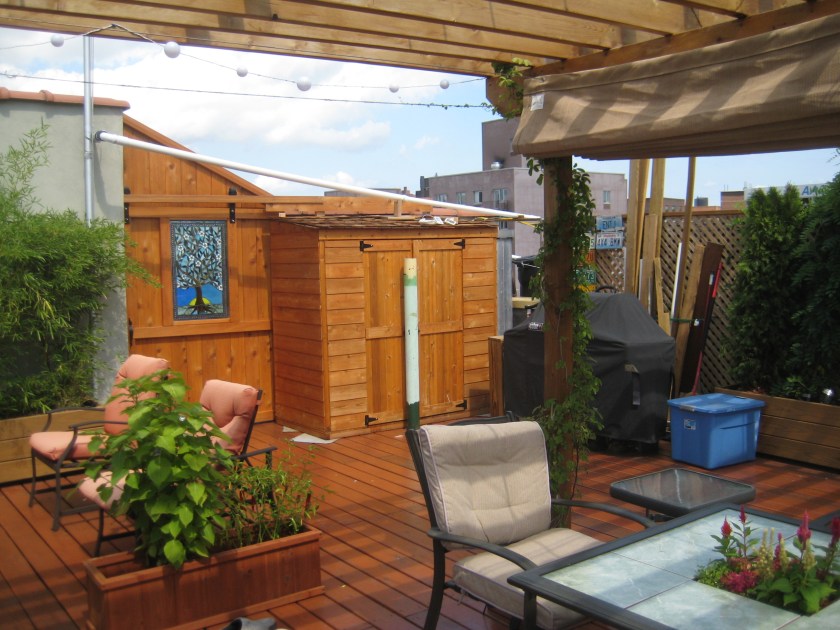
Thus in 2007, When we moved to our new rooftop apartment in New York in 2007. Having spent half a million dollars for a one-bedroom apartment, I considered our choice of grills. This was the primary reason we had moved after all.
Reading so many rave reviews about the Weber, I figured the extra few hundred dollars it would cost was worth it. Thus, in the summer of 2007, I bought my first Weber, the Genesis.
My Weber Genesis in the spring of 2013 on our roof top in NYAnother view of the rooftop with the Weber (under cover) on the right
A cooking pamphlet came with the grill, which essentially said, forgot what you think you know, do it this way and your foods, will come out perfectly.
I did and they did. Other than following directions and understanding the difference between direct and indirect heat, the build quality and more importantly the heavy iron materials used, made all the difference.
With its heavy cast iron components, the grill was able to hold heat extremely well. Thus, I did make the best steaks I had ever cooked. The reviews raving about the Weber were spot on. It did make a difference. I even used the Weber to bake apple pies, since I was able to put a little smoke into them. While I miss that Weber and that rooftop a little, I also know that it set the stage for my circumnavigation on Dauntless. I’d been there 7 years, the longest I’d lived anywhere in the previous 50 years. Dauntless had come into our lives and it was time to move on. I also know myself well enough that I’d get bored with heaven after 7 years.
In the first months with Dauntless, still in Florida before we made the trip to the Northeast, I found a light, “boat” grill. I figured I was on a boat, I had to make a sacrifice. There really wasn’t room for a larger Weber “portable” grill.
While coming north on the Intercoastal Waterway (ICW), we used the grill once. What a disappointment. It had trouble really getting hot. But within a couple of days the ICW solved the problem for me. The grill was mounted on the port rail near the stern.
One day while motoring northward, I got too close to a channel marker that was mounted on a telephone pole stuck in the water. I panicked and instead of turning the wheel, I tried to turn off the autopilot, but didn’t succeed. The pole swept along the port side rubbing on the rub rail until it got the grill, at which point it mangled the grill and mounting bracket that I had had made for it.
The grill ended up in the dumpster in St. Augustine. The Dutch friends who were with me at the time, had come from rainy Holland to get some sun, found Florida with the worst weather in years. When they left to return to Holland a week later, they were thankful to get away with their lives and back to the rain they were familiar with.
Could have been worse.
Besides you’ve read about all these close calls before. Well, most of them!
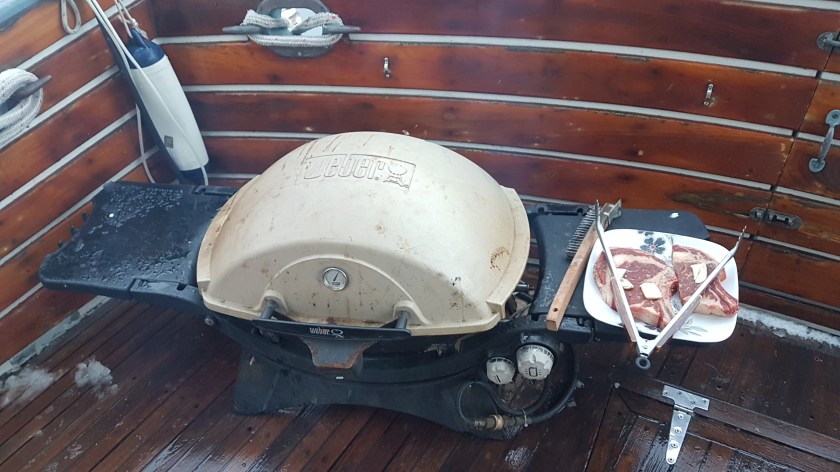
Weber had the Q-280, which was the largest of their “portable” grills and would use a normal 20-pound propane connection. I got it and it had been on Dauntless ever since.
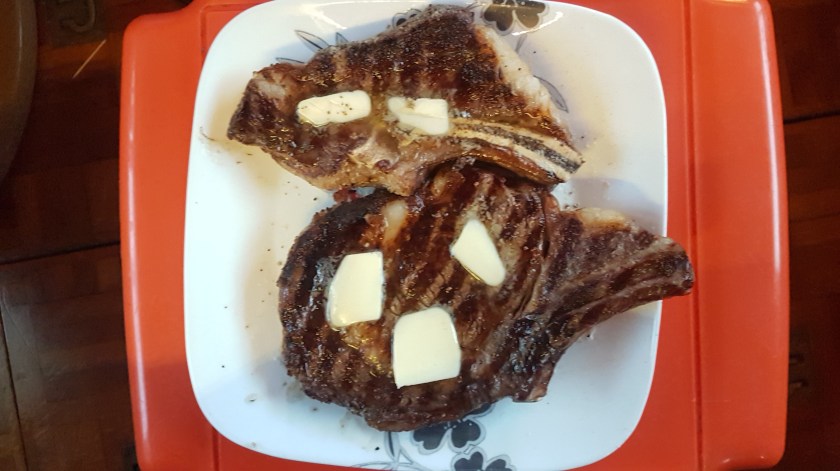
Getting ready yesterday
I’ve grilled in temperatures as cold as minus 30°F (-35°C) in Fairbanks, so I wasn’t going to let a little snow get in the way yesterday.
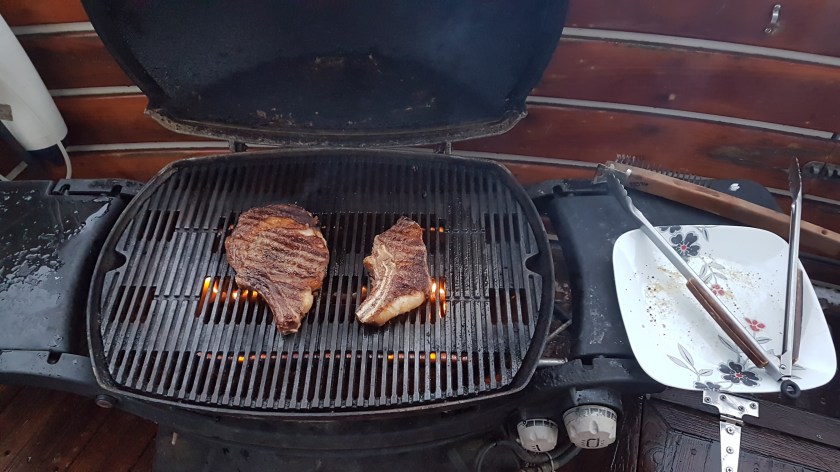
Almost done
We had planned to have steaks and we did. Delicious as ever. Thanks Weber.
Vallejo to Crescent City California, 26 to 28 June 2019.
I’m finally getting around to writing in detail about my cruise up the west coast.
Since this is a past summary, I am going to change the format a bit. I have also started a You tube channel, Dauntless at Sea, where I am posting the Go Pro videos, I took along with some commentary of what is going on.
So, this blog will be a short summary about the start of my voyage to Alaska in the summer of 2019. We (John a friend/crew joined me from California to Astoria, left Vallejo on 26 June and arrived in Crescent City on the evening of the 28th. It was a miserable trip.
The Maretron Data says it all. This data is sourced from a number of different instruments, among them: the solid state compass, the GPS and the Weather Sensor. The scales for Pitch (lower left) and Roll (lower right) are purposely set at my “miserable limit”. This means for pitch that +2.0 degrees (which is actually down direction) and -4.0 degrees (up) is really miserable. Same for the roll, once it gets to 20 degrees in any direction (it’s bigger on the lee side [away from the wind] of the boat).
The data above shows the first three days were punctuated by three significant bouts of head seas, 3 to 5-foot waves on short 3 or 4 second periods which produced a miserable hobby horse ride, with constant pitching up and down.
Adding insult to injury, this also slowed the boat considerably, so instead of doing our normal 6+ knots, we were in the 3.8 to 4.8 range. Yes, that also means the miserable ride is 50% longer than normal, while fuel consumption remains steady, based on engine rpms, but fuel consumption per mile is also 25% down. Therefore, the miserable time is extended, and you pay 50% more for the experience.
Here is a little summer by period:
Cumm time
Hr:min
Dist (nm) per time pd
Avg speed (kts)
Cumm Dist (nm)
Running avg sp (kts)
1:17
1:17
8
6.1
8
6.23
25:17
24:00
138
5.8
146
5.77
49:17
24:00
136
5.7
282
5.24
55:17
6:00
42
7.0
324
5.86
That first 1 hr. and 17 minutes was the time it took to leave Vallejo and stop in Benicia for fuel. So the next time period started once we left Benicia.
Overall, it was 324 nautical miles in 55 hours and 17 minutes. We anchored in 12 feet of water in Cresencet City Bay at 19:54 on the 28th.
My You Tube channel is a work in progress. Please feel free to leave comments on You Tube about any suggestions or things I need to explain better or clarify. I am also still debating as to how to best upload the long Go Pro videos that frankly are quiet boring.
Just finished checking the rigging for the paravane pole and bird.
I’ve been ready to leave Vallejo for a month now. This is getting old. But I have vowed not to let myself be beat up any ore than usual.
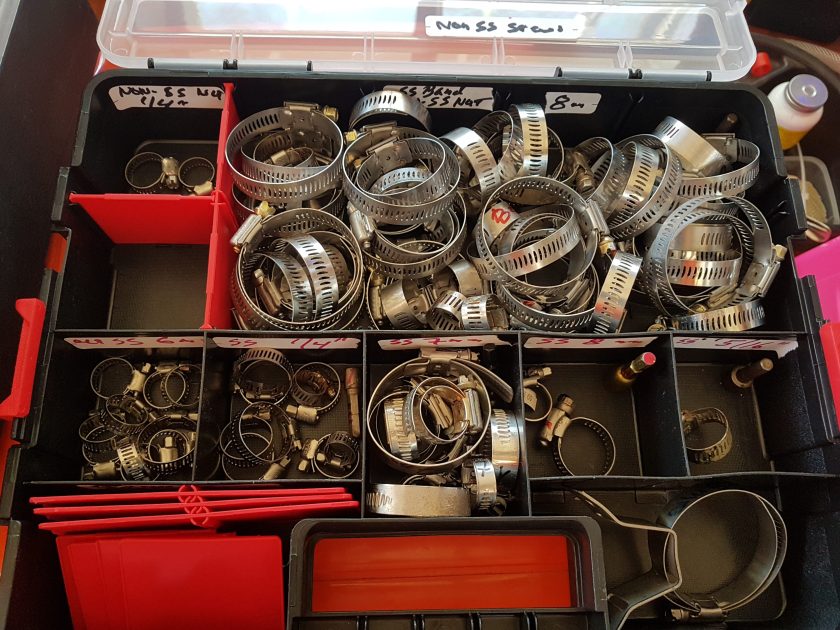
I spent much of last week organizing parts. I thought I had only two types of hose clamps, stainless and non stainless, which I separated last year. If only life would be so easy.
As you can see from the attached picture, I have essentially 7 different stainless-steel hose clamps and guess what, that large bunch in the back of the organizer all have stainless bands, but non stainless screws! That’s totally worthless. I wish I could be sure that that bunch was not Made in America!
My 7 types of hose clamps
And they are also organized now by the size of the screw: 5mm, ¼”, 6mm, 7mm, 8mm. this allows me to easily use the same size for any particular job, as opposed to discovering that the dual clamped sanitary hoses have two different sizes of nuts.
I’m now doing things that were not on the list, like measuring the paravane bird rigging. When we left Martinique, 5,000 miles ago, I had the birds set to run 19 feet below the water surface. that’s 5 feet deeper than previously, as I finally realized that in larger seas, waves greater than 10 feet, the bird itself was being picked up in the rotor of the wave, negating much of its effect.
Stbd paravane pole with double loop proving a quick extra 10 feet of depth should conditions require it.
Since Martinique all has been good on that front. Now, I made sure of the depth and also marked the poles. In addition, I re-rigged the extra line, so that I can quickly run then 10 feet deeper if the situation, really large seas, warrant it, without stopping or even slowing down. With the re-rigging, I just have to take out a few clove hitches and the extra 10 feet is free.
Here is also a before and after picture of the driving lights. They are handy when anchoring in strange spots with other boats or mooring buoys around. I’ve also used them in dark, narrow, lonely channels. T
here have been a few too many of those.
My long term filter carton is a bit depleted. I have already taken out my last 6 Racor 2010 filters. I keep them in the engine room by the Racors.. I have only half a dozen Racor 2050 filters left for my fuel polisher, as well as a number of engine mounted filters, along with some water sediment filters for the water maker.Driving lights off
Driving lights on. I only use them for anchoring in unknown places or in narrow, but marked channels.
I’ve been ready to leave Vallejo for a couple of weeks. But the winds off the northern California coast are proving to be more persistent than the northerly winds off the Mexican coast last year. There is a blocking high pressure area in the eastern Pacific that just won’t leave. It’s certainly been there almost all spring. Doesn’t it realize summer is almost here?
One of the other manifestations of this weather pattern is the north east has been cooler than normal. Let New York have the brutal hot and humid conditions they are used to and let me have gentle breezes.
This is all stainless except for that compartment of brass screws on the right. I’m holding a 1 Kroner Norwegian coin. It has a hole in it and is not magnetic, so it goes with the washers.
So, in the meantime, I am organizing.
I had wanted to put off this tool and parts re-organization until this summer when Ti and Thien are with me. I had thought that it would be a good way for them to understand what things are, where they go and how we use them.
Oh well, the best laid plans of mice and men, sometimes go astray.
During the last two months as I have worked on various projects on Dauntless, countless jobs have taken longer than they should because I can’t find the right tool or part. Admittedly, it doesn’t help that I have spent 20 minutes looking for a flashlight that I could not find because it was ON and my brain was not looking for something that was lite, no matter how obvious.
I have also spent 15 minutes looking all over the boat, for a part I had just found only to have placed it someplace. 15 minutes! I knew I had put it someplace I wouldn’t lose it. Where was it? In my left hand!!
Talk about the right hand not knowing what the left hand is doing!
Crescent wrenches and sockets
So, a re-organization is necessary. I mentioned before that I had mixed stainless-steel bolts and screws with non-stainless. But I discovered I did not just have one tray organizer like that, but three or four. I also found fasteners that I thought I had but couldn’t find.
Now, everything is in its right place.
I also had the problem of finding four 13 mm wrenches, but not the one 14 mm I was looking for. Now, I have a full set hanging in the engine room (before I just had the 13, 14, 19, and large adjustable that I needed for the fuel filters).
Tomorrow, I’ll tackle my electric parts. I know I have a lot, 220 v, 110 v, 12 v, but the 5 or 6 containers I thought I had has grown to more than a dozen.
Getting or not getting “seasick” is a subject I have been meaning to write about for quite awhile now. I had partially addressed it in the excerpt below which I published two years ago. But I never made the follow-up post of my reflections on the subject and conclusions after the three month and 5,000-mile passage from North Africa to the Panama Canal. A video I made on our nice Christmas Day
Christmas Dinner with Micah on the Atlantic 2016
That’s 5,000 miles in strong, 18 to 36 knot winds produced by the northeasterly trade winds. While these winds are called the NE Trades, because that is their long-term direction, the actually winds on this passage were NE through SE, with three distinct swells from those directions with differing amplitudes and periods. This produced 8 to 16-foot seas with relatively short periods of 6 to 8 seconds from the NE thru the SE. Not the most pleasant conditions, even for a boat like Dauntless that loves following seas. In fact, this was the most difficult conditions with following seas we’ve ever encountered.
Some of the worst conditions possible if one is prone to seasickness, with the boat corkscrewing its way across the Atlantic at 7 knots. I expected that as I got my sea legs, sea sickness would be just a bad memory. But no, in fact, it was to the contrary. It got me to wondering what was really going on.
Stress builds and crossing an ocean is stressful in the best of conditions. For one, my insurance does not cover me past 200 miles off-shore. So, abandoning ship is not an option. For another, with a three-week passage, you are asking every component to work 24/7 for that time period and if something does go wrong, how to minimize the damage. Therefore, it’s a constant weighing of risks, rewards. E.g. Can I fix this problem with the engine running or do I increase the chances of something else going wrong by turning off the engine?
This is what I had written two years ago, just days after leaving Morocco for the Canaries at the very start of my second Atlantic Passage:
Morocco to the Canaries
Four days on the North Atlantic, 600 nm, four days, 1 hour, 35 minutes, what could go wrong?
For one, we found the weak link on this Krogen, it’s me.
In my first year of cruising, I would get sea sick maybe a quarter of the time. Now in my third year, it’s more like three-quarters of the time.
What’s changed? Who knows? I’m older, but usually one’s body becomes more adapted. No, I think the problem is in my brain.
When conditions are rough, I know to take a remedy or put on the Scopolamine transdermal patch. I’ve been using the patch for more than 3 years, now all of a sudden, the patch gives me a bad rash, but it’s also very effective as long as I put it on the night before departure.
With nice cruising conditions, or I should say, relatively nice, with winds and seas less than 15 knots and 3 feet (1m), respectively, I never had to worry, now, if the slightest unexpected event happens, I get seasick.
This last episode was one of the worst I’ve ever had. But I’m not 100% sure it’s “seasickness”. It’s more like my body gets a whole load of adrenaline and then when crisis is over, my body doesn’t know what to do.
…
We were heading 240 degrees, with Southeast winds 20 to 25 knots, producing seas from the south of 4 to 8 feet.
The paravanes work most effectively with seas on the beam, so our ride was actually not so bad with a gentle rolling of 8 degrees to the lee side and 4 degrees to the windward side.
On the 3rd day out of Morocco, I was in the galley filling my water bottle, when I felt the boat motion change. I looked out the salon window to see the windward paravane bird being dragged on top of the water, clearly broken.
I purposely take my time and want to remain calm. I finish filling my water bottle. I go to stop the boat, neutral, idle, then up to the fly bridge to retrieve the pole and the broken bird.
Dauntless is quite tame when not underway, in other words, she rolls much less. So, there was no big crisis.
The two spare birds are stored in the lazerette. The one that broke had been repaired in Ireland, as it had previously broken crossing the North Sea. So, I wasn’t too worried as to the cause. We had two spares in the lazzerette. The one on the starboard side was easier to reach, but as we tried to get it out, the fin of the bird became lodged under the generator exhaust hose. And the more stuck it became; the more stressed I became. I didn’t like the idea of leaving it as it, with its metal fin pressed against the exhaust hose and the wooden bird, so close to the hydraulic rudder piston. But after 10 minutes of trying dislodge it, I gave up, unloaded the port side of the lazzerette and got the other bird that was stored on the other side of the lazerette.
It took just another minute to replace the broken one and we were underway again, finally 20 minutes later, having spent most of that time, trying to get the one bird out.
Underway again, all was OK, but I was feeling very strange. Very strange.
I went to change my clothes, as I was very hot, sweaty and covered in anti-corrosion oil I had sprayed liberally in the lazzerette before leaving.
But after changing my clothes, I felt worse; like overheating badly, I figured a shower would help.
I shower, figuring that cooling off would make me feel better, but now, I can’t even dry myself off. It was a bizarre feeling. I wasn’t able to stand up or move. I dragged myself to bed and lay on top.
I figure I just need a little rest, but had wanted to walk around the boat, make sure all is OK before we get underway again. So, after a few minutes, getting more stressed because I knew Micah and Dauntless were waiting for me, as I go to put on my shirt, I became violently ill. First time that’s happened in years, even though, I get sea sick a lot and have that miserable nauseous feeling, I don’t throw up. This time I did.
I finally understood that I can do nothing but lay on top of my bed naked. I couldn’t even dry myself off. I use what little strength I have to tell Micah to make sure everything looks OK and to get underway.
I stayed on top of the bed and went to sleep.
Three hours later, I am up and OK. Like it never happened.
After I posted the above, my friend Dan added this comment:
“I have read of at least one person who has spent decades at sea who get sea sick every time they set to sea for three days or so. They, like so many, take a while to get their sea legs, and then they are just fine. What was interesting about this person is that they ONLY get sea sick when they are captain. If they are crewing on a boat, they don’t get sea sick at all. Their guess was that the stress of being captain was what caused the sea sickness.”
+++
By the time we arrived in the Caribbean, I’d had two more stressful incidents and very similar physical reactions. Not only that, but suddenly, my skin was very allergic to the adhesive on this particular batch of Trans-dermal patches. So, I couldn’t wear it anymore and I’m left with these two quarter sized areas behind by ears of no pigmentation. No Michael Jackson jokes please.
I had also started to see a pattern. On Christmas Day, it was one of the calmest of the trip, with seas not more than 8 feet and winds in the mid to high teens. We saw whales that day and had a couple cruise with us for about 15 minutes. They were 30 to 40 feet in length and swam underwater next to the paravane bird.
Christmas being more important to my nephew Micah than myself, I wanted to make a special dinner, so I BBQed the last of four delicious Canary Island Tee Bone Steaks. The best ever.
As soon as I had served our dinner, I had that feeling of “seasickness” come over me. A bit of nausea and overall weakness.
Sitting in Martinique in the wonderful marina Le Marin, I had time to reflect on what was really going on. In all my cases of “seasickness”, the motion of the boat was actually less than it had been over any given period of time. Also, it was clear that I wasn’t sick before a crisis, I wasn’t sick during the crisis, but as soon as the crisis was over, I was sick.
Didn’t really sound like motion sickness to me, but more a reaction to stress.
I’s already stopped using the Transdermal patch and now I decided to not take any more seasickness medicine at all, when we left Martinique for the Panama Canal
I also decided to take a shower every morning before my watch and every night before bed. The shower in the morning seemed to calm me down. I had no idea why, but starting my day at a lower anxiety level seemed to make a significant difference.
From Martinique to San Francisco, a distance of 3,600 miles and 90+ days of cruising, in some of the worst seas I have ever encountered, I’ve taken an anti-nausea medicine only twice.
I now understand that that terrible “seasick” felling was my body adjusting to the lack of adrenaline that the stress had produced and my para-sympathetic system was now getting my body back to normal.
Clearly the shower in the morning or before my watch, makes a significant difference.
And then in the November 30, 2018 Wall Street Journal, they did a book review of the book, Never-Home-Alone
And the shower in the morning starts to make sense scientific sense.
Here is the article from the Journal (bolding and underline is mine):
BOOKSHELF
‘Never Home Alone’ Review: The Critters Chez Nous
In trying to rid our homes of insects, fungi and the like, we’re forcing the species around us to evolve ever faster—often at our own expense.
Lisa Margonelli reviews “Never Home Alone” by Rob Dunn.
When Rob Dunn was a young ecologist he rummaged through rainforests in search of biodiversity. More recently he discovered another type of wilderness: In a study of 1,000 houses in the U.S., Mr. Dunn’s team found 80,000 kinds of bacteria and archaea hidden inside—that’s at least 10 times the number of bird and mammal species observed in all of the Americas.
He soon also unearthed in our homes some 40,000 kinds of fungi and hundreds of insects, many yet to be named by entomologists.
“I was ecstatic,” Mr. Dunn writes. “Back in the jungle again, albeit the jungle of everyday life.”
In his fascinating new book, “Never Home Alone: From Microbes to Millipedes, Camel Crickets, and Honeybees, the Natural History of Where We Live,” Mr. Dunn brings a scientist’s sensibility to our domestic jungle by exploring the paradox of the modern home: In trying to make it “clean,” we’re forcing the species around us to evolve ever faster—often at our own expense.
Mr. Dunn is a fine writer, wringing poetry out of the microbial explorations of Antonie van Leeuwenhoek, who spent half the 17th century documenting all the tiny living things around him—in his neighbor’s mouth, in the snow, in cheese rinds and in wasps. Leeuwenhoek “was to become an astronaut of the miniature,” Mr. Dunn tells us, “all alone exploring a realm that was more diverse and elaborate than anyone but him seemed to understand.”
Mr. Dunn also gracefully explains, without getting bogged down in details, the technology that has allowed scientists during the past decade or so to sequence the DNA of millions of previously unknown microbes, making his book an excellent layperson’s guide to cutting-edge research.
Mr. Dunn’s larger purpose is to explain how the ecology of the home has gone awry. Once upon a time, we lived in leaf huts, with interiors that looked a lot like our outdoor environment.
Soon we moved to round houses, then square houses and finally to air-tight apartments in cities.
Now we close our windows, use products that claim to kill 99% of germs and have unknowingly domesticated bedbugs—so they adjust their workdays around ours.
Our homes no longer resemble the garden outside but have a weird human-centered microbial signature that is also found on the International Space Station, and that’s not a good thing.
The problem, according to Mr. Dunn, “is not what is present but instead what is absent. The problem has to do with what happens when we create homes devoid of nearly all biodiversity except that which falls from us and then, for twenty-three hours of the day, we don’t go outside.”
To understand how mundane and occasionally deadly this evolutionary project of ours is, consider the shower head. In many American homes, water is treated with chlorine and chloramine, which kill pathogens but not mycobacteria, a genus that includes the cause of tuberculosis.
Meanwhile, in homes with water drawn from wells, nonharmful microbes flourish, including mycobacteria’s natural competitors.
By wiping out all the other bacteria in chlorinated water, we create environments where troublesome microbes thrive and even evolve.
This has led Mr. Dunn, together with his colleague Noah Fierer, to find that mycobacteria in shower heads can accurately predict instances of mycobacterial infections, as well as the regions where these outbreaks are likely to occur.
And yet mycobacteria are not entirely bad. One species has been found to enhance serotonin production, which can lead to greater happiness and lower stress. Mice exposed to a species of mycobacteria are more likely to remain calm when facing a bigger, more aggressive mouse.
Might this also explain how a morning shower helps us deal with a stressful commute and a bad day on the job?
These twin stories—of scientific discovery right under our noses and the perilous impact of our unwitting genetic engineering—thread through Mr. Dunn’s book.
Cockroaches were once easily lured with glucose baits but have now rapidly evolved to dislike sweet things. Good strategy for the cockroaches, more troubling for us.
“Just as military specialists study the battles of the past to prepare for the future,” Mr. Dunn suggests that “we might consider our battle with the German cockroach in contemplating our own evolutionary future.”
“Never Home Alone” is a prescription for more biodiversity in the home and, more specifically, a plea for more attention to ecology. The more we understand how different creatures interact and influence our immune systems, the healthier we may be. But in the service of getting more people into ecology, Mr. Dunn believes the field needs to deliver tangible products.
He wants to systematically explore the species in our homes to determine which ones could contain useful chemistry. The camel cricket, a previously unnoticed and rarely studied thumb-size little bugger that lives—possibly by the billions—in American basements, has gut bacteria that can break down black liquor, a highly alkaline toxic waste produced by the paper industry.
The thief ant traipsing across your kitchen counter also produces an antibiotic that may eventually be useful against hard-to-fight infections. Personally, what I want to see is a home “makeunder “show dedicated to “rewilding” homes—similar to what you’d see on the Learning Channel, only more anarchic.
A bunch of giggling scientists show up at the door, toss the hand sanitizer, the shower head, the Sheetrock and the fungus-laden air conditioner.
In their place, they hand the homeowner a bar of soap, throw open the windows, install a ball of spiders to fight flies in the basement and start a batch of sourdough—all in the service of re-creating the garden indoors.
No doubt there will be tension in the idea of a wild domicile. Even King Tut, Mr. Dunn notes, was buried with a fly swatter.
Ms. Margonelli is the author, most recently, of “Underbug: An Obsessive Tale of Termites and Technology.” ■
Since I’ve been back in HCMC, I don’t even do the little I have to do.
My Orange Juice and Yogurt today (cost $1.80)
What do I really have to do?
I’d like to get my electronic Dauntless logs up to date. I’ve been stalled in August 2017 for the longest time. I need to re-organize my hard drive on my laptop, so I only have one current directory that I keep backed up, with other files, music and pictures, stored on my external drives.
Not exactly the most onerous tasks. So, why aren’t they getting done?
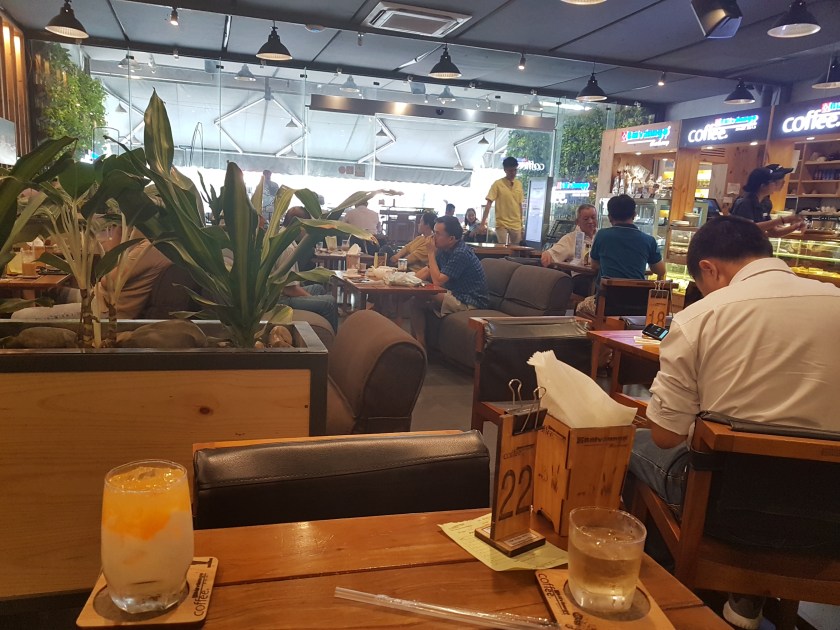
Fundamentally, I think I’m simply too much of an extravert to sit home and be productive. I’m writhing this post now, while sitting in one of my two favorite cafes, in this case, Coffee Bui Van Ngo, about an 8-minute drive on the motorbike from my house.
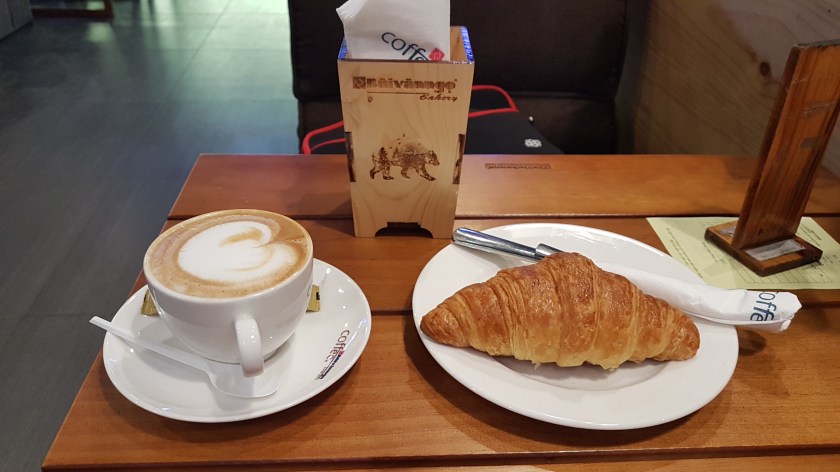
Sometimes I get Cappuccino, as I find it as good as in Italy (undrinkable in USA)
I’m enjoying a yogurt with ice and orange juice. Usually I get it blended but decided to get wild today and try it this way. I’d already had my coffee at home. Vietnam is one of the few places where I find almost anyplace, I go the coffee is as good as I make at home.
In fact, New Yorkers would feel this is the one place they would feel at home in regard to coffee. The normal coffee is very strong, with milk and sugar; what New Yorker’s call “regular”.
I was 19 years old, driving across the country for the first time with my first car returning to the University of Washington for my second year.
When i want an Avocado Smoothie, I go to this cafe. (cost $0.90)
I stopped late in the evening in Montana, just south of Missoula, to get a cup of coffee since I was planning on driving thru the night, on my way to Kennewick, Washington. When I asked for a coffee to go, I was asked how I wanted it and I told her “regular”. She gave me a funny look, but minutes later my coffee in a container and bag arrived and I was on my way. Always pressed for time, I got underway before trying it down the road.
Black and bitter. Ugh.
That’s how I discovered that not everyone drank “regular” coffee.
That got added to the list of Things Aren’t Like This in NY. Already on the list was the shocking discovery that the buses stopped running in Seattle at 11:00 p.m. 10 years later, I discovered it was the same in London, as we found ourselves with scores of others trying to find a taxi.
How anyplace that calls itself a major city has a transportation system that goes to sleep makes one understand why people like cars so much.
But today, no tilting at windmills, the Vietnamese coffee is rich, strong and creamy. Perfect over ice, as most Vietnamese have it. The ice dilutes it to a perfect state, still very strong .
So, getting out of the house seems to give me purpose.
The owner and his girl at my smoothie place
Being around people is part of that process.
Though, on Dauntless, I do get restive, but there is always something physical for me to do, which I really enjoy. In a perfect world, Dauntless would be a not too far drive away. Much like when she was in providence , Rhode Island. Living in upper Manhattan, I could drive to Dauntless in about 4 hours. Stay a few days, get some work done and return home for the long weekend.
Even now, If I was anyplace in the States, I’d consider flying to her in Vallejo, staying 5 or 6 days, then home again. Round trip plane tickets can be had for around $300. I’d do that.
But a trans-Pacific flight is a horse of a different color. 15 hours from the west coast to Northeast Asia for a connecting flight of 4 to 6 hours to Saigon. Sometimes it ends up being two red-eyes. One is bad enough.
I’ll just have to be more disciplined and get out more.
During the last week on Dauntless, getting her ready for the winter without me, tears all around, I realized how sweet it was to work under a roof.
Error
This video doesn’t exist
Looking aft with the mast down, under the roof of the Vallejo City Marina
I loved it so much, I changed my project priorities a bit. I figured it made the most sense to do those things that are difficult to do under normal circumstances. It is such a pleasure to sit on the fly bridge, out of the hot blazing sun or the cold wet rain. With the mast down, I didn’t have to wrap one arm around the mast and hold on for dear life. Under such ideal conditions, I realized I had to get all the things done I had been contemplating for years.
Four years ago, getting Dauntless ready for her first ocean crossing, I took what was given. Unlike the Lexan storm windows which were done in the last hours, the Maretron system and instruments on the mast were completed with days to spare.
One thing that has sunk into my dense brain is if I don’t have a clue as to what I am doing, then at least do the simple solutions instead of making complicated ones. To that end, I mounted the Maretron instruments on an existing antenna arch that extended forward and was above the radar.
It was the simplest solution and worked well enough for four years, but now, I wanted to make it better. I have felt that the weather instrument that measures all the normal weather parameters, including wind speed and direction, is not in a clear air stream with winds from the stern. As you know, this Kadey Krogen loves following winds and seas, therefore if the data is being affected under such conditions, it’s not ideal.
The other issue that is also related to stern winds is that every once in a while, lines related to the paravanes, get enough slack that over time, being blown forward, like 21 days in following winds and seas, that they were easily snagged on those weather instruments or the bracket itself. In the first years, more than once, after deploying the paravanes, I discovered that the weather instrument arch was carrying the weight of the paravanes. Not good. (Though it does confirm the forces on the paravane system are as expected).
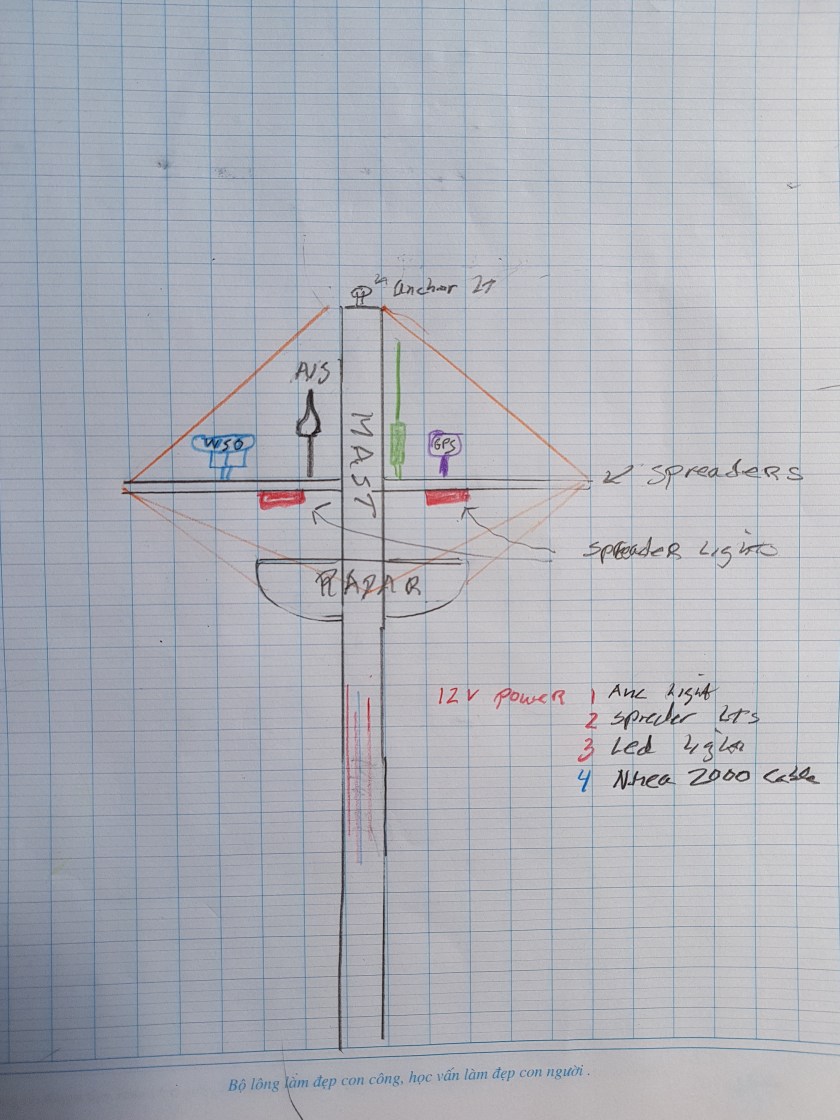
Just too many times, that antenna arch has been seconds from disaster. Time to get rid of it. The Maretron cable that runs inside the mast must also be replaced. So, the Maretron WSO and GPS will be mounted on the spreaders. In addition, I will mount my Wi-Fi extender antenna and I hope to also move my current AIS antenna to the spreader. Currently it’s mounted on the cowling of the fly bridge near the helm. It’s too low. Many times, it will not see big ships until 5 or 6 miles away. At the Dauntless speed of 6 knots and big ships possible speed of 20 knots, that still gives me more than a 10-minute warning, but that antenna should be maximized just on principal.
Plan for the Mast Spreaders March 2019
I also need to remount the two Chinese LED spreader lights. The lights themselves, bought 5 years ago on Amazon for $20 each, have been great, but the mounting hardware is mild steel that rusts badly. I have a way to mount them directly to the spreaders, without the steel hardware. Since I am doing that, I will also change the electrics a bit and add an electrical circuit to power a LED stripe that I will also mount on the mast.
Now, your thinking, while I have eliminated one protuberance, I have made the spreaders much more complicated. That’s true. But I have a plan.
I will also add a 1/16th Amsteel line from the top of the mast to the end of each spreader, then forward to the front of the radar arch. Looking aft from the bow, this will look like a triangle. Looking from either side, this will look almost like an obtuse triangle.
Now, I have not added this yet. This will happen in March when I return to Dauntless, but in my mind’s eye, I see this little line as making it much more difficult for a loop of any line to become snagged around the spreaders, radar arch or the mast itself.
It’s 20:30 hours. I had a glorious day in all aspects. The weather could not have been better, 72°, light breeze. Dauntless is under the roof, no problems with sun or rain. Of the two projects I started out this morning to get done: one’s done and the other two are almost done.
this picture was taken just 5 hours before my departure. I was so enamored with the sunset that I really did not look at the situation. Notice the solar panel array on the port side stern of the sail boat in front of me.
But this evening, I felt a disquiet. My project list is not even a quarter done and I’m leaving for the winter in 5 days.
Then I realized it’s not about progress on the projects, days left, or anything else. It’s that I’m alone.
But even that is not so simple. In fact, my happy meter is well above my “normal”. Boat wise, relationship wise, career wise, pretty much everything, I’m quite happy about. So why the grumpy face and thoughts?
I’m not feeling lonely; but something is still missing.
Then it occurred to me. My entire life, from as early as I can remember, has been about teamwork. Working with others to a common purpose.
I can’t even begin to tell you the times I sacrificed personal accolades for the sake of the team.
All my successes in life can be attributed to building and nourishing successful teams.
Even when I started my teaching career, I did not become a successful classroom teacher until I realized that I needed to make the students in each class understand that they were a team and needed to help each other for their own learning, not for me.
As a high school principal, it was harder, because professionals in education have never been taught anything about teamwork, but the successes we had were all because the entire staff was working together for the good of our students. Sure, there were a few bad apples, but despite them, we got a lot of kids to college and success that would not have happened otherwise.
Then, I look at the other side. Even though I was quite successful selling cars, I hated it. The General Manager at a very successful dealership once made the comment to all in our sales meeting that, “Bost, probably tells everyone that he is a lawyer” I wondered how he knew, though I didn’t pick lawyer, I just never told anyone I sold cars.
While I was successful there, I was a duck out of the water.
With my project list for Dauntless, the list would feel less daunting if my teammate was here. Teammates don’t let you get overwhelmed with small stuff and they convince you the big stuff isn’t so big.
Even better, teammates give you that Cesar Milan nudge or click, that gets you off the obsession and back on track.
That’s what I miss. Otherwise it’s too easy to go around in circles or become obsessed about the unimportant.
In teaching, once I realized that I had to convince the students that they are a learning team. One time, I noticed one of my special colored pencils was missing from my grade book, that was open on the first row of desks. I used color codes for different types of work. I was irritated about it and started complaining to the class about my missing pencil.
In a New York minute, which in this case was probably 30 seconds, one of the students calls out, “OK, we get it Mr. Bost, now can we move on”
I snapped out of it. It was the nudge I needed.
(A couple of days later, in walking around a different class, I saw my pencil in front of one of my problematic students. Without a word and I just took it back. Months later I finally got that student to start working and she passed with a 72 out of 100 on the NY State Regents. She worked hard, finally. How we got there, is another story, I’ll save for the book).
And I wouldn’t have spent 3 hours on the Maretron power problem without checking the fuse from the very beginning.
Oh Richard, since you know the circuit had power until you shorted it, why don’t you check that fuse once again?
Oh yeah, that’s probably better than spending the next three hours on this connector!
For a little, non-electronic boat, I sure love my Maretron data. I have 9 modules:
two to communicate with everything else, (USB, IPG) and the N2K Viewer
two for the fresh water tanks, (TLM),
one solid state compass, (SSC),
one GPS, (GPS),
one depth sounder with paddle wheel and lastly, (DST),
the love of my life, my (WSO), the weather instrument.
The solid sate compass seems to work better with my ComNav autopilot. In addition, it gives me the roll and pitch data I often quote in my blog.
The weather instrument is also solid state with ultrasonic wind measurement. Considering I installed the system myself over 4 years and 20,000 miles ago, I’ve had few problems.
A glorious day in Vallejo, under a roof, with the mast down, facing aft
Coming west across the Atlantic, the constant winds behind us and to the side, from 15 to 35 knots for 528 hours or 22 days (No, I didn’t stop to change the oil) took a toll on my connections on the mast. Everything still worked, but occasionally, if a line got caught it would put enough strain to disrupt the connection until I freed it.
So, one of my projects now is to redo all the connections in the system. I also now slather everything in dielectric grease. So much so, that I almost put it on my pancakes the other morning.
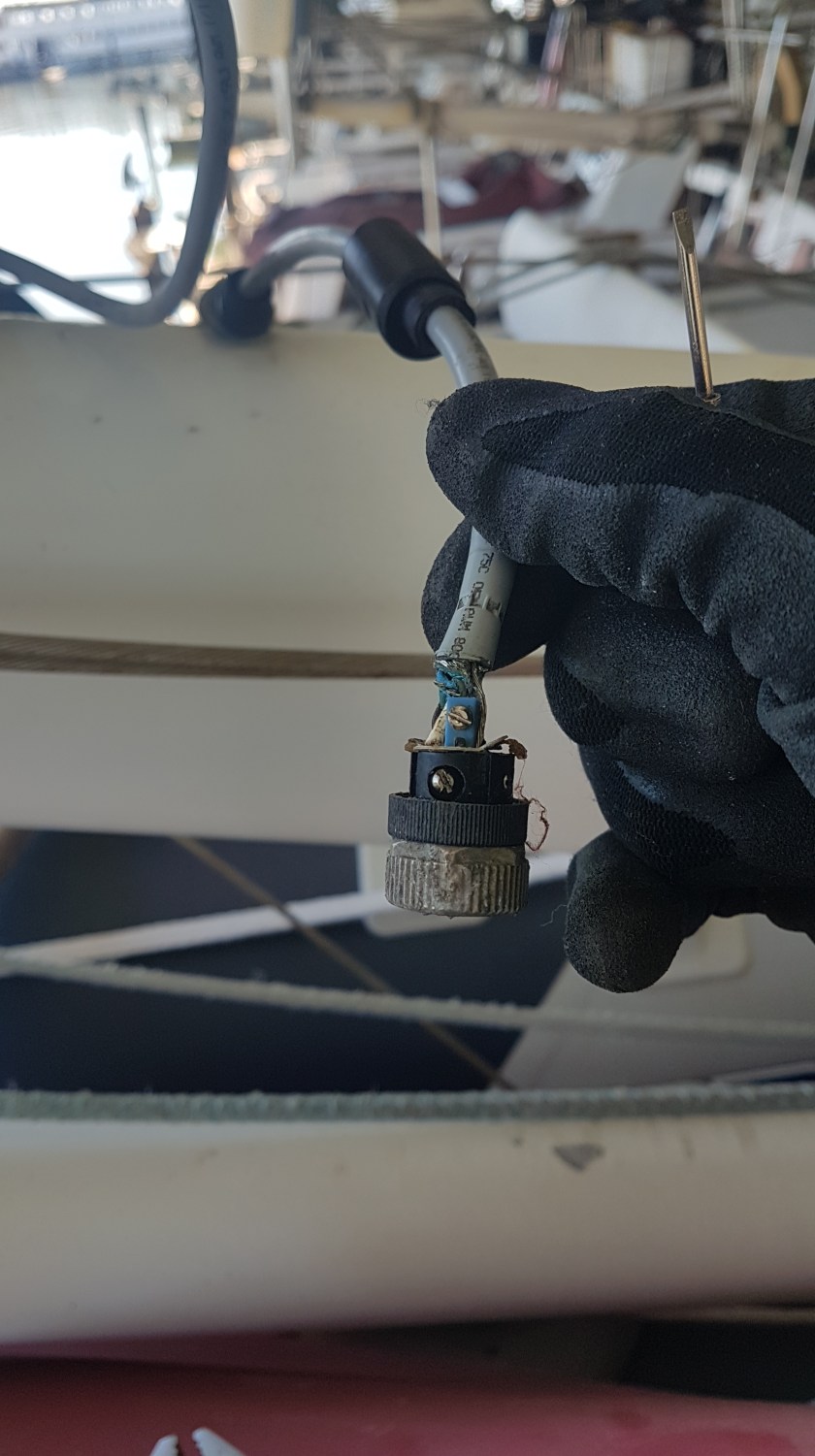
One of the offending connectors
So, the day started out so very well. Sitting on deck, with the mast down, Dauntless under a roof, protecting us from the elements and sun, I thought about climbing up the mast in Cabo San Lucas, in hot, 95° sun, holding on the mast with one hand, while trying to tighten the 5 little wires inside the plug just under the WSO.
I was in hog heaven. I carefully tool the plug apart, unattached the 5 little wires, and recut them all and trimmed them. Now, I knew power was still on the system. Before I started any of this, I wanted to make sure that it was only the WSO that was incommunicado. So, just as I was thinking that I would have to be careful in cutting the positive power line, meaning not to cut it with the ground wire at the SAME time; I did exactly that. The little spark, showed me that I’d f..ed up.
Sure enough, when I go below to check, now the whole Maretron system has no data.
Had I shorted out something serious? Was there a fuse in the system? If so, where was it?? Who the hell installed this system?? Oh, it was me!
Let me check the computer cabinet. Open cabinet and what do I see, the fuse block that I put in 4 years ago and even nicely labeled at that.
It went downhill from there.
To check the fuses, I had to pull them, to do that I needed to power down the whole system. That done, I pulled each fuse and looked at it very carefully. Very carefully (for those of you who already know the answer, don’t spoil it for your dear ones who are also reading this).
They all looked good. I powered the system back up. That takes a few minutes because the modem and router have to be booted up before the computer otherwise everyone gets confused.
At this point, I noticed that the little light for the Maretron circuit was not lit on the router until I turned on the computer. I hadn’t noticed that before. (and in the future, I will explain that issue).
No change. I went back to the fly bridge. One of dozens of trips I would make over the next couple of hours. I figured I had screwed up the wiring of the plug. I took it all apart again. I convinced myself that possibly the ground shield covering was touching one of the data lines. I put it all back together again, rebooted the entire system and alas. No joy.
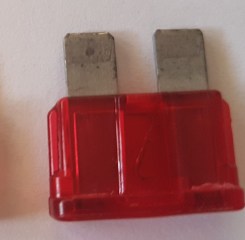
At this point, I’d spent an hour on this. I pulled the fuses again. They still looked good. I even held them up to the light. But finally, just to be sure, I changed the 5-amp fuse that powered the Maretron system. Surely now, it would work.
Still No Joy. Now, more than ever I was convinced it was the plug. The plug was the only thing I had worked on.
Back to the flybridge. Took plug apart again. Put it back together again. Rinse and repeat.
I got my electric meter out (finally you think), check the plug for the umpteenth time. No power.
I go online and check the Maretron site. It tells me I should see 60 and 120 ohms between certain lines. I see exactly that. But still no power. I must have shorted something else out. Where did I install the power tap?
Oh, I remembered where the power tap was because it’s in the port side pilot house wire race that is so full of wires I have trouble getting the teak panel back in place.
Other than no power, the continuity on the plug and lines tested correctly.
I’ve been working on this for three hours now. I return to the computer and fuse block.
I finally decide to test for power in the fuse block. Umm, the Maretron circuit has no power here.
I pull that fuse and check it. No circuit. I check the old fuse I had pulled out, no circuit.
I got fuse number three and checked it, a circuit.
I stick it in and low and behold, power.
Two hours earlier I had replaced a bad fuse with another bad fuse. Both fuses showed no sign that they were open. Both had very clear “Z” wire that wasn’t broken.
I was looking forward to this project, as I like working on the electrical things and I just wanted to also tidy up the wires and the things I’d done over the last couple of years.
I needed to put new female spade connectors on the gauges and switches in the forward head. I also needed to replace the little bilge pump and replace the float switch for the big Rule 200 bilge pump in the forward bilge.
Cleaning up my cabin. This fuse and terminal block is for the forward head and bilge. The Raritan black box is for the old ElectroScan that I replaced with a Purisan.. This was the easy part. I had no corrosion here.
So, I get my two trays of electric connectors, with hundreds of pieces and what do I find: hundreds of males and a half dozen females. Sociologists warn of impending disaster when the male to female numbers reach 52% to 48% respectively in society. Because those single males unable to find mates wreak havoc on the society.
All those rogue elephants in Africa, male. Nuff said.
Female spade connectors are needed to connect a wire to the switch or instrument. I need about a dozen just for the forward head. The current connections are all corroded considerably. I know why, but don’t think I’ll mention it, other than to say, my not wanting to throw anything away can be dangerous.
Amazon will deliver the females on Tuesday.
So, I could tackle the paravane bird holders. I’ve tried various things in the last 4 years. Some have been a bit more effective than others, but in the last weeks I’ve gotten tired of stepping over them on the side deck. With the paravane pole taken down, there is not way to secure them.
In normal use, even if I think I won’t need the paravane stabilizers, I will deploy the poles only. This allows me to deploy the birds without having to go the flybridge again. So, I need a method to secure them, with or without the poles in place.
This has been an ongoing issue. Each half-assed system I make, breaks sooner rather than later.
My solution is very simple, net and won’t get in the way, in the narrow deck space. I must say, that I think my time in Vietnam has enabled me to see simpler solutions. The Vietnamese make do with whatever they have, which is fractions of what we Americans are accustomed to.
The New paravane bird holder, suing eye hooks and 1/16″ Amsteel. Another viewThe New paravane bird holder, suing eye hooks and 1/16″ Amsteel
It’s a thrifty culture and probably what I need in my reduced earning years.
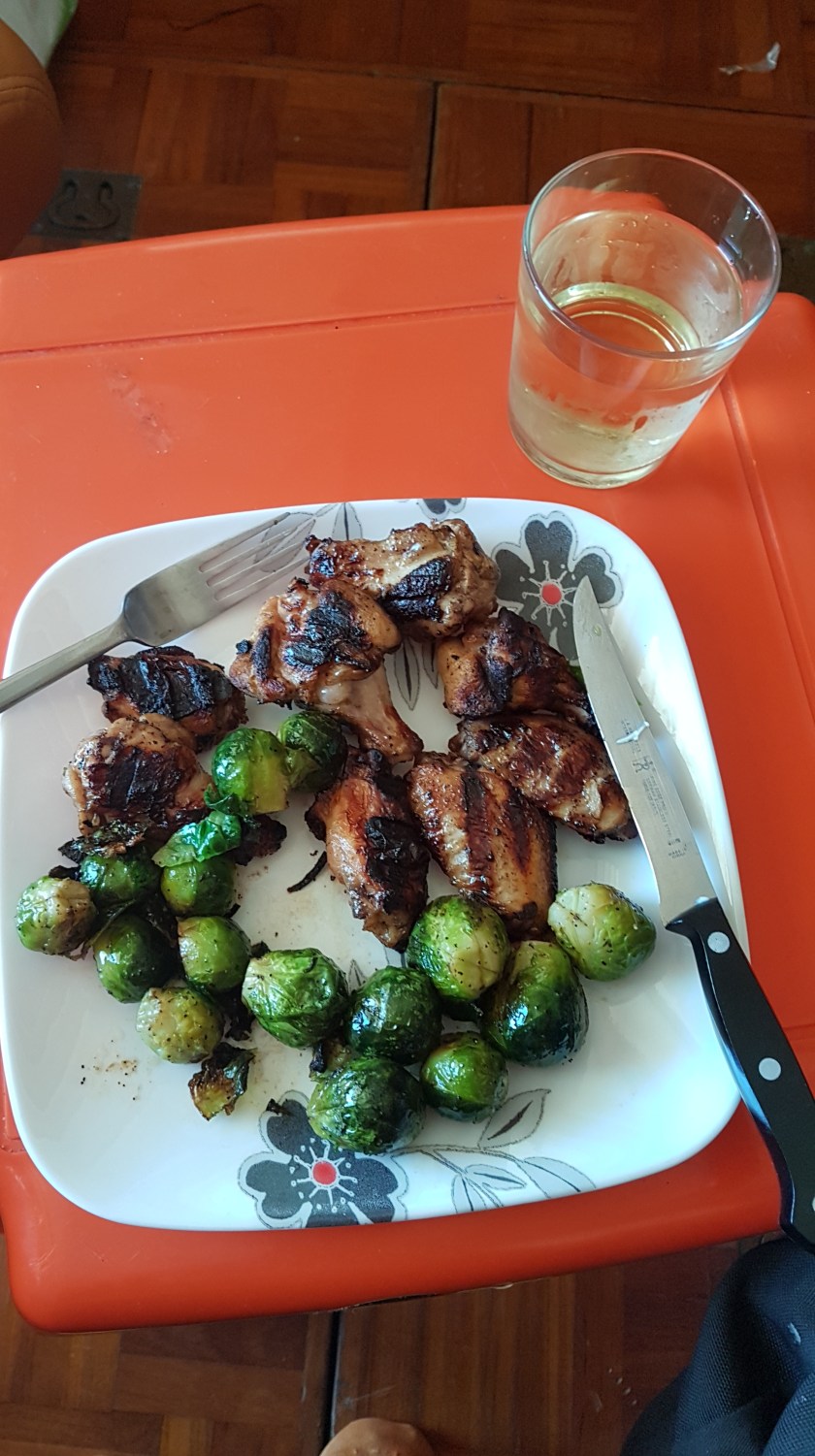
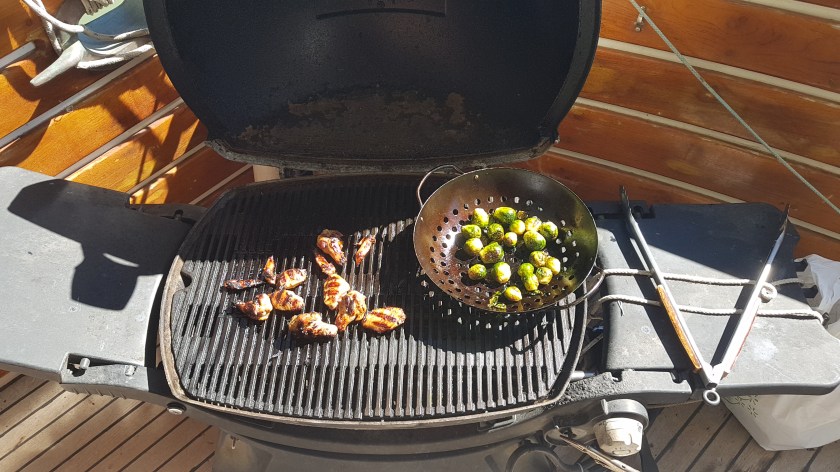
To that end, I have also really tried to limit my going out for dinner. Thus, my chicken and brussels sprouts for dinner today. Very good.
My plated dinner, chicken and Brussels sprouts.My dinner cooking, chicken and Brussels sprouts
There are those who have few parts, but they are well organized and whenever they need something, they always have just what they need. Best of all, they have very few extra pieces, everything being stored in a few 2-liter containers.
Then, there is the boater who every marine store, big box store and Amazon loves. They have literally hundreds if not thousands of parts: plumbing connectors, electrical wires of all sizes, butt connectors, spade connectors, every connector under the sun; except for the one they need.
All threaded NPT
I’m in the latter group.
So, my little, very little, dock filter project, took three days and 4 trips to Home Depot, Wal-Mart and Ace hardware. Why, you wonder with the plethora of things I already have on board?
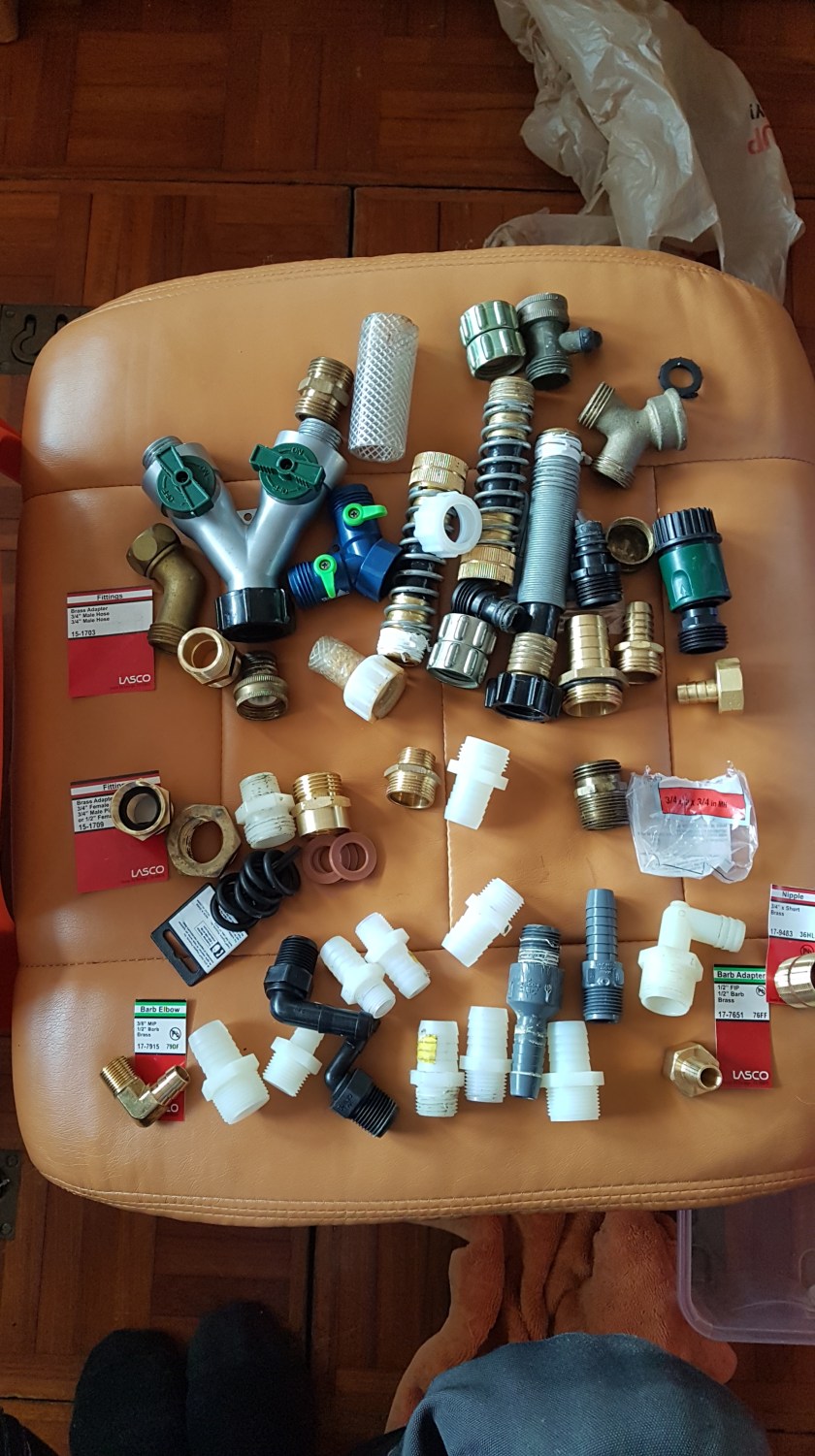
An assortment of hose barbs and NPT connectors
Well, it’s like this. I have 100 feet of ½” clear braided nylon tubing. I also have about 25 feet of 3/8” of the same, as well as 50’ of 1 inch. The water filter I bought used ¾” fittings. I didn’t want to use ½ inch. I also needed ¾” NPT to Hose thread. I had a nice variety and quaintly of stainless steel ¾” hose barbs to ¾” NPT, and many ½” barbs, but alas no ¾” tubing.
I will spare myself the embarrassment of the Rube Goldberg setup I made first, then second, finally third, but with too many connectors of different sizes, it was difficult to not have a joint leaking.
Finally, I bit the bullet and went back to HD for the umpteenth time and bought a ¾” NPT male/female water heater hose of two feet.
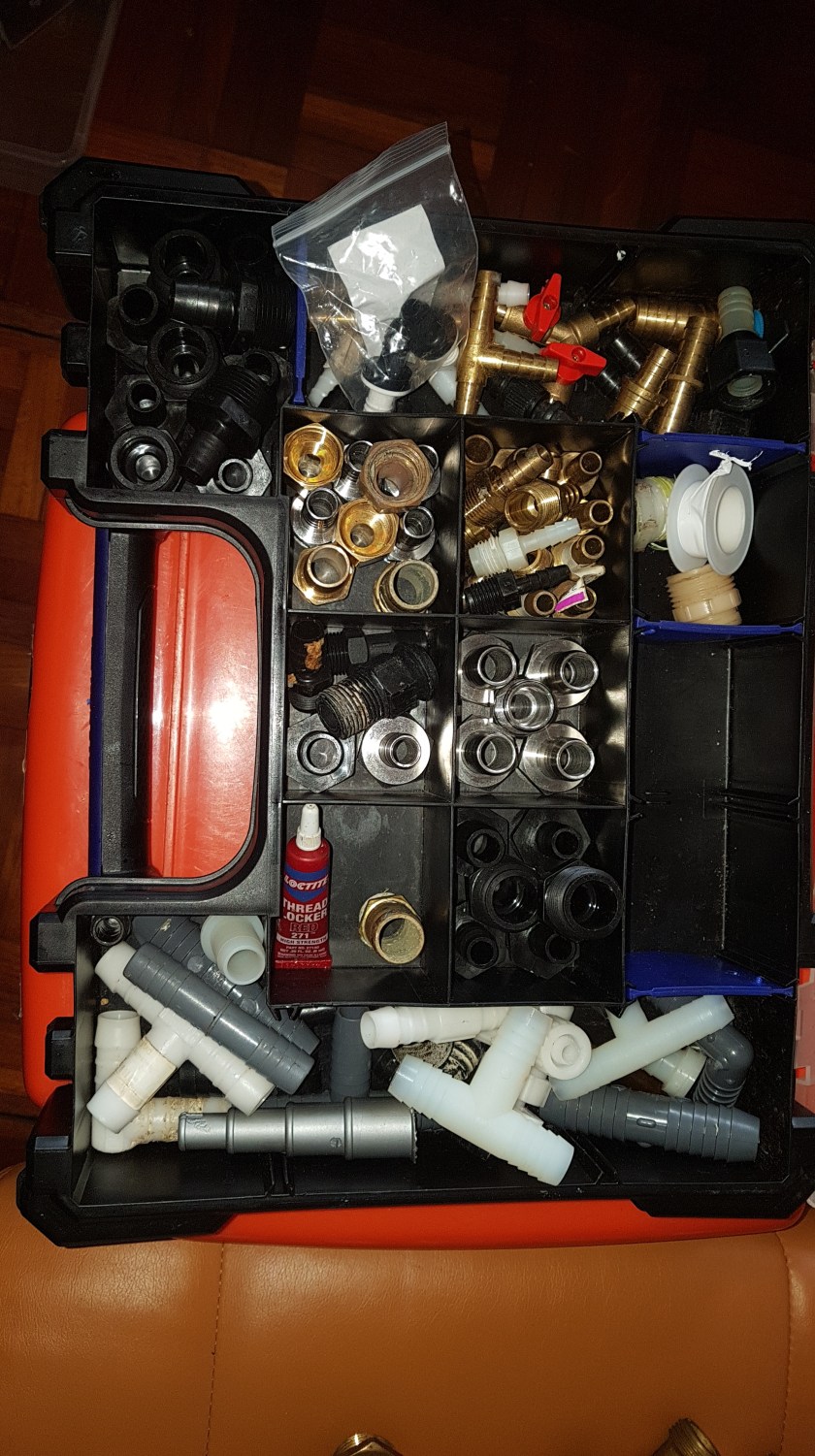
Thus, my dock water household filter was installed in a manner that I’m happy with. Even got a quick disconnect to work that I’ve been carrying around for 4 years. I also took the time to re-organize all my hose and pipe fittings.
Now as you look at the pictures, while it may seem relatively organized, I seem to have soooo many ¾” fittings for who knows what, since I have few ¾” anythings on board.
An assortment of Hose thread (top), hose to NPT and all NPT (middle) and hose barbs (bottom)
The dock water filter was certainly not a necessity, as I have gotten along fine without it for these 5 years. But I am on a self-imposed deadline, getting the stuff done that is at best superfluous and at worst a waste of money. For next year, with Trinh here, she’ll ask me how I managed all these years without it, not having a good answer, she’ll tell me to save my money.
I’ve already calculated that I will save $500 per month. I feel richer already.
I did have a much bigger and serious problem, that I have worked around, but had to be fixed.
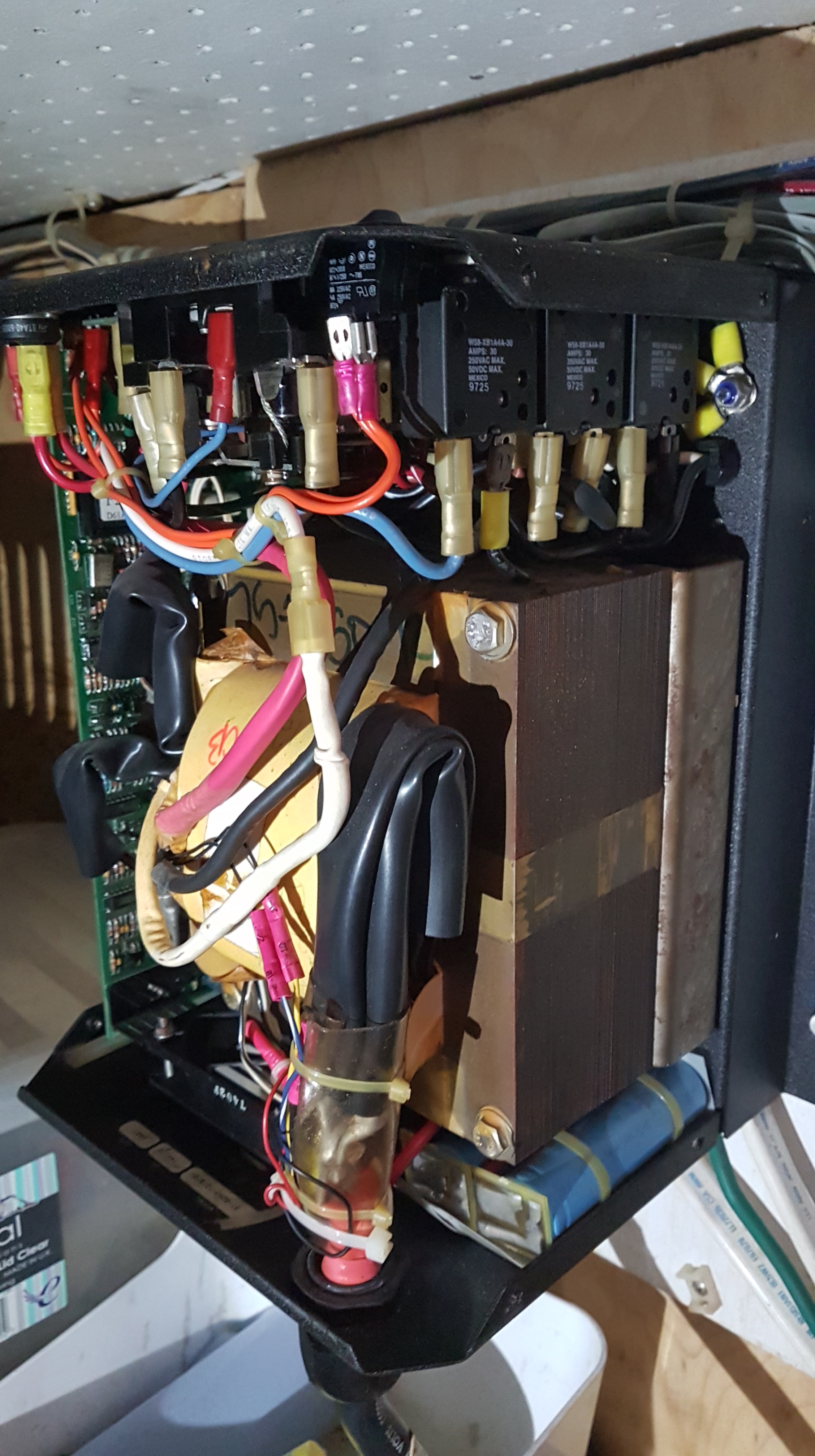
My Heart Inverter/Charger has not been charging for the last few months. I could tap it and it would wake up and start to charge, but sometimes within minutes, sometimes within hours, it would revert to not charging. So, I knew it was an internal relay problem. But I hate disconnecting it from the 930 amp-hours of batteries.
Also, I could work around it relatively easily, as I have another charger, a Neumar, that charges only, but will work on any voltage, which made the time in Europe very easy. It’s on circuit 1 and as you have read, in this marina, I only am connected to circuit 2. When I left Dauntless in July, I left her connected to circuit 1 and therefore the Neumar was charging. But now, being on the boat, circuit 2 is more convenient. I didn’t want to do another work around like I did for the washer and water heater. I needed the Heart Inverter/Charger to work as it is supposed to.
So, I depowered everything, turned off all external power and disconnected the batteries (at the 300-amp fuse). Open the Inverter case and sprayed a lot of contact cleaner on everything, especially the two sets of points that make up the charger relay.
I also tightened the female spade connections on the circuit breaker for the charger (on the upper right of the picture). They didn’t feel loose, but still, couldn’t hurt and a loose connection like that, while very simple, can cause havoc or worse.
I let it dry for an hour, re-connected everything and powered her up. This time, I didn’t have to tap it and it worked as it should. Battery voltage slowly worked its way up to 14.04 v and stayed there for a while as the amperage came down. But even after 24 hours, voltage was 13.78 v, while the amperage was still about + 4 amps.
49 hours later, the voltage as stabilized around 13.70 and the amps going into the batteries stays a little positive, even if it is only +0.4 amps.
Very happy. Now, when I leave the boat this winter, I will leave it on that inverter charger.
I also ate some great Korean food this past weekend, as I had a great day in San Jose with some wonderful Korean friends.
Korean food in San Jose
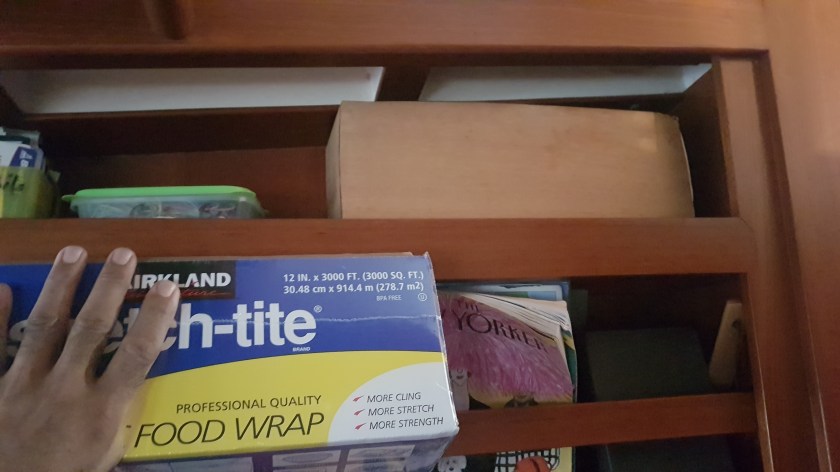
And I did go to Costco, since my 3000 feet of plastic wrap which as lasted me 5 years ran out yesterday. While at Costco I bought romaine lettuce, Brussel’s spouts and rack of lamb.
The new box and old box (with wood veneer)
Coming up next, a hundred males, only a few females; nothing good can come from that.














 I was looking forward to this project, as I like working on the electrical things and I just wanted to also tidy up the wires and the things I’d done over the last couple of years.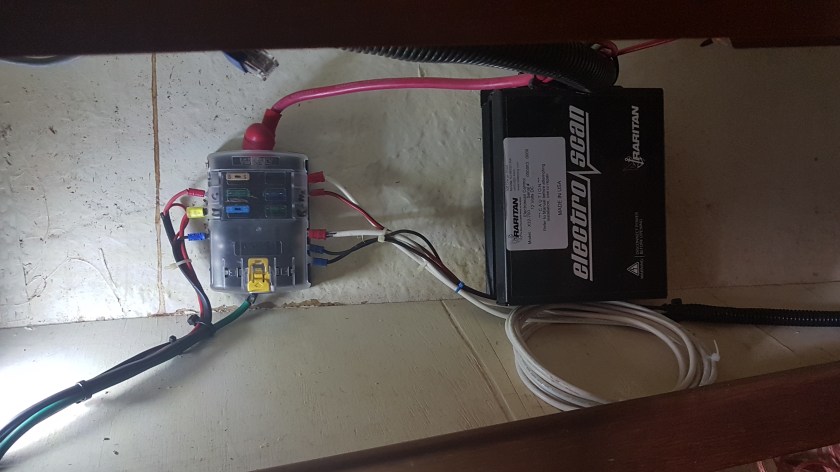





 Dauntless at Sea