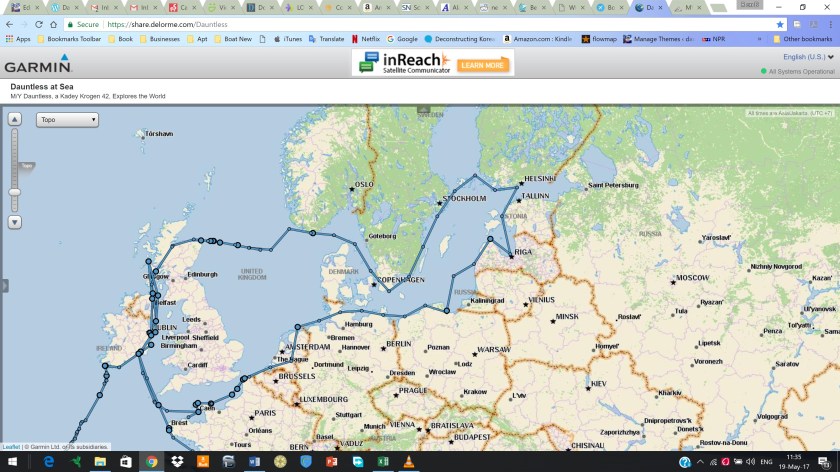
Third Time is the Charm; But it Wasn’t Easy

leaving Cabo the first time on 13 May

After arriving on the southern tip of Baja California May 9th, two weeks later we are faintly getting out of this tourist trap. Oh, Cabo, or better yet, Cabo Falso, has finally loosened her grip on us to to us pass.

My two previous attempts were unpleasant at best, more like miserable. And on each the previous attempts to round the cape in ferocious seas and winds, I had tried two or three times, either tacking away from shore or closer to shore to escape her grip. Each time, I dragged myself back to Cabo, tail between my legs.

On the second attempt, the autopilot also started to not act right, so I felt the failure even more.

My Octopus pump. the top screw was leaking
The screw, replacement “O” ring and broken circ clip for the Octopus pump

With thousands of boats in Cabo San Lucas, I thought it would be easy to find the little “O” ring and broken circ clip my Octopus pump needed. After walking around to numerous places in the hot sun, I found the ring, but not the clip. I called my followers who is a plethora of mechanical advice (he’s the one who told me how to make emergency hydraulic fluid in the middle of the Atlantic), who explained that the circ clip was just a stop, so the screw would not come all the way out.  It was already out, so that solved that problem. I put the new “O” ring on, leak stopped, and pump worked fine.
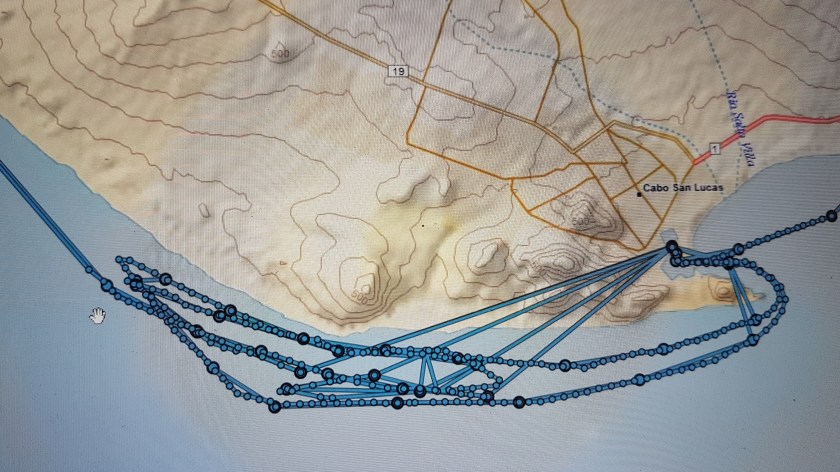
The Garmin InReach track for the May 13, 20 and 23.
The superfluous tracks are Garmin’s way of introducing us to their world. https://share.delorme.com/dauntless

I am really in debt to Octopus Pumps. This is on the list of winter projects. I really need to have a spare.

We waited and waited. I was very conscious that every day was costing me $100+ The reality is on my budget with all the cruising I do, necessities come first, so a marina becomes a convenience. Thus, it’s the one place I really try to try to control my costs.

That I didn’t like Cabo just added insult to injury.

I make a habit to only look at Windy.com and the forecast winds once or twice a day. With crew on board, I look at it more often to make them happy, but I really don’t. The nature of forecasts is that if they change radically, they are most probably wrong. Thus, once a day will provide enough guidance. Also, while nowadays, the forecast models are run more often, at least every three hours, planet Earth still has a 24-hour day. In simplistic terms, the winds and weather are driven my differential heating caused by our day and night cycle. Therefore, running the model more often does helps, but it won’t totally cure instability issues with the forecast.

I know this is getting too complicated. Let me say this, if you are waiting for a specific weather window, like I was in Cabo, how many times have you noticed that during the day, the forecast is changing, only to return to what it said originally 24 hours later? So, looking at a forecast more than a couple times per day is simply not helpful and more often confusing. This was quite apparent as I watched the winds off the southern Baja Peninsula.

The other phenomena with numerical forecasts are the sliding weather window. I mean it shows favorable whatever in the 24 to 48-hour time frame. But the following day, the favorable whatever is still forecast to come in the 24 to 48-hour time frame. It’s like the forecast is waiting for something to happen. It is in fact; numerical models are just predictors of fluid dynamics. But something in the real world is not acting like the model suggests. Therefore, it keeps sliding the forecast.

Which is fundamentally why numerical models have not replaced weather forecasters. Weather forecasters will know the proclivity of each model for each area and time of season. Changing seasons is the biggest bugaboo for both man and machine. That’s why some months are easier or harder to forecast.

Enough weather for now.

Rounding Cabo Falso

Error
This video doesn’t exist

On 23 May 2018, we finally got underway heading to Ensenada with stops along the way. The first protected stop was Maddalena Bay, about 200 miles up the coast.
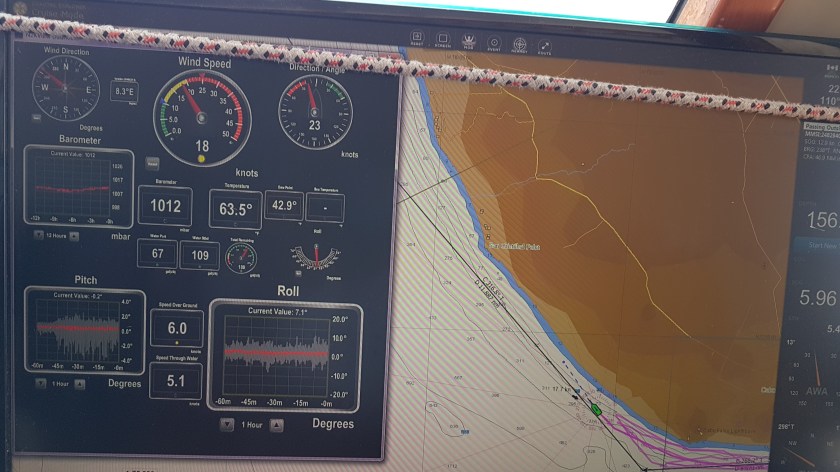
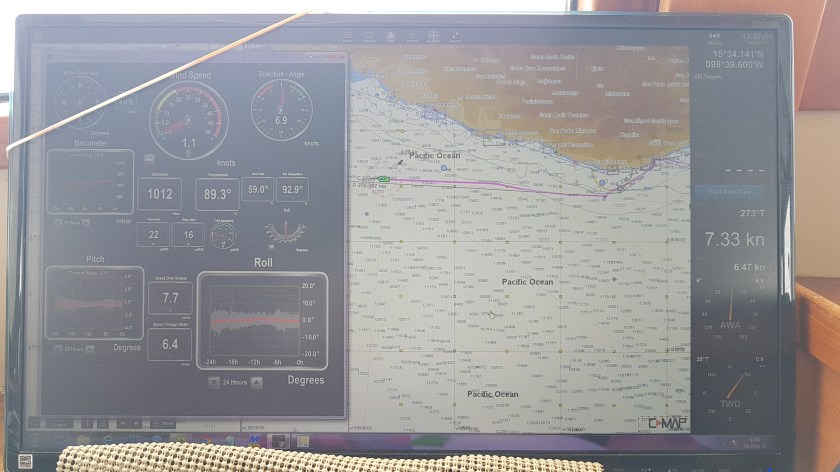
Our track on Coastal Explorer. We are finally past the point that we turned around last time.

Coming abreast of Cabo Falso, winds had picked up to 310° at 15 gusting to 25 knots. I put one bird in the water to reduce the roll, which had gotten to 10° to 15° to port, as the winds were on the forward starboard quarter. We were pitching 6° to 8° up and down. Not fun, but tolerable for a while.

Six hours after departure, we were finally around the cape and heading NNW. Winds had died down to 10 knots, but we still had an unpleasant pitching motion.

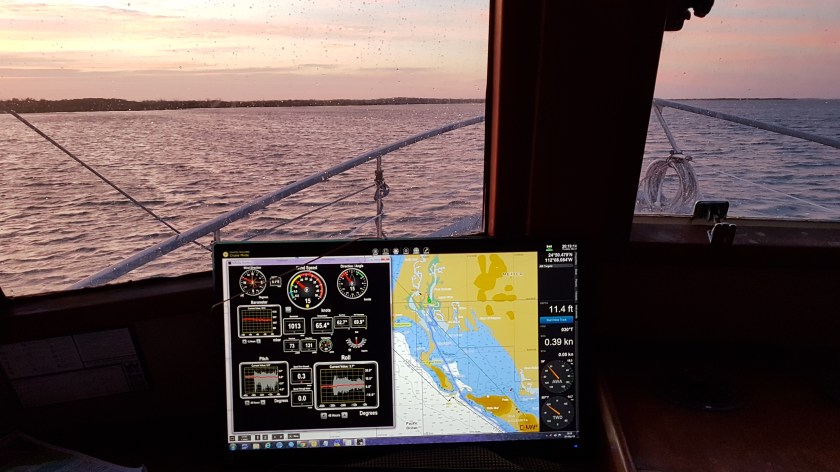
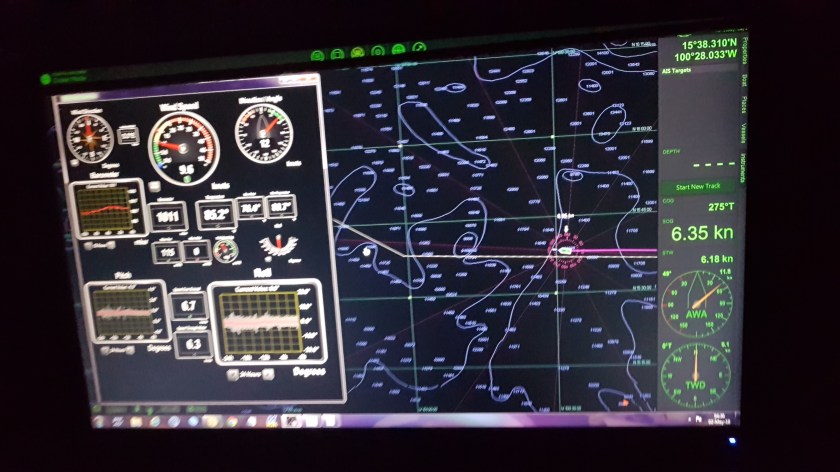
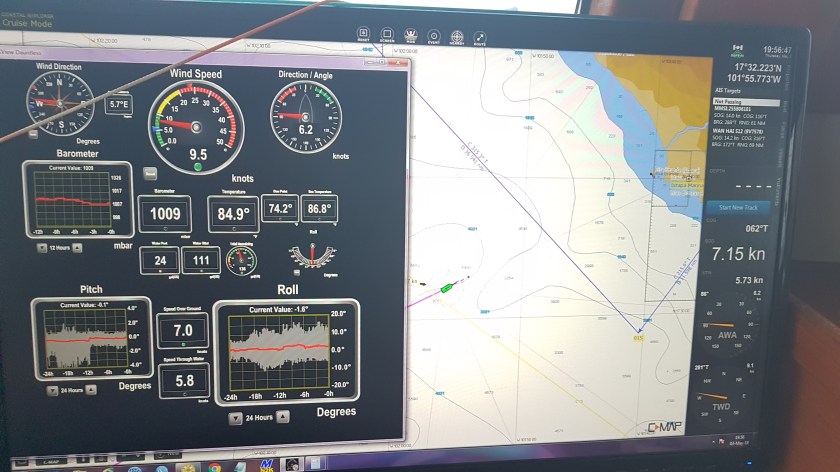
Night view of Coastal Explorer our first night out of Cabo.
You can see the pitching and rolling motions for the last 12 hours on left on bottom of screen.

During the spring and more recently in my time in Cabo, it was apparent that there are three distinct weather regimes off the Baja coast. The southern third has the strongest and most consistent NW winds. The second third has slightly more variety, while the last third, north of Tortuga Bay, must more variable weather, more like southern California.

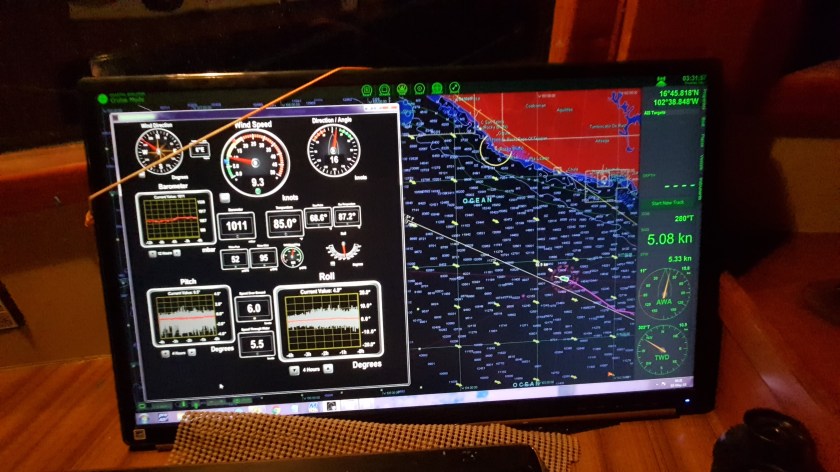
Our Coastal Explorer chart showing our route for the previous 36 hours, after arrival in Magdalena Bay
Navionics on Tablet, further out view on Coastal Explorer, as we proceed up the channel in Magdalena Bay
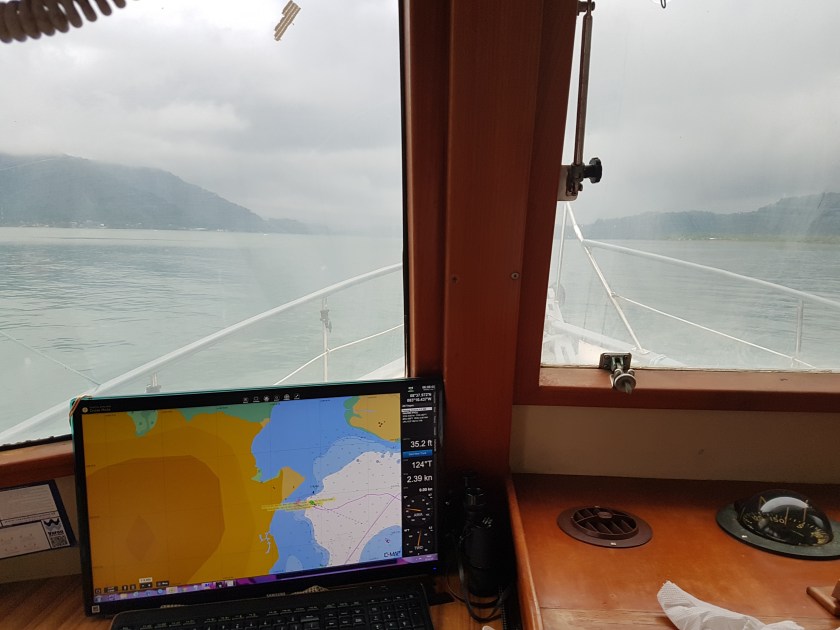
Another view out the pilot house window, with Maretron and Coastal Explorer chart

Not until we were close to Magdalena bay did the winds back around to the west, though they were strong at 15 to 20 knots.

We pulled into Magdalena Bay 17:00 on the second day, the 24th, we then spent a few hours going up channel to Puerto San Carlos, to be protected from the coming wind storm.

Another view out the pilot house window, with Maretron and Coastal Explorer chart. It did stay like that the entire time

Error
This video doesn’t exist

This leg’s summary: 188 nm, 35 hours, 25 min, avg speed 5.45 knots

Now, let’s check out that dingy. If you missed that fiasco, see:

https://dauntlessatsea.com/2018/07/14/the-dingy-fiasco-part-1/
 

Things I Must Do on Dauntless

Upon waking up this Monday morning, as I was organizing my day, thinking about what I wanted/needed to do, I thought about this blog and what to write. I’d like to finish writing about the events of the trip to Vallejo. But as time passes, so does emotion of the events, making it harder to write about in an interesting way. Thus, the main casualty of losing my laptop for almost two months is insightful writing.

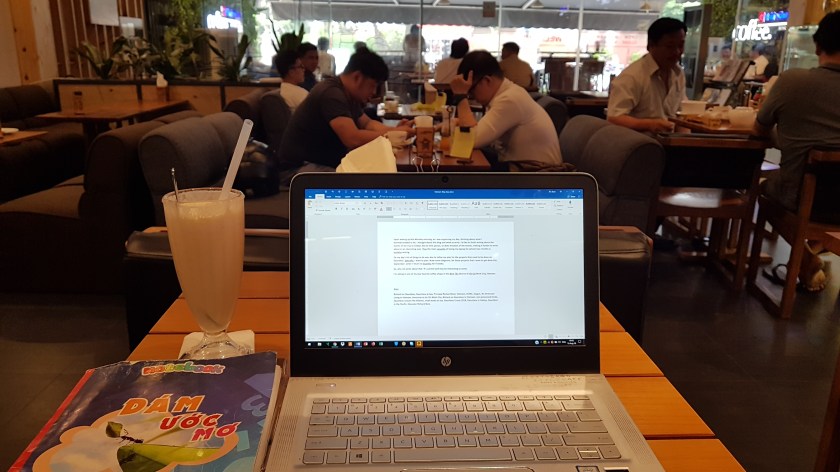
This morning in HCMC, writing this post

On my day’s list of things to do was also to refine my plan for the projects that need to be done on Dauntless. Specially, I want to plan, draw some diagrams, for those projects that I want to get done this September, when I return to Dauntless for 4 weeks.

So, why not write about that. It’s current and may be interesting to some.

I’m sitting in one of my two favorite coffee chops in the Bình Tân district of Hồ Chí Minh City, Vietnam. I come here when I want coffee, or a yogurt blended with orange juice, and that’s what I’m drinking today. The other shop I like, when I want a fruit smoothie, usually avocado.

I’m alone, so it’s a good time to write. My girlfriend Trinh (pronounced like Din), is working. Doing my three-month hiatus bringing Dauntless north, she expanded her sub-contracting job and now has 9 people working for her producing marking and ink pens.

Dauntless under cover in Vallejo

I can’t complain; I do like women who like work. Ultimately, my breakup with Julie was because she picked work over me and D. Why it will be different next time is not in the scope of this post, but one day I’ll write about it. I will say it’s more a cultural thing than a personality thing.  I’ll see Trinh later this morning and afternoon.

During the time on Dauntless, I started to make a list of the things that needed to be done on Dauntless at some point. I hate lists, as they remind me of all the stuff I still must do, but in this case, it’s needed.

Dauntless under cover in Vallejo

My biggest problem when cruising alone (in the sense of not having a long-term partner with me) is that when I arrive wherever, I’m tired. I don’t have the will or desire to sit for the next X number of days and fix, repair, replace, modify what needs to be done.

Of course, I’m fixing things that must be fixed, but no more. I may do some half-assed job just to get going, but I know I must come back and modify it.

One of the big attractions of the marina in Vallejo is that I am in a covered slip. I don’t have to worry about working in the rain or worse, in the sun. I’m looking forward to it.

My current list of projects includes everything that must be done before September 2019, once in Southeast Alaska. Obviously, some things are more critical than others, e.g. I don’t need the diesel heater until Alaska. Other things are conveniences, but on a boat, conveniences are important. So, one of my first projects next month will be to move my fresh water tank selector valve so I don’t have to go under the floor in the guest cabin every xxxing time to change water tanks. Along with that, I will also clean out the water tanks and reseal the inspection ports and install a baffle on the Maretron ultrasonic sending unit. This should be a day’s worth of work. If Trinh was with me, probably half-a-day, since she’s always busy like a bee. I’m more like a sloth, so it will probably actually take two to three days.

Here’s the current Dauntless Project List:

System Item  Problem/Issue/Goal Notes, parts? Est Completion
Engine Change Oil

R&R Impeller Cover


Been leaking for 2 years


Done 6663.88 hrs.

April 2019

H2O Move tank valves

Reseal tank fittings

Replace lines, one-way valves,

Check and redo all clamps

Place caps on Maretron tubes

Make external filter system for tank fill

September
Water Pump pressure switch Adjust ?
Mount Spare pump?
Transmission Real seal leak Check engine alignment?? ?? April 2019
Fuel Sight tubes Put LED strip behind tubes

Bundle wires on port side

Watermaker R&R Seals with kit

Add three-way intake valve

September
Generator Oil & filter

Install Battery

Check remote start switch

Install Perko switch to house?

Check Charger to Gen


Nice not to have to get out jumper cables?

September
Bow Thruster R&R broken gear Would be nice to use again, OTOH I’ve done wo for 3 yrs.
VHF’s ICOM 304 Internal relay?

Handheld

Chinese handheld

Send back to ICOM

Needs battery

Figure it out

September

April 2019

April 2019

Salon Hatches Add hinges to middle two Get someone who knows wood September
Outside Hull R&R rub rail

Touch up paint

Cap Rail refinish

With Stainless steel (CI Hbr) September

April 2019

2019

Ext Doors Touch up, Tung oil 2019
Fly Bridge Water ingress Where? Rail fittings? 2019
Windlass & Anchor Lube windlass

Re-mark Anchor chain

September

2019

Solar Panels Re-wire controllers, fuses, switches

Add array over dingy

Replace terminal blocks and fuse holder September
Purisan Controller corroded Return to Raritan September
Pilot House Electrical Add capacity Run additional cable, pos and neg from ER distribution Sept or April
Paravanes Get two new 28”, Use current as spares

Make holder

Reduce excess lines

April 2019
Boom Winch R&R April 2019
Mast Make New Bracket for Instruments

Get 25’ NMEA 2000 cable

Re-attach spreader lights

September
Diesel Heater Complete Wallas installation 2019
Hookah Face mask and compressor 2019
Hydraulic Fittings

Octopus Pump & Capilano piston

Standardize all fittings

Rebulid

Spare?? 2018 -2019


I’m tired just wiring this list. I think I’ll rest now.


Who Can Say No to Hitchhiking Boobies?

Certainly not me.

The stop in Xtapa gave me a chance to reboot my mind. It was fitting that the trip ended at the same high stress level as just after leaving Huatulco. Having to enter a strange harbor and marina at night is always stressful. My depth perception is askew. Everything seems significantly closer than during the day. I have to force myself to trust the instruments.

Error
This video doesn’t exist

We docked without incident, as usual. Got a good night’s sleep. And then my HP Envy laptop decided to give up the ghost. It was not to be replaced/repaired for another month, when I arrived in southern Calif, so no blogging for a while.

While this may appear to be a relief, in fact, it was the opposite. Writing about my adventures, my mishaps, my miscalculations, allows me to reflect on my practice.

As a high school principal, I quickly realized that during job interviews, when I was looking for additional teachers, the outcome of the interview really came down to three questions:

  1. Was the prospective teacher intelligent, did they know their content area?
  2. Did they like children?
  3. Where they reflective in their practice?

I didn’t care if they knew how to teach; I could teach them that. But there is no way to overcome the negatives of any of the above three questions. You can’t make a lazy or stupid person, smart and not lazy. You can’t make them like children. There are too many teachers who teach because it’s convenient. In moments of black humor, we, principals, would say, they are here for the parking (some schools have convenient parking, some don’t).

And lastly, we live in a culture of blame. If things don’t go as we as we would like, we look to blame others, never looking in the mirror. It’s my parents, government, spouse, boss, fill in the blank’s fault. But good teaching practices only happen when the educator is reflective. After every teaching period, every day, every week, every year:  what could I have done better? How can I connect with that student(s) better? Why didn’t they understand_____? or something as simple as, what worked, what didn’t?

Reflection allows our brain to better organize new data, recognize mistakes or things we could have done better or even just differently. In writing this post, I remembered in my 4th year of teaching, I had put up a mirror on the entry door with the caption, “Meet the person responsible for your learning today”. Much like reminding people to turn off cell phones in inappropriate places, it’s a little reminder that can go a long way.

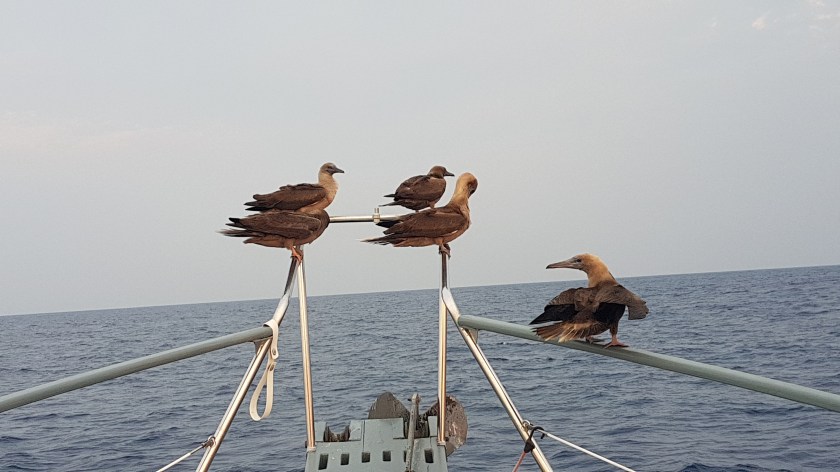
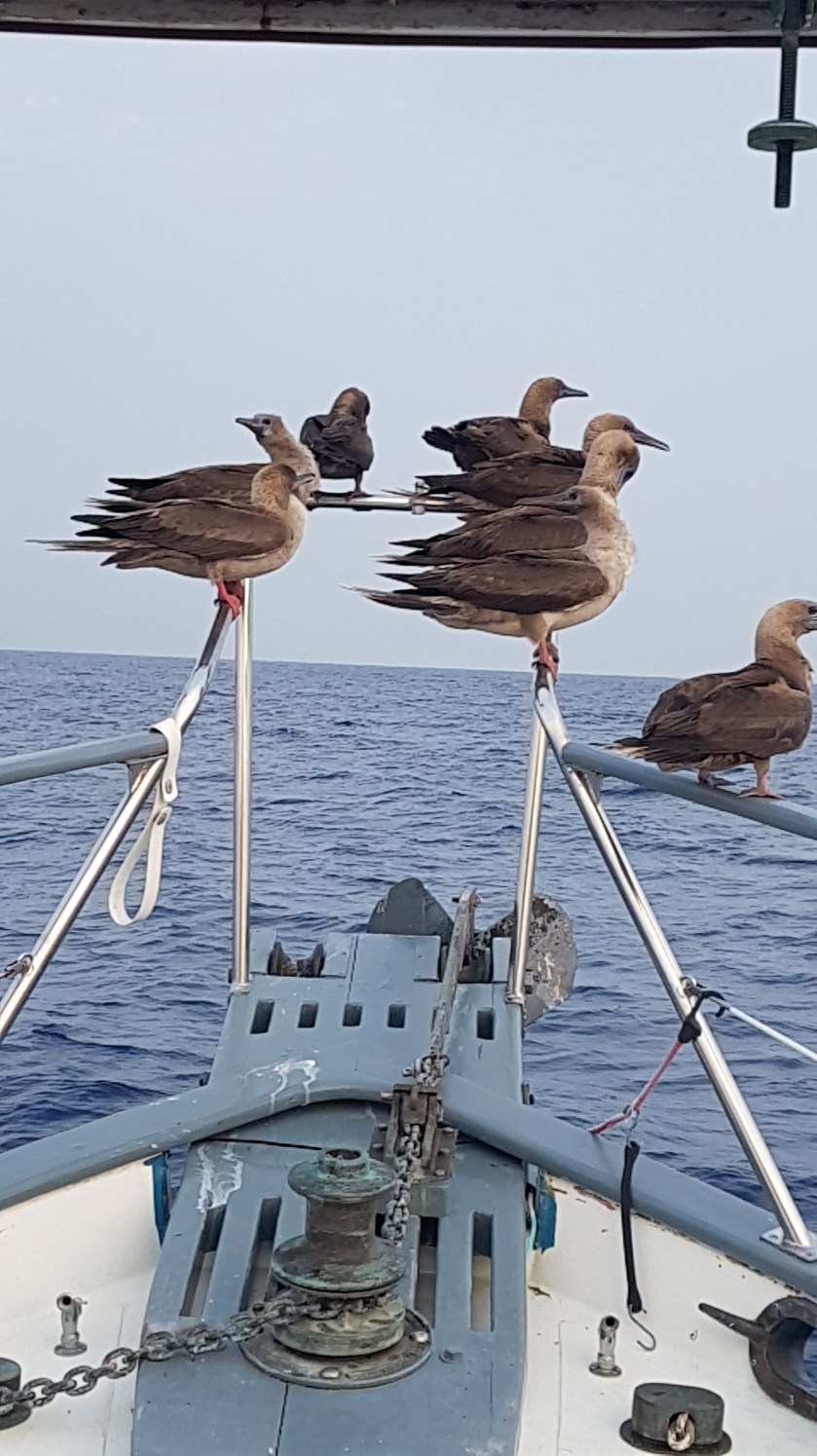
As the boobies started to congregate on Dauntless, first resting on the paravane pole lines and at the end of the pole. Then, an intrepid fellow managed to land on the bow pulpit rail despite the pitching bows. Once other’s saw his success, we because a virtual bus ride north.

They did promise to clean up before they left, but I suspected they would forget that promise. But as I thought about their lives, I thought about how good we, Americans, have it so good. There was one fellow who parked himself on the rail right near the pilot house door. He was keeping watch with me. When I had to go out to pee, I didn’t want to disturb him/her, so I walked thru the boat to the stern deck, instead of my normal spot on the starboard side deck (where the high side rail offers more protection from falling overboard).

The numbers increased every day, until that last 24 hours when the pitching became untenable even for them.   I think their coloring indicated they were juvenile blue or brown footed boobies.

Xtapa was a nice, albeit unexpected respite. It was 30-minute bus ride to Zihuantanejo. We ate, drank and slept well for 3 days waiting for the winds to subside.


An Eventful Passage

Only an hour and a half after leaving the wonderful little stop of Marina Chahue, Dauntless’ winter home, we were underway once again. I wanted nothing more than an uneventful passage. I was so appreciative of Mark and Brian stepping up and volunteering as crew, so I wanted them to have a good time too with no worries.

Beginning of Day 2, 07:53
End of Day 1, First night, 04:45

Now I realize, that having a “good” time varies greatly from person to person, but in general, being on the open ocean is peaceful. It can be the epitome of serenity itself, unless there are nagging issues.

Error
This video doesn’t exist
Beginning of Day 2, morning after the first night, 07:53

Dauntless was suffering from abuse. In the pervious two years, I’d ridden her hard and put her way wet. I loved this Kadey Krogen so much because I could do exactly that. The leak in the heat exchanger was the first “must stop the engine” problem I’d had since the middle of the Atlantic! That was more than 5,000 miles and 18 months ago.

End of Day 1, First night, 05:51

This boat was made to take a beating and keep on ticking. But just as rough seas bothered me far more than Dauntless, the little problems on the periphery did the same. They kept me in a state of what’s next?

We spent the next 40 hours going west. I’ll explain why in more detail in the upcoming post, Chasing Weather Forecasts, but for now it suffices to say that I wanted to be 60 miles off the coast.

We were also running a bit harder than usual; the Ford Lehman was purring along at 1800 rpms. Maybe the purr was more of a growl to me, but it was important that we make good time while we had favorable winds, in this case they were WSW at 5 knots and we were making 7 knots.

The primary reason I don’t run at 1800 rpms is the significant decrease in efficiency from 1500 to 1800 rpms. Here are my estimated numbers in a flat sea:

 Kadey Krogen 42-148 w Ford Lehman Sp135 & 4 Blade Prop
 RPMs  Gal/hr  Avg Sp Range
700  Kts nm
  1,800     2.00       7.2   2,520
  1,700     1.75       6.9   2,760
  1,600     1.55       6.6   2,981
 1,500     1.40       6.2   3,100
  1,400     1.25       5.7   3,192
  1,300     1.10       5.3   3,373


Thus, for a 16% increase in speed from 1500 rpms @ 6.2 kts, we consume 43% more fuel. That’s fuelish.

By early morning on the second day out, we turned northwest, on a heading that would parallel the coast until we could turn further north in a couple more days. Winds were still OK, from the north at 10 knots, thus on our beam, but not strong.

Error
This video doesn’t exist
Evening of the of Second Day

By the end (48 hours underway) of the second day, we had covered 320 nm for an average of 6.7 knots. The pitching and rolling had been minimal, pitch less than 3° up or down and rolling less than 5° in either direction (always greater to lee side).

Day 2, 24 hr since departure
Evening of the of Second Day, 19:48
End of Second night, early morning, 04:25

But then it all started to change. From the beginning there was a smallish weather window, from 2 to 3 days. Now, during our third night, that window was closing. Winds picked up to 320° @ 12 knots, so only 15° off the starboard bow (our course being 304°). Pitching increased to +4 (this is downward as measured by the Maretron Solid State Compass (which the autopilot uses too since it reacts better than the flux gate compass) and a more significant, -12° (bow pitching upward).

This was getting uncomfortable. For my intrepid crew, they took it in stride, far better than I.

The third night, 03 May 03:32 Maretron data shows the pitch lower left graph (each unit is about 4 degrees of pitch).

Our watches were set so that I would get 6 hours sleep overnight. Brian and Mark covered 21:00 to 04:00 as they saw fit.

End of the third night, 3 hours after last picture, ride is better, but winds are picking up, now at 9 knots, but gusting to 16 ( upper row, middle, telltale on the winds)

Before going to sleep that night, I did discuss with them the issue of weather. Our weather window was not only closing, but the forecast was for increasing winds right on our nose for the foreseeable future. While I was still hoping to get to Cabo direct from here, that was still 3+ days away. 12 knots on the bow is tolerable, 15 is borderline and 18 is a no-go.

Sunrise on Day 4

They were up for it; as I went to bed that evening, I wasn’t sure I was.

I awoke 3 hours later. The boat was pounding, not constantly, but on every third pitch. Pounding to me is when the boat slams into a wave, like hitting a log. Thump.

I tried to go back to sleep. The master cabin in the Kadey Krogen is forward and the only downside is that this pitching motion is most apparent there.  However, it usually doesn’t bother me. My first experience with a corkscrew movement was a few years before Dauntless came into our lives. We were sailing (literally) with my Dutch friends, Jan and Karin, in the Outer Hebrides, west of Scotland. Anchored in a rolly harbor off of St Kilda, that night I felt, dreamt, that I was sleeping on a roller coaster. The rhythmic corkscrew motion I found almost soothing. I slept well.

But this was different. The pounding bothered me. Things break with that sudden, jarring movement (and in fact it was during these days that the pressure switch stopped working on my fresh water pump. I later discovered it only had soldered connection which came apart).

My sleep became very fitful, waking every 10 to 15 minutes, my mid seemingly wanting to figure out what was going on. Finally, I turned on the light and tried to figure out the pattern the boat was in. For 30 minutes I measured the frequency of the pounding. On virtually every third pitch, which were 8 d=seconds apart, the boat would pound hard, every 25 to 28 seconds.

I also knew that which these seas, pitching movement, unlike rolling, takes significant power. In other words, instead of going 7 knots, we were now going 5.5, but using the same fuel as if we were going 7.

At 5.5 knots, it would take 100 hours to get to Cabo, that’s 4+ days of this crap. That was impossible.

I decided to start my watch early, figure out if we could mitigate the ride and if not, determine my options.

First thing I did, after I got the lay of the land, was to reduce rpms to 1650 and change course by 10° to the west. This put the seas on the stbd bow. Weirdly, our speed just slowed a tad to 6.0 from 6.1 (we also have currents off the Mexico coast, which are both tidal and non-tidal).

Significantly our pitch was reduced by almost 50%. I liked that. Even more importantly, the pounding stopped.

I could live with these conditions.

Alas, they were not to stay.

Just before sunrise, around 05:00, the winds increased to 330° @ 12 gusting to 16. This increased the pitch +4 to -8° and the roll +10 to -9°. I further reduced the rpms to 1590. Over the next couple of hours, Mother Nature started to mock me. The winds backed around to 290°, right on our nose again.

At 08:00 the winds were steady at 300°12 to 14 knots. I knew they would only get stronger during the day (the sun heating the air and land do cause the winds after all).  This was also in line with the forecast of increasing winds over the next few days.

At 08:45, I informed the crew that we were changing course and would head to Xtapa, a little town with a nice marina just north of Zihuantanejo. This would mean a bit of backtracking. We were already north of Xtapa; however, the other alternative was Manzanillo, which was 113 nm at 330°. With the seas on our bow, increasing winds, it would take us 24 hours to get there. Whereas, Xtapa, at a heading of 065° would put the seas behind us and we should have a quick 12-hour ride. So long, because we were 70 miles offshore.

It ended up taking 14+ hours, but after pounding into the seas for 10 hours, who noticed.

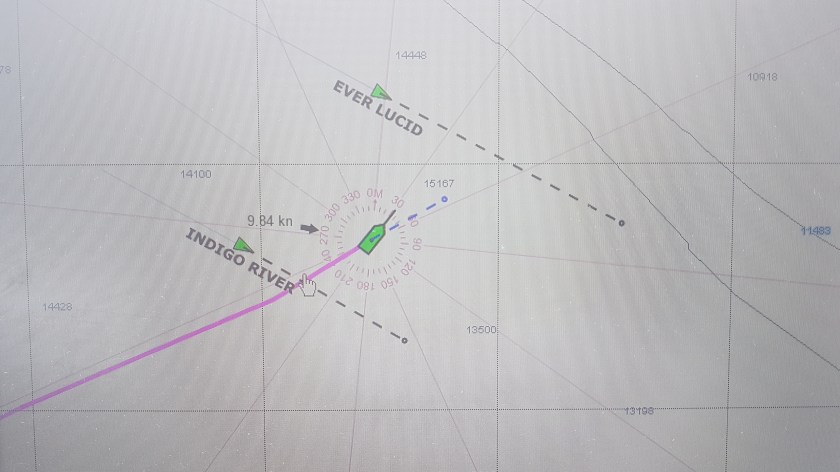
Passing thru the shipping lanes, it was nice to have the Digital Yacht AIS transceiver.  It allowed us all to avoid one another.

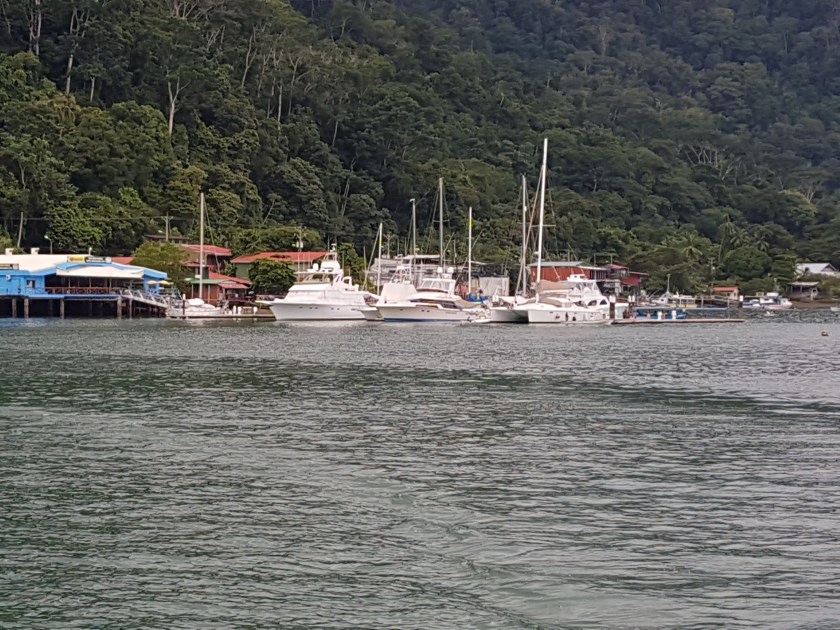
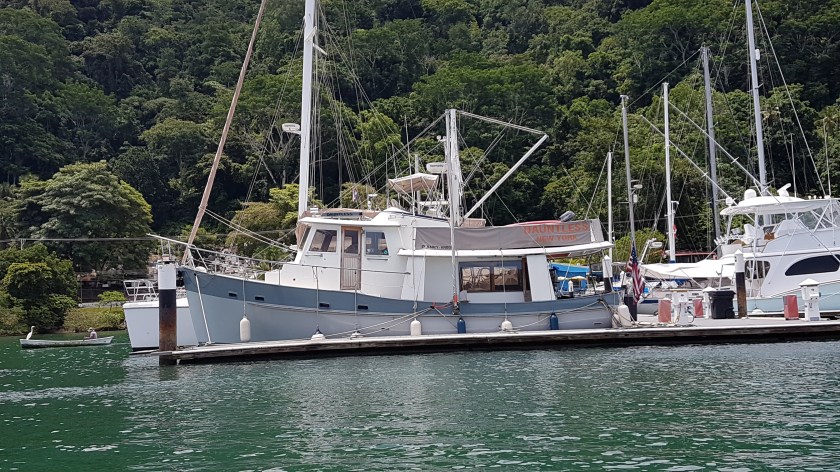
14 hours later, at 23:00, we entered yet another unknown harbor and docked in the dark, at Marina Xtapa

What else is new.

I did get a good night’s sleep.

Four hours after we made the turn to head to Xtapa, we are bracketed by two freighters. Again AIS transciever makes this easy for ALL concerned.
Depiction on Coastal Explorer
Four hours after we made the turn to head to Xtapa, we are bracketed by two freighters. Again AIS transciever makes this easy for ALL concerned
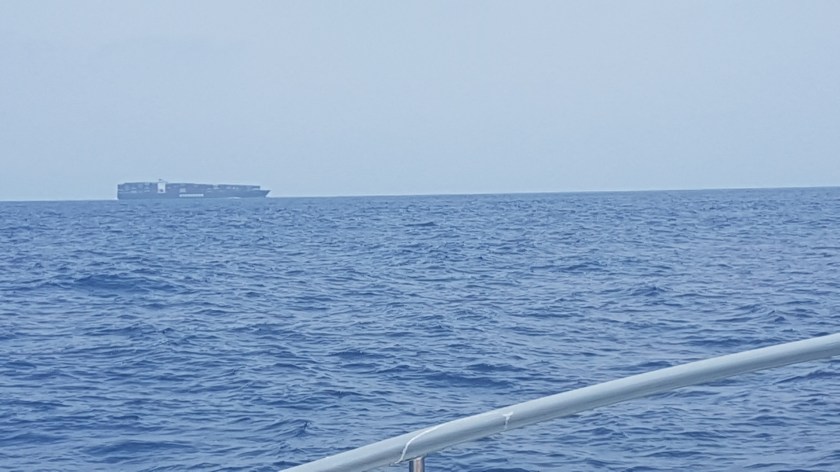
What it looks like looking out the window
The Maretron data shows how much better the ride became, though rolling continues.
The Maretron data shows the four days of Pitching and Rolling. The last day before we turned to the east was untenable with pitching as much as 20 degrees.


Third Time is the Charm, I Hope

Dauntless is ready to go.

As of Tuesday evening,  we are planning to try to get to Magdalena Bay, 130nm, tomorrow. Our third try in the last 9 days.

Error
This video doesn’t exist

Though even at that, we will probably we stuck there for three days over the weekend, as another period of very strong (15 to 25 kts) winds is forecast to hit the area then.  But it’s time for new, less touristy scenery.

We’ll leave mid morning, as the winds diminish mid morning to late afternoon.
We had a few issues to deal with in the last few days, the most serious, a worn rubber “O” ring on the autopilot hydraulic pump.
With a new ring and a few hours of getting the air out of the system, we are good to go and better than before.
My Maretron weather instrument was off line due to a failed “T” connector.  After a couple hours hanging on the mast for dear life, that too has been fixed.

Lastly,  on my third trip to Costco in as many days,  the dingy finally appeared in front of my eyes.  On sale for only $500 delivered,  it was too good a deal to pass up.  Took me all afternoon to blow it up,  and then a day to fix the carb that was pouring gas all over the place,  but finally as i drove it to the fuel dock to fill the gas can,  I felt pretty good.

The New Dingy
So tomorrow we leave Dauntless in as good a shape as she has been in a long time.
Our weather window is not as open as I’d like,  but we simply must pound out the next 200 miles to get into better,  more favorable winds. Once north of Tortuga Bay,  life is better.
We’ll check out of Mexico in Ensenada and check in to USA in San Diego.

It’s then to my friend’s Mike and Adriana in the Oxnard area, hopefully by mid June.

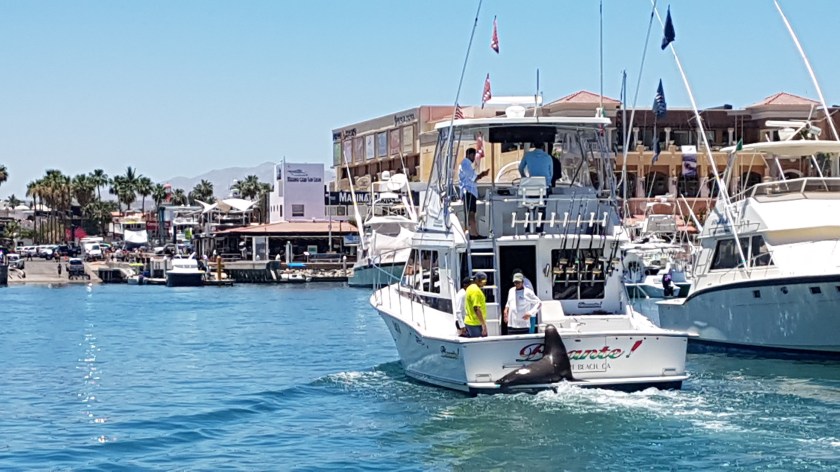
Pancho, the 12-year old Sea Lion of Cabo San Lucas

Stay tuned

Pancho again, takes lift, waiting for a free fish.

What I’m Really Afraid Of?

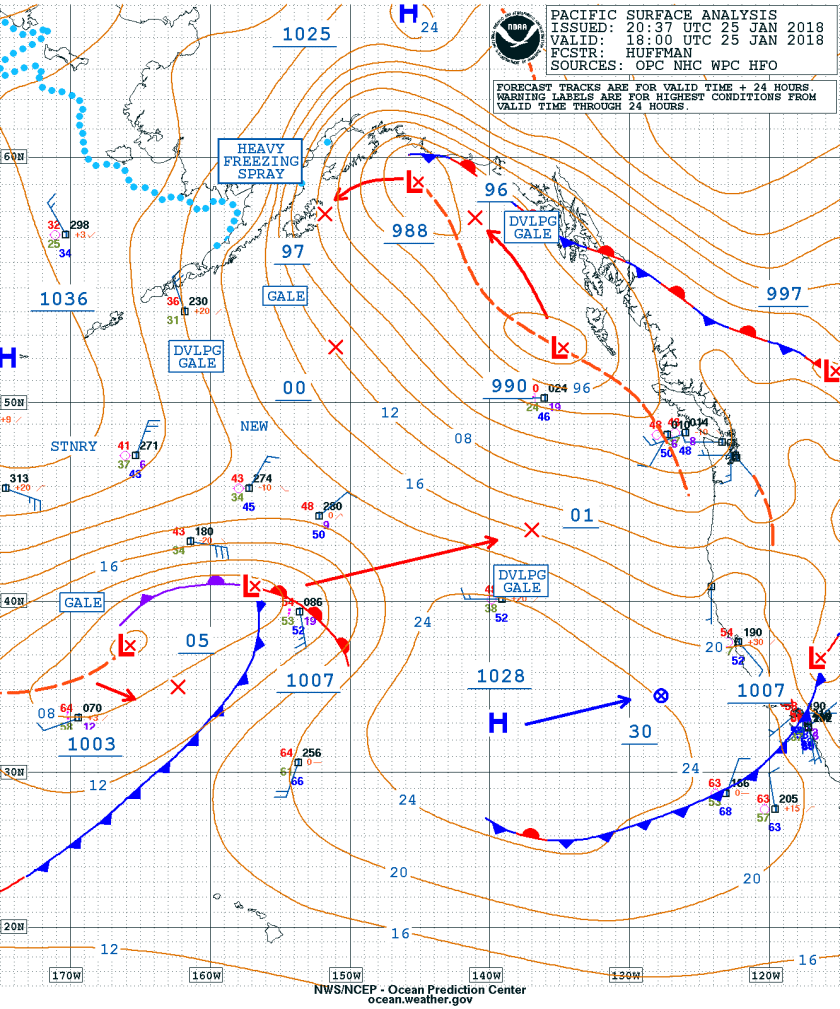
Just when I thought I had the Plan, I read a story about drug driven crime spreading to the west coast of Mexico. Manzanillo, one of my planed stops, was prominently mentioned.

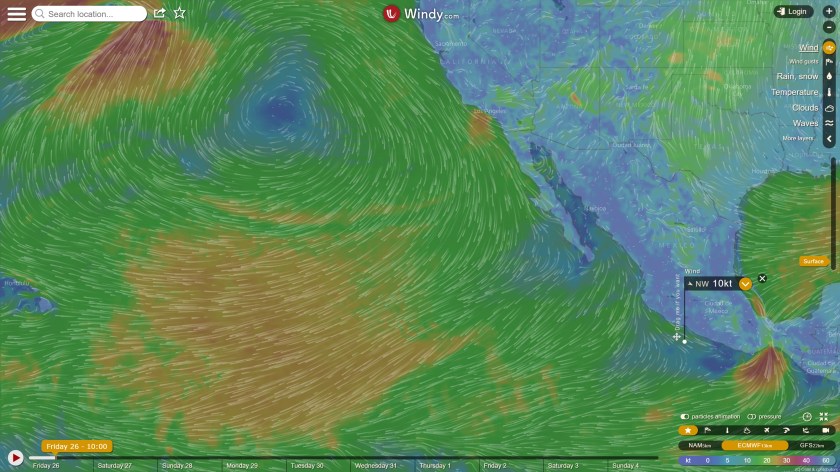
20180126 Win
dyty Depiction of Surface Winds

Where does that leave me? Besides the obvious, afraid!

Last summer I had a detailed plan to cruise up the coast of Mexico, stopping every night, hitting all the nice spots, with only a couple overnight passages. Let’s call that plan, the Coastal Cruise Plan. This is essentially what we had done 3 years ago in the Baltic.  I had even spent the last month alone, cruising from Stockholm all the way back to Ireland.

Last year, I had my nephew, Micah, with me from Ireland to Costa Rica.  It’s no coincidence that when he left Dauntless in March to go to law school, I lost a lot of my ambition to continue north alone. Cruising alone for me is not fun. It’s what I do when I need to get from A to B or as I did from Stockholm to Waterford.

20180126 NWS P_e_sfc_color

I am hoping that this coming summer, my girlfriend Trinh and her son, Thien, will have visas for Mexico. This is something that I must initiate this April when I return to Huatulco. If that is possible, they, with other friends who have expressed interest in joining Dauntless this summer, would make the Coastal Plan at least feasible. We would enjoy the numerous stops and towns along the coast, plus many eyes make for less stressful cruising.

A visa for the U.S. is another story and it takes forever. I’m hoping for 2019.

The Pacific coast of Mexico is not the Baltic and North Sea. The weather is not necessarily worse, but the predominant winds are from the northwest, the direction Dauntless must go. Adding to that problem, there are numerous fishing boats and nets and other boat traffic near the coast, whereas in the Baltic, there was none of that.

Lastly, safe harbors (protected from weather) on the Pacific coast of Mexico are few and far apart. North from Huatulco to Manzanillo, a distance of almost 600 miles, there are only two safe harbors. In a normal (for me) coastal cruise of 40 to 60 miles per day (6 to 9 hours), that’s 8 out of 10 nights anchored or in some port, at the mercy of the weather.

That’s a no-go.

For those of you who have read my precious comments about weather forecasts, you will know that even in the best circumstances, I don’t trust weather forecasts past three days and even at that I assume they are 50% off. That means, if the forecast is for winds from 270° at 12 knots, I plan for winds 240° to 300° at 8 to 16 knots (50% and 150% of forecast).

Therefore, to cruise an unprotected coast in any but the mildest of conditions is perilous.

I needed a plan B.  The Near Coastal Plan.

In this plan, we will take what the weather gives us. If we get four good days (favorable winds and seas) we’ll cruise until the weather becomes unfavorable. This potentially means we would take chunks of distance, 3 days, 24/7 is 450 nm. Making the entire trip into 4 chunks of 500 miles each, would get the job done and reduce time spent too close to the coast.

It would be far less fun however, but probably safer in many ways and less stressful.

Then came plan C, the Ocean Plan.

But first we talk to talk about hurricanes.

Hurricane season runs from June through October, with the highest frequency, mid-July to mid-September.

I can see an advantage in avoiding the high summer.  Looking at the Windyty depiction of the surface winds over the eastern Pacific today, you can see the big ass high pressure system that keeps the easterly trade winds over Hawaii (far left of picture) as well as the northwest winds over the west coast of California and Mexico.  Now, one of the disruptors of these winds are hurricanes.  The circulation pattern around hurricanes is far smaller than this massive high-pressure system, but a Pacific Ocean hurricane a few hundred west of Mexico, would cause southerly winds off the Mexican coast.

If it moved slowly north, maybe I could tag along??

It all depends on the situation and I’d have to figure out my escape routes, but it’s something for me to think about and plan for. It’s also significant that eastern Pacific hurricanes are weaker than Atlantic ones, with wind patterns not much stronger (if at all) than Northern Atlantic low-pressure systems in August and September (and I’ve certainly had my fun with those!).

Then the Ocean Route would entail an end around, running almost west, then curving slowly northwestward and finally northward, ending up east of Ensenada or southern California. With little winds, it would be an easy 10 to 12-day voyage, just like I did alone from the Azores to Ireland.  I’d only do this though if I saw the possibility of an extended time of light winds.

Also, time of year matters in my decision making. In the scenario just mentioned above, In May or June, I’d have plenty of time to wait or make it happen.  I may have different options later in the summer.

In September 2015, while waiting in Norway to cross the North Sea (I anticipated a 72-hour crossing), my weather windows were getting smaller and smaller. September is simply too late to be doing such a trip. But Sweden was so nice!

There had been strong northerly winds 25+ winds and driving rain, for days. I waited and waited. Finally, I saw a high-pressure ridge building into the North Sea from the English Channel, but this ridge of high pressure was also moving eastward.  But it only gave me a two-day window for a three-day trip.

Dauntless Crosses the North Sea 2015

I had to take it. It meant that I left my little port of Egersund, Norway, with 35+ knot winds from the NNW and rain. If you look at my route I took to Fraserburgh Bay, Scotland, those strong winds caused that dip in my route. Even with the paravane stabilizers, it’s just easier on the boat to put the winds and resultant seas on the starboard stern quarter. After 24 hours, as the winds died, I was able to head more westerly and on the third day, to the northwest. But that little longer route also added 12 hours to the trip and the next frontal system was right on, so my last 8 hours were in the weather again.

Would a longer, better weather window has come eventually? Sure. In the winter, under very cold air and high pressure. I couldn’t wait that long.

Dauntless in Ireland, next to a fishing boat with almost the exact same lines. There is a reason she handles the North Atlantic like she was born there.

When we decided to cruise the world or at least get away from the coast, we knew we wanted, needed a boat that that could all that and more. All the readings I did about boats and people cruising in boats all over the world, led me to Kadey Krogen.

Our little 42-foot boat was well built, extremely well designed for the worst of the worst and affordable.

Having Dauntless under my feet gives me confidence that she can handle any stupid situation I put her in.

Now, people are another matter.

.

Keys:


Planning – It Ain’t for the Faint Hearted

As I sit in my 10th floor apartment in Ho Chi Minh City, a.k.a. Saigon, the People’s Republic of Vietnam this balmy January 2018, writing these words, I think back one year.  I was in Martinique, in the Lessor Antilles, luxuriating in having just completed a harder than expected crossing of the Atlantic from North Africa to North America.

Looking north from my apartment in HCMC, Vietnam

Vietnam wasn’t even on the radar and if it was, I thought it was a wave top. Impossible it imagines how different 2017 would end up.

So, how can a person who doesn’t have a clue as to where they will be in 12 months’ time write about planning?

And not only write about, but spend a good portion of every day’s waking hours thinking about The Plan?  So much so that just a while ago, I found myself looking at the noonsite.com information about Taiwan.

Taiwan? wtf, he still hasn’t figured out how to get Dauntless out of Mexico, you’re thinking.

And right you are. So, I thought you would be interested in knowing or better understanding my planning process.

To understand my planning process, let’s look at my goal and some background information:

  • The Goal
    • Long term, cross the North Pacific, return to Northern Europe & complete my circumnavigation.
    • Short term, spend a couple of summers in Southeast Alaska.
    • Near term, get Dauntless to California before next winter.

Dauntless is now in the wonderful little town of Huatulco, Mexico, in the little Bahia Chahue.

  • Background information
    • In 2016, once I made the decision to return to North America, I made an elaborate plan (published in some blog post last year) to transit the Panama Canal and cruise up the west coast of North America to SE Alaska.
    • Looking aback at the plan now, I stayed pretty much on time and on target, only transiting the Panama Canal a couple weeks later than originally planned, until Costa Rica.
    • Arriving in Golfito, Costa Rica in March 2017, the wheels then came off or a more apt description, I was beached.
      • What happened? A perfect storm of: local bureaucracy, my nephew who cruised with me since Ireland, had to go back to school and I met this wonderful woman in faraway Vietnam.
      • Returning to Dauntless in June, I needed to get moving north. Costa Rica is a wonderful country that I had visited in 2004 and had really looked forward to returning. But, it turns out, it is not really cruiser friendly. The few marinas are ridiculously expensive and the paperwork of checking in and out was cumbersome and confusing.
    • My newfound friend, Cliff joined me and we took Dauntless from Costa Rica to Mexico. Mexico, it turns out is everything Coast Rica isn’t. Cliff had to go back to work and hurricane season had arrived, so in reaching the wonderful town of Huatulco in August, I decided that enough was enough.
  • The Task at Hand is to get Dauntless from southern Mexico to California, 1800 miles.

Dauntless cruises at about 6.5 to 6.8 knots. thus a 24-hr. period is 150 nm. That’s the figure I use for planning.  With light winds and small seas, then the planning exercise is about planning stops after a day of cruising.

Two years ago, in the Baltic Cruise, I largely ignored the weather and planned the whole 4,000-mile trip based on cruising days of 5 to 8 hours. Usually we would stay a few days in each town or city stop.  But the pacific coast of North America is a whole different creature.

Climatology tells me that the winds are predominantly from the northwest (the direct I must go) 2/3’s to ¾’s of the time. I use Jimmy Cornell’s Ocean Atlas which has pilot charts for each ocean by month. Jimmy Cornell’s Pilot Charts also tell me the secondary wind direction and currents. June thru September is 4 months, 120 days. I figure that I will have favorable winds about ¼ of those days, or 30 days. I have 1800 nm to go divided by 30 days means 60 miles per day.  No bad, about what I did in the Baltic in September.

But it also means that when the winds are favorable, I must make miles. The reality of seasonal climatology is best looked at and planned for over periods longer than a few weeks. In this situation, I can easily be stuck in port 30 days waiting for the winds. Then if I’m lucky, I’ll have a good period, 5 to 10 days of southerly winds. Depending upon where we are along the coast, it means we may do 48, 72 or even 96 hours to take advantage of our good weather window.

Now in this context, when I say “weather” I really mean winds and seas. I’ve left port on many stormy days. Rain, showers do not bother me, it’s really all about the winds and seas for my little Kadey Krogen.

The effect of head winds and seas vary greatly. 5 to 7 knots are hardly noticeable and may produce small seas, less than 2 feet. Dauntless will lose a few tenths of a knot under such conditions.

Going out into the storm

As winds off the bow become stronger, it all goes down rapidly from there. 12 to 15 knots produce 3 to 5 ft. seas, pitching become unpleasant and we’ll lose more than a knot of speed.  18 + knots are untenable from a comfort level. Too much hobby horsing and probably down to 5 knots, less with any counter current. This is what happened to me off the French coast going up the English Channel to Holland. We were making 2 to 3 knots in pure misery of pitching.  Because of the conditions, I finally decided to abort to Ostend, Belgium. It took another 6 hours to go 15 miles.  Some of the worst 6 hours I have ever experienced. The Kadey Krogen was fine, she takes a beating and keeps on ticking. The humans inside were not as happy.

What I took out of that beating was to more carefully consider winds and seas on the bow. A 20-knot wind from the stern is fine. We had 20 days of that crossing the Atlantic last year. Even 20 knots (and resultant seas) on the beam are ok. The paravanes are most effective with beam seas. Though I tend not to venture out in such seas if I am in port. 20 knot headwinds are untenable. Stay in port. If at sea, options are reduced, but probably a change in direction is warranted.

I use Windyty.com for my forecast winds.  I tend not to look at forecast seas because the accuracy is seldom good enough to use in an effective manner. Though Windyty will give you the first, second and third swells.

Now when it comes to forecast winds, for whatever reason, the forecast winds are almost always understated, though I do realize it’s possible that I only notice the over and not the under. Thus, when winds are forecast to be 12 knots, that usually means 8 to 15 knots. If 8, ok, if 15 it’s a no go.  So, in this case, I will use 8 knots for the Go-No Go decision.

From Huatulco to the Channel Islands, it’s only 1800 nm in three long legs. that’s basically the distance I did between Martinique and the Panama Canal.  But with much more un-favorable winds and currents.

Top speed for Dauntless is about 8.5 knots, but it’s non-factor because it’s impossible to justify the double to treble fuel consumption for 2 knots. So, my effective (long term) hurry up speed is 7.5 knots at 1800 rpms and 2 gallons/hour. Thus, I usually keep it to 1700 rpms, 6.8 to 7.0 knots and 1.6 gal/hr.

In my next post, Planning is the Mother of Anticipation, I’ll discuss the Mexican coast, what options we’ll have, crew and hurricanes.


2016 & 2017 Pictures and Videos of Dauntless in Action

I thought I should share with everyone the pictures and videos I’ve taken on Dauntless in the last year.

The gallery pictures are in ascending chronological order.

Some of you may know and already have seen some of these pictures, but the most recent Galleries are now public:

  • Dauntless 2017 Panama Canal
  • Dauntless Crosses the Atlantic Again
  • Dauntless 2016 Northern Europe

Richard

https://dauntless.smugmug.com/browse

Dauntless Starts Moving North

Central America Cruise Summary Day 1

The View from the Krogen Pilothouse as we head out

Monday, 17 July 2017.  Up at the crack of dawn. I had told Sergio, we were leaving at 06:00.  I hadn’t heard from him in two days, so… that normally means he changed his mind.  I can’t begin to tell you the number of times I’ve corresponded with people who are so excited, over time and frequently, only to have them disappear or to tell me they have to wash their cat the day of departure.

So far, the score is 1, who turned up as promised to 7 no-shows.  Mind you, all these people contacted me first!

Chantal, the one who did show was great. Even left her alone on Dauntless for a week in the Bahamas. Oh well.

My friends who have joined me have all been great and they made the 2016 Cruise of the Baltic, the Baltic Republics, Poland, Sweden and Finland, so enjoyable.

I start with all this because it influenced my decision to leave, on a day that I simply should have stayed put.

I was anxious to get this show on the road. I was burning days and hadn’t even move a mile north, yet had almost 2000 miles to go.

So, when I realized Sergio was going to be a no-show, I wasn’t unhappy.  Being alone is actually far less stressful for me is many ways:

  • I’m not responsible for someone else’s life
  • I don’t have to feed them or explain how not to screw up the toilet
  • I don’t have to worry about them getting home safe and sound
  • I can run around in the middle of the night, as I did last night, checking on strange noises, naked.

Yes, many advantages.

I now use Windyty.com as my main weather source while outside the USA.

It indicated light winds, 3 to 5 kts, Monday, increasing a bit Tuesday and much more on Wednesday. Therefore, it seemed Monday was the best day and I wanted to go in any case.

But when I got up, I could see a large thunderstorm to the west and it had been producing strong winds and rain all night.  It was an extensive area, probably 15 miles by 10 miles.  I don’t mid traveling in such conditions, however this storm produced strong, 12 kts westerly winds.  Since I had to go west, then SW, then NW, that was not good.

And now I did what I tell everyone NEVER to do.  Never ever. I got fixated on the forecast, 3 kt winds, thinking the seas will be small.  Totally ignoring the fact that this storm had produced relatively strong winds, 10 to 18 knots for the last 12 hours.

As you see in the picture, I take off into this storm and immediately I notice 3 to 5-foot waves that I’m going into. Up and down we go.  I slow up to 1400 rpm, and press on.  I should have turned around and gone back to my peaceful, sheltered anchorage.  I didn’t.

Two hours later as I turn the corner finally getting out of the Bay of Golfito, to head NW, I discover a significant swell, from the south to southwest 4 to 6 feet.  Now the boat really started to roll. Of course, in my idleness, I did not stow everything well, in fact the salon was a mess.

I deployed one paravane stabilizer bird, then half an hour later, the other.

Fishhook Marina
A Great Place for Man & Boat

The roll was never so bad, only about 8° in each direction and the extreme rolls where just over 12°.  These numbers are half of what we put up with for 21 days crossing the Atlantic 6 months earlier, but still.  But having furniture roll around the salon is always disconcerting.

The ride didn’t ameliorate until the last 1.5 hours when I turned NE to go to Bahia Drake. An anchorage that given its’ 3-star rating was clearly over-optimistic.

Rolling Down the Road

Day’s Cruise Summary: Engine start, 05:52, stop 17:29; 11 hrs:15 min underway (uw), distance 62.2 nautical miles (nm), average speed 5.6 knots (kt)


Spring Cleaning

Since spring happens once a year in most places, one would think that spring cleaning is a yearly event.

Though not on Dauntless.  With a surely, lazy crew, when I have even thought about a through reorganization, the look I see in the mirror is downright mutinous.

Of course, besides being, Master, Captain, Skipper, I am also the crew.

So, it’s no surprise that upon returning to Dauntless after my 3-month hiatus, it was time to evict the hitchhikers and other life forms.

I’d managed to go four years with nothing worse than the occasional fly or mosquito on board.

Well now the intrepid explorer has been put in his place by a bunch of roaches and a mouse or maybe two.

Dauntless in Golfito

Last week the whole upper part of the boat was cleaned and I threw away, I’m embarrassed to say about 8 trash bags, large ones, of crap that should have been thrown away eons ago.

I need a watch bird like that

Stuff like three copes of the bus schedule for the Waterford Bus.  Won’t need that for a few years.

The skills we learned in the pre-internet years, have gone by the wayside. A coveted bus schedule, or even a phone book could always come in handy.

Maps though. Only when we got Dauntless did I reduce my map collection.  How can I explain to someone who uses Google to get anywhere, how I use to have two or three maps of places and countries of interest? Balancing them on your knee, finding the quickest way, having to know when and where traffic was bad and hot to avoid the worst.

Even with this week’s boat cleaning, I had one small file of European maps.  My most coveted ones, that I justified in not throwing away saying to myself that the next time I go to Europe, I’ll use them.

But it’s not to be.  I put them on the dock and only later after the latest rain storm did I remember them.  In a normal environment, I would have dried them out, but on a boat, nothing dries out that is not already dry.  Into the dust bin they went.

Today, it was time to empty the engine room.  Well not really empty, but to take out all the things that are not fastened down.

The picture below shows the things stored in the back of the engine room, on either side of the generator.  It’s a lot of stuff.  Most of which I’ll never need. But it gives me piece of mind to venture far away or at least far away from the closest Amazon delivery.

It’s spare parts for almost all of the systems on Dauntless.  It’s plumbing, electrical (both 220v and 110v) and woodworking, parts, replacements and spares.  It’s what allows this 29-year-old Kadey Krogen to make its own electricity, power, water.  Just like a self-contained city, the only thing missing is snow removal; Oh, we’ll have that next year.


Envy

So, I was reading the adventures of M/Y Dirona as she crosses the North Atlantic.

Check out Dirona’s Atlantic Passage

It made me envious; I know, that’s ridiculous, but still.

Dauntless has come so far

Dauntless spent two and a half years in Northern Europe because I knew we would like it. The weather, the people, the cultures all, the food, fit my number one criteria of staying off the beaten track and living well as I did so.

I Loved the Baltic, Sweden, Norway, Scotland & Ireland

That was expected. All the lands of coastal Northern Europe have a real seafaring culture. Every boat waves at you, especially fisherman. From Galicia in northwest Spain to the far eastern Baltic, it was a wonderful experience with minimal bureaucracy.

In those 2+ years, 20+ countries, 100+ stops, mostly in towns and cities, I probably spent less than 120 minutes on the formalities of checking in (Passports, boats documents, crew lists) and checking out.

No wait, there was no checking out.

The peoples, the lands, met and greatly exceeded my expectations.

Then, we headed south. 90% of all boats are south, mostly in the Mediterranean, you know, Italy, Greece, Turkey and southern France and Spain. Everyone wants to go there, so that’s a big Do Not Enter sign for me.

So, we headed south with low expectations. Little did I realize they were not low enough.

Prices trebled, temperatures doubled and bureaucracy was like a pig is slop. The first two stops in Portugal took the same amount of time as the last 100 stops of the previous two years.

And then it got worse.

In virtually every stop, 5 to 10 pieces of paper to sign to check-in; make sure you return tomorrow to fill out and sign the same papers to check-out. Don’t even mention the expense.

But you have read all of this before.  Turns out Martinique was the high point of the entire Caribbean. It’s almost weird to say that they were the least bureaucratic.  In fact, they were just like northern France.  But that was certainly the exception.

So now, having endured all of that and more to get Dauntless a quarter of the way back around the world, I sit here with envy of Dirona.

But I realize it’s not Dirona I’m envious of, it’s being in the middle of the ocean.

I’m a traveler, so when I’m not, I’ll always be envious of those who are.


Crisis in the Mid-Atlantic – The Chickens Come Home to Roost

Just After the 1st Repair. It’s 13:33 this is the normal screen I run with. I’ll minimize the Maretron data (black box on left) is there is more traffic or is I have a reason to look at the chart. In this case, what’s important: winds 090 at 23 g 28; Apparent Wind Angle (How is the boat feeling the wind) is right on our stern at 180 degrees. Bottom right shows the roll and one can see the roll reduction while the boat was stopped at the same time the pitch increased. Then the roll greatly increased once we got underway again.

Error
This video doesn’t exist
 This video shows the day before, Dec 21st.  Even before the preventer stick broke (which you can see going form the fly beige rail to the middle of the paravane pole)

Error
This video doesn’t exist
 This is from the afternoon.  GIves you a nice idea of the seas. This is what we had plus or minus for 21 days.

So, as December 22nd dawned, (end of Day 13 and beginning of Day 14), the little problems that had popped up were solved quickly.

Though during the night, my last second and last preventer stick broke.  It wasn’t critical, I had not used it since it was made three years ago, but still, this morning I wanted to find a real solution.

The winds had been very strong since daybreak, in the low 20’s, gusting to 35 knots.

I decided to stop the boat, just put her in idle and adjust the paravanes somehow. It nice to know that the boat will bob more than roll when stopped. While not underway, Dauntless rolls at about half the rate of our underway roll. So, we’d been rolling 10 to 20 degrees, pretty consistently, now we settle in the trough of the waves, but bob as much as roll.

Now, months later, my brain refuses to remember why I actually stopped the boat.  It must have gotten superseded by the traumatic events that followed.

Autopilot disengaged, Idle, then neutral, the boat will coast to a “stop” in about three minutes.  Winds and current are still pushing the boat, in this case about 1.5 knots.

Then before I did whatever I had intended to do, I decided to turn the rudder to see if it made any difference in the boat motion.  Not a stupid plan; yet.

The rudder was already hard over to port. And then in an act of gross stupidity, I turned the wheel more to port. Why? Why? Why?

I knew the rudder was at or close to the stops.  The steering system had had some air in the system for a long time. No matter what I did, I could not get it all out.  So, I thought a little more turn couldn’t hurt.

Oh, my God, it could hurt.  After turning the wheel about a quarter, I felt it go slack in my hand.

I knew exactly what happened and turned to Micah to say, “We’re fucked now”.

I knew because I’ve had this sickening sense before: pushing on brake pedal that goes all the way to the floor or turning a steering wheel and nothing happens. When a hydraulic system goes slack: clutch, brakes, steering. It means the hydraulic system has no more pressure, A hose, fitting or part has given way.

He knew from my tone that I was serious, very serious.  I was so angry at myself. Had Micah done something like this, it’s an accident. For me, I knew better than anyone the consequences of over-pressurizing a system.

The Kadey Krogen has does have an emergency tiller that connects through a purposeful hole in the hatch.  But I hate even manually steering the boat in a sea.  To stand, sit in the stern deck and hand steer for 7 days like were some god-forsaken sailboat, fuhgeddaboudit.

But I also immediately realized I couldn’t afford the Pity Party. I also could let Micah start thinking of the consequences. Now was the time for solutions and solutions only.

When the Going Gets Tough; the Tough Get Going.

We had 200+ feet of hydraulic lines and the failure could be any place. gain, trying to control the sickening feeling in my stomach, If I’ve learned anything on this boat, it’s to always look for the easiest solution first.

So, we’d start at the rudder piston in the lazzerrette. Open the hatch, and at this point, a wonderful sight (on a boat everything is relative), hydraulic fluid oozing from a hole in the hose just above the fitting. This hose, one of two, for the rudder piston.

First thought, let’s try easy, easy solution, rubber tape, with hose clamps around it.

Error
This video doesn’t exist
 This video is after i had completed this repair and also shows how I stopped the paravane pole from bouncing by using a fender.

It worked. We got our filing funnel for the upper helm station, from which the entire system is filled with AFT, Automatic Transmission Fluid, which conveniently, both the hydraulic steering and the Borg-Warner manual transmission use for lubrication and pressure.

The system took about 2 liters of fluid.  But I only had a total of 4 liters. I’m starting to think of chickens coming home to roost.

We get underway just under an hour later at 10:28. Everything is working reasonably well. You can see from the Maretron data how the boat roll is about half, while the pitch increases when dead in the water.

Coastal Explorer, our main navigation program, running on a dedicated solid state 12-volt boat computer had been acting up.  For a few days, it had not been displaying AIS information, no matter what little tricks I had used in the past to “wake it up”.

Now, I knew I was still sending, which is actually far more important, as since I have had transmit capability large ships always stay away. Having seen only one ship in 13 days, the display wasn’t critical, but I wanted it working. I like everything working.

So, as a last resort, I decided to reboot everything. Everything off and on again, in order, about a 4-minute process.  The log shows at 12:15 all was well.

We had been checking our repaired hose every hour, as well as topping up the fluid as needed.  In the last two hours, we had put another liter into the system.  The hose was leaking enough, probably a few liters every 12 to 24 hours.

Now this would have been no problem in coastal cruising.  We would have just topped it off until port.  I didn’t have that option.  So about 7 hours after the first fix, I knew I had to find the real fix.

Two Issues I had to solve: Hose & Fluid.

  1. For the hose, I knew I had a number of spare hydraulic hoses in two different places in the engine room. One set stored with all the extra hoses and tubing, the other set stored in the long-term spares containers on either side of the generator.
  2. The fluid was a bigger challenge. I used the Delorme InReach to text my contact Roger, who got in touch with Ski in NC. Ski, a long-time diesel expert, had been really helpful in the past, so I needed to figure out what I could use as substitute ATF.

The answer turned out to be simple and vexing, 4 parts diesel fuel to 1 part engine oil. Yes, the engine oil of which there was not extra. The engine needed every bit of oil.  Dauntless was now full of chickens.  They had all come home to roost.

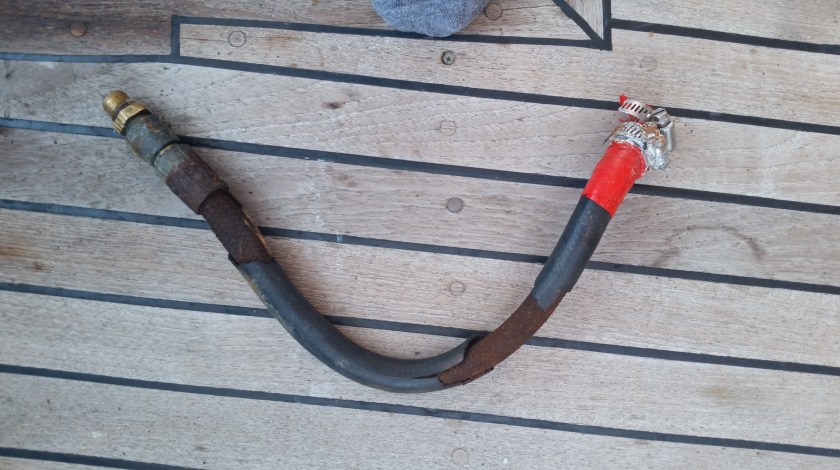
The offending hose, steel braid rusted to the core.
I’m replacing these hoses and standardizing the fittings.

OK, first I had to clear out all those chickens. They were all over the place.  Before we did anything, I found the spare hose with the correct fitting in seconds. So far so good. I then stopped the boat again and also the engine, as I wanted to check the oil level to make sure of my calculations (on a passage like this, I just fill the engine at its usual use rate, without turning it off).

Oil level was just were I expected, so I decided I could spare one liter of oil. Worse case, we would arrive in Martinique one liter low, but that’s not a big deal for a day.

I got my tools and wrenches. Getting the old fitting off the three-way control valve ended up taking me 15 minutes.  I even heated it up with my kitchen torch, but I was very careful not to make my hose problem into something far bigger and unfixable.

Finally, it came out.  I put pike gunk on all the new fittings, makes for a better seal and I don’t want any more leaks.

In the video Micah took, you see one time water came across the deck. That’s water that enters thru the scuppers, usually on rolls of more than 15 to 20 degrees.  As I said, dead in the water, we bob more than roll, so I was only inundated with water twice in this operation which took about 40 minutes.  I wanted Micah to get more pictures of the outside scene not just the top of my head, but he was nervous and I think he felt better not looking out much.

Error
This video doesn’t exist

Me on the other hand, I may not look it, but I was pretty ecstatic.  I’d fucked up and was able to fix it. We now had 5 liters of substitute ATF which would be more than enough.

The finished product

Error
This video doesn’t exist

At 18:00 we were underway again.  Immediately, it was apparent that I had way too much air in the system.  The Auto-Pilot was acting errantly.  It would work for a few minutes, but once the rudder got far enough over, there was not enough pressure to get it back.  We would have to turn off the autopilot, then turn the wheel lock to lock three times until pressure built up in the system, check and top up the fluid at the upper helm station and reengaged the autopilot. This went on for a couple hours until I realized I needed to go to sleep to get ready for my 04:00 watch and the boat almost needed hand steering at this point.

That would not do.  I did not do all this to have to hand steer for 7 days.